Last Sunday at the weekly market in Tlacolula de Matamoros…

Chickens
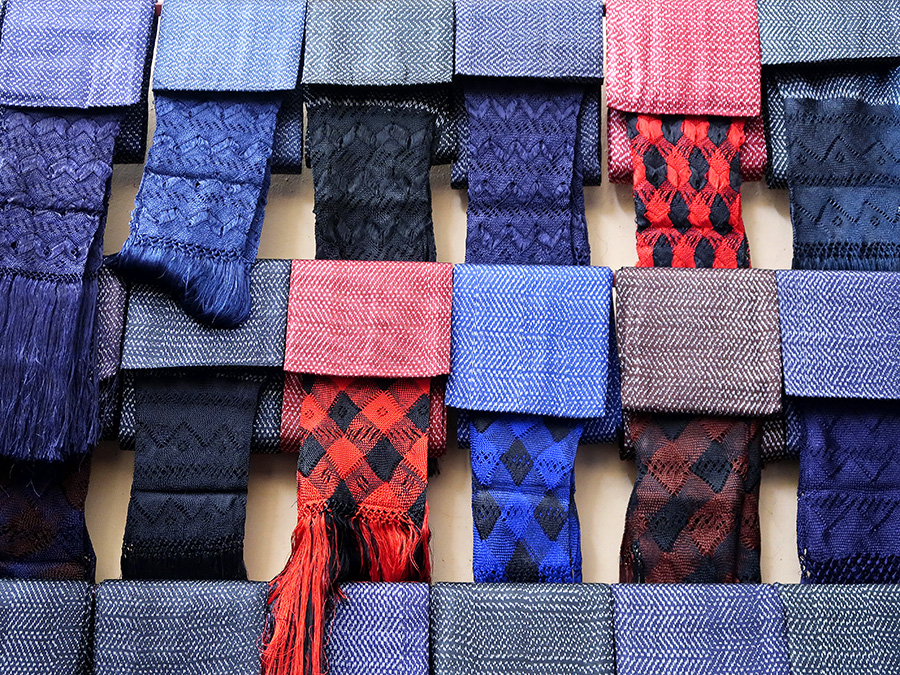
Rebozos
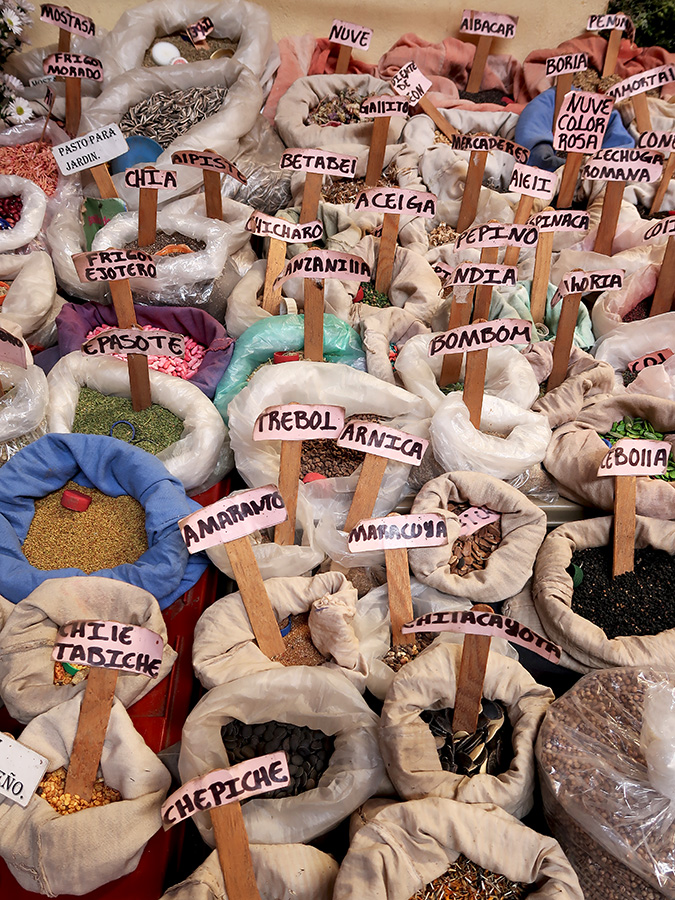
Seeds
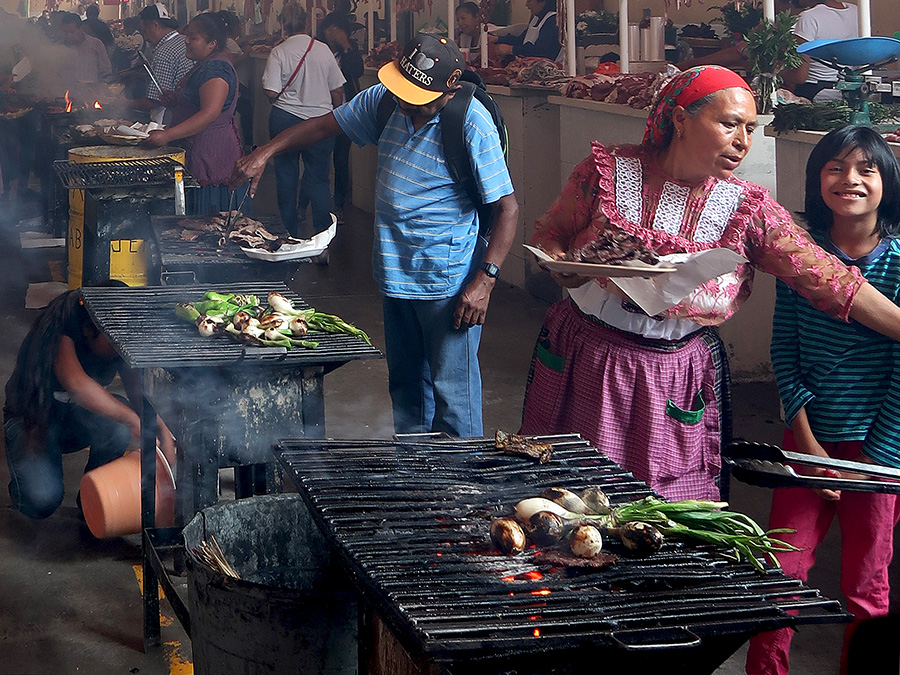
Lunch
It’s not just about produce, bootleg DVDs, tools, and underwear.
Posted in Creativity, Culture, Food, Gardens, Markets, Textiles, Travel & Tourism, tagged artisan markets, chickens, grilled onions, market day, mercados, Mexico, Oaxaca, photographs, photos, popular travel destinations, rebozos, seeds, shawls, Tlacolula de Matamoros on May 26, 2018| 4 Comments »
Last Sunday at the weekly market in Tlacolula de Matamoros…
Chickens
Rebozos
Seeds
Lunch
It’s not just about produce, bootleg DVDs, tools, and underwear.
Posted in Celebrations, Creativity, Culture, Flora, Travel & Tourism, tagged Capilla de la Cruz, cucharilla, desert spoon, festival, fiesta, flower decorations, Mexico, Oaxaca, photographs, photos, plants, sotol, Tlacolula de Matamoros on May 23, 2018| 7 Comments »
I love Sunday market day in Tlacolula de Matamoros — the people, colors, food, cacophony, and frequent surprises speak to the life of Oaxaca. So, after returning Saturday night from two weeks in el norte, I jumped at the suggestion by blogger buddy Chris that we go to Tlacolula the next day. It did not disappoint.

Carnival rides were being set up where we frequently park and, in the usually deserted patio of the modern chapel at the intersection, several men were hard at work fashioning decorations. We peered from behind the wrought iron fence but were quickly invited in. They explained they were preparing for a festival honoring the chapel, the Capilla de la Cruz, all the while continuing to weave flowers out of a spiky, sword-like plant.
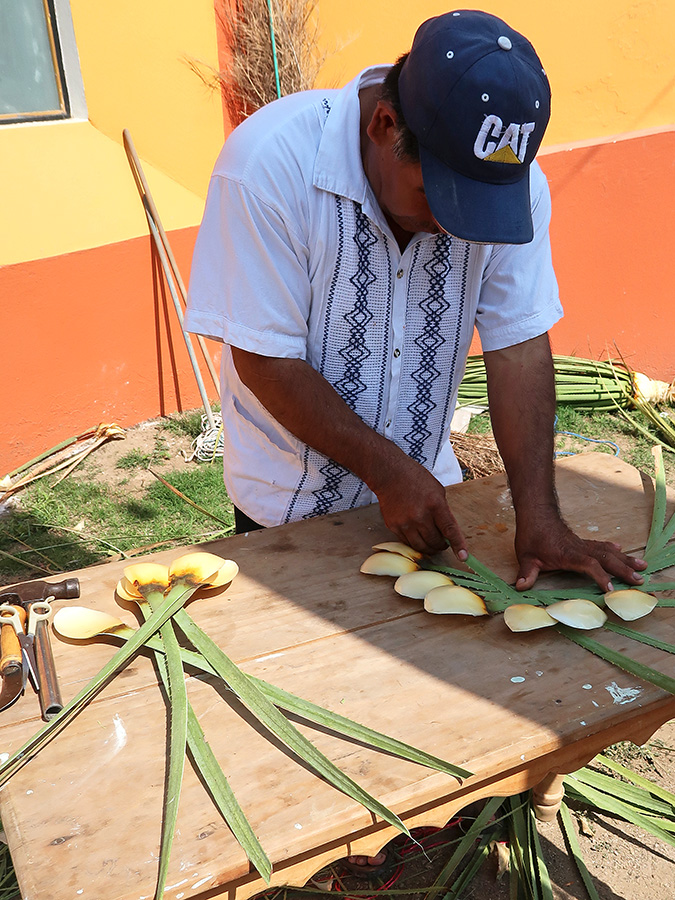
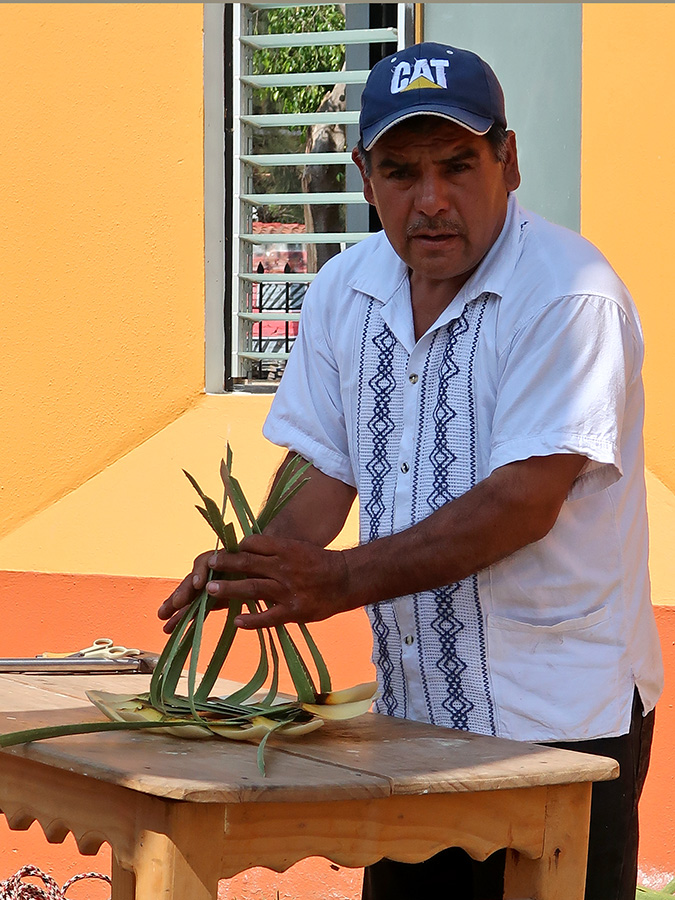

Especially during the Easter season, I’ve seen these flowers sold along with woven palms, but didn’t know what they were made from.

Once home, I couldn’t resist doing a little research (I’m a librarian, after all!) and discovered it was a species of Dasylirion (aka, Sotol, cucharilla, desert spoon). I can’t imagine what those spikes lining the sides of the leaves must do to their hands!


It was such fun talking with these guys and watching their nimble, practiced fingers at work. After two weeks away, what better way to get back into the swing of things in Oaxaca? And, the market was still to come.
Posted in Creativity, Culture, Travel & Tourism, tagged alebrije, artisans, Mexico, Oaxaca, photographs, photos, popular travel destinations, San Antonio Arrazola, San Martín Tilcajete, wood carving on May 18, 2018| 10 Comments »
Carved from the wood of the copal, an owl for my older son.
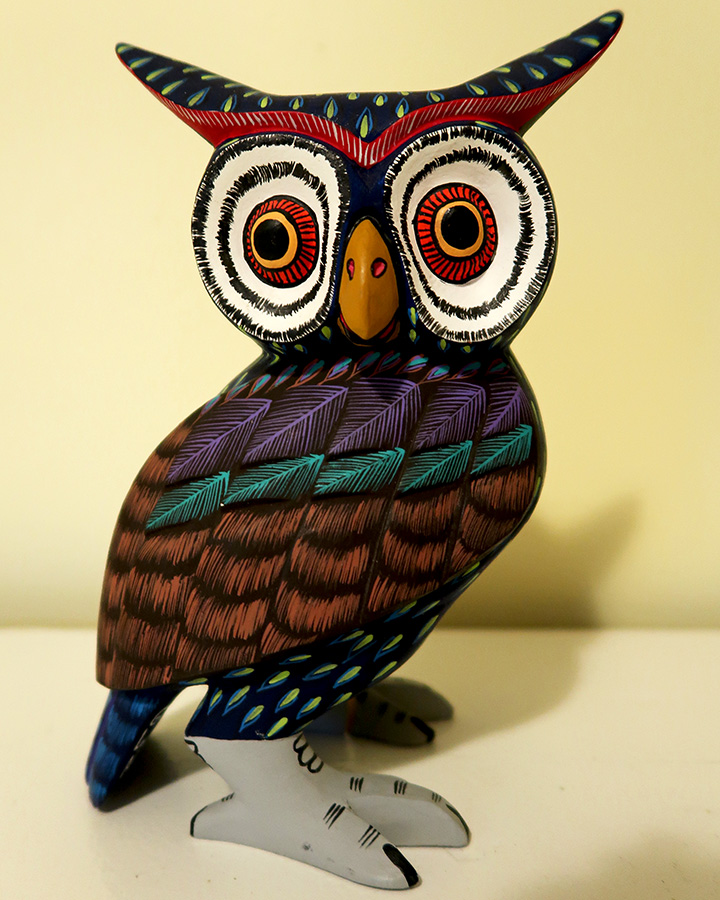
Carved by Lauro Ramírez and painted by Griselda Morales, San Antonio Arrazola, Oaxaca
A rabbit for my daughter-in-law.
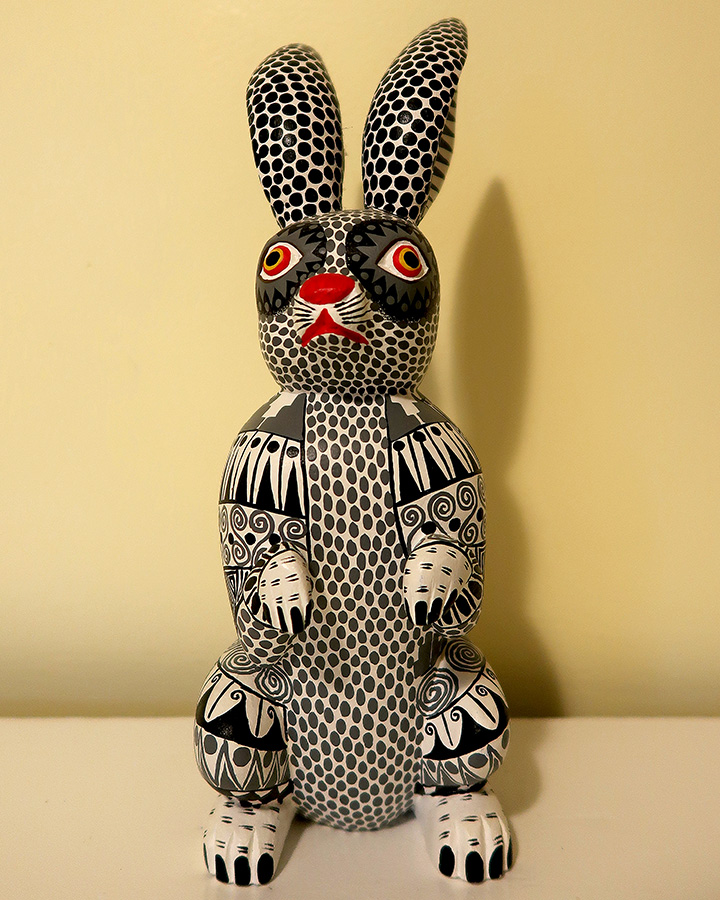
Carved by Mario Castellanos and painted by Reina Ramirez, San Antonio Arrazola, Oaxaca
A lion for my grandson.

Carved by Zeny Fuentes Santiago and painted by Reyna Piña Ramírez, San Martín Tilcajete, Oaxaca
And, a horse for my granddaughter.

Carved by Jesús Hernández Torres and painted by Roxana Fabian Ortega, San Martín Tilcajete, Oaxaca
Beautifully hand carved and painted alebrije for my family.
Posted in Creativity, Culture, Food, Markets, Travel & Tourism, tagged aprons, cooking, embroidery, mandiles, Mexico, Oaxaca, People, photographs, photos, popular travel destinations, Teotitlán del Valle, textiles, Tlacolula de Matamoros, women, Zapotec fashion on May 15, 2018| 18 Comments »
The lowly utilitarian apron has been elevated to an art form by the Zapotec women of the Tlacolula valley in Oaxaca. Worn every day, mandiles (aprons) are an essential and practical part of their traditional dress. Most women own several and take great pains to color coordinate them with the day’s attire.

Fiesta honoring the Virgen de Guadalupe at the home of Fidel Cruz and Maria Luisa Mendoza, Teotitlán del Valle.
Plainer aprons are worn around the home. However, they don one of their “Sunday best” aprons for special occasions. These are heavily embroidered and often have necklines and hems that are scalloped and, as a fashion statement, are frequently worn to the weekly market.

Vendor at the Sunday market in Tlacolula del Valle.
Mandiles are made of store-bought poly-cotton fabric, usually in a small plaid design. While “100% cotton” sounds more desirable to many of us, the blend is undeniably more practical. After all, who wants to iron when there is work to do and the temperatures are summery all year ’round?

Andrea weaving in Teotitlán del Valle.
Even though the embroidery is done by sewing machine, the more elaborate designs can take from three to four days days to make. Aprons range in price from approximately 150 to 700 pesos.

Leonor Lazo feeding a baby goat in Teotitlán del Valle.
Given that, in addition to being practical, these are also a fashion accessory, it should come as no surprise that styles can vary from village to village.

Young women from San Miguel del Valle attending a festival in Teotitlán del Valle.
I grew up with aprons. My grandmother lived next door and could always be found wearing a “house-dress” and a pinafore style apron with front patch pockets. Some were plain, but many she decorated with embroidery. Thus the mandiles of Oaxaca spoke to me and I listened.

Reyna Mendoza speaking to her El Sabor Zapoteco cooking class.
My first “Oaxaca” apron was a maroon plaid cobbler style with only a moderate amount of embroidery. After a year or two, it became so much a part of my home attire that I bought another in brown plaid. These are my workhorses and I wear them every day while cooking, cleaning, and even gardening. And, I proudly bring my own apron to cooking classes and make sure to pack one when I’ve been invited to a fiesta in Teotitlán del Valle — putting it on to help clear tables. I always get smiles from the women (and some of the men, too).

Me, mi mandil, a metate, and maiz at El Sabor Zapoteco cooking class in Teotitlán del Valle.
However, after countless Sunday market day trips to Tlacolula de Matamoros, not to mention, spending a lot time over the past several years in Teotitlán del Valle, I couldn’t help but be inspired by the fashion statements women, both young and old, were making, so I bought a slightly more elaborately embroidered pinafore style and then another and another.
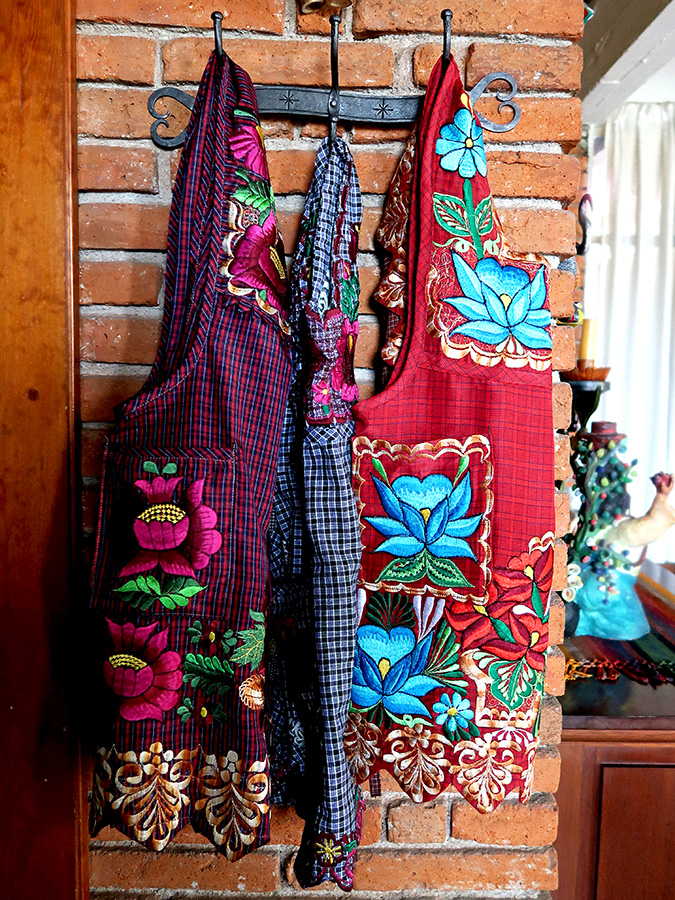
Three of my mandiles; the red is the newest.
I even dared to wear one recently in New York at my granddaughter’s first birthday party. With children ranging in age from six weeks to six years, I thought it was a very practical fashion statement on my part. And, guess who got one for her birthday?

Birthday present to my granddaughter — a toddler-size mandil.
A good place to check out who is wearing what style of mandil is at Tlacolula’s Sunday market. And, should you want to buy one for yourself and/or give one as a gift, there are at least eight apron stalls at the back of the market on Sundays.
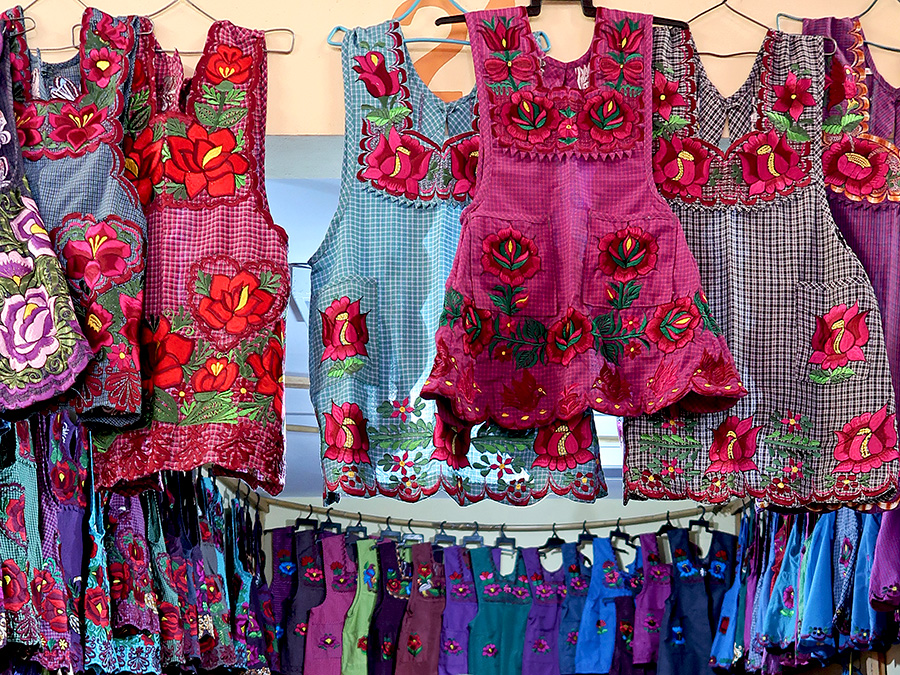
Apron stall at the back of the Tlacolula de Matamoros market.
Posted in Creativity, Culture, Food, Travel & Tourism, tagged aprons, artisan markets, artisans, Cocineras Tradicionales de Oaxaca, cooking, Encuentro de Cocineras Tradicionales de Oaxaca 2018, food festival, Mexico, mocajete, Oaxaca, photographs, photos, popular travel destinations, produce, textiles on May 12, 2018| Leave a Comment »
I couldn’t resist posting more from the Encuentro de Cocineras Tradicionales de Oaxaca 2018 to tempt you to put next year’s gathering of traditional Oaxacan cooks on your calendar.


Amazing traditional cooks from the state of Oaxaca served up taste tempting fare in the Plaza de la Danza for four full, and I mean FULL days, April 25-28.


And, should one be inspired to immediately head to one’s own kitchen, the Mercado Oaxaca set up in the courtyard of the Facultad de Bellas Artes (across from the Plaza de la Danza) offered mouth-watering fresh fruits and vegetables, herbs, dried chiles, honeys, vinegars, and so much more. I came away with a luscious cantaloupe.


In addition, to assist one in the preparation and serving of one’s own delicious meals, Arte de la Mesa presented vendors, next door in the courtyard of the Palacio Municipal, selling “made in Oaxaca” glassware, utensils, pottery, placemats, tablecloths, and dish towels, aprons, metates and molcajetes, among other kitchenware.


Do you see the piggy-face molcajete? I bought it and have spent hours and hours, not to mention muscle power, seasoning it. If you don’t believe me, use your favorite search engine to check out the various methods — there are no shortcuts!
Posted in Buildings, Creativity, Culture, Travel & Tourism, tagged abandoned buildings, crumbling buildings, graffiti, Mexico, Oaxaca, photographs, photos, popular travel destinations, street art, The Positive Affect, urban art, wall art on May 9, 2018| Leave a Comment »
Even if it looks like the world is crumbling around you…

On Reforma, at the corner of Constitucion in Oaxaca — courtesy of The Positive Affect project.
Posted in Celebrations, Creativity, Culture, Exhibitions, Holidays, Museums, People, Travel & Tourism, tagged art, artists, Día de los Trabajadores, Día del Trabajo, Día Internacional de los Trabajadores, Diego Rivera, International Workers' Day, labor, May Day, Mexico, Mexico City, murals, paintings, photographs, photos, Secretaría de Educación Pública, Secretariat of Public Education, workers on May 1, 2018| 2 Comments »
Today is International Workers’ Day, also known as May Day, and in cities and towns all over the world (except the USA, but that’s another story), workers and the dignity of the work they do is being celebrated. It’s a federal holiday in Mexico and as I write, I can hear loudspeakers from the various marches taking place in Oaxaca city. Given that non-citizens are forbidden by the Mexican Constitution from participating in political activity, I’m staying home. However, to honor the workers of the world, I’m looking back to my visit to the Secretaría de Educación Pública (Secretariat of Public Education) building in Mexico City and the murals of Diego Rivera.

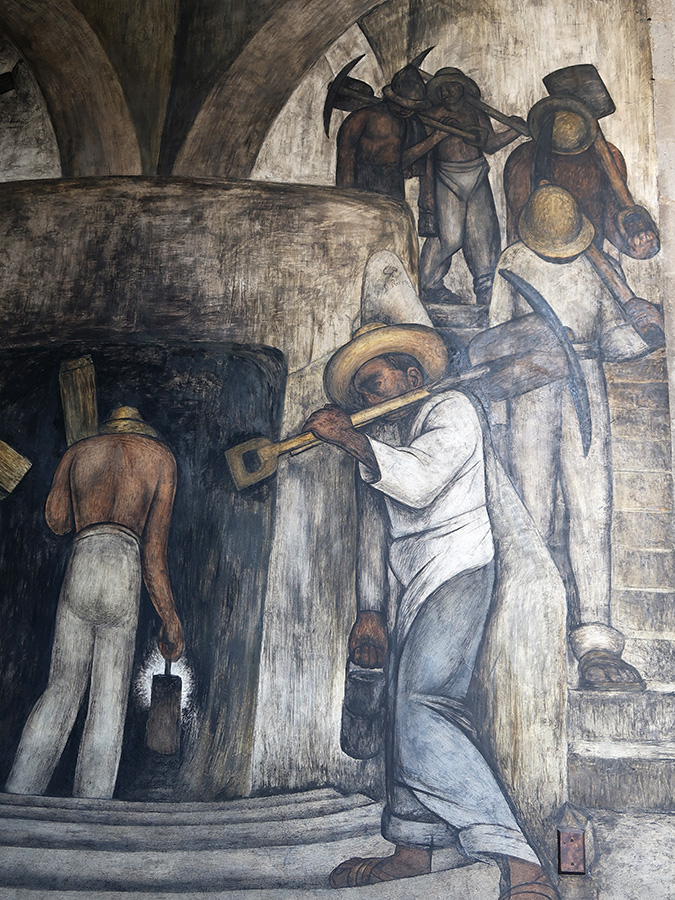


…Let the winds lift your banners from far lands
With a message of strife and of hope:
Raise the Maypole aloft with its garlands
That gathers your cause in its scope….
…Stand fast, then, Oh Workers, your ground,
Together pull, strong and united:
Link your hands like a chain the world round,
If you will that your hopes be requited.
When the World’s Workers, sisters and brothers,
Shall build, in the new coming years,
A lair house of life—not for others,
For the earth and its fulness is theirs.
Walter Crane, The Workers’ Maypole, 1894
¡Feliz Día del Trabajo a tod@s! Happy International Workers’ Day to all!
Posted in Creativity, Culture, Food, Travel & Tourism, tagged cochinita, cochino a la cubana, Cocineras Tradicionales de Oaxaca, cooking, food festival, Mexico, Oaxaca, photographs, photos, popular travel destinations, rotisserie pork, spit-roasted pig, women cooks on April 28, 2018| Leave a Comment »
Though today is the fourth and final day of this year’s Encuentro de Cocineras Tradicionales de Oaxaca 2018, diners continue to line up around the stall of Rosario Cruz Cobos for her Cochino a la Cubana — piggies roasted over a wood fire — fiesta food from San José Chiltepec in the Papaloapan region of Oaxaca.


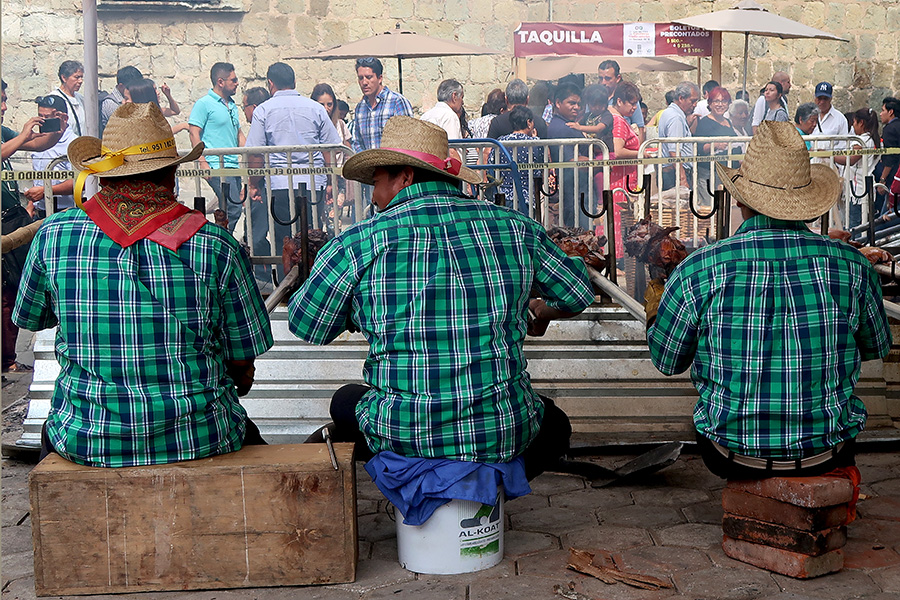
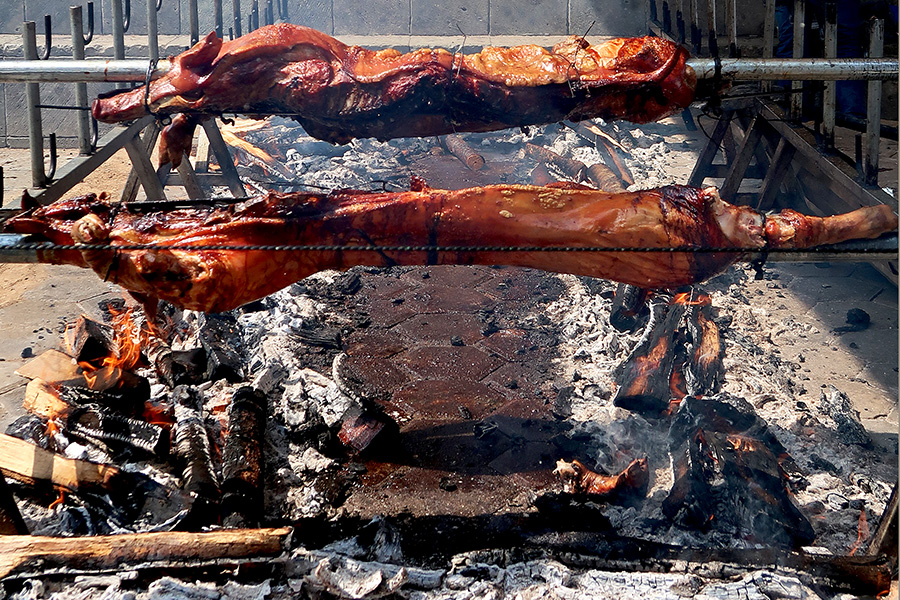
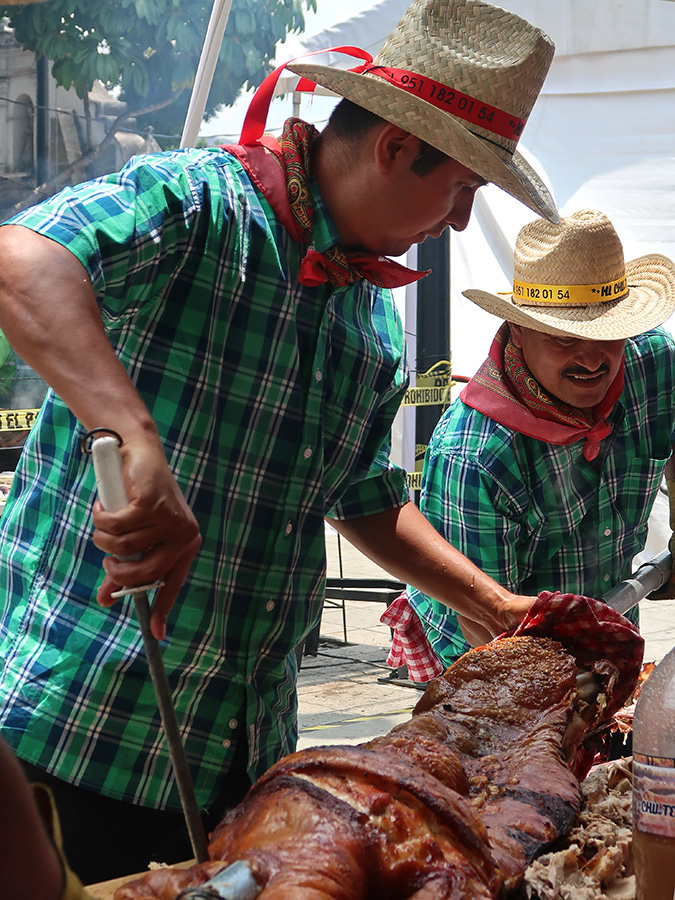


Mouth-watering and succulent, it is well worth the wait!
Posted in Celebrations, Creativity, Culture, Food, Travel & Tourism, tagged calenda, Cocineras Tradicionales de Oaxaca, convite, cooking, costumes, dancing, food festival, Mexico, Oaxaca, parade, photographs, photos, popular travel destinations, women, women cooks on April 27, 2018| 6 Comments »
What can I say? Lately, I have been having way too much fun to blog. A Gran Convite on Tuesday evening kicked off the festivities celebrating Oaxaca’s 486 birthday and inviting one and all to the previously mentioned, 2nd Encuentro de Cocineras Tradicionales de Oaxaca opening the following day. Beginning at the Cruz de la Piedra, the parade came to a sparkling climax in front of the Cathedral.


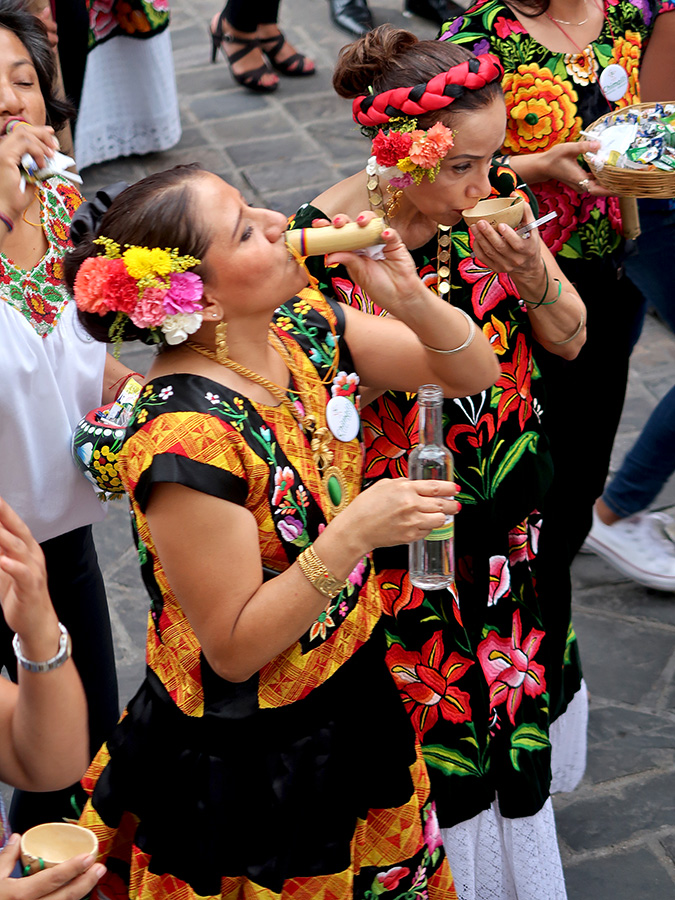


Wednesday began with an early morning ringing of the Cathedral’s bells (and several other churches, I’m pretty sure) and the booms and bangs of cohetes announcing Oaxaca’s official birthday. Then the event that I had been hungrily awaiting — the opening of the four-day gathering of Oaxaca’s traditional cooks at the Plaza de la Danza. It was worth the wait!

Mixtec ritual of Aromas y Sabores del Alma using basil and rosemary to open Encuentro de Cocineras Tradicionales de Oaxaca.
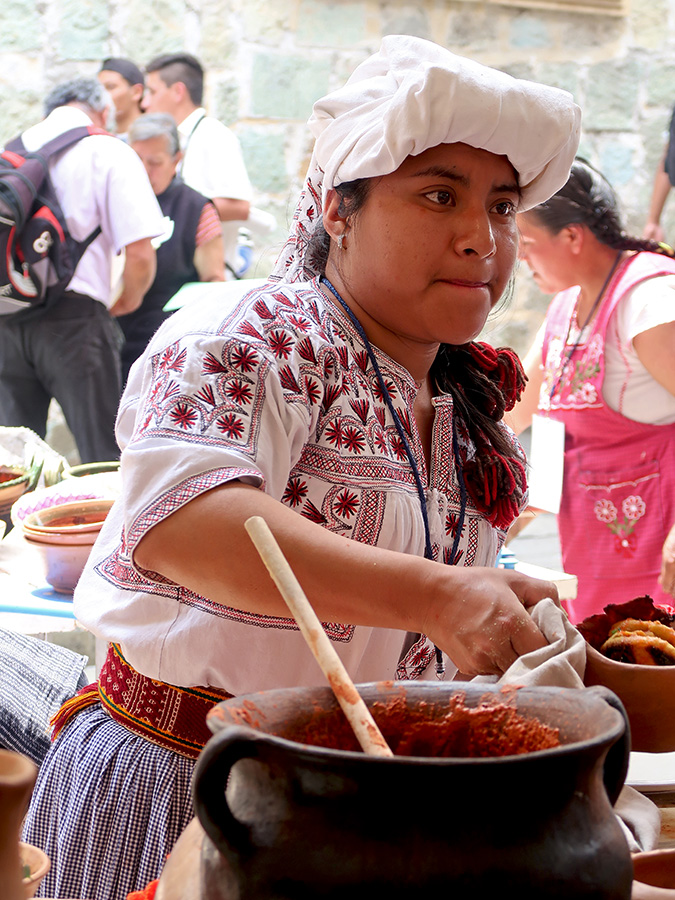
Machacado mixe, Caldo mixe from Santa María Tlahuitoltepec in the Sierra Norte.
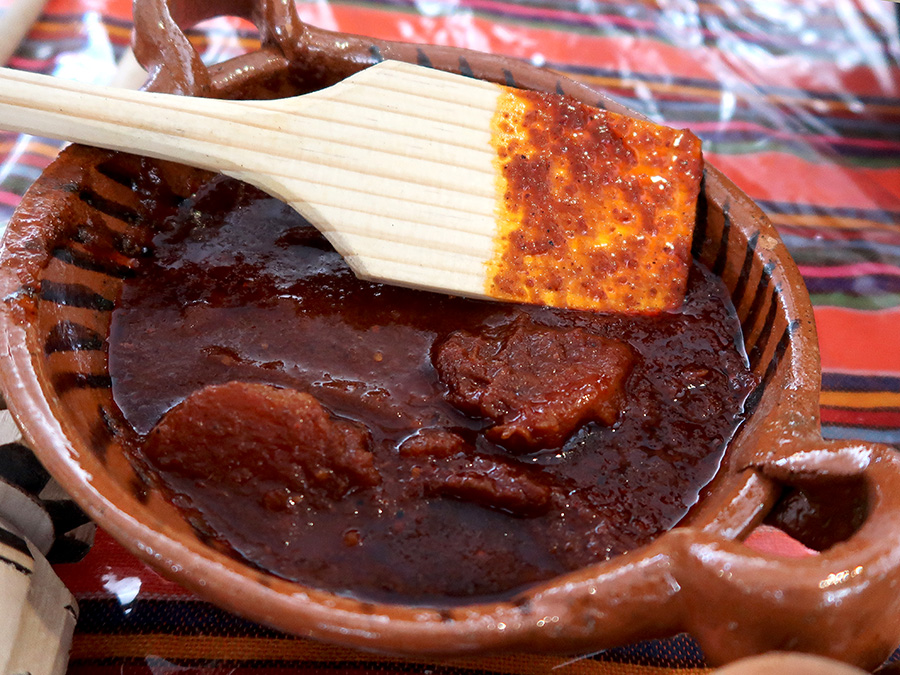
Chileajo amarillo from Huayuapan de León in the Mixteca.

Ingredients on display by Carina Santiago of Tierra Antigua restaurant in Teotitlán del Valle, in Oaxaca’s Valles Centrales.
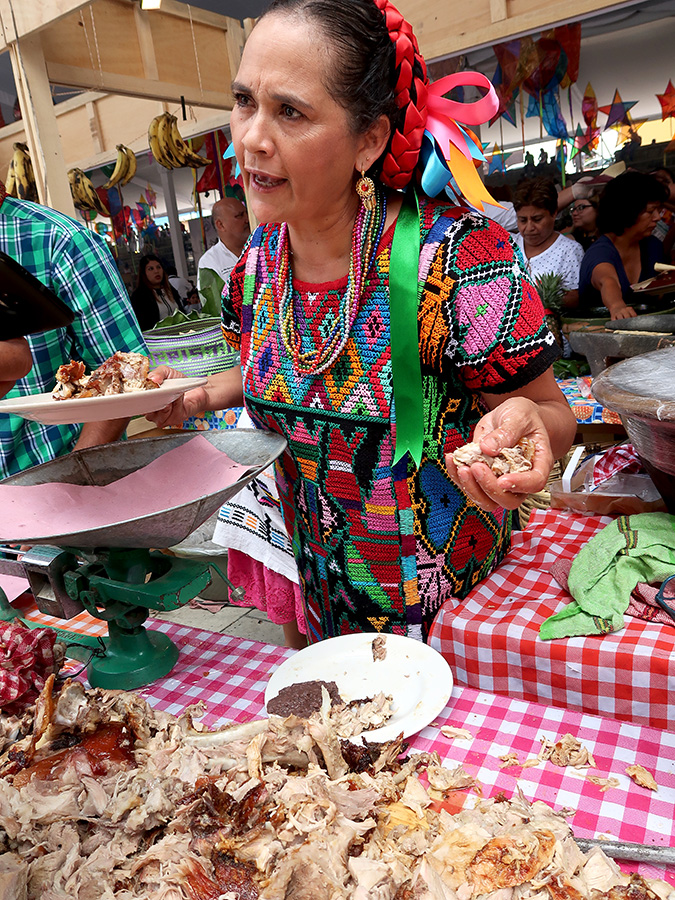
Cochino a la cubana from the Papaloapan region of Oaxaca being served by cocinera Rosario Cruz Cobos.
There is also an expo-venta of Oaxacan artesanía at the Palacio Municipal adjacent to the Plaza de la Danza.
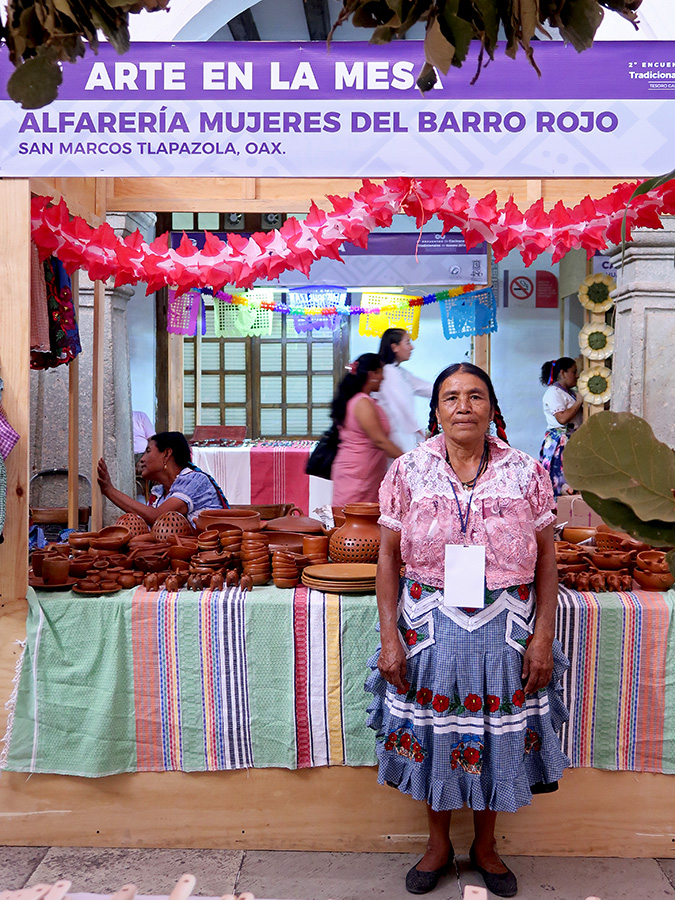
Some of the best red clay pottery from San Marcos Tlapazola for sale.
I took yesterday off to do my volunteer gig at the Oaxaca Lending Library, but I’m returning to the Encuentro today, right after I post this. My stomach is already rumbling!
Posted in Children, Creativity, Culture, Exhibitions, Museums, Textiles, Travel & Tourism, tagged children's clothing, clothing, costumes, exhibits, Mexico, Museo Textil de Oaxaca, Oaxaca, Oaxaca Textile Museum, photographs, photos, popular travel destinations, Textile Museum of Oaxaca, traje on April 18, 2018| 7 Comments »
It’s been all about boys in my family — two sons, a stepson, and a grandson. That is, until eleven months ago when finally a girl — my granddaughter — made her much welcomed entrance into the world. Of course she is adorable, but so were her brother, dad, and uncles. However, I must admit that clothes shopping for a little girl is so much more fun, especially here in Oaxaca.
Naturally, I had to go to the current Museo Textil de Oaxaca exhibition, Vestir hijos con amor (Dressing children with love) — very timely for the upcoming Día del Niño on April 30

Cotton baby hat – probably Santiago Mexquititlán, Querétaro, Mexico (c. 1960) Otomí village.

Woven baby hat – San Lucas Tolimán, Guatemala (c. 1990s) Tz’utuoil community.
The curator’s note explains that the textiles shown “are not the sumptuous accoutrements of an ancient aristocracy, but children’s clothing of the poorest people in Mexico and Guatemala… made of cotton and wool.”

Girl’s huipil from Palín, Guatemala (c. 1980s). Community speaks Pokomam, a Mayan language.

Girl’s huipil from San Bartolomé Ayautla, Oaxaca, Mexico. (c. 1950s) Mazateco community.
“In setting up this exhibit, we have tried to show how textiles intended for children make visible the love felt for them by the first nations of this land.”
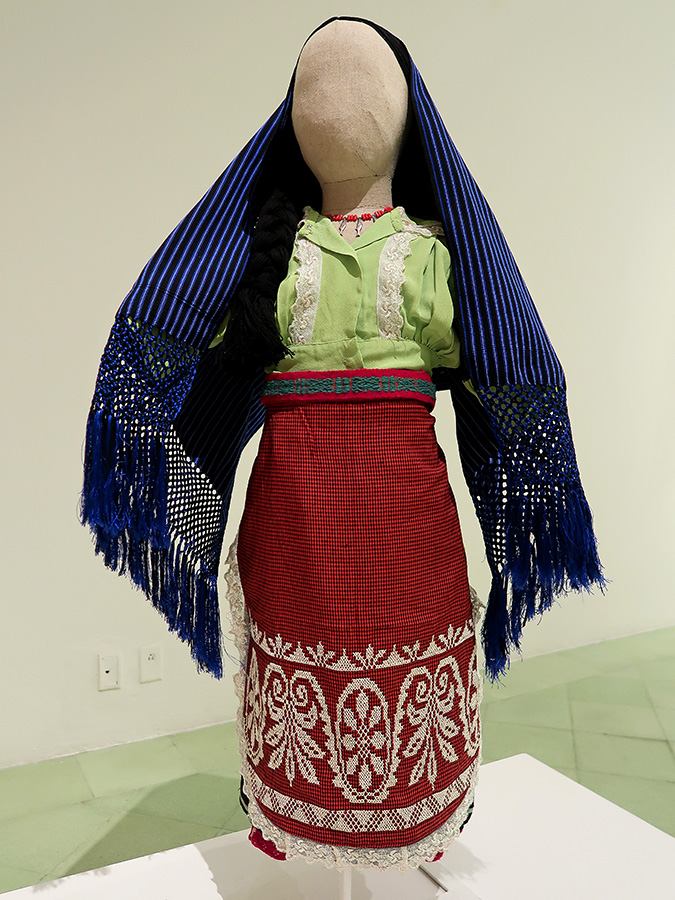
Girl’s clothing from Pátzcuaro, Michoacán, Mexico. (c. 1940s) Purépecha village.
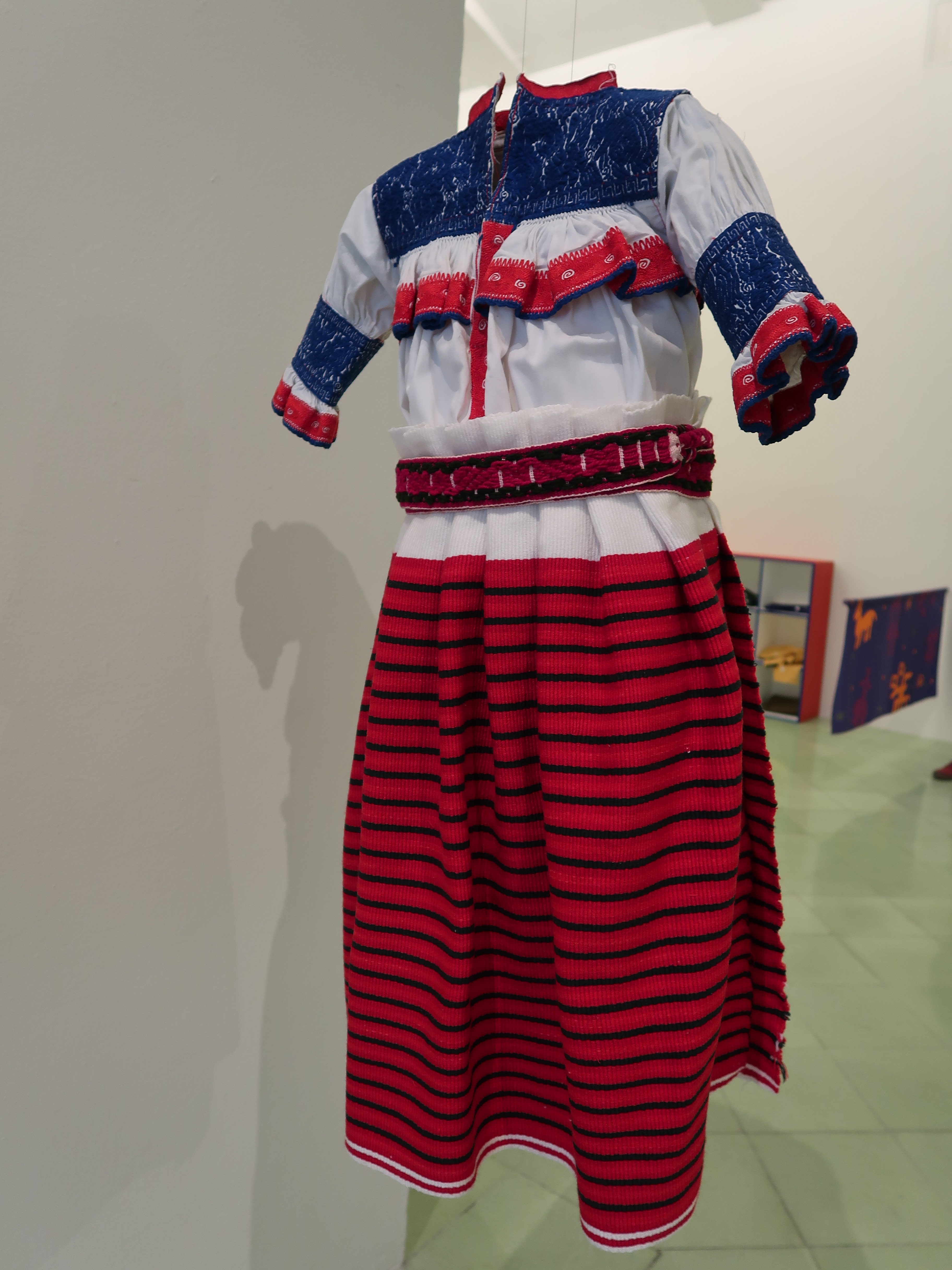
Costume of baptism – Chachahuantla, Puebla, Mexico (1999-2017) Community speaks Náhuatl.

Venustiano Carranza, Chiapas, Mexico (c. 1950s). Tsotsil village.

Huipil of black velvet with cotton embroidery from districts of Juchitán and Tehuantepec, Oaxaca, Mexico. (c. 1950-1960) Zapotec communities.

Villa Hidalgo Yalálag, Oaxaca, Mexico (c. 1990). Zapotec village.

Villa Hidalgo Yalálag, Oaxaca, Mexico (c. 1990). Zapotec village. Embroidery detail using rayon threads.
It isn’t just the girls who are dressed with love in these indigenous communities. The clothing of the boys is also just as lovingly detailed and decorated.

Boy’s clothing from San Andrés Tzicuilan, Puebla, Mexico. (c. 1988-1993) Community speaks Náhuatl.

Boy’s clothing from Santiago Ixtayutla, Oaxaca, Mexico. (c. 1990s) Mixtec village.
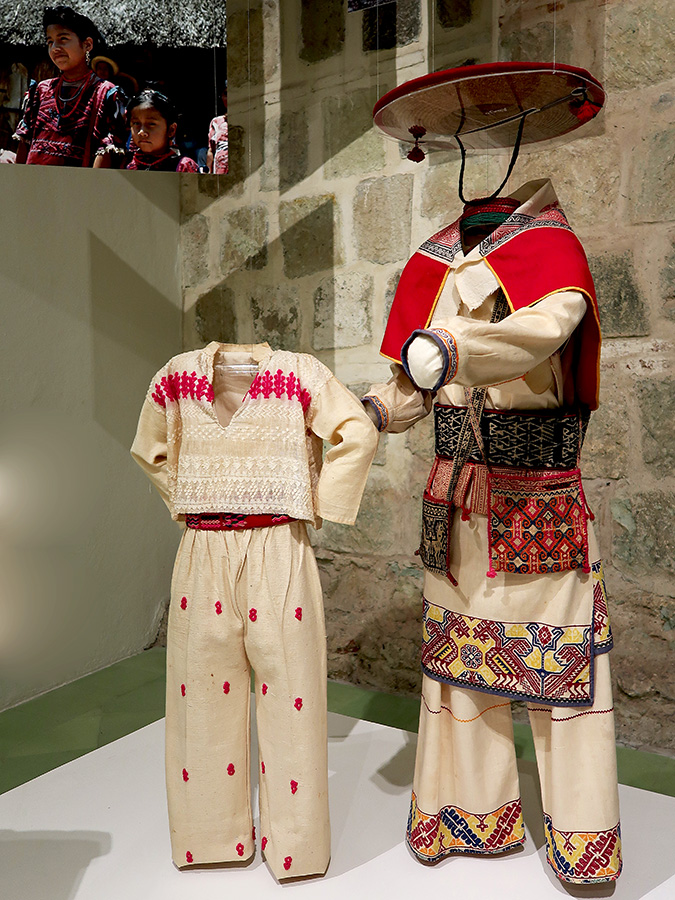
(R) Boy’s clothing from Venustiano Carranza, Chiapas, Mexico. (c. 1950s). Tsotsil village. (L) Teen boy’s clothing from Sierra Madre Occidental to the north of Jalisco and east of Nayarit. (c. 1930s) Wixárika (Huichol) community.

Detail from teen boy’s clothing from Sierra Madre Occidental to the north of Jalisco and east of Nayarit. (c. 1930s) Wixárika (Huichol) community.
There are so many more pieces to see and there is even an interactive component for children — a play area where they can assemble and decorate textile pieces. The Museo Textil de Oaxaca is located at Hidalgo 917, at the corner of Fiallo and the exhibition, in the Caracol room, runs until July 1, 2018.
Posted in Creativity, Culture, Travel & Tourism, tagged graphic arts, La Unión Revolucionaria de Trabajadores del Arte, Mexico, Oaxaca, photographs, photos, popular travel destinations, stencil art, street art, URTARTE, wall art on April 14, 2018| 2 Comments »
From boys to men, there are fierce faces watching from the walls in my neighborhood.


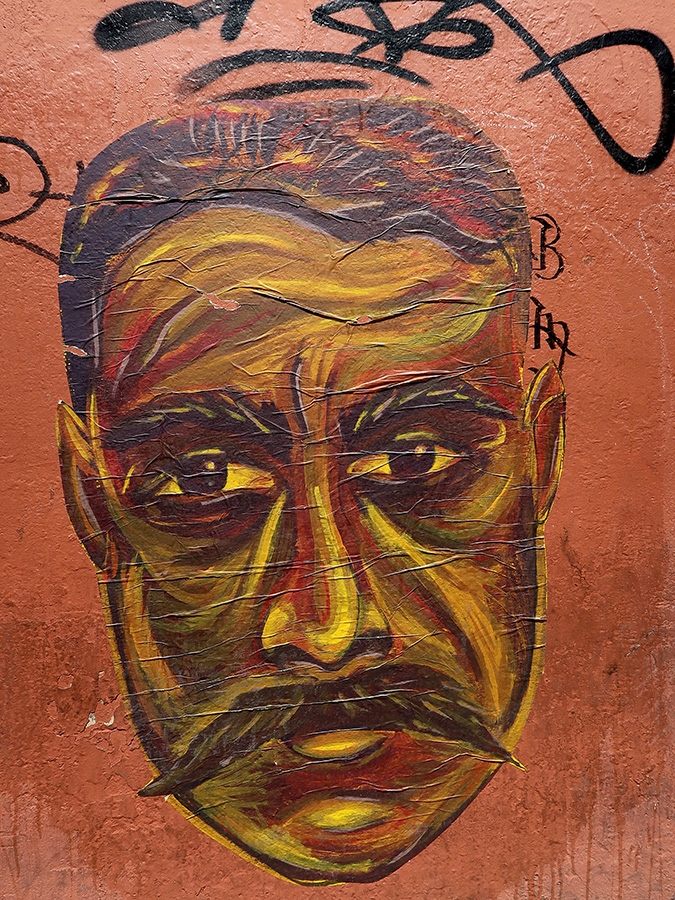
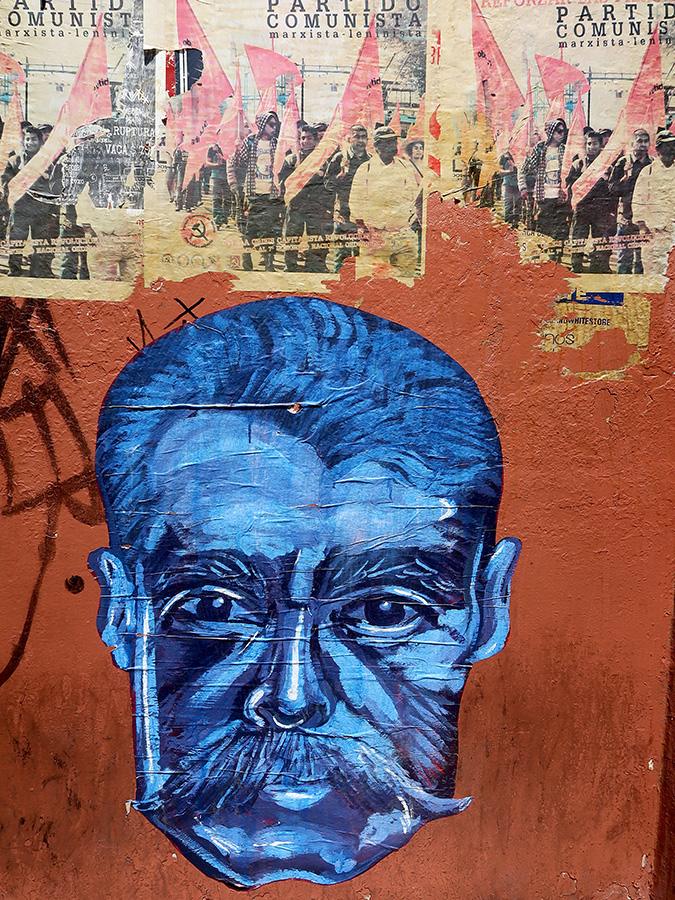
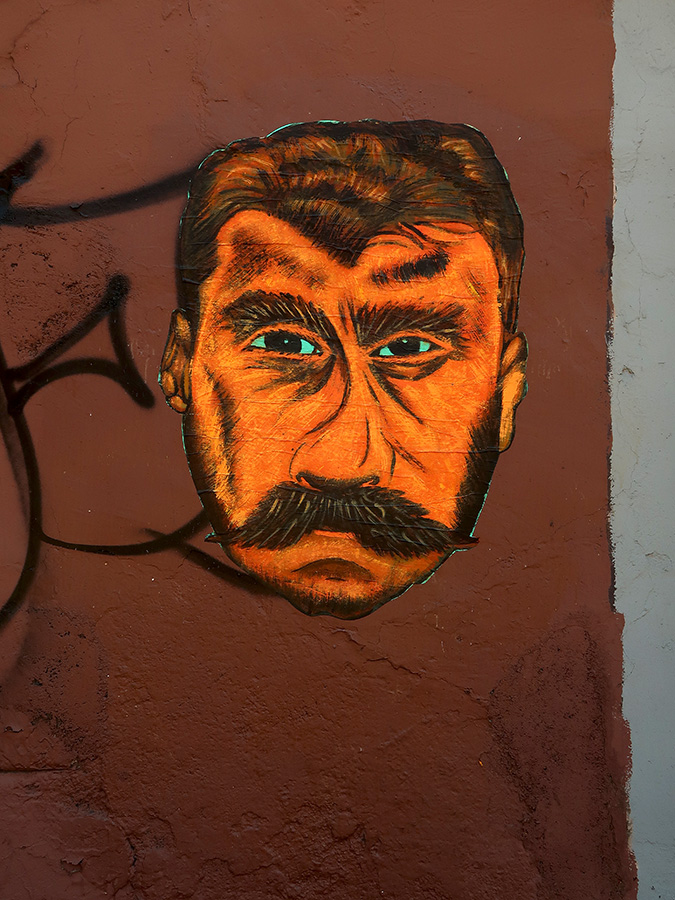
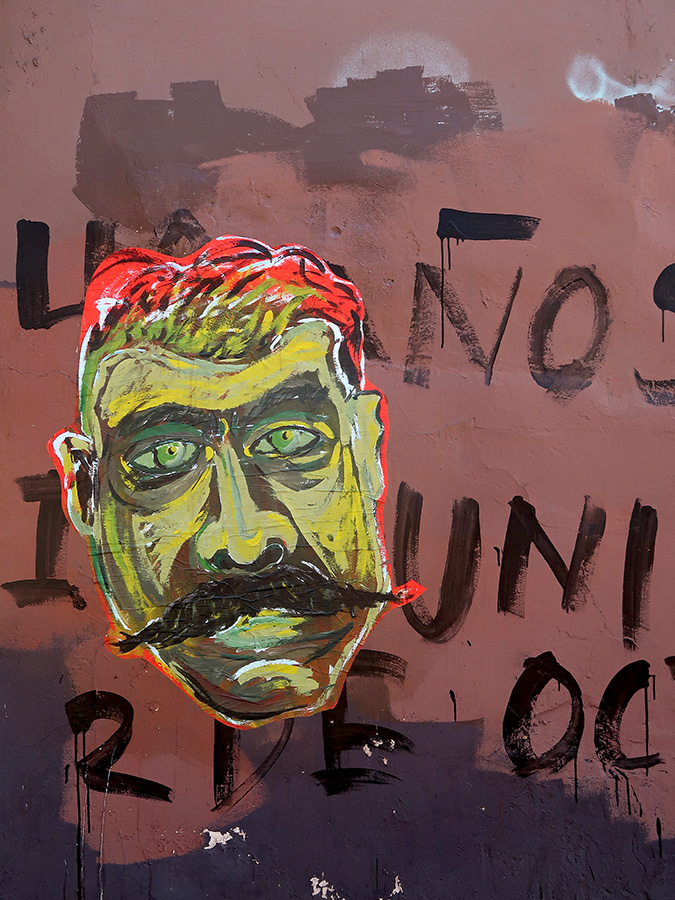

Color from La Unión Revolucionaria de Trabajadores del Arte (URTARTE).
Posted in Creativity, Culture, Travel & Tourism, tagged graffiti, graphic arts, La Unión Revolucionaria de Trabajadores del Arte, Mexico, Oaxaca, photographs, photos, popular travel destinations, stencil art, street art, URTARTE, wall art on April 12, 2018| 4 Comments »
Faces at Manuel Sabino Crespo and Mariano Matamoros…

Man in a green hat – Crespo at Matamoros

Man in a red hat – Matamoros at Crespo
The art of standing on the corner in Oaxaca.
Posted in Buildings, Creativity, Travel & Tourism, tagged abandoned buildings, buildings, crumbling walls, doors, Mexico, Oaxaca, photographs, photos on March 22, 2018| 2 Comments »
… and danger!

Doorways propped up with 2x4s, yellow caution tape, and continuing aftershocks — this is one of the many buildings in Oaxaca that has me walking on the opposite, even if sunny, side of the street.
Posted in Buildings, Creativity, Culture, Music, Travel & Tourism, tagged art, Magic Carpet Ride song, Mexico, murals, Oaxaca, photographs, photos, Steppenwolf, street art, urban art, wall art on March 12, 2018| 6 Comments »
On Calle de Ignacio Allende at the corner of Tinoco y Palacios, a new mural is ready to take you on a magic carpet ride.

Well, you don’t know what we can find
Why don’t you come with me little girl
On a magic carpet ride
You don’t know what we can see
Why don’t you tell your dreams to me
Fantasy will set you free
Close your eyes girl
Look inside girl
Let the sound take you away
— Magic Carpet Ride, written by Normal Cook, Robert Manuel Clivilles, and David Bryon Cole; performed by Steppenwolf.
Hopefully, this mural won’t be slapped with “pintura no autorizada” signs like its predecessor.


 Mexican Peso Converter
 View From Casita Colibrí
Oaxaca’s wallpaper
Posted in Creativity, Culture, Politics, Travel & Tourism, tagged graffiti, Mexico, Oaxaca, photographs, photos, political art, political commentary, protest, stencil art, street art, URTARTE, wall art on May 29, 2018| 4 Comments »
Protest art continues to paper the streets of Oaxaca.
It’s there in black and white against walls of texture and color — greeting the morning’s light and disappearing as shadows fall.
Today, the faces of rage, resistance, and anguish are not only looking down from walls, they are seen at eye level in Oaxaca’s zócalo and streets. They’re back… The annual occupation and blockades by Sección 22 of the CNTE (teachers’ union) has begun.
Share this:
Read Full Post »