Feeds:
Posts
Comments

Archive for the ‘Celebrations’ Category

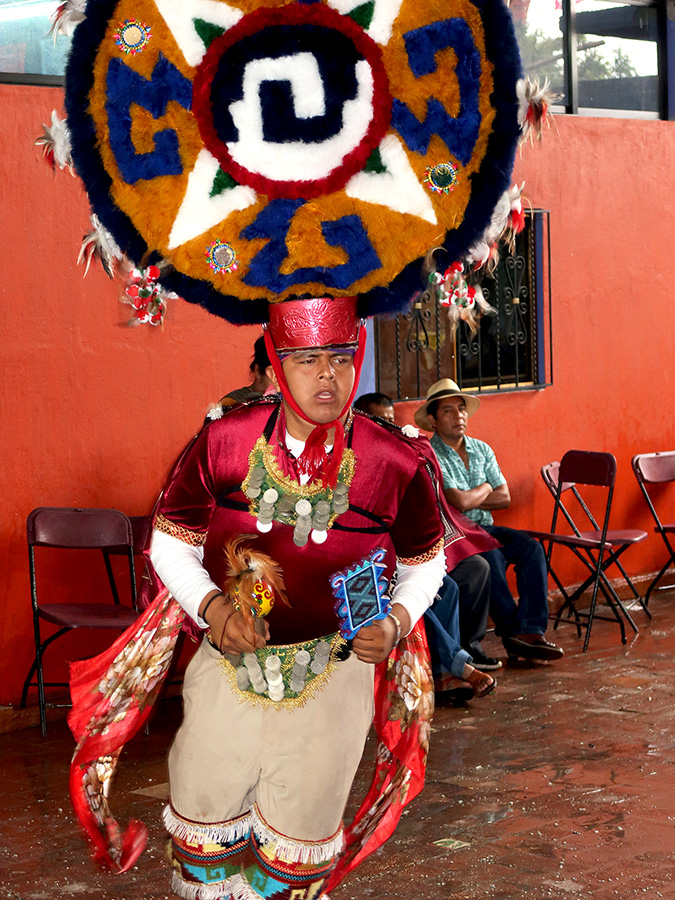
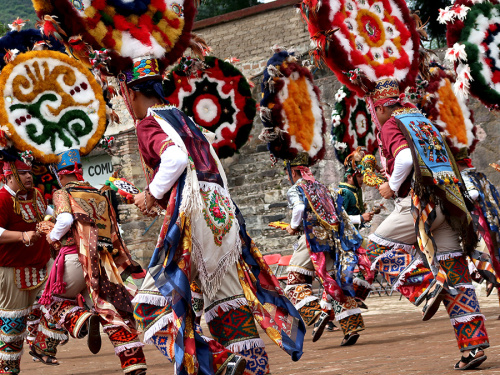
If you are in town… As background to the December 12, Fiesta a la Virgen de Guadalupe performance of the Danza de la Pluma in Teotitlán del Valle, blogger buddy Chris (of Oaxaca-The Year After fame) and I are again doing a presentation at the Oaxaca Lending Library.  It will be on Tuesday, December 4 at 5:00 PM.  And, new this year:  There will be very special guests!

img_0905

From the library’s description of the talk, “The Danza de la Pluma, with its giant feathered headdresses, is one of the most famous dances performed in Oaxaca and is particularly special in the Zapotec weaving village of Teotitlán del Valle.  The dance, dancers, and village all have rich stories.  Come join Chris Stowens and Shannon Sheppard, who have spent several years observing and learning about this amazing culture, for a presentation filled with stories, photos and video.”

Alas, it’s not free.  Besides memberships, presentations like this are what keeps the library afloat.  The cost is 90 pesos for OLL members and 130 pesos for non-members.  Reservations can be made using the library’s Online Store.  Hope to see you on Tuesday!

Read Full Post »

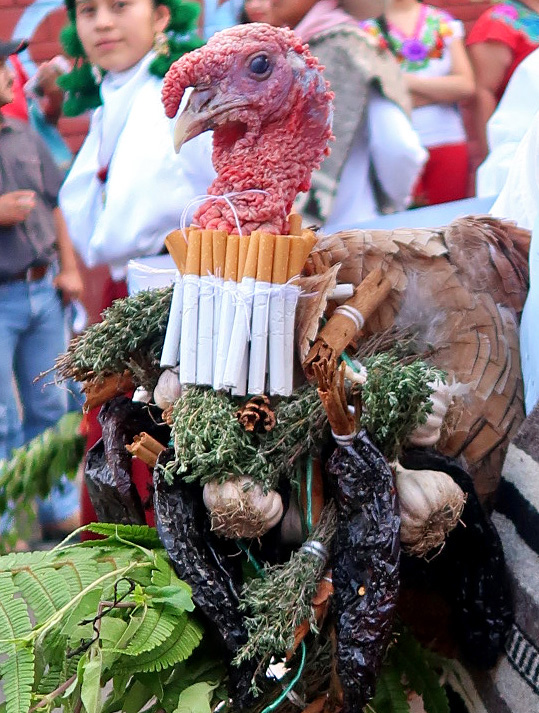
Ya got your herbs, ya got your spices, ya got your smoker — smoked turkey, Oaxaca style!

IMG_9471

San Antonino Castillo Velasco delegation, Guelaguetza desfile, July 21, 2018

In addition to my fabulous family, friends, blog readers, and indigenous peoples who survived genocide, colonization, and other inconvenient turkey day truths, I’m also feeling grateful for guajolotes.  ¡Feliz Día de Acción de Gracias!

Read Full Post »

Today, the 20th of November, Mexico commemorates the 108th anniversary of the beginning of the Mexican Revolution. It raged on for ten years, as various factions battled for power, and the peasantry fought for, in the words of Emiliano Zapata, ¡Tierra y libertad!  (Land and liberty!)

From the smallest of pueblos to the mega metropolis of Mexico City, most every town and city has a street named 20 de noviembre, including Oaxaca.  In addition, Oaxaca has a 20 de noviembre market, where you will find Conchita, my favorite chocolate store, Pasillo de Humo (hall of smoke/grilled meats), aisles of stalls filled with bread, and lines of counters offering menudo and other traditional street food — a very popular destination for locals and adventurous tourists.

Alas, the Mexican Revolution has a complex and bloody history — 1.9 to 3.5 million lives were lost, revolutionary leaders assassinated each other in turn, and promises were repeatedly broken.  The goals of land, water, liberty, justice and law for the peasantry and workers went unrealized.   However, once the armed conflict ended, a cultural revolution began that celebrated and honored working people, peasants, and Mexico’s indigenous roots and helped to forge a new Mexican identity.  As the documentary The Storm That Swept Mexico concludes:

“If we celebrate the revolution, it appears as though we are celebrating the status quo: the miserable conditions of the farmers, workers and the average Mexicans.  And if we are the inheritors of that revolution, then there is nothing to celebrate. Now if we think of the Revolution as an explosion of creative energy then I think we do have reason to celebrate because it was a movement to create a nation more just, more equal, more honest, and an identity we could be proud of.”

To highlight a Oaxaca connection, today’s NVI Noticias published the article, Enciende Madero mecha revolucionaria; Visita Oaxaca en 1909, about Francisco I. Madero’s visit to Oaxaca to light the fuse of revolution in this remote state.

By the way, in 2005, Article 74 of Mexican labor law established the third Monday of November as the “official” holiday — thus following the USA’s “time-honored tradition” of creating 3-day holiday weekends and setting the stage for the bargain hunting shopping extravaganza promoted as Buen Fin.

Read Full Post »

Several pan de muerto festivals sprung up in the valley of Oaxaca during Día de los Muertos — including a Festival del Pan de Muerto in Villa Díaz Ordaz, a Feria del Pan de Muerto Adornado in Villa de Zaachila, and a Feria del Pan y Chocolate in the city of Oaxaca.  While the intention of these fairs is to attract tourists, both foreign and domestic, the primary market remains ofrendas (offerings) to the difuntos (departed) — who must be fed during their brief return to visit with their loved ones.

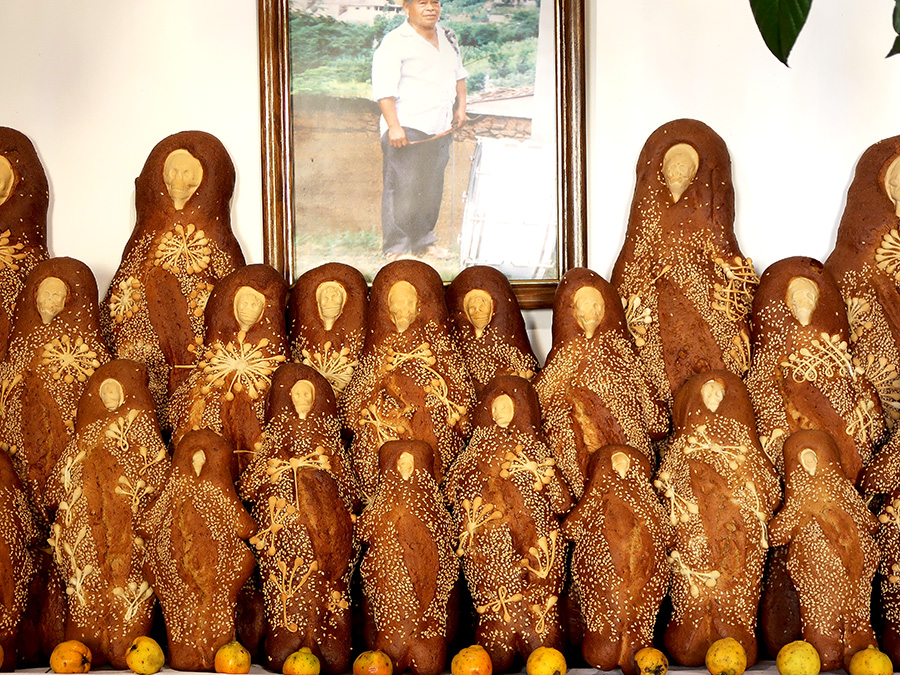
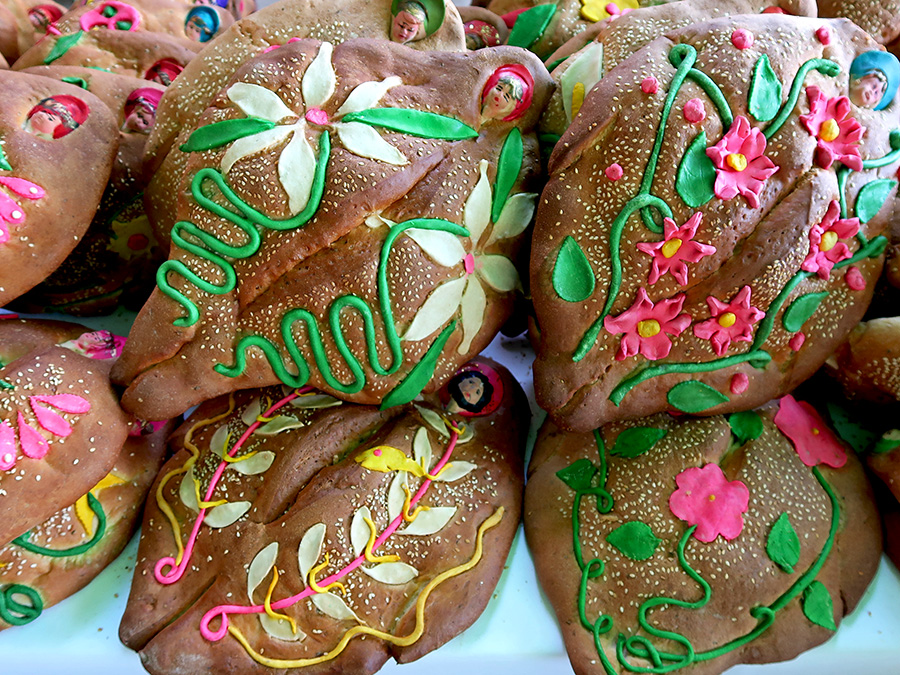
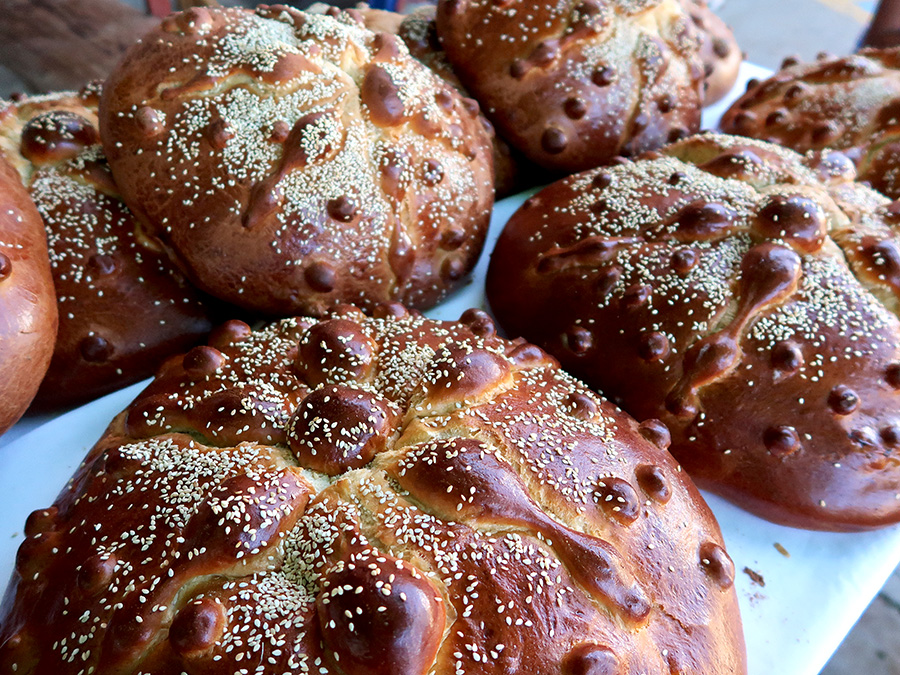
And, like apron styles, pan de muerto (bread of the dead) varies from village to village, be it sold at a feria, mercado, or neighborhood panadería.

Panadería Yalalag in Oaxaca city.

San Pablo Villa de Mitla.

San Pablo Villa de Mitla.

Mercado, 20 de noviembre, Oaxaca city.

Villa de Zaachila.

Villa de Zaachila.

Villa de Zaachila.

Villa de Zaachila

Villa de Zaachila.

Though my difuntos have departed and my altar has been disassembled, I couldn’t consign my beautiful (but stale) pan de muerto offerings to the garbage can.

Pan de muerto from Yalalag, Mitla, and Zaachila.

So, here they remain in a basket on my counter — until they disintegrate or the hormigas (ants) enjoy a feast.

Read Full Post »

Under the dappled sunlight filtering through the 500 year old ahuehuete trees in the panteón of Tlacolula de Matamoros, lovingly placed fruit and nuts nourish the souls.  (Click on images to enlarge)


In the afternoon, when the light and shadows dance on the graves, beautiful still lifes greet the departed, their living family, friends, and visitors.  It is a tranquil setting to contemplate the words of Octavio Paz (The Labyrinth of Solitude, the other Mexico, and essays, Grove Press, 1985, p. 54)

The opposition between life and death was not so absolute to the ancient Mexicans as it is to us.  Life extended into death, and vice versa. Death was not the natural end of life but one phase of an infinite cycle.

Read Full Post »

Today, at 3:00 PM in Teotitlán del Valle, as leaves in the mountains and fields rustled, the arrival of the difuntos (departed) was announced with the sound of cohetes (rockets) and church bells.  Incense burners were lit and placed in front of ofrendas in each home’s altar room — the smoke and scent of copal helping to guide the spirits home for their yearly twenty-four hour visit.

Tonight they will feast on tamales amarillos — special tamales that are traditionally served three times a year in Teotitlán — in July for the Fiesta de la Preciosa Sangre de Cristo, in October for the Fiesta de la Virgen del Rosario, and today, November first, in honor of the returning difuntos.

IMG_3964_crop

As we have done for many years, blogger buddy Chris and I came to the home of Zacarías Ruiz and Emilia Gonzalez with our offering of pan de muertos and a bottle of mezcal to place on their altar — paying our respects to their difuntos.  In turn, we were offered mezcal and cervesas (beer), followed by the aforementioned tamales amarillos.

The tamales were days in the making.  Several of the family’s organic free range chickens were sacrificed; corn from their milpa was nixtamalized to make a silky smooth masa; and the ingredients for mole amarillo were toasted, chopped, blended, and boiled.  The final preparation began at 3:30 this morning — 250 tamales were assembled, filled, and wrapped in fresh green leaves from their milpa and placed in the steaming pots.  The results were to die for!

For me, more than painted faces and parades, this is what makes experiencing Día de los Muertos in Oaxaca so special.

Read Full Post »

As my grandchildren finished their trick or treating up in el norte, I put the final touches on my Día de los Muertos ofrenda (offering) here in Oaxaca.

IMG_1662

A yellow (the color of death in pre-hispanic southern Mexico) cloth covers two chests; papel picado (cut tissue paper), signifying the union between life and death, has been added, along with the traditional flowers of Day of the Dead — cempasúchil and veruche (domesticated and wild marigolds), their scent to guide the spirits, and cockscomb to symbolize mourning.  Visitors brought the sunflower and, since my grandfather, father, and father-in-law were avid gardeners, it is for them!

IMG_1645

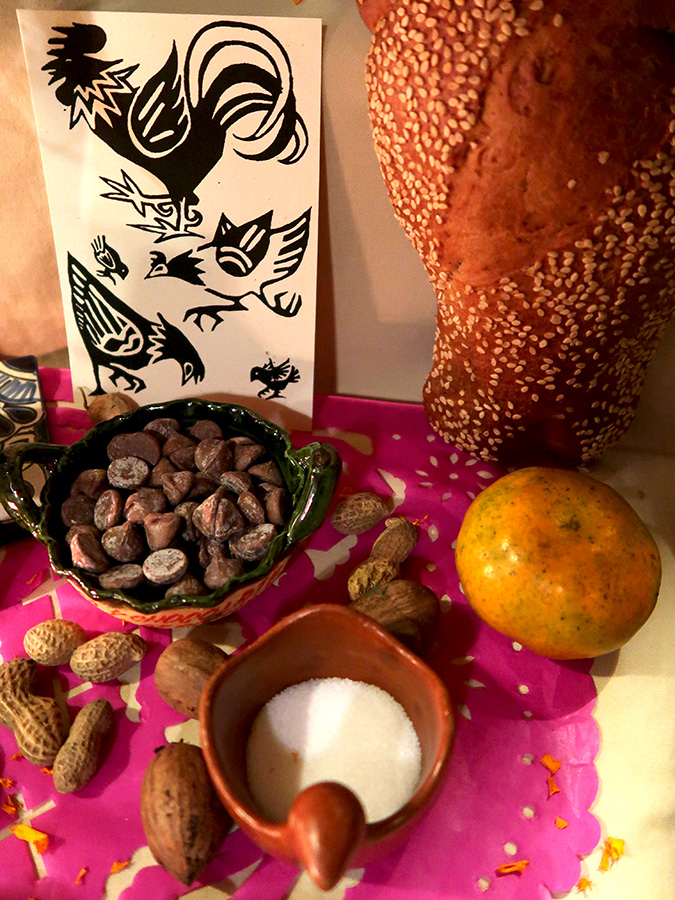
There is salt to make sure the souls stay pure and chocolate, peanuts, pecans, apples, mandarin oranges, and pan de muertos (Day of the Dead bread) to nourish them.

IMG_1665

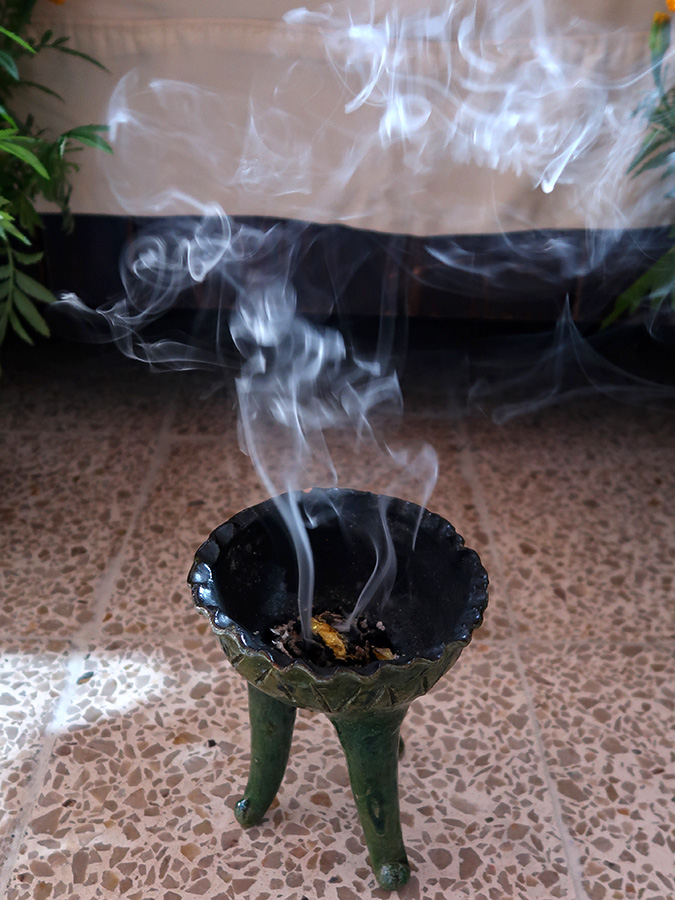
The sweet smell of copal incense and its smoke help guide my loved ones to the feast I have prepared.  And, there is water to quench their thirst, as they travel between worlds, not to mention mezcal and cervesa (beer).

IMG_1767

But, most important of all, there are the tangible remembrances of my departed — photos and some of their favorite things.

IMG_1655

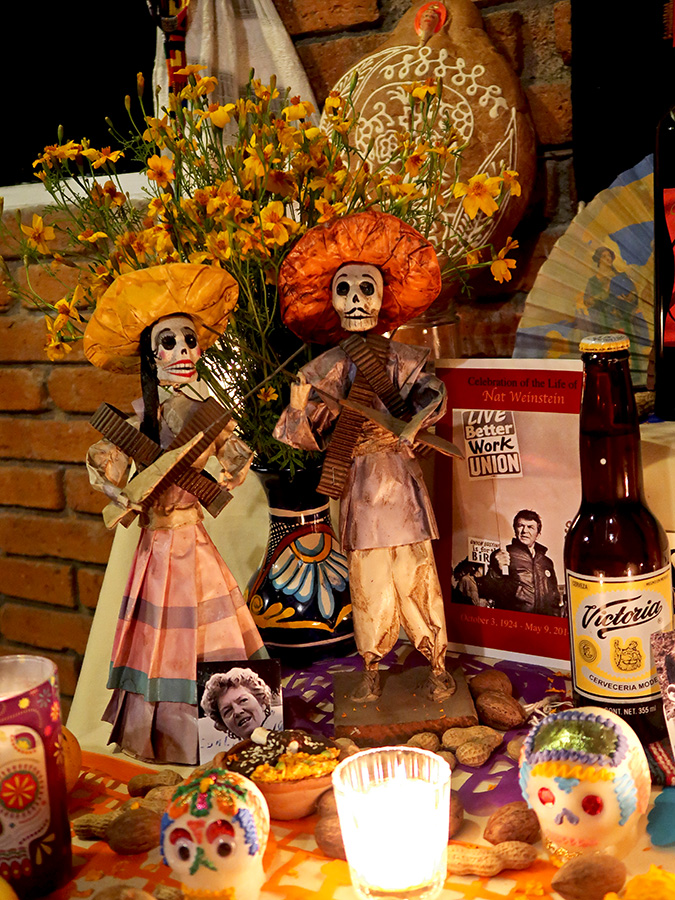
Revolutionary catrina and catrin for my revolutionary comadre and compadre, Sylvia and Nat.

IMG_1765

Yarn and a crochet hook for my dear grandmother who many of the abuelas (grandmothers) in Oaxaca remind me of — always wearing an apron, never wearing pants, and incredibly adept with crochet and embroidery thread.  And, for my adored grandfather, a San Francisco Giants baseball cap.  My grandparents moved next door at the same time the Giants moved from New York to San Francisco and grandpa and I listened to many games together on his transistor radio, as I helped him in the garden.

IMG_1660

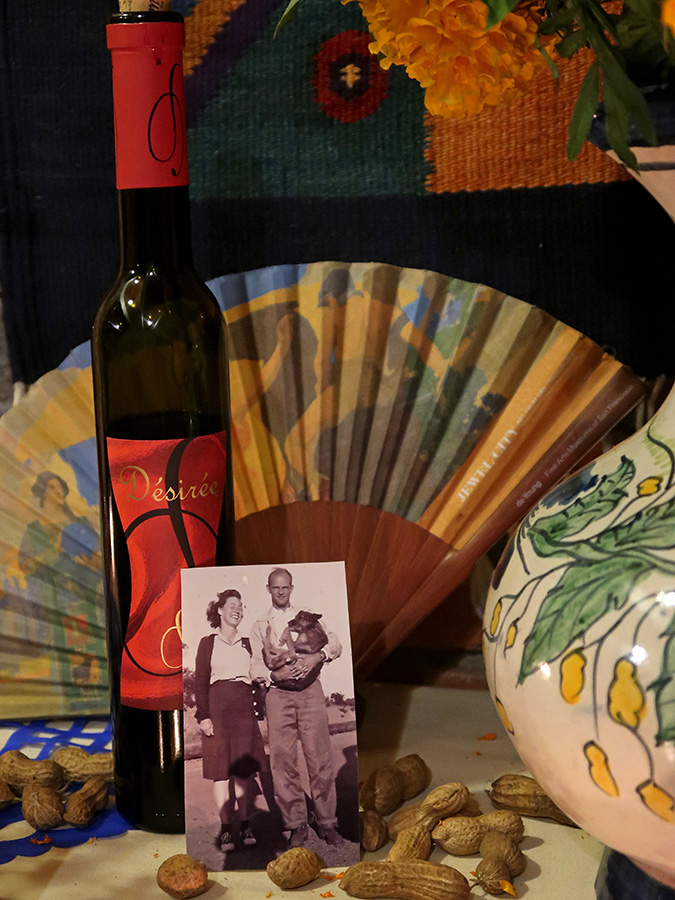
There are other cherished friends and relatives on my altar, but pride of place goes to my parents.  For my father, who was killed when I was only two and a half, there is beer (below the above photo) — alas Victoria not Burgermeister!  And for my mother, a fan to cool herself as she dances and a bottle of port to sip before she sleeps.

IMG_1794

It’s been a two-day labor of love as I wanted everything to be perfect for my difutos (departed) to find their way and feel welcome in my Oaxaca home.

Read Full Post »

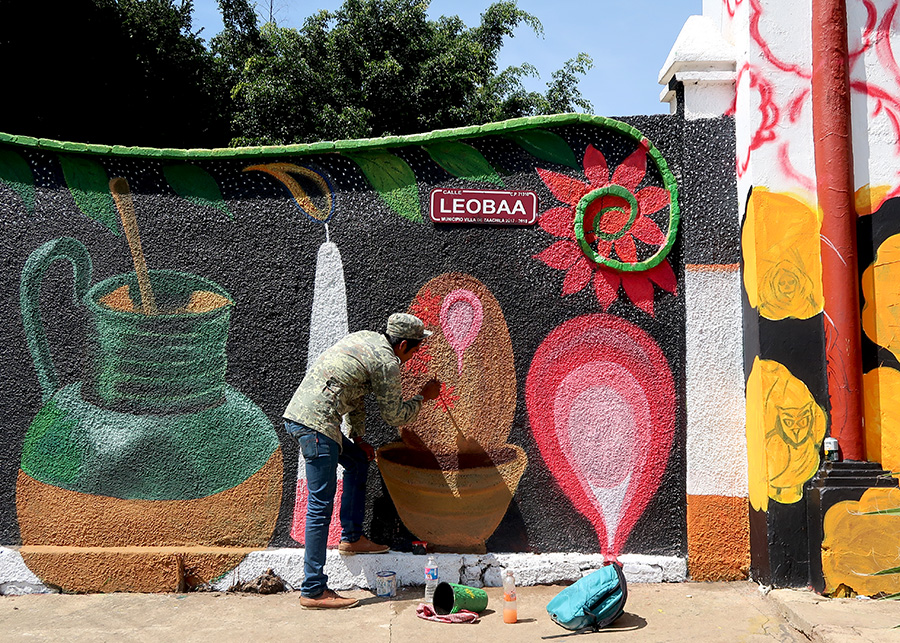
Not all the Día de los Muertos murals in Villa de Zaachila were finished, some were still works in progress…

IMG_1288

with ladders and paints standing by…

IMG_1309

waiting for their artists to pick up the brush…

IMG_1286

or spray can, as the case may be.

IMG_1327

I first saw many of the murals in the summer of 2017 and was happy to see they are still intact, albeit some are a little faded.  Celebrated by the community, the new murals join the old and become a part of the landscape of the village.

Read Full Post »

A regalito (little gift) to my calaca and calavera loving grandson from today’s visit to Villa de Zaachila for their first Feria del Pan de Muerto, Mole, Chocolate y Espuma.

From murals along the outer side of the panteón (cemetery) in Villa de Zaachila.  Click to enlarge images.

Read Full Post »

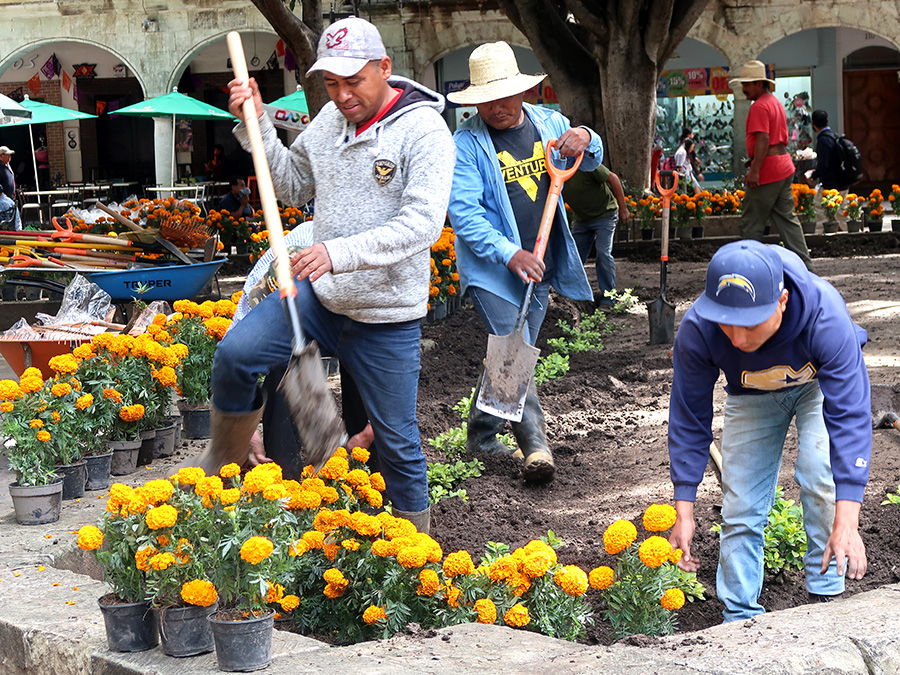
Today the sun (finally) came out and hundreds (thousands?) of pots of cempasúchil (aka, cempoalxóchitl, cempaxochitl, cempoal, zempoal, flor de muertos) arrived in the city center.

IMG_1089

This was a photo op not only for yours truly but also the local press, as they trailed after the wife of Oaxaca’s governor while she viewed the unloading…

IMG_1078_land

and planting of the iconic Día de los Muertos flowers in the beds of the Zócalo and Alameda.

IMG_1076_crop2

The color and fragrance of the cempasúchil provide a lovely setting to sit and contemplate the world (and check your cell phone).

IMG_1077_port

Oaxaca is putting on her best to welcome her difuntos (deceased) along with the thousands of tourists who will soon be arriving.

Read Full Post »

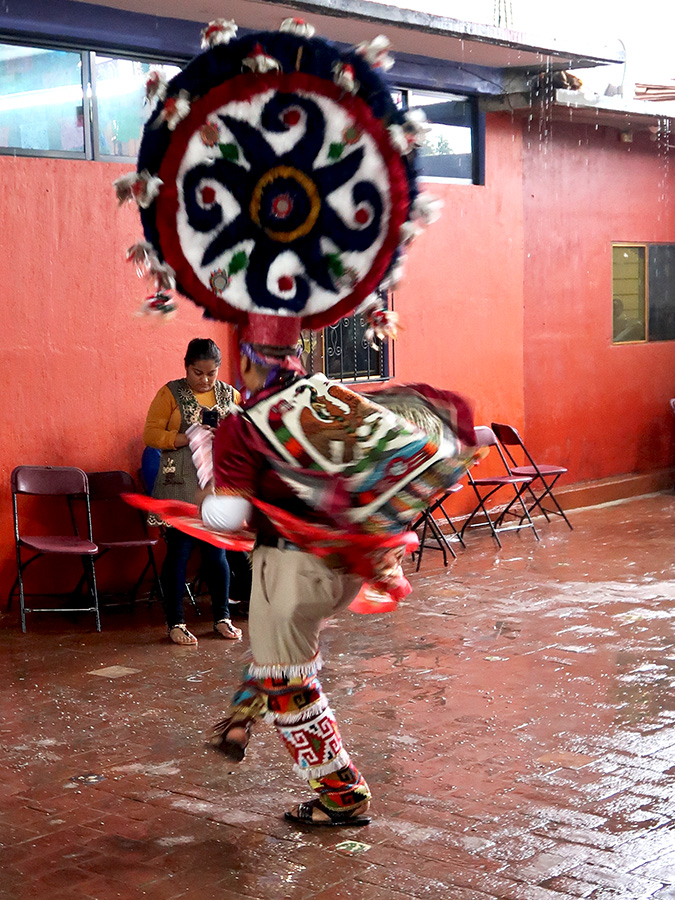
Monday afternoon, in the middle of a fiesta at the home of Danza de la Pluma danzante Juan Pablo González Gutiérrez, a torrential downpour came to Teotitlán del Valle.

IMG_0865

As I’ve mentioned, rain has been scarce this rainy season — a serious situation for a community that relies on subsistence farming.

IMG_3910

So, despite the fact that the dirt road in front of the house became a muddy rushing river and festivities had to be put on hold for awhile as rain blew in through openings in the tented patio, this deluge was good news and people were smiling.

IMG_0872_port

Everyone, including Juan Pablo, waited patiently for the life-giving rain to let up.

IMG_0882

It eventually did and he was able to dance.

IMG_0933

On a wet patio, surrounded by 100+ proud family members, fellow danzantes, and guests, he performed his solo dance.

IMG_0931

Blogger buddy Chris and I felt so incredibly honored to have been invited.  It was a truly memorable experience that we will treasure always.  Muchisimas gracias to Juan and his family and all the members of the Danza de la Pluma Promesa 2016-18 for being so warm and welcoming to us over the past couple of years.  We are going to miss you!

Read Full Post »

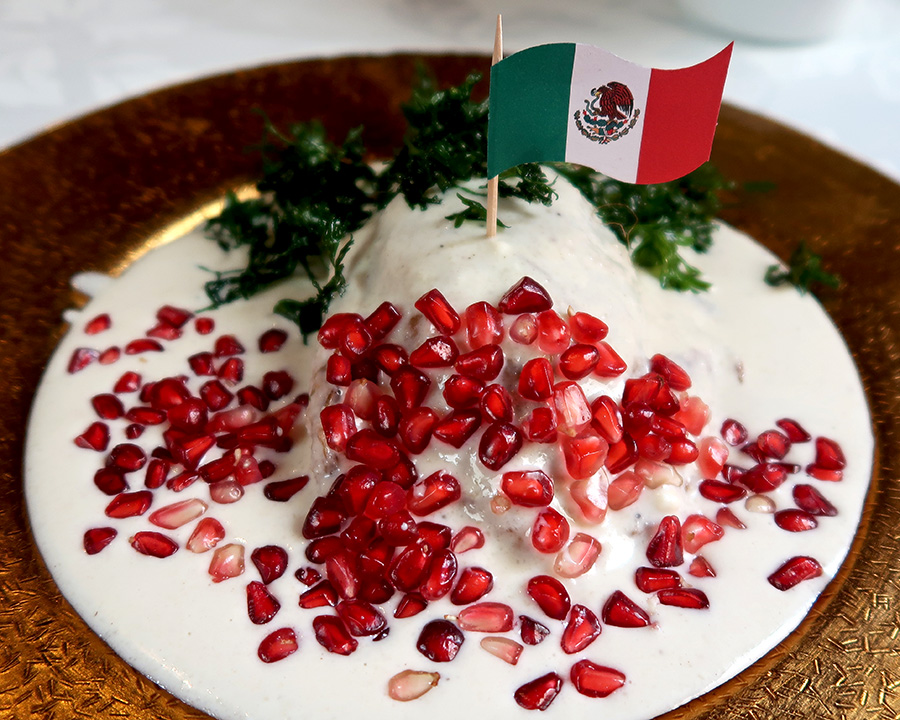
I returned to Oaxaca very late last night and just in the nick of time.  As I previously noted, chiles en nogada is prepared during the month of September — El Mes de la Patria celebrating Mexico’s independence from Spain — and I was keeping my fingers crossed that it would still be available.  Thus, today (the LAST day of September) on my way back from Mercado Benito Juárez (a necessary restocking the empty larder shopping trip), when I saw the prominent “chiles en nogada” sign in front of Restaurante Catedral and heard the hostess explain to a small group of tourists that today was the last day they would be serving it, I had to seize the opportunity.

Chile en nogada with Mexican flag

Just color me happily sated by the green, white, and red of the poblano chile stuffed with a special fruit and meat picadillo, blanketed with a smooth slightly sweet walnut sauce, and garnished with parsley and pomegranate seeds.  So, mis amig@s (you know who you are) you are off the hook!

Read Full Post »

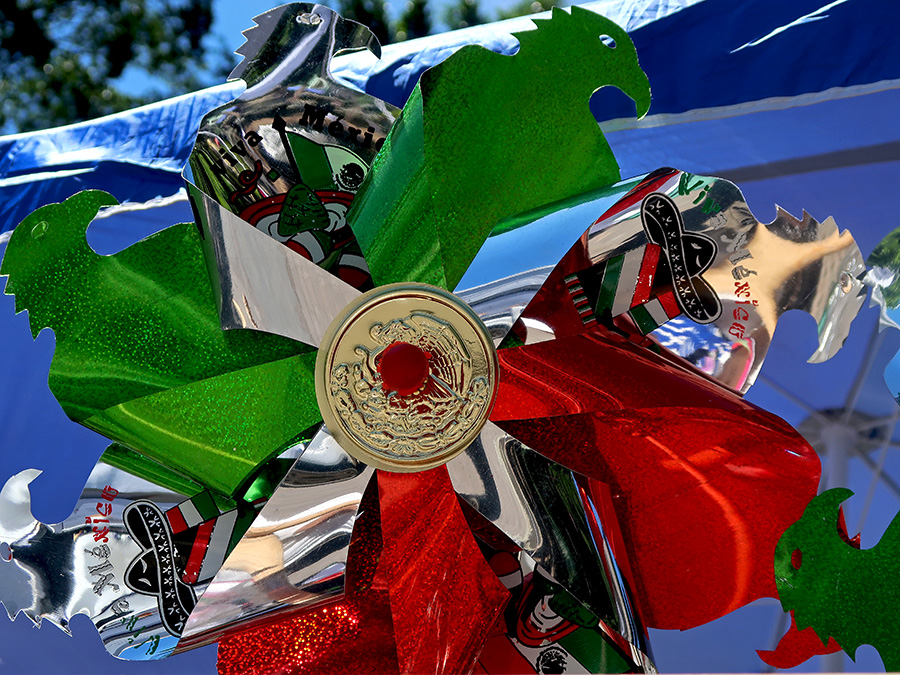
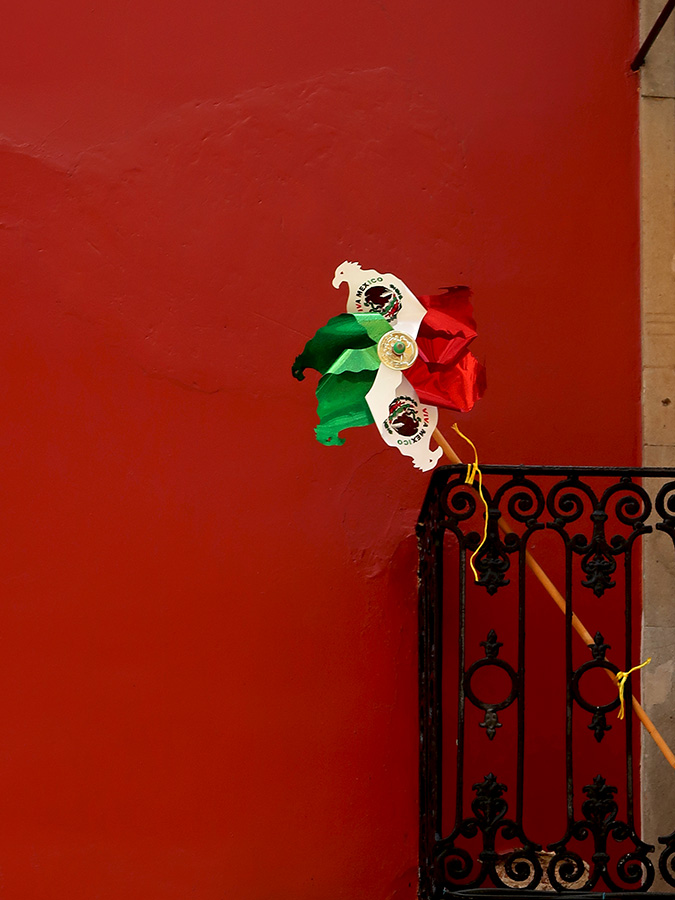
On September 16, Mexico celebrates Día de la Independencia — marking Father Hidalgo’s call to arms (Grito de Dolores) to begin the ten-year war for independence from Spain.  However, the entire month of September is El Mes de la Patria (the month of the homeland) and streets and vendor stalls are awash with the green, white, and red of the Mexican flag.

Last week, walking down to Mercado Benito Juárez to pick up a few last-minute regalitos (little gifts) to bring up to family and friends in el norte, within two blocks I saw…

There is even a very yummy green, white, and red patriotic dish that appears in restaurants in September — Chiles en nogada.  I’m hoping it will still be on the menu when I return at the end of the month from the el norte trip.

Read Full Post »

The very dry rainy season continues and is the major topic of conversation among anyone who has any connection to la tierra (the land).  However, during today’s Fiesta a la Natividad de la Virgen María in Teotitlán del Valle, the Zapotec god Cosijo answered the prayers for rain.

The sky darkened over Templo de la Preciosa Sangre de Cristo

Moctezuma (Sergio Gutiérrez Bautista) danced the story of the Conquest.

Doña Marina (Elizabeth Hernández Gutiérrez) danced her part.

The rain began to seriously fall and the plastic penacho (headdress) covers came out in force, but the danzantes continued to dance.

Comida (lunch break) came just in time, the sun came out, and Malinche (Quetzali del Rayo Santiago Ruiz) graciously posed for photos.

And, Javier Gutiérrez Hernandez (dance master, choreographer, former danzante, and father of Moctezuma) posed with his son’s penacho.

A little means a lot, though probably not enough to salvage this season’s milpa (field of corn, beans, and squash).  But, when your culture dates back at least 2,500 years, you take a long view of history.

Read Full Post »

Saturday saw the inauguration of the long awaited Centro Cultural Comunitario de Teotitlán del Valle (CCCTV).  We, along with the citizens of this Zapotec community, have been wondering and watching the progress of the building, located between the municipal building and tapete (rug) vendor stalls, for 3+ years.

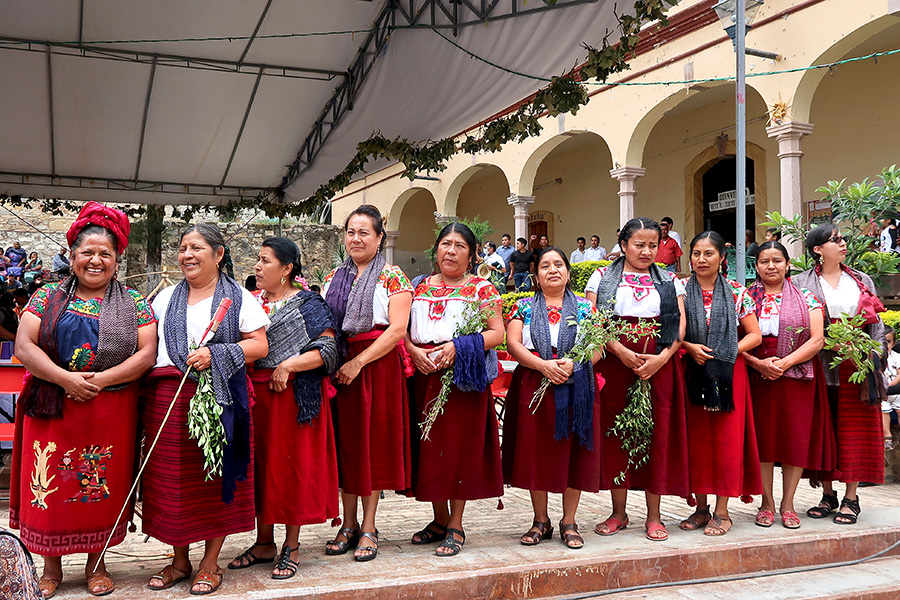
To begin the celebration, a desfile departed from the plaza in front of the new center, wound its way through the streets of Teotitlán, and returned to its starting point almost an hour later.  Parading through town, there were kids and abuelas…


Community leaders and villagers…

And neighboring municipality, Tlacolula de Matamoros, participating with one of their gigantic marmotas and dancers.

There were two bands supplying a marching rhythm and soundtrack — the first to lead the procession and, at the tail, Los Reformistas, accompanying the Danza de la Pluma Promesa 2016-2018.

The danzantes danced their way onto the plaza and performed.

Then villagers and visitors settled down for words of welcome by community leaders and the new cultural center director Abigail Mendoza (yes, the world famous cocinera), food and drink prepared by the women of Teotitlán, and a moving song by Lila Downs, a madrina of the inauguration.

By the way, several times during the event, Teotitecos proudly informed me that besides the CCCTV’s newly elected director, all the members of the cultural center’s governing committee are women.

Centro Cultural Comunitario director Abigail Mendoza (far left) and her committee.

There were musical performances and then a ribbon cutting to formally open the CCCTV — a building that was awarded the 2017 Cemex first place in the category of Collective Space, Gold Medal in the 3rd edition of the Architecture Biennial of Mexico City 2017, and the Silver Medal in the 15th edition of the National and International Biennial of Mexican Architecture 2018 (Centro Cultural de Teotitlán del Valle, Oaxaca).

At long last, the Centro Cultural Comunitario de Teotitlán del Valle was open to the public — and they poured in to view the spaces, exhibits, and Pablo Picasso community library.

However, that was far from the end of the celebration!  A mini Guelaguetza began with the (above mentioned) delegation from Tlacolula, followed by the folkloric group, Grupo Dancistico Ritmo de Mi Raza, showcasing dances from the eight regions of the state of Oaxaca, and finished with an encore performance by Teotitlán’s Danza de la Pluma Promesa.

The celebration ended 10+ hours after it began, with the abuelas (seen above), village leaders, and the Cultural Center Committee dancing the jarabe in front of the municipal building, accompanied by the exploding sights and sounds of toritos dancing in the plaza, a few steps below.

In addition to permanent exhibits and library, the CCCTV also includes gardens, a store, meeting spaces, and will host temporary exhibitions, along with ongoing cultural and educational activities for children, youth, and adults.

Read Full Post »
« Newer Posts - Older Posts »