Feeds:
Posts
Comments

Archive for the ‘Culture’ Category

And, then there was the Festival de los 7 Moles opening buffet lunch set amidst the beauty and tranquility of the Jardín Etnobotánico.  Serendipity and synchronicity brought us there… running into a friend, conversation, investigation (see pots below), and her enthusiasm and powers of persuasion (gracias, Rosa!) had us purchasing tickets on the spot.

While kitchen staff prepared the serving platters and bowls…

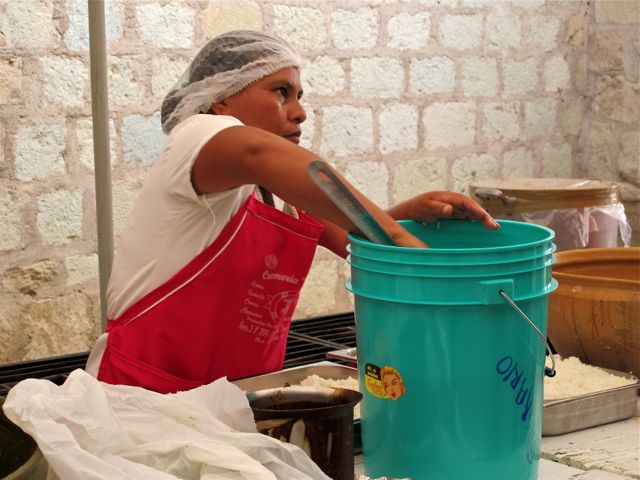
Woman in apron and wearing hairnet, scoops cooked rice out of a large bucket.

Dancers gathered on the Alameda for a calenda that would lead people the luncheon.

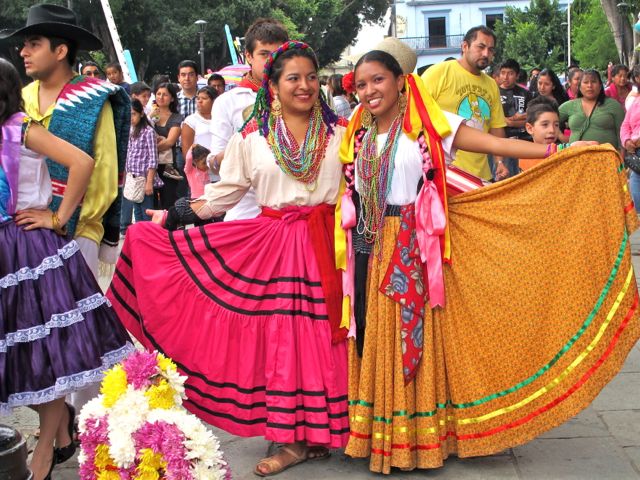
Two women displaying their long  colorful full skirts

They included a number of small children…

Woman squatting down and clasping hands with a toddler-age boy - both in indigenous dress

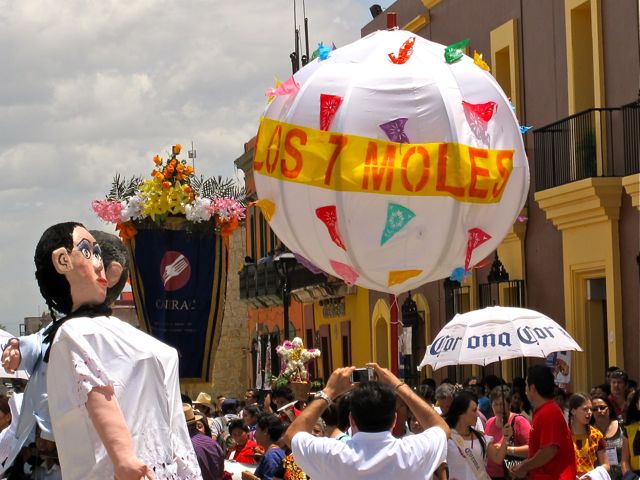
The calenda, including the requisite marmota (giant cloth balloon), monos (giant puppets), band, dancers with canastas (see yesterday’s post), and the sponsoring banner of CANIRAC (national association of the restaurant and food industries), made its way up the Alcalá…

Procession with marmota, monos, and banner

before turning onto Constitución and entering the Jardín, where wait staff and divine moles awaited.

Wait staff, wearing black, white, and grey gathered next to table.

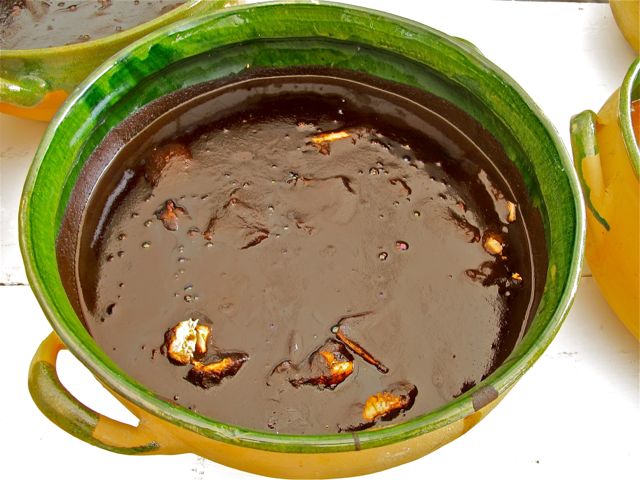
Yummm, mole negro

Large green pottery bowls filled with black mole.

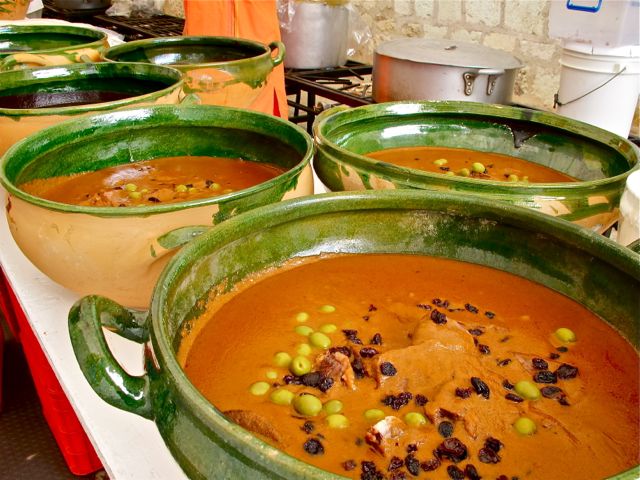
Mole amarillo

Green pottery bowls of red colored moles

Mole coloradito

Green ceramic pot with red mole.

Mole verde

Green mole in green ceramic pot

There was also mole chichilo, mole manchamanteles, and mole rojo.  I tried them all!!!  And, I haven’t even mentioned the cervesa, mezcal, aguas, and appetizers of quesillo, chicharon, and tacos filled with guacamole and chapulines (grasshoppers).  You’ll have to switch over to Chris’s blog to see those and much more.  Oh, and for dessert, a scoop of each of my favorite nieves (sherbet); leche quemada (burned milk) and tuna (cactus fruit).

A day filled with light, color, music, fabulous food, and, most of all, wonderful friends — the recipe for a perfect day!

(ps)  There are almost 50 restaurants around town that will be featuring mole as part of this 12-day festival.

Read Full Post »

It didn’t start that way; I awoke to horrifying news from Colorado.  Thank goodness blogger buddy Chris called and the heart that beats in Oaxaca beckoned.

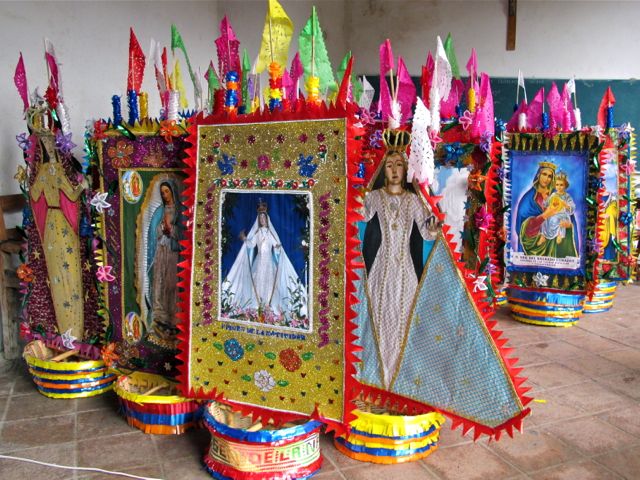
First stop was the “Al Son del Valle,” an exhibition of canastas from 17  villages in the central valleys of Oaxaca.  These are baskets that are carried on the heads of women during calendas (parades); you may remember them from previous posts on the convites in Teotitlán del Valle.  The art of crafting canastas and the traditions and culture they represent have been proudly and lovingly passed down through the generations.

San Antonino Castillo Velasco canasta decorated with Flor Inmortal, the flower that never dies.

Canasta from San Mateo Macuilxóchitl

From San Jerónimo Tlacochahuaya, these canastas are lit and become pinwheels of fireworks at the end of a calenda.

Canasta of Las Chinas Oaxaqueñas of the city of Oaxaca

Canasta from Tlacolula de Matamoros.

Canasta from Zimatlán de Álvarez made of crepe paper.

Muchas gracias, Oaxaca, I needed that!

Read Full Post »

This year marks the 80th anniversary of the modern Guelaguetza festival in Oaxaca.  The calendar is filled with official Guelaguetza activities and other events that take advantage of the massive annual influx of tourists (especially from other parts of Mexico).  The colorful and distinctive costumes worn by the Guelaguetza delegations from each of the 8 regions of the state of Oaxaca play a major role in wowing visitors and residents — including, me!

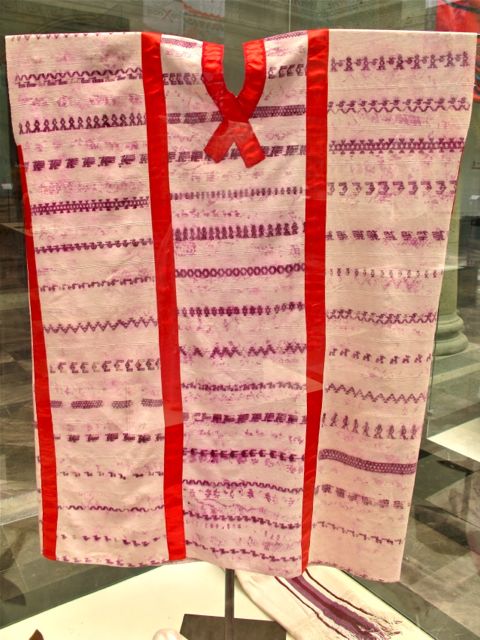
Huipil de San Andrés Chicahuaxtla, Putla Villa de Guerrero, Oax.

As a result, the “Oaxaca Xaba Lulá” exhibition has been mounted in the Government Palace.

Traje de la Villa Sola de Vega, Oax.

These are only a fraction of the items on exhibit and the photos were chosen primarily because they showed the least amount of reflection on the plexiglass display cases.  It is a beautiful, but challenging to photograph, setting!

Huipil de San Bartolomé, Ayautla, Teotitlán, Oax.

The collection of trajes típicos (typical costumes) representing the 8 regions of Oaxaca runs through the end of the month.

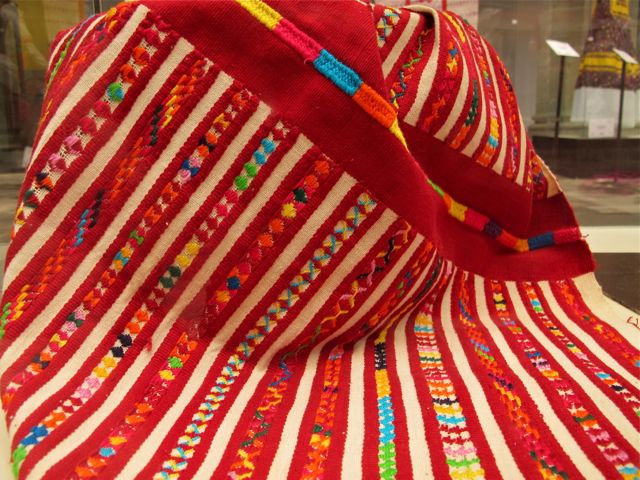
Rebozo de San Juan Colorado, Jamiltepec, Oax.

The dresses, hats and accessories were donated by Oaxacan citizens from different regions of the state and were made in the traditional way, with many using natural dyes.

Huipil de Gala de San Lucas Ojitlán, Tuxtepec, Oax.

At the July 6 opening, José Zorrilla de San Martin Diego (Minister of Tourism and Economic Development), explained that they reflect a cultural essence that has prevailed for centuries in customs and traditions of the people of Oaxaca.

Funda de San Jerónimo Tecoátl, Teotitlán. Oax.

He observed that the Oaxacan costumes are a reflection of the depth of the culture, traditions, and ancestral weaving techniques that have been passed from generation to generation of Oaxacan hands.

Traje de Santa María Tlahuitoltepec, Mixe, Oax.

“The huipiles display in all their splendor the details that form a labyrinth of colors, a tiny universe that reflects the vastness of fertile nature and the symbolism that characterizes our native land and which graces the greatest festival of Oaxacaños,” Zorrilla de San Martin Diego very poetically suggested.

Huipil de Jalapa de Díaz, Tuxtepec, Oax.

Needless to say, during the next two weeks, I’m going to try to hit as many of the fairs, parades, dances, and exhibitions as possible.  Stay tuned…

Save

Read Full Post »

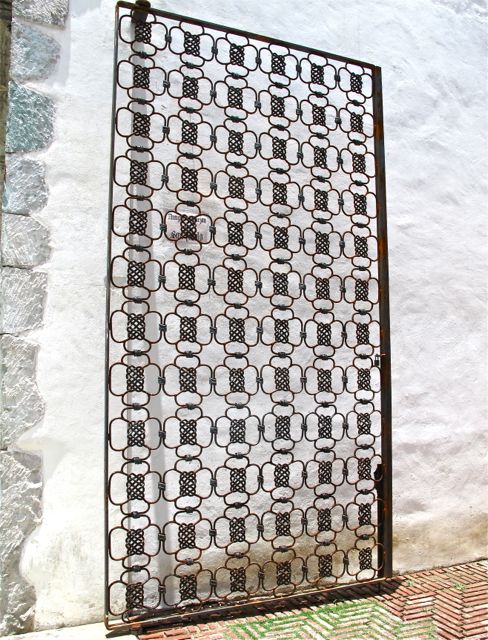
Intricately designed and executed iron gates have been installed at either end of Antiguo Callejón de San Pablo, ushering visitors into the “Old meets new” grounds of the Centro Académico y Cultural San Pablo.

Iron gate

Oaxaca’s favorite son and Mexico’s foremost living artist, Francisco Toledo, narrates a video documenting the construction of the gates.  It’s in Spanish, but even if you don’t understand the language, it’s worth watching, anyway.

By the way, today is Toledo’s 70th birthday.  ¡Feliz cumpleaños, maestro!

Read Full Post »

Early Saturday morning I was on my way to the doctor’s office, thus walking with purpose.  However, turning onto Constitución, along the south side of Santo Domingo, I had to pause…

Man and woman in stylized Aztec costume in jewel tones.

A photo shoot in progress?  I didn’t actually have a doctor’s appointment, just dropping by for a consultation (common here), so I lingered.

HE was obviously modeling “glamed-up” Aztec.  But SHE…

Woman in stylized Aztec costume in jewel tones.

Hmmm… Japanese???  Of course not!  Comparing it to images found in the codices, it, too, is an extremely stylized expression of  the fashion and hair of some classes of Aztec women.

Close-up of woman wearing purple silk huipil and stylized Aztec hairdo.

¡Muy hermosa!

Update:  I think Sheri is probably correct.  This may be a promotion for, or at least evoke, the annual reenactment of the Donají la leyenda, during Guelaguetza.  It is the legend of Princess Donají, a Zapotec princess who was kidnapped and decapitated by rival Mixtecos.  Her beautiful head was later found intact by a shepherd under a lily.  The body and head were reunited and buried together near, what is now, the city of Oaxaca’s airport.   The face of Donají appears on the official shield of the city of Oaxaca de Juárez.

Official shield of Oaxaca de Juárez.

The elevation and celebration of this story makes me wonder how today’s Mixtecos feel about it…

Read Full Post »

The word "ask" spray painted on wall.

Painted on wall: a cross followed by words "adiccion o conviccion?"

Shadow on wall that looks like a podium; words written "I love Phaooluchiiz. Signed by Fapely"

Who do you love?

Read Full Post »

MLB All Star Game is on Cablemas (Lo siento mi maestra, el idioma es el Inglés.) and players from my San Francisco Giants are kicking “you know what!”  I’d hoped to take the ferry (a very civilized way to go) to a Giants’ game when I was in the Bay Area last month, but, alas, time got away from me.

Oaxaca has a Minor League team, the Guerreros de Oaxaca, a Triple-A team in the Mexican League and their stadium is within (long) walking distance.  Alas, I haven’t been to one of their games this season, either!  However, last week I did wander by their office; the door was open and revealed this wonderful sculpture…

Sculpture of three baseball players topped by a gold mitt

Baseball player on sculpture, with bat on shoulder.

Closeup of baseball player on sculpture with bat on shoulder, wearing Guerreros de Oaxaca cap and jersey.

By the way, during the seventh inning stretch, fans rise and sing, “Linda Oaxaca” (Beautiful Oaxaca).  It always brings a smile and I’ll take it over “God Bless America” every time!

Read Full Post »

The convite (covered in the Uplifting post) is only one of the traditions of the patronal festival of La Preciosa Sangre de Cristo.  During the five days of the celebration, the church is filled with floral arrangements and believers stream in and out clutching flowers; the Danza de la Pluma (with Moctezuma, Cortez, Malinche, Doña Marina, danzantes, and soldados) is performed several times; and the cargo holders of the community preside, are honored, and presented with fresh fruits, vegetables, sacred herbs, and beverages.

This slideshow requires JavaScript.

Sunday was another amazing day in Teotitlán del Valle.  And I haven’t even mentioned the tacos and tamales we devoured during our three visits this past week!

Read Full Post »

Late yesterday afternoon, we returned to Teotitlán del Valle for the convite (parade) of unmarried young women and girls, a part of the annual patronal festival of La Preciosa Sangre de Cristo.  The sun was shining, the rains of two days before were nowhere to be seen, and the sacred mountain, El Picacho, gracefully, but commandingly, presided as the soldados and danzantes entered the church courtyard.

Soldados and danzantes with the mountain in the background

Bands also arrived to take part…

Band with tuba in front; mountain in background

Canastas (baskets) were lined up, ready to be carried…

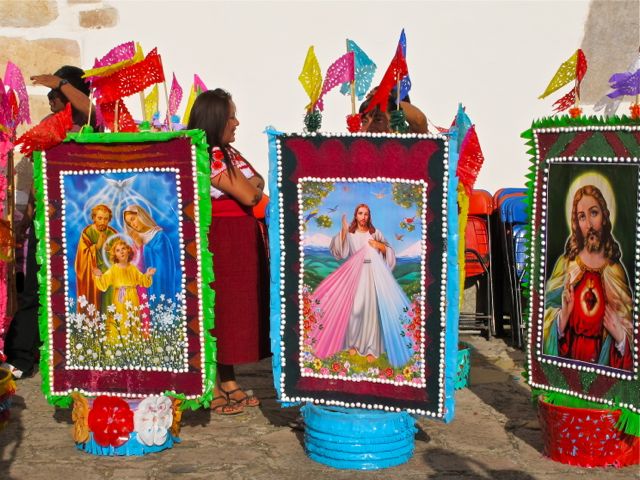
Canastas with images of the Virgen Mary lined up.

3 canastas with images of Jesus

Canasta with Virgen de la Navidad woven into the design

The young men of the village gathered…

Young men sitting on a ledge

Young men in profile

Family and friends awaited…

Women standing and facing down the street

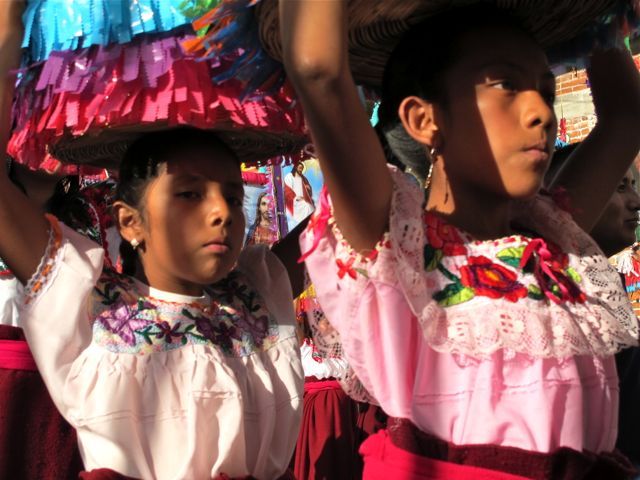
And then the young unmarried women and girls, the stars of the evening, raised the canastas over their heads…

Young women and girls in red skirts and white blusas carrying canastas on their heads lined up and

3 young women carrying canastas on their heads

Close-up of 2 young women carrying canastas on their heads

Balancing the canastas, they processed from the courtyard, down several long and cobblestone blocks, turned left, and headed back up another street to where they had begun, to be greeted by proud family and friends, who had gathered to acknowledge and celebrate the young women and girls of Teotitlán del Valle.

For some inexplicable reason, we never cease to feel moved and uplifted by this ritual.

Read Full Post »

Yesterday, fellow blogger, Chris, and I drove out to Teotitlán del Valle for their yearly patronal festividad de La Preciosa Sangre de Cristo.  The rains came and we didn’t stay long.  But, as we almost always find, just being out there provides much appreciated food for the soul.

Black and white photo of Zapotec woman sitting upright with a rebozo draped on her head.

Read Full Post »

In the last month, several articles in the US press referencing Oaxaca have been called to my attention.  They aren’t the usual travel features enumerating the “10 must see sites,” “best places to stay,” and “local fare dining.”  Nor do they cater to the ever more popular fear mongering and demonization of Mexico and her citizens.  Instead, these articles provide a window on Oaxaca’s indigenous past and challenging present.
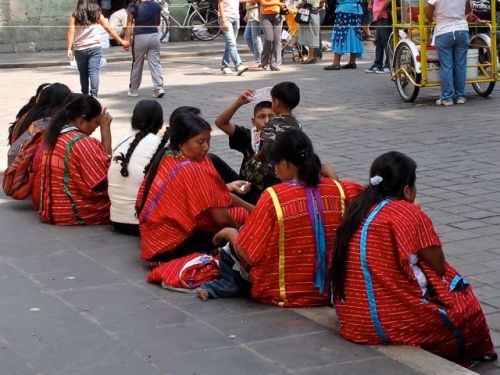
Triqui women sitting on a sidewalk

Triqui women and children in front of the Government Palace in Oaxaca de Juárez

From the June 15, 2012 New York TimesThe Past Has a Presence Here by Edward Rothstein.

OAXACA, Mexico — The past casts a sharp shadow here, wherever you look. You see it on mountaintop plateaus, where the ruins of ancient pyramidal staircases and capital-I-shaped ball fields hint at mysterious rituals that disappeared over a millennium ago.

<snip.

We are not dealing here with imagined reconstructions, but with the past’s palpable presence. And most of these ancient cities and monuments were abandoned some six centuries before the Spaniards plundered the region. After 80 years of archaeological research, their meanings are still unclear, though much has been written about Zapotec social hierarchies, gladiatorial-style games and stone carvings.

What is more clear is that remnants of those worlds also exist in the valley, where the slow-changing cultures of this buffeted but protected region still reflect Zapotec and Mixtec heritages. So here everything is plentiful that in the United States is rare: indigenous ruins, ancient languages, signs of direct lineage. And there is an edge to it all. Centers like Monte Albán are monuments to power and accumulated material wealth; they are also clearly evidence of a large-scale political organization, relics of perhaps the earliest state in the Americas.  [Read full article]

From California’s June 7, 2012 Monterey County Weekly, Native speakers and local missionaries work to save an indigenous Mexican language by Sara Rubin.

Gloria Moreno walks with a slight limp under the weight of the black messenger bag slung over her shoulder. It holds something of a botanical encyclopedia, petals and leaves gathered from the streets of Greenfield, which Moreno says help alleviate any number of ailments – pain, anxiety, weak bones.

Moreno says her collection is part of a medical tradition she began practicing as a teenager in Mexico. It was there, at 15, that she says she was instructed in a dream to take up herbal medicine.

Moreno dreamt her directive in Triqui de la baja, an indigenous language of the Copala region of Oaxaca in southern Mexico.

As native Triqui speakers disperse, leaving behind a notoriously violent region, there’s pressure both to preserve that language, and to leave it behind.

Of an estimated 40,000 Triqui speakers worldwide, about half of them are thought to have migrated away from Oaxaca, and as many as 10 percent live in the Salinas Valley.

<snip>

Moreno hopes for a generation of trilingual children, but many younger Triqui speakers are encouraged to trade their native tongue for English or Spanish, says a Salinas-based interpreter (who asked not to be named for fear of reprisal), because indigenous Mexicans are viewed as inferior. He trekked two hours to school from his childhood home in Oaxaca where he says he was bullied for being different.

“Because of the discrimination, parents don’t want their kids to learn [Triqui],” he says, “but then we lose tradition and culture.”

To reverse that, he hopes to get a grant or some cash to revive a bimonthly Triqui class piloted at the Greenfield Public Library two years ago. It drew about 35 students; of those, only a quarter were native speakers. The rest, mostly service providers, were there to learn Triqui.

“To speak Spanish, I used to think you had more value,” he says. “When I came here, I learned it is not that way. If you know three or four languages, you can explore and learn more.”

View Barbara Hollenbach’s Spanish-Triqui dictionary at www.sil.org/~hollenbachb/Posted.htm  [Read full article]

And finally from the May 28 Los Angeles Times, Epithet that divides Mexicans is banned by Oxnard school district, by Paloma Esquivel.

Rolando Zaragoza, 21, was 15 years old when he came to the United States, enrolled in an Oxnard school and first heard the term “Oaxaquita.” Little Oaxacan, it means — and it was not used kindly.

“Sometimes I didn’t want to go to school,” he said. “Sometimes I stayed to fight.”

“It kind of seemed that being from Oaxaca was something bad,” said Israel Vasquez, 23, who shared the same mocking, “just the way people use ‘Oaxaquita’ to refer to anyone who is short and has dark skin.”

Years later, indigenous leaders are fighting back against an epithet that lingers among immigrants from Mexico, directed at their own compatriots. Earlier this month the Mixteco/Indigena Community Organizing Project in Oxnard launched the “No me llames Oaxaquita” campaign. “Don’t call me little Oaxacan” aims to persuade local school districts to prohibit the words “Oaxaquita” and “indito” (little Indian) from being used on school property, to form committees to combat bullying and to encourage lessons about indigenous Mexican culture and history.

Indigenous Mexicans have come to the U.S. in increasing numbers in the last two decades. Some estimates now put them at 30% of California’s farmworkers. In Ventura County, there are about 20,000 indigenous Mexicans, most of whom are Mixtec from the states of Oaxaca and Guerrero who work in the strawberry industry, according to local organizers.

Many speak little or no Spanish and are frequently subjected to derision and ridicule from other Mexicans. The treatment follows a legacy of discrimination toward indigenous people in Mexico, said William Perez, a professor of education at Claremont Graduate University who has interviewed and surveyed numerous indigenous Mexican students.  [Read full article]

Read Full Post »
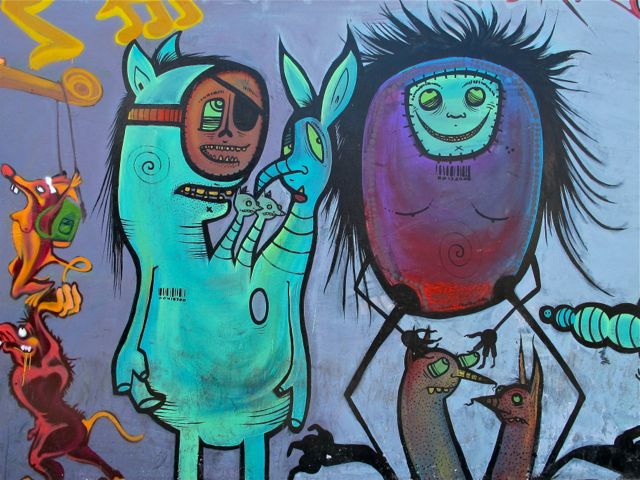
Wanna see me pull a rabbit out of my hat?

Creature with long nose with rabbit in hat

Happy first day of summer.

Creatures painted on wall

From the walls of Oaxaca…

Creatures painted on wall

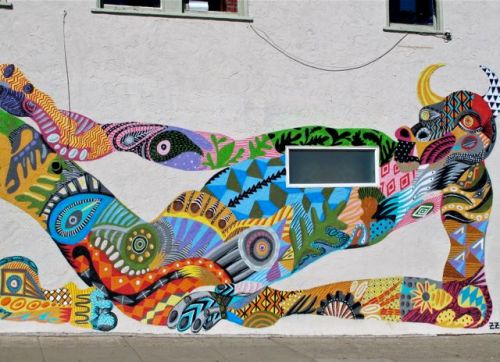
To the walls of Mill Valley…

Reclining bull painted on side of wall

by artist, Zio Zieler

Enjoy!!!

Save

Read Full Post »

As hoped, I managed to make my way to the Mexican Consulate in San Francisco for .  It’s the exhibit (I mentioned a few days ago) that celebrates the Zapotec artists of Oaxaca from Rufino Tamayo and Francisco Toledo to those they encouraged and influenced.

On the consulate’s ground floor the scene was a familiar one — signage and conversations en español; the eagle, serpent and green, white, and red of the Mexican flag prominently displayed; waiting room filled with patiently waiting people — a sliver of Mexico in San Francisco.  Climbing the two flights of stairs (elevator was broken) up to the third floor, a friend and I found the exhibit…

This slideshow requires JavaScript.

According to the article, Oaxacan surrealism hits the SF Mexican consulate, the consulate’s cultural affairs attache, Marimar Suárez Peñalva, hopes the gallery and its exhibitions will offer Mexican expats an opportunity to connect with the creativity, not just the bureaucracy (my word), of their culture.  However, I don’t know how many of those waiting on the first floor make it up to the third floor; early in the afternoon, we had the gallery to ourselves.

And yes, works by Tamayo and Toledo are included, but I thought I’d feature some of the lesser known artists.  By the way, did you notice the name, Alejandro Santiago Ramírez?  This is the same Alejandro Santiago of the 2501 Migrantes sculptures that I’ve previously written about.

Read Full Post »
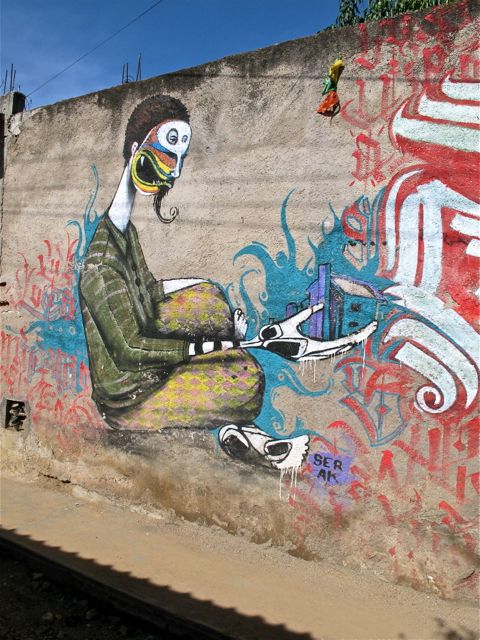
Walking back from grocery shopping, with a lighter than usual load, I took a detour and stumbled on this wall only two blocks from home.

colorful mural on wall

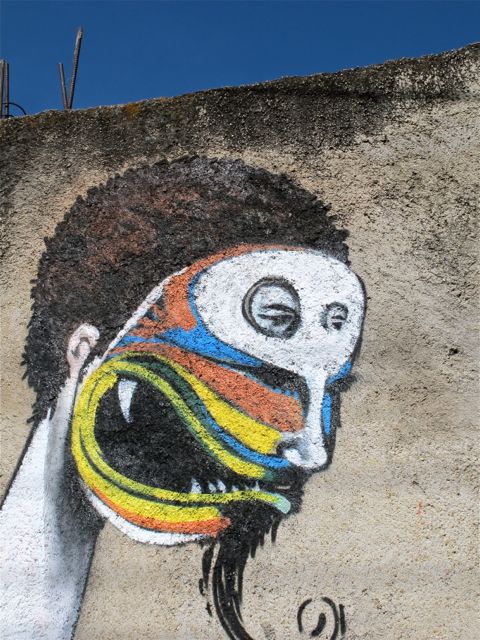
Closeup of colorfully painted face on wall

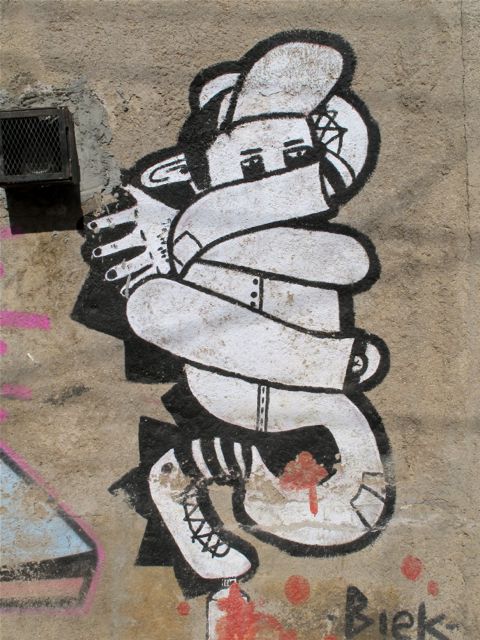
Black and white wall art of boy with cap wrapped in arms

Doing a little research, I found a video of it being painted…

Graphic design, Oaxacan style!

Read Full Post »

Just another day, just another walk.

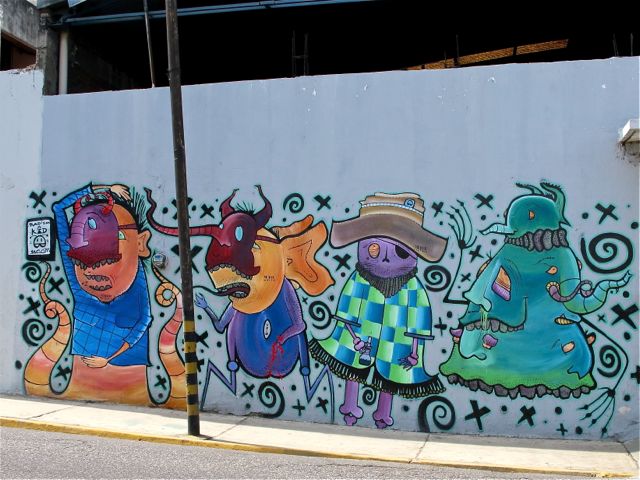
Colorful street art mural of imaginary characters

Just another wall of street art.

Close up of colorful street art face with mask.

Just another April Fools Day (2012) mural.

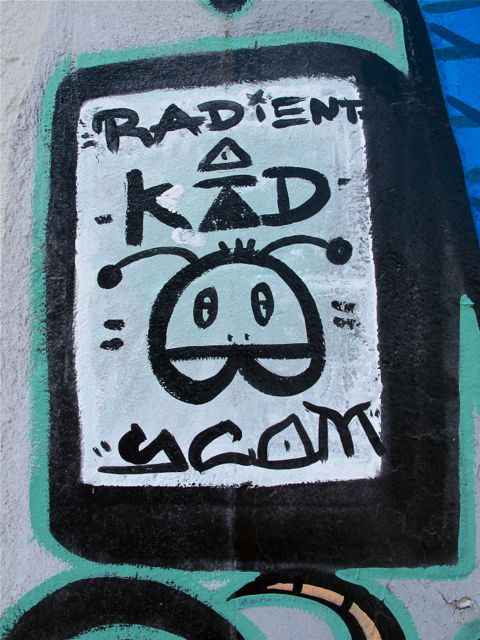
Signature on mural:  Radient; Kad; Ycom

Muchisimas gracias, KAD, for bringing a smile…

Close up of mural with the word "void" written vertically in an oval.

and leading us into the void.

Read Full Post »

« Newer Posts - Older Posts »