Feeds:
Posts
Comments

Archive for the ‘Culture’ Category

At the top of my Oaxaca Yahoo! Alerts today…

GW professor’s research on ancient ballgame reveals more about early Mesoamerican society

GW anthropology professor Jeffrey Blomster’s research featured in PNAS journal

WASHINGTON—George Washington University Professor Jeffrey P. Blomster’s latest research explores the importance of the ballgame to ancient Mesoamerican societies. Dr. Blomster’s findings show how the discovery of a ballplayer figurine in the Mixteca Alta region of Oaxaca demonstrates the early participation of the region in the iconography and ideology of the game, a point that had not been previously documented by other researchers. Dr. Blomster’s paper, Early evidence of the ballgame in Oaxaca, Mexico, is featured in the latest issue of Proceedings in the National Academy of Sciences (PNAS).

Dr. Blomster, GW associate professor of anthropology, has spent 20 years researching the origin of complex societies in Mesoamerica. The participation of early Mixtec societies in ballgame imagery is a new aspect of his research. For the journal publication, Dr. Blomster worked with undergraduate students Izack Nacheman and Joseph DiVirgilio to create artistic renditions of the figurine artifacts found in Mexico.

While early games used a hard rubber ball, the ballgames Dr. Blomster researches bear little resemblance to today’s Major League Baseball. The games and the costumes or uniforms participants wore were tied to themes of life and death, mortals and underworld deities or symbolizing the sun and the moon. In some instances, the ballcourt itself represented a portal to the underworld.

According to Dr. Blomster, “Because the ballgame is associated with the rise of complex societies, understanding its origins also illuminates the evolution of socio-politically complex societies.”

During the Early Horizon period, or roughly between 1400 BCE (Before the Common Era) and 1700 BCE, there was little evidence of ballgame activity in the way of artifacts in the Oaxaca region of Mexico. Dr. Blomster’s findings of a clay figurine garbed in distinctive ballgame costume, similar to both Olmec figurines and monumental sculptures from the Gulf Coast, indicate such engagement did take place in the area.

“Exploring the origins and spread of the ballgame is central to understanding the development of the Mesoamerican civilization,” he said. “We know there were earlier versions of a ballgame prior to the Early Horizon with both a ballcourt and rubber balls found in coastal Chiapas and the Gulf Coast, but the institutionalized version of the ballgame, a hallmark of Mesoamerican civilizations, developed during the Early Horizon. While there has been some limited evidence about the participation of the nearby Valley of Oaxaca in the ballgame, the Mixteca has largely been written off in terms of involvement in the origins of complex society in ancient Mexico. This discovery reemphasizes how the ancient Mixtecs were active participants in larger Mesoamerican phenomenon.”

###

By the way, there was a lot more to these ballgames than mere athletic competitions — think ritual, conflict resolution, sacrifice.  Below is the ballcourt just up the hill at Monte Alban.

Ballcourt at Monte Albán

The stories it could tell…

Read Full Post »

As the promotional material for Ma (yo) en Oaxaca, Mujer (es) Arte y Cultura explains (loose translation), like a skilled weaver, women create the fabric of life… part of the history of humanity, intelligence that moves, the look that looks, which is regarded in the construction of better horizons of life for her and those who are around her.  And so, from May 3rd through 13th, the women of Oaxaca are being celebrated with workshops, exhibitions, lectures, and concerts.

Last night, under the supermoon, one of the accomplished women of Oaxaca, Alejandra Robles, gave a free concert, just a block away, in the Plaza de la Danza…

Ma (yo) en Oaxaca is a party for all of the principles of inclusion and participation to make possible the knowledge and appreciation of the cultural richness of groups which, for various reasons, have been marginalized.

¡Viva las mujeres!

Read Full Post »

A belated Happy 20th Birthday, Museo de Arte Contemporáneo de Oaxaca!

20 MACO banner

As the theme of the birthday celebration on February 28th said, Say ‘Coma’ Twenty Times,

20 and 4 bicycles with a comma in the center of the front wheels

COMA, COMA, CO-MACO, MACO, MACO…

Large red 20 painted on window

Come say, Feliz Cumpleaños MACO, in person!

Read Full Post »

When I was a child and asked, “If there is a Mother’s Day and a Father’s day, why isn’t there a Children’s Day?”  My mother’s usual reply was, “Everyday is children’s day!”  Hmmm… I never did buy her explanation, until I had kids of my own.  However, here in Mexico, there is a day to celebrate children and today is that day — Día del Niño, a day when children are made to feel special.

Schools organize parties with games and treats instead of lessons, parents may give their niños y niñas gifts, and special community activities for kids are organized.  Yesterday, here in the city, the Service Workers Union threw an all day party for 5,000 children in the annex of the Eduardo Vasconcelos baseball stadium.  There were box lunches, candy (of course), a petty zoo, games, shows, and even a raffle for new bicycles.

So, here’s to the girls and boys of Oaxaca…

girl sitting and smiling with 2 front teeth missing

To their good humor.

Boy with a hat and scarf on head

Their pride in celebrating their communities…

Girl in Istmo huipi

Their beauty…

Boy in plaid shirt and red scarf

Their amazing patience…

Girl sitting and looking sad

Even when they are shy and tired.

Young child, barefoot standing next to a car

And, especially to the street children, who, despite the challenges of their lives, seem to find ways to “just be kids.”

Read Full Post »

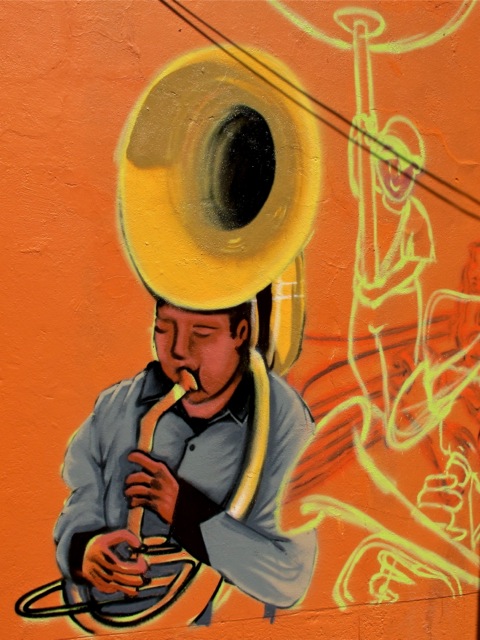
Every time I pass by the turnoff to Tlacolula de Matamoros, I break into song, “Be-bop-a-lula, she’s my baby.”  And, seeing this guy on the front of a building on one of the town’s main streets only contributes to channeling Gene Vincent.

Wall art of tuba player

I was last there early this month for the first Festival de la Nieve, Mezcal y Vinagre.  Ice cream, mezcal, and fruit and veggies in vinegar… what’s not to like?

Bottles of mezcal

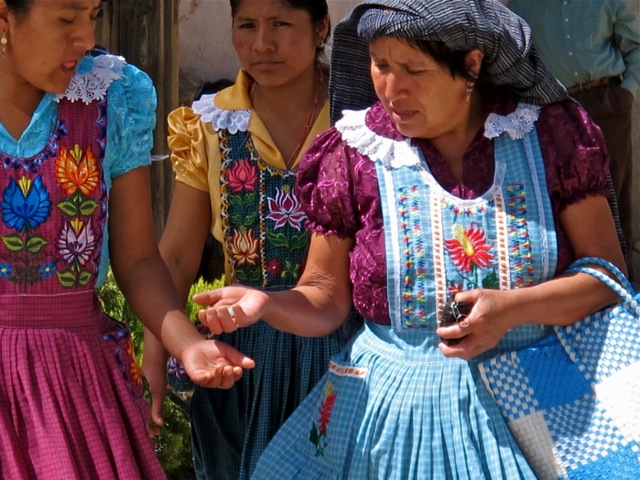
And then there is the weekly Sunday tianguis (market), where women in colorfully embroidered cotton aprons over tightly pleated polyester brocade skirts (where did that style come from?) buy and sell everything under the sun.

3 women in embroidered aprons.

As the article, The Pop-up Food Shops of Oaxaca confirms, I’m not the only one who is captivated by Tlacolula.

Read Full Post »

Tonight, instead of candles…

Fireworks blossom

Fuegos artificiales exploded from the Alameda de León…

Fireworks blossom

As Oaxaca celebrated her 480th birthday!

Fireworks

Read Full Post »

Today is Oaxaca’s 480th birthday as a colonial city .  Of course, among other events, a calenda (parade) marked the date.

This slideshow requires JavaScript.

In 1532 Spanish settlers (their bloody way paved by Hernán Cortés and his conquistadores) successfully petitioned the Queen of Spain for a land grant of 1 square league.  The colonists had already established their own town on the site of Huaxyacac, renamed it Antequera (after an old Roman city  in Spain) and received a Royal Charter from King Charles I of Spain.

However, Cortés had successfully gotten the entire Valley of Oaxaca (hundreds of thousands of acres) declared as his own private marquisate and, his greed knowing no bounds, kept trying to evict the colonial townspeople.  By obtaining the queen’s charter, this end-run around Cortés insured the rights of the townspeople to the land.

Thus, April 25th continues to be celebrated as Oaxaca’s birthday.  ¡Feliz Cumpleaños!

Read Full Post »

…fighting in Oaxaca.

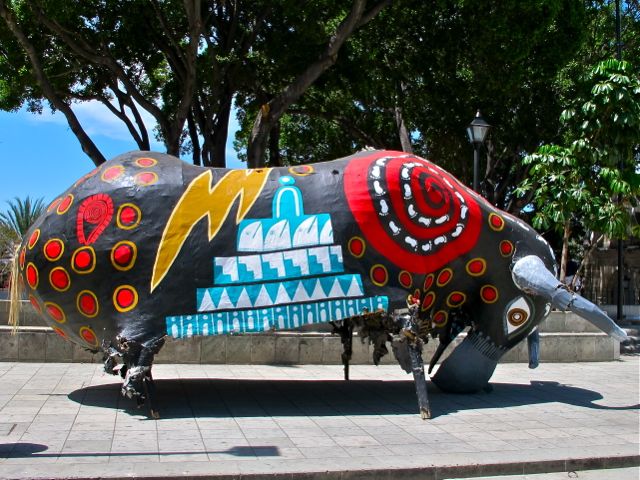
Colorful gigantic papermache bull

Corrida de Toros, as it is known in Mexico, was outlawed by, then governor of Oaxaca, Benito Juárez.  The ban was instituted throughout Mexico in 1867 by Juárez during his presidency.  Some say it was to “civilize” Mexico, but others contend it was for nationalistic reasons, as bullfighting had been a legacy of the Spanish conquest.  I tend to think the latter tipped the scales.

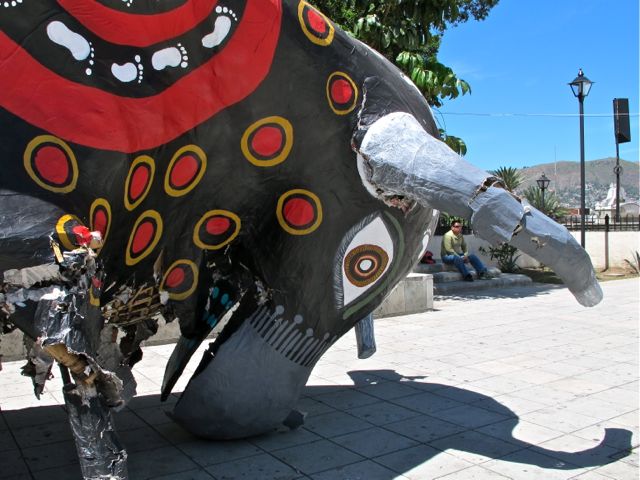
Close-up of the head of a colorful giant papermache bull

However, Porfirio Díaz reinstated it during his presidency, but the ban remained in Oaxaca in honor of her favorite son.  And thus, on the Plaza de la Danza, we have only a paper mache bull ready to charge at his shadow…

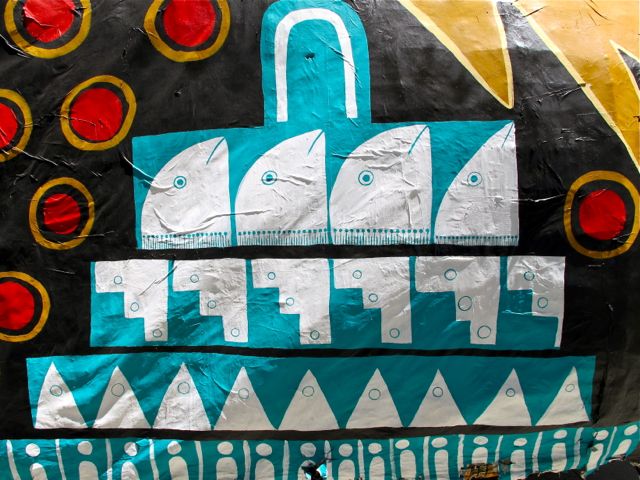
Design of fish heads, Mitla frets, triangular mountains, etc.

and serve as a canvas for imagery, ancient and contemporary.

Read Full Post »

Friday was a delightful day… a late morning and early afternoon spent in leisurely conversation with one of my closest friends over desayuno at Cocina Economica Isabel, a stop at the Merced mercado to pick up some pan dulce, and a stroll through the Zócalo, before returning home.  I envisioned a late afternoon and evening of visiting with my neighbor before she is heads north for a USA visit, catching up on email, and watching a movie.  Perfection, I thought!  Who could ask for more?

“More” came via my email inbox; notice of the 10th Guelaguetza Infantil, with a calenda (parade) from Santo Domingo de Guzmán to the Zócalo beginning at 6 PM.  This definitely called for a change of plans!  And, sure enough, as I got closer to Santo Domingo, there they were; delegations of children representing the regions of Oaxaca.

Girl and boy in costume of the Istmo.

Istmo de Tehuantepec couple (a young Frida Kahlo, perhaps?) posing for photos.

Girl in Istmo costume covering her ears

There were several bands playing and it got a little too loud for this girl from the Istmo.

Girl in Tuxtepec costume holding basket of candy.

However this girl, representing the Papaloapan, didn’t seem to mind and was ready to toss candy to the crowd. She wasn’t alone — once the calenda started, candy began flying fast and furious and the pockets of the kids watching on the sidelines began bulging!

Girl wearing a costume from the Costa regionGirls from the Costa region received last-minute instructions.

Boys in white shirts and straw cowboy hats holding school banner reading "Cervantes"

Costa boys were charged with holding up their school banner.

Close up of girls in the costumes from Tuxtepec

The girls representing the Papaloapan clutched plastic pineapples, ready for the always popular Flor de Piña dance from Tuxtepec.

2 girls standing together; one in Istmo costume and one in Tuxtepec costume

A little cross cultural comparing of notes (actually, cell phone games) was happening between the Istmo and Papaloapan.

Girl in Mixteca costume dancing.

All the while, the dancers from the Mixteca danced their way down the Álcala.

Closeup of boy with Danza de la Pluma head dress.

And, the young Danza de la Pluma danzantes, representing the Valles Centrales, carefully balanced their penachos (headdresses).

Tonight at 5 pm, these 300 kids from 52 preschools, will perform traditional regional dances in the auditorium of the Universidad Regional del Sureste, Rosario campus in San Sebastián Tutla.

Read Full Post »

Hip hop is probably not the first thing that pops to mind when you think of Oaxaca.  However, I can assure you, there is more to Oaxaca than colonial architecture, religious processions, colorful traje (costume), and traditional music.  As repeated blockades and occupations attest, and the El Silencio Mata posters illustrate, there are voices struggling to be heard.

For one of those voices, check out this trailer from the documentary film, Cuando Una Mujer Avanza (When a Woman Takes a Step Forward), about “Mare” a young Zapotec hip hop artist from Oaxaca.  As the promo states, her unique life experience is a rarely heard perspective on life and community liberation.  As an up and coming MC in a state known for popular and indigenous rebellion, Mare’s life and experience has been channeled into very powerful and conscious rapping and singing.

Update:  Check out the article, Mare Is a Rapper Hell-Bent on Equality for Women in Mexico.

Read Full Post »

Carved wood woman sitting -- back curved into chair.

“It’s not what you look at that matters, it’s what you see.”  — Henry David Thoreau

Read Full Post »

It’s been a week since the end of Semana Santa and I’m still sorting through photos and videos and reflecting on impressions and feelings.  However, I’m finding that, with too much thinking, the experience slips through the fingers and the magic vanishes.

Thus, I give you the night of Pascuas (Easter) at Carmen Alto…

And then, the hisses, bangs, and brilliant explosions of a castillo…

Flaming castillo

brought Semana Santa to a spectacular close.

Read Full Post »

Yesterday, I spent another magical day with friends in San Antonino Castillo Velasco (about 23 miles/1 hour  from the the city).  It was Domingo de Palmas (Palm Sunday) and San Antonino celebrates in its own unique, warm, and welcoming way.

Townspeople gather in the cemetery to decorate the “Señor del Burrito” with fruit, vegetables, flowers, and everything they sell or grow during the year.  In addition, livestock (goats, chickens, pigs, etc.), more foodstuffs, flowers, etc. are gathered and priced.  The pastor of the parish church arrives to bless the “Lord of the Little Burro” and offerings.  Palm crosses are distributed, all are invited to help carry the offerings to the church, 10-12 men hoist the burro (now laden up to his neck and weighing who knows what!), and a procession to the church commences, lead by a fast-tempo drum beat and punctuated by shouts warning the men carrying “Señor del Burrito” of upcoming topes (speed bumps) and telephone wires, which must be navigated.

This slideshow requires JavaScript.

At the church, “Señor del Burrito” has an honored place in the courtyard and the offerings are gathered and arranged.  Many then attend an hour-long mass inside the church, while others partake in yummy amarillo and pork empanadas, taste mezcal, and browse the wares of the artisan booths.  By the way, at least two of the “maestros” from the new, previously mentioned, book, Grandes Maestros del Arte Popular de Oaxaca were present:  Familia García Mendoza (ceramics)  and Antonina Cornelio, who makes the exquisitely embroidered clothing typical of San Antonino Castillo Velasco (and seen in one or two of the photos above).  Following the mass, the offerings are sold, with the proceeds going to an orphanage in the village.

Muchisimas gracias to the people of San Antonino Castillo Velasco for being so gracious and allowing us to share this special day with them.

Read Full Post »

In Coyoacán, Federal District of Mexico City

Magenta numbers 104 against bright yellow wall

San Cristóbal de las Casas, Chiapas…

Wooden number 40 against white patch on tan rock wall with terracotta geometric design

And Oaxaca…

Black Art Deco 502 against white wall

The zeros have it!

Read Full Post »

For a whole variety of reasons, this is so appropriate not just here, but…

all over the world…

And, given the current war on women’s hard won reproductive rights, it’s especially pertinent during this “election” season in the USA.

Silence does indeed kill!

Read Full Post »

« Newer Posts - Older Posts »