Feeds:
Posts
Comments

Archive for the ‘Creativity’ Category

For lovers of textiles and Mexico, the latest online issue of the magazine, HAND/EYE (love the title!), has a terrific interview with friend and textile designer/collector/researcher, Sheri Brautigam.  The article, Documenting the Lives of Textiles, covers a wide range of topics, including preservation and revival of traditions and concerns re traditional versus modern designs.  As would be expected, given the subject matter, it includes lots of photos!


Documenting the Lives of Textiles

BY Annie Waterman | October 10, 2012

Close-up of traditional shawl

Courtesy of Sheri Brautigam

An Interview with Sheri Brautigam

Textile expert, Sheri Brautigam, shares with HAND/EYE Online, her experience as a documenter of “living” indigenous textiles. 

HAND/EYE: How did you first find yourself in Mexico and documenting “living” indigenous textiles?

Sheri Brautigam: I went to the university in Mexico City in the 60’s and that was the beginning of my lifelong relationship and many in-depth experiences with Mexico. This time, I was training Mexican English teachers through the English Language fellowship with the U.S. State Department—sort of like the English Teachers’ Peace Corps. My location was in a small town in the State of Mexico—Atlacomulco, surrounded by many different indigenous villages. When I went to a nearby village Mazahua ‘Saints Day’ festival and saw the amazing garments the ladies were wearing, I started my documentation.

H/E: How did you first get into becoming a researcher/ textile collector?

SB: I had a textiles design studio (surface design textiles) in San Francisco for about 18 years, so I had been collecting world textiles since the 1960s. That was when they were readily available from world travelers. I have loved and been involved with textiles most of my life and always want to know how these beautiful things are made … and now in Mexico, it’s even more exciting to see them in context. 

H/E: What sort of future do you predict for the world of traditional textiles? What changes have you noticed over the years? 

SB: I’m very hopeful that many traditional Mexican textiles will survive and become even finer. This I have seen in Oaxaca and Chiapas. When appreciation comes from the outside world and the artisans can earn money, they have an incentive to keep producing. The more money they can earn from superior work also encourages some artisans with higher skills to train their children. The more affluent indigenous people become, the more pride they have in their own culture and the continuation of their textile traditions.

Certainly some of the indigenous will leave their village and go to the towns and cities to work and wear jeans and t-shirts—but when they come home they will wear a huipil for the feast day. It’s their cultural identity.

Click HERE to read full article.

Read Full Post »

I’ve got my eye on you…

Decorated skeleton on top of building.

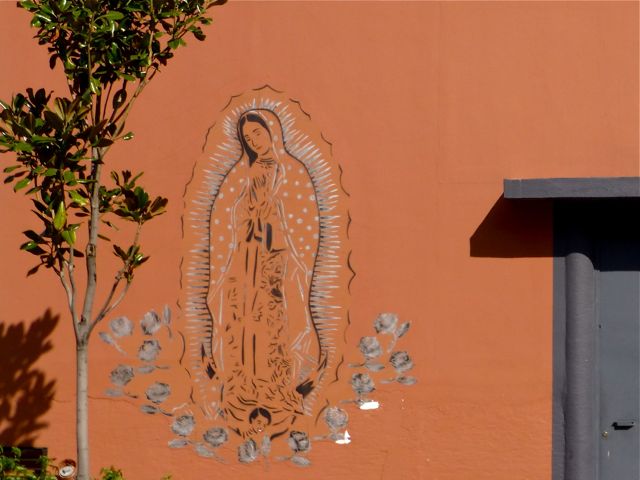
I’m praying for you…

Virgin of Guadalupe image stenciled on a wall

You just never know who might be looking over your shoulder.

Skeleton perched on rooftop above a stencil of the Virgen of Guadalupe

Días de los Muertos are coming…

Read Full Post »

While Oaxaca is filled with music, art, and dance, it hasn’t been known for its contribution to live theater.  However, there are signs that this may change.  In August, the cultural monthly journal, El Jolgorio featured theater in Oaxaca.  One of the articles explained, that thanks to the work of Teatro Juárez and the Fundación Cultural Crisol, a drama workshop was established in Oaxaca and in three years, fifteen plays have been written, with eleven being presented in Oaxaca and Mexico City.  As ex-pat playwright Kurt Hackbarth asked at the press discussing his newest play, El Ostrakón, “Oaxaca is a destination for art.  Oaxaca is a destination for music.  Why not now make Oaxaca as a national destination for original theater…?”

By the way, you may remember Kurt Hackbarth from my post on his comedy, La [medio] diezmada.  This time around he penned a well received drama, El Ostrakón, that premiered on August 29, 2012 and ran through September 2 — a long run here!  It “is a contemporary tragedy which, by using elements of farce and social criticism, tells the story of Gabriel, a homeless youth, and his attempts to avoid the traps laid by the chameleonic narrator, the incarnation of a hostile society.” (translated from El Ostrakón Facebook page)

El Ostrakón home web page screenshot.

If you missed it the first time around (or would like to see it again) and will be in Oaxaca on Monday, October 15 at 6 pm, you are in luck.  El Ostrakón will be performed at the beautiful Teatro Macedonio Alcalá as part of the inauguration of the Oaxaca State Theater Festival.  And, the performance is free, though a 5 peso (that’s only about 40¢ US!!!) donation is requested to help support the festival.  El Ostrakón is in Spanish, but English-only language speakers can download an English language synopsis from the website.

Full disclosure:  I designed the El Ostrakón website.

Read Full Post »

All things on earth point home in old October; sailors to sea, travellers to walls and fences…  — Thomas Wolfe.

Colorful painting of faces tacked on telephone pole

It’s good to be back in Oaxaca.

Read Full Post »

I’m back in Oaxaca… arrived last night after a brief trip to El Norte.  However,  over the last three years, culture shock (on both sides of the border) has subsided and I am struck and heartened that despite our differences, humans share so much more… especially the compulsion to make even the most common and utilitarian, beautiful.

Artist, Zio Ziegler added a little pizzazz to a car in Mill Valley… (Yes, I know, a Porche!)

Porche painted decoration

Car in Oaxaca… (Ahhh, a VW bug!)

VW bug painted with decoration

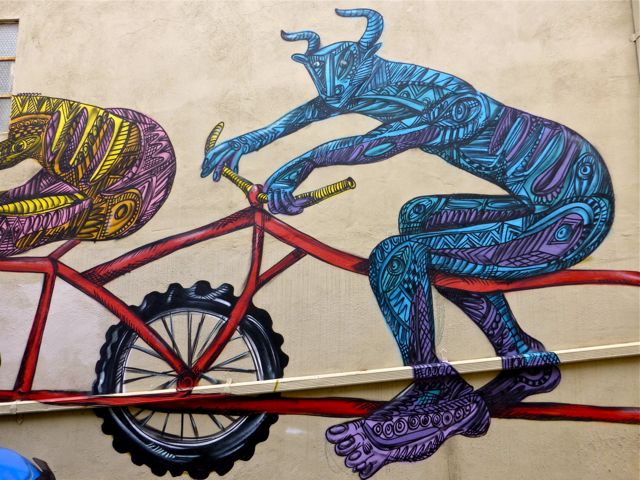
Wall in Mill Valley (also by Zio Ziegler)…

Painted horned creature riding a bike.

Wall in Oaxaca…

Savannah scene, with elephant in foreground, painted on wall.

Veggies in Mill Valley…

Vegetables in bins at outdoor market

Veggies in Oaxaca…

Vegetables mounded in mercado

From one of my favorite journalists, Linda Ellerbee:  “People are pretty much alikeIt’s only that our differences are more susceptible to definition than our similarities.”

Save

Save

Read Full Post »

Lost or discarded?

Roof of car decorated with found objects

Artist found and created in Sausalito, Ca.  You better believe it!

Old car decorated with found objects with word "believe" in front.

And please, don’t “liberate” any of the found objects, in other words… stop stealing!!!

Found objects with clenched fist and peace symbol.

La lucha continúa.  Paz y amor a todos.

Read Full Post »

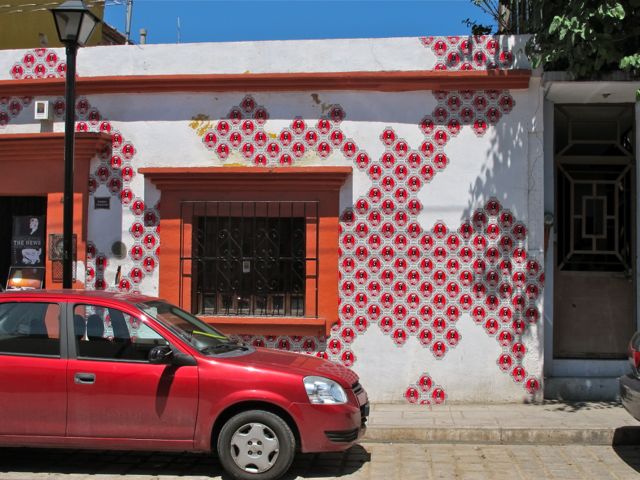
White, one-story building with stickers on front

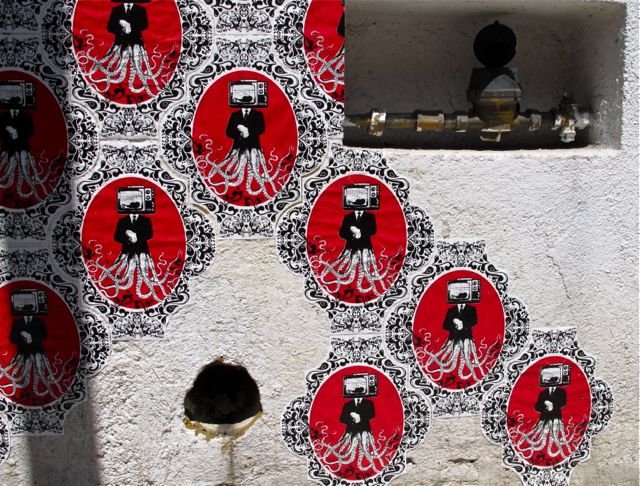
Stickers of a person with a monitor for a head and tentacles for legs, on front of building

Close up of sticker of a person with a monitor for a head and tentacles for legs, on front of building

Graphic in red, black, and white of dead canary in a cage on a TV moniter

Read Full Post »

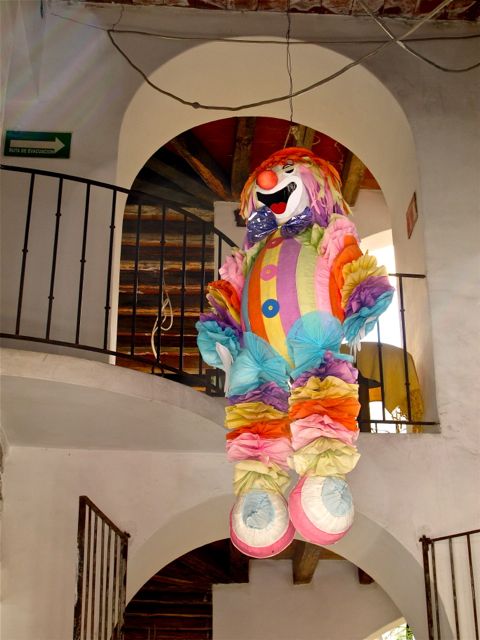
Walking down the street… an open door… can’t help but look in…

Clown piñata hanging from a ceiling

¡Feliz fin de semana!

Read Full Post »

On chairs in Reyes Etla.

On a chair: sheet music "Zapateando Istmeño xxx" for tuba

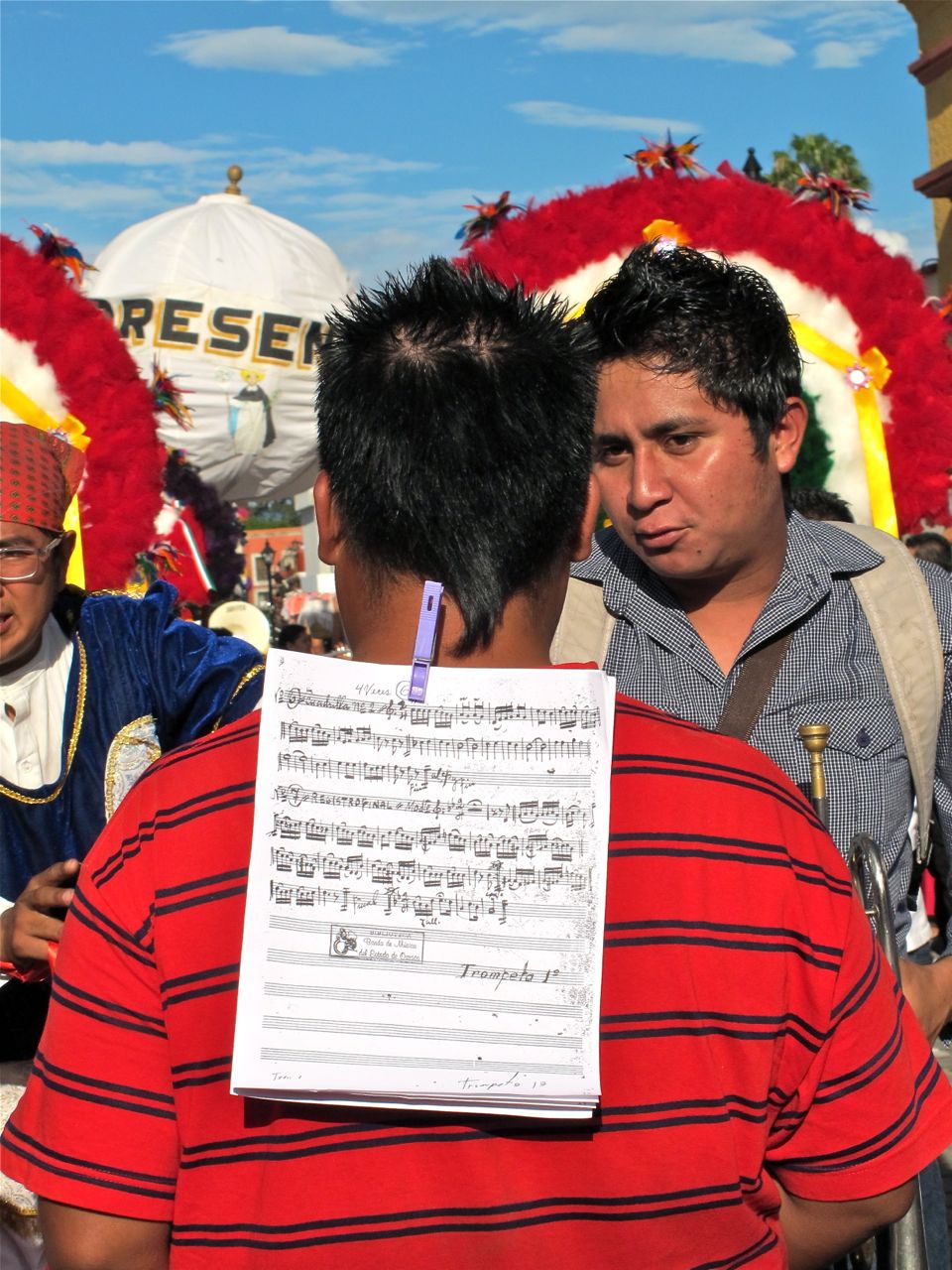
On people’s backs in the city.
"Cuadrilla no. 2" sheet music clipped on the back of a man wearing a red and black striped shirt

Wherever… especially during Guelaguetza!

Read Full Post »

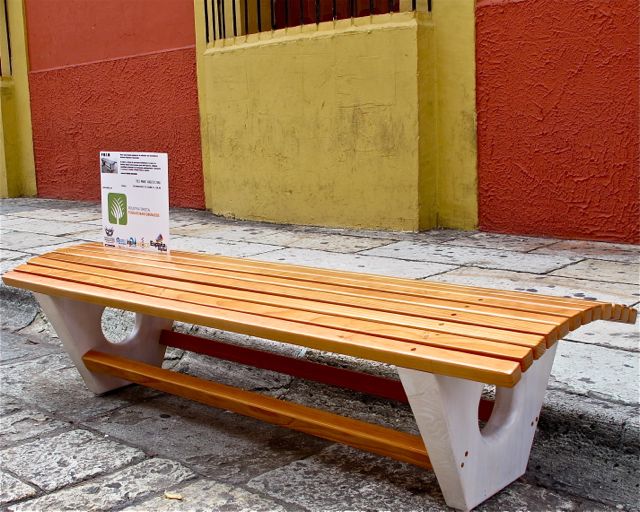
From Sangre de Cristo to Santo Domingo, along the Alcalá, one is now able to “have a seat.”

Wooden bench with a curved seat.

As part of the inauguration of the Me Siento Bien en Oaxaca (I Feel Good in Oaxaca) and to celebrate, International Youth Day, 13 pieces were created by students of the Faculty of Architecture Cinco de Mayo, the Free School of Art and Design, and the Urban Contingency B_root studio.

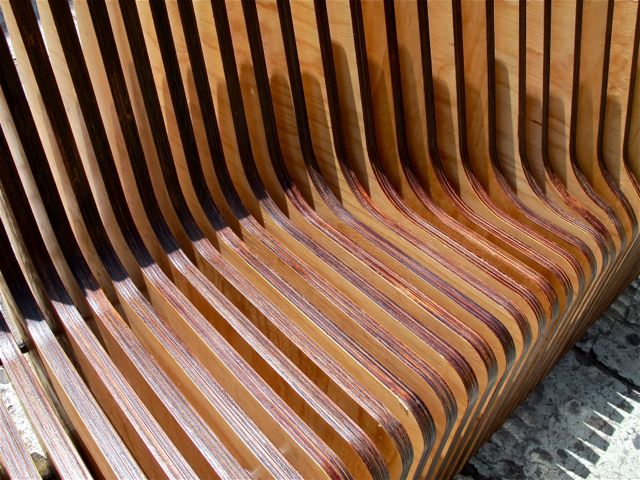
Slats of curved pieces of wood forming a bench

The theme was Evolution and the young people were charged with using recycled materials and innovative design.

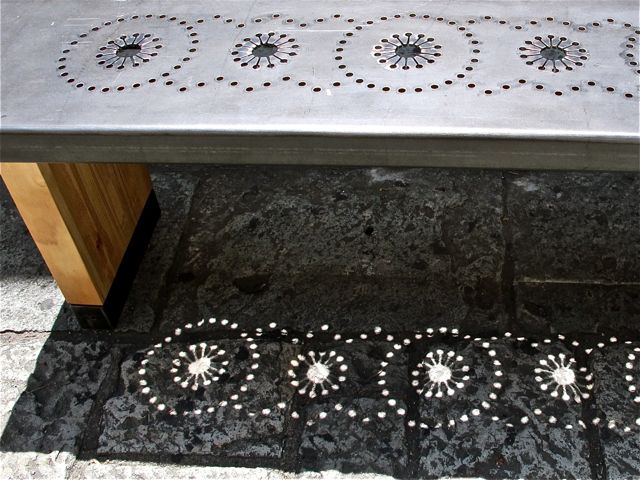
Bench with metal seat with punched design, which is mirrored in the shadow on the paving stones.

I think they succeeded!

Brass looking metal bench reflecting paving stones, building, and lamp

Alas, it is only temporary; August 18 is the last day.


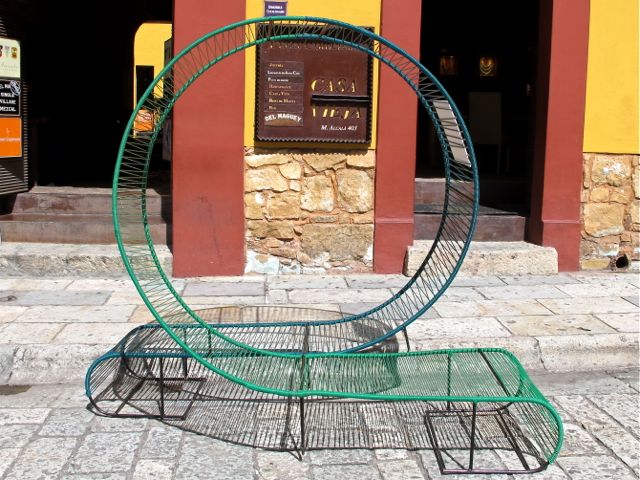
Circular double bench - metal and plastic.

However, according to a newspaper report, as a more permanent part of Me Siento Bien en Oaxaca program, benches “rescued by the City” will be put in public spaces.

Wooden boxes


Read Full Post »

Even though the Guelaguetza is over, textiles continue to be on my mind — actually I can never get enough of them!  So, a few days ago I walked down to the Museo Textil de Oaxaca to see the current exhibition, “Tormentos y Sueños” by Carolyn Kallenborn.  While not a Oaxaqueña, the respect she has for and inspiration she draws from the weavers and textile traditions of Oaxaca are obvious.

Kallenborn explains, “The pieces in this exhibit speak to the beauty and interaction between opposites.” (my translation)  The works are at once, complex and simple, using detail and negative space — much like storms and dreams.  Photographing a whole piece proved too much for my novice skills, thus I hope close-ups of these four pieces will whet your appetite.

If you are, or will be, in Oaxaca, I encourage you to see the whole!  The exhibit runs through November 9, 2012.

Read Full Post »

Oh those beautiful braids of many of the dancers in Guelaguetza!  How do they do it?  In Reyes Etla, trapped between a yellow caution tape barrier and the folding chairs of the Tuxtepec delegation (the pineapple dancers), the answer was revealed…

Number 1:  You can’t do it yourself!

Woman standing braiding a hair extension into a seated woman's hair.

Number 2:  Hair extensions!  (Who knew???)

Close-up of hands braiding ribbons into hair

Number 3:  Practiced hands.

Hands braiding ribbons into hair.

Number 4:  Patience.

Hands braiding ribbons into hair.

But, it’s well worth the effort!

Hands finishing long braid, with red and blue ribbons, that extends beyond top of chair.

Read Full Post »

The textiles of Oaxaca are currently on center stage, both literally and figuratively, during these 10 days of Guelaguetza festivities.  And perhaps, besides drawing in much-needed tourist pesos, the Guelaguetza plays an important role in the appreciation and preservation of Oaxaca’s textile traditions.

Delegation from San Andrés Huaxpaltepec, District of Jamiltepec, in the Costa region of the state of Oaxaca.

However, the textile traditions of Lebanon have not fared so well.  According to the article, The End of the silk road, by Ana Marie Lucas and posted to Now Lebanon, silk production, which dates back to the Middle Ages, is on death’s doorstep.  Only two artisanal workshops remaining today.  However, along with the Italian Embassy, the Mexican Embassy, Alfredo Harp Helú Foundation, and Textile Museum of Oaxaca are coming to the rescue.

“We wanted to share our experience with the Lebanese,” Mexican Ambassador Jorge Alvarez Fuentes told NOW Extra. “When I saw the House of the Artisan closed and in need of more attention I thought this was the perfect place to exhibit both Mexican and Lebanese items,” he explained.

“Aside from the exhibition, we wanted to organize two conferences and a workshop of how to dye the silk with natural pigments. This way many people will be able to see how the Phoenicians could extract the purple dye from the Murex shell,” he added.

According to Héctor Meneses, head of the Textiles Museum in Oaxaca, there are surprising similarities between the Lebanese and Mexican traditions in terms of pigment extraction. Mexicans extracted the red dye from a species of snail, very similar to the purple dye extracted by the Phoenicians from the Murex shell. “The difference is that in Mexico, this process is still alive and it’s being used,” he said during a conference.  [Read full article HERE]

FYI:   Alfredo Harp Helú is a Mexican businessman who, like his cousin Carlos Slim Helú (world’s richest man), is of Lebanese extraction.  Harp Helú maintains a residence in Oaxaca and, besides his foundation funding the Textile Museum, he and his foundation are involved in several other philanthropic projects in the state of Oaxaca.

h/t to Margie Barclay for the article.

Read Full Post »

And, then there was the Festival de los 7 Moles opening buffet lunch set amidst the beauty and tranquility of the Jardín Etnobotánico.  Serendipity and synchronicity brought us there… running into a friend, conversation, investigation (see pots below), and her enthusiasm and powers of persuasion (gracias, Rosa!) had us purchasing tickets on the spot.

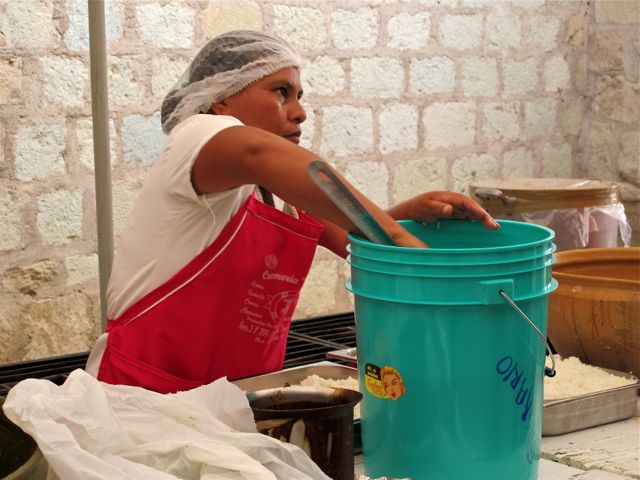
While kitchen staff prepared the serving platters and bowls…

Woman in apron and wearing hairnet, scoops cooked rice out of a large bucket.

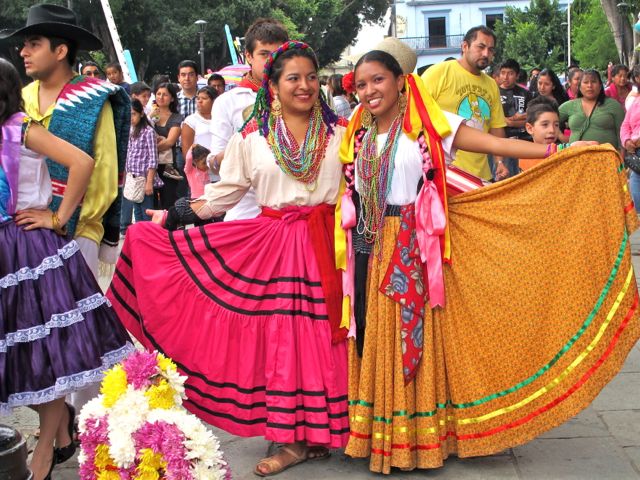
Dancers gathered on the Alameda for a calenda that would lead people the luncheon.

Two women displaying their long  colorful full skirts

They included a number of small children…

Woman squatting down and clasping hands with a toddler-age boy - both in indigenous dress

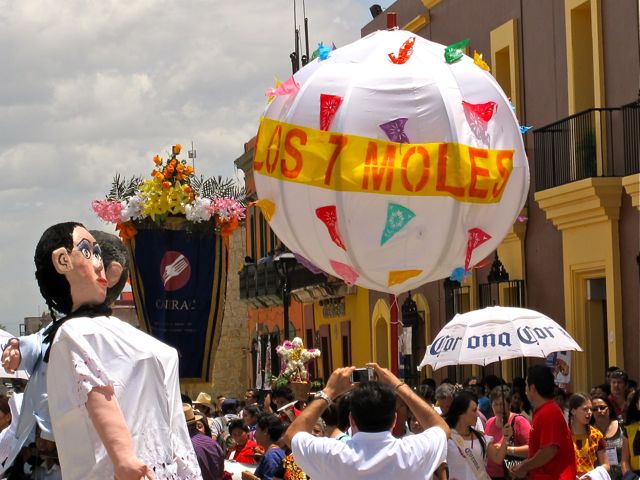
The calenda, including the requisite marmota (giant cloth balloon), monos (giant puppets), band, dancers with canastas (see yesterday’s post), and the sponsoring banner of CANIRAC (national association of the restaurant and food industries), made its way up the Alcalá…

Procession with marmota, monos, and banner

before turning onto Constitución and entering the Jardín, where wait staff and divine moles awaited.

Wait staff, wearing black, white, and grey gathered next to table.

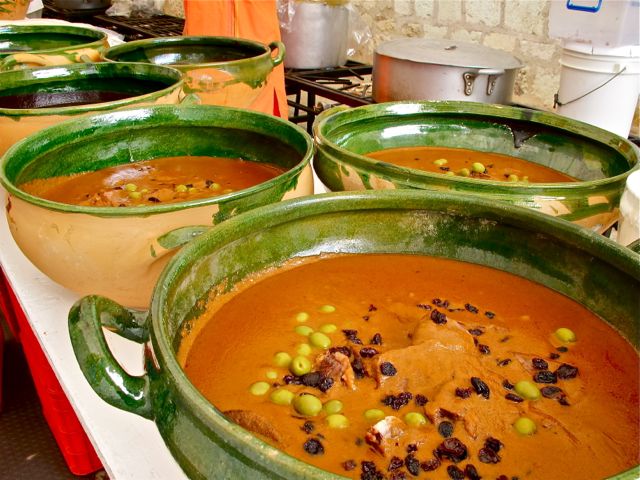
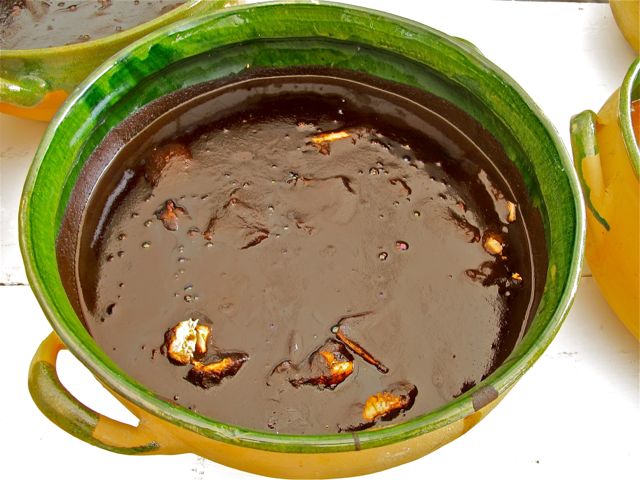
Yummm, mole negro

Large green pottery bowls filled with black mole.
Mole amarillo

Green pottery bowls of red colored moles

Mole coloradito

Green ceramic pot with red mole.
Mole verde

Green mole in green ceramic pot

There was also mole chichilo, mole manchamanteles, and mole rojo.  I tried them all!!!  And, I haven’t even mentioned the cervesa, mezcal, aguas, and appetizers of quesillo, chicharon, and tacos filled with guacamole and chapulines (grasshoppers).  You’ll have to switch over to Chris’s blog to see those and much more.  Oh, and for dessert, a scoop of each of my favorite nieves (sherbet); leche quemada (burned milk) and tuna (cactus fruit).

A day filled with light, color, music, fabulous food, and, most of all, wonderful friends — the recipe for a perfect day!

(ps)  There are almost 50 restaurants around town that will be featuring mole as part of this 12-day festival.

Read Full Post »

It didn’t start that way; I awoke to horrifying news from Colorado.  Thank goodness blogger buddy Chris called and the heart that beats in Oaxaca beckoned.

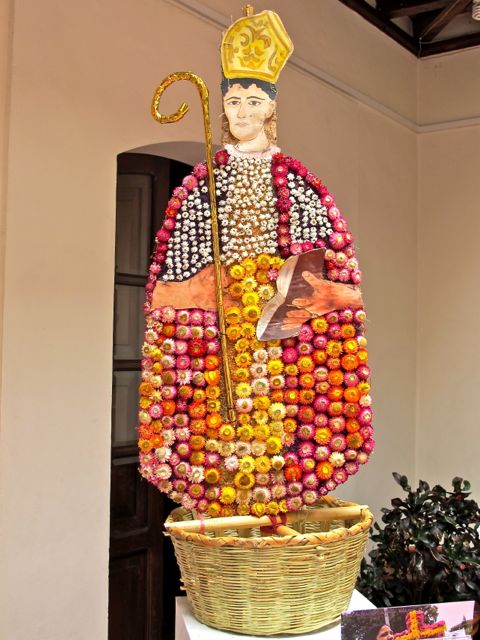
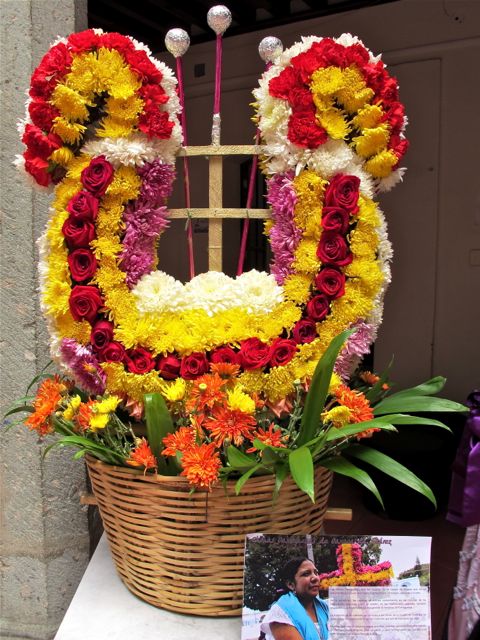
First stop was the “Al Son del Valle,” an exhibition of canastas from 17  villages in the central valleys of Oaxaca.  These are baskets that are carried on the heads of women during calendas (parades); you may remember them from previous posts on the convites in Teotitlán del Valle.  The art of crafting canastas and the traditions and culture they represent have been proudly and lovingly passed down through the generations.

San Antonino Castillo Velasco canasta decorated with Flor Inmortal, the flower that never dies.

Canasta from San Mateo Macuilxóchitl

From San Jerónimo Tlacochahuaya, these canastas are lit and become pinwheels of fireworks at the end of a calenda.

Canasta of Las Chinas Oaxaqueñas of the city of Oaxaca

Canasta from Tlacolula de Matamoros.

Canasta from Zimatlán de Álvarez made of crepe paper.

Muchas gracias, Oaxaca, I needed that!

Read Full Post »

« Newer Posts - Older Posts »