Feeds:
Posts
Comments

Posts Tagged ‘photos’

If you suffer from arachnophobia, you might want to click away from this post.

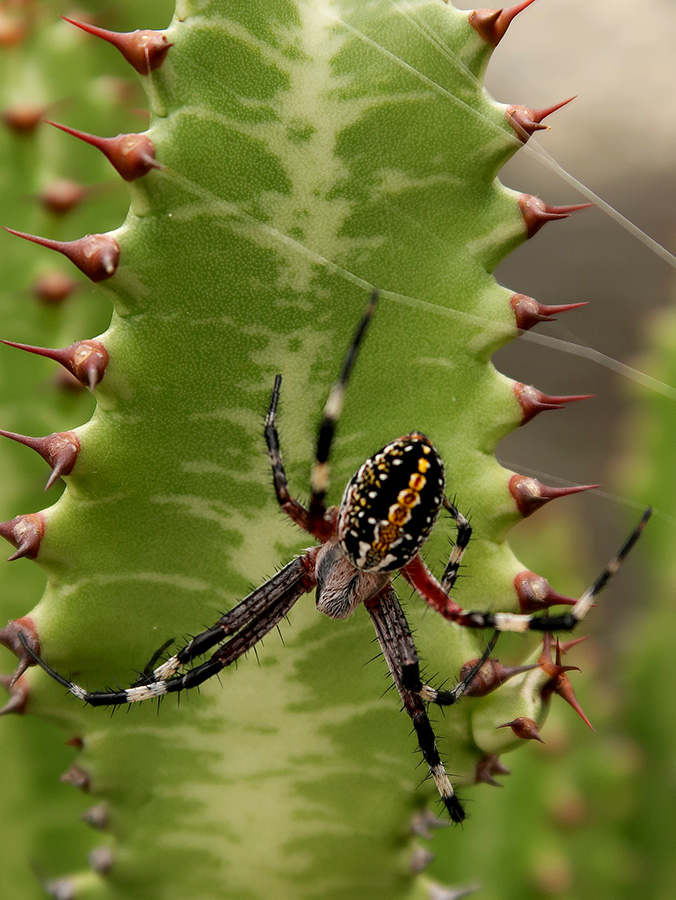
You were warned, so I will continue…  Two spiders, a Neoscona oaxacensis and an Argiope, have taken up residence on my terrace.  This isn’t the first time I have played hostess to these two kinds of orb weaver spiders.

IMG_0750

Neoscona oaxacensis (back)

IMG_0754

Neoscona oaxacensis (underside)

My latest guests arrived a week ago and have been settling in ever since.  Their webs are strung across neighboring plants, though the Argiope’s also extends across a walkway onto the deck.  Unfortunately, a few days ago, I inadvertently walked through it but, undeterred, she rewove it in the same place.  So I have blocked the route with an extremely spiky cactus, to prevent further human destruction.

IMG_1012

Argiope (top)

IMG_0768

Argiope (underside)

Aren’t my new visitors beautiful?  By the way, they eat insects and are harmless to humans, so nothing to be afraid of!

Save

Read Full Post »

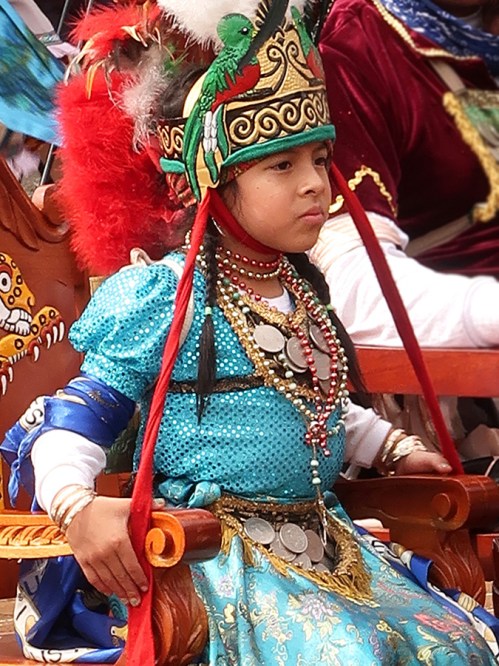
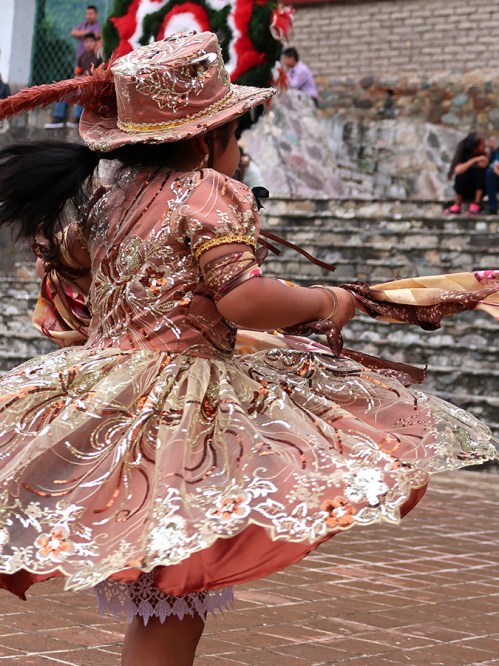
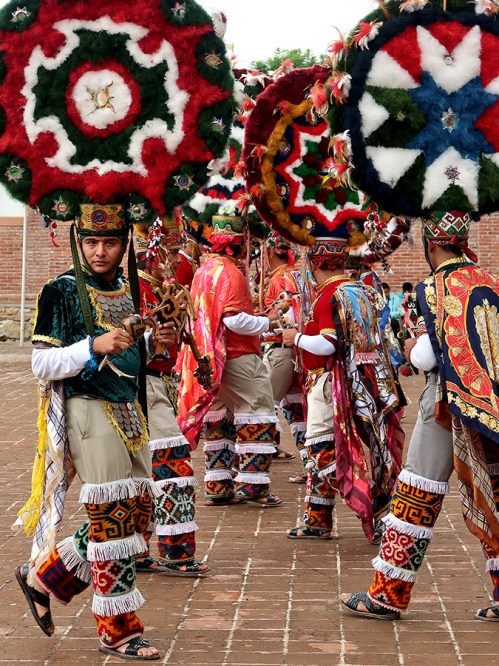
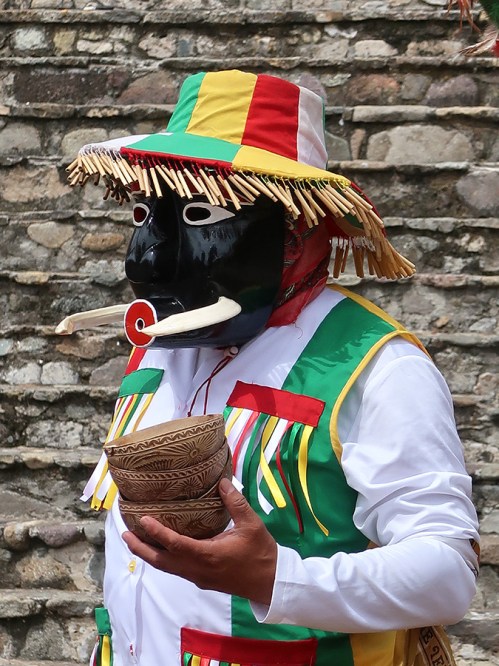
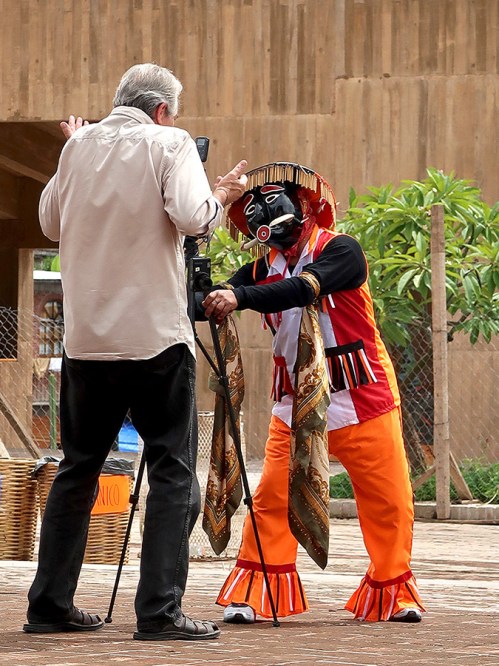
Yesterday, after missing the Fiesta de la Natividad because I was in the middle of my 6-week cross-country sojourn in el norte, I managed (courtesy of blogger buddy Chris and his trusty VW Jetta) to make it out to Teotitlán del Valle for the last day of the Fiesta de La Virgen del Rosario and performance of the Danza de la Pluma.

IMG_0915

Sergio Gutiérrez Bautista (Moctezuma)

The dance is day-long and recreates the Spanish Conquest from the Zapotec point of view.

IMG_0968_copy

Quetzali del Rayo Santiago Ruiz (Malinche)

IMG_0804

Elizabeth Hernández Gutiérrez (Doña Marina)

Miracle of miracles, the rain held off, the clouds parted, and the sun made a much welcome appearance.

IMG_0905

IMG_0776

Foreground:  Marcos Vicente Gutiérrez (Capitán 1 ro.)

IMG_0876

Foreground:  Edgar Daniel Ruiz Ruiz (Vasallo 8vo.)

IMG_0906

As we approached the atrium of the Templo Preciosa Sangre de Cristo, the father of one of the Danzantes explained a venue change — due to some (hopefully) minimal earthquake damage to one of the bell towers of the church, the Danza de la Pluma was moved next door to the plaza in front of the municipal building.

IMG_0856

Juan Bautista Ruiz (Subalterno)

IMG_0811

Florentino Martínez Ruiz (Subalterno) and Señor Inocencio

A heartfelt muchisimas gracias to the people of Teotitlán del Valle, many of whom I am so lucky and grateful to call friends.  The warm welcome I received was such an incredible tonic to the grey days we have been experiencing in Oaxaca.

Save

Read Full Post »

In Oaxaca city, while nerves remain on edge, life is going on as usual with only a few signs of the recent earthquakes:  Buildings years ago labeled “inmueble en mal estado” (property in a bad state) now sport yellow caution tape, as does Templo De La Virgen De Las Nieves, which has a huge crack along one of the bell towers.  And, on my block, a plywood retaining wall has been erected to contain a wall that collapsed back in 2012.

IMG_0702 (1)

Those atrapada (trapped) by the September 7th and September 19th earthquakes have mostly been rescued, though réplicas (aftershocks) continue daily, especially in the Isthmus of Tehuantepec region — still in the 4 to 4.5 on the Richter Scale (though not felt in Oaxaca city).   Damnificados (victims) and escombros (debris) are all that remain in the hardest hit areas but tens of thousands of people are being forced to live in the streets.  To add insult to injury, they must cope with torrential downpours and flooding from this very long and destructive rainy season.

Fundraising events are being held and centros de acopio (collection centers) have been set up to gather donations, with countless volunteers traversing damaged and dangerous mountain roads to deliver supplies.  The need is massive!

HOW YOU CAN HELP:

Como Ayudar – A large international list of information and links regarding assistance and distribution of goods to help those affected by the most recent earthquakes in Mexico.

How To Help The Earthquake Victims In Mexico City, Morelos, Puebla & Oaxaca – List of organizations collecting monetary donations, compiled by Mexico City based food writer, Nicholas Gilman

In addition, a couple of friends have asked me to publicize small organizations they are working with:

Help to San Mateo del Mar, Oaxaca, Earthquake Victims – Norma Schaefer, of Oaxaca Cultural Navigator, is getting the word out on the earthquake relief efforts of cultural anthropologist Denise Lechner and medical doctor Anja Widman.

SER Mixe – An indigenous organization serving the Mixe people in the Mixe region of Oaxaca; recommended by Margaret Macsems, general manager of Khadi Oaxaca.

*** Words in red type have become hardwired in my brain — new Spanish vocabulary I wish I didn’t have to learn under these circumstances.

Save

Read Full Post »

I can’t believe it has been three years since 43 student teachers went missing one night in Iguala, Guerrero.  And, I can’t believe the key questions remain.

P1160509_b&w

Who is responsible?  What happened that night?  Where are they?  Why are there still no answers?  How can 43 human beings be disappeared so completely?  When will the truth be revealed?

P1160500

In the midst of our current tragedies, let us not forget the 43 normalistas from Escuela Normal Rural Raúl Isidro Burgos, Ayotzinapa, Guerrero.

P1160508_b&w

Three years without answers must seem like an eternity to their families….

Read Full Post »

Here in Oaxaca we continue surfing the temblors and tormentas…

IMG_0708

Calle de Ignacio Allende at the corner of Tinoco y Palacios

Torrential downpours and flooding have returned.  Aftershocks from the September 7 earthquake continue.  But, aside from difficulty navigating the flooding and potholes, suffering from frayed nerves, and being worried sick about friends and family in the critically affected areas of central and southern Mexico, we are okay in the city and surrounding villages.

Re geography:  Oaxaca is the name of both a state and its capital city.  The epicenter of the September 7th earthquake in Oaxaca was in the southeast part of the state — as the crow flies, it is almost 150 miles and through the Sierra Madre del Sur mountain range from Oaxaca city.   To see where Oaxaca’s earthquakes are happening, check out Earthquake Track.

Save

Read Full Post »

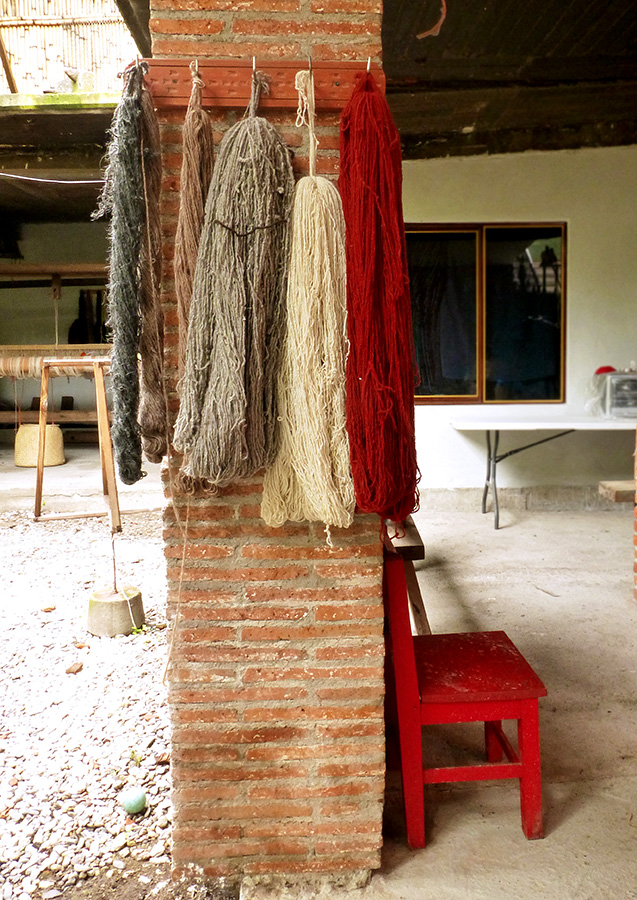
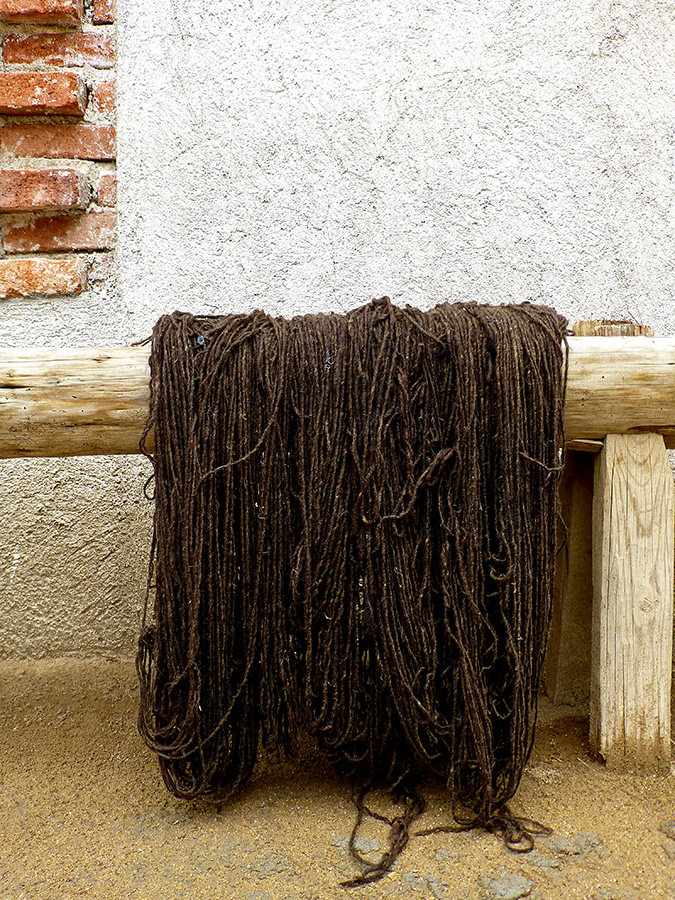
A skein of yarn waiting to be woven…

IMG_0695

Agave blossoms reaching for the sky…

IMG_0691

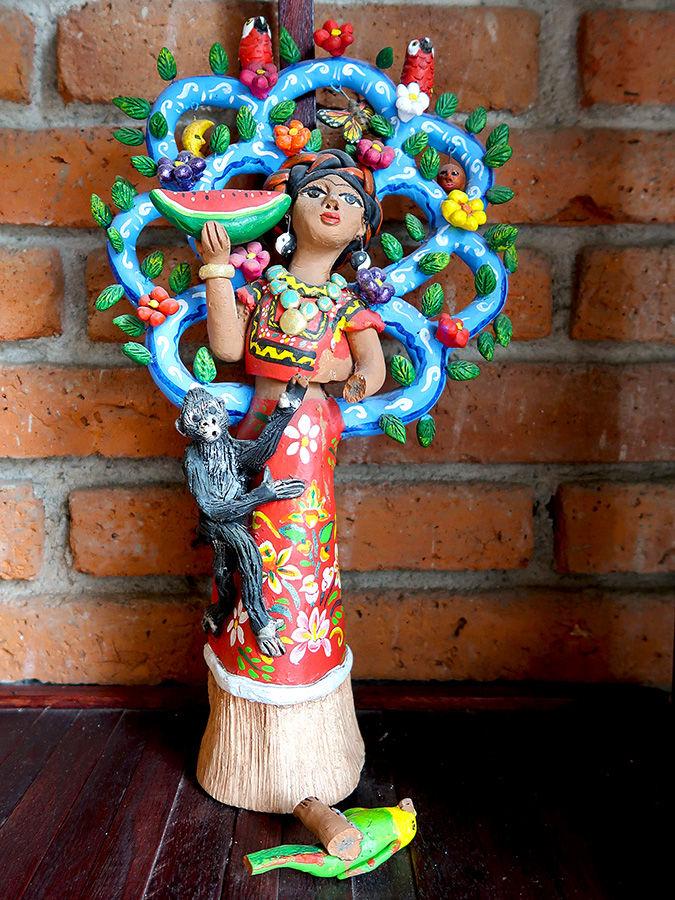
Ceramic sculpture of a Tehuana by Fran Garcia Vásquez.

IMG_0699

Ooops, a broken arm!  It seems appropriate that my only casualty from the 8.2 earthquake depicts a woman from the Isthmus of Tehuantepec — the region where some of the most severe damage in the state of Oaxaca occurred.  However, like the people she represents, she is strong, proud, and healing will happen.

If you want to help the victims of the September 7 earthquake, please see my previous post.  If you do, reward yourself by watching last night’s benefit at the Guelaguetza Auditorium, Oaxaca Corazón.  And, if you don’t, perhaps this spectacular concert will encourage you to donate to earthquake relief.

This all-star event, organized in less than a week by Lila Downs and Susana Harp, will have tears falling — I guarantee it!

Save

Read Full Post »

Oaxaca continues to be inundated with rain.  I’m in Colorado now (inhaling smoke from fires throughout the west), but friends in Oaxaca are describing flooding, leaking roofs, water coming through windows and doors, and rain without end. Today’s news is reporting more than 13 communities are incommunicado and that urban development is a major cause of flooding by the Atoyac River that runs through the valley of Oaxaca.

Perhaps there are lessons to be learned from the builders of Monte Albán, where the Pre-Hispanic drainage works better than current systems.

Read Full Post »

Wool was brought to Teotitlán del Valle in the 16th century…

Spun into yarn…

Dyed with natural dyes…

In the 20th century, less labor intensive aniline dyes were introduced…

However, now many weavers are returning to their roots — harvesting and using natural dyes.

The history, culture, and art that is yarn is alive and well and living in Teotitlán del Valle.

Save

Read Full Post »

In June, I finally had a chance to meet fiber artist, Carolyn Smythe Kallenborn.  In 2012, I’d been captivated by and wrote a small blog post about her “Tormentos y Sueños” exhibition at the Museo Textil de Oaxaca.  So, I was thrilled to meet her at the Weave a Real Peace (WARP) annual meeting held this year in Oaxaca.  We chatted a couple of times during the conference, but it was the final evening, as many of us were standing in the lobby of the hotel waiting for the business meeting to begin, that Carolyn provided us with a real treat — renown weaver Erasto “Tito” Mendoza, from Teotitlán del Valle, delivered a tapete that was to be used in a collaborative work with Carolyn.

IMG_0268

We were all in awe as he unrolled his creation for us to behold.  ¡Espectacular! was the response from all.  Then Carolyn began describing how she would use mixed media to embellish this woven illustration of the balance of Mother Earth.  However, aside from a hazy picture in my mind, I really had no idea what the finished work would look like.  Then synchronicity came to pass… an announcement that the fruit of their collaboration, Equilibrio/Balance, had won the Surface Design Association, Award of Excellence at the International Fiber Arts VIII exhibition at the San Francisco Bay Area’s Sebastopol Center for the Arts.  And, best of all for me, the show coincided with my Bay Area visit.  Without much difficulty, I managed to persuade B (of Week in Oaxaca fame), who had fallen in love with the tapetes of Teotitlán AND lives in Sebastopol, to accompany me to the exhibition a few days ago.


Equilibrio/Balance traces cycles of nature: water through earth and sky; elements of previous life, feeding new growth; and the conversation between the mountains and the universe above.  — object label

IMG_0264

This is one of seventy pieces in this International Fiber Arts show.  Like Equilibrio/Balance, most of the works are not only visually stunning, but also have much to say about our world and contemporary life.  If you are in the Bay Area and love textiles, I highly recommend making your way to the Sebastopol Arts Center by September 3, when the show closes.

Save

Save

Save

Read Full Post »

As I’ve previously mentioned, my grandson loves skeletons and skulls AND he also loves Oaxacan chocolate.  Recipe for the perfect gift to take to him:  Go to my favorite chocolateria, Conchita (local # 210) inside Mercado 20 de Noviembre.

P1280681

Take 1 kilogram of chocolate beans, add 1 kilogram of sugar and 25 grams of cinnamon sticks, and mill in the Mexicano embalado.

P1280687

Bring home a plastic bag full of warm chocolate, spread out on a cookie sheet, let cool, then cut and stamp.

P1280697

A recipe for the perfect gift to bring to my Day of the Dead loving, chocoholic grandson.

Read Full Post »

Sunday was the last day of B’s Week in Oaxaca and he had some last-minute shopping to do.  Family back home had requested a stack of tlayudas (also spelled, clayudas), the 12″ diameter handmade and dried tortillas, and quesillo, Oaxacan string cheese.  The closest mercado to B’s hotel was Mercado de la Merced.  It’s one of the best in Oaxaca city — selling fresh fruits and vegetables, nuts and dried chiles, healing herbs and incense, meats and poultry, breads and cheeses, baskets and oil cloth, housing juice bars and small restaurants (like the well-known Fonda Florecita), and more — almost everything one could ever need.  These mercados make shopping social and fun — way more enjoyable than impersonal supermarkets and shopping malls.

After purchasing the requested items and wandering up and down the maze of aisles, we returned to B’s hotel to off-load the cheese (hotel’s refrigerator) and tlayudas (spread out on the bed to dry).  Our appetites having been stimulated, we walked across the city to the off-the-beaten-path location of Criollo, the year-old creation of Chef Enrique Olvera (Pujol in Mexico City, Cosme in New York), Chef Luis Arellano (originally from the Cañada region of Oaxaca), and architect Javier Sánchez.

It was a good thing we were famished, as the 7-course tasting menu was more than enough.  However, each plate brought such deliciousness, we happily continued on.  And, the setting?  While on an extremely busy street, once one steps inside this modern take on the traditional colonial courtyard, a sense of peace takes over.  Sated, we wandered to their orchard at the back of the restaurant, where we were warmly greeted and offered a cup of poleo tea brewed in the outdoor kitchen set in the orchard.  Our hostess explained this kitchen allows for the traditional preparation of some of the menu items.  In addition, she pointed to another building that she explained was going to be a culinary bed and breakfast.

By the time we left Criollo, it was late afternoon.  Before B returned to his hotel and I to my apartment, we marveled at what a full, delicious, and delightful six days it had been.

Just a note:  A week isn’t nearly enough time to experience all that Oaxaca city and surrounding villages have to offer.  We never made it to the Sunday market in Tlacolula de Matamoros, Hierve el Agua, Centro de las Artes de San Agustín (CASA), the alebrije pueblos of San Martín Tilcajete and San Antonio Arrazola, San Bartolo Coyotepec for their black pottery and Museo Estatal de Arte Popular de Oaxaca (State Museum of Folk Art (MEAPO), Santa María Atzompa for green pottery and the archaeological site, the Pueblos Mancomunados of the Sierra Norte, and then there are the mezcal palenques in the valley of Oaxaca.  I guess B will just have to come back!

Save

Save

Save

Save

Save

Save

Save

Read Full Post »

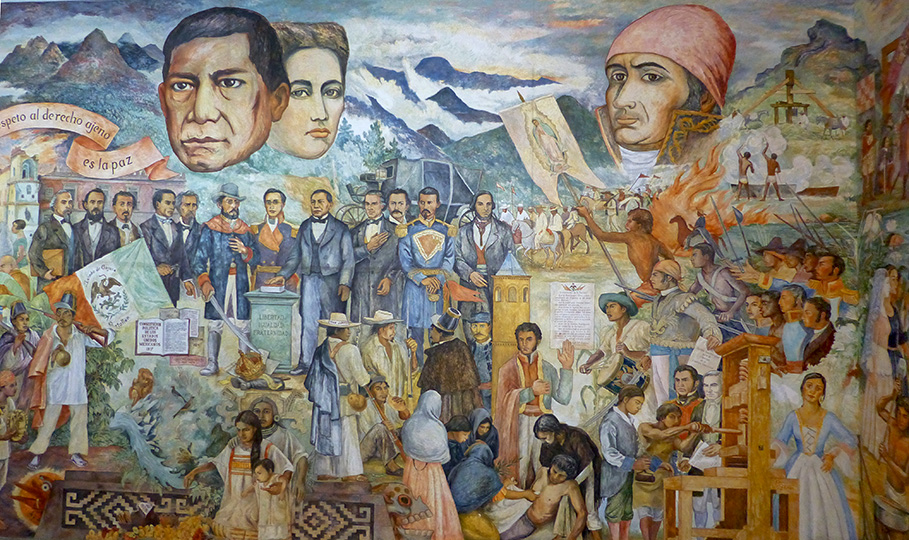
Our first stop on day five of B’s Week in Oaxaca was the Palacio de Gobierno to see the magnificent Mural of Oaxaca history.  Ooops!  I had forgotten that the Government Palace was now closed to the public.  However, a polite appeal to see the mural, addressed to one of the guards by a couple of tourists (okay, one tourist and one resident), resulted in the guard receiving permission from a superior to let us in.  We were instructed, mural only!  We obeyed, walking only half-way up the grand staircase to take in the entire work of art.  I love this mural by Arturo García Bustos and hope the palacio will again be opened to the public.

Once we had finished marveling at the Bustos history of Oaxaca, we walked up the Macedonio Alcalá to the Museo de Arte Contemporáneo de Oaxaca (MACO) to check out the Espejos de Cal mural being painted in the courtyard by Jesús González.  Engrossed in watching the mural unfold and fascinated in the technique explained by the artist’s Russian assistant, we never made it inside this treasure of a museum.  Next time!

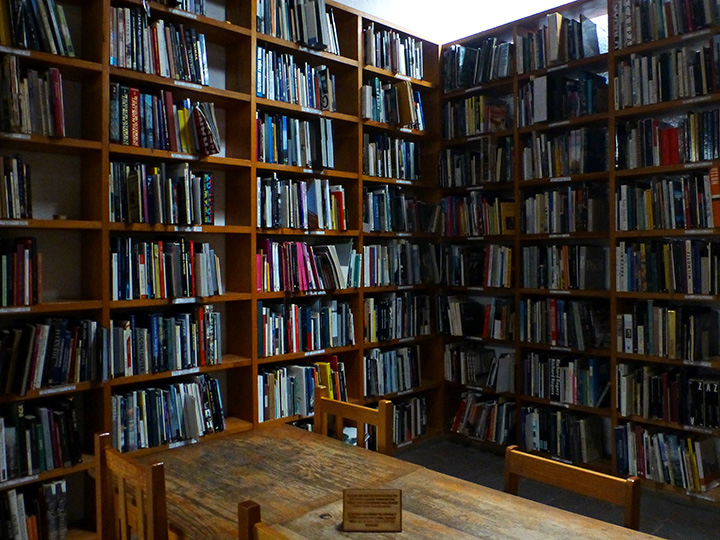
We strolled further up the Alcalá to the Instituto de Artes Gráficas de Oaxaca (IAGO), founded in 1988 by renown artist, philanthropist, and social activist, Francisco Toledo.  First we wandered through the exhibition rooms and then into the impressive library.  The 60,000+ books on art, architecture, design, photography, and much more is one of the most extensive arts-related collections in Latin America.  A photography professor friend raved to me about finding a book at IAGO that he had been searching for and B (the architect) was ooh-ing and ahh-ing at titles he eyed — and pulled a few off the shelves to leaf through.  IAGO also hosts lectures, conferences, musical performances, workshops, poetry readings, and film showings.

Needless to say, by the time we finally left, we were hungry.  Lucky for us, the acclaimed restaurant Pitiona was only a block away.  Born in Pinotepa Nacional, Oaxaca, Chef José Manuel Baños spent time in Spain under the tutelage of innovative chefs Feran Adrià and Juan Mari Arzak.  However, as the name Pitiona (a native herb frequently used in Oaxacan cooking) suggests, the starting point for Baños is local ingredients.  The simple elegance of the old colonial building and attention to detail in table settings, service, and especially food, made for a sublime interlude in the day’s activities.

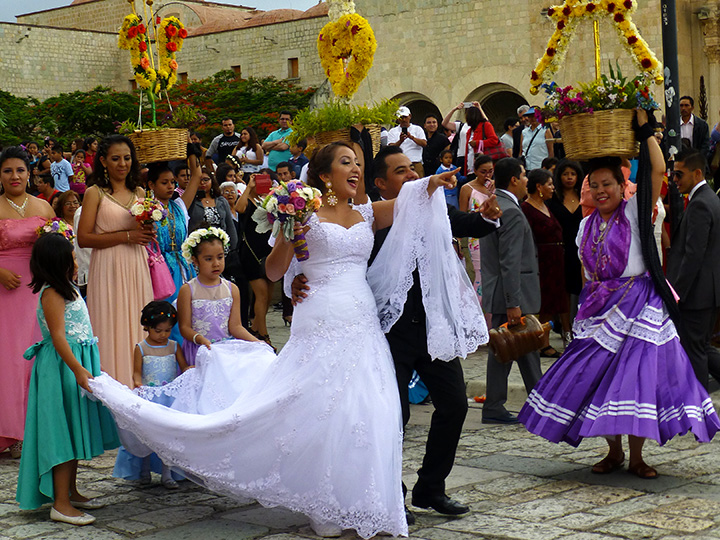
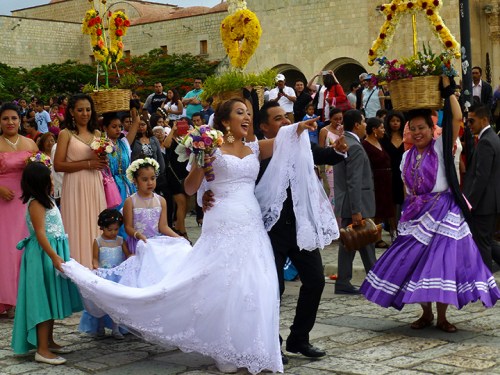
We descended the stairs of Pitiona to the sound of music coming from the atrium of Templo de Santo Domingo de Guzmán.  It was Saturday and that means wedding day at Santo Domingo – each featuring a band, folkloric dancers, marmotas (giant cloth balloons), bride and groom monos (giant puppets), a wedding procession down the Alcalá, and scores of tourists and locals stopping to watch — which we did, too!
Our final stop was at the photography museum Centro Fotográfico Manuel Álvarez Bravo, another brainchild of Francisco Toledo.  The museum has over 18,000 photographs in its permanent collection, including by its namesake Manuel Álvarez Bravo, his first wife Lola Alvarez Bravo, Henri Cartier-Bresson, Tina Modotti, Guillermo Kahlo (yes, Frida Kahlo’s father), and Mary Ellen Mark.  Works from the collection and by photographers from all over the world are exhibited in galleries surrounding a beautiful courtyard featuring a reflecting pool.

However, that wasn’t the end.  After a siesta, we gathered with eight other diners for a Waje pop-up dinner.  The June menu was an homage to mole and the setting was at the restaurant Mezquite Gastronomia Y Destilado where Waje chef, José Daniel Delgado is the new chef.  As always, José Daniel and his Waje team provided a creative, delicious, and delightful evening.  An added bonus was being seated across from Jason Cox, co-owner and mezcal steward of El Destilado — a restaurant I definitely need to try.

Only one day left in B’s Week in Oaxaca.  Where to go?  What to do?  Stay tuned!

Save

Save

Save

Save

Save

Save

Save

Save

Save

Save

Save

Save

Read Full Post »
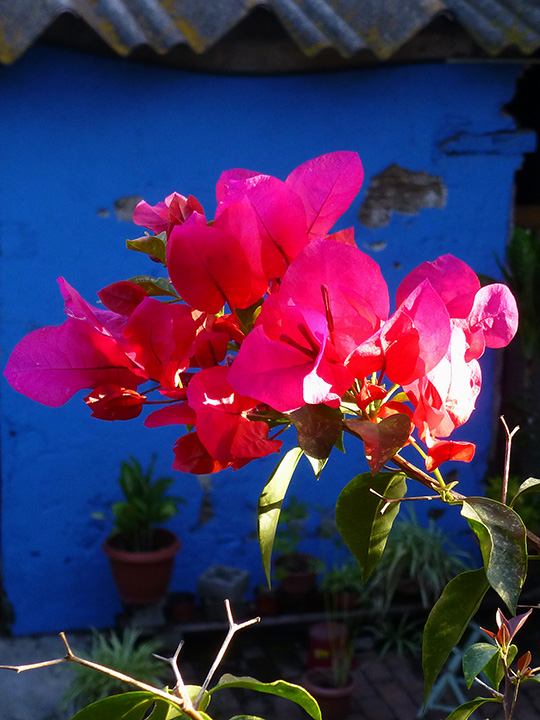
Two weeks ago, as the sun was about to sink behind the mountains to the west, I glanced up from my desk.

Light and shadow highlighted the Mexpost pink of the bougainvillea against the backdrop of a Frida Kahlo blue wall.  Ahhh…

Read Full Post »

Day four of B’s Week in Oaxaca had B relying on yours truly for the day’s sights and sounds.  Where to begin?  The answer, because it was near Casita Colibrí and we had just been to Mitla and Monte Albán, was the Museo de Arte Prehispánico de México Rufino Tamayo (Rufino Tamayo Museum of Prehispanic Art).  The collection is spread over five rooms surrounding a courtyard in a 16th century colonial building.  Each room is painted a different iconic Mexican color, chosen by the late Zapotec Oaxaqueño artist Rufino Tamayo, to highlight the pieces of his extraordinary collection.

Next we walked down to and through the iron gates, designed by Francisco Toledo, and across the brick pathway of the Centro Cultural San Pablo (Cultural Center of San Pablo).  We explored the interior rooms of this ex-convent, now an academic research and cultural center, that hosts concerts, lectures, exhibitions, and houses a library.  Pausing to rest, we took advantage of the cafe in the courtyard to order a couple of aguas.

Our thirst quenched, we walked around the corner to the Museo Textil de Oaxaca (Textile Museum of Oaxaca) to explore the ground floor and upstairs exhibitions of one of this textile lover’s favorite museums.  One of the exhibits was the stunning “Almas bordadas, vestido y ornamento en el Istmo de Tehuantepec” — displaying the iconic embroidered clothing of the Isthmus of Tehuantepec.  (Think, the dress of Frida Kahlo.)

Forty-five minutes later, we were certifiably hungry and, lucky for us, Origen, restaurant of Top Chef Mexico 2016 winner, Rodolfo Castellanos, and one of my oft recommended restaurants in Oaxaca, was only a block away.  As always, its relaxing interior, attentive service, and delicious food provided a perfect respite.

Once rested and satiated, it felt good to set feet to pavement for the short walk to the Catedral Metropolitana de Nuestra Señora de la Asunción (Cathedral of Our Lady of the Assumption).  The cathedral towers over the zocaló and the Alameda.  The construction of this green cantera (stone) edifice began in 1535 and was consecrated on July 12, 1733.  It is dominated by a spectacular altar and lined, on both sides, with chapels — the most important being that of Señor del Rayo.  In addition, it is home to one of the historic pipe organs of Oaxaca.

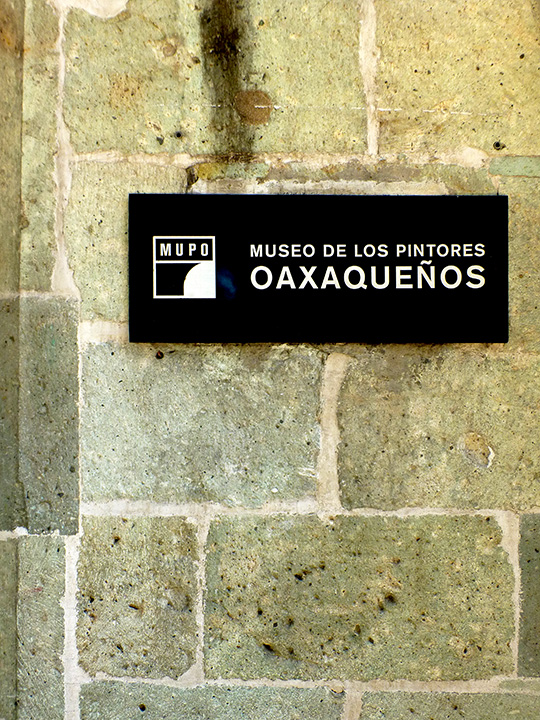
After being wowed by the Cathedral’s soaring ceiling, altar, art, chapels, and organ, we crossed Independencia for a taste of the modern — the Museo de los Pintores Oaxaqueños (Museum of Oaxacan Painters).  This, often overlooked, two-story restored colonial era mansion showcases the creativity and talent of Oaxaca’s painters.  I had been to the museum only a month before, but the exhibitions are ever-changing, and new artists were on display.

Of course, no day in Oaxaca is complete without a parade and we were not disappointed.  We departed the Museo de los Pintores Oaxaqueños to be greeted with a calenda (parade) by “Ranchu Gubiña” from Union Hidalgo in the Isthmus of Tehuantepec region — attired in clothing similar to that which we had seen earlier in the day at the textile museum.  We had come full circle!

Another long day’s journey into evening….  However, we weren’t finished yet; two more days await!

Read Full Post »

Whether just passing by…

P1280313

P1280424

Or, stopping to study…

P1280314

P1280425

Even black and white stencils add color commentary to the walls of Oaxaca.

Read Full Post »
« Newer Posts - Older Posts »