Feeds:
Posts
Comments

Posts Tagged ‘Oaxaca’

Yesterday in the United States…

Former Senate Majority Leader Bob Dole (R-Kan.) made a rare Senate appearance this morning, sitting in a wheelchair just off the floor so that members would have to see him as they entered the chamber. Why? Because they were poised to vote on ratification of the U.N. Convention on the Rights of People with Disabilities, and Dole hoped to send a message.

It didn’t work. The Senate killed the treaty this afternoon, with a final vote of 61 to 38, which seems like a lopsided majority, but which fell short of the two-thirds necessary for ratification.  [Link to full article in The Maddow Blog]

Today in Mexico…

Mexico’s Supreme Court issued a unanimous ruling Wednesday striking down a marriage ban in the southern state of Oaxaca. Advocates say the language of the decision could open the door for same-sex marriages throughout the nation. 

The ruling effectively changes Oaxaca’s civil code to state that marriage takes place “between two people,” instead of between a man and woman, reports Spanish-language site AnimalPolitico.

The Court ruled in favor of three same-sex couples who sued the state of Oaxaca for the right to marry. The ruling does not immediately eliminate marriage equality bans in other Mexican states, but it does set a legal precedent to begin challenging statewide marriage bans, according to the blog AfterMarriage.  [Link to full article in The Advocate]

I am not the only gringa and gringo who is speechless re how low US politicians have sunk.  A gal pal (since we were 12) who now lives in Mexico and is confined to a wheelchair due to MS just posted on Facebook that she is “disgusted and, frankly, very upset” and feels “like traveling to Washington and getting in their face.”  And, Chris over at Oaxaca-The Year After asks, Seriously?

Which country do I feel prouder to live in?  ¡Bravo, México!

h/t  Michelle V.

Read Full Post »

Walking home today…

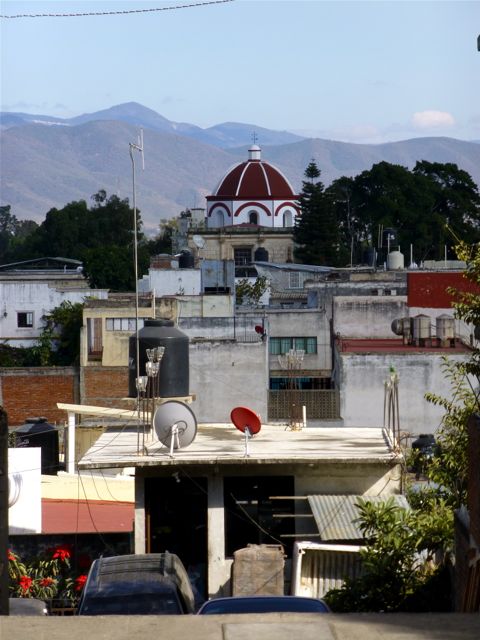
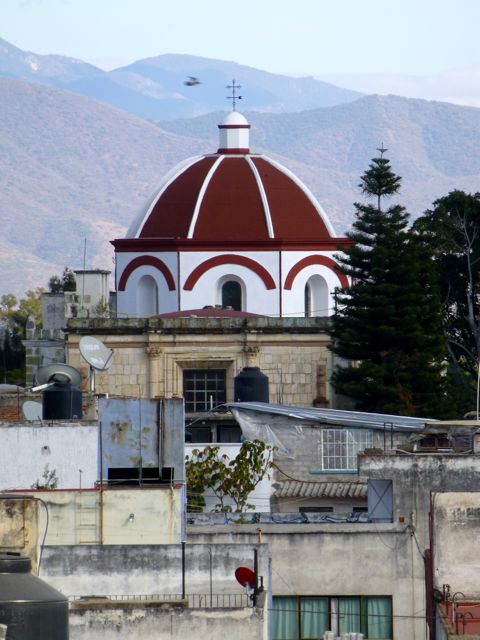
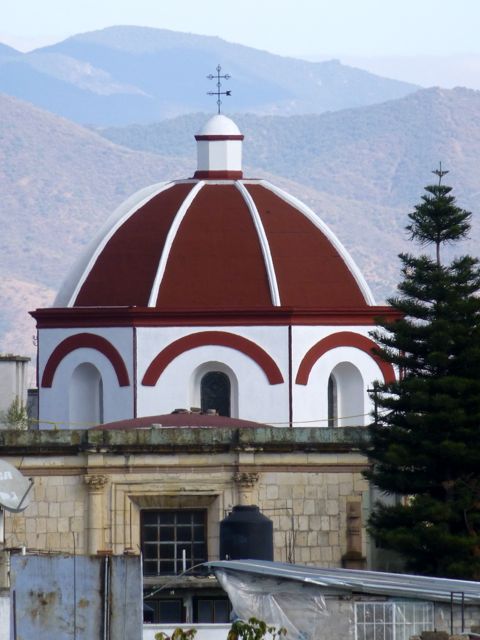
Besides walls of street art (which will no doubt appear here when inspiration hits or I can’t think of anything else to post), I came across this view.

Looking down street, red domed church mid ground, mountains in distance

Looking over rooftops at red domed church in mid distance and mountains in background

Looking over rooftops at red domed church in mid distance and mountains in background

Red dome of church in foreground with mountains in background

View of Templo del Carmen Alto from Crespo, near the Escaleras del Fortín.

There is beauty out there…

Read Full Post »

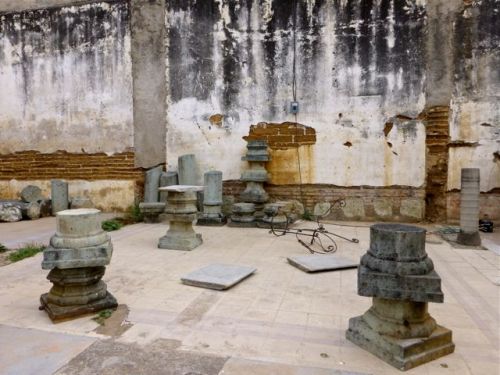
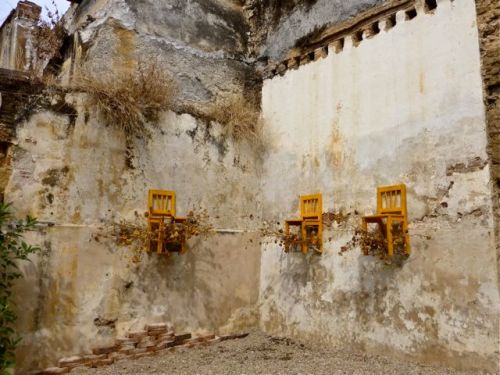
On Saturday, thanks to MexicoRetold, I stepped through the doorway and entered El Sueño de Elpis (the dream of Elpis), an art installation by Mauricio Cervantes in one of the many abandoned buildings in the city center.

P1020697

P1020653

In Greek mythology, Elpis was usually depicted carrying flowers and was the spirit of hope.  She alone chose to remain when Pandora opened the lid of her infamous box.

P1020641

P1020639

I arrived a little after 10 AM.  The glow of morning light on the colors and textures of this crumbling beauty and her furnishings was captivating — and I was reluctant to leave.

P1020687

P1020685

Elpis and her dream will continue to offer hope for another 3-1/2 weeks at Murguía 103 (between Macedonio Alcalá and 5 de mayo).  There were candles — and according to the docent, it is especially magical at dusk.

P1020683

P1020658

I will return.  Keep dreaming…

Read Full Post »

Life and death is a family affair…

This slideshow requires JavaScript.

November 1 and 3, 2012 in the panteón municipal, San Antonino Castillo Velasco.

Read Full Post »

The Y-shaped valley of Oaxaca is about 700 square kilometers, not all that big when compared to California’s Sacramento Valley, which is approximately 2,570 square kilometers.  Yet, unlike the “sameness” one encounters in Sacramento Valley towns (sorry, CA), one can’t help but be struck by the unique identity of each of the Zapotec villages that are only kilometers apart.  One specializes in red clay pots, another in black pottery, and another in green glazed ceramics.  There are villages of woodcarvers near weavers of cotton and others of wool, never mind the fashion trends!

Thus, it should come as no surprise that Day of the Dead celebrations and cemeteries differ, often dramatically, from village to village.  And so, from the whitewashed graves of Santiago Apóstol and the candlelight of Santa María Atzompa (today’s earlier post), we came to the carved wooden crosses in the Panteón Municipal of the Villa de Zaachila.

This slideshow requires JavaScript.

Along with livestock, produce, and household goods, wood gathered from the hills surrounding Zaachila is a major part of Zaachila’s weekly Thursday tianguis (open air market).  It’s one of my favorites!

Read Full Post »

With only a couple of days left in November and the Christmas holiday season already making its presence known, it’s now or never to finish sorting through this year’s Día de los Muertos photos — my thoughts and impressions will take the remains of this lifetime, and then some, to process.

To an outsider, especially one whose worldview was shaped by a Judeo-Christian culture, Day of the Dead is often seen through the lens of juxtaposition.

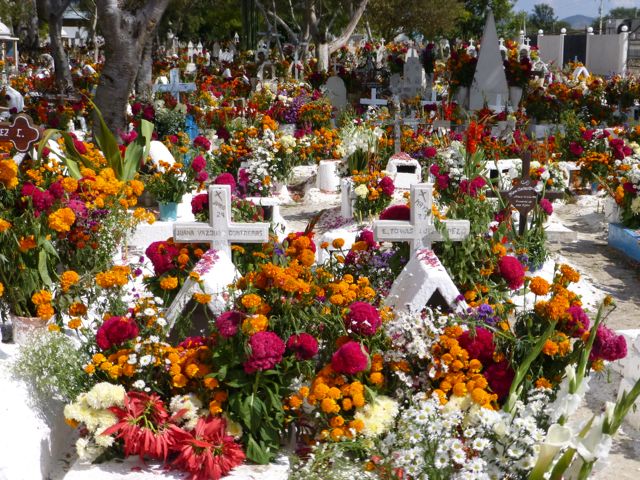
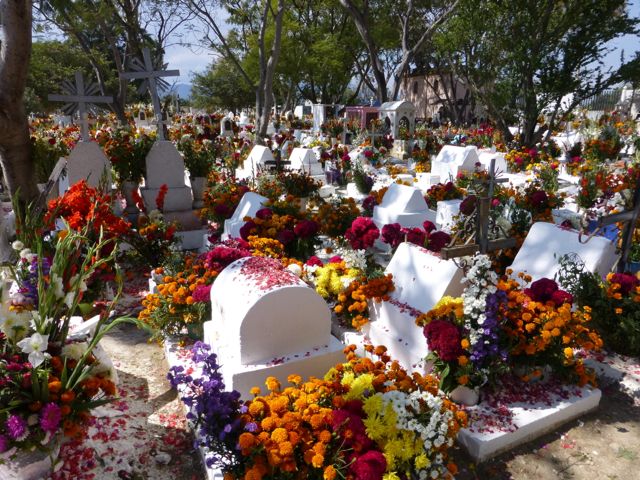
The “unbearable lightness of being” in Santiago Apóstol…

Whitewashed graves covered with multicolored fresh flowers

Whitewashed graves covered with multicolored fresh flowers

Whitewashed graves covered with multicolored fresh flowers

Whitewashed graves covered with multicolored fresh flowers

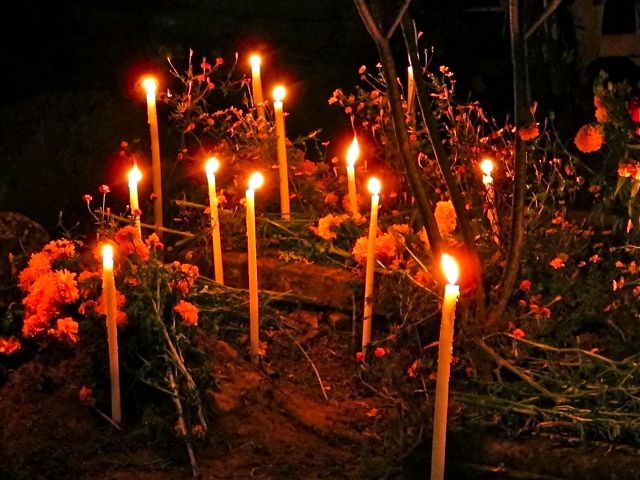
The blurred otherworldly darkness of Santa María Atzompa…

Night shot of tall lighted candles perched around and on graves.

Night shot of tall lighted candles perched around and on graves.

Night shot of tall lighted candles perched around and on graves.

Night shot of two lighted votive candles casting halos on the ground

However, light becomes dark becomes light becomes dark, as day becomes night becomes day becomes night, as life becomes death becomes life becomes death…  dualism beginning to vanish.

Read Full Post »

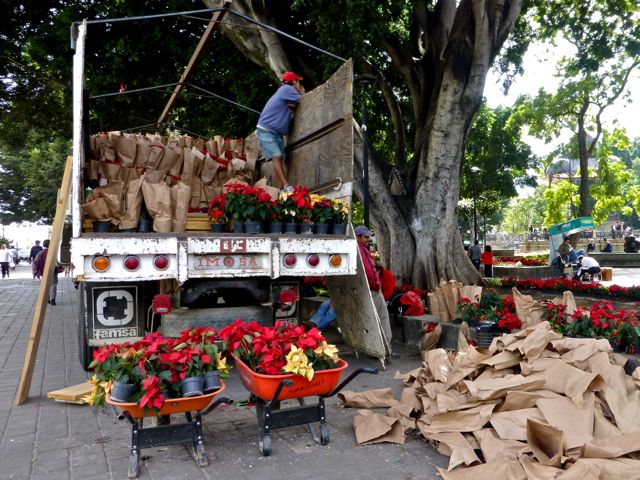
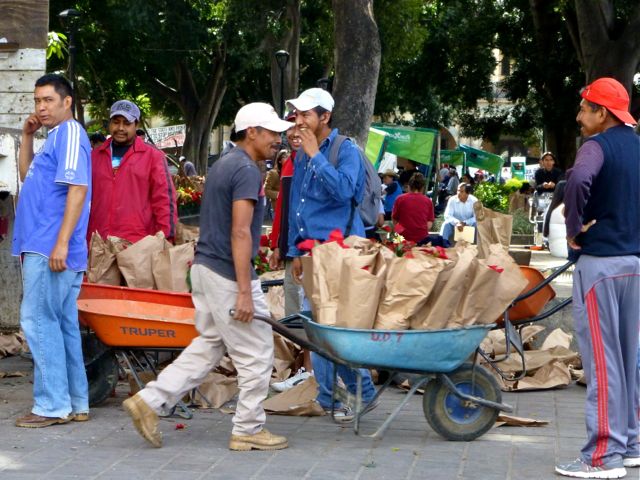
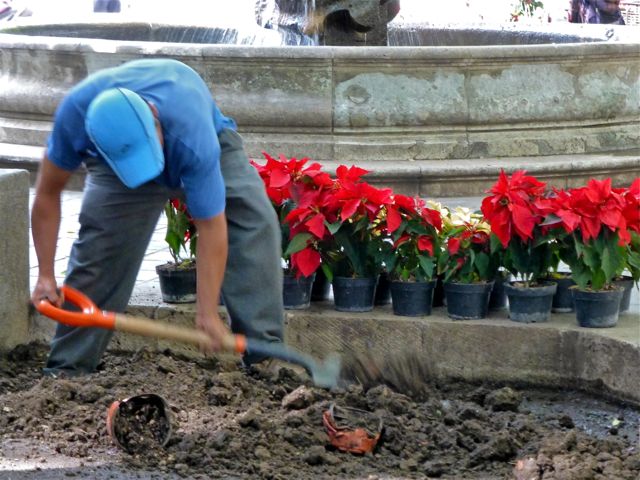
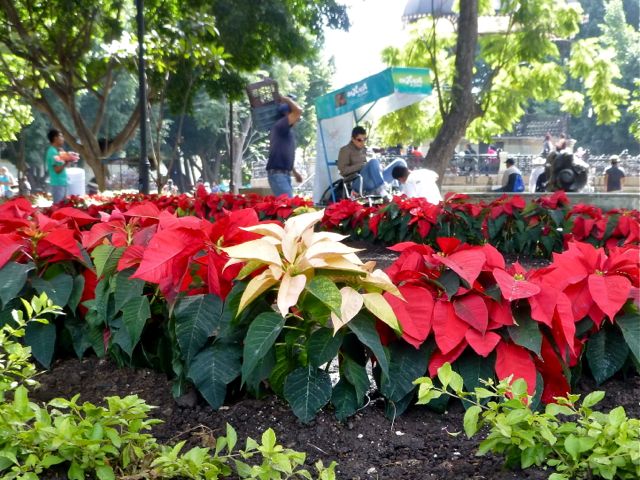
Today, the truck arrived, the wheelbarrows were loaded, and the gardening crew began filling the flower beds of Oaxaca’s zócalo…

Truck filled with poinsettias

Workers with wheelbarrows filled with poinsettias

Worker digging up flower bed, with poinsettias in pots in background

Mass of red and one white poinsettias in flower bed.

Navidad is coming to Oaxaca!

Read Full Post »

November 25, 2012 marks the sixth anniversary of the bloody attack by the Federal Preventive Police on the teachers and members of the Popular Assembly of the Peoples of Oaxaca (APPO) in the zócalo of the city of Oaxaca.  I wasn’t here during the 5-month long struggle, but its repercussions continue to reverberate.

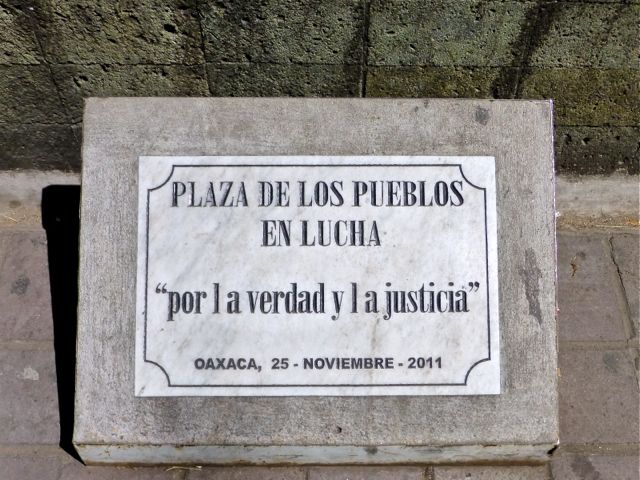
Plaque "Plaza de los pueblos en lucha." "por la verdad y la justicia" Oaxaca, 25 - noviembre - 2011

Last year a plaque was unveiled by organizations representing victims, survivors, human rights, and social activists.  Located where the Alameda de León meets the zócalo, it symbolically renames the zócalo, “Plaza of the peoples in struggle; for truth and justice.”

Man with cap looking at photos

Truth and justice have not been attained, assassins go unpunished, many of the same issues remain, and Oaxaca’s economy still hasn’t rebounded.  Today, the Survivors and Former Political Prisoners of Oaxaca in Defense of Human Rights (SEPODDH) mounted a photo exhibition across from the Government Palace.

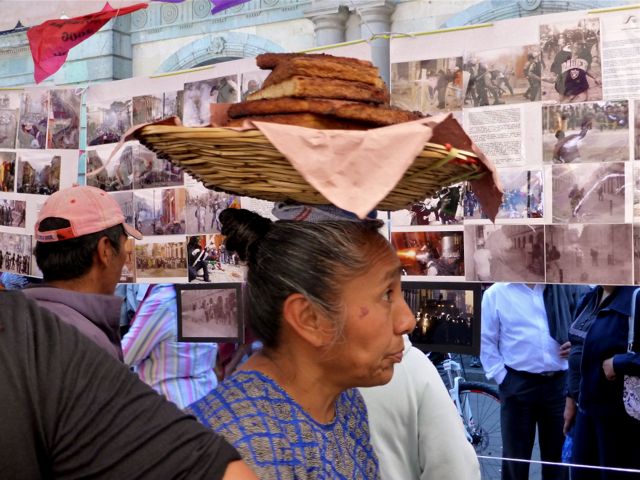
Women looking at photos, with a basket of sliced bread on her head.

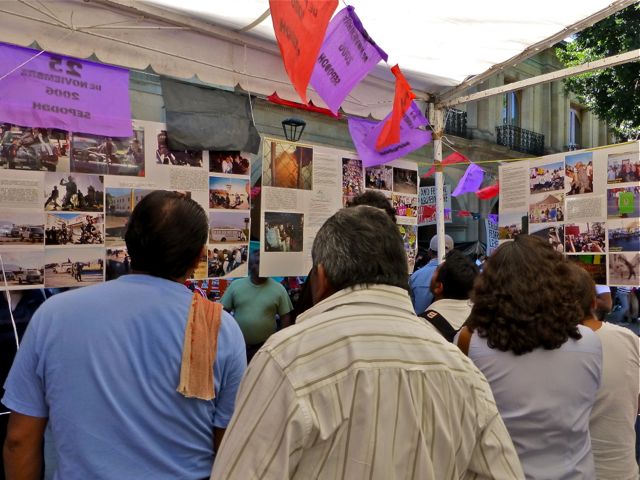
Adults, children, and even vendors stopped to look and, for many, remember those days and nights six years ago.

Crowd of people looking at photos

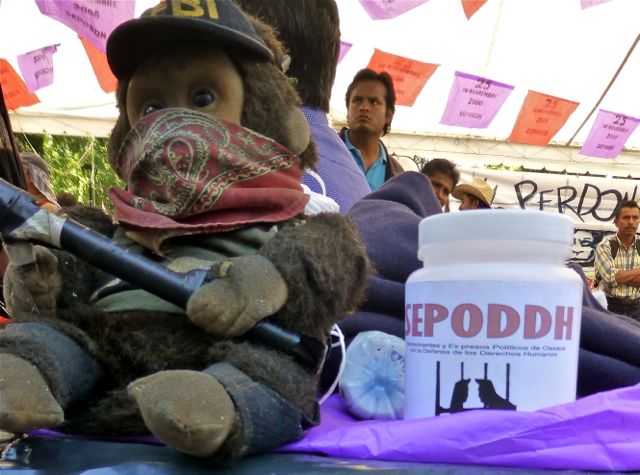
Somber and unsmiling, they stood silently, gazed at the photos, and read the captions.  The only hint of levity was SEPODDH’s mascota, who sat beside a collection bucket.

Plush monkey wearing bandana across his face.

Section 22 of the teachers’ union held another march and rallied in the zócalo, but today these photos spoke much louder than the words coming from the loud-speakers.

Read Full Post »

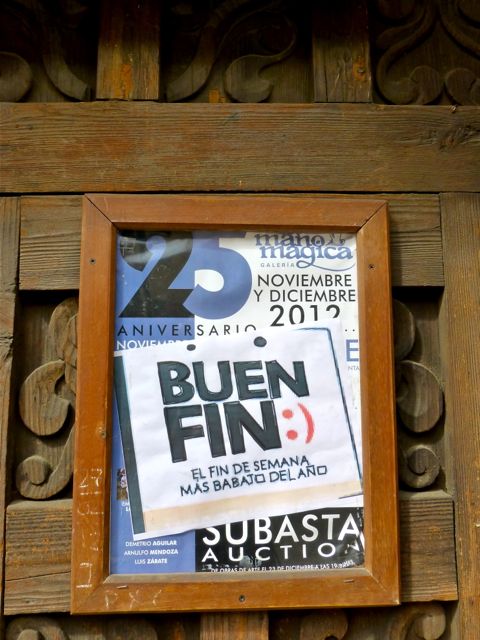
Signs reading, “Buen Fin” began to appear on shop windows around town last week.  How nice, I thought, with a 3-day weekend coming up (Monday, 11/19 was Mexican Revolution commemoration day), the stores are wishing one and all a “Good Weekend.”

Sign on carved wooden door reading, "Buen Fin. El fin de semana mas barato del año."

I’d only glanced and didn’t come close enough to read the smaller and more important print, “Weekend:  Cheapest of the Year.”  What’s it all about?  Last year’s LA Times article, “A ‘Black Friday’ shopping ritual coming to Mexico?” explains it all.

Apparently, I’ve been oblivious or this newest US export has taken a while to make its way all the way down to Oaxaca.  But, make its way down to Oaxaca, it has!  According to Monday’s Noticias, “This weekend hundreds of Oaxacans went to department stores and shops of all kinds in the city, to stock up on essentials and electronic products, mainly taking advantage of ‘Good Weekend’ promotions.”

Depressing, is all I can say…


Read Full Post »

After 6+ months of being Under construction,

today, the waiting is over!

This morning, Oaxaca’s governor, the city’s mayor, and the head of the Ministry of Tourism and Economic Development opened the newly constructed entrance on Independencia…

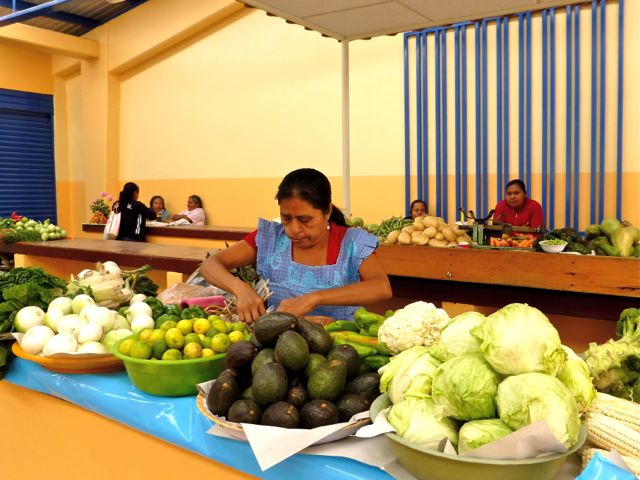
and welcomed vendors and shoppers to the newly renovated Mercado IV Centenario.

New stalls, with improved electrical and sanitation systems are part of this renovation project.

Vendors, including one of my favorite vegetable sellers, began moving their goods from the temporary site in Jardín Morelos to their new stalls.

After only a few hours, my vendedora de frutas already looked happily ensconced in her new digs!

There are still a few stalls waiting to be filled…

Any takers???


Read Full Post »

They say, “politics makes strange bedfellow.”  Rivers do too, as US, Mexico reach pact on Colorado River water sale.  Hopefully, Mexico isn’t getting the short end of the stick, like Southern California’s Imperial Irrigation District is accusing its SoCal neighbor, the Metropolitan Water District, of handing it.

Having grown up and spending most of my life in Northern California and suffering through a couple of major droughts that included water rationing, while water flowed south to fill LA’s swimming pools and water its lawns, the only answer to stave off the upcoming worldwide “water wars,” is the recognition that water is a precious resource that must be conserved and not wasted.

Hmmm… I wonder how these neighbors on the 500 block of Avenida Morelos get along?

Front of Iglesia Evangelica Bautista

Outside of vegetariano Flor de Loto restaurant

Sign on building, Mezcalería In Situ Torrentera

The mezcalería is the newest addition to the ‘hood and for some reason it tickled me that the vegetarian restaurant is the only thing standing between it and the Baptist church.

Read Full Post »

Felicitaciones to Oaxaca’s favorite daughter, Lila Downs!  Her CD, Pecados y Milagros, won Best Folkloric album at the Latin Grammys on Thursday night.  When the album first came out, her promotional tour brought her to the Guelaguetza Auditorium, just up the hill, and we got to experience the spectacular show she put on in front of the hometown crowd.

And, at the Latin Grammys, she pulled out all the “spectacle” stops when she, Celso Piña, and Totó la Momposina performed, “Zapata Se Queda” from the album.  (Yes, THAT Zapata!)

The thank you by Lila Downs, posted on her website:

¡GRACIAS por creer en el folklor! Gracias por darnos ánimos cuando andamos tristes, por hacer con su cariño y palabras de buena fe que sigamos creyendo en Zapata, en México, en la tradición, en nuestros pueblos… ¡En la magia y la fe interminable de Latinoamérica!

(Thank you for believing in the folklore!  Thank you for giving us courage when we’re sad, to make with love and words of good faith that continue to believe in Zapata, in Mexico, in tradition, in our towns …In magic and the endless faith of Latin America!)

I strongly encourage you to check out the CD, Pecados y Milagros.  It really conveys the life, the love, the history, and the reverence that is the essence of Oaxaca.

Also, there’s a terrific review of her Latin Grammy performance at Examiner.com.

Read Full Post »

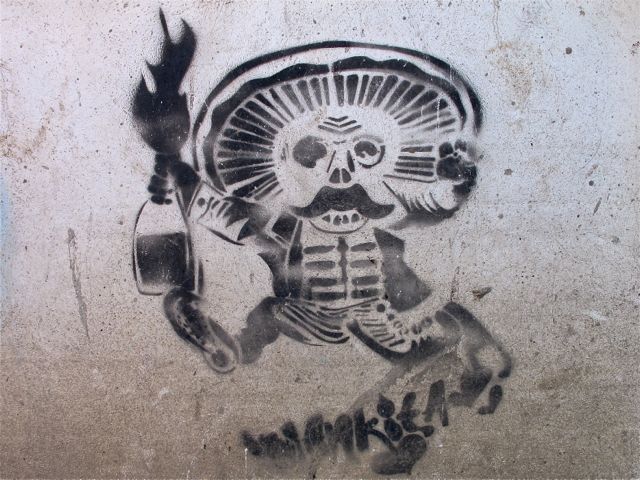
Zapata and Villa live!  Their iconic bigotes (mustaches) have taken on a life of their own on the streets of Oaxaca…

Wall art - Pancho Villa

Wall art tapete with Zapata's face in middle

Black and white skeleton face with mustache

Colorful wall mural of skeleton with mustache with female skeleton

Read Full Post »

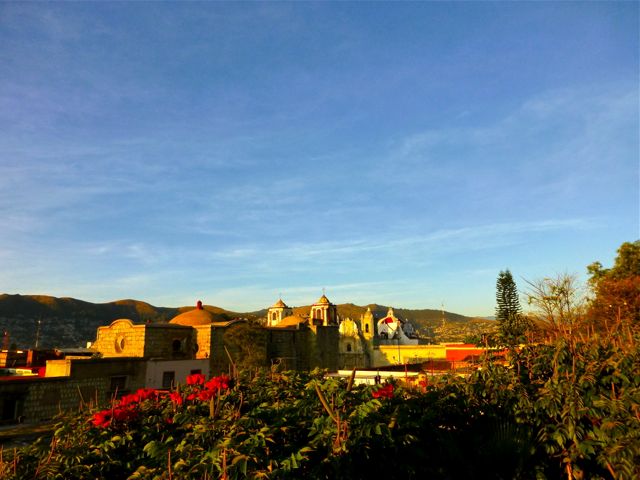
View from Casita Colibrí yesterday morning.  Ahhh…

Blue sky, African tulip trees in foreground, churches in mid-ground, mountains in distance.

Read Full Post »

You might well ask, “What is a muerteada?”  It is a comparsa (parade) that is part of traditional Día de los Muertos celebrations particular to the state of Oaxaca.  According to the book, Day of the Dead: When Two Worlds Meet in Oaxaca, the muerteada allows the dead “to ‘occupy’ a living body, either a muerteada participant or an audience member, for a time, and therefore enjoy the entertainment directly rather than vicariously.”

Like Commedia dell’Arte, there are stock characters — in this case, the happy widow, the dying or dead husband, the father of the widow, a doctor, a priest, a shaman, people dressed like death, devils, and las lloronas (weeping women).  However, unlike Commedia dell’Arte, in the muerteada men play all the roles.

Last year we joined the Vista Hermosa, Etla murteado.  However, this year blogger buddy Chris decided I was ready for the big time — the “battle of the bands” when the muerteadas of San Agustín Etla and Barrio San José meet — Banda Tromba Sinaloense for San Agustín and MonteVerde Banda for San José.  FYI:  This is after participants and their bands have danced their way up and down the hills of their respective neighborhoods all night long, stopping at designated houses for food and drink — mezcal and cervesas seemed to be the beverage of choice, especially among the men!

So, early on the Nov. 2, we went in search of the San Agustín contingent, we found them, joined in the merriment, were offered food and drink along the way, and eventually came to the crossroad where mania turned to mayhem, albeit organized mayhem — courtesy of the white-shirted security for San Agustín and red-shirted security for San José.  They kept the dancers and supporters from each side apart, leaving the face-off to the two bands.  It was wild!!!  After 20+ minutes of battling bands, it was over and we and the San Agustín contingent trudged back up the hill.

You may have spotted a tall silver-haired gringo right in the middle of the action in one or two of the photos, that would be Chris.  Be sure to check out the video he put together of all the madness.

According to Organizing Committee President, Alfredo Erick Pérez, the muerteada in San Agustín Etla dates back to the 1800s, possibly to the days of Mexican President Porfirio Díaz.

Read Full Post »

« Newer Posts - Older Posts »