Feeds:
Posts
Comments

Archive for the ‘People’ Category

A beautiful photo montage and song by Arturo Leyva honoring the 43 students of the Escuela Normal Rural Raúl Isidro Burgos, teachers’ college in Ayotzinapa, Guerrero.

The video uses some of the #IlustradoresConAyotzinapa illustrations, paintings, and embroidery by Mexican designers, artists, and artisans of the faces of the 43 student teachers of Ayotzinapa. 

In addition, journalist París Martínez has developed profiles of the 43 disappeared students by talking with their families and friends.

Read Full Post »

Tomorrow, it will be 43 days since the 43 students at the Escuela Normal Rural Raúl Isidro Burgos, teachers’ college in Ayotzinapa, Guerrero went missing.  Images of the missing are being posted online and on walls.
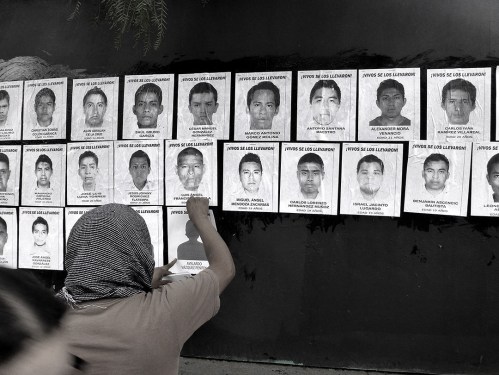
Person putting photos of missing students on wall

Oaxaca, along with the rest of Mexico, is heartbroken and outraged that her sons have not been found.  “We are not sheep to be killed whenever they feel like it”  Emiliano Navarrete, father of one of the missing students, declared following a meeting with Mexico’s president, Enrique Peña Nieto.
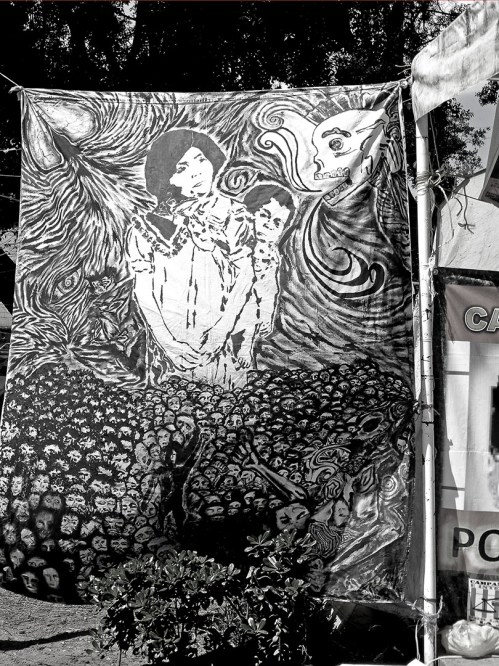
P1030011 b&w

As the brilliant Día de los Muertos colors of cempasúchil (marigolds), cresta de gallo (celosia or cockscomb), and roses began to fade, a massive march, led by the parents of the missing, filled the streets of Mexico City on November 5.
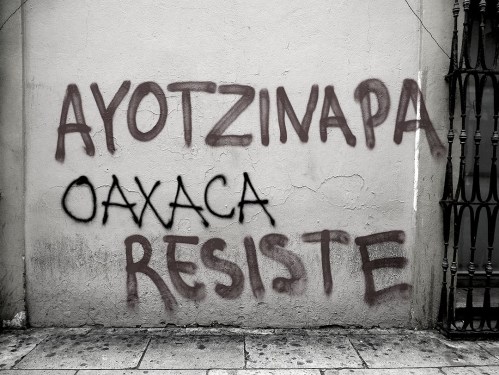
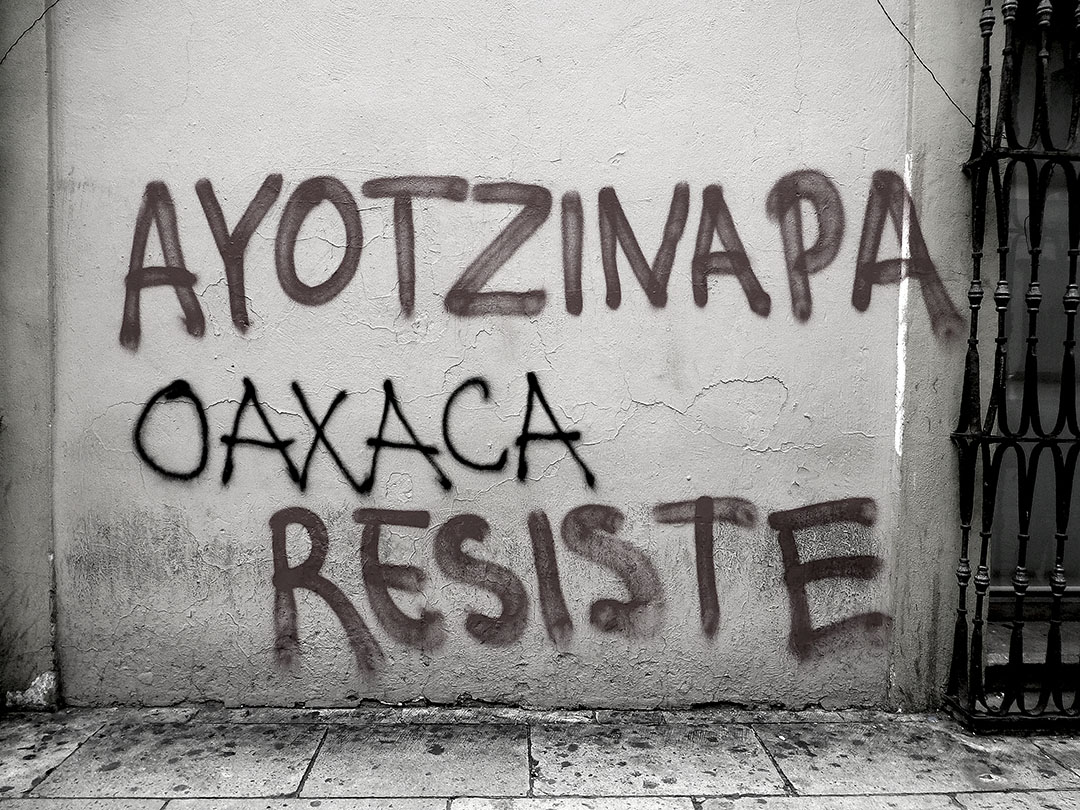
Graffiti: Ayotzinapa Oaxaca Resiste

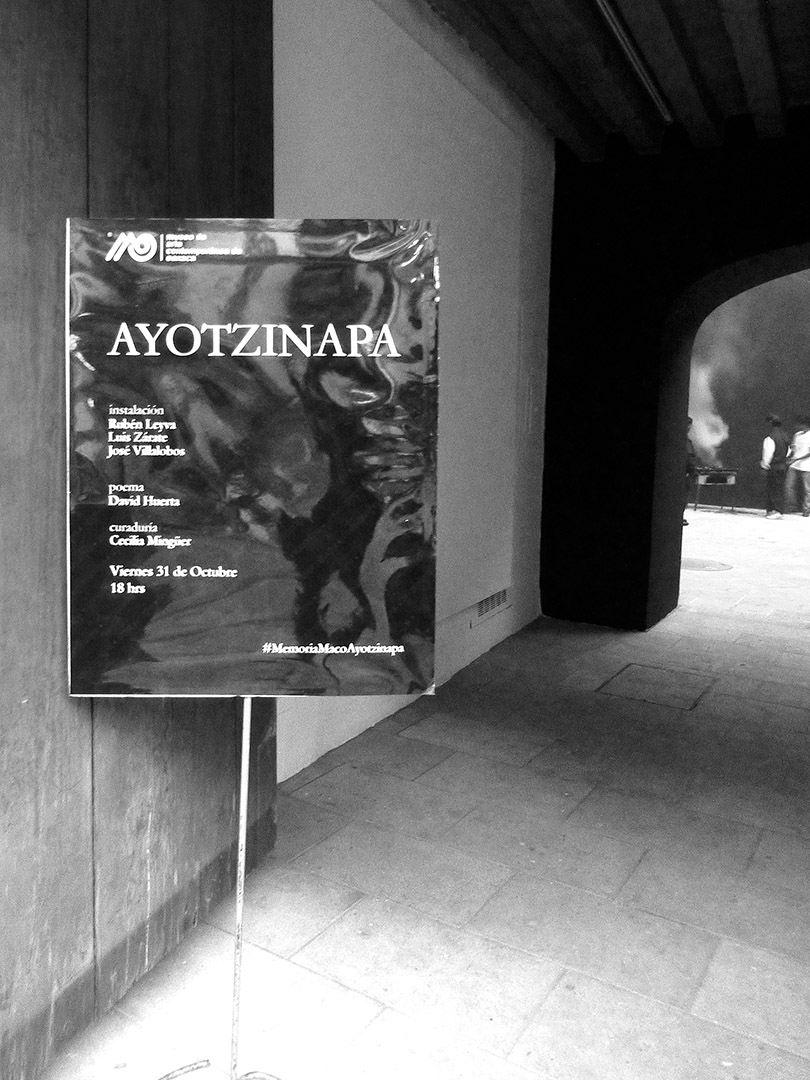
And, Oaxaca continues to add her voice on walls, in the streets, and at the Museo de Arte Contemporáneo de Oaxaca (MACO).
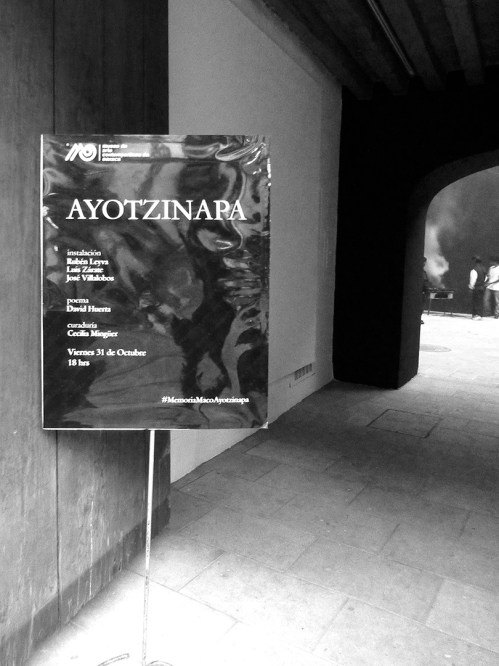
Entrance to MACO with Ayotzinapa exhibit announcement

… where a beautiful poem, simply entitled “Ayotzinapa,” fills one of the walls of the courtyard.

Ayotzinapa

Mordemos la sombra
Y en la sombra
Aparecen los muertos
Como luces y frutos
Como vasos de sangre
Como piedras de abismo
Como ramas y frondas
De dulces vísceras

Los muertos tienen manos

Empapadas de angustia
Y gestos inclinados
En el sudario del viento
Los muertos llevan consigo
Un dolor insaciable

Esto es el país de las fosas
Señoras y señores
Este es el país de los aullidos
Este es el país de los niños en llamas
Este es el país de las mujeres martirizadas
Este es el país que ayer apenas existía
Y ahora no se sabe dónde quedó

Estamos perdidos entre bocanadas
De azufre maldito
Y fogatas arrasadoras
Estamos con los ojos abiertos
Y los ojos los tenemos llenos
De cristales punzantes

Estamos tratando de dar
Nuestras manos de vivos
A los muertos y a los desaparecidos
Pero se alejan y nos abandonan
Con un gesto de infinita lejanía

El pan se quema
Los rostros se queman arrancados
De la vida y no hay manos
Ni hay rostros
Ni hay país

Solamente hay una vibración
Tupida de lágrimas
Un largo grito
Donde nos hemos confundido
Los vivos y los muertos

Quien esto lea debe saber
Que fue lanzado al mar de humo
De las ciudades
Como una señal del espíritu roto

Quien esto lea debe saber también
Que a pesar de todo
Los muertos no se han ido
Ni los han hecho desaparecer

Que la magia de los muertos
Está en el amanecer y en la cuchara
En el pie y en los maizales
En los dibujos y en el río

Demos a esta magia
La plata templada
De la brisa

Entreguemos a los muertos
A nuestros muertos jóvenes
El pan del cielo
La espiga de las aguas
El esplendor de toda tristeza
La blancura de nuestra condena
El olvido del mundo
Y la memoria quebrantada
De todos los vivos

Ahora mejor callarse
Hermanos
Y abrir las manos y la mente
Para poder recoger del suelo maldito
Los corazones despedazados
De todos los que son
Y de todos
Los que han sido

David Huerta
2 de noviembre de 2014. Oaxaca
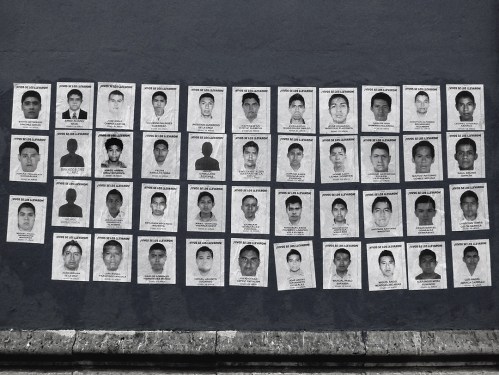
Photos of the 43 students pasted on wall

Update:  Just hours after posting this, the worst has been announced.  According to Mexico’s attorney general, “The 43 Mexican students who disappeared near Iguala, in southern Mexico in September, were kidnapped by police on order of the mayor, and turned over to a gang that killed them and burned their bodies before throwing the remains in a river….”  — CNN

I can’t even begin to imagine the pain the parents must be feeling with the knowledge of the suffering and brutality their sons endured.  I am so sad and tears are welling up.  I think I will just let them fall…

Read Full Post »

Tonight, from the valley where corn was first cultivated, I’ll be watching my San Francisco Giants play game one of Major League Baseball’s, 2014 World Series.

I was amazed to discover that one of San Francisco’s ace relief pitchers, Yusmeiro Petit, the Giants’ do-everything man, played for the Oaxaca Guerreros in 2011!!!   The Guerreros, a Triple-A team in the Mexican League play at Estadio Eduardo Vasconcelos, within walking distance (albeit, a long walk) from my apartment.  I attended several of the Guerreros’ games in 2011 and, who knows, maybe I saw him.

When I was in Mexico, I always said to myself, “This is going to be my goal, to go back to the United States and be successful,” said Petit, through a translator. “I always knew that this could happen. I didn’t know how it was going to happen, but I knew this could happen.”  (from article, Giants’ do-everything man Petit ready for any task)

 (AP Photo/Don Boomer, File)

(AP Photo/Don Boomer, File)

And, from another article:

Petit thinks his experience with the Oaxaca Warriors was crucial in his career surge.   In Mexico he learned to mix his pitches and mastered the curve.  “I was in a slump, which happens to anyone,” he said. “But in Mexico I learned that I had to work harder to keep going and to reach what I was looking for, which was to come back (to the majors) and stay here.”

¡Felicidades Yusmeiro Petit y vamos Gigantes!


Read Full Post »
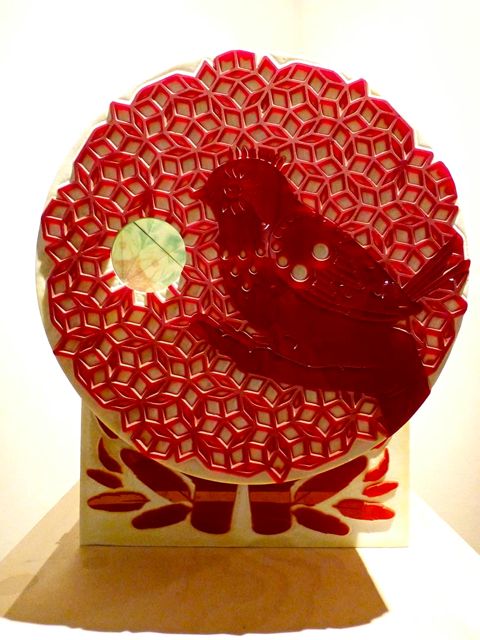
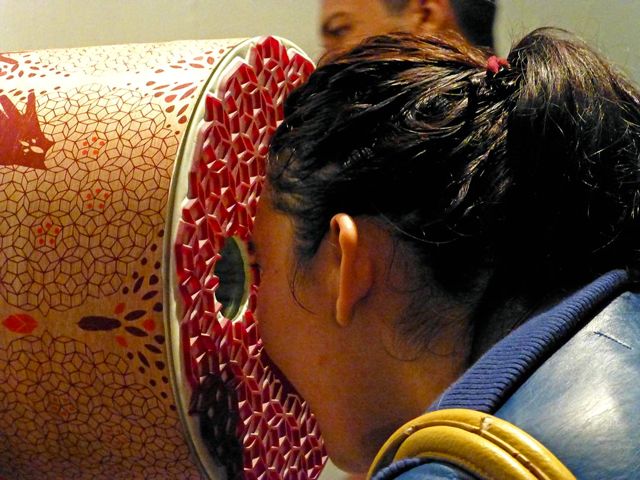
Many of you may remember Juan Martinez, mi amigo and carpenter extraordinaire of Adios mosquitos and A terrace transformed fame.  Well, he is a man of many talents — and one of them is building kaleidoscopes.  Given that his “day job” is working in the office of Gorilla Glass, he has come into contact with many of the hip, young, and talented artists currently creating in Oaxaca.  Thus, a natural collaboration ensued.   Juan + Gorilla Glass + Lapiztola stencil = an exhibition of the Lapiztola Collective’s artistry at Gorilla Gallery.

P1020733 copy

Looking into the eye of the kaleidoscope.

P1020750

What do you see?

There is the second kaleidoscope — this one a hand-crank.  Come by Gorilla Gallery on one of the next couple of Thursdays from 2 PM to 8 PM, to give it a try.

P1020742

And, be forewarned, they are working on a special Día de los Muertos kaleidoscopic project.  Prepare to be amazed!

Read Full Post »

Today, in Santa Catarina Juquila, about 200 km southwest of the city of Oaxaca, la Virgen de Juquila, is receiving a papal coronation.  Roads leading to this remote mountain village have been repaired and repaved and extra emergency services have been in place since Monday, all in anticipation of the thousands of pilgrims who were expected to descend on Juquila.

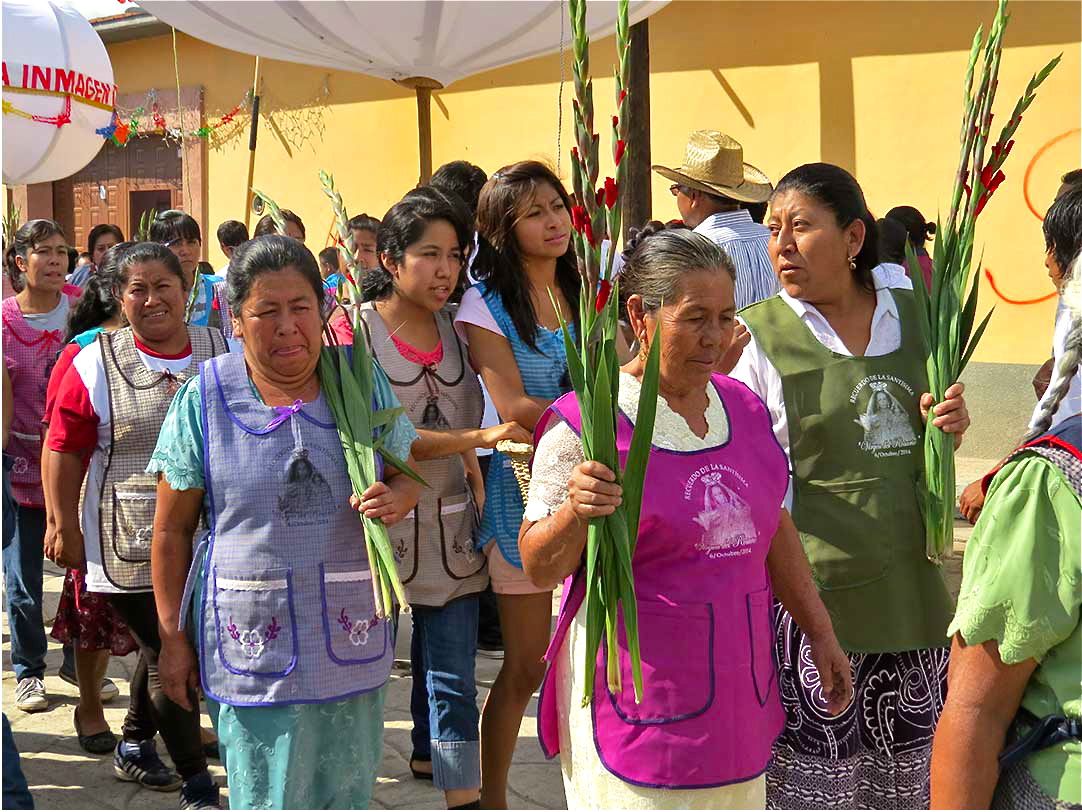
However, for those who chose to stay closer to the city, celebrations in honor of the Virgen del Rosario (Virgin of the Rosary) have been occurring for the past week throughout the valley of Oaxaca.

IMG_6012_copy2

Thus, blogger buddy Chris and I headed to Tlacolula de Matamoros on Friday for their annual procession.

IMG_6076_copy2

Beginning on the street in front of the panteón, young women wearing traditional red wool skirts and beautifully crocheted white cotton blouses…

IMG_6124_copy2

…danced their way through the streets balancing towering canastas (baskets) on their heads — the letters spelling out “Virgen del Rosario.”

IMG_6105_copy2

The arm and neck strength it takes to carry the canastas is phenomenal and can only come from years of practice.  As you can see, they begin early…

IMG_6152_copy2

Rockets announced the procession’s arrival.

IMG_6131_copy2

Bandas provided the music.

IMG_6122_copy2

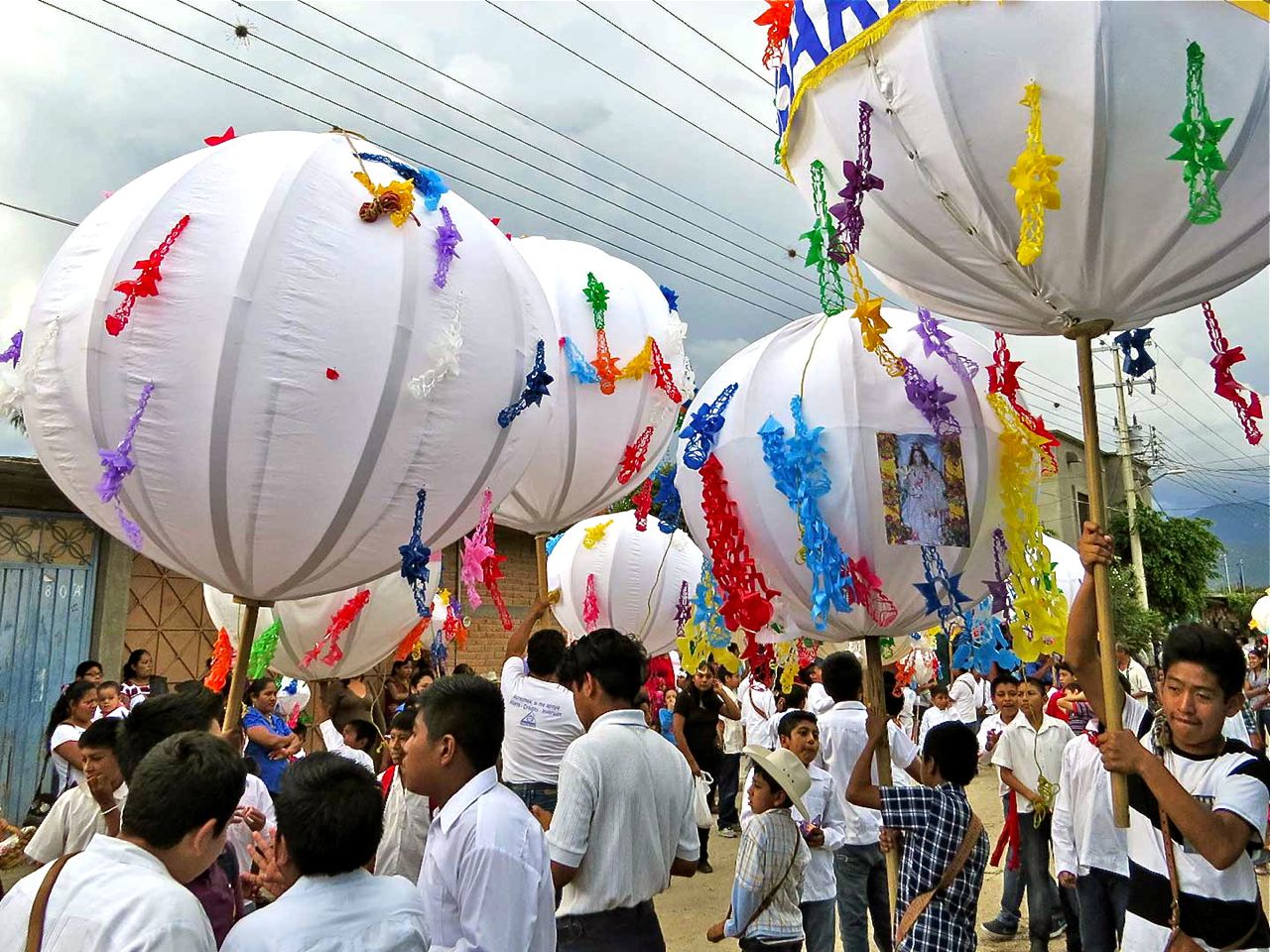
And, “boys to men” carrying marmotas two-stepped and twirled their way along the route.

IMG_6148_copy2

Years of practice is required to do this, too!

IMG_6162_copy2

Participants stop at altars throughout the village, where prayers are recited, rest breaks are taken, and tamales, sweets, and beverages (yes, including mezcal) are consumed.

IMG_6127_copy2

This goes on until 1:00 or 2:00 AM.  We arrived at 4:00 PM, stayed for a couple of hours, carried nothing heavier than our cameras and daypacks, and were ready to call it a day!

However, this is a bittersweet post.  While we were reveling in the festivities, a family in Tlacolula de Matamoros was in agony.  It was reported last night that 18-year old, Cristian Tomás Colón Garnica, from Tlacolula de Matamoros, is one of the 43 students at Normal Rural ‘Raúl Isidro Burgos’ in Ayotzinapa who went missing on September 26 in Iguala, Guerrero after police opened fire on the students, who were soliciting funds for an Oct. 2 demonstration protesting funding cuts to their state-financed school.

Read Full Post »

Yesterday, as I was walking home, the eyes of these guys caught my eye.

P1020046

More eyes beckoned me across the large driveway/parking area, that separated the mural filled walls from the sidewalk.

P1020048

A sign for Okupa Visual Oaxaca was pointing the way, so I figured I must not be trespassing and might even be welcome.

P1020052

More eyes drew me toward an open door…

P1020054

I peered inside the Taller de Grafica Experimental de Oaxaca and was greeted with the warm smile of artist, Guillermo Pacheco López.  He showed me around the light airy gallery and studio and explained the programs they offer.  We then proceeded through an open doorway into a another multipurpose space.

P1020059

Besides more gallery and workshop space, it is home to Café Panartesano and where his delightful wife, Kate, along with an assistant, bake brownies, blondies, chocolate chip cookies, oatmeal cookies, and other yummy looking sweets.  In addition, they make homemade pizza and tortas.

P1020055

As you may have guessed from the above menu, Kate is from the USA — San Francisco to be geographically precise.  We had much in common and I stayed for almost half an hour chatting with her.  Naturally, I couldn’t resist buying a chicken with zucchini and red bell pepper torta on focaccia, which was muy sabrosa!

P1020057

If you are in town, I highly recommend stopping by Taller de Grafica Experimental de Oaxaca and Café Panartesana.  They are located at La Noria 305 (at the corner of Melchor Ocampo).

Nourishing body and soul — that’s Oaxaca!

Read Full Post »

Feliz cumpleaños to Cantinflas.  Today, the beloved Mexican actor, comedian, writer, and producer, born Fortino Mario Alfonso Moreno Reyes, would have turned 103.  I’ll be waiting in line to the movie, Cantinflas, based on his life, when it opens in Mexico on September 19, 2014.  For those in the USA, you get first crack, as it is scheduled to open on August 29, 2014.

Cantinflas on a wall in Teotitlán del Valle

Image of Cantinflas on a wall in Teotitlán del Valle — painted by the lovely and multi-talented, Luvia Lazo.

I would also like to say RIP, Robin Williams, another actor with the gift of combining humor and pathos.  How blessed we are to have shared this planet with both and to continue to have the opportunity to experience their creative genius.

Read Full Post »

One of the qualities that amazes me about most Oaxaqueños is their patience with waiting in interminable lines.  On the one hand, I think those north of the border could take some much-needed lessons in civil and well-mannered behavior.  However, on the other hand, I think Oaxaqueños deserve much better than having to stand in endless lines, be it the bank, a government agency, or to get tickets to a concert by their favorite daughter, Lila Downs.

Lila Downs with bottle of mezcal

Last year, unable to figure out the hows and wheres of getting a ticket to her free concert during the ten days of the Guelaguetza festivities, I was on the verge of giving up getting tickets to see Lila Downs, when friends coming in from out-of-town(!), offered a couple to me.  Of course, I accepted!

Lila Downs fluttering skirt

This year, after several false leads, on Tuesday morning L and I climbed back up to the Guelaguetza Auditorium to try to score some tickets to this year’s free concert.  The box office was scheduled to open at 9 AM, we got up there at 8:30 AM and found ourselves at the end of a line that stretch halfway to the planetarium AND that continued to grow as the hours ticked by.  Abuelos, niños, moms, dads, and teens lined the pathway, talking on cell phones, eating, talking, and laughing — without a raised voice or harsh word spoken.

Lila Downs with guitar

At almost 10 AM, when the line hadn’t moved an inch, I walked down the hill to the box office to see what was happening.  Nothing, as it turned out!

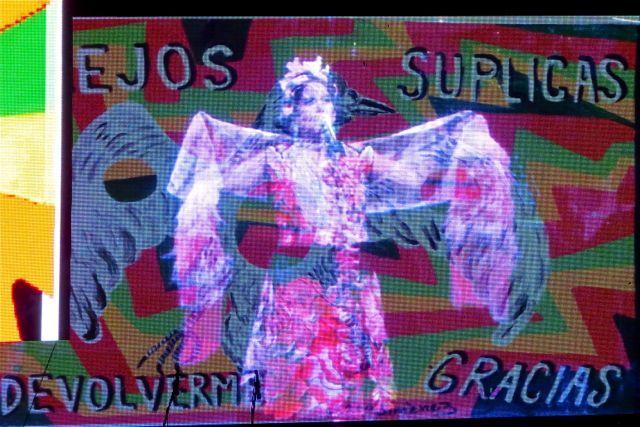
Projected image of Lila Downs

However, good-natured patience finally succumbed to whistles and shouts by those who were in the line of sight of the ticket booth — after all, according to the newspaper they had begun lining up at 4:30 AM!!!

Lila Downs arm raised

I wound my way back up the hill to report my findings to L.  Alas, after another 45 minutes of no movement, impatient gringas that we are, we gave up.  However, to borrow from the musical Sound of Music, “somewhere in [our] youth or childhood, [we] must have done something good,” because 48 hours later, my neighbor presented us with tickets!  And so last night, we climbed back up Cerro Fortín to see Lila Downs.  We were very happy campers.

IMG_5134

She put on another spectacular show — mixing new tunes with old, incorporating several of the Guelaguetza delegations into the production, and generally bringing cheers and sing-a-long voices from the hometown crowd.  By the end, everyone was on their feet.

Read Full Post »

This post is really just an excuse to post photos of two young women who are presiding over this year’s Guelaguetza activities.  The first is the Reina (queen) of the 4th Expo Feria del Queso y Quesillo.  She is a writer, loves books, and her eyes lit up (even more!) when I told her I was a librarian.  She and her mother were so gracious and radiated joy and warmth.  Alas, I didn’t catch her name; if anyone knows, please post in comments.

Friday evening, the Diosa Centéotl (corn goddess) was chosen to reign over this year’s Guelaguetza.  Jacqueline Reyes Rosario Sarabia, a native of Santo Domingo Tehuantepec, Oaxaca, was selected from 33 participants who represented the 8 regions of the state of Oaxaca in a 2-part competition.  Each entrant was required to make a presentation, in both her native language and in Spanish, about the gastronomy, crafts, dances, legends, traditions, and customs of her village and on the clothing of her region.  Even though we were way in the back, Jacqueline caught our attention with her impassioned speech.  One of the first of her duties was to lead yesterday’s desfile (parade of the Guelaguetza delegations) through the streets of the city of Oaxaca.

I love Jacqueline’s reaction when her name was announced as Diosa Centéotl 2014.

Read Full Post »

Four days of non-stop sights, sounds, and adventures in Mexico City with my BFF is coming to a close.  So much to do and see, there’s been no time for blogging.  However, all my bags are packed and I have a few minutes…

Today, L and I ventured out to the Museo Dolores Olmedo in Xochimilco, at the southern end of Mexico City.  The museum houses her extraordinary collection of Frida Kahlo and Diego Rivera’s work (25 of her pieces and 145 of his), 6000 pre-Hispanic figurines and sculptures, exquisite Chinese ivory, porcelain, cloisonné and lacquer, along with other works of art and artesania.  The gardens of this former 16th century hacienda are beautifully landscaped and provide a tranquil escape from the big city.  And, they are home to a muster of peacocks.  I have no idea how many, but they seemed to be everywhere.

And that’s not all.  A pack of Xoloitzcuintles (Mexican hairless dogs) also reside on the grounds, seeming to “pose” for visitors; they especially like the Xolo sculpture in their part of the garden.  As anyone who has seen the dogs depicted in pre-Columbian figurines can see, their origins date long before the Spanish ever knew of the Americas. 

Museo Dolores Olmedo isn’t easy to get to — it took several metro lines, a train, and a bus to get us there and back — but it was well worth it!!!

Now back to Oaxaca for desfiles (parades), ferias, artesania, and Guelaguetzas.

Read Full Post »

This afternoon, the headline of Noticias announced, “Oaxaca paralyzed by Mexico-Brazil match.”  It goes on to report that zócalo restaurants offered drink promotions and there were cries, sighs, applause, and prayers as people were glued to the TV monitors and their mobile devices. 

I, too, have caught World Cup fever.  I’m relatively new to fútbol/soccer (my sons played American football), but began learning during Mexico’s march to the Gold during the summer Olympics two years ago.

Still in California, today I was one of the Millions of U.S. Soccer Fans … Cheering for Mexico.  Friday, I watched Mexico’s 1-0 (should have been, 3-0) defeat of Cameroon by myself, albeit from the comfort of my younger son’s living room (he was at work).  However, for today’s match against Brazil, I headed to Sweetwater Music Hall and their ginormous screen.

Screenshot of Chicharito and Brazilian player

It was a full house and cries, sighs, applause, and prayers were evident there, too.  I’d say the crowd was 60-40 for Mexico, though some of the Brazilian contingent was particularly vocal.  Our (El Tri’s fans) hopes rose when Chicharito FINALLY came into the game, but in the end, the score remained nil-nil.  No scoring?  No, but it was a great game and Mexico’s goalkeeper Memo Ochoa played the game of his life.

Screenshot of Guillermo Ochoa

Immediately following the game, Memes Hail Guillermo ‘Memo’ Ochoa’s Remarkable Saves for Mexico vs. Brazil.  I was going to try to add to it, by putting his face on an airborne Moctezuma during Danza de la Pluma, but I don’t have Photoshop on this computer.  Anybody?  Chris???

¡¡¡ #VamosMexico !!!

Read Full Post »

Mexico has a long and important place in the history of communication through murals — from stories related by pre-Hispanic civilizations…

Maya fresco circa 790 C.E. - Bonampak, Chiapas

Maya fresco circa 790 C.E. – Bonampak, Chiapas.

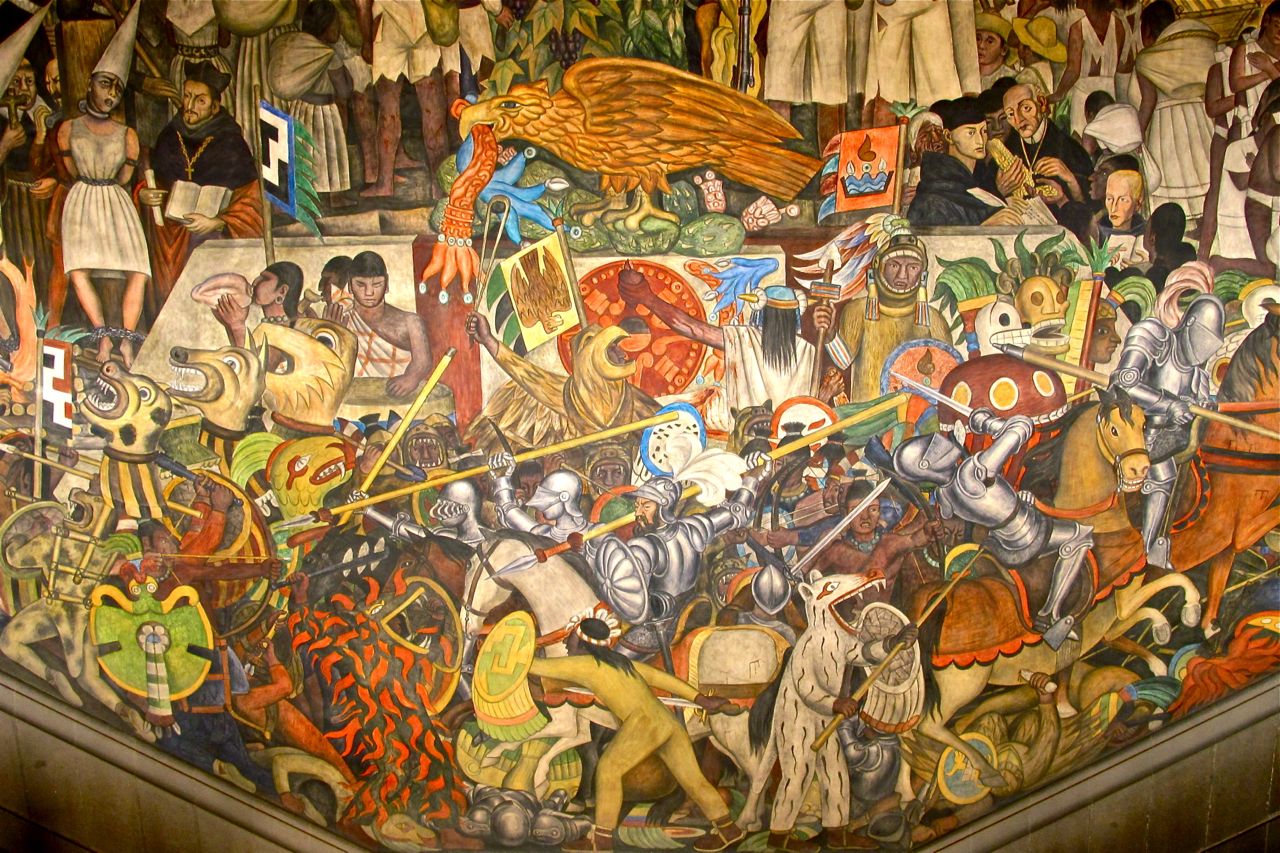
through the world-renowned and influential Mexican muralists of the twentieth century:  Orozco, Rivera, Siqueiros, and others.

History of Mexico by Diego Rivera, 1931 - National Palace, Mexico City.

History of Mexico by Diego Rivera, 1931 – National Palace, Mexico City.

And, as many of you know, murals on the walls of Oaxaca are part of the urban landscape, authorized or not, like them or not, they celebrate…

One of the murals in the pedestrian tunnel to the Guelaguetza auditorium.

One of several murals in the pedestrian tunnel to the Guelaguetza auditorium in Oaxaca city.

educate…

San Antonino Castillo Velasco, Oaxaca.

San Antonino Castillo Velasco, Oaxaca.

reveal past and present — and hopes and fears for the future.

Calle Tinoco y Palacios, between Vasconcelos and Niños Héroes.

Calle Tinoco y Palacios, between Vasconcelos and Niños Héroes, Oaxaca city.

Those found on the streets we expect to be ephemeral, but commissioned work, both inside and outside of buildings, we hope would have a longer and more permanent lifespan.  Of course, the Rockefeller family’s destruction of Diego Rivera’s Rockefeller Center mural showed differently.  And, more recently, my friend and artist, Mike Alewitz experienced the obliteration of his mural on the side of the Pathfinder Building, also in New York.  Both were instances of political differences and, while distressing, perhaps not too surprising.

However, today Mike is leading a battle in defense of his students’ murals.  According to NBC Connecticut:

Central Connecticut State University (CCSU) has built up one of the largest mural collections in the country since the program started in 2001. But Professor Mike Alewitz, who oversees CCSU’s mural painting program, said that collection is at risk.

The school has painted over six of the murals without notice and plans to do the same with another 12, Alewitz said Richard Bachoo, director of operations, confirmed. He said he hopes an appeal to the university and community support will protect the remaining murals.

“It made them feel part of the larger world, that they weren’t looking at blank walls inside an institution, but they were looking at the hopes and dreams of young people,” Alewitz said. “We found out that 18 murals were scheduled to be destroyed.”

<snip>

He says in the 14 years the mural program has existed, the policy has never been implemented in this way. Alewitz said in a statement that this is “the largest destruction of public art in recent history.” While administrators have removed murals in the past, they normally consult with the art department first, he said.

“The real policy has been that people love the murals, so when they’ve been painted, they’ve stayed up,” Alewitz said.

Oaxaca would lose much of her character and lessons would be lost, if we were to wake one morning and find all her murals disappeared.  The story is the same at CCSU.  For the full article, click HERETo send messages of protest and to see some of the amazing student murals that enliven the walls and stimulate thinking at CCSU but are slated for destruction, click HERE.  And, Why Bureaucrats Fear Art, is a letter to students and fellow artists, by Mike Alewitz.

Read Full Post »
Yippee!!!  A new, and extremely colorful, species of grasshopper has been discovered in the pine-oak forest of the Sierra Madre del Sur Mountain Range in Oaxaca.  Liladownsia fraile has been named for Oaxaca’s favorite daughter and one of my favorite performers, Lila Downs, someone I’ve written about often.

(Photo Credit: UCF)

(Photo Credit: UCF)

From Science Codex,

A newly discovered grasshopper by University of Central Florida scientists now bears the name of Grammy-award winning singer and activist Ana Lila Downs Sanchez.

The scientists named the new species discovered on the side of a mountain road near Oaxaca, Mexico, after the Mexican-American singer as a nod to her efforts to preserve indigenous culture and penchant for wearing colorful, local costumes as part of her performances.

“It was primarily Paolo’s idea to name the grasshopper after the singer” said Derek Woller, one of the authors of the paper referring to colleague Paolo Fontana. “He’s a big fan of Lila Downs (her stage name). The grasshopper is so beautiful, so vibrant and colorful. When he told us all about her, her work, her colorful clothes, and that she was born in the region where we found the specimens, we thought, yeah, that’s great, let’s do it.”  Read full article HERE.

According to the Zootaxa article, Studies in Mexican Grasshoppers: Liladownsia fraile, a new genus and species of Dactylotini (Acrididae: Melanoplinae) and an updated molecular phylogeny of Melanoplinae (a mouthful, I know, but the photos are worth scrolling through the article), Liladownsia fraile had been sighted in San José del Pacifico, Suchixtepec, and Pochutla.

By the way, if you are in Oaxaca, Lila Downs is performing tonight at the Teatro Macedonio Alcalá — a benefit for Fondo Guadalupe Musalem, a nonprofit dedicated to improving the lives of the young indigenous women of Oaxaca through education.

poster for benefit

Read Full Post »

Even though the significance of May 1, as International Workers’ Day, had its origin in the USA, it is not celebrated there (for a variety of reasons I won’t go into here).  However, like most countries in the world, Día del Trabajo is a national holiday in Mexico.  To honor labor everywhere, here is Oaxaca’s favorite daughter singing her song, “Mother Jones.”

“Pray for the dead, but fight like Hell for the living.”  — Mary Harris Jones (aka, Mother Jones, the miners’ angel)

Read Full Post »

According to the Indigenous Farmworker Study (IFS), there are approximately 165,000 indigenous Mexican farmworkers and their children living  in California — with a significant percentage coming from the state of Oaxaca.  Writer and photographer David Bacon has been photographing and interviewing indigenous Mexican migrants working in California’s agricultural fields for many years.  The following Truthout article is from his photo-documentary project, Living Under the Trees, sponsored by the California Council for the Humanities and California Rural Legal Assistance.

Young, at Work in the Fields

by David Bacon

(Photo: Bacon/After Image)

(Photo: Bacon/After Image)

Most young farm-workers in California are migrants from Mexico, especially the south of the country, where many people share an indigenous culture and language. Ricardo Lopez, living in a van with his grandfather in a store parking lot in Mecca, a tiny farmworker town in the Coachella Valley, says working as a migrant without a formal home was no surprise:

This is how I envisioned it would be working here with my grandpa and sleeping in the van. It’s hot at night, and hard to sleep well. There are a lot of mosquitoes, very few services, and the bathrooms are very dirty. At night there are a lot of people here coming and going. You never know what can happen; it’s a bit dangerous. But my grandfather has a lot of experience and knows how to handle himself. With the money I earn I’m going to help my mother and save the rest. I’ll be attending college in the fall at Arizona Western College—my first year. I want to have a good job, a career. I’m not thinking of working in the fields. Not at all. I look at how hard my grandfather has worked. I don’t want to do field work for the rest of my life because it’s so hard and the pay is so low.

Lopez describes the reality for farmworkers in California in a way that gives tangible meaning to the facts and numbers describing farmworker life. There are about 120,000 indigenous Mexican farmworkers in California. Counting the 45,000 children living with them, that is a total of 165,000 people. They are the most recent migrants from Mexico. They speak twenty-three languages, come from thirteen different Mexican states, and have rich cultures of language, music, dance, and food that bind their communities together.

<snip>  Click HERE to read full article.

This project is therefore a reality check. The idea is to give indigenous migrant communities a vehicle they can use to find support for dealing with the social problems they face, such as housing, low wages, and discrimination. This documentary work is not neutral. Its purpose is to help provide a means for people to organize and win support in a world that, at best, treats them as invisible, and at worst demonizes them. I used to be a union organizer, and this work is very similar. Social documentation not only has to have an engagement with reality, but should try to change it.

Click HERE to read full article.

Read Full Post »

« Newer Posts - Older Posts »