Feeds:
Posts
Comments

Archive for the ‘Holidays’ Category

Life and death is a family affair…

This slideshow requires JavaScript.

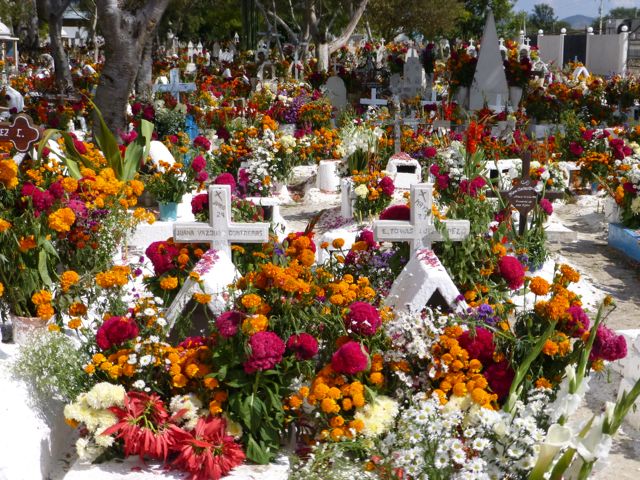
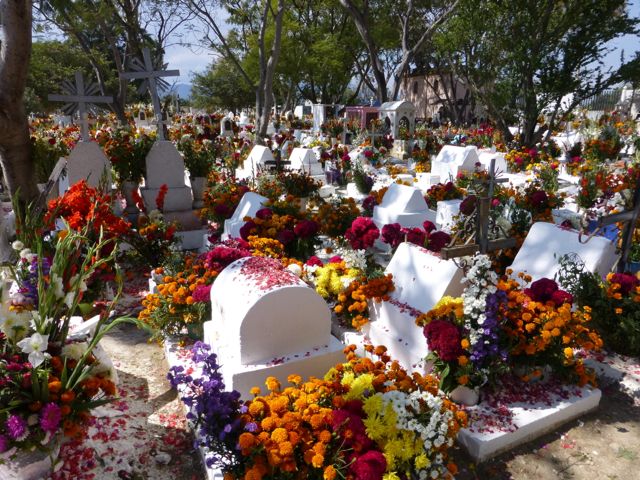
November 1 and 3, 2012 in the panteón municipal, San Antonino Castillo Velasco.

Read Full Post »

The Y-shaped valley of Oaxaca is about 700 square kilometers, not all that big when compared to California’s Sacramento Valley, which is approximately 2,570 square kilometers.  Yet, unlike the “sameness” one encounters in Sacramento Valley towns (sorry, CA), one can’t help but be struck by the unique identity of each of the Zapotec villages that are only kilometers apart.  One specializes in red clay pots, another in black pottery, and another in green glazed ceramics.  There are villages of woodcarvers near weavers of cotton and others of wool, never mind the fashion trends!

Thus, it should come as no surprise that Day of the Dead celebrations and cemeteries differ, often dramatically, from village to village.  And so, from the whitewashed graves of Santiago Apóstol and the candlelight of Santa María Atzompa (today’s earlier post), we came to the carved wooden crosses in the Panteón Municipal of the Villa de Zaachila.

This slideshow requires JavaScript.

Along with livestock, produce, and household goods, wood gathered from the hills surrounding Zaachila is a major part of Zaachila’s weekly Thursday tianguis (open air market).  It’s one of my favorites!

Read Full Post »

With only a couple of days left in November and the Christmas holiday season already making its presence known, it’s now or never to finish sorting through this year’s Día de los Muertos photos — my thoughts and impressions will take the remains of this lifetime, and then some, to process.

To an outsider, especially one whose worldview was shaped by a Judeo-Christian culture, Day of the Dead is often seen through the lens of juxtaposition.

The “unbearable lightness of being” in Santiago Apóstol…

Whitewashed graves covered with multicolored fresh flowers

Whitewashed graves covered with multicolored fresh flowers

Whitewashed graves covered with multicolored fresh flowers

Whitewashed graves covered with multicolored fresh flowers

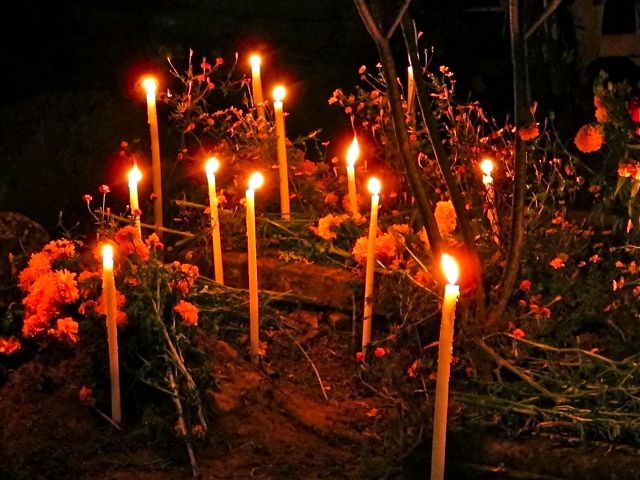
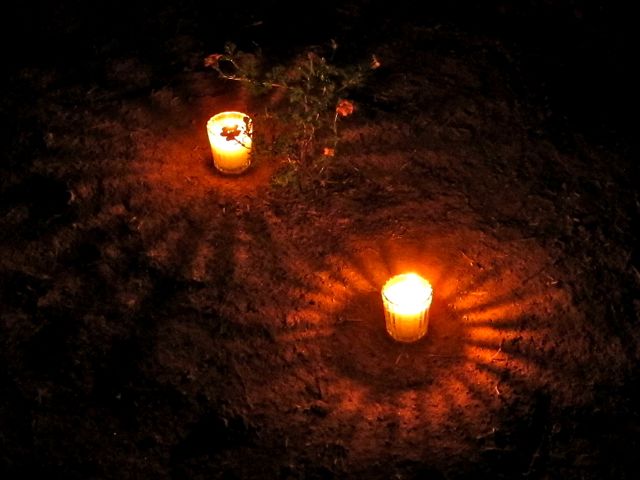
The blurred otherworldly darkness of Santa María Atzompa…

Night shot of tall lighted candles perched around and on graves.

Night shot of tall lighted candles perched around and on graves.

Night shot of tall lighted candles perched around and on graves.

Night shot of two lighted votive candles casting halos on the ground

However, light becomes dark becomes light becomes dark, as day becomes night becomes day becomes night, as life becomes death becomes life becomes death…  dualism beginning to vanish.

Read Full Post »

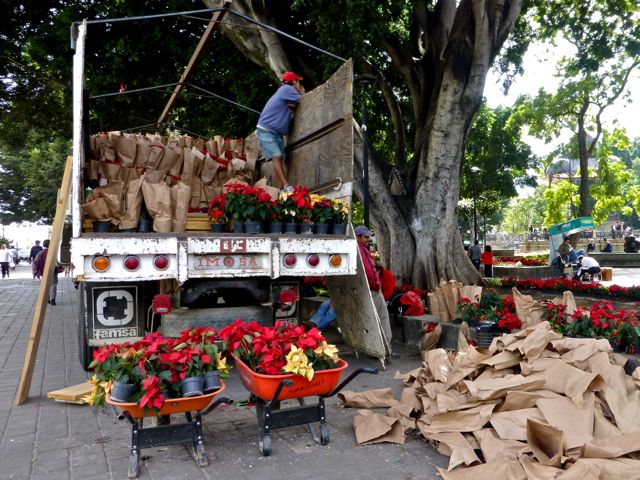
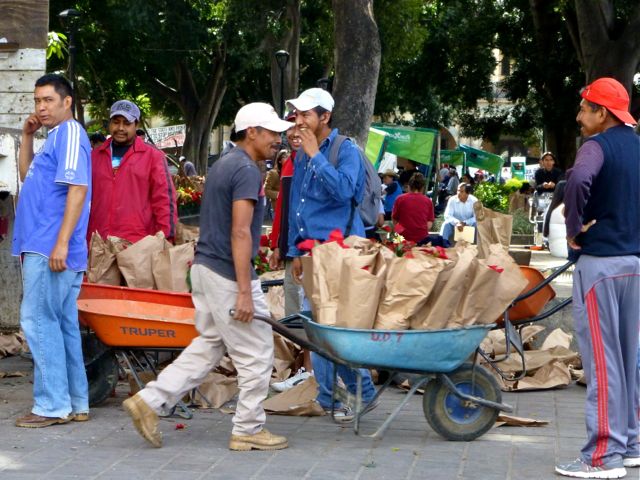
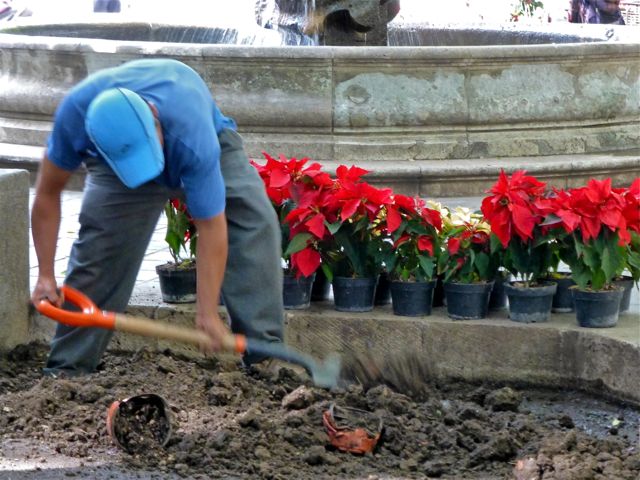
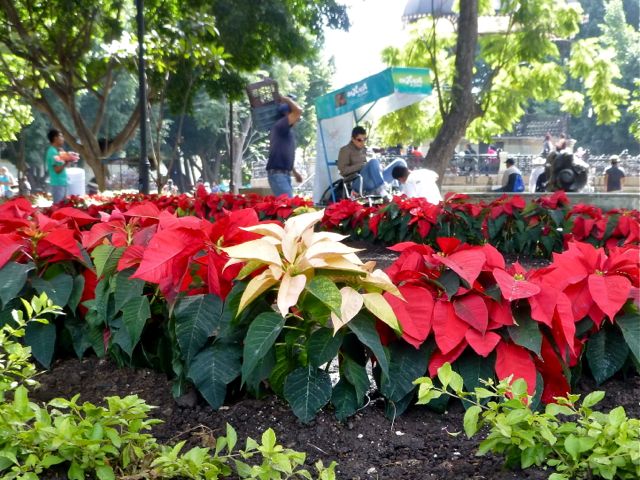
Today, the truck arrived, the wheelbarrows were loaded, and the gardening crew began filling the flower beds of Oaxaca’s zócalo…

Truck filled with poinsettias

Workers with wheelbarrows filled with poinsettias

Worker digging up flower bed, with poinsettias in pots in background

Mass of red and one white poinsettias in flower bed.

Navidad is coming to Oaxaca!

Read Full Post »

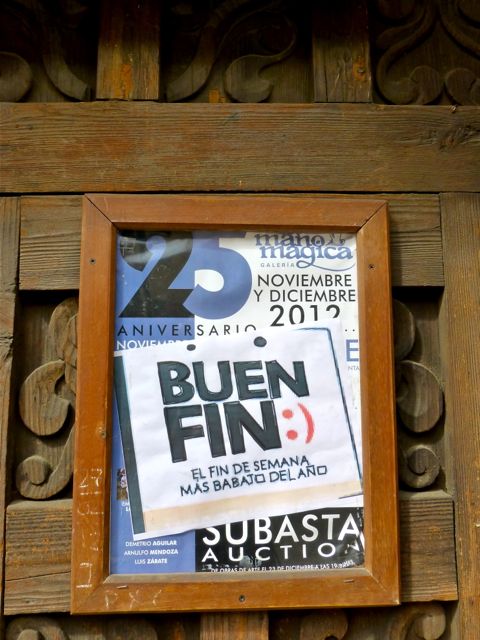
Signs reading, “Buen Fin” began to appear on shop windows around town last week.  How nice, I thought, with a 3-day weekend coming up (Monday, 11/19 was Mexican Revolution commemoration day), the stores are wishing one and all a “Good Weekend.”

Sign on carved wooden door reading, "Buen Fin. El fin de semana mas barato del año."

I’d only glanced and didn’t come close enough to read the smaller and more important print, “Weekend:  Cheapest of the Year.”  What’s it all about?  Last year’s LA Times article, “A ‘Black Friday’ shopping ritual coming to Mexico?” explains it all.

Apparently, I’ve been oblivious or this newest US export has taken a while to make its way all the way down to Oaxaca.  But, make its way down to Oaxaca, it has!  According to Monday’s Noticias, “This weekend hundreds of Oaxacans went to department stores and shops of all kinds in the city, to stock up on essentials and electronic products, mainly taking advantage of ‘Good Weekend’ promotions.”

Depressing, is all I can say…


Read Full Post »

You might well ask, “What is a muerteada?”  It is a comparsa (parade) that is part of traditional Día de los Muertos celebrations particular to the state of Oaxaca.  According to the book, Day of the Dead: When Two Worlds Meet in Oaxaca, the muerteada allows the dead “to ‘occupy’ a living body, either a muerteada participant or an audience member, for a time, and therefore enjoy the entertainment directly rather than vicariously.”

Like Commedia dell’Arte, there are stock characters — in this case, the happy widow, the dying or dead husband, the father of the widow, a doctor, a priest, a shaman, people dressed like death, devils, and las lloronas (weeping women).  However, unlike Commedia dell’Arte, in the muerteada men play all the roles.

Last year we joined the Vista Hermosa, Etla murteado.  However, this year blogger buddy Chris decided I was ready for the big time — the “battle of the bands” when the muerteadas of San Agustín Etla and Barrio San José meet — Banda Tromba Sinaloense for San Agustín and MonteVerde Banda for San José.  FYI:  This is after participants and their bands have danced their way up and down the hills of their respective neighborhoods all night long, stopping at designated houses for food and drink — mezcal and cervesas seemed to be the beverage of choice, especially among the men!

So, early on the Nov. 2, we went in search of the San Agustín contingent, we found them, joined in the merriment, were offered food and drink along the way, and eventually came to the crossroad where mania turned to mayhem, albeit organized mayhem — courtesy of the white-shirted security for San Agustín and red-shirted security for San José.  They kept the dancers and supporters from each side apart, leaving the face-off to the two bands.  It was wild!!!  After 20+ minutes of battling bands, it was over and we and the San Agustín contingent trudged back up the hill.

You may have spotted a tall silver-haired gringo right in the middle of the action in one or two of the photos, that would be Chris.  Be sure to check out the video he put together of all the madness.

According to Organizing Committee President, Alfredo Erick Pérez, the muerteada in San Agustín Etla dates back to the 1800s, possibly to the days of Mexican President Porfirio Díaz.

Read Full Post »

In addition to graveside gatherings and decoration, altars, parades, sugar skulls, sand paintings, marigolds, and Day of the Dead bread, painted faces are another distinctive feature of Día de Muertos celebrations.  They are most likely seen hanging around cemeteries and dancing through the streets but, like everything else here, you just never know…

This slideshow requires JavaScript.

From Meaning of Dia de los Muertos Face Painting:

The day of the dead in Mexico is a fascinating mixture of Spanish Catholic and native Aztec traditions and beliefs. Skulls and skeletons were an important part of All Saints Day festivals in medieval Europe, especially since the Black Death ravaged the population of Europe in the 1300s. Across Europe artists, playwrights and poets mused on the theme of ‘memento mori’ (remember death) and the ‘dance of the dead’. Many artworks and books from the time depict dancing skeletons, or portraits with a skull to ‘remember death’.

At the same time, in Mexico, the Aztec culture believed life on earth to be something of an illusion – death was a positive step forward into a higher level of conscience. For the Aztecs skulls were a positive symbol, not only of death but also of rebirth.

Read full article here.

Read Full Post »

Last night we went to my favorite panteon (cemetery) at Atzompa, today we visited six villages, and tonight I went with out-of-town guests to the Panteon General here in Oaxaca.   First thing tomorrow morning a comparsa (parade) and then probably off to Teotitlán del Valle.  I’ve already taken hundreds and hundreds of photos, but there has been no time to even look at them!

So, in the meantime…  My pan de muerto (Day of the Dead bread) from Sunday’s trip to Tlacolula.

Four small loaves of decorated bread

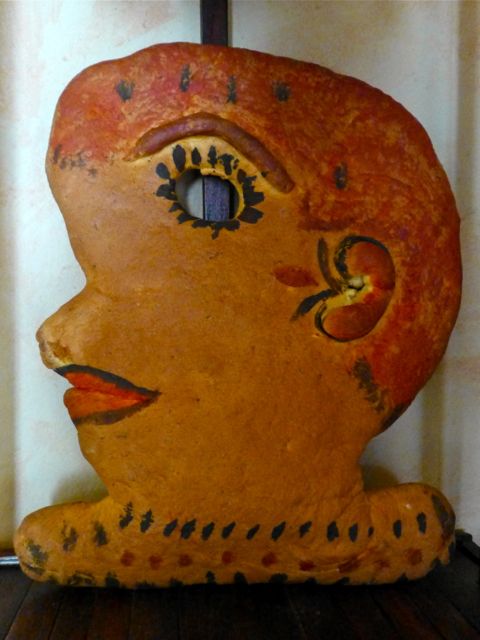
Very special pan de muerto from Restaurante La Abeja just a few blocks from Casita Colibrí.  This one will eventually get two coats of shellac and join her sister (purchased last year) hanging on the wall.

Bread in the shape of the profile of a woman's face

Last, but not least, my altar where photos of departed family and friends join apples, tangerines, pan de muerto, sugar skulls, candles, and incense of copal.

Day of Dead home altar with fruit, candles, bread, calaveras, sugar skulls, etc.

This is a magical time to be in Oaxaca.

Read Full Post »

Sunday, blogger buddy Chris and I drove out to Tlacolula for market day.  It didn’t take long to realize this wasn’t your usual Sunday market — there seemed to be twice the number vendors and twice as many shoppers.  It was the Sunday before the Días de los Muertos and this mega mercado was providing those who live in the surrounding area with everything they could possible need for their ofrendas (Day of the Dead altars).

Mounds of apples, tangerines, and other fruit.

mounds of bananas and tangerines

Rows upon rows of pan de muerto (the special Day of the Dead bread).

Pan de muerto

Wheelbarrows full of peanuts and pecans.

Wheelbarrow full of nuts

And, in the city of Oaxaca, special Muertos vendor stalls have been set up between the Benito Juárez Mercado and 5 de Mayo Mercado for city dwellers to stock up.  Intricately decorated sugar and chocolate skulls (calaveras) to satisfy the sweet tooth of Mictlantecuhtli (Goddess of Death).

Shelves of sweet calaveras

Decorated clay incense burners…

Clay three-legged incense burners

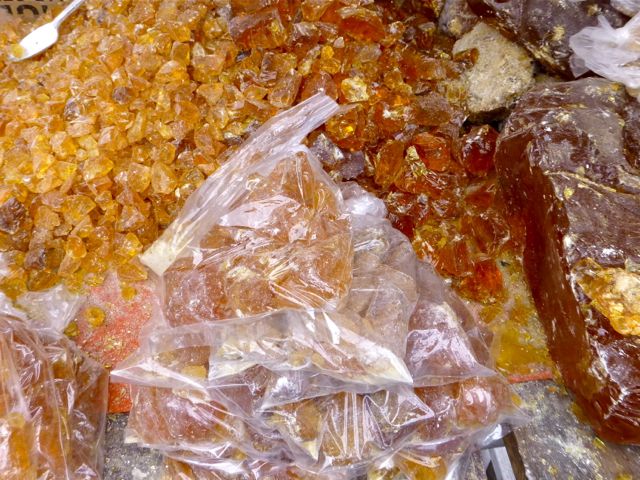
waited to burn copal resin and perfume the air with its wonderful, and now familiar, scent.

Bags and piles of copal resin

Doll house size tables were filled with miniature clay food and beverages (favorites of the departed) …

Tiny tables with miniature clay foods and beverages

and included these diminutive plates of mole and arroz (rice) — which I couldn’t resist buying for my altar!

Tiny plates of ceramic mole and arroz

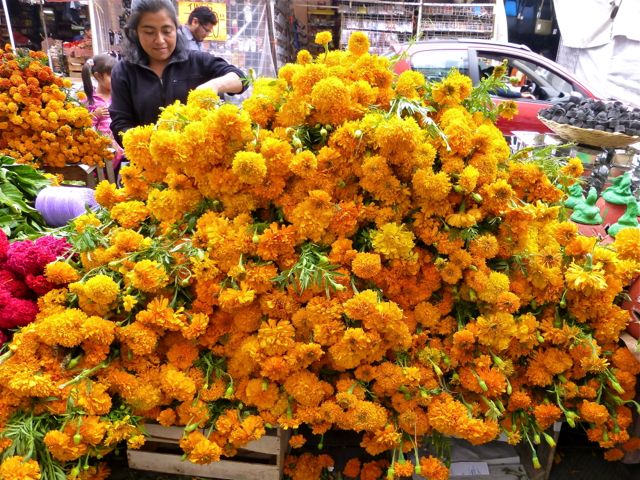
And, of course, there were mounds and mounds of Cempazuchitl (marigolds), the flower of the dead, that grows wild in Oaxaca at this time of year.

Pile of marigolds

All the necessary purchases have been made, now to build my ofrenda.

Read Full Post »

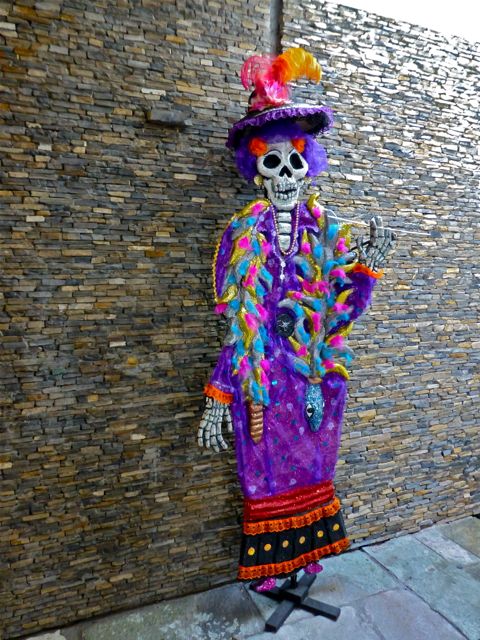
This Catrina arrived styling and ready to party.

Stylish Catrina posing in front of stone wall

Manicured fingers and toes, flower in her hair, and umbrella drink in hand, all she needs is a guy (or gal).

Seated Catrina in Tehuana traje holding cocktail glass with umbrellas.

Young man beware — she has her eye on you!

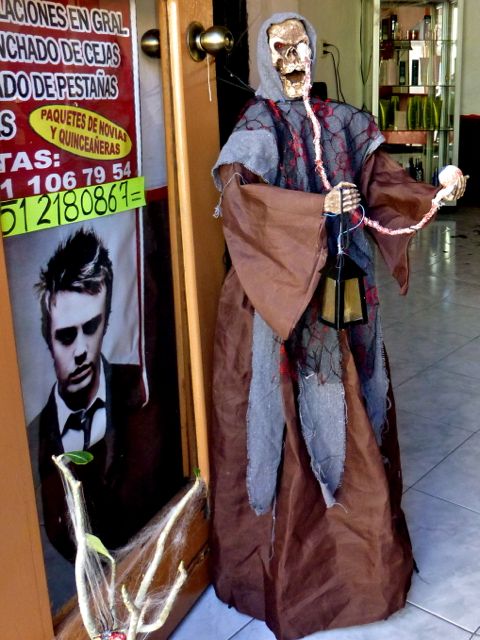
Ghoulish Catrina standing next to head shot of handsome young man

Read Full Post »

And, guess who’s coming to dinner?  Catrinas, pinkies up!

Catrina in lavender dress sitting at table

Dahling, don’t start the party without me!

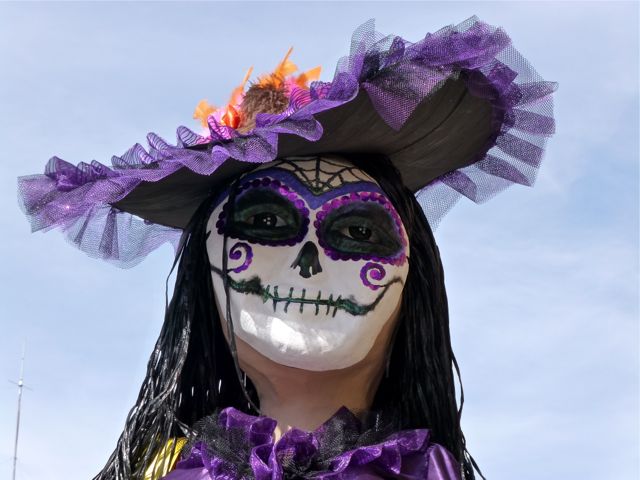
Close-up of face of a Catrina with lavender hat

Lo siento mis amigas, sending regrets from Juchitán.

Close-up of Tehuana Catrina with hand raised

Decisions, decisions, decisions… Shall I take the Jetta, Crossfox, Suburban, or Express Van???

Close-up of face of Catrina standing next to a sign with a list of autos

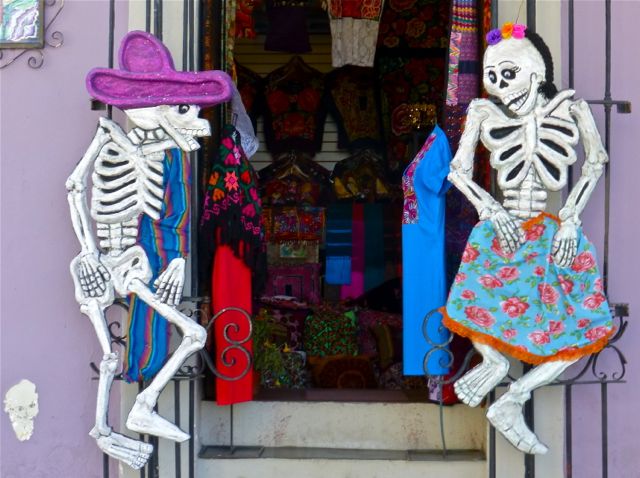
As for these two…

Male calavera and female calavera facing each other in a doorway

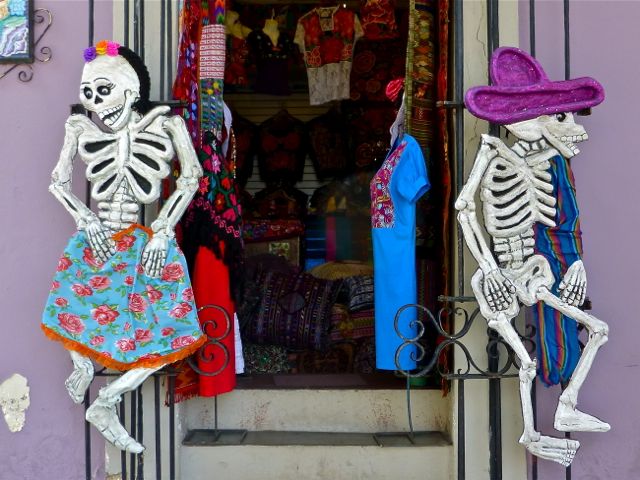
I’m not sure they are coming.

Male calavera and female calavera facing away from each other in a doorway

Hmmm… a lover’s quarrel?  Sheesh, even in the afterlife??!!!

Read Full Post »

The announcement came at midnight with the ringing of the Cathedral’s bells and explosions of cohetes (rockets).  Today el Señor del Rayo is having his day!  Like Guelaguetza, Noche de Rabanós (Night of the Radishes), and Día de la Samaritana (Good Samaritan Day), this is an “only in Oaxaca” celebration.

Señor del Rayo crucifix surrounded by lilies.

The carving of Christ on the Cross was brought to Oaxaca during the 16th century and was placed in the temple of San Juan de Dios, a church which had adobe walls and a straw (or possibly wood) roof.  Legend has it that lightning struck the church and everything was destroyed, save for this figurine.  Un milagro!  It was christened Señor del Rayo (Lord of Lightning), was given its own chapel in the newly built cathedral, and has been much venerated ever since.

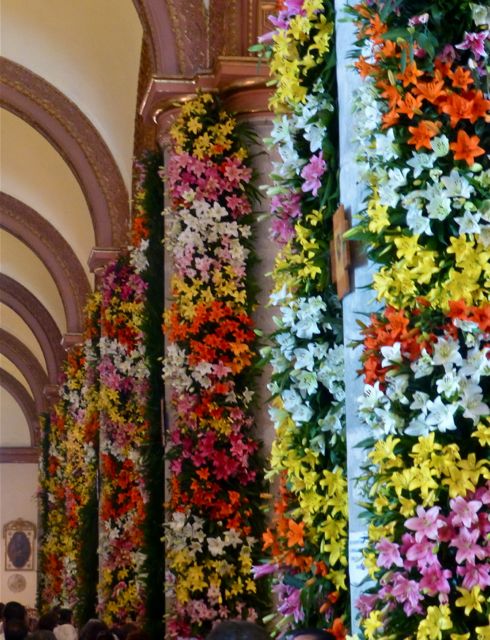
Pillars covered in multicolored lilies

On Sunday, October 21, el Señor del Rayo is moved from his capilla (last chapel on the left) to the main altar.  The cathedral fills with lilies (the scent “breathtaking”), and the faithful flock to pray before Señor del Rayo.  When one inhales the fragrance, one exhales a heavenly, “ahhhh…”

Close-up of orange, yellow, and lavender lilies covering a pillar

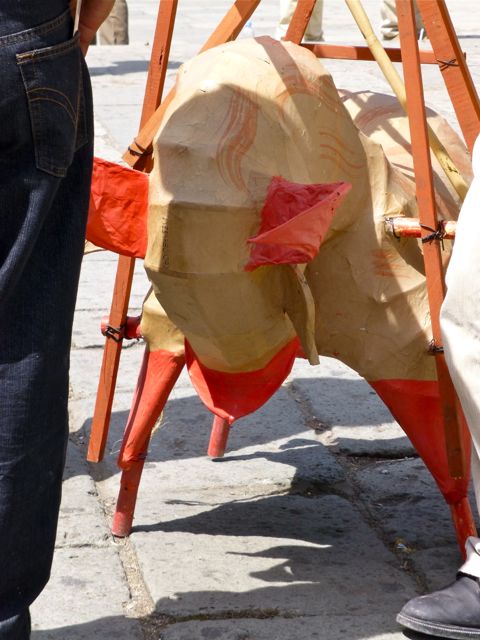
Like all good Mexican celebrations, be they religious or secular, there will be pirotécnicos tonight.  Toritos de luces (little paper-mache bulls wired with fireworks) have begun gathering.

Papermache bull (tornito)

And, as I write, the frame of the castillo below has been raised to its “upright and locked position,” its various spinning appendages have been affixed, and gunpowder tracks are waiting to be lit.

Main structure of a "castillo" laying on its side.

Alas, the action doesn’t begin until around 10:00 PM.  The spirit is willing, but it’s been a busy day, and this “too too solid flesh” is looking forward to melting into her bed.  Think I’ll just watch the fireworks from the terrace.  I know, what a wimp!!!

Read Full Post »

As I write, it is late on September 15, and all over Mexico El Grito de Dolores, also known as El Grito de la Independencia (the Shout of Independence), is echoing from government buildings throughout the country, from the Palacio Nacional in Mexico City to Oaxaca’s Palacio de Gobierno to ayuntamientos (city halls) in small towns.

Mexicans!
Long live the heroes that gave us the Fatherland!
Long live Hidalgo!
Long live Morelos!
Long live Josefa Ortiz de Dominguez!
Long live Allende!
Long live Aldama and Matamoros!
Long live National Independence!
Long Live Mexico! Long Live Mexico! Long Live Mexico!

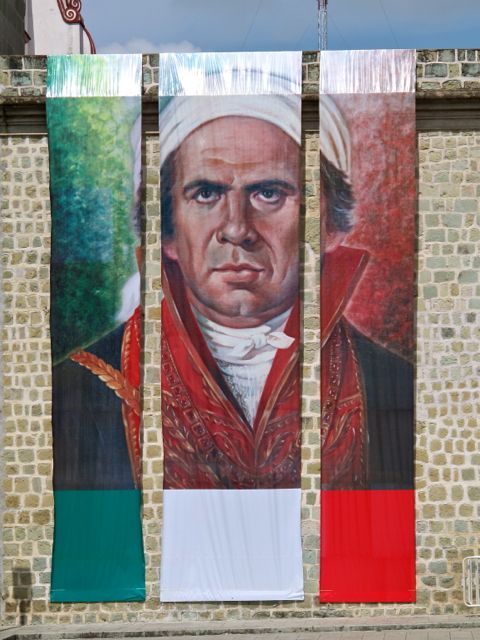
Portraits of the above listed heroes of Mexico’s War of Independence from Spain hang from the Government Palace in Oaxaca, as well as from the Municipal Building facing the Plaza de la Danza.

Massive 3-piece banner portrait of Morelos hanging from wall of Oaxaca's Municipal Building

And, this year, José María Morelos y Pavón is honored with a second massive portrait on the outer wall of the Municipal Building.  Last year, it was a reproduction of Orozco’s dramatic painting of Miguel Hidalgo y Costilla.

Read Full Post »

El Grito not only heralds green, white, and red decorations, clothing, and Mexican flags.  It is also the season to savor the multi-layered, delicate flavors of Chiles en Nogada and delight in its colorful, patriotic presentation.  Legend has it, the dish was created in 1821 by nuns in Puebla to honor a visit by Mexican General Augustín de Iturbide, that pretty much signaled the end of the eleven-year long Mexican War of Independence.

There are probably as many recipes for Chiles en Nogada as there are chefs and abuelas, but the basics include green poblano chiles stuffed with a picadillo of meats, fruits, nuts, herbs and spices; served with a creamy white cheese and walnut sauce; and topped with a garnish of red pomegranate seeds, walnuts, and the green of chopped parsley.

Serving of Chiles en Nogada on a white plate.

This was my lunch of Chiles en Nogada today at La Popular, a delightful new restaurant in Oaxaca (Garcia Vigil 519, Centro).  Yummm….

(ps)  Chris just posted this video of Lina Fernandez making Chiles en Nogada.  She makes it look almost doable!

Read Full Post »

Revolutionaries behind bars.

Boy and girl figures, seen through window bars in shop display dressed in traditional revolutionary clothing

Couldn’t resist just one more El Grito window display!

Read Full Post »

« Newer Posts - Older Posts »