Feeds:
Posts
Comments

Archive for the ‘History’ Category

This week the city of Oaxaca celebrates her 485 birthday.  Yes, we know she is older…  However, we are talking the colonial city, here.  And, despite her age, this birthday girl began the festivities by inviting the best cocineras from the eight regions of the state to cook for her citizens and visitors — from 1 PM until 9 PM — under the shade of a giant tent covering the Plaza de la Danza.  The Primer Encuentro de Cocineras Tradicionales de Oaxaca was not free, but quite reasonable.

The food was riquísima (beyond delicious) and, while we were there, the guys from Santiago Juxtlahuaca in the Mixtec region of Oaxaca, performed the Danza de los Rubios.

I returned home satisfied and sleepy, but the day wasn’t over.  There was a calenda (parade) scheduled for 5 PM and a procession of “Gigantes” at 7 PM — route for the latter was unclear.  I was hot, tired, and torn.  To go, or not to go?  That was the question.  Thunder began rumbling and I figured my answer was to stay in for the evening.  However, at 7:30 PM, when a the sounds of a procession came practically to my doorstep and not a drop of rain had fallen, I had to run out to join it.

The “Gigantes” were supposed to represent the giants of all time that Oaxaca has given to the world.  Most were a mystery to me, though I think I saw Benito Juárez and maybe Porfirio Díaz (both Oaxaqueños) and I’m guessing the bunny is a nod to the alebrije wood carving and decorating tradition.  In any case, it was great fun!

Just as the calenda reached the Plaza de la Danza, it began raining on this parade and everyone made a beeline for the cover of the Cocineras tent.  I’m sure they will eat well!  And the rain?  It was probably the best birthday gift Mother Nature could bestow on Oaxaca’s parched earth and dusty sidewalks.

This was just day one of the anniversary festivities.  Tomorrow (Tuesday) is Oaxaca’s actual birthday and the church bells will begin chiming at 6:45 AM.  So I’d better get to bed!  By the way, the Encuentro de Cocineras Tradicionales de Oaxaca opens again at 1 PM tomorrow and lasts until 8 PM or whenever the food runs out.  For a complete schedule of events, click HERE.

Read Full Post »

I read the news today, oh boy…

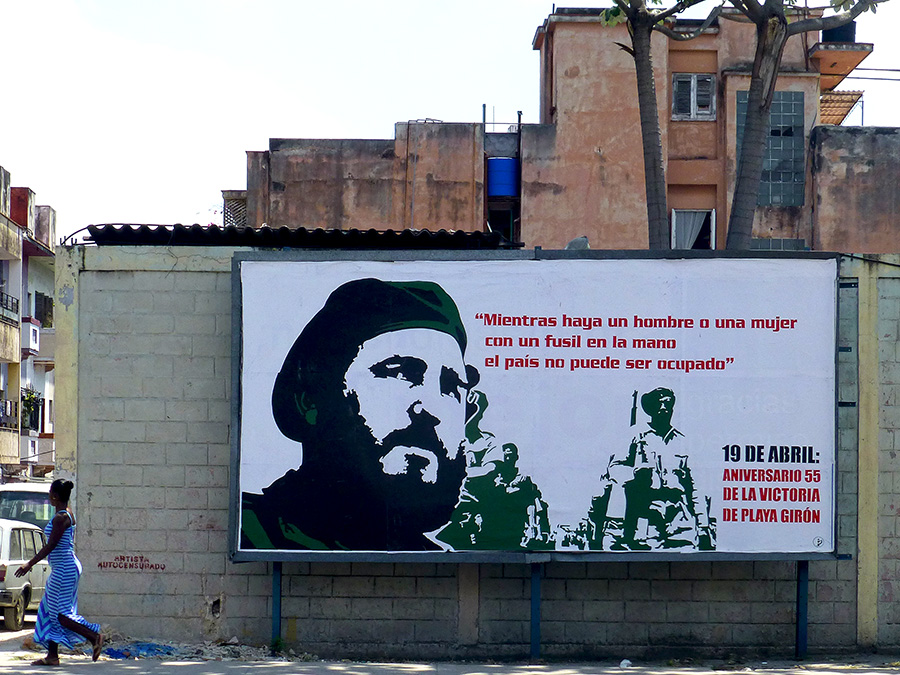
Fidel Castro, Leader of the Cuban Revolution Dies at 90.

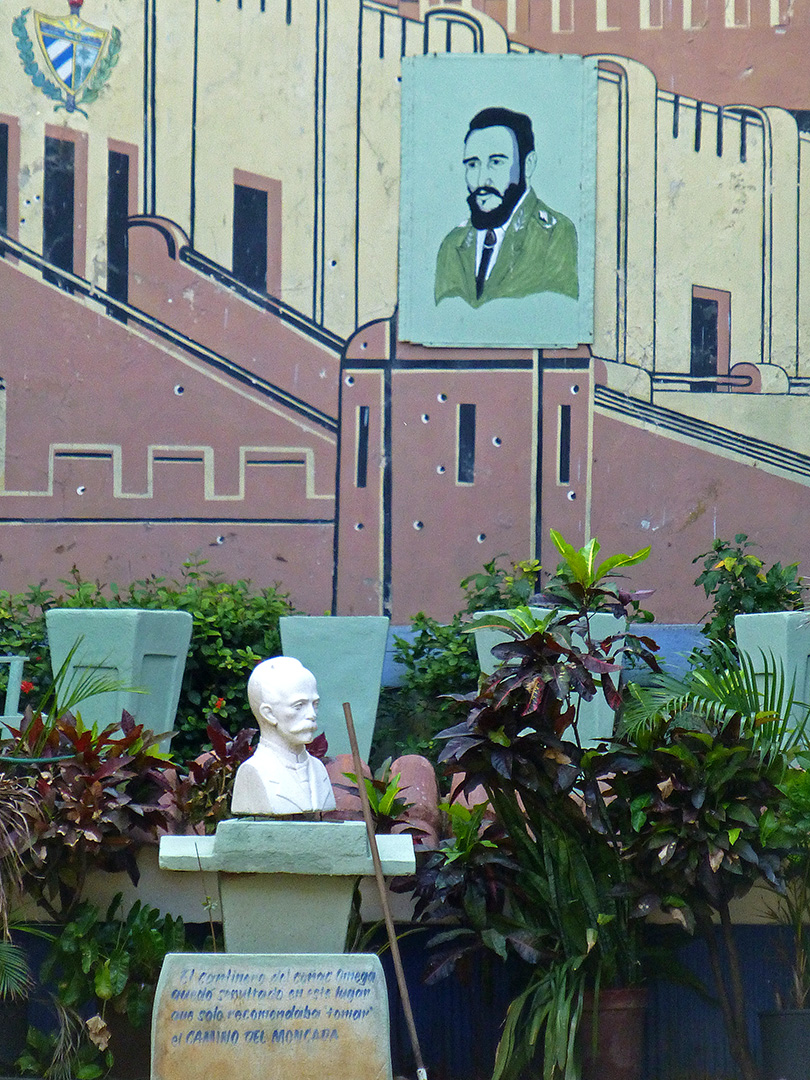
Sitial Moncada museum, Havana -- April 2016.

Sitial Moncada museum, Havana — April 2016.

The revolutionary’s achievements in the face of US meddling made him a powerful symbol of resistance against hegemony.

Terminal de Omnibus de la Habana -- April 2016.

Terminal de Omnibus de la Habana — April 2016.

Cuba Declares 9 Days of Public Mourning to Honor Fidel Castro.

"As long as there is a man or a woman with a gun in hand the country can not be occupied."  On a street in the Vedado neighborhood in Havana -- April 2016.

“As long as there is a man or a woman with a gun in hand the country can not be occupied.” On a street in the Vedado neighborhood in Havana — April 2016.

And, from the personal poster collection of my friend, archivist and librarian, Lincoln Cushing, Castro’s Revolution, Illustrated.

Farewell Fidel and thank you for standing up to US imperialism.  May the Cuban people continue to stand strong.

Read Full Post »

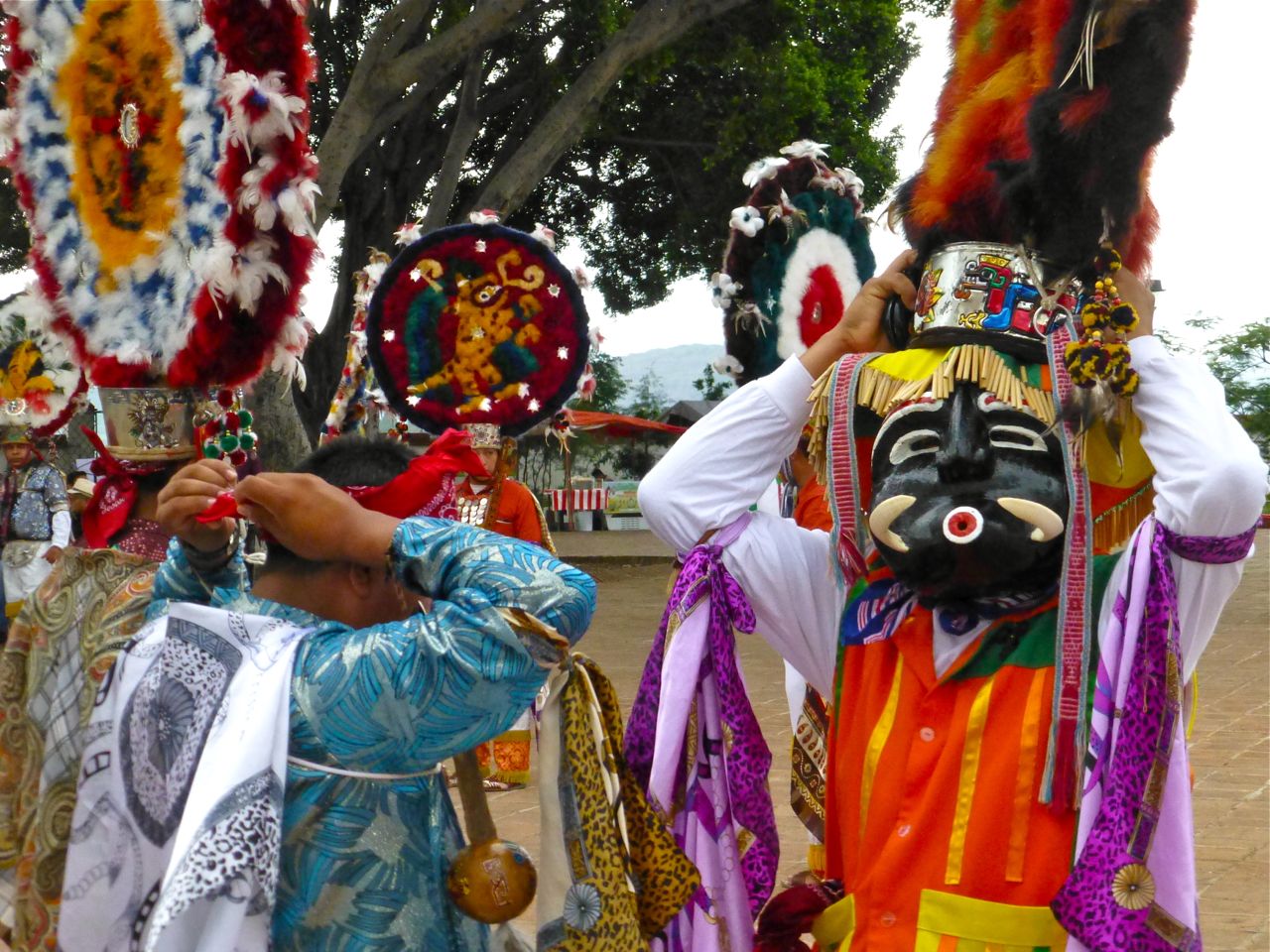
One of the much anticipated features of this year’s Fiesta Titlular a la Preciosa Sangre de Nuestro Señor Jesucristo in Teotitlán del Valle was the debut of the new Grupo de Danza de Pluma Promesa.

IMG_1307_copy

Danzantes

IMG_1447

Danzantes

Unlike in many of the other villages, where the Danza de la Pluma is danced by folkloric dance troupes, in Teotitlán del Valle nineteen young men and two little girls make a promise to their god and, thus, their community to learn and perform the dance at each of the four annual major religious festivals in the village for three years.

P1200147

Moctezuma with Malinche and Doña Marina

IMG_1387

Danzantes woven wool leggings

This is not a commitment to be taken lightly, as there are 40+ dances that comprise this Zapotec retelling of the story of Moctezuma and the Aztecs battle with Cortes and the Conquistadors.  The entire telling of the story takes almost eight hours to perform in the church plaza — in conditions that can vary from brilliant sun with sweltering temperatures to gusty winds to drizzling rain.

IMG_1379

Subalterno offering water

IMG_1360

Subalterno imitating the danzantes

It’s been almost six months since we first saw the new group at one of their early practice sessions.  In jeans, t-shirts, and gym shoes, the guys were at the beginning stages of learning the steps.

IMG_1308

Moctezuma, a danzante, and Doña Marina

IMG_1437_crop2

Moctezuma and the danzantes

They have learned well and it’s going to be an outstanding three years!


Read Full Post »

What can one say about a country that celebrates a poet/essayist/philosopher/journalist as a national hero?  Granted, José Martí was also a fierce fighter for Cuban independence from Spain and died in battle on May 19, 1895, shot by Spanish troops in Dos Ríos, Cuba.

However, it is his writings that appear to be his most powerful and lasting legacy.  Exiled from Cuba due to his political activity against Spain, he spent many years in the United States and while there, he wrote a passionate report following the 1886 execution by hanging in Chicago of the Haymarket martyrs.  And so, let’s commemorate this May Day with words from José Martí…


Every human being has within him an ideal man, just as every piece of marble contains in a rough state a statue as beautiful as the one that Praxiteles the Greek made of the god Apollo.  — José Martí

P1180398

Memorial José Martí, Plaza de la Revolución, Havana

To educate is to give man the keys to the world, which are independence and love, and to give him strength to journey on his own, light of step, a spontaneous and free being.  — José Martí

P1180432

Biblioteca Nacional José Martí, Havana

Men are like the stars; some generate their own light while others reflect the brilliance they receive.  —José Martí

P1180440

Display at the Biblioteca Nacional José Martí, Havana

Man can never be more perfect than the sun. The sun burns us with the same light that warms us. The sun has spots (stains).  The ungrateful only talk about the spots (stains). The grateful talk about the light.  — José Martí, La edad de oro

P1180268

Courtyard of El Sitial Moncada, Havana

In a time of crisis, the peoples of the world must rush to get to know each other.  — José Martí

P1180702

Bookseller stall in the Plaza de Armas, Havana


I have a white rose to tend
In July as in January;
I give it to the true friend
Who offers his frank hand to me.  — José Martí

P1180353

Dagoberto, our waiter at a bar on the grounds of Castillo de los Tres Reyes Magos del Morro, Havana — the white rose he made and presented to me

If translated back into Spanish, those last words may sound familiar to you…

Cultivo una rosa blanca,
En julio como en enero,
Para el amigo sincero
Que me da su mano franca.

This Playing for Change YouTube video may refresh your memory, then there is Pete Seeger.  The above is one of four stanzas from Martí’s Versos Sencillos that are often used as lyrics to Guantanamera.

Read Full Post »

The Mexican-Irish connection may date back farther than most of us have considered.  Séamus Ó Fógartaigh writes in the essay, Ireland and Mexico, “The first Irishman to set foot on Mexican soil may well have been St. Brendan the Navigator, who, according to legend, crossed the Atlantic Ocean in his ‘currach’ (traditional Irish rowing boat) in search of new converts to the Christian faith. An ancient manuscript found in Medieval European monasteries allegedly described his voyage to strange Western Lands, and is known as the Navigatio Sancti Brendani Abbatis. Some historians claim that Christopher Columbus found inspiration for his seafaring adventure in the pages of the Navigatio of St. Brendan the Abbot.”  And, he notes, there is even speculation that Quetzalcóatl was actually a deified Irish monk.

As you raise your pint of Guinness on this St. Patrick’s Day, consider this and the other Mexico and Ireland connections, while you sing a rousing chorus of Saint Patrick Battalion.

The song celebrates the Batallón de San Patricio, the Irish-American soldiers who deserted and fought alongside the Mexican army against the United States during the Mexican American War, 1846-1848.  And, don’t forget to watch One Man’s Hero, the 1999 feature film about the San Patricios, starring Tom Berenger.

Sláinte mhaith!  ¡Salud!  And, remember, don’t drink and drive!

Read Full Post »

Wishing all my sisters, whoever and wherever you may be, a happy International Women’s Day.  The struggle continues, because…

P1160390

San Juan Guelavia, January 2016

From an article today:

An estimated 120 million girls and women under the age of 20 have been subjected to forced sexual intercourse or other forced sexual acts – around 10 per cent.

More than a third of women worldwide have also experienced physical or sexual violence at some point in their lives, with this being most common between a woman’s teenage years and menopause.

Meanwhile, nearly a quarter of a billion more women are in the global workforce today than a decade ago, but they are only earning what men did in 2006, according to the World Economic Forum.

And one in 10 married women are not consulted by their husbands on how their own cash earnings will be spent.

Read Full Post »

A year and a half ago, I cut off the top of a pineapple (piña, en español), stuck it in a ten inch pot in full sun, watered it very occasionally during the dry season, and it actually began to grow.  This member of the Bromeliaceae family is thought to have originated in the area between southern Brazil and Paraguay and spread throughout Latin America and the Caribbean.  Reaching Mexico, it was cultivated by the Mayas and Aztecs.  Spanish, Dutch, and Portuguese conquerors took it across the pond, and the rest is history.  No surprise, as the fruit (which resembles a pine cone — hence the name) is sweet, succulent, and ridiculously easy to grow!

P1150504crop

A symbol of home: warmth, welcome, friendship and hospitality.  The Welcoming Pineapple

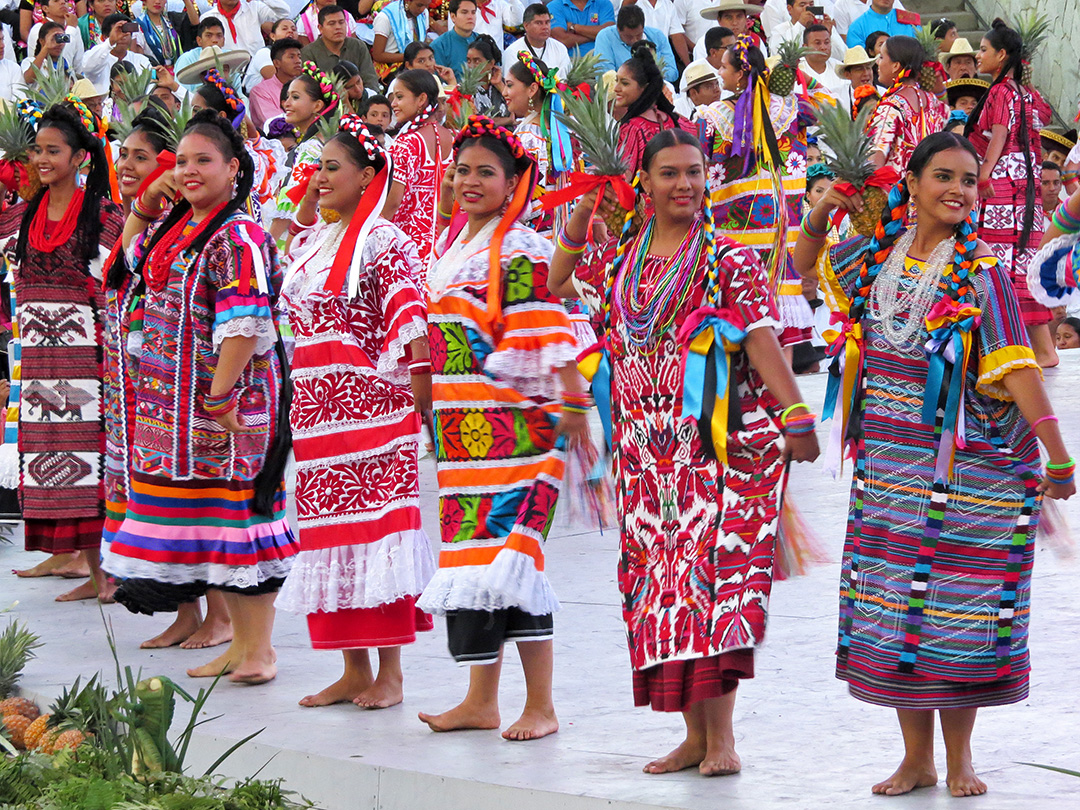
Grown in the Papaloapan region of Oaxaca, the pineapple has inspired elaborate embroidery designs and the crowd-pleasing Flor de Piña dance.   What’s not to love?!


Read Full Post »

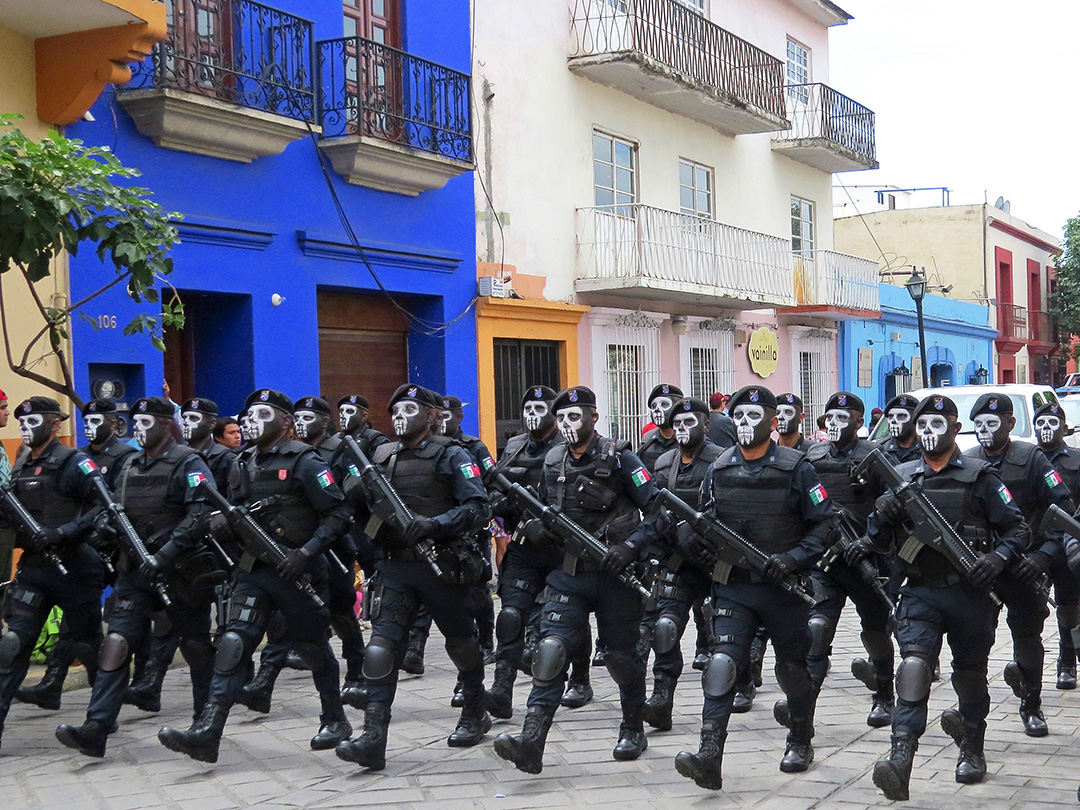
September 16, 2015 marked the 205th anniversary of the beginning of Mexico’s fight for independence from Spain.  Like all such occasions worldwide, it was celebrated with patriotic parades.  Here in the city of Oaxaca, civic and military contingents marched from the corner of 20 de noviembre and Trujano, passed the Government Palace, east on Guerrero, then north on Pino Suarez, to wind up at Paseo Juárez (aka, Llano Park).

P1140081

Oaxaca’s Palacio de Gobierno, with images of Josefa Ortiz de Domínguez and José María Morelos y Pavón, two of the heroes of struggle for independence.

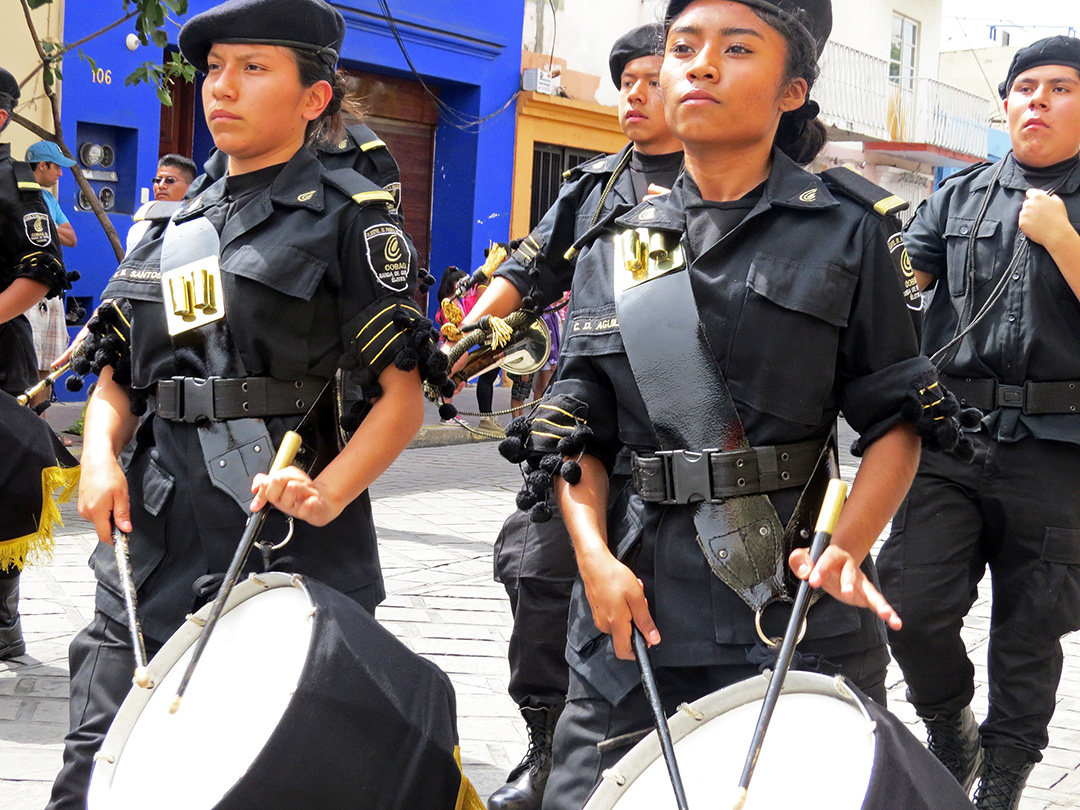
Before you could see a contingent, you could hear it; often drums and drummers heralded the arrival of both school and military groups.

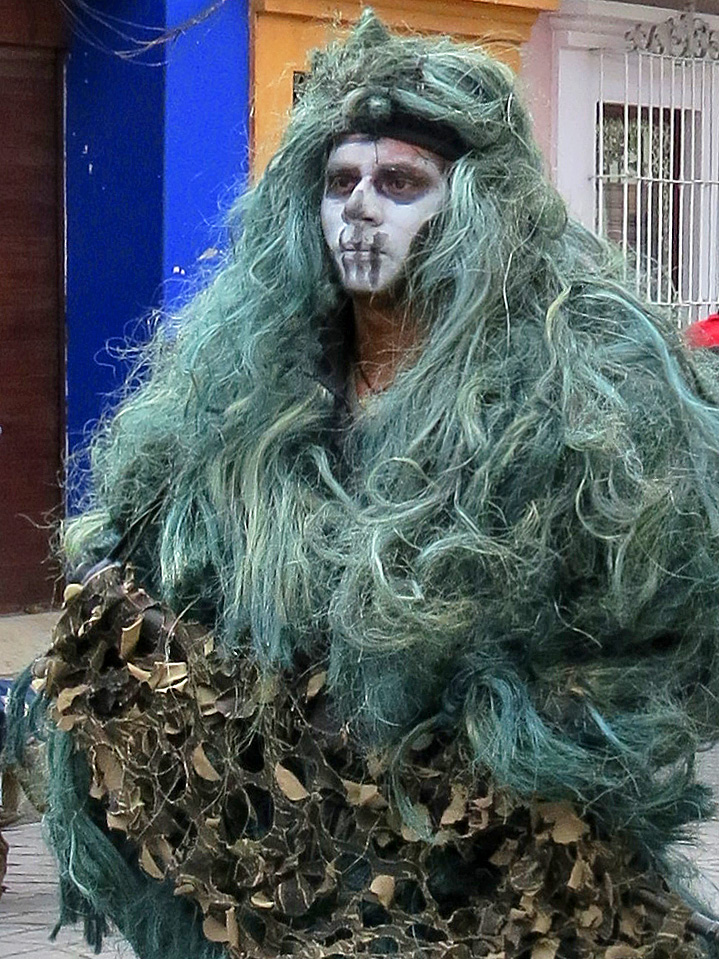
IMG_9648IMG_9653Like most patriotic parades, military and police elements dominated the civic.  In Oaxaca, we are talking federal, state, and municipal, including units from the thousands of members of the Gendarmaría Nacional, who have been in town for at least a month.  I do have to say, besides the usual, some of the camouflage face paint had an “only in Mexico” flair.IMG_9691

IMG_9719IMG_9717copySpectators lined the streets along the route, but mostly reserved their applause for the bomberos (firefighters)…

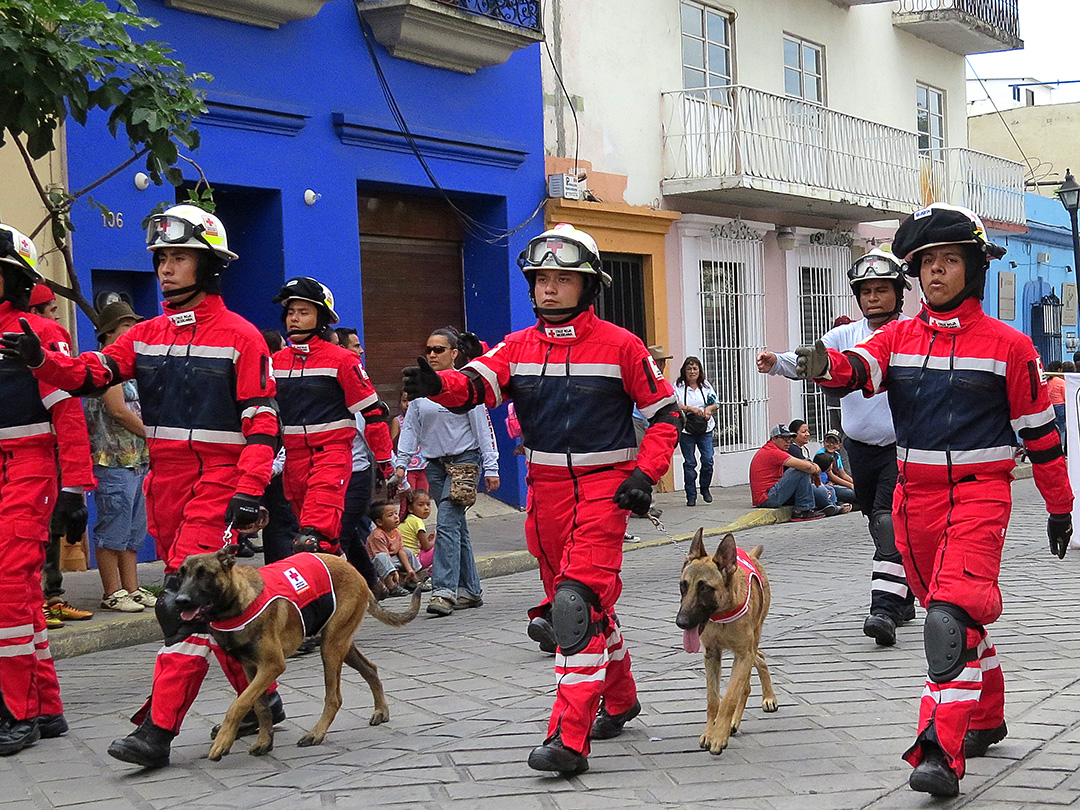
IMG_9710IMG_9711Cruz Roja (Red Cross) workers, especially the canine unit and young volunteers…

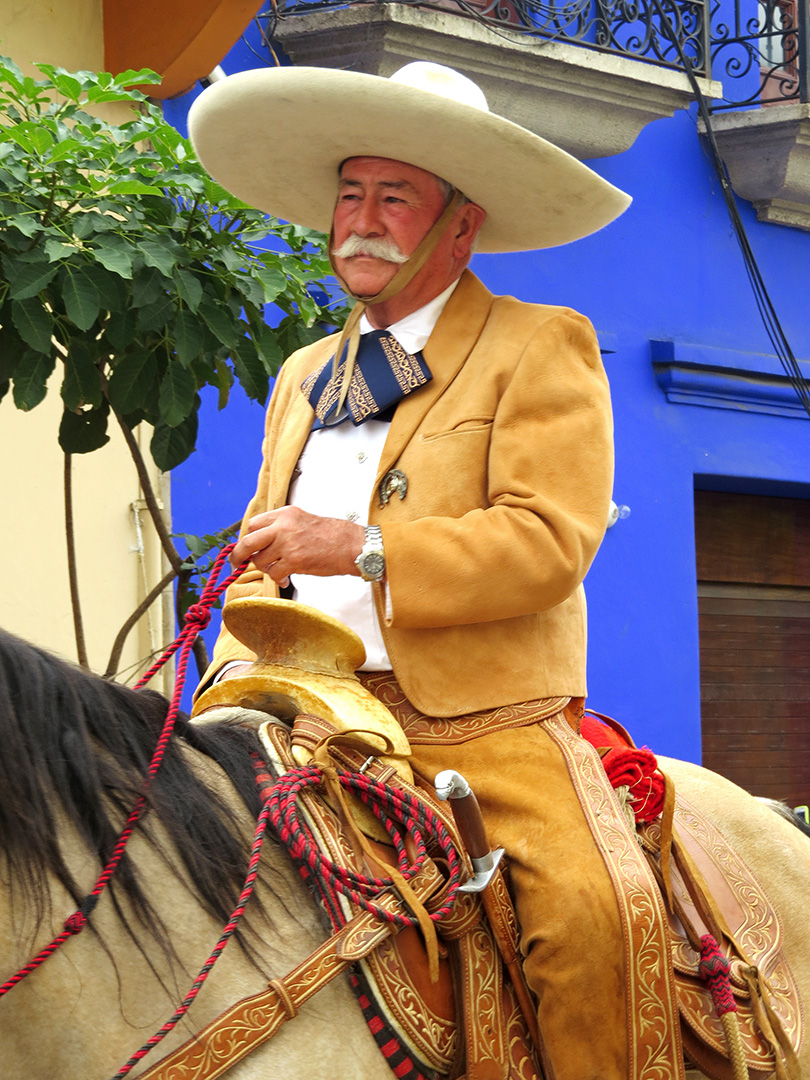
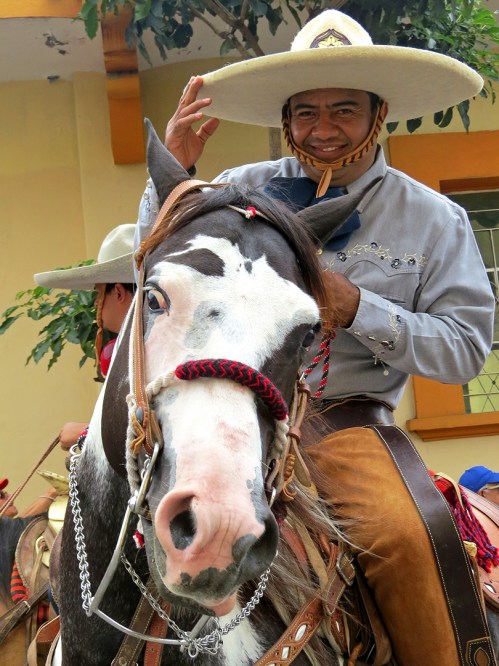
IMG_9731IMG_9727and, last but not least, the riders from the Asociación de Charros de Oaxaca, who brought up the rear.  I guess the thinking was to keep the streets free of horse manure until the end!

IMG_9742IMG_9743IMG_9758IMG_9757IMG_9750That’s all, folks!

Read Full Post »

It’s International Workers’ Day and workers all over the globe are marching.

P1090214 They march to celebrate past victories; they march to proclaim the dignity of work; they march to defend the right to collective bargaining; they march to demand living wages and safe working conditions; and they march to secure a better future for their children.

P1090223If you have any doubts about why workers in Mexico are marching today:  19.5 Million Mexicans Are Tethered To The Minimum Salary, The Lowest In The Americas.  According to the article (translated from the original Spanish by Peter W. Davis),

Mexico has a minimum wage of around 69 pesos a day ($4.50 US), the lowest in Latin America….the Economic Commission for Latin America and the Caribbean placed Mexico as the only country with a minimum wage below the poverty line.  Furthermore 14% of employees receive a salary even lower than this minimum.

P1090220It’s no wonder that, as I write, there are marches converging on Oaxaca’s zócalo from points north, south, east, and west.  When I was out and about an hour ago, I ran into healthcare workers from as far away as Tuxtepec, in the northeast of the state, and Huatulco, in the southwest.

¡Feliz Día del Trabajo a tod@s!  The struggle continues…

Read Full Post »

March 8 is International Women’s Day — established by V. I. Lenin in 1922 (I’ll wager this is news to most), revived by women in the USA in 1968, and recognized by the United Nations in 1975.  We may have come a long way, but the struggle for equal rights, respect, freedom from violence, and control of our own bodies continues.

However, the hard work, warmth, strength, creativity, and dignity of the women of Oaxaca continues to inspire me.

¡Feliz día internacional de la mujer!  But, as news around the world and the Inequality in Charts reminds us, LA LUCHA CONTINÚA…

Read Full Post »

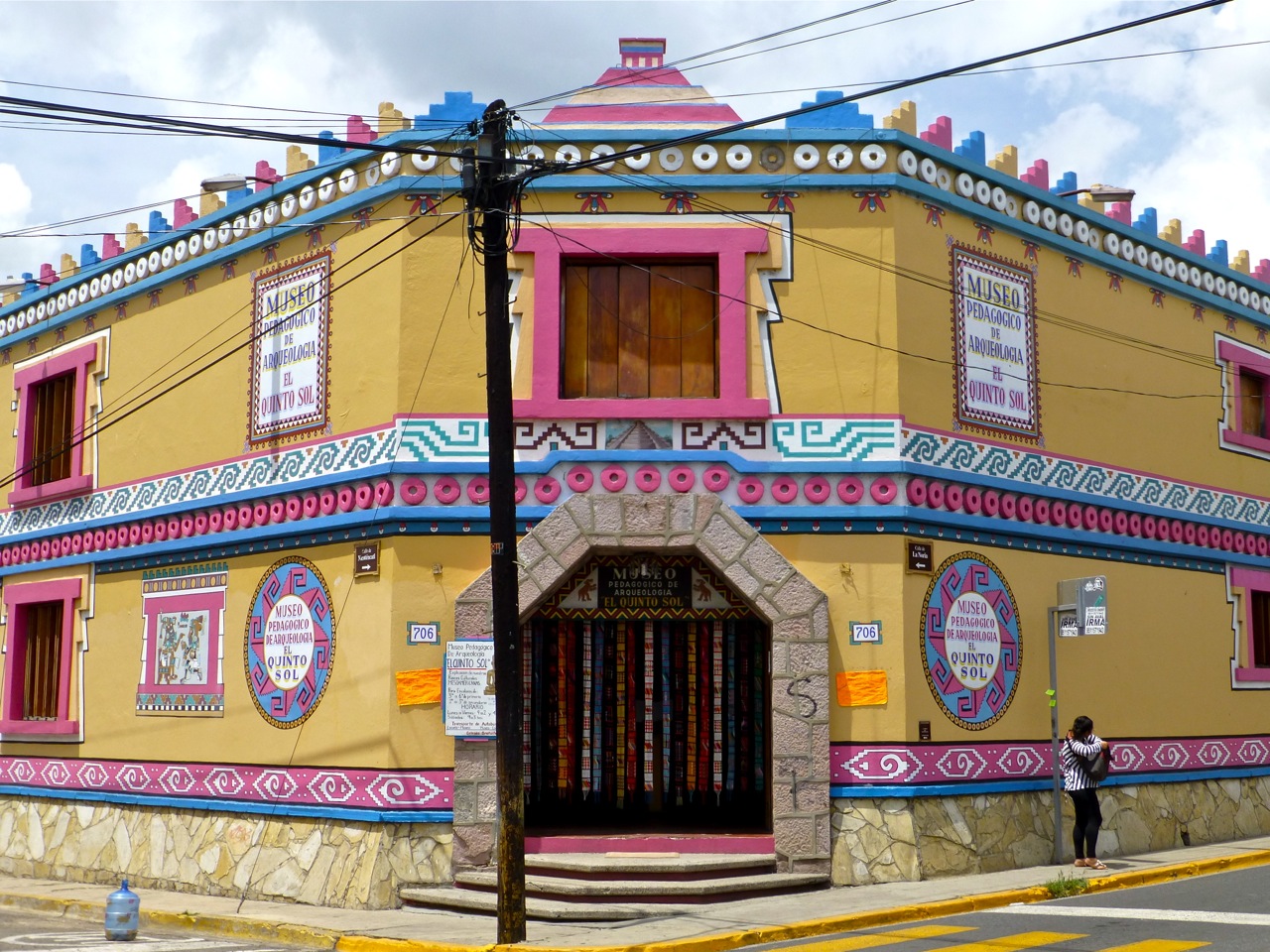
Oaxaca is one of the most child friendly places you will ever visit.  Kids are welcome most everywhere — it’s part of the culture — and there is much for them to see and do, including El Quinto Sol, an archaeological museum for children.P1020037

I’ve been meaning to write about this colorful, yet hidden, gem since a friend and I discovered it in 2008 on an early Sunday morning ramble.  It was closed for remodeling, but we managed to peek in and vowed to return.

Of course, we didn’t write down the address or name and all I remembered was that it was somewhere south of the zócalo.  It took several expeditions once I moved to Oaxaca before I found El Quinto Sol again.

According to the museum’s brochure, this delightful and educational museum was the brainchild of Oaxaqueño, Manuel Ramirez Salvador and first opened March 19, 2000 in order to teach, preserve, and appreciate the “great heritage bequeathed by our Mesoamerican ancestors.”

Not only a museum, there is also a fabulous “old school” toy store, El Cri-Cri, named for the “grillito cantor” (the singing cricket), a character created by the beloved Francisco Gabilondo Soler.  There are no plastic, battery-powered games and toys in sight and I guarantee those “of a certain age” will be reminiscing and exclaiming, “Ooh, I used to have one of these!” and “Ahh, I always wanted one of those!”

By all means, pay El Quinto Sol a visit — even if unaccompanied by a child.

Address:  Xicotencatl No. 706 (at the corner of La Noria)
Telephone:  951.514.3579
Hours:  Monday through Friday,  9:00 AM – 2:00 PM and 4:00 – 6:00 PM
Saturday, 10:00 AM – 6:00 PM.  Closed on Sunday

Read Full Post »

Is it cheating to post photos from the 2013 Mexican Independence Day desfile in Oaxaca?  What can I say?  It was raining today and, if it counts for anything, I never got around to posting these photos last year.

This slideshow requires JavaScript.

However, I do have some news from this year:  The state police staged a protest and, besides your’s truly, Governor Cue did not attend — and I don’t think it was the rain that stopped him!

Read Full Post »

My morning caller flew the coop and so did I.  After being confined to quarters for the past several days due to the rain and gloom, I walked downtown.

P1020289

Also, I was curious as to the state of the Zócalo, in light of the teachers, ambulantes, and the annual reenactment of “el Grito de Independencia” by the Governor, from the balcony of the Government Palace, at 11 PM tonight.

P1020307

I found, except for a handful of tents and tarps, the Alameda and Zócalo were back to normal.

P1020309

Castillos were being constructed on either side of the Government Palace.

P1020301

P1020304

P1020297

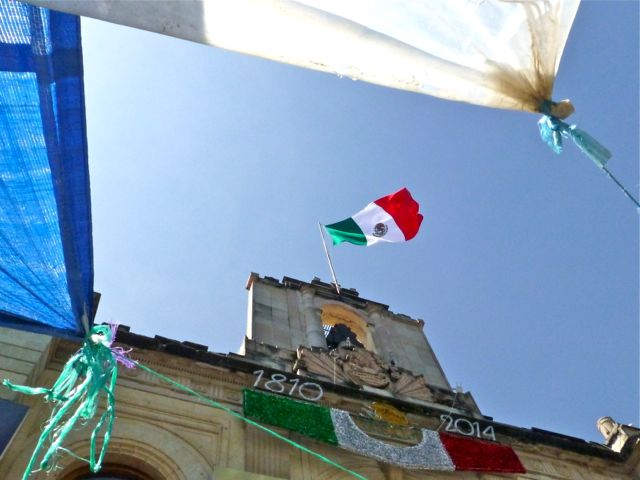
And, like every year, the Mexican flag was flying high, green, white, and red lights and banners were strung, and images of the heroes of the Mexican War of Independence from Spain decorated the front of the Palacio de Gobierno

P1020291

P1020292

Most of the teachers and ambulantes have departed and all is being readied for el Grito de Independencia 2014.  And, nobody seems to miss the State Police, who are staging a “work stoppage.”   Ahhh, Oaxaca…  Ya gotta love her!

El Grito de Independencia
¡Mexicanos!
¡Vivan los héroes que nos dieron la patria y libertad!
¡Viva Hidalgo!
¡Viva Morelos!
¡Viva Josefa Ortíz de Dominguez!
¡Viva Allende!
¡Viva Galeana y los Bravo!
¡Viva Aldama y Matamoros!
¡Viva la Independencia Nacional!
¡Viva México! ¡Viva México! ¡Viva México!

In English
Mexicans!
Long live the heroes that gave us the Fatherland (and liberty)!
Long live Hidalgo!
Long live Morelos!
Long live Josefa Ortiz de Dominguez!
Long live Allende!
Long live Galeana and the Bravos!
Long live Aldama and Matamoros!
Long live National Independence!
Long Live Mexico! Long Live Mexico! Long Live Mexico!

Read Full Post »

We returned to Teotitlán del Valle on Tuesday and Wednesday the Danza de la Pluma — more of the multi-day fiesta honoring Preciosa Sangre de Nuestro Señor Jesucristo.

Moctezuma and Danzantes

An airborne Moctezuma and the Danzantes

The Danza de la Pluma is a ritual re-enactment of the Spanish conquest.  The story is told in 41 bailes (dances) and lasts from early afternoon into the night.  It is an honor to be a participant — the Danzantes, Moctezuma, the Subalternos, Malinche, and Doña Marina are selected years in advance and make a promise to the church and community to perform their roles for 3 years.

Dance of Malinche and Doña Marina

Dance of Malinche and Doña Marina

All is not completely serious — the Subalternos provide a little levity along the way.

Subalterno trying on the Penacho of a Danzante

Subalterno trying on the Penacho of a Danzante

The subtext and “hidden” narratives of the danza are multiple and complex and after 5 years, I’m only in the infant stages of understanding.  I will leave it to the two scholarly articles listed below to attempt interpretation.

Danzantes with El Picacho in background

References:

Cohen, Jeffrey.  Danza de la Pluma:  Symbols of submission and separation in a Mexican Fiesta.  Anthropological Quarterly, Jul 93, Vol. 66 Issue 3, p. 149-158.

Harris, Max. The Return of Moctezuma.  The Drama Review, Sp 97, Vol. 41 Issue 1, p. 106, 29 p.

Read Full Post »

Even though the significance of May 1, as International Workers’ Day, had its origin in the USA, it is not celebrated there (for a variety of reasons I won’t go into here).  However, like most countries in the world, Día del Trabajo is a national holiday in Mexico.  To honor labor everywhere, here is Oaxaca’s favorite daughter singing her song, “Mother Jones.”

“Pray for the dead, but fight like Hell for the living.”  — Mary Harris Jones (aka, Mother Jones, the miners’ angel)

Read Full Post »

« Newer Posts - Older Posts »