Feeds:
Posts
Comments

Posts Tagged ‘photographs’

As I’ve previously written, two separate (and battling) French designers were exposed as plagiarizing the traditional embroidery designs of Santa María Tlahuitoltepec, a village in the mountainous Mixe region of Oaxaca.

P1100015

However, at last there is a triumph for the embroiderers and the time-honored motifs handed down from their ancestors and inspired by the land — A Court Rules High-End French Label Doesn’t Own Rights to Indigenous Oaxacan Design.

P1100017

The people of Santa María Tlahuitoltepec may not be financially wealthy, but they and their community are rich in culture and pride in their history and traditions.  They are not angling for a monetary settlement — all they want is that their work and designs be recognized and respected.

P1110662

While we are on the topic of disrespect of indigenous peoples, we have the recent disgraceful Coca-Cola México advertisement, showing Hipsters Bringing Soda To Indigenous Mexicans — another Mixe village, Totontepec Villa de Morelos.  After an immediate social media campaign challenged the ad, Coca Cola pulled it.  As this teleSUR article details, This New Coca Cola Ad Shows Mexico’s White Savior Problem.  In addition, like the USA, obesity is growing problem here, thus a Reply to Coca-Cola comes in new video by the Alliance for Food Health featuring two Mixe students speaking about the health risks posed by these kinds of “soft drinks” that lack any nutritional value.

By the way, the English language Mexico News Daily is running a poll, asking if you “agree that the controversial Coca-Cola Christmas video was racist or offensive?”  And, I’m appalled that as I write, the results are:  32% yes and 68% no!!!

Read Full Post »

Black Friday and Cyber Monday sales are in the rear view mirror,  December is upon us — only twenty-three more shopping days until Christmas — and the shopping frenzy in el norte continues.  Thanks, but no thanks, I say.   I prefer this…

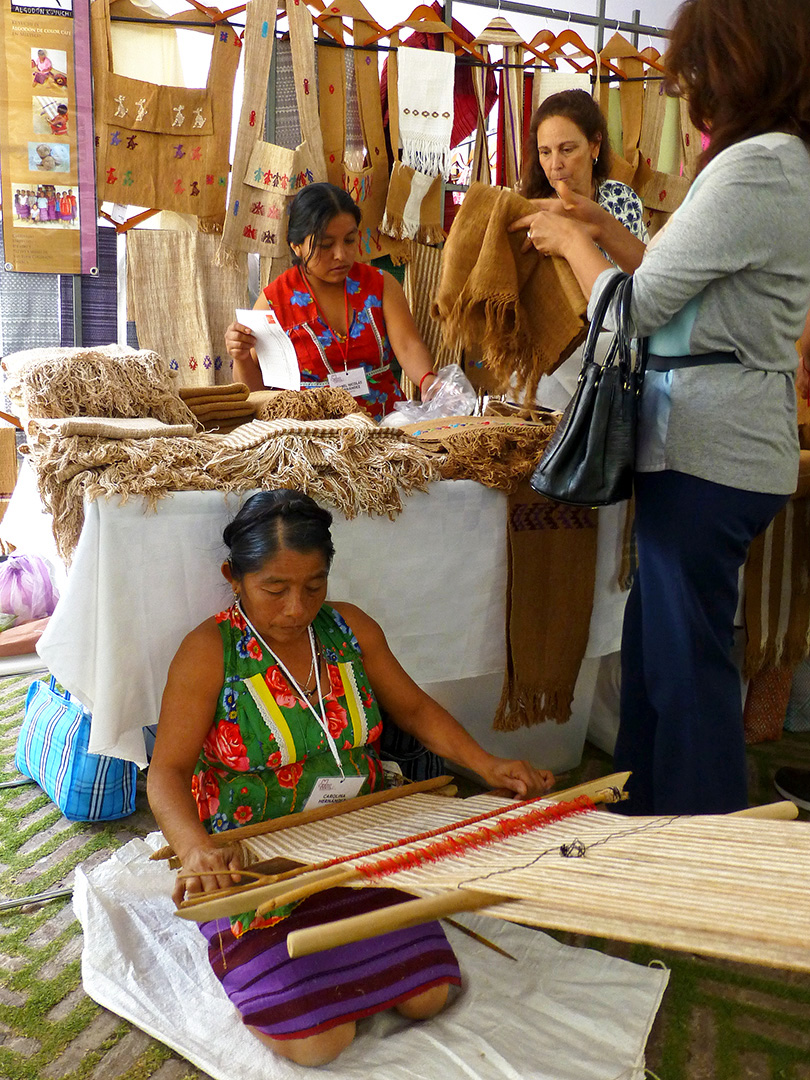
Weaver from the Katyi Ya'a Taller Colectivo de Algodón Native (Collective workshop using native cottons)

Weaver from the Katyi Ya’a Taller Colectivo de Algodón Native (Collective workshop using native cottons)

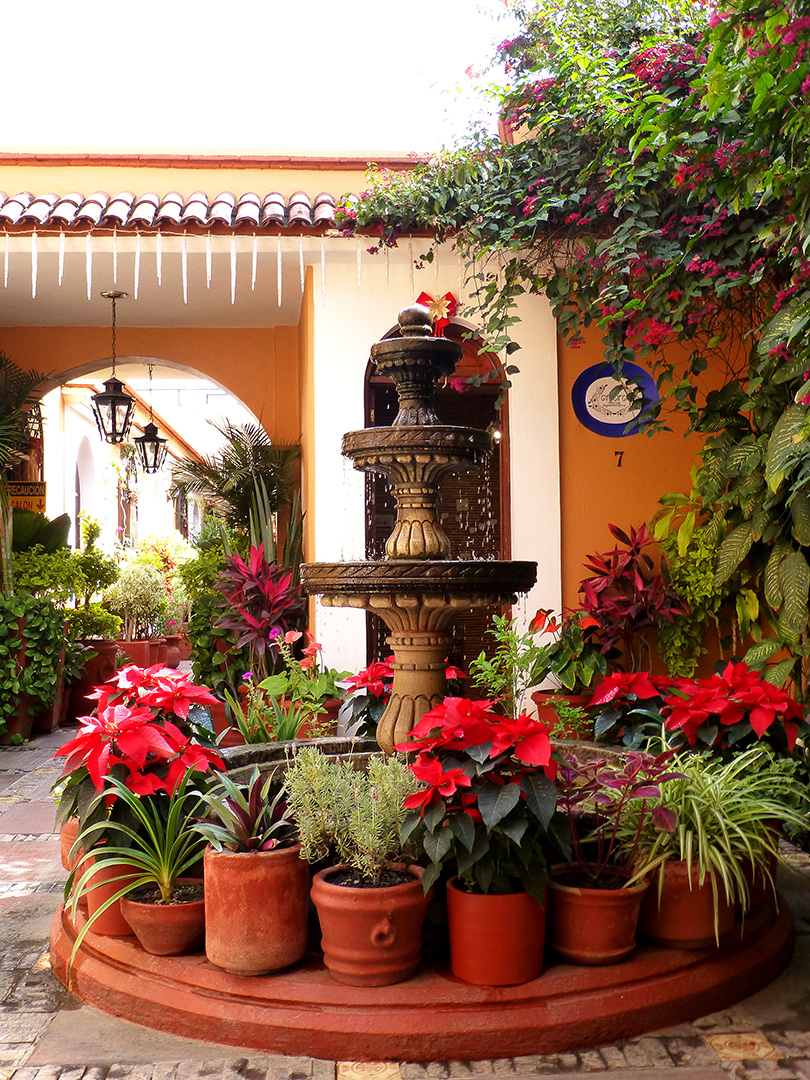
On the Friday after Thanksgiving, I took leisurely stroll down to the 2-day expo-venta (exposition and sale), sponsored by the Museo Textil de Oaxaca and held in the tranquility of the Centro Cultural San Pablo patio.  After much oohing and ahhing and talking with many of the artisans, I headed up 5 de mayo to one of my favorite pocket courtyards and the shops tucked in along its garden path…

5 de mayo #408

5 de mayo #408 – home to tapetes (rugs) at the Fe y Lola gallery and Seasons of My Heart retail store, among other small shops.

I won’t reveal where or if I bought anything — I wouldn’t want to spoil any Christmas surprises!  What I will say is… I prefer strolling to rushing; personally meeting and paying the artisans for their work to handing over a credit card at an impersonal department store; and, perhaps most of all, experiencing the pride radiated by an item’s creator when I admire their work.

Read Full Post »

A year and a half ago, I cut off the top of a pineapple (piña, en español), stuck it in a ten inch pot in full sun, watered it very occasionally during the dry season, and it actually began to grow.  This member of the Bromeliaceae family is thought to have originated in the area between southern Brazil and Paraguay and spread throughout Latin America and the Caribbean.  Reaching Mexico, it was cultivated by the Mayas and Aztecs.  Spanish, Dutch, and Portuguese conquerors took it across the pond, and the rest is history.  No surprise, as the fruit (which resembles a pine cone — hence the name) is sweet, succulent, and ridiculously easy to grow!

P1150504crop

A symbol of home: warmth, welcome, friendship and hospitality.  The Welcoming Pineapple

Grown in the Papaloapan region of Oaxaca, the pineapple has inspired elaborate embroidery designs and the crowd-pleasing Flor de Piña dance.   What’s not to love?!


Read Full Post »

Ahhh… the joys of navigating Oaxaca’s sidewalks.

P1150497

And, this is nothing compared to manholes minus their covers!  I tell visitors they must ALWAYS watch where their feet are going; if they feel compelled to look up at the bell towers of a colonial church or at a gal balancing a basket of sweets on her head — STOP, then look!P1150492

However, in the absence of municipal action to remedy these hazards to one’s health and safety, Grupo Salvando Vidas Oaxaca (Saving Lives Oaxaca Group), an organization of concerned citizens, has come to the rescue.  According to this news report, the volunteer group was born last year after the founder of the group, Manuel Chávez Nuñez saw a disabled person fall into an uncovered sewer drain.P1150489

Yesterday, the group, which numbers around 15, set up a display of the wooden covers they use to replace gaps and holes in sidewalks around the city.  In addition to showcasing their work and recruiting volunteers, they were collecting donations for materials and giving away free books.  What’s not to like?!!!

P1150496“Everything that is done is for love… We put ourselves in the place of the other person and get down to work.”  (translated from article in today’s Noticias)  Grupo Salvando Vidas Oaxaca, those of us negotiating the sidewalks of Oaxaca offer you our very grateful muchisimas gracias!

Now if only someone could do something about vehicles making right and left turns without stopping or signaling.  Sigh…

Read Full Post »

Looking up in Villa de Etla last week.

P1150313The conversation continues…

Read Full Post »

P1150416

“Telephones” on the street in Oaxaca.  Call me, maybe.   😉

Read Full Post »

Pretty in pink on the streets of Oaxaca…P1140835

P1140380

P1140833

P1140814

P1130556

And, this doesn’t even include the pink and lime green of Correos de México (Mexican post office).

Read Full Post »

Young and old, male and female…

it’s a family affair, labor of love…

as the tombs of San Antonino Castillo Velasco are painstakingly decorated on November 3.

Read Full Post »

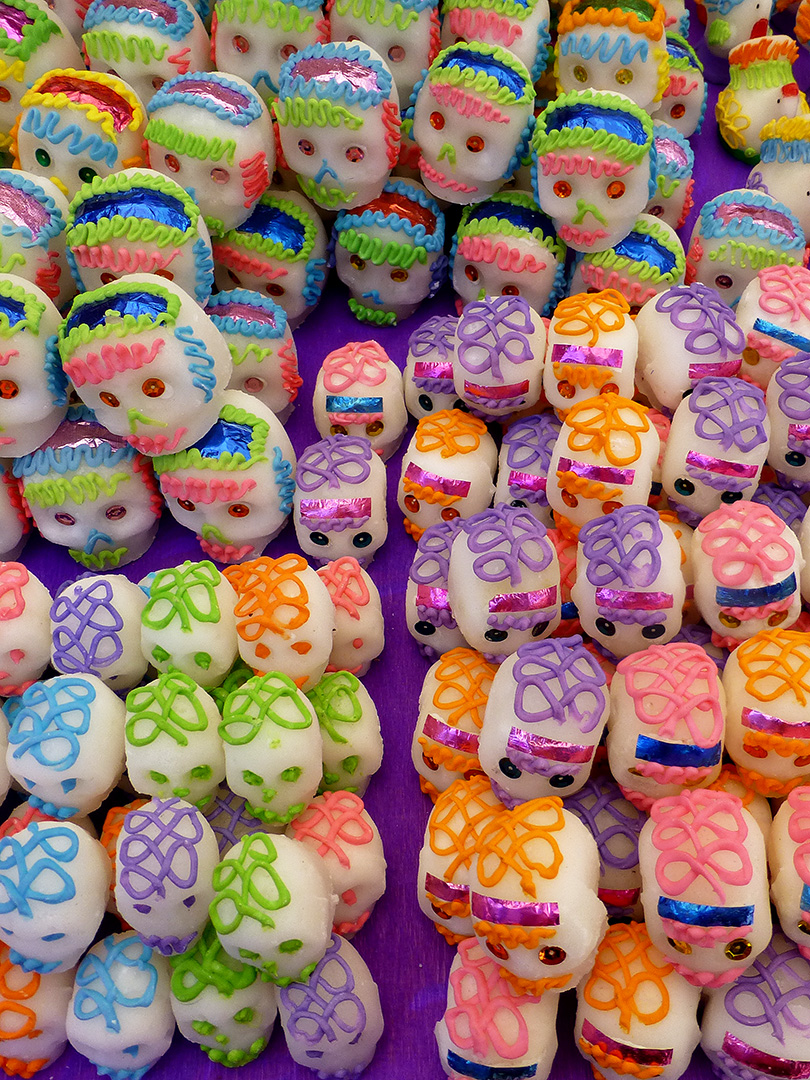
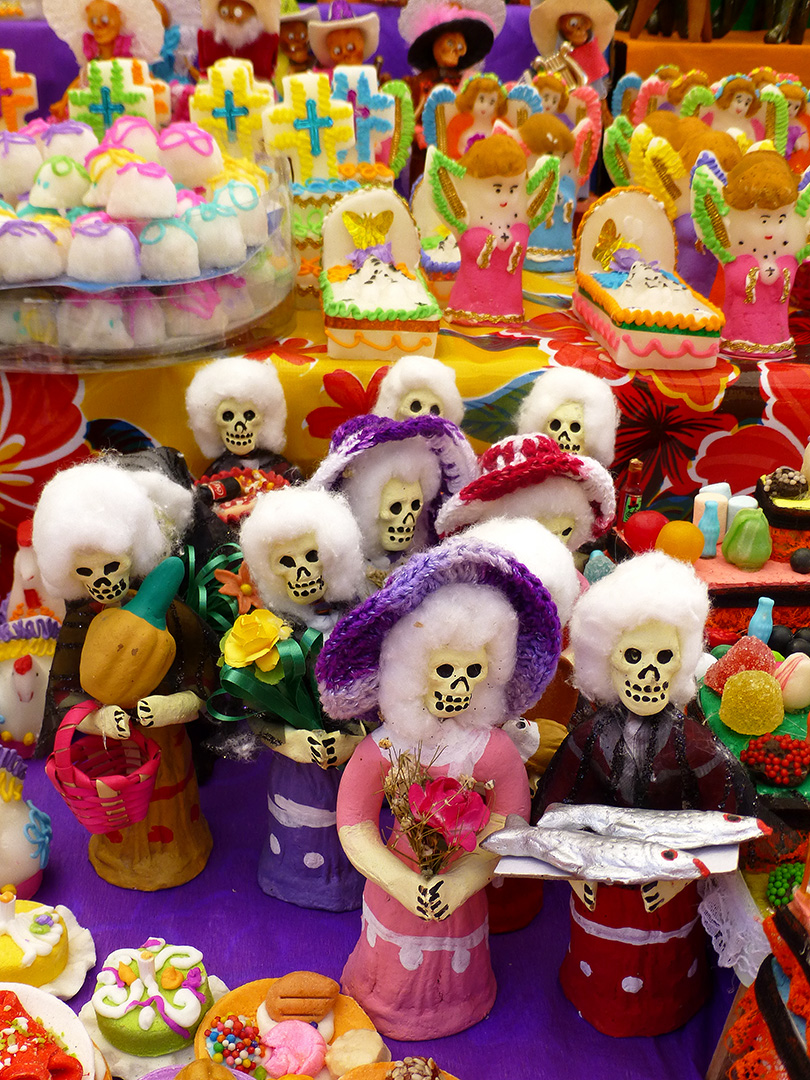
This year, around and about Oaxaca during Día de Muertos, especially for my skeleton loving grandson.  (Click on images to enlarge)

Besos y abrazos, Abue. 😉

Read Full Post »

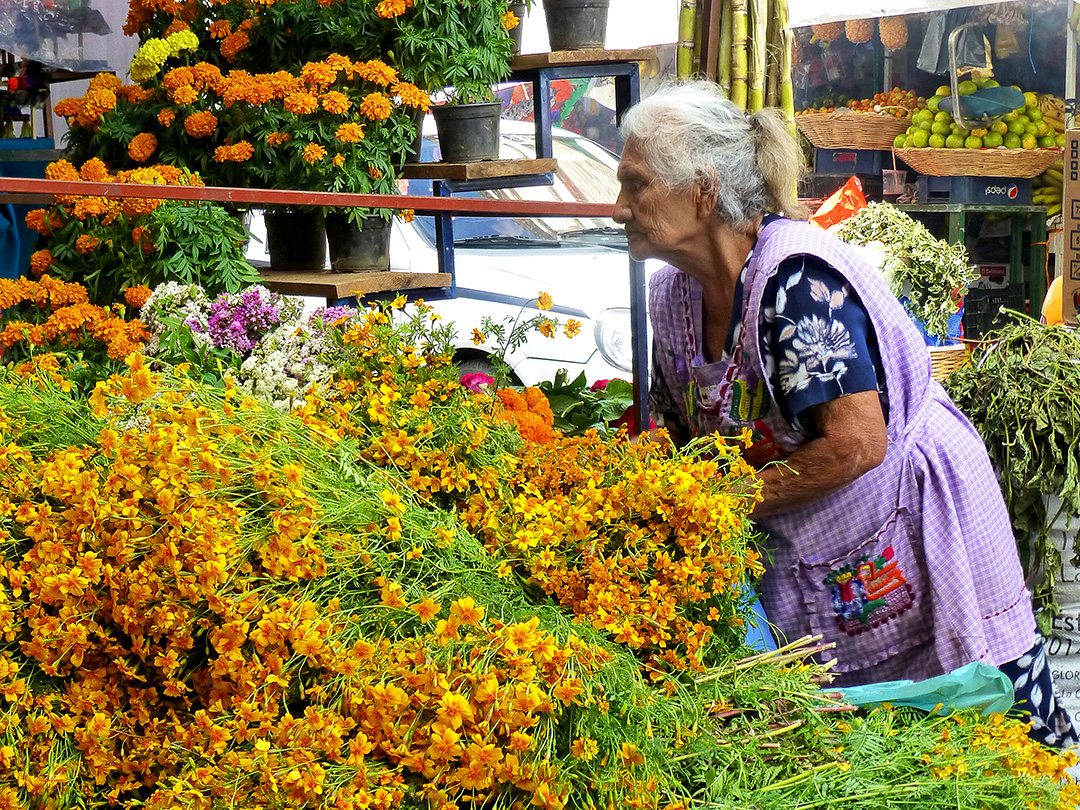
Today I ventured down to Calle de Ignacio Rayón (the block between the Benito Juárez and 20 de Noviembre mercados) to purchase flowers for my Día de Muertos ofrenda (an altar of offerings).  On the list was cockscomb (cresta de gallo or borla de Santa Teresa), marigolds (cempasúchitl), and veruche (also known as flor de muertos).  I wasn’t alone, the sidewalks were crowded with other shoppers in search of the same traditional flowers, fruits, nuts, copal, and other items to place on their ofrendas.

P1150140

Veruche is a tiny relative of the marigold that grows wild in the valley of Oaxaca at this time of year.  Yellow was the color of death in southern Mexico, long before the Spanish set foot on the continent and, along with the scent of the flowers and smoke from the candles and copal, it is thought to attract the difuntos (spirits of the dead) to bring them to the ofrendas prepared for them.

Muchisimas gracias to Shawn D. Haley for his informative presentation at the Oaxaca Lending Library on the Zapotec celebration of Día de Muertos.  Needless to say, I also purchased the book he coauthored with photographer Curt Fukuda, The Day of the Dead: When Two Worlds Meet in Oaxaca.

Read Full Post »

To borrow from Meredith Willson, it’s beginning to look a lot like Muertos…P1150004

Everywhere you go.

P1150005

No “five and tens” here…

P1150007

Just a street stall set up in Tlacolula de Matamoros.

P1150008

Beginning to shop for my Día de Muertos ofrenda.

Read Full Post »

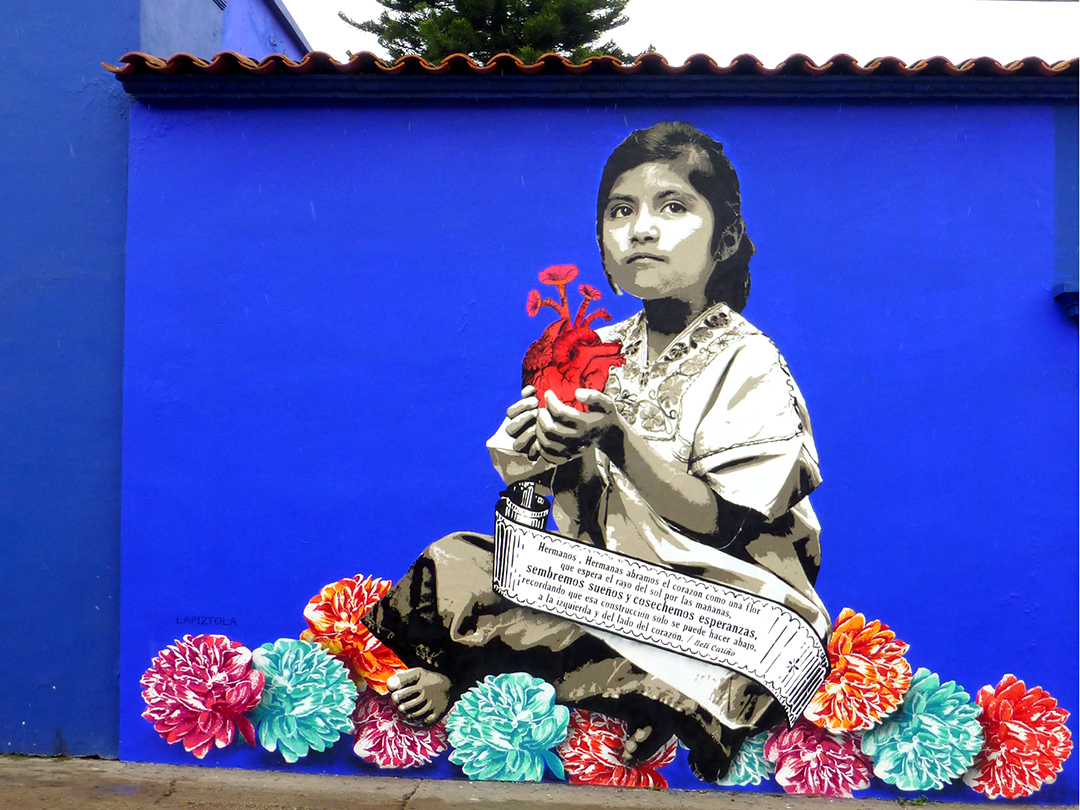
She’s gone…

P1090814_copyAs feared, by order of the government, the beautiful and moving mural by Lapiztola, on the side of Museo Belber Jimenez, has been erased.

P1140922copyOnly her ghost remains.

P1140920 copyI miss her, too.  Color and culture, indeed, seem to be unwelcome.

Read Full Post »

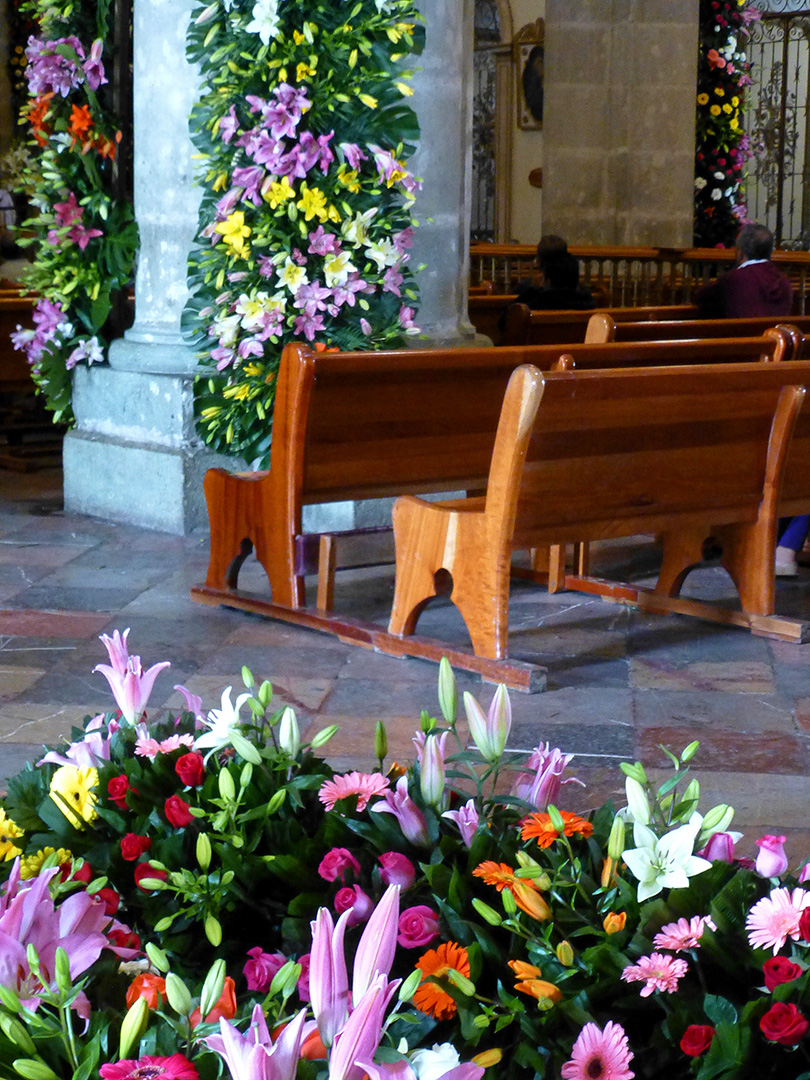
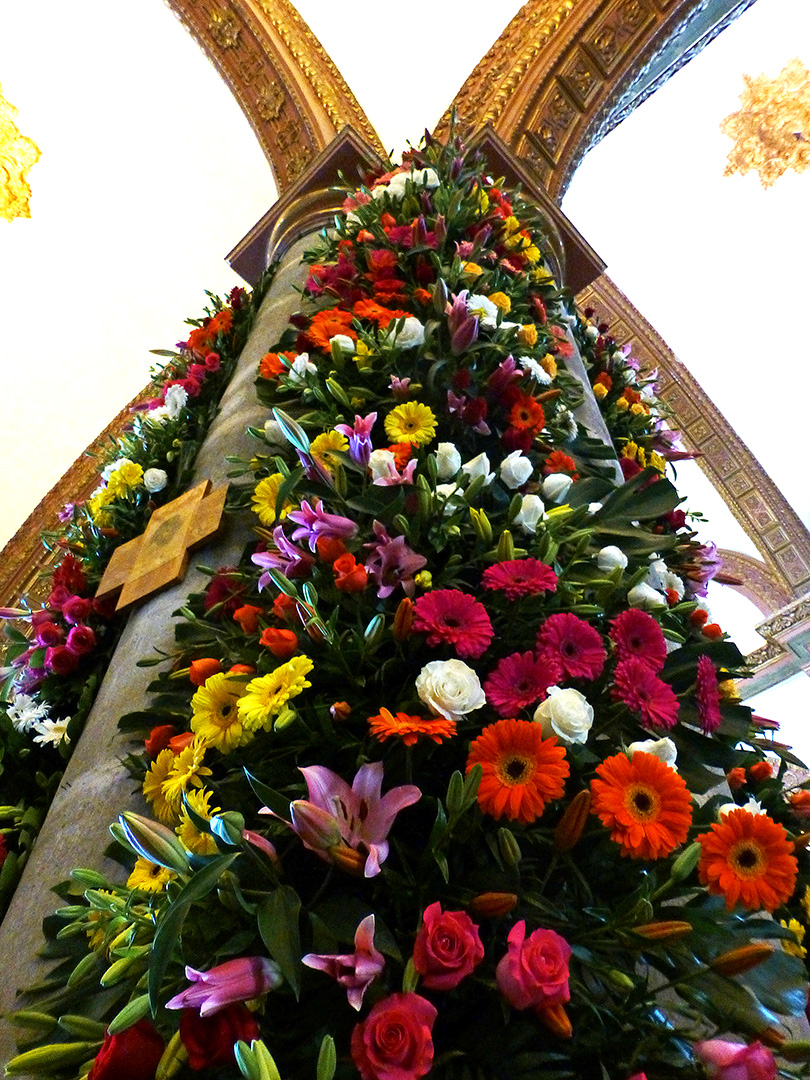
I love going into Oaxaca’s cathedral at this time of year, when the fragrance of thousands of flowers, especially lilies, perfumes the air.

P1140863

The Catedral de Nuestra Señora de la Asunción is being readied for October 23, the day Oaxaca celebrates Señor del Rayo.

P1140837

Like Guelaguetza, Noche de Rabanós (Night of the Radishes), and Día de la Samaritana (Good Samaritan Day), this is an “only in Oaxaca” celebration.

P1140866

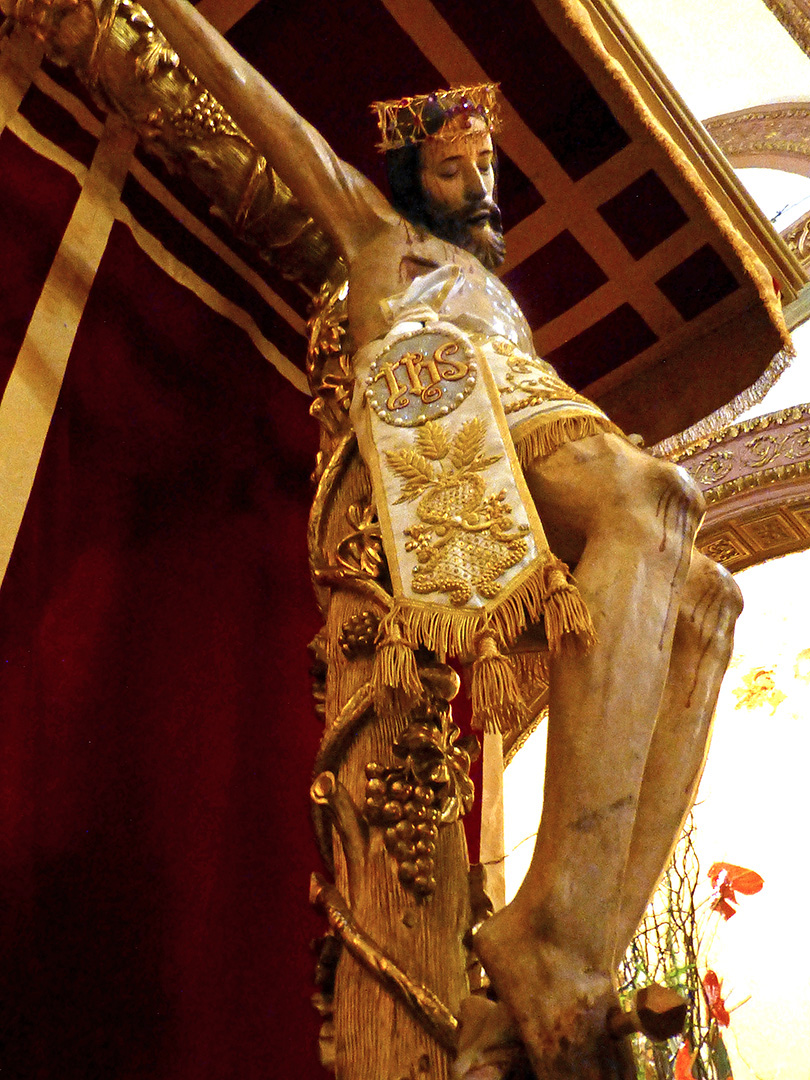
This carving of Christ on the Cross was brought to Oaxaca during the 16th century and was placed in the temple of San Juan de Dios, a church which had adobe walls and a straw (or possibly wood) roof.

P1140850

Legend has it that lightning struck the church and everything was destroyed, save for this figurine.  A miracle!

P1140859

The statue became known as Señor del Rayo (Lord of Lightning), was placed in his own chapel (the furthest capilla from the main entrance on the left) in the newly built cathedral, and has been much venerated ever since.

P1140855October 21, in anticipation of his special day, the cathedral is festooned with lilies and Señor del Rayo is moved out of the glass case in his chapel, to the main altar of the cathedral.

P1140888copy

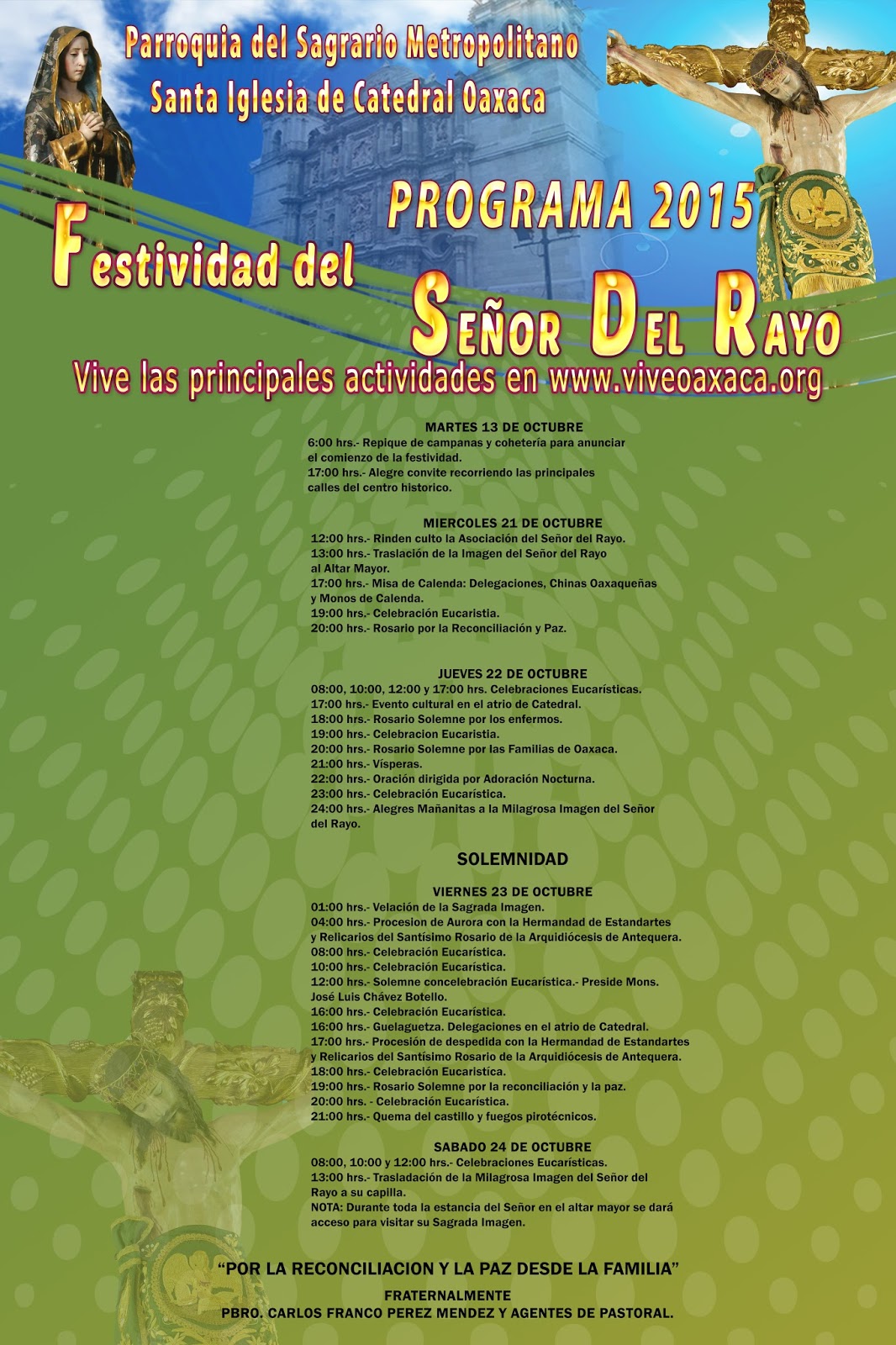
October 22 will be filled with religious and cultural events and at midnight, when the calendar day changes, the cathedral bells will peal and cohetes (rockets) will announce the arrival of Señor del Rayo’s special day.

P1140861

In honor of His day, on October 23, there will more spiritual and cultural festivities, culminating in a castillo and fireworks.

P1140838

As the color and scent of the lilies fade, on October 24 Señor del Rayo will be returned to his chapel.

señor del rayo 2015 - copia

The end of eleven days of festivities celebrating Señor del Rayo.

Read Full Post »

As many of you already know, one of my favorite things about living and being in Oaxaca is, you just never know what you will stumble across.  Rounding a corner, one might come upon a calenda (parade) with band, marmotas, monos, and dancers; a street artist or payaso (clown) entertaining a gathering of nin@s to abuel@s; street art; or a newly opened store.

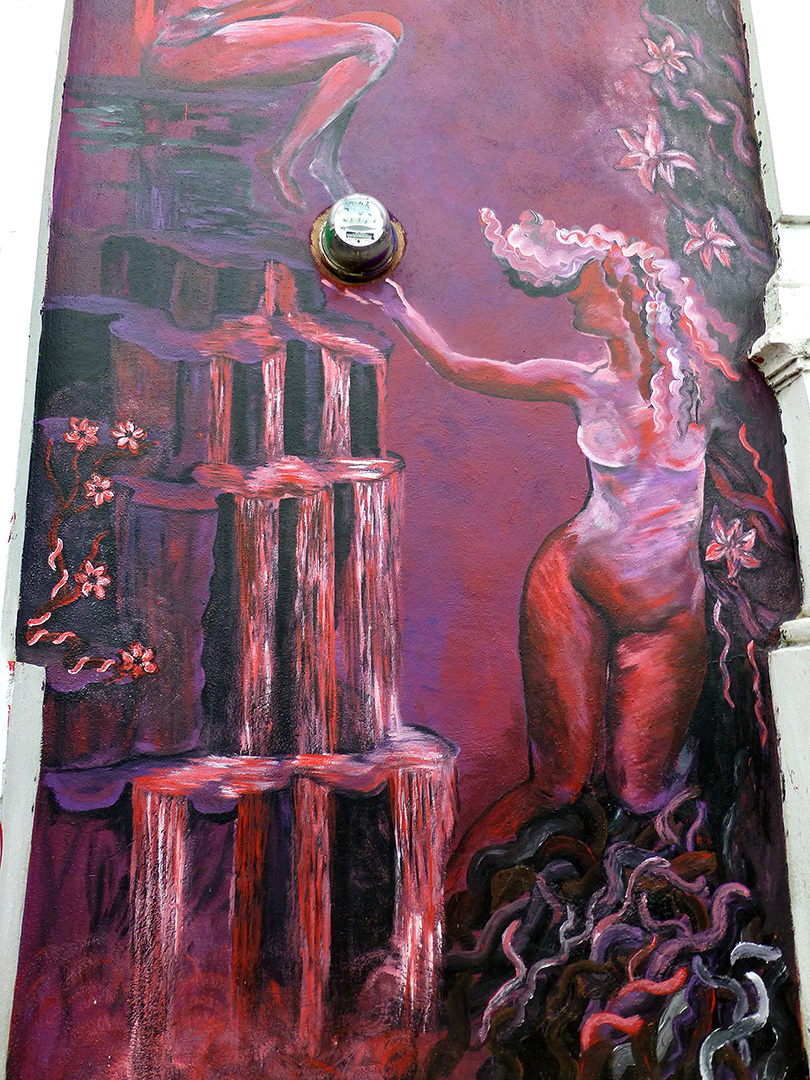
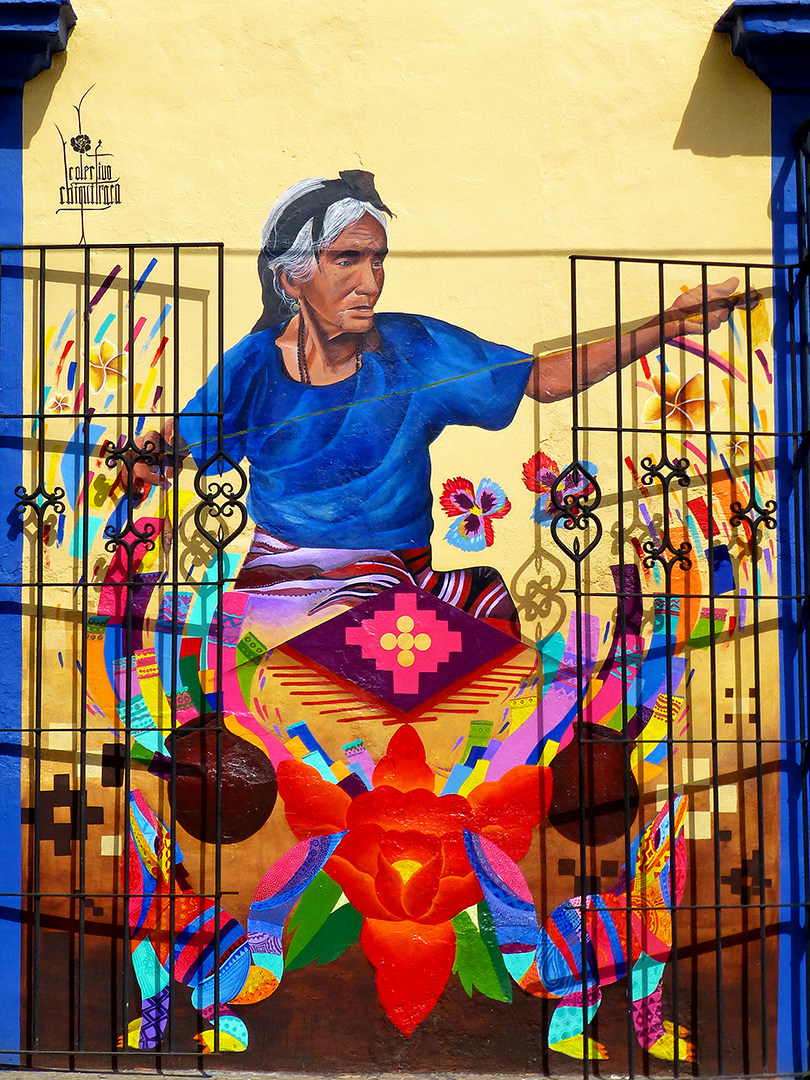
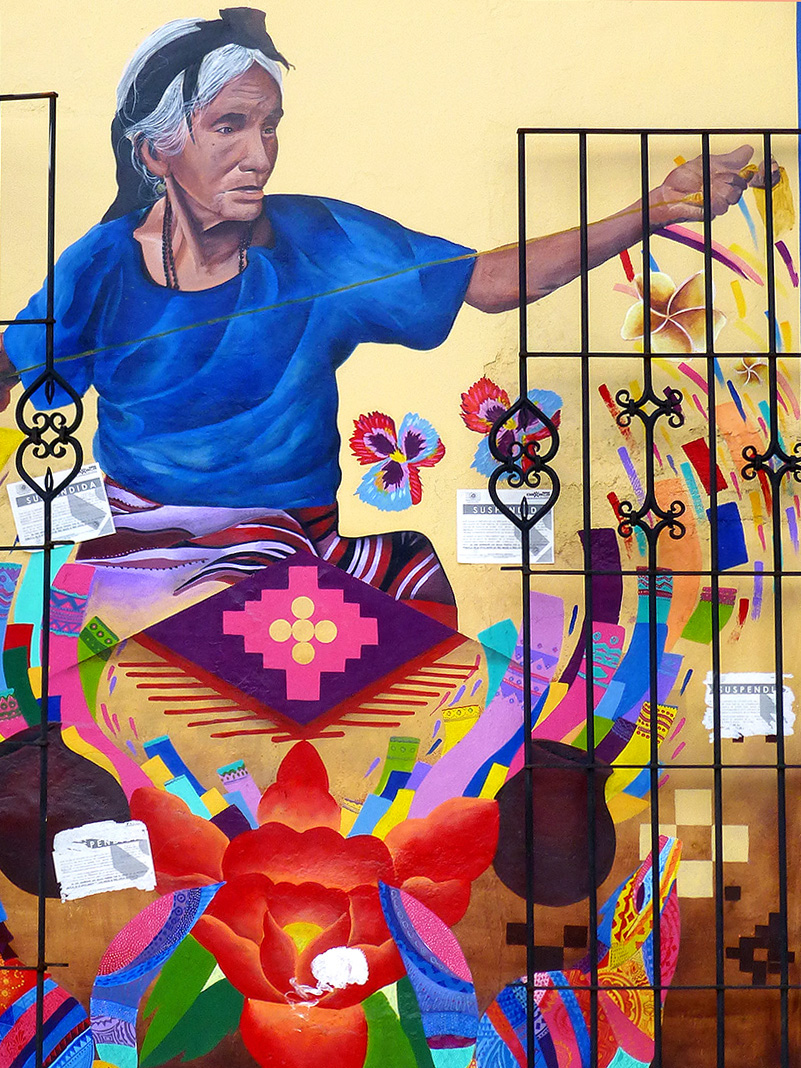
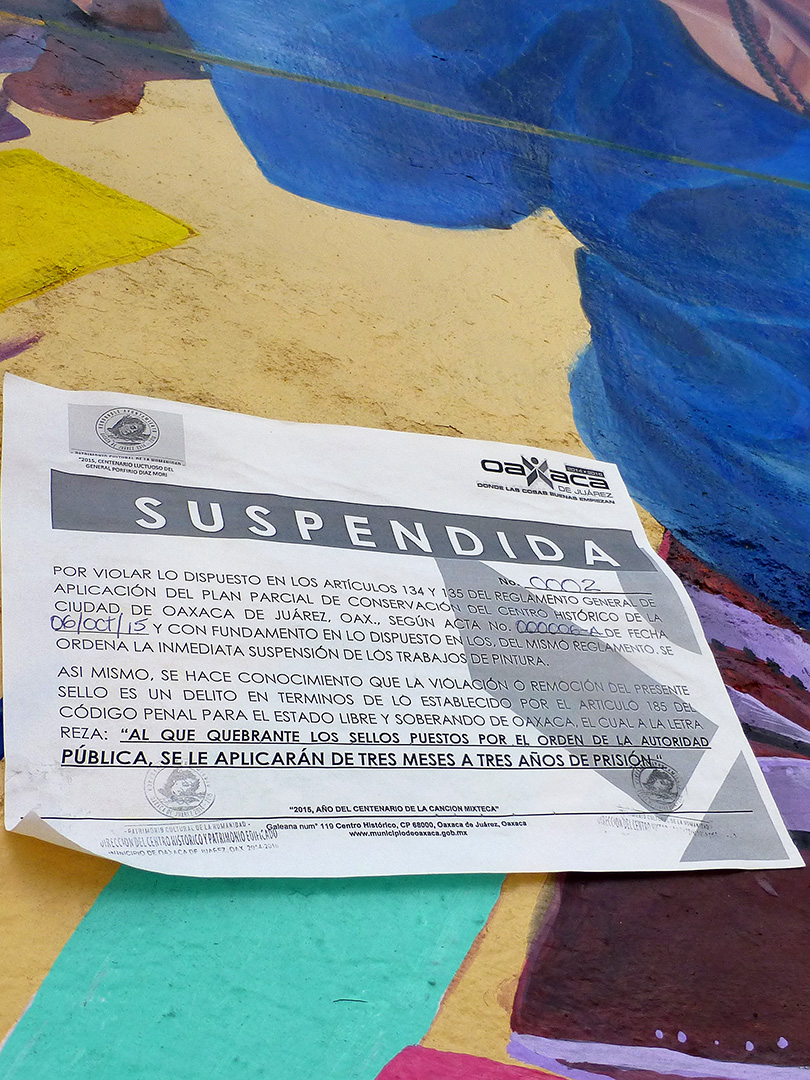
So (no surprise), a few months ago, walking up Tinoco y Palacios enroute to the Sanchez Pascuas mercado (in need of a few staples like quesillo, aguacates, and tamales), a stunning new mural caught my eye.P1120515Positioned to entice potential customers into Color y Cultura, a newly opened artisan community shop, the mural is the work of Chiquitraca Colectivo from Juchitán.  It worked, I was hooked, and later returned to browse and eventually buy a pair of earrings carved from a gourd.  However, during a return trip to the mercado, I was rather shocked to see unsightly papers defacing the mural.
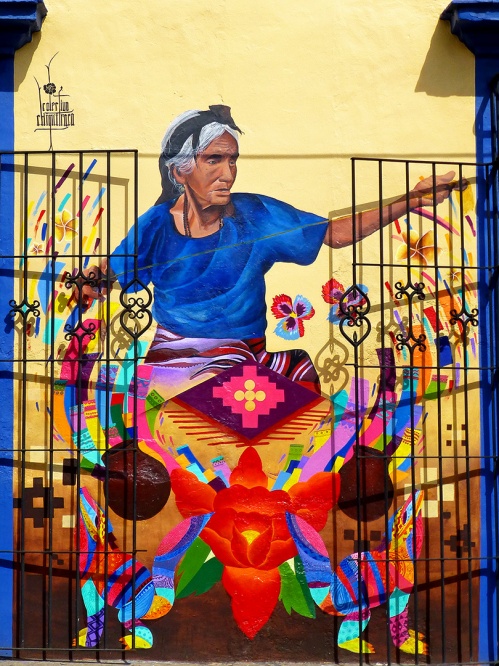
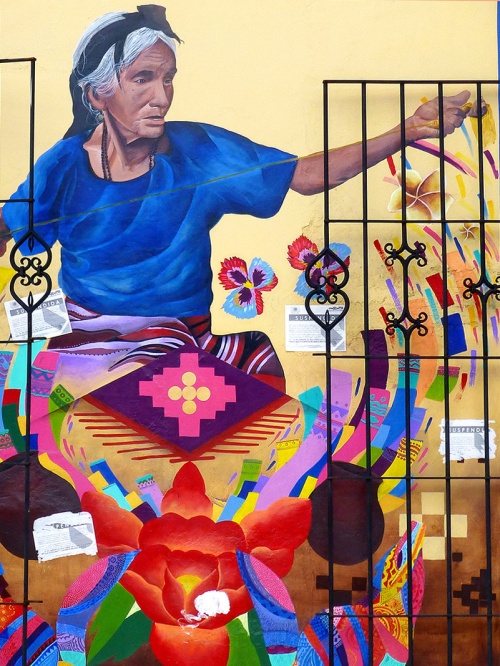
P1140828

Usually, street murals are “hands off” zones for vandalism.  However, closer inspection revealed official notices declaring, “Suspendida” (suspended) and going on to say that the mural violates regulations on the conservation of the historic district.
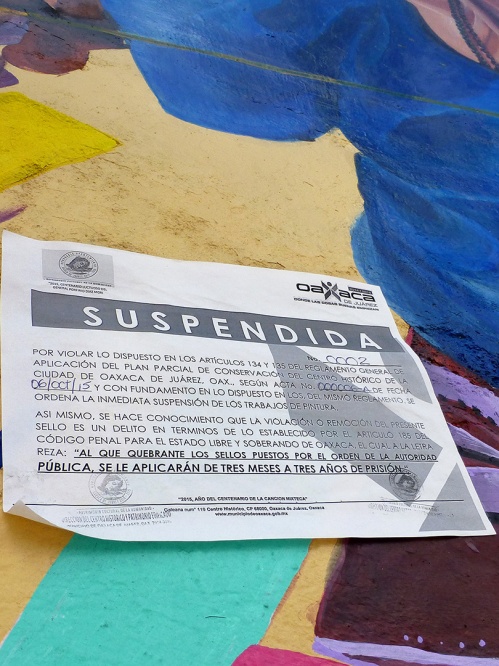
P1140829

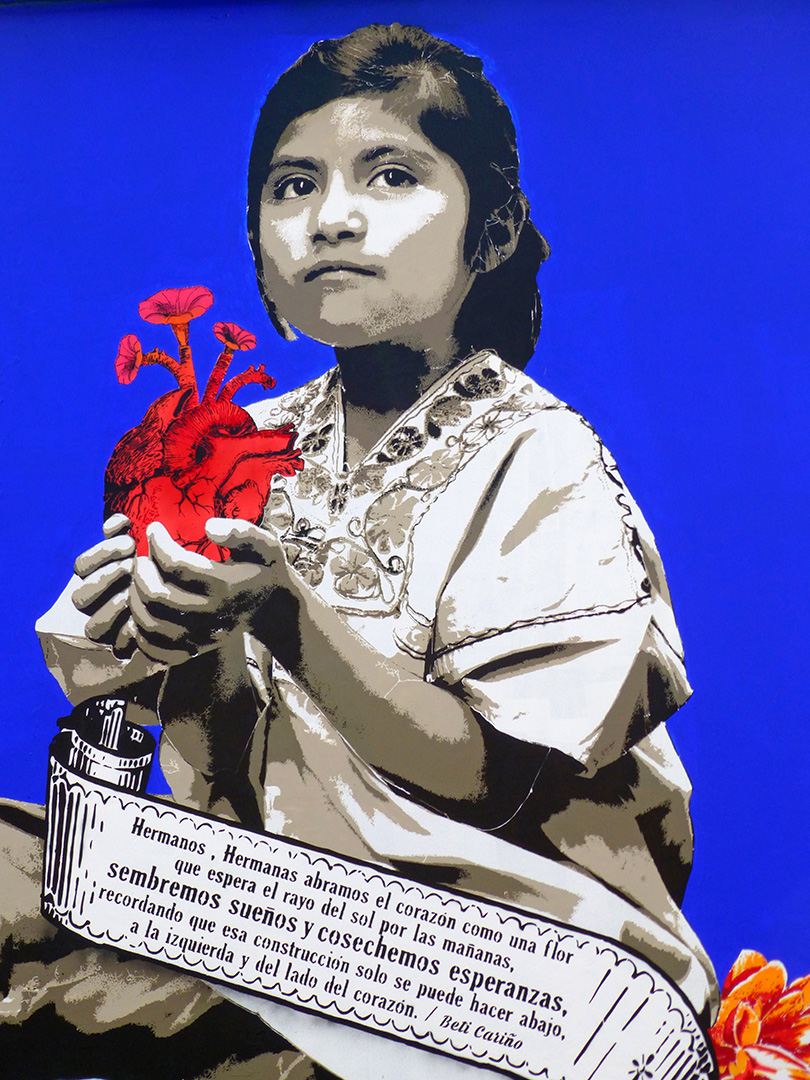
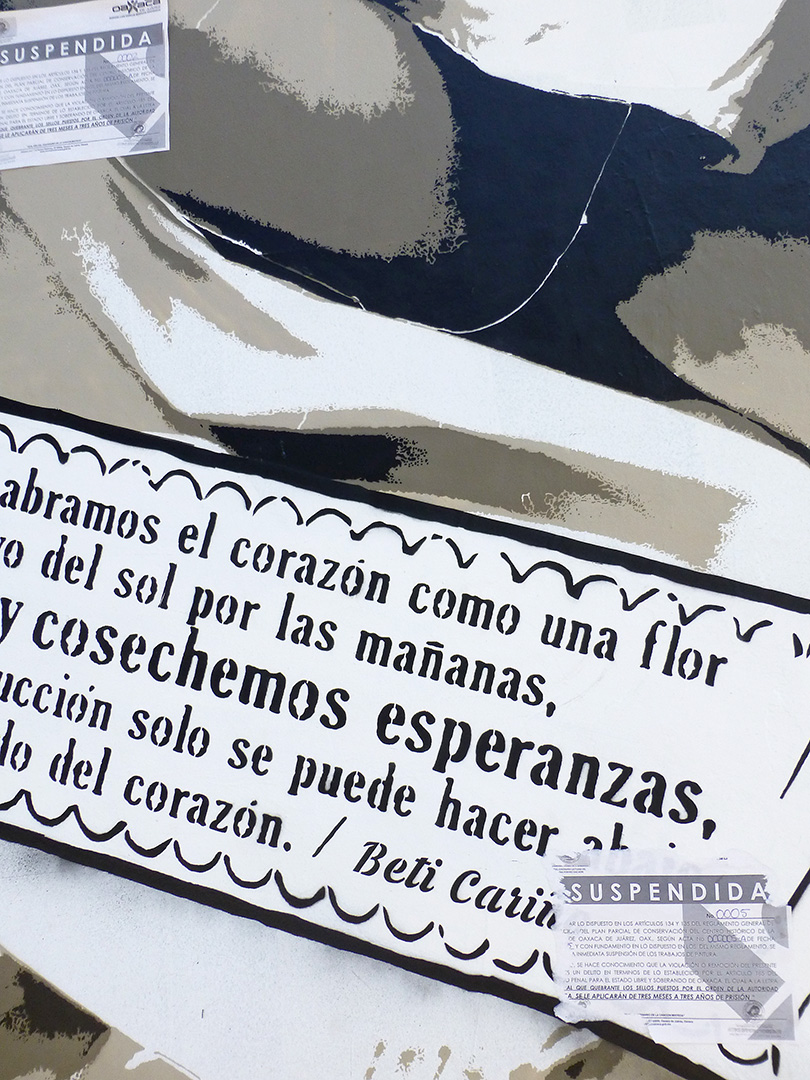
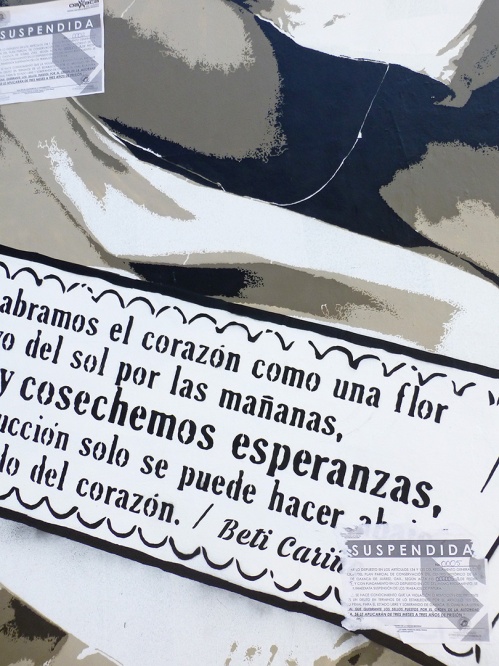
And, if this weren’t egregious enough, remember the stunning We sow dreams and harvest hope mural on the side of Museo Belber Jimenez?
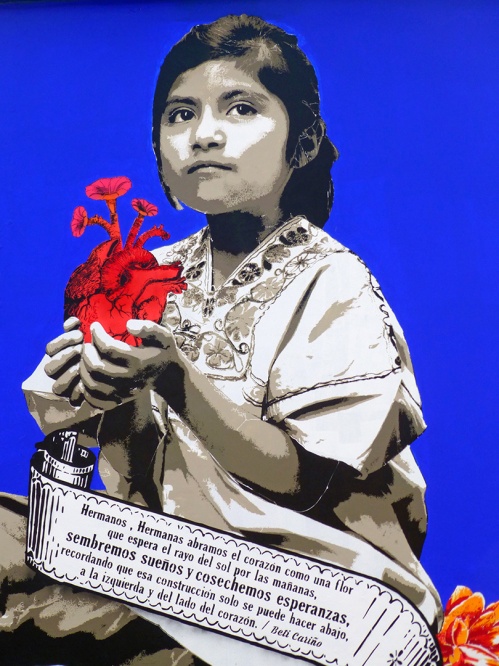
P1090820copy

It too now has appalling “Suspendida” notices plastered on it.  WTF is going on???  A little research revealed that a law was recently passed to “criminalize” wall art.  Yes, yes, yes… I understand that the “powers that be” and even ordinary residents are sick of graffiti on historic buildings.  BUT to lump the anarchist “A” spray-painted on the side of the Cathedral with magnificent murals painted on ugly decaying walls and beautiful works of art privately commissioned by businesses and museums to decorate their buildings, is the height of absurdity, never mind assigning a “criminal” aspect to it.  Believe me, Oaxaca has a laundry list of more important issues that it needs to address.
P1140752

If in their “infinite wisdom” they are attempting to “clean up” the city to better appeal to tourist dollars, euros, yen, etc., then I think they are barking up the wrong tree — we extranjeros (foreigners) love the street art!  To that end, below is a copy of a letter I sent to the president of Central Connecticut State University (CCSU) last year, when officially authorized murals painted by art students as part of their course work were ordered removed by the university administration.

Dear President Miller:

I am writing to you from the city of Oaxaca de Juárez in southern Mexico, nestled in the valley where corn was first cultivated.  I have the privilege of living in culture that has a deep respect for, and appreciation of, communication through all forms of art.

Oaxaca is filled with museums and public art.  In addition, her walls are covered with murals, both officially sanctioned and unauthorized.  An example of the latter:  My current neighbor, previously lived next to a concrete bench built into a wall along her street.  It’s primary function seemed to serve as a gathering place for garbage and graffiti.  Being an artist, she painted a living room scene around the bench, replete with, a lamp, bouquets of flowers, pillows on the sofa/bench, and a framed painting with the image of a smiling creature holding a sign that quotes Oaxaca’s favorite son and former Mexican president, Benito Juárez:  “El respecto al derecho ajeno es la paz.”  (Respect for the rights of others is peace.)  It is a quote that every Mexican school child learns and in the eighteen years since the bench and mural were first painted, it has become a beloved icon of the street and very little graffiti and garbage have reappeared.

Oaxaca would lose much of her character and lessons would be lost, if we were to wake one morning and find all her murals disappeared.  The story is the same at CCSU and it would be shameful if the beautiful and thought-provoking student murals at CCSU were to be needlessly destroyed.

Read Full Post »

Can you believe it?  It seemed that no sooner had last month’s Oaxaca Sabe culinary adventure concluded, than the seventh annual Saber del Sabor: Festival Gastronómico 2015 kicked off.  This past Friday, the Plaza de la Danza was tented and decorated for a buffet dinner prepared by cooks from the eight regions of the state of Oaxaca.

For only 300 pesos (approximate $18.50), one could feast on a mind-blowing and waist-expanding galaxy of gastronomic delights.

Menu inauguacion Saber del saborThe dinner seeks to recognize and promote Oaxaca’s traditional cuisine.  Always a highlight are the maestros of barbacoa, who brave blistering heat and eye-stinging smoke as they turn and tend the spit-roasted piglets, lambs, and chickens.   Alas, this year by 8 PM the line was too long and I elected to miss these always succulent and mouth-watering delights.  However, I was in no danger of starving!

Of course, the chefs were the stars of the show and young and old alike savored their creations.

This year El Saber del Sabor is honoring two regional chefs:  Young chef, Ixchel Ornelas from Tlaxiaco, in the Mixteca Alta region of Oaxaca and Teotitlán del Valle’s own, Abigail Mendoza, who has done so much to promote and bring respect for Oaxaca’s traditional indigenous methods and flavors.

The festival continues with lectures, workshops, and gourmet meals prepared in the kitchens of Oaxaca’s top restaurants by celebrated chefs from all over Mexico — as well as a couple from Spain and the USA.

Read Full Post »

« Newer Posts - Older Posts »