Feeds:
Posts
Comments

Posts Tagged ‘Mexico’

The little Embraer may have touched down in Oaxaca late Saturday night but, in the words of a long ago Buffalo Springfield song, I’m still “flying on the ground.”

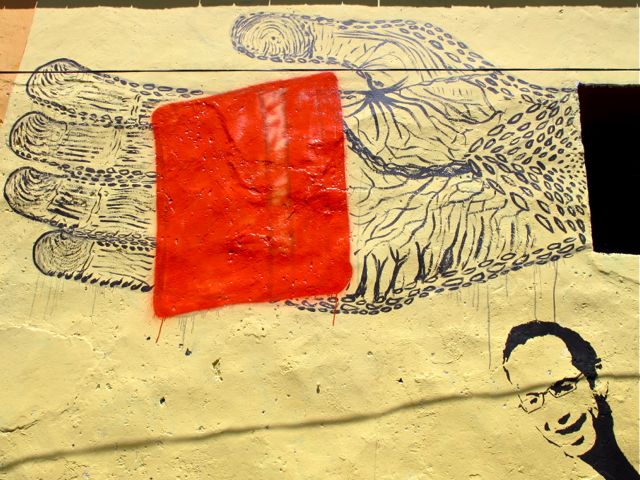
Mural on the wall outside Academia de Arte Musical in Oaxaca.

Mural on the wall outside Academia de Arte Musical in Oaxaca.

Moving two days before a California and New York trip…  What was I thinking?

Read Full Post »

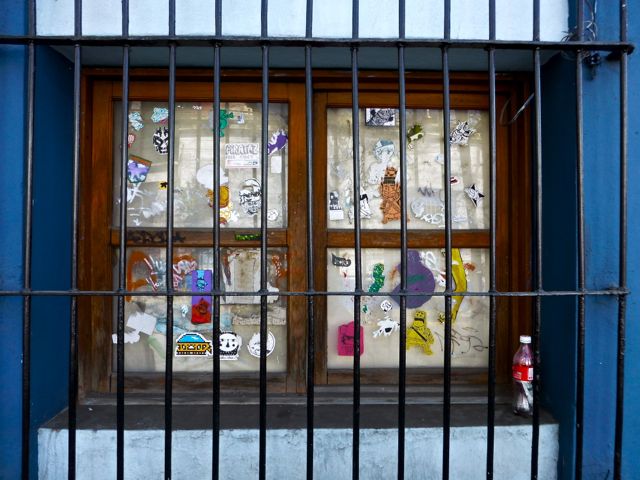
Pop culture stickers are, “ubiquitous in urban centers around the world. Often seen at eye level or just beyond reach, stickers grace most every imaginable surface of the built environment.”  [Digital Collections Street Art Graphics]

As you can see, Oaxaca is no exception.

P1040657

Jimmy and María Sabina, I know. — even got to see Hendrix perform twice, back in the day.

Stickers on window panes behind iron grating

But, that qualifies me as being “certain age” and so most of the references escape me.Stickers on the back of sign on lamp post

And, what’s with the skull and cross-bones?  Rebellion?  Symbol of a toxic culture??  Perhaps.  But, like Che, one now sees them everywhere — even on toddler clothes.  Co-opted, again!

Read Full Post »

In 1999, UNESCO designated February 21 as International Mother Language Day.  Tomorrow, February 20, Oaxaca begins her own celebration of Día Internacional de la Lengua Materna 2013 with a 2-day conference.

dia internacional de la lengua materna oaxaca 2013

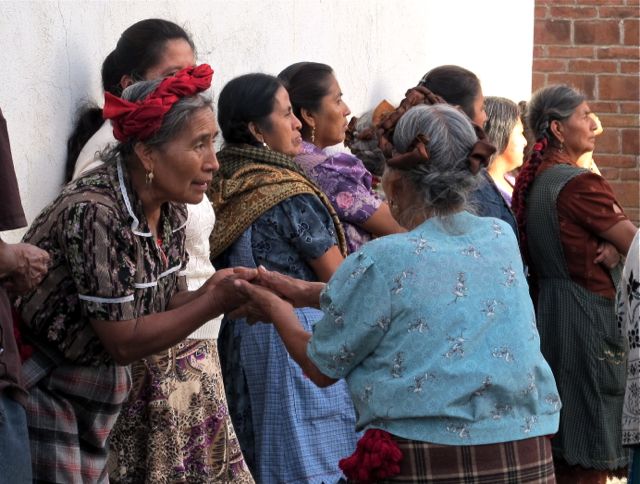
The issue of “lenguas maternas” has a particular resonance in Oaxaca, as the state is home to 16 distinct ethnolinguistic groups:  Amuzgos, Chatino, Chinanteco, Chocho, Chontal, Cuicateco, Huave, Ixcateco, Mazateco, Mixe, Mixteco, Náhuatl, Popoloca, Triqui, Zapoteco, and Zoque.  As anyone who has visited the villages of Oaxaca has discovered, sometimes the abuelos and abuelas only speak their native language, not Spanish.

However, as Ernestina Gaitán Cruz notes in an article in sinembargo.mx, most of these indigenous languages lack an alphabet, having been passed from one generation to another through an oral tradition, and because these “Mother Tongues” are not taught in the schools, a significant number of these languages are in danger of becoming extinct.

Oaxaca is not alone.  From the article, Indigenous Youth Step up to Protect their Roots:

UNESCO estimates that every two weeks, one language disappears from the world.

Education systems have historically played a large part in the disappearance of indigenous languages, sometimes even forcing their extinction by severely punishing and shaming children for speaking native tongues or expressing indigenous identity in any way.

<snip>

In some communities where a large portion of the population speaks only the native language, another issue arises: access to important information on topics such as health care, employment opportunities, legal rights and public services.

And, it isn’t just a particular community that suffers, as The Endangered Languages Project explains, The disappearance of a language means the loss of valuable scientific and cultural information.

Zapotec village of Teotitlán del Valle

Zapotec village of Teotitlán del Valle

One of the missions of the Centro Académico y Cultural San Pablo in the city of Oaxaca is to document, study, and preserve the indigenous languages of Oaxaca.  The center includes a library, offers language classes, and will be hosting several events during Día Internacional de la Lengua Materna 2013.

Cartel-web-cursos-2013

Read Full Post »

The sun is shining, but it’s cold.  With snow on the ground, I’m living inside.  I’m definitely not in Oaxaca anymore!  I’m outside of Saratoga Springs, New York.  Yes, I traded the land of blue skies, brilliant colors, warm temps, and open doors and windows, for ten days in the frigid, fifty shades of gray, northeast — but for the best of reasons, my grandson’s first birthday. However, I need my Oaxaca fix!  So, with a little time on my hands (nap time for baby) I am going through Noche de Rabanos photos.  And, these little devils, jumped out at me.  (Gosh, I have no idea why!) P1030666 These dancers portray La Danza de los diablos, a dance that is the result of a fascinating fusion of African and Sonoran rituals. P1030669 They are made of dried corn husks P1030668 and were created by Moisés Ruiz Sosa.  The detail is amazing! P1030667 La Danza de los Diablos de Santiago Juxtlahuaca won second prize in the 2012 Totomoxtle Decorado division. P1030670 Ooops!  The adorable little devil who melts this heart just woke up.  Time to do the crawling-around-on-the-floor dance.

Read Full Post »

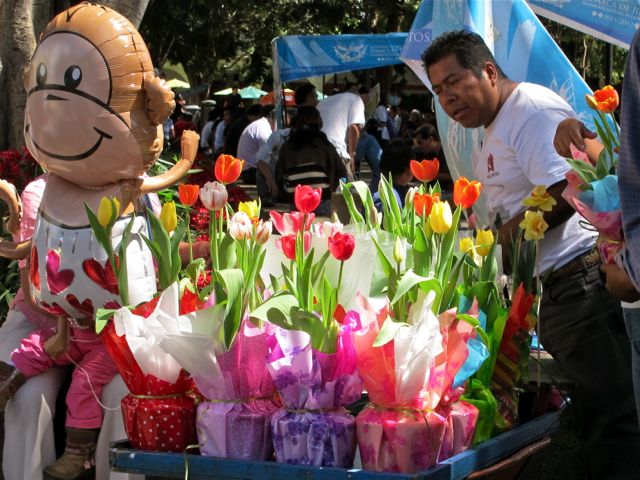
Got your hearts?  Yes!

Bouquets of heart shaped balloons

Got your flowers?  Yes!

IMG_2263

Got your candy?  Yes!

Candy display on counter

¡Feliz Día del Amor y la Amistad!  (Happy day of love and friendship!)

(ps)  To expand your linguistic skills, learn Frases de amor y amistad en 7 lenguas indígenas mexicanas — including Mixe, Mixteco, and Zapoteco.

Read Full Post »

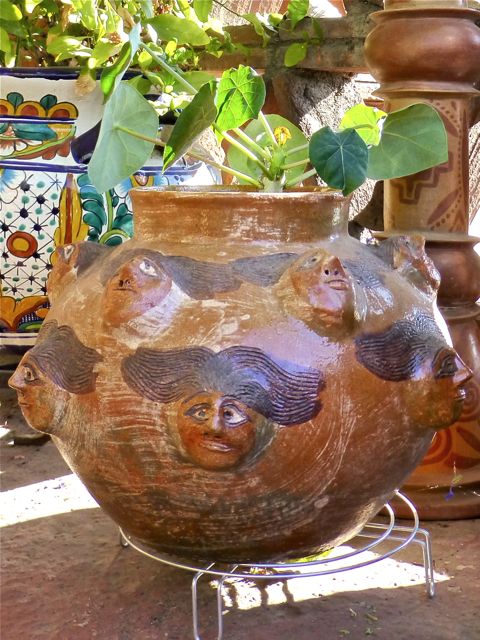
One of the biggest challenges of the recent move was carrying 150+ potted plants down two flights of stairs, across the driveway, and up a flight of stairs.  They ranged in size from eight to eighteen inches across and ten to twenty-four inches tall.  Needless to say, major respect was given to the cactus and their perilous spikes.  However, I also gave special care to my two pots by the late potter, Dolores Porras.

P1040391

Growing up and spending her life in one of the villages of Oaxaca known for working in clay, Santa María Atzompa, her style was unique in the use of color and imagery — a touch of whimsy wherever her pots are found.

P1040390

If you will be in Oaxaca tomorrow (Feb. 11, 2013), be sure to stop by the Oaxaca Lending Library to see Michael Peed discuss and show his documentary, Dolores Porras: Artista Artesana de Barro.  And, if you’re not lucky enough to be there, check out the website for the film’s trailer.

Porras blurb


Read Full Post »

Oaxaca is mourning the loss of painter, Juan Alcázar Méndez, who succumbed to complications related to diabetes yesterday.

Juan Alcázar Méndez.  Photo from Consejo Nacional para la Cultura y las Artes

Juan Alcázar Méndez. Photo from Consejo Nacional para la Cultura y las Artes

Alcázar was born in Guadalupe Etla, Oaxaca in 1955 and entered the School of Fine Arts at the University Benito Juarez of Oaxaca at the age of 13.   He became known for his unique magic realism style.

Painting from fundraising auction by the Oaxaca Lending Library, 2010.

Painting from fundraising auction by the Oaxaca Lending Library, 2010

He was the founder of the Taller Rufino Tamayo, el Taller de Gráfica en la Casa de la Cultura, and the Taller Libre de Gráfica Oaxaqueña.  He was also one of the artists exhibited in the at the Mexican Consulate in San Francisco in 2012.

"El Rapto" at the The Magic Surrealists of Oaxaca exhibition 2012, San Francisco, CA.

“El Rapto” from the The Magic Surrealists of Oaxaca exhibition 2012, San Francisco, CA.

RIP, Juan Alcázar Méndez.  You will be missed but your magic will live on.

Read Full Post »

43 houses at risk of collapse, the October 2012 Noticias headline screamed!  This is up from 23 dangerous old buildings discussed in my July 2011, Old and dangerous post.  The “high degree of deterioration” of properties in the historic district of Oaxaca seems to be an annual topic.

The most recent article came at the end of the 2012 rainy season and the article noted that in the preceding week the walls of two abandoned houses had collapsed due to the softening of building materials.  I’m pretty sure the bottom right photo is of one of those walls.  And 6 months later, it’s still in the same state of disrepair.

Picturesque?  Yes!  Dangerous???  Oh, yes!!!

Read Full Post »

Super Bowl madness in the Bay Area.  Can’t find any San Francisco 49er-Oaxaca connection, except scores of fanáticos.  So, here’s a little red and gold from the walls of Oaxaca…

IMG_0362aIMG_0379 P1020707

¡Vamos Niners!

Read Full Post »

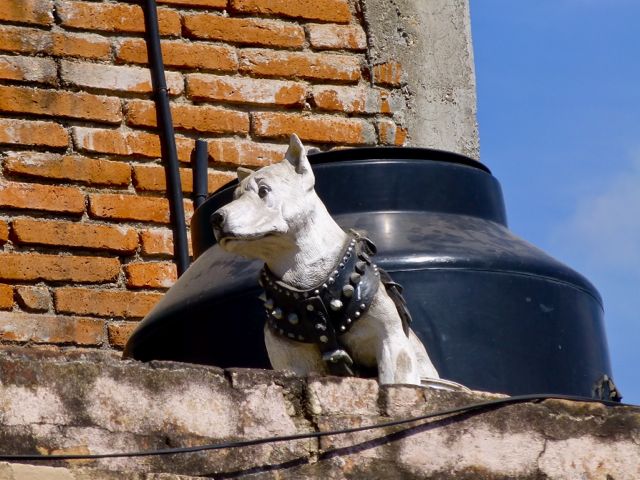
Female and male, big and small, menacing growlers and annoying yappers, the roof dogs of Oaxaca are on the job patrolling rooftops in the city and in the countryside.  They are so ubiquitous, San Pablo Etla, Oaxaca is the setting for an illustrated children’s book, Pipiolo and the Roof Dogs.

P1030401

But sometimes one has to ask, “Is it real or is it Memorex?”

P1040376

What do you think?

Read Full Post »

After the 3-day moving adventure, Monday morning I walked down to the Transporte Terrestre office (next to Oaxaca’s Post Office, across the Alameda from the Cathedral) to buy an airport shuttle ticket for my Tuesday morning, bordering on crack-of-dawn, flight to California.  At 55 pesos (less than $4.50 US) from my apartment in the Centro Histórico (more outside the historic district), it’s a bargain.

P1040655

The driver pulled up at 6 AM on the dot.  Unfortunately, instead of ringing my buzzer, he began banging on the massive iron front gate and shouting, thereby waking my neighbors with apartments closer to the gate.  Then, of course, there was the fact that, in my physically and (apparently) mentally exhausted state the night before, I’d set my alarm for the wrong time, and had only awakened 20 minutes before his noisy arrival. So, with teeth brushed but no shower, no make-up, and probably irritated neighbors, I set off for el norte.  This trip was not off to a promising start!

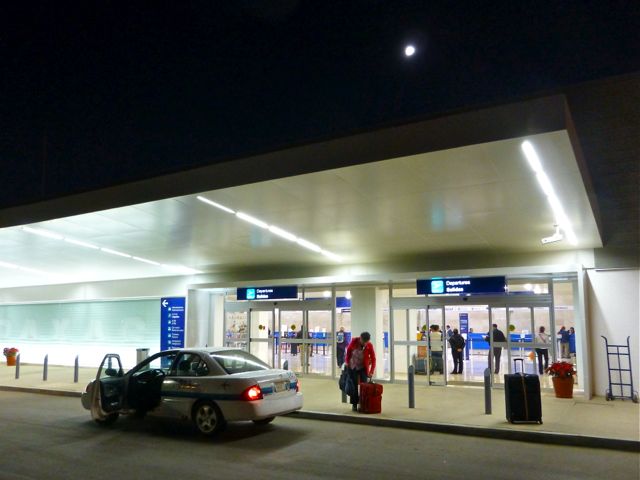
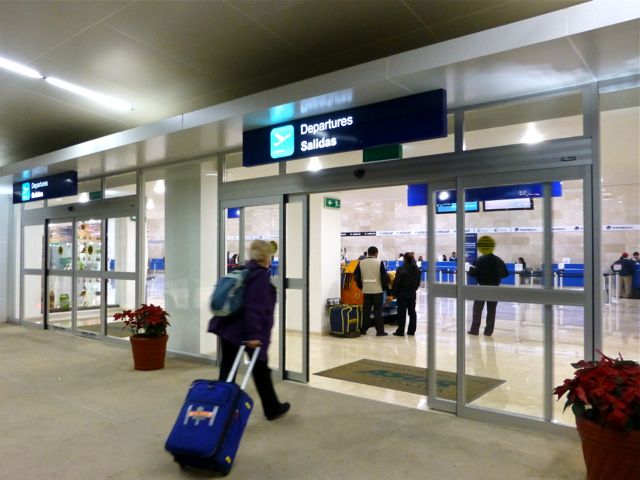
The other two passengers and I were dropped off at the Oaxaca Xoxocotlán International Airport’s new departure terminal.  Modern, light, airy, signs and announcements in Spanish and English, mezcal and gift shops (but no food!) — everything’s up-to-date in Oaxaca’s new departure terminal.

P1040671

However, one still must walk outside to get to the old terminal (now dedicated to arrivals) where the only bathrooms, before going through security, are located — a minor hiccup for passengers, but a major inconvenience for airport staff!  Renovation connecting the two terminals is in the works.

There were only a couple of other people lined up at United’s desk and my turn came in less than 5 minutes.  Hoisting my suitcase up on the scale, handing over my passport and flight information, I was prepared to be on my way through security in no time.

P1040670

Dream on…  for some unexplained reason, the United customer service agent did not like what she saw when she ran my passport through the scanner.  Conversation with the other agent, calls to a superior (who I could see standing in a doorway on the second floor balcony), more computer input and passport scanning, and the line behind me began growing.  Did I mention, this trip was not off to a promising start?

After twenty minutes, whatever problem my passport possessed was miraculously unraveled and I was on my way through security.  It was at this point, ravenously hungry, I began silently chanting to the cocina goddess, that a food stall or at least the convenience store would be open.  In September (my first experience with the new terminal) I sat, with stomach grumbling, at my gate for an hour before the convenience store opened its doors.

P1040672

This time around, I and other early morning passengers were in luck — various puestos were open to satisfy hunger pangs, snack food cravings, and caffeine withdrawal.  I opted for a generous and delicious cup of coffee and a ham and quesillo torta, topped with tomato, avocado, chile pepper, and lettuce — filling and yummy.

With a happily satisfied stomach, I walked out into Oaxaca’s warm winter morning air, boarded the little Embraer, and, after a brief delay on the tarmac (mechanical difficulty rapidly solved), we took off into the wild (and clear) blue yonder.  Circling twice over the city to gain altitude, the pilot provided us with a couple of bird’s-eye views of Monte Albán and the newly opened Atzompa archeological sites.  Not a bad beginning, after all — the journey northward was definitely looking up!

Read Full Post »

In the city and in the villages, the signs are everywhere…

Sign for Neuroticos Anónimos

The recent article, Native neuroses: Sharing their emotional struggles in Spanish by Marisa Gerber, gives a little background on the popularity of Neuróticos Anónimos, south of the Río Bravo del Norte (aka, Rio Grande).

After two days spent cleaning the new apartment and schlepping the small stuff (boxes, plants, furniture, etc.) down two flights of stairs, across the driveway and up one flight (with a lot of help from my friends), today the moving crew is coming to do the heavy lifting.  For some reason the above topic resonates!

Read Full Post »

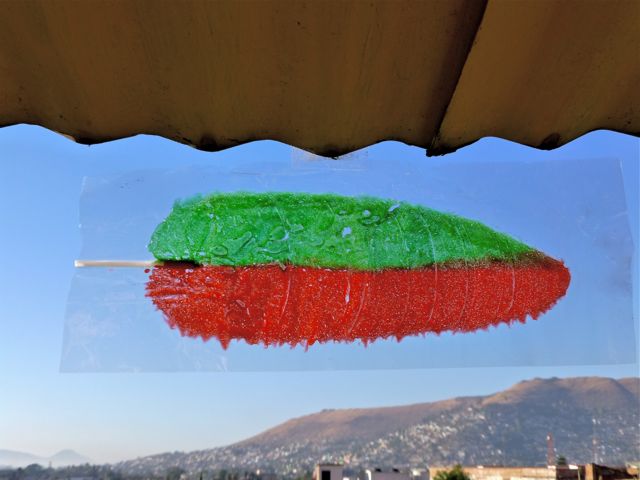
Last week, my neighbor Marga gave me a cachetada.  No, not a slap on the cheek!  A cachetada is also a Mexican candy — similar to the dried fruit roll ups my kids used to eat, though I have a sneaking suspicion these may just be dried, dyed, and flavored sugar water.  Here is mine, hanging out in Oaxaca.

Cachetada, Mexican candy

Cachetada – slap
A Mexican long candy
Red, green, lick or bite

– Haiku by Margarita Shubart –


Read Full Post »

The packing begins — this is “big move” week.  In the meantime, a little more graffiti…

… from under the fútbol (soccer) stadium.

Read Full Post »

Sunny, warm, and dry, Oaxaca’s sidewalks, mercados, restaurants, and zócalo are filled with “snowbirds” (the human variety) escaping the bone-chilling and wet wintry weather of el norte.  Alas, almost immediately after the previously mentioned “big move” next week, I’m heading in the opposite direction — to the bleak gray north for several weeks to visit family and friends in California (it’s not all bikini beaches and blue sky) and then east to celebrate my first grandchild’s first birthday — the best and maybe only reason to visit upstate New York in the dead of winter!  And, if previous return trips to el norte are a predictor, I’ll be missing the warmth and color of Oaxaca almost from the minute I step off the plane.

The “snowbirds” and I have the luxury of coming and going.  Some people do not.  One of my favorite journalists interviews a young Oaxaqueña trying to support her young daughter by working the fields in Madera, California.  As the title suggests, it is a poignant story…

The Only Job I Can Do–A Young Mother’s Farm Work Story

Editor’s Note: Lorena Hernandez is a young farm worker and single mother from Oaxaca, Mexico. Today she lives in Madera, Calif., with her daughter and aunt. She told her story to David Bacon.

hernandez_blueberries.jpg
Lorena Hernandez picking blueberries   [photo by David Bacon]

MADERA, Calif.–To go pick blueberries I have to get up at four in the morning. First I make my lunch to take with me, and then I get dressed for work. For lunch I eat whatever there is in the house, mostly bean tacos. Then the ritero, the person who gives me a ride to work, picks me up at 20 minutes to five.

I work as long as my body can take it, usually until 2:30 in the afternoon. Then the ritero gives me a ride home, and I get there by 3:30 or 4 in the afternoon. By then I’m really tired.

Costs of Rides, Childcare on Little Pay

I pay $8 each way to get to work and back home. Right now they’re paying $6 for each bucket of blueberries you pick, so I have to fill almost three buckets just to cover my daily ride. The contractor I work for, Elias Hernandez, hooks us up with the riteros. He’s the contractor for 50 of us farm workers picking blueberries, and I met him when a friend of my aunt gave me his number.

<snip>

No Vision of My Future

I don’t have friends, just acquaintances from work. They don’t have responsibilities like I do, so they go out on the weekend. They share their stories with me because since I have a daughter, I don’t go out. I just stay at home.

I wash my daughter’s clothes on the weekends because during the week I’m so tired. There isn’t time to clean the house during the week either. That’s what we do on the weekends.

I don’t have a vision of my own future. I don’t really think about it. I know I want to work every day. I don’t think I’ll ever return to school because of my age. My job will be working in the fields. I’m at peace with my current situation. I would love to go back to school, but it’s too late for me. Perhaps one day.

Please read full story HERE.

Read Full Post »

« Newer Posts - Older Posts »