Feeds:
Posts
Comments

Posts Tagged ‘food’

I kind of have an unwritten rule for this blog of not promoting commercial enterprises.  However, being an alumna of the sixties, I wholeheartedly subscribe to the rule that rules (especially unspoken ones) were made to be broken.  Thus I encourage you to click on the “Behind the Scenes” videos of season 9 of Rick Bayless, Mexico: One Plate at a Time in Oaxaca.  Start with episode 13 and work your way backwards.  These “Behind the Scenes” clips really do give a flavor of the culinary culture, traditions, and scenery of Oaxaca.

If you are in El Norte, watch the shows.  What’s not to like?  Come on down!!!

h/t: Margie B.

Read Full Post »

“But one day we shall be rich, and the next poor. One day we shall dine in a palace and the next we’ll sit in a forest and toast mushrooms on a hatpin….” — Katherine Mansfield, The Aloe.

Last Sunday, via a narrow winding road, we drove up into the Sierra Norte for the 13th Regional Wild Mushroom Fair (Feria Regional de Hongos Silvestres) in San Antonio Cuajimoloyas.  The village is part of the Pueblos Mancomunados, a union of seven villages formed to protect the forest, preserve local traditions, and promote ecotourism, in order to provide employment. Thirty-seven miles northeast of Oaxaca city, 10,433 feet above sea level, and often in the clouds, Cuajimoloyas has an ethereal feel and seems a world apart from the valley below.

“I am… a mushroom on whom the dew of heaven drops now and then” — John Ford, The Broken Heart (1633).

Entering the plaza in front of the portales of the municipal building, we were surrounded by the 20 species of wild mushrooms endemic to the region.  There were mushrooms with shiny orange caps; mushrooms resembling coral, trumpets, a head of cauliflower, flower petals; baskets of freshly dug mushrooms, baggies of dried mushrooms, a bowl of spores; mushrooms sauteed, grilled on hot coals, stuffed in empanadas and tamales, and made into candy.

“Nature alone is antique, and the oldest art a mushroom.” — Thomas Carlyle, Sartor Resartus.

And there were the people of Cuajimoloyas…  I quickly found the enchanting abuela from last year, again selling Atole Rojo and it hit the spot!  Another abuela was selling fragrant fresh herbs, most I’d never heard of.  I forgot about a sprig she gave me and it was a pleasant surprise when I returned home and emptied my pockets.

I’m already looking forward to next year…

Read Full Post »

There is SO much going on in Oaxaca right now that the doing isn’t leaving much time for the writing!

However, I’ll give it a try with today’s Feria del Tejate y el Tamal.  The festival is part of an effort to preserve the food culture of the Zapotec.

IMG_3345

What, you may ask, is tejate?  It’s a frothy, refreshing, and nutritious non-alcoholic pre-Columbian beverage made from Nixtamal corn mixed with tree ash, toasted cacao beans, mamey seeds, and Rosita de Cacao flowers.  The sale of tejate is the main economic activitity in San Andrés Huayapam, located about 7 miles north of the city, and it is prepared and served by the tejateras of the Unión de Mujeres Productoras del Tejate.

Then, of course, there were the tamales — in tin buckets and giant pots covered in layers of tea towels, many colorfully embroidered.  So many vendors anxious to reach into the steaming buckets and so many varieties to choose from.  Where does one start?

Blogger buddy Chris recommended the Rajas and Verde from the gal “down at that end,” a taste of a friend’s Flor de Calabaza added that to the list, Mole is a given, and I had to find Chichilo.  The latter is one of the seven moles of Oaxaca, it is only served on special occasions, such as weddings and christenings, or when the crops have been harvested.  Chilhuacle negro, mulatto, and pasilla chiles; blackened tortillas and seeds of the chiles; and avocado leaves (the latter imparting a subtle anise flavor) give it its distinctive flavor.  After three unsuccessful attempts, eureka, I found it!  And so I returned home with five mouth-watering tamales.

Platter with 5 tamales

Speaking of ingredients like corn, cacao, chiles, and calabaza, for a graphic of foods Mexico gave to the world, click HERE.

¡Buen provecho!

Read Full Post »

Yesterday, we began the marathon than is Guelaguetza in Oaxaca.  First on the day’s agenda was a morning trip to Reyes Etla.

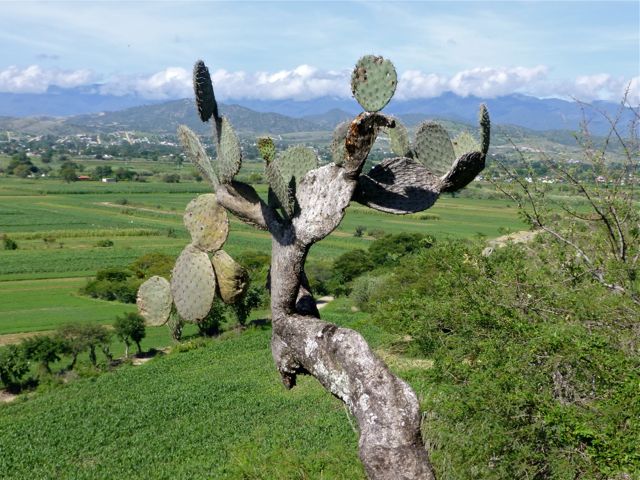
The Señor de las Peñas church sits atop at hill and views of the lush green fields (gracias, rainy season) and the mountains were breathtaking.

Cactus, farmland, mountains

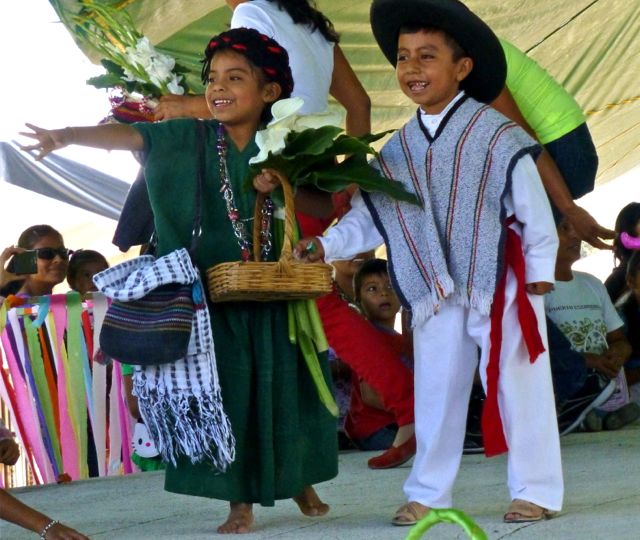
Impossibly adorable children danced and shared, in the spirit of Guelaguetza.

Boy and girl in traje throwing candy to audience

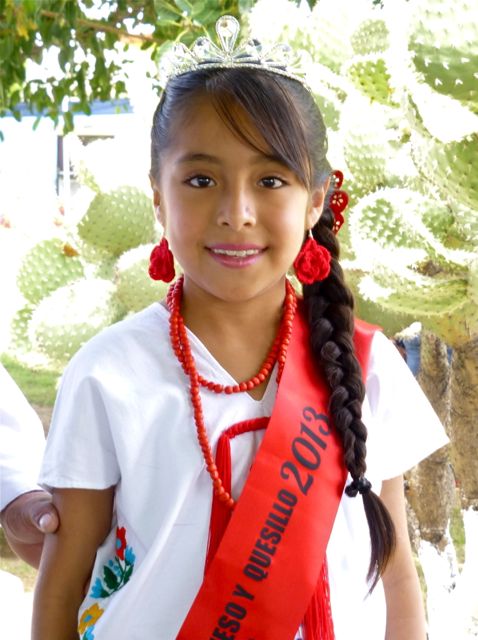
We were in the heartland of Oaxaca cheese country for the crowning of  Jimena Santiago Vasquez, as queen of the third Expo Feria de Queso y Quesillo.

Girl with crown and red sash

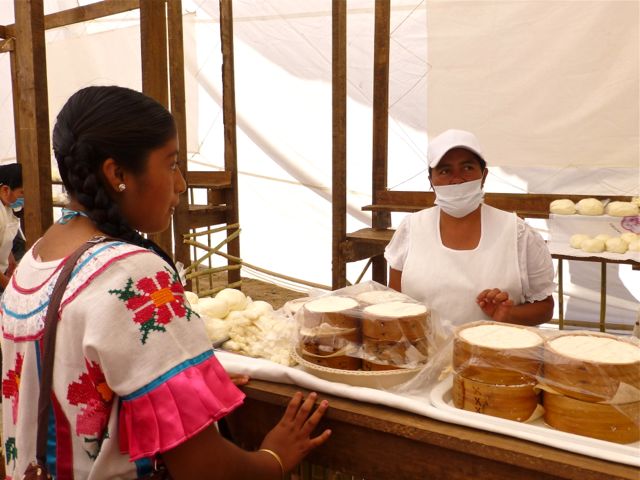
Did I say cheese?  Oh, yes — stalls and stalls of yummy cheese.  The fair runs through Monday and we will be back!

Woman selling cheese

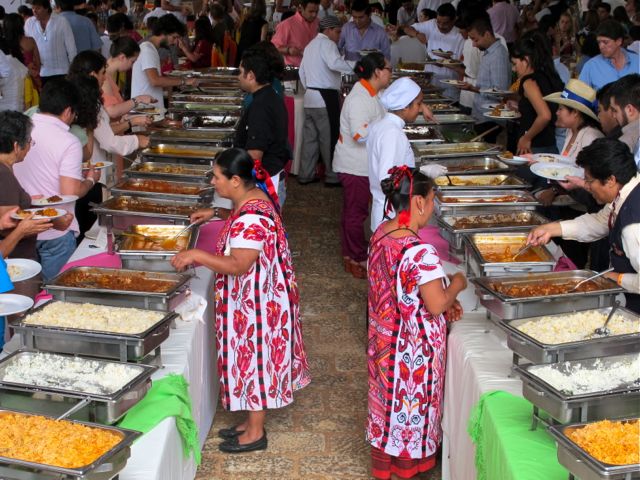
Next on our itinerary was a return to the city for a little (?) gluttony — the Festival de los 7 Moles opening banquet on the grounds of the Jardín Etnobotánico de Oaxaca.  Botanas Oaxaqueña (cheese, chicharrón, chiles rellenos), followed by Sopa de Fandango, 15 (not 7) Moles, 4 Tipos de Arroz, followed by a platter of pastries and scoops of Leche Quemada and Tuna nieves (sorbets).  Oh, and did I mention, cervesas and mezcal?

Lines of serving platters and people

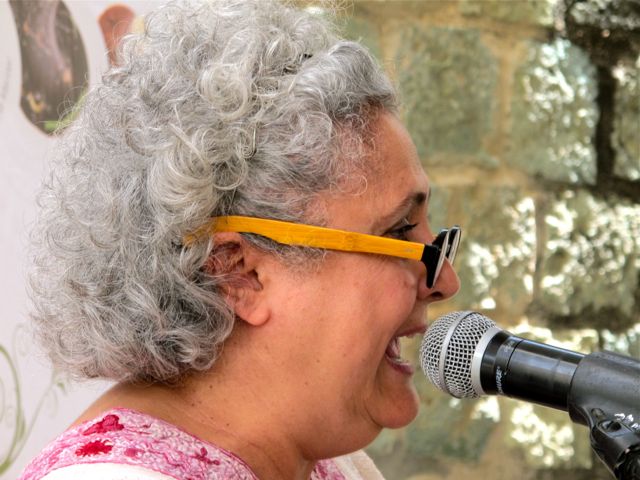
We even got a little culture, as author, Laura Esquivel (Like Water for Chocolate) spoke, though it was a little hard to hear her, with all the eating, drinking, and related conversations!

Profile of Laura Esquivel

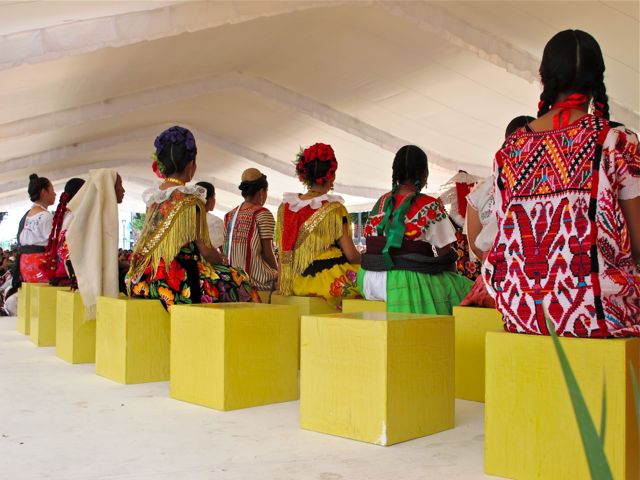
Moving rather slowly, we pushed back from the table and headed down to the Alameda (oh, it felt good to walk!) to take in the last stage of the Diosa Centéotl competition — the chosen “Goddess” presides over Guelaguetza.  However, the area surrounding the tented stage was a mass of people by the time we arrived and the best I could do was see the backs of the magnificent traje.  (See Chris’s blog for close-ups from the stage one competition.)  And, the winner is…  Dulce Yanet Grijalba Martínez, from the Zapotec community of San Pablo Villa de Mitla.

Backs of women sitting in traditional dress

After a brief siesta, I rendezvoused with some young friends and we walked over to the Plaza de la Danza for a free performance by Alejandra Robles, one of my favorite Oaxaqueña singers.  (For video from the last time I saw her, click HERE.)

Alejandra Robles

The night was still young for my young friends and they were off to get a nieve at Jardín Socrates.  I was off to bed, because I’d already had my day’s allowance of nieve AND we’ve only just begun!

Read Full Post »

A meal named for the 3 parts of a bullfight?  Yes, the origin of the name of Mexico’s ubiquitous 3-course, fixed price, midday meal, Comida Corrida, is derived from the “Tres tiempos” of a “Corrida de toros.”

Ordinarily, simple and substantial, chef Jean Michel Thomas of Gío (aka, Dondé está el Chef?) has taken it to a French infused gourmet level — all for only 80 pesos.  My lunch on Monday…

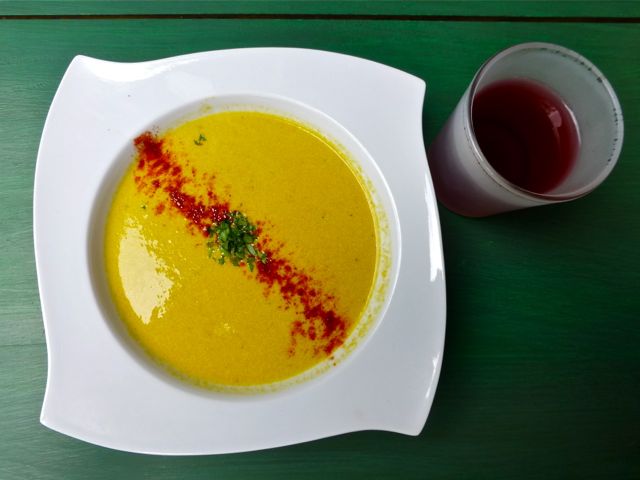
Crema de Flor de Calabaza al Aji Panca

Crema de Flor de Calabaza al Aji Panca accompanied by Agua de Jamaica

Tartare de Atún Fresco con Tomate y Arroz a la Mostaza de Dijon

Tartare de Atún Fresco con Tomate y Arroz a la Mostaza de Dijon

Pastel de Chocolate Oaxaca con Coulis de Mango

Pastel de Chocolate Oaxaca con Coulis de Mango

Gío currently can be found at Eucaliptos 407A, Colonia Reforma, in the city of Oaxaca.  It is open Monday through Friday, from 2:00 – 5:00 PM.

¡Buen provecho!

Read Full Post »

As yesterday’s post reported, fireworks late Monday night heralded the feast day of La Virgen de la Soledad, the patron saint of Oaxaca. P1030476

However, that was far from the end of the nocturnal tale.  At the stroke of midnight, only an hour after the snaps, crackles, and pops had ended, and when I had finally drifted off to sleep, the bells of the Basilica began a frenzied pealing.  They were immediately joined by repeated rocket explosions, and the unmistakable sounds of a tuna band; at 2 AM bells, rockets, and mariachis; at 4 AM more bells, rockets, music, AND a procession winding its way through the streets of the city; its sounds ebbing and flowing for  almost two hours.

At 6 AM, I gave up attempting sleep, threw on jeans, shoes, and a sweatshirt (didn’t even bother to wash my face or brush my teeth — don’t tell anybody), grabbed my camera, and headed over to the Basilica.  What a sight!!!

P1030423

The Plaza de la Danza was covered with food stalls offering barbacoa, molotes, empanadas, tacos, buñuelas, hot chocolate, breads, and pastries — the best of Oaxaca street food.  And, they were all open!

P1030456

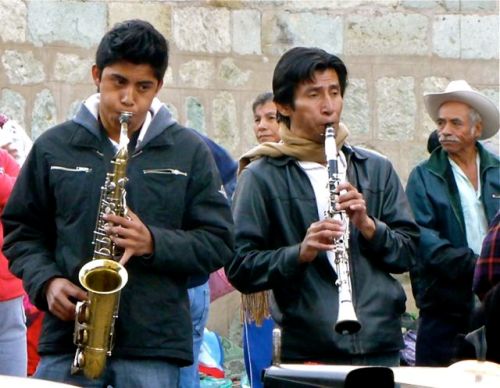
On the Basilica’s plaza, the Banda Auténticos (from San Andrés Huayapam) was playing…

P1030465

Dancers were dancing…

P1030482

People were just waking up…

P1030451

Vendors were selling roses and bouquets of herbs…

P1030485

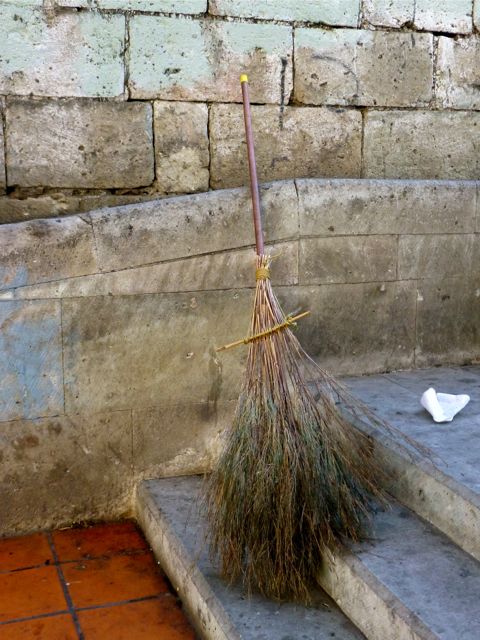
And, ubiquitous twig brooms (escobas de otate) waited to sweep-up the detritus from Soledad and friends pulling an all-nighter.

P1030490

After a breakfast of barbacoa (chivo) and hot chocolate, I walked back home.  Sleep deprived or not, it was a great morning!

Read Full Post »

Last night we went to my favorite panteon (cemetery) at Atzompa, today we visited six villages, and tonight I went with out-of-town guests to the Panteon General here in Oaxaca.   First thing tomorrow morning a comparsa (parade) and then probably off to Teotitlán del Valle.  I’ve already taken hundreds and hundreds of photos, but there has been no time to even look at them!

So, in the meantime…  My pan de muerto (Day of the Dead bread) from Sunday’s trip to Tlacolula.

Four small loaves of decorated bread

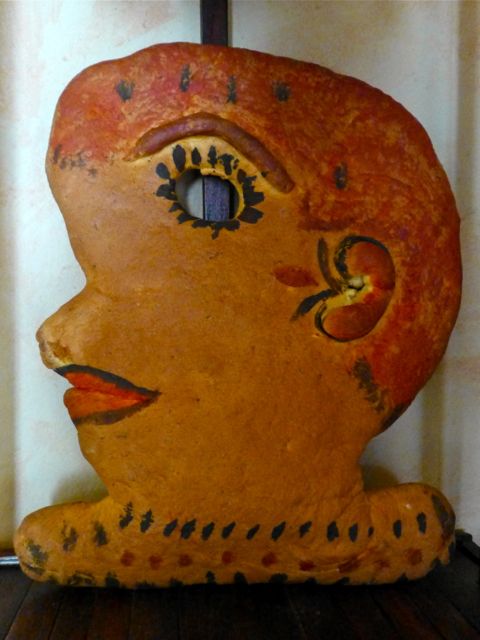
Very special pan de muerto from Restaurante La Abeja just a few blocks from Casita Colibrí.  This one will eventually get two coats of shellac and join her sister (purchased last year) hanging on the wall.

Bread in the shape of the profile of a woman's face

Last, but not least, my altar where photos of departed family and friends join apples, tangerines, pan de muerto, sugar skulls, candles, and incense of copal.

Day of Dead home altar with fruit, candles, bread, calaveras, sugar skulls, etc.

This is a magical time to be in Oaxaca.

Read Full Post »

Sunday, blogger buddy Chris and I drove out to Tlacolula for market day.  It didn’t take long to realize this wasn’t your usual Sunday market — there seemed to be twice the number vendors and twice as many shoppers.  It was the Sunday before the Días de los Muertos and this mega mercado was providing those who live in the surrounding area with everything they could possible need for their ofrendas (Day of the Dead altars).

Mounds of apples, tangerines, and other fruit.

mounds of bananas and tangerines

Rows upon rows of pan de muerto (the special Day of the Dead bread).

Pan de muerto

Wheelbarrows full of peanuts and pecans.

Wheelbarrow full of nuts

And, in the city of Oaxaca, special Muertos vendor stalls have been set up between the Benito Juárez Mercado and 5 de Mayo Mercado for city dwellers to stock up.  Intricately decorated sugar and chocolate skulls (calaveras) to satisfy the sweet tooth of Mictlantecuhtli (Goddess of Death).

Shelves of sweet calaveras

Decorated clay incense burners…

Clay three-legged incense burners

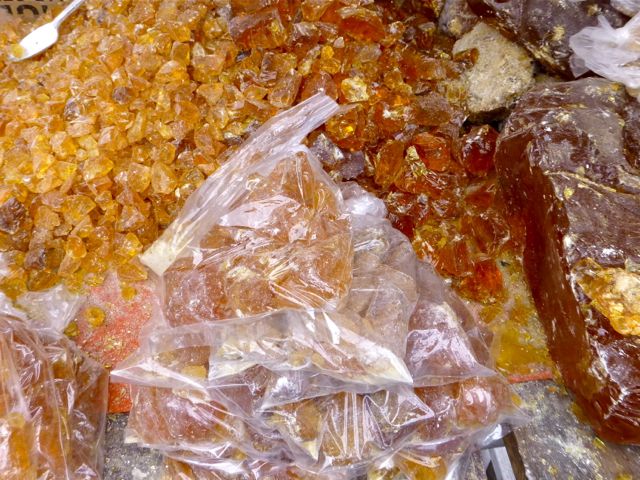
waited to burn copal resin and perfume the air with its wonderful, and now familiar, scent.

Bags and piles of copal resin

Doll house size tables were filled with miniature clay food and beverages (favorites of the departed) …

Tiny tables with miniature clay foods and beverages

and included these diminutive plates of mole and arroz (rice) — which I couldn’t resist buying for my altar!

Tiny plates of ceramic mole and arroz

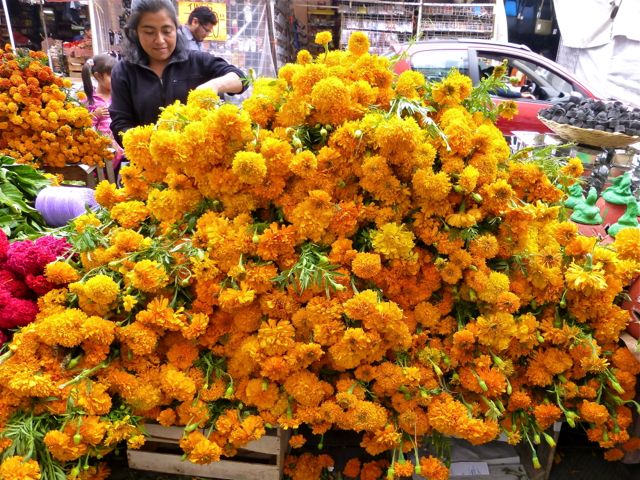
And, of course, there were mounds and mounds of Cempazuchitl (marigolds), the flower of the dead, that grows wild in Oaxaca at this time of year.

Pile of marigolds

All the necessary purchases have been made, now to build my ofrenda.

Read Full Post »

El Grito not only heralds green, white, and red decorations, clothing, and Mexican flags.  It is also the season to savor the multi-layered, delicate flavors of Chiles en Nogada and delight in its colorful, patriotic presentation.  Legend has it, the dish was created in 1821 by nuns in Puebla to honor a visit by Mexican General Augustín de Iturbide, that pretty much signaled the end of the eleven-year long Mexican War of Independence.

There are probably as many recipes for Chiles en Nogada as there are chefs and abuelas, but the basics include green poblano chiles stuffed with a picadillo of meats, fruits, nuts, herbs and spices; served with a creamy white cheese and walnut sauce; and topped with a garnish of red pomegranate seeds, walnuts, and the green of chopped parsley.

Serving of Chiles en Nogada on a white plate.

This was my lunch of Chiles en Nogada today at La Popular, a delightful new restaurant in Oaxaca (Garcia Vigil 519, Centro).  Yummm….

(ps)  Chris just posted this video of Lina Fernandez making Chiles en Nogada.  She makes it look almost doable!

Read Full Post »

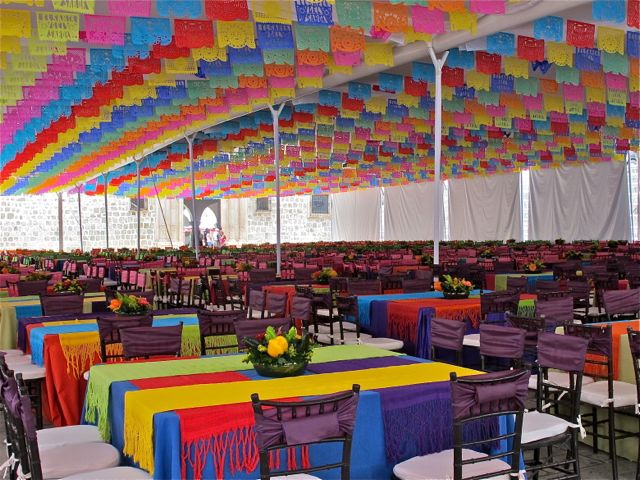
Thursday night was the kickoff event for the 5th annual El Saber Del Sabor (literally, the knowledge of flavor) Festival Gastronómico Oaxaca 2012.  Early in the day, the Plaza de la Danza had been tented and turned into a colorful banquet hall.

Interior of large tent decorated with multicolor tableclothes and papel picado on ceiling

A couple of the evening’s chefs arrived early and were cooling their heels, waiting to begin doing what they do best.  Hmmm… what’s with the bricks on top of the cantera?  (Stay tuned!)

2 chefs sitting behind brick platform

By 9:30 PM the tables had filled and cooking was well underway.

Young man in chef's toque sauteeing bananas.

Casa Oaxaca chef and event host, Alejandro Ruiz Olmedo circulated, greeted old friends and fans, and was interviewed by a crush of press.  Cameras and microphones were omnipresent — good for publicity, bad for navigating the aisles en route to food!

Chef Alejandro Ruiz Olmedo talking to a table filled with people.

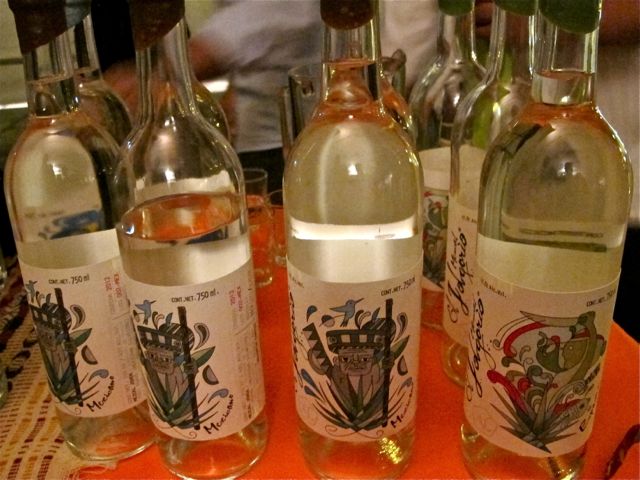
To begin the evening and ready the palate, wines, beers, aguas, and (of course!) mezcals were offered.  We sampled a couple of mezcals from El Jolgorio and all I can say is, Wow!  (BTW, that’s a good, “Wow!”)

Bottles of El Jolgorio Mezcal on a table.

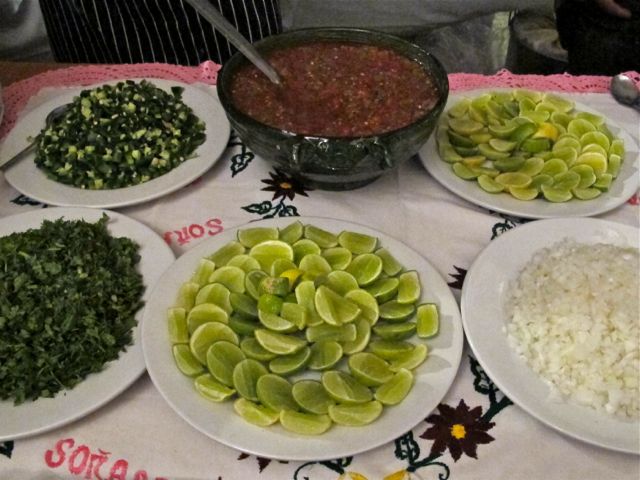
The festival seeks to promote and protect Oaxaca’s traditional cuisine and to inspire innovation.  For this evening’s event, we were invited to sample an incredible range of appetizers, side dishes, main courses, and desserts from 23 cooks, representing the 8 regions of Oaxaca.

A bowl of a stew surrounded by platters of limes, rice, cilantro, and onions.

I think I must have tasted at least 30 dishes — and this was late at night.  Needless to say, no breakfast for me the next morning.

Serving pans of food.

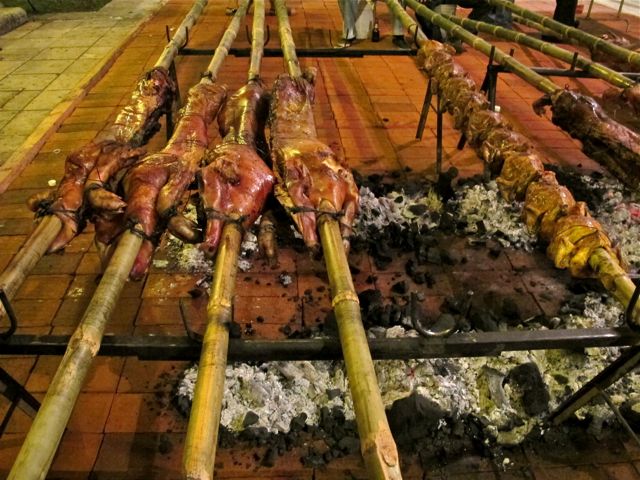
And, remember the bricks?   My favorite sight of the evening were the little piggies roasting on bamboo skewers over red and white-hot coals.  The tag line for the festival is, “tierra, fuego y cocina” (earth, fire, and kitchen).  Yes!!!

Roasting pigs on bamboo skewers over hot coals.

From the Plaza de la Danza, the festival moves to restaurants throughout the city, where 36 renowned chefs from all over Mexico have come to prepare innovative cuisine that pays homage to Oaxaqueño foodstuffs and traditions.

A big “thank you” to Henry and Rosa (Amate Books) for inviting me to share such a delightful and delicious evening!

Read Full Post »

As that wise philosopher and Charlie Brown creator, Charles M. Schulz once wrote,

All you need is love. But a little chocolate now and then doesn’t hurt.

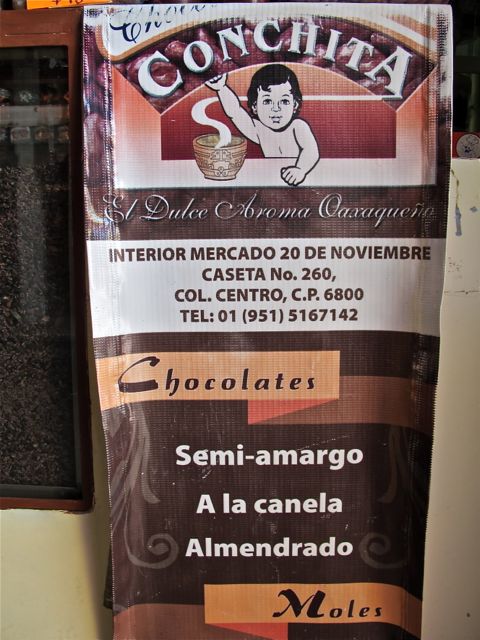
And, chocolate in Oaxaca is easy to find and is almost as well-known as Oaxaca’s cheeses and mole.  Ground almonds and cinnamon give it a distinctive and slightly spicy flavor — and everyone has their favorite.  Mayordomo and La Soledad are two of the most well-known labels, but my favorite brand (as opposed to homemade, which is in a class all by itself), is the much smaller, Conchita.

Conchita poster

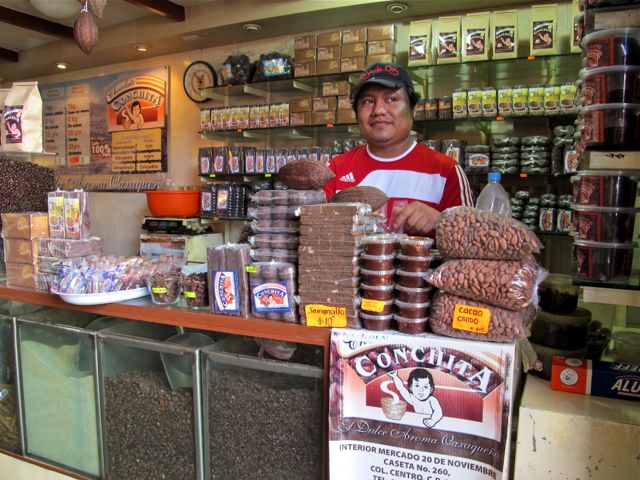
Every month or so, I weave my way in and out through the crush of the always teeming sidewalks of Miguel Cabrera to the Conchita puesto immediately to the right, inside the Mercado 20 de Noviembre — the entrance between Aldama and Mina.

Sky blue entrance to the mercado 20 de noviembre.

I’m always greeted with a smile of recognition and the question, “Semi-amargo?”  Sí, I always reply!

Male sales clerk behind counter filled with chocolate products.

I buy the little semisweet chocolate chips for snacking (especially decadent and delicious when mixed with dried cranberries) and the large discs, which I grate into a fine powder to mix with hot milk to add to my morning coffee — a delectable way to jump-start the day!

Read Full Post »

Besides mushrooms, tejate, tamales, and mole, there is cheese and mezcal… and last Monday I hopped in a colectivo bound for Etla; my destination was Reyes Etla (about 20 km. from the city) for the 2nd annual Queso y Quesillo Expo Feria.  Oaxaca is known all over Mexico for its cheese and, without a doubt, the best comes from the municipalities around Etla — and Oaxaca’s department of tourism is on a mission to promote its position globally.

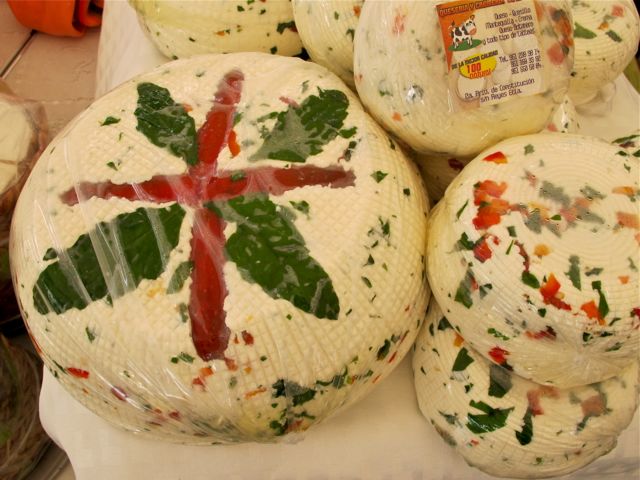
Ball of cheese decorated with basil leaves and red bell pepper strips.

Vendors tempted with artistic displays and tastings of, among others, queso fresco, queso crema, and quesillo.  Yummm….  It is a dark day around Casita Colibrí when there isn’t a ball of quesillo in the refrigerator.

Display of cheeses with woman vendor behind counter

FYI:  Quesillo (aka:  Oaxacan string cheese) was first made in Reyes Etla in 1884 — supposedly by mistake!  According to one legend, a young girl from Reyes Etla disobeyed her mother and allowed the cheese curds to expand into a spongy mass.  She attempted to correct her mistake by pouring boiling water over the curds, then she kneaded it and pulled it into the first strip of what is now known as quesillo.

Woman vendor wearing mask behind display of quesillo
And, now, we turn to the 15th annual Feria Internacional del Mezcal…  After years of languishing in tequila’s shadow, being considered a “poor relation” — that is, if it was considered at all — mezcal’s profile has risen dramatically in the past several years.

XV feria internacional del mezcal oaxaca 2012

In August 2010, none other than Eric Asimov wrote about, Mezcal, Tequila’s Smoky, Spicy Cousin in the New York Times.  A year later, a NYT ‘s article advised, Move Over, Tequila, It’s Mescal’s Turn to Shine.  (You say mescal, I say mezcal.)

And, sheesh, I was flipping channels the other night and stumbled on Tim and Tim in Oaxaca, being instructed on the art of making mezcal by my landlord, on an episode of the TV program ROAM!  Then there is the No Reservations “Obsession” episode, where  Anthony Bourdain explores Ron Cooper’s obsession with mezcal.

Back to the feria, where over 40 vendors displayed their wares…

Bottles of mezcal lined up in two shelves of a display

poured generous tasting shots…

3 guys behind counter offering shots of mezcal

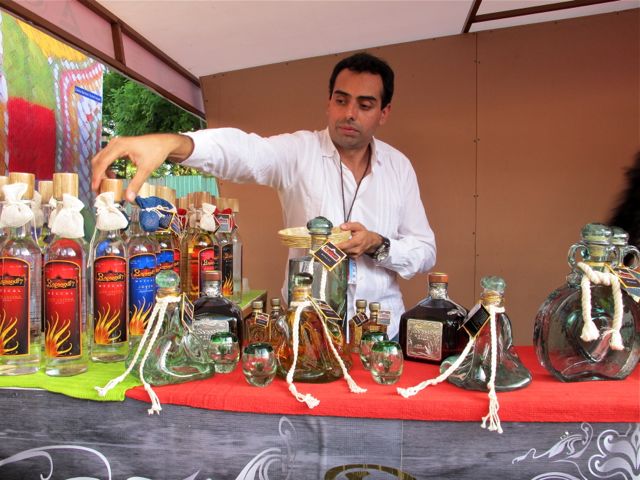
and sold their mezcals.

.Male vendor reaching for a bottle of mezcal

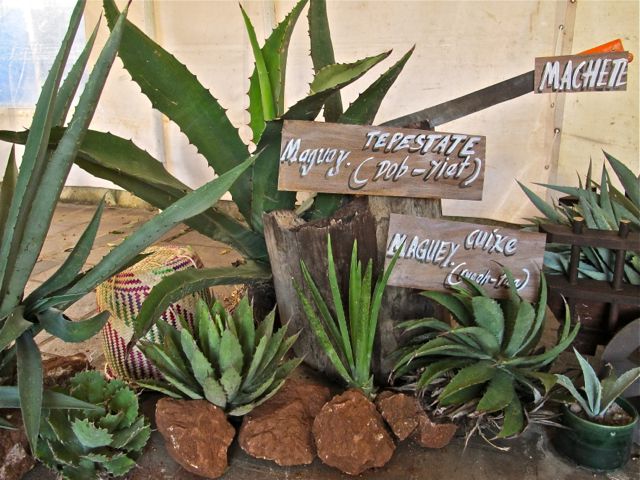
In addition, there was an exhibit showing the various types of maguey, from which mezcal is made…

Variety of agave plants with labels.

and the equipment used and processes they undergo to become this smoky and complex distilled spirit.

A mezcal still

As the old Oaxaqueño saying goes, “For everything bad, drink mezcal, and for everything good, you also should.”

Read Full Post »

Sunday, we headed up into the clouds of Oaxaca’s Sierra Norte to San Antonio Cuajimoloyas.  At 10,433 feet above sea level and nestled in a forest of pine and oak trees, the setting has an ethereal feel and seems a world apart from the valley below — almost like being in an alpine village in Switzerland.

Wood house with tin roof

Getting up there wasn’t easy, thanks to the bumpy and winding dirt road.  However, reaching our destination, the Feria Regional de Hongos Silvestres (fair of wild mushrooms) was well worth it!

Banner above municipal building, against a cloudy sky, announcing, "Bienvenidos,12va. feria regional de Hongos Silvestres"

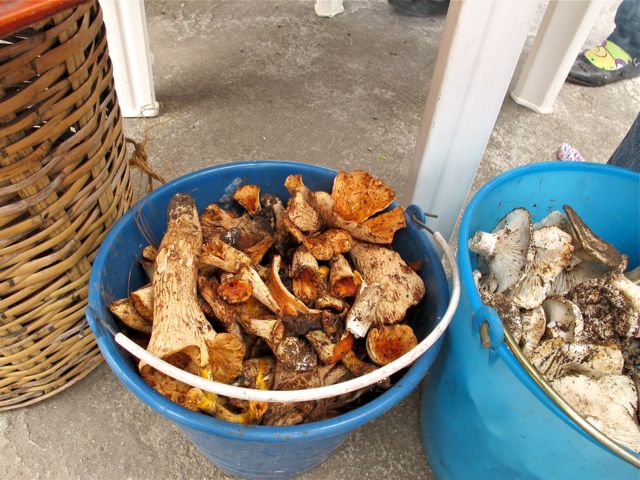
Once there, baskets, buckets, and boxes filled with freshly gathered mushrooms greeted us.

Blue plastic bucket of trumpet mushrooms

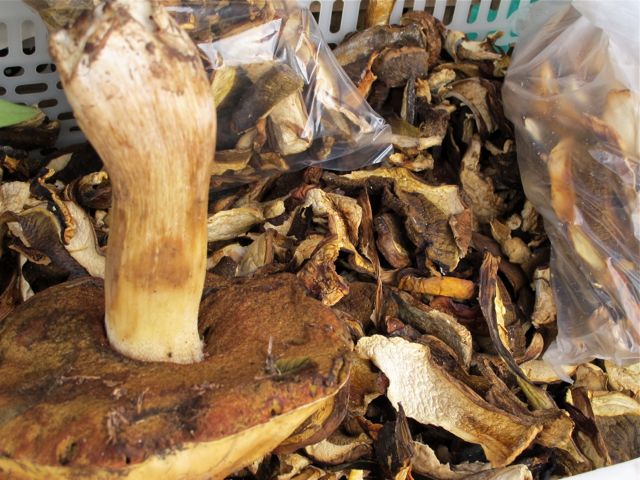
Close-up of mushrooms

Mushrooms in a box

Orange capped mushrooms in a green container

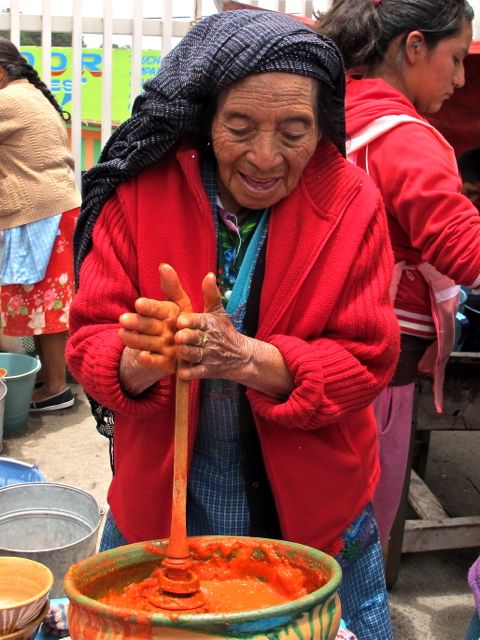
Not only was there a bounty of raw mushrooms, the aroma of sautéed mushrooms, mushroom tamales, and mushroom empanadas stimulated our appetites and we tried them all, and washed it down with an atole rojo made by this beguiling gal.

Elderly woman mixing atole rojo.

And no, these were not “magic mushrooms” but the experience was, indeed, magical.

Read Full Post »

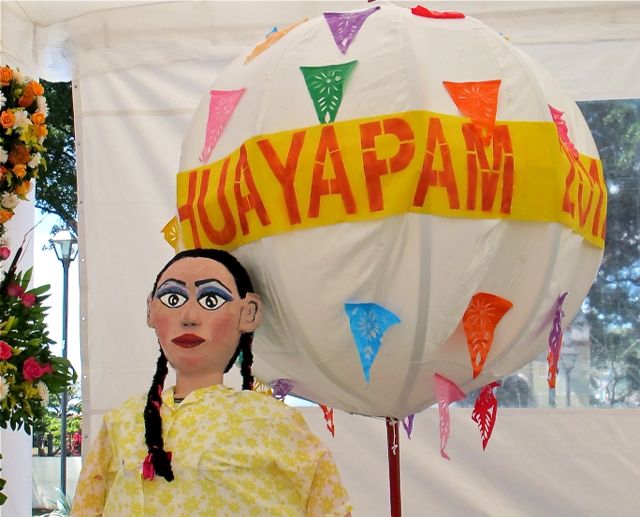
Oaxaca is a foodie paradise, in major part, because much of its cuisine draws on and honors its pre-Hispanic roots.  And, right now, during this time of Guelaguetza, various food and beverage ferias and festivals are also happening throughout the city and central valleys of Oaxaca.  Today, on the Plaza de la Danza, the Feria del Tejate y el Tamal, celebrating these specialties of San Andrés Huayapam, opened with the usual fanfare — music, monos, a marmota, and speeches.
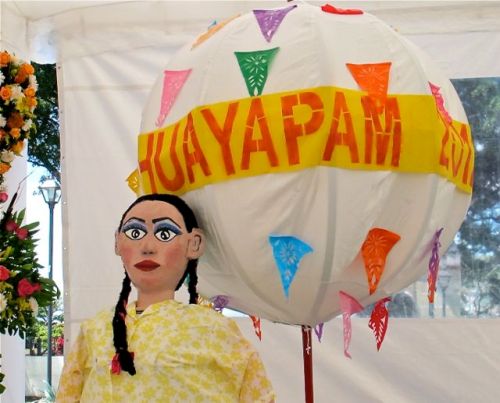
Mono and marmota with "Huayapam" printed around it.

Present were a number of local dignitaries, including Evelyn Acosta López, the recently elected corn goddess, la Diosa Centéotl 2012, who presides over the Guelaguetza.
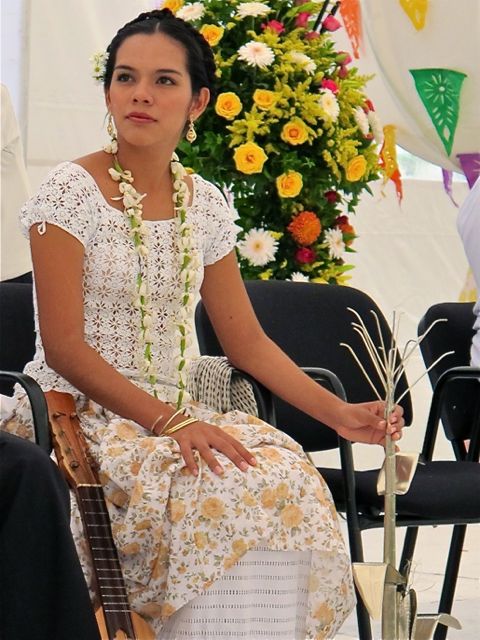
Evelin Acosta López seated.

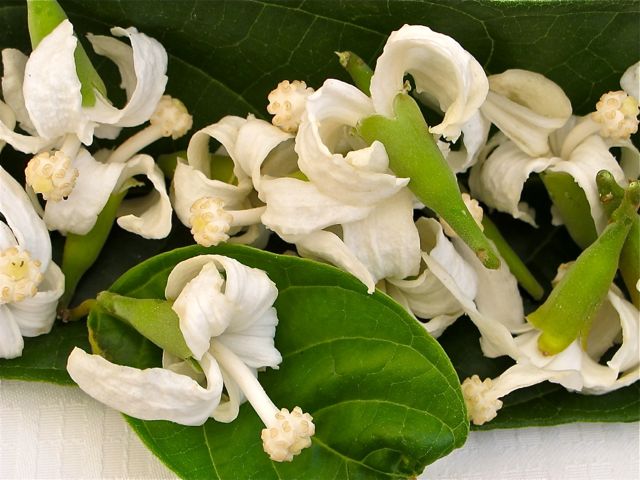
Tejate is a foamy, refreshing, and nutritious non-alcoholic pre-Columbian beverage made from Nixtamal corn, mixed with tree ash, and toasted cacao beans, mamey seeds, and Rosita de Cacao flowers.
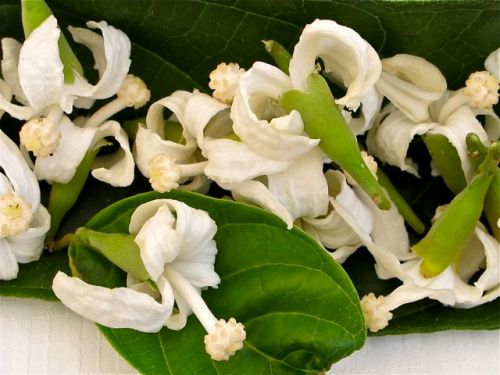
Rosita de Cacao blossoms.

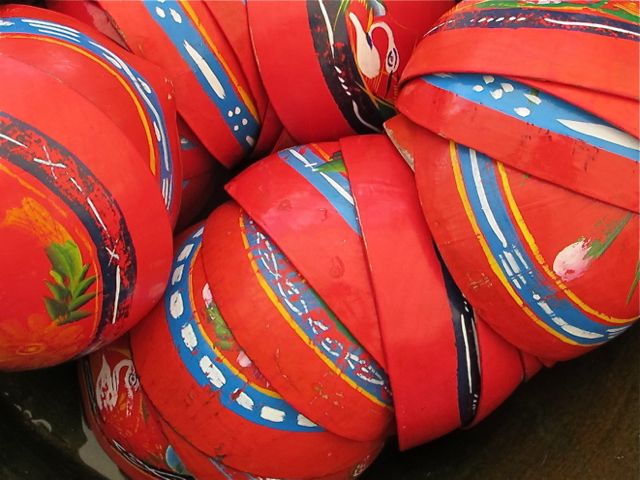
One frequently sees tejate, served in these colorfully painted gourds, in the mercados of Oaxaca, at festivals, and street side stands.
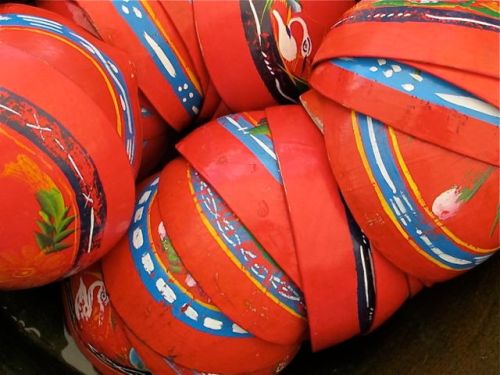
Dried and hollowed-out gourds painted red with blue, yellow, and green decoration.

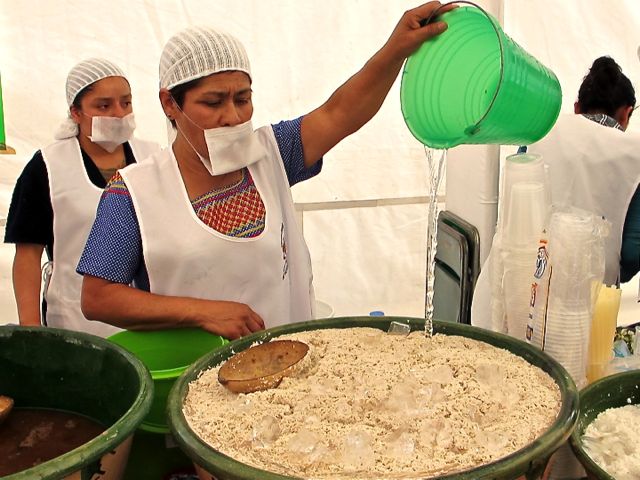
And, yes, it is safe to drink.  The water and ice that are added…
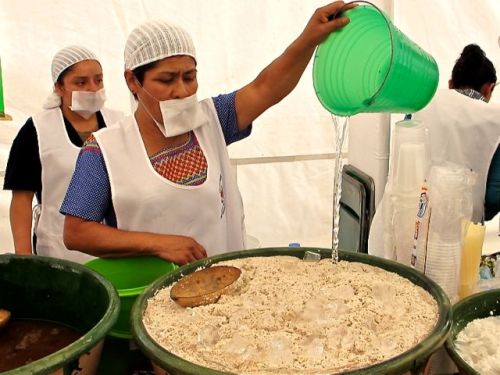
Woman with surgical mask pouring water from bucket into large pot of tejate

come from garrafons of “pure” water.

Stack of garafons (jugs) of pure water.

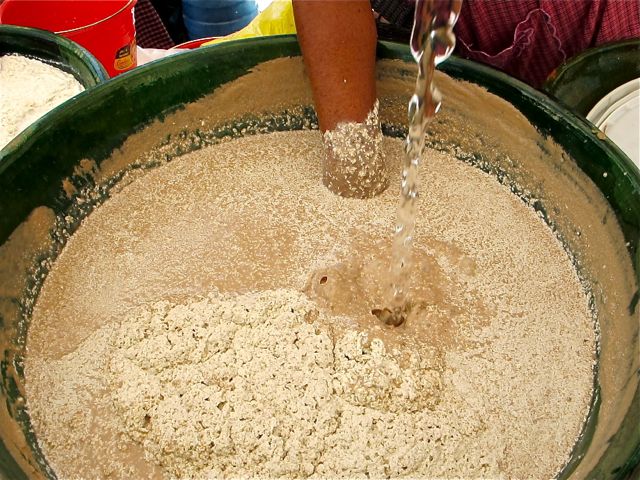
And, please, don’t be put off by the women, up to their elbows, mixing the ingredients.  Just think about it…  Chefs often use their hands when preparing food and arms are generally much cleaner than hands!  Believe me, these women take great pride in their expertise and product.
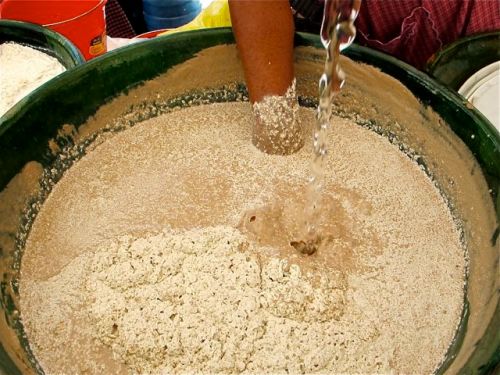
Hand and lower arm mixing tejate as water is added

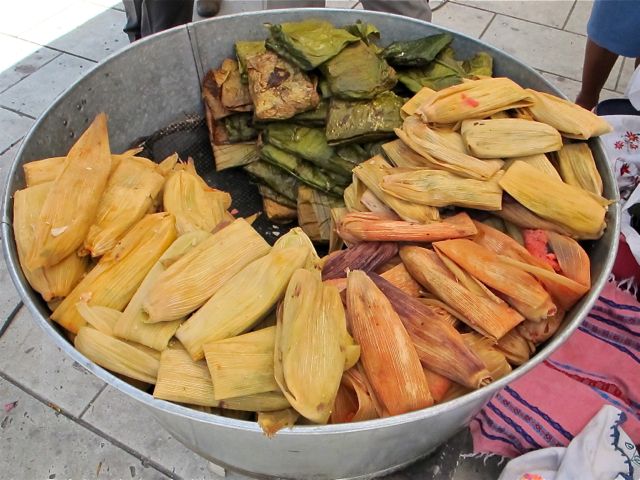
Oh, right, there were also tamales!  Once I finished taking photos and drinking a tall cup of tejate, I made my day’s tamal purchase; chepil, chichilo, and mole.  Tomorrow, I will be returning for more.
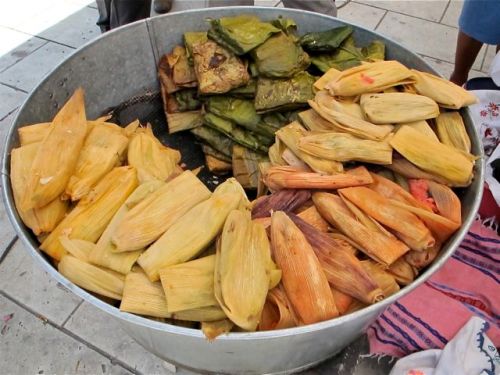
Large galvanized aluminum bucket filled with a variety of tamales wrapped in corn husks and banana leaves.s

The Feria del Tejate y el Tamal runs today and tomorrow at the Plaza de la Danza, then moves up to San Andrés Huayapam for Saturday and Sunday.  You can find a little more information about the feria in last year’s blog post, Tejate and tamales.

And, sheesh, I still haven’t blogged about the cheese feria, mushroom feria, not to mention, the Feria Nacional del Mezcal — all of which I’ve attended during the past several days!

Read Full Post »

And, then there was the Festival de los 7 Moles opening buffet lunch set amidst the beauty and tranquility of the Jardín Etnobotánico.  Serendipity and synchronicity brought us there… running into a friend, conversation, investigation (see pots below), and her enthusiasm and powers of persuasion (gracias, Rosa!) had us purchasing tickets on the spot.

While kitchen staff prepared the serving platters and bowls…

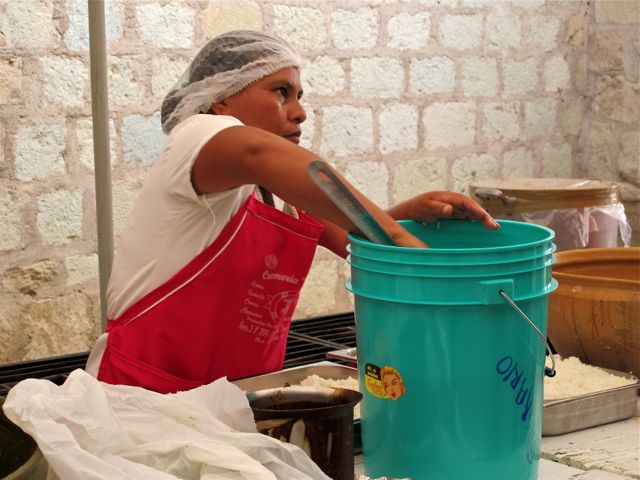
Woman in apron and wearing hairnet, scoops cooked rice out of a large bucket.

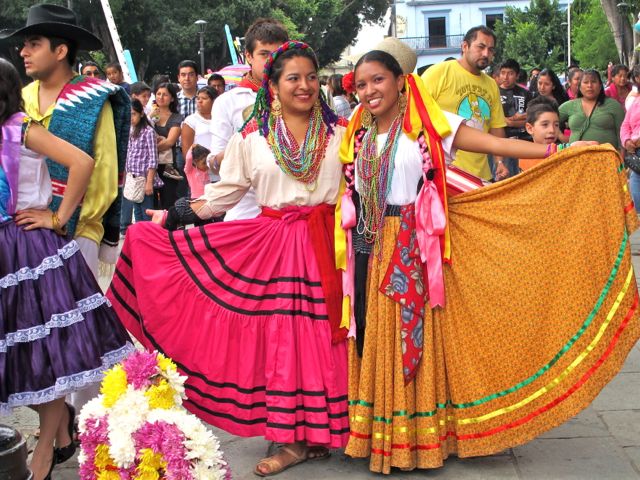
Dancers gathered on the Alameda for a calenda that would lead people the luncheon.

Two women displaying their long  colorful full skirts

They included a number of small children…

Woman squatting down and clasping hands with a toddler-age boy - both in indigenous dress

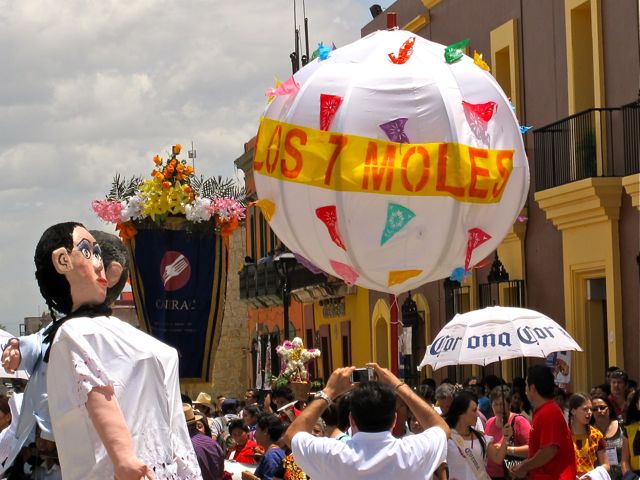
The calenda, including the requisite marmota (giant cloth balloon), monos (giant puppets), band, dancers with canastas (see yesterday’s post), and the sponsoring banner of CANIRAC (national association of the restaurant and food industries), made its way up the Alcalá…

Procession with marmota, monos, and banner

before turning onto Constitución and entering the Jardín, where wait staff and divine moles awaited.

Wait staff, wearing black, white, and grey gathered next to table.

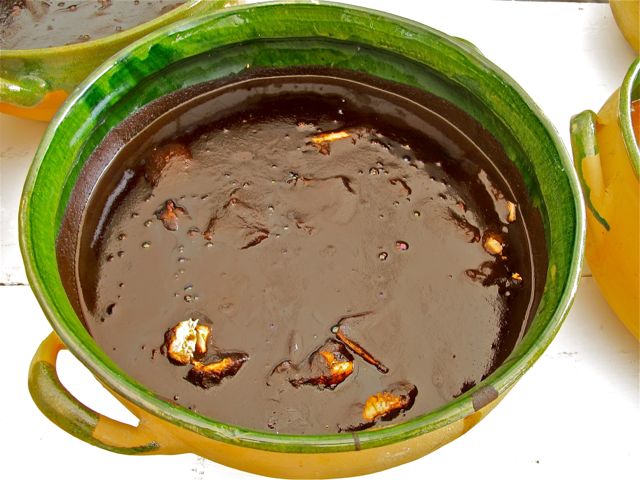
Yummm, mole negro

Large green pottery bowls filled with black mole.

Mole amarillo

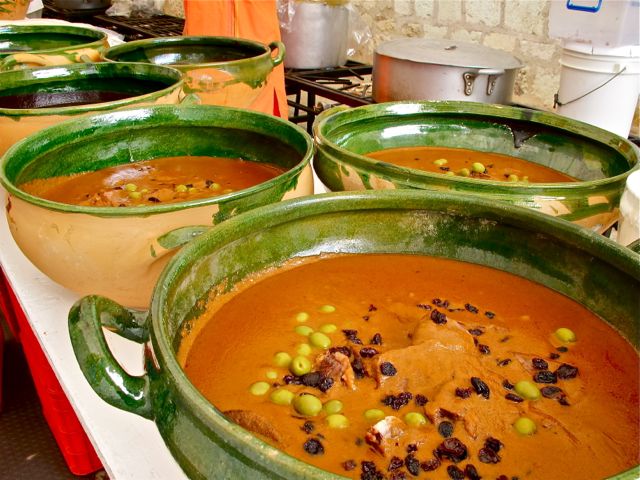
Green pottery bowls of red colored moles

Mole coloradito

Green ceramic pot with red mole.

Mole verde

Green mole in green ceramic pot

There was also mole chichilo, mole manchamanteles, and mole rojo.  I tried them all!!!  And, I haven’t even mentioned the cervesa, mezcal, aguas, and appetizers of quesillo, chicharon, and tacos filled with guacamole and chapulines (grasshoppers).  You’ll have to switch over to Chris’s blog to see those and much more.  Oh, and for dessert, a scoop of each of my favorite nieves (sherbet); leche quemada (burned milk) and tuna (cactus fruit).

A day filled with light, color, music, fabulous food, and, most of all, wonderful friends — the recipe for a perfect day!

(ps)  There are almost 50 restaurants around town that will be featuring mole as part of this 12-day festival.

Read Full Post »

« Newer Posts - Older Posts »