Buried treasures continue to be found in Oaxaca. Mexico’s INAH (National Anthropology and History Institute) reported this week another burial chamber has been uncovered at the nearby Santa María Atzompa archaeological zone.
Current findings in the tomb include this urn, which they date to sometime between 650 CE and 850 CE.

Photo: Red anthropomorphic urn (EFE/INAH)
Here is an English language article that reports on these latest discoveries from the site.
Published at 10:06 pm EST, August 16, 2012
The tomb of a high-ranking member of Zapotec society was found at a 1,200-year-old funerary complex in the southern Mexican state of Oaxaca, the National Anthropology and History Institute, or INAH, said.
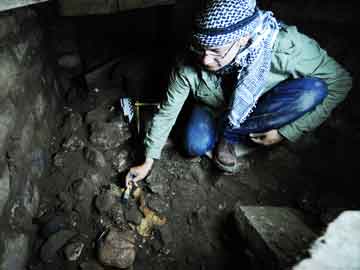
Photo: Burial and offering (INAH)
The funerary complex, which has three burial chambers, was found about three months ago at the Atzompa archaeological zone, the INAH said.
Archaeologists managed to get into the third pre-Columbian burial chamber, which contained human remains that are likely those of a male, INAH archaeology coordinator Nelly Robles Garcia said.
The remains will be analyzed to determine the age, nutrition and health of the individual, as well as whether there are intentional deformities of a cultural nature.
Archaeologists found a fractured skull belonging to another individual next to the remains, leading them to conclude that it may have been an offering.
A small, black tubular pitcher and pieces of a vessel were also found in the burial chamber.
A red urn with a human face on it and other items were found in the grave, archaeologist Eduardo Garcia said.
The vessel, which is estimated to date back to 650 A.D. to 850 A.D., is 50 centimeters (1.6 feet) tall, archaeologists said.
“We are dealing with a building where the remains of people with a very high status were placed. Who they were and what role they played in Zapotec society is still to be determined based on the findings that are being made and their later analysis,” Robles said.
Archaeologists found the building, which was designed exclusively as a burial site, in late April.
The tombs are located one on top of the other and, unlike previous discoveries, are not underground.
One of the burial chambers is decorated with a mural of a ball game, a theme not found before in Zapotec funerary practices.
Atzompa was a small satellite city of Monte Alban, the main center of the Zapotec state that dominated what today is Oaxaca.
“This discovery changes the perception we had in the sense that it was not as similar to Monte Alban as had been thought but, instead, developed its own architectural expressions, such as in the case of tombs and palaces,” Robles said.
For more on the Santa María Atzompa archaelogical zone, take a look at a January 2012 article I reprinted on an Ancient Zapotec kiln discovered there. The site is scheduled to open sometime this year.
Posted in Archaeology, Culture, History | Tagged archaeological zone, archaeology, burial chamber, INAH, Mexico, Oaxaca, Santa María Atzompa, Zapotec culture, zapotecs | Leave a Comment »
On chairs in Reyes Etla.

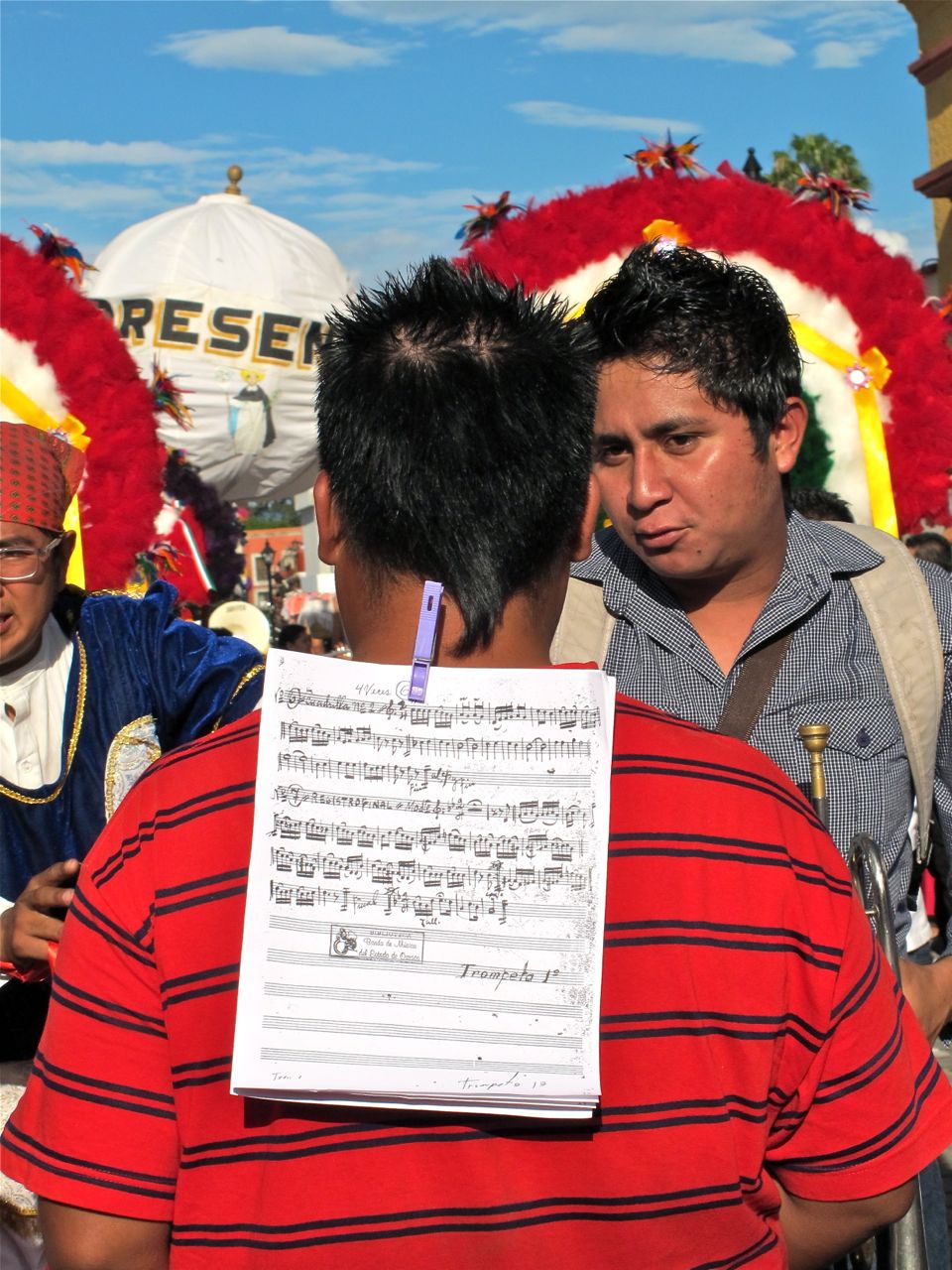
On people’s backs in the city.
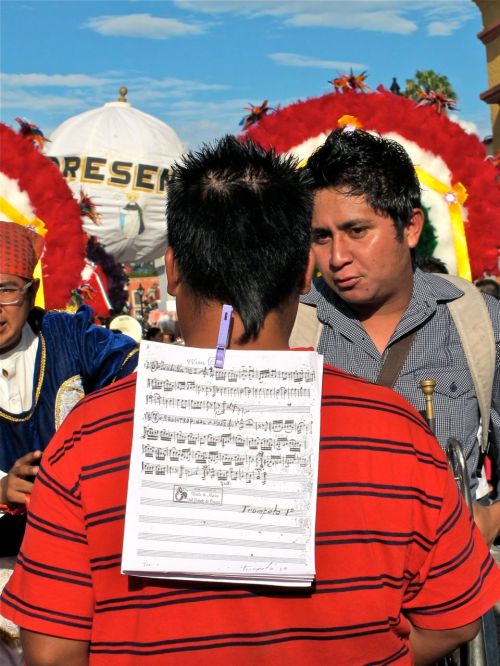
Wherever… especially during Guelaguetza!
Posted in Celebrations, Creativity, Culture, Music, Travel & Tourism | Tagged desfile, Guelaguetza, Mexico, music, Oaxaca, parade, photographs, photos, popular travel destinations, sheet music | Leave a Comment »
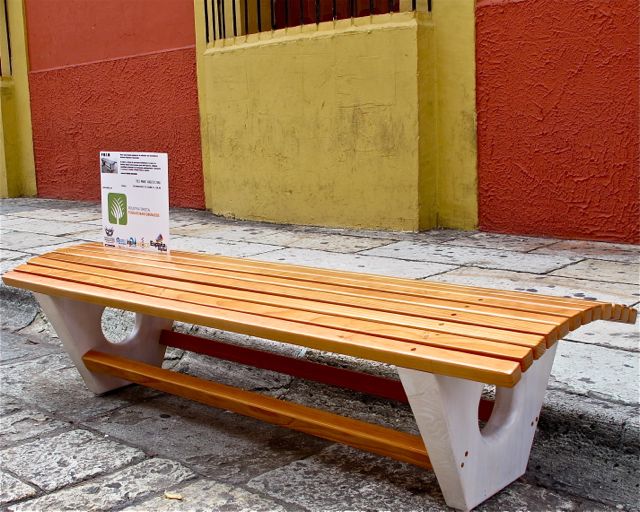
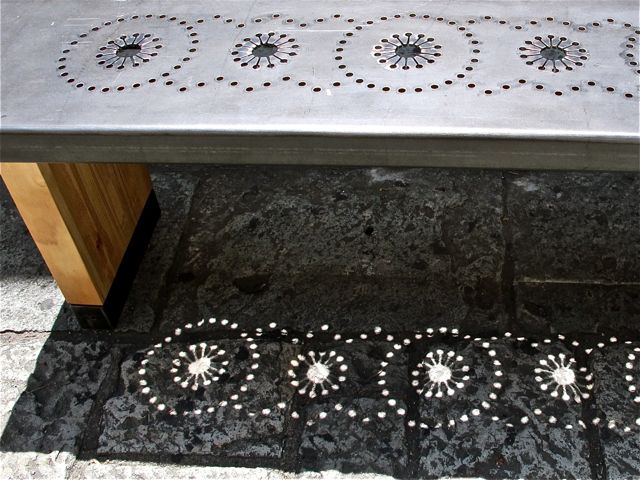
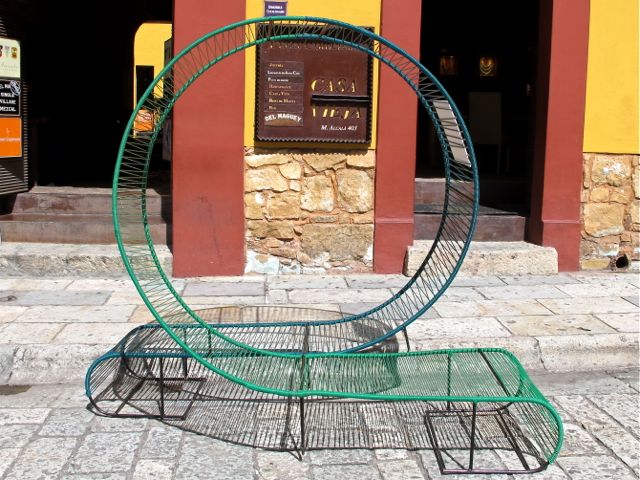
From Sangre de Cristo to Santo Domingo, along the Alcalá, one is now able to “have a seat.”

As part of the inauguration of the Me Siento Bien en Oaxaca (I Feel Good in Oaxaca) and to celebrate, International Youth Day, 13 pieces were created by students of the Faculty of Architecture Cinco de Mayo, the Free School of Art and Design, and the Urban Contingency B_root studio.

The theme was Evolution and the young people were charged with using recycled materials and innovative design.
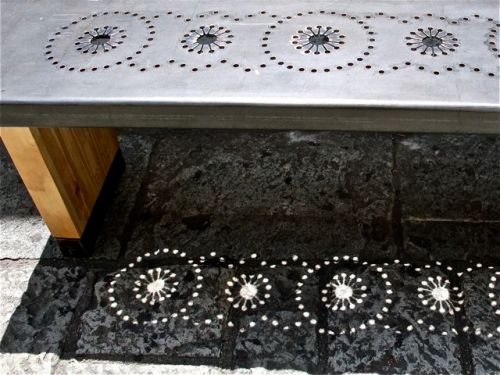
I think they succeeded!

Alas, it is only temporary; August 18 is the last day.
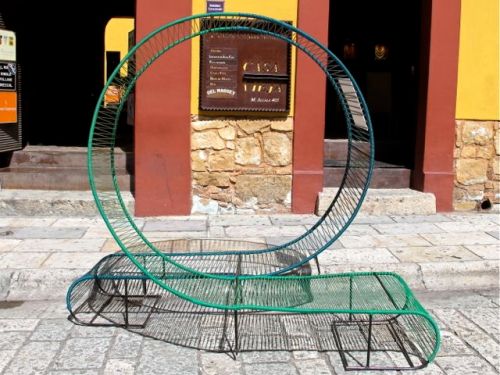
However, according to a newspaper report, as a more permanent part of Me Siento Bien en Oaxaca program, benches “rescued by the City” will be put in public spaces.

Posted in Creativity, Environment, Exhibitions, Parks & Plazas | Tagged bench, design, I Feel Good in Oaxaca, International Youth Day, Me Siento en Oaxaca, Mexico, Oaxaca, photographs, photos, students | 2 Comments »
Hmmm… hope you didn’t need a taxi in Oaxaca today. It’s not that they weren’t around; they were everywhere! August 12 is Día del Taxista and, instead of picking up fares, taxis are decorated and parade through the city, accompanied by banners, bands, monos, and the Virgen de Guadalupe.
This slideshow requires JavaScript.
I think I managed to capture one of each of the (color-coded) taxi organizations participating — 13 by my count. However, the procession didn’t seem as long this year and I’m thinking some of the organizations were missing. Charges of corruption, going back to the previous governor have been ramping up and the July 25th blockade that paralyzed transportation into and out of the city, by some taxistas, seemed to put the issue on the front burner. But, who knows??? Certainly not this gringa!
Posted in Celebrations, Holidays, Travel & Tourism | Tagged cab drivers, cars, Día de los Taxistas, Día del Taxista, Mexico, monos, Oaxaca, photographs, photos, taxis, taxista, taxistas, transportation, travel, Virgen de Guadalupe, Virgin of Guadalupe | 2 Comments »
Congratulations to the Gold Medal winning Mexican fútbol team!!! With all the bad press Mexico continues to be subjected to, El Tri, as they are known down here, has provided México with a much-needed and well deserved win.

Reuters photo
The TV is showing celebrations in the streets of Mexico City, Guadalajara, and other major cities, but (surprisingly, at least to me) all is quiet in Oaxaca. I watched much of the game while eating breakfast with my neighbor at Del Jardín, on the zócalo. We arrived 10 minutes before the game began and were able to sit right in front of one of the televisions. The restaurants had been packed for the Mexico vs Japan game — maybe it was today’s 9 AM start. I watched the end of the game at home, but no bells rang, no horns honked, and I only heard one shout. After the medal ceremony, I went back out. The streets still were still emptier than usual. A few buildings had hung flags.

And, these guys were driving around waving a flag and beeping their horn, but that was pretty much it.
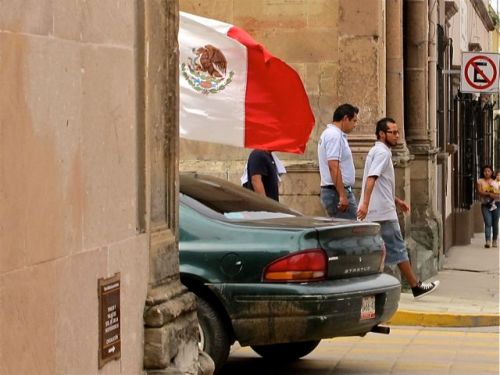
Maybe tonight there will dancing in the streets…
By the way, if you watched the game, you heard the name of midfielder Javier Aquino Carmona (#11) frequently mentioned. Aquino is from San Francisco Ixhuatán, in the Isthmus of Tehuantepec region of Oaxaca.
Update: This just in from Noticias… apparently some celebrating was being done up at the Fuente de las Ocho Regiones, 25-30 blocks NE of the zócalo, and gathering point for many marches into the city center.
Posted in Celebrations, Sports & Recreation | Tagged El Tri, fútbol, futbol Mexicano 2012, Gold Medal, Mexico, Mexico national football team, Oaxaca, Olympics 2012, photographs, photos, San Francisco Ixhuatán, soccer | 2 Comments »
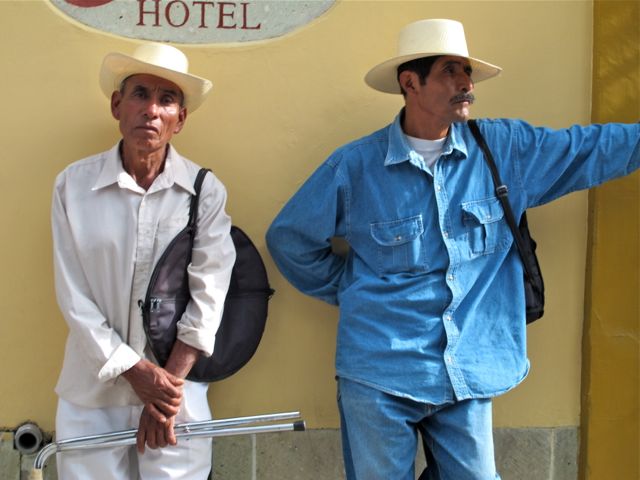
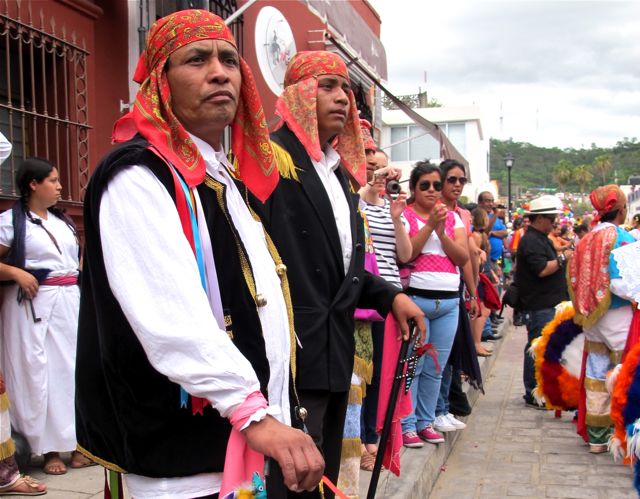
Waiting is a way of life down here and we all do it in our own way. Right now Oaxaca is waiting for Tropical Storm Ernesto to “break on through to the other side.” These guys were waiting to “get in step,” before the parade passes by.

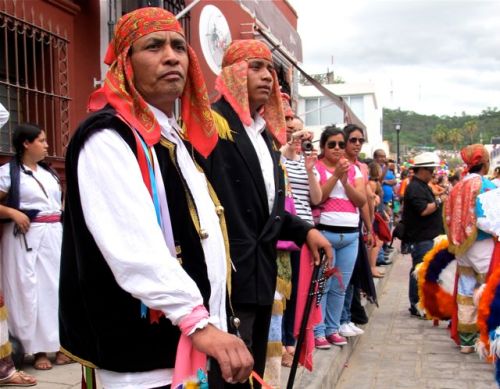

A peso for his thoughts…
(Mixing The Doors and Barbra Streisand lyrics — what was I thinking???)
Posted in Celebrations, Culture | Tagged calenda, Guelaguetza, Mexico, Oaxaca, parade, photographs, photos, popular travel destinations, travel, waiting | Leave a Comment »
Even though the Guelaguetza is over, textiles continue to be on my mind — actually I can never get enough of them! So, a few days ago I walked down to the Museo Textil de Oaxaca to see the current exhibition, “Tormentos y Sueños” by Carolyn Kallenborn. While not a Oaxaqueña, the respect she has for and inspiration she draws from the weavers and textile traditions of Oaxaca are obvious.
Kallenborn explains, “The pieces in this exhibit speak to the beauty and interaction between opposites.” (my translation) The works are at once, complex and simple, using detail and negative space — much like storms and dreams. Photographing a whole piece proved too much for my novice skills, thus I hope close-ups of these four pieces will whet your appetite.
If you are, or will be, in Oaxaca, I encourage you to see the whole! The exhibit runs through November 9, 2012.
Posted in Creativity, Culture, Museums, People, Textiles, Travel & Tourism | Tagged Carolyn Kallenborn, Mexico, Museo Textil de Oaxaca, Oaxaca, photographs, photos, popular travel destinations, Textile Museum of Oaxaca, textiles, travel | 3 Comments »
I’ve got to admit that up until yesterday, I was suffering from Guelaguetza burn-out. In fact, I still have 1000+ photos that need to be weeded down to a more manageable number.
However, then yesterday happened — “Una Guelaguetza muy especial” presented by the very special people of Los Angeles de Luzy. Sixteen young people with Down’s Syndrome, from the Yucatan, Campeche, and Oaxaca danced the traditional dances of the eight regions of Oaxaca in the Plaza de la Danza.
This slideshow requires JavaScript.
Part of Oaxaca’s first Down’s Syndrome festival, it was an inspiring, moving, and incredibly joyful experience — and I wouldn’t have missed it for the world. ¡Muchisimas gracias a Los Angeles de Luzy!
Posted in Celebrations, Culture, Parks & Plazas | Tagged costumes, dance, dancers, Down's Syndrome, Guelaguetza, Los Angeles de Luzy, Mexico, Oaxaca, photographs, photos, pineapple dancers, traditional dances, traje | 5 Comments »
As that wise philosopher and Charlie Brown creator, Charles M. Schulz once wrote,
All you need is love. But a little chocolate now and then doesn’t hurt.
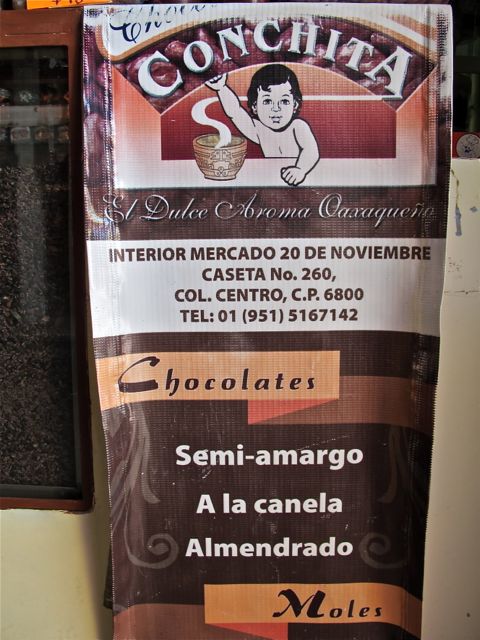
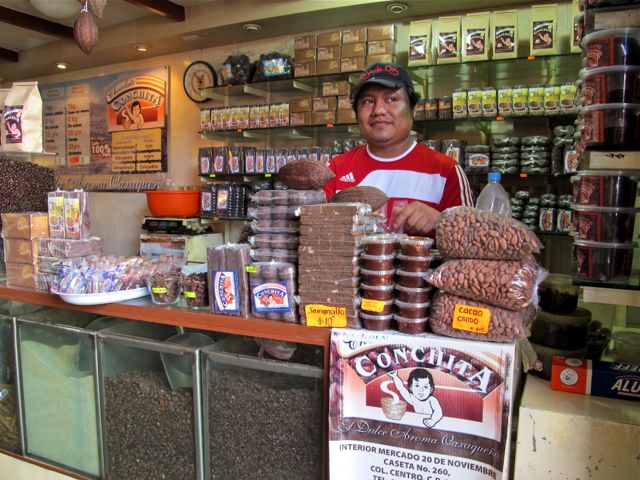
And, chocolate in Oaxaca is easy to find and is almost as well-known as Oaxaca’s cheeses and mole. Ground almonds and cinnamon give it a distinctive and slightly spicy flavor — and everyone has their favorite. Mayordomo and La Soledad are two of the most well-known labels, but my favorite brand (as opposed to homemade, which is in a class all by itself), is the much smaller, Conchita.

Every month or so, I weave my way in and out through the crush of the always teeming sidewalks of Miguel Cabrera to the Conchita puesto immediately to the right, inside the Mercado 20 de Noviembre — the entrance between Aldama and Mina.

I’m always greeted with a smile of recognition and the question, “Semi-amargo?” Sí, I always reply!

I buy the little semisweet chocolate chips for snacking (especially decadent and delicious when mixed with dried cranberries) and the large discs, which I grate into a fine powder to mix with hot milk to add to my morning coffee — a delectable way to jump-start the day!
Posted in Food, Markets, Travel & Tourism | Tagged Charles M. Schulz quote, chocolate, Conchita, food, mercado 20 de noviembre, Mexico, Oaxaca, photographs, photos, popular travel destinations, travel | 3 Comments »
Oh those beautiful braids of many of the dancers in Guelaguetza! How do they do it? In Reyes Etla, trapped between a yellow caution tape barrier and the folding chairs of the Tuxtepec delegation (the pineapple dancers), the answer was revealed…
Number 1: You can’t do it yourself!
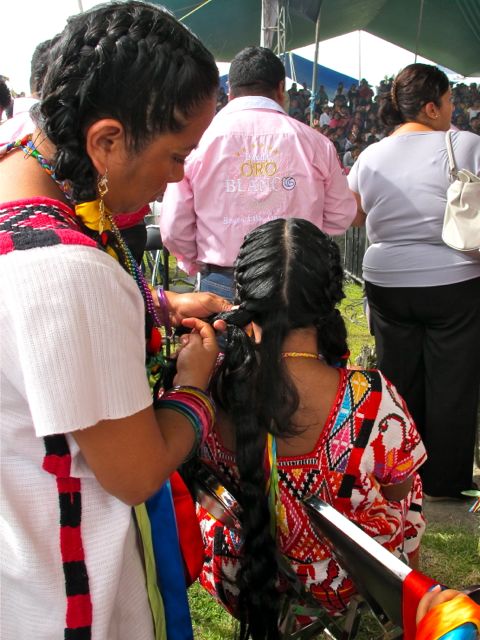
Number 2: Hair extensions! (Who knew???)

Number 3: Practiced hands.

Number 4: Patience.

But, it’s well worth the effort!

Posted in Celebrations, Creativity, Culture, Travel & Tourism | Tagged braiding, braids, dancers, Flor de piña, Guelaguetza, hair, Mexico, Oaxaca, photographs, photos, pineapple dancers, popular travel destinations, Reyes Etla, style, travel, Tuxtepec | 7 Comments »
Saturday night, a spur of the moment invite from my indomitable 86-year-old neighbor had us hailing a taxi at 10:30 PM, en route to attend the 13th Gran Vela and coronation of the queen of Vinnii Gaxhee (Zapotec for “different people” — gente diferente, en español). Vinnii Gaxhee was born, according to their website, in “July 2000, when a group of people in Oaxaca, whose sexual preferences were different, met and created a group whose members were not afraid to stand up to society and publicly accept their sexual preference or orientation.” (my loose translation)
The venue, in an area of the city neither of us was familiar with, proved to be unknown to the taxi driver, as well. After a few blocks, with much conversation back and forth re the location, and a call to his dispatcher, he asked (hopefully) if we would like to find another driver. Yes, we said and crawled out, hailed another taxi, and successfully headed out to Colonia Primavera Santa Lucía del Camino.
The “suggested” per person entry donation was the purchase of a case of beer. A case of beer, we asked? Even though they were small bottles, there was no way the two of us could drink a case, let alone two cases! Well, the issue was settled when we schlepped our cases over to our assigned (not sure how or why) seating area, where we were relieved of our boxes and where they joined stacks of others. However, chilled cervesas and food were offered without charge for the duration of the evening — and into the early morning! Besides, the floor show was worth the price of admission; a banda playing traditional music of the Istmo and hot Latin rhythms had people up and dancing, a runway-style procession of contestants (at least I think that is who they were), a Rockettes-like production number, and the crowning of the queen. What more could anyone want for about $15 (US)?
This slideshow requires JavaScript.
On a serious note… A little background on the name of the organization, Vinnii Gaxhee. Zapotec culture has historically acknowledged a “third” sex. These are men who from childhood, “consider themselves women and live in a socially sanctioned netherworld between the two genders,” according to a 2008 New York Times article. This has been traced back to pre-Columbian times, but was mostly wiped out by the Spanish colonists, except in the region around Juchitán de Zaragoza, on the Isthmus of Tehuantepec in Oaxaca.
As Vinnii Gaxhee, explains on its website, “it is as a tribute to all those in the region of the Isthmus, who fought for a place in society, regardless of sexual preference, making this region a place where homosexuality worldwide is accepted without any remark, first by the family after by society.” (my loose translation)
(ps) I still don’t understand how anyone can walk in those high, high heels!
Posted in Celebrations, Culture, Politics | Tagged gays, Gente Diferente, homosexuality, Isthmus of Tehuantepec, Istmo, Juchitan, lesbians, LGBT, Mexico, Muxes, Oaxaca, photographs, photos, third sex, transgender, Vinnii Gaxhee | 4 Comments »
The textiles of Oaxaca are currently on center stage, both literally and figuratively, during these 10 days of Guelaguetza festivities. And perhaps, besides drawing in much-needed tourist pesos, the Guelaguetza plays an important role in the appreciation and preservation of Oaxaca’s textile traditions.

Delegation from San Andrés Huaxpaltepec, District of Jamiltepec, in the Costa region of the state of Oaxaca.
However, the textile traditions of Lebanon have not fared so well. According to the article, The End of the silk road, by Ana Marie Lucas and posted to Now Lebanon, silk production, which dates back to the Middle Ages, is on death’s doorstep. Only two artisanal workshops remaining today. However, along with the Italian Embassy, the Mexican Embassy, Alfredo Harp Helú Foundation, and Textile Museum of Oaxaca are coming to the rescue.
“We wanted to share our experience with the Lebanese,” Mexican Ambassador Jorge Alvarez Fuentes told NOW Extra. “When I saw the House of the Artisan closed and in need of more attention I thought this was the perfect place to exhibit both Mexican and Lebanese items,” he explained.
“Aside from the exhibition, we wanted to organize two conferences and a workshop of how to dye the silk with natural pigments. This way many people will be able to see how the Phoenicians could extract the purple dye from the Murex shell,” he added.
According to Héctor Meneses, head of the Textiles Museum in Oaxaca, there are surprising similarities between the Lebanese and Mexican traditions in terms of pigment extraction. Mexicans extracted the red dye from a species of snail, very similar to the purple dye extracted by the Phoenicians from the Murex shell. “The difference is that in Mexico, this process is still alive and it’s being used,” he said during a conference. [Read full article HERE]
FYI: Alfredo Harp Helú is a Mexican businessman who, like his cousin Carlos Slim Helú (world’s richest man), is of Lebanese extraction. Harp Helú maintains a residence in Oaxaca and, besides his foundation funding the Textile Museum, he and his foundation are involved in several other philanthropic projects in the state of Oaxaca.
h/t to Margie Barclay for the article.
Posted in Celebrations, Creativity, Culture, Exhibitions, Museums, Textiles, Travel & Tourism | Tagged Alfredo Harp Helú, Ana Marie Lucas, Costa region, costumes, Fundación Alfredo Harp Helú, Guelaguetza, Jamiltepec, Lebanon, Mexico, Museo Textil de Oaxaca, Now Lebanon, Oaxaca, photography, photos, popular travel destinations, preservation, San Andrés Huaxpaltepec, silk, Textile Museum of Oaxaca, textile traditions, textiles, The End of the silk road, traje, travel | 1 Comment »
Besides mushrooms, tejate, tamales, and mole, there is cheese and mezcal… and last Monday I hopped in a colectivo bound for Etla; my destination was Reyes Etla (about 20 km. from the city) for the 2nd annual Queso y Quesillo Expo Feria. Oaxaca is known all over Mexico for its cheese and, without a doubt, the best comes from the municipalities around Etla — and Oaxaca’s department of tourism is on a mission to promote its position globally.

Vendors tempted with artistic displays and tastings of, among others, queso fresco, queso crema, and quesillo. Yummm…. It is a dark day around Casita Colibrí when there isn’t a ball of quesillo in the refrigerator.
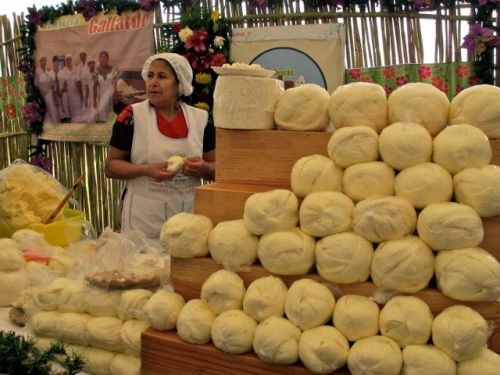
FYI: Quesillo (aka: Oaxacan string cheese) was first made in Reyes Etla in 1884 — supposedly by mistake! According to one legend, a young girl from Reyes Etla disobeyed her mother and allowed the cheese curds to expand into a spongy mass. She attempted to correct her mistake by pouring boiling water over the curds, then she kneaded it and pulled it into the first strip of what is now known as quesillo.

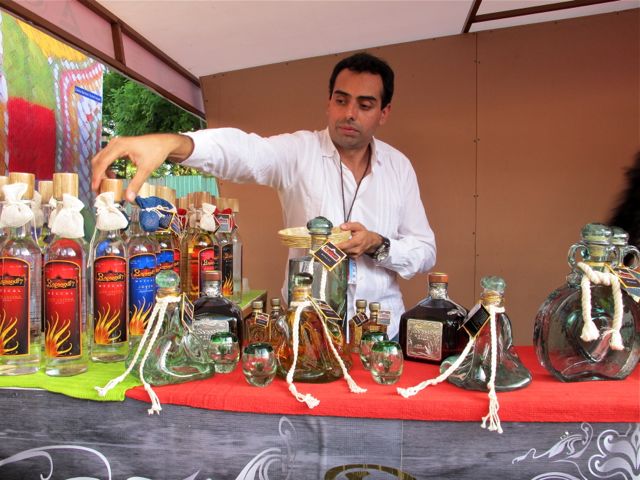
And, now, we turn to the 15th annual Feria Internacional del Mezcal… After years of languishing in tequila’s shadow, being considered a “poor relation” — that is, if it was considered at all — mezcal’s profile has risen dramatically in the past several years.

In August 2010, none other than Eric Asimov wrote about, Mezcal, Tequila’s Smoky, Spicy Cousin in the New York Times. A year later, a NYT ‘s article advised, Move Over, Tequila, It’s Mescal’s Turn to Shine. (You say mescal, I say mezcal.)
And, sheesh, I was flipping channels the other night and stumbled on Tim and Tim in Oaxaca, being instructed on the art of making mezcal by my landlord, on an episode of the TV program ROAM! Then there is the No Reservations “Obsession” episode, where Anthony Bourdain explores Ron Cooper’s obsession with mezcal.
Back to the feria, where over 40 vendors displayed their wares…

poured generous tasting shots…

and sold their mezcals.
.
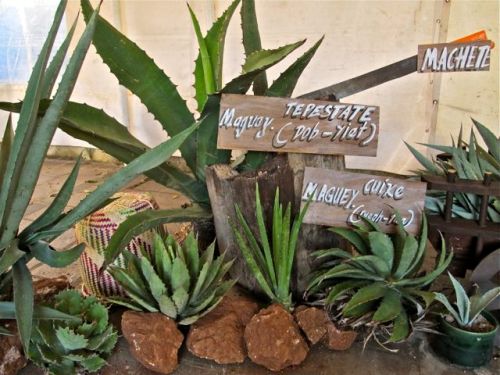
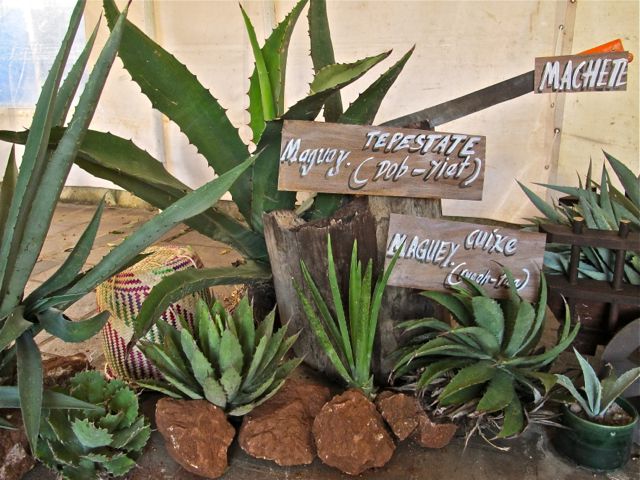
In addition, there was an exhibit showing the various types of maguey, from which mezcal is made…
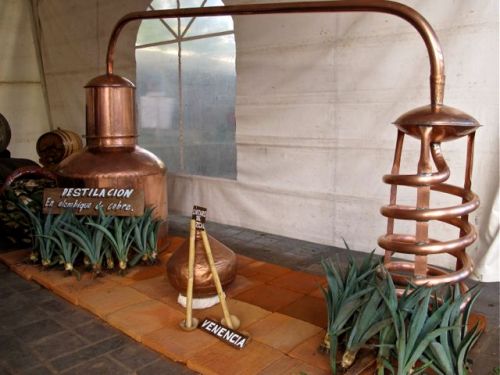
and the equipment used and processes they undergo to become this smoky and complex distilled spirit.
As the old Oaxaqueño saying goes, “For everything bad, drink mezcal, and for everything good, you also should.”
Posted in Beverages, Celebrations, Culture, Food, Travel & Tourism | Tagged cheese, Feria Internacional del Mezcal, food, mescal, Mexico, mezcal, Oaxaca, popular travel destinations, quesillo, queso, Queso y Quesillo Expo Feria, Reyes Etla, travel | 1 Comment »
Sunday, we headed up into the clouds of Oaxaca’s Sierra Norte to San Antonio Cuajimoloyas. At 10,433 feet above sea level and nestled in a forest of pine and oak trees, the setting has an ethereal feel and seems a world apart from the valley below — almost like being in an alpine village in Switzerland.

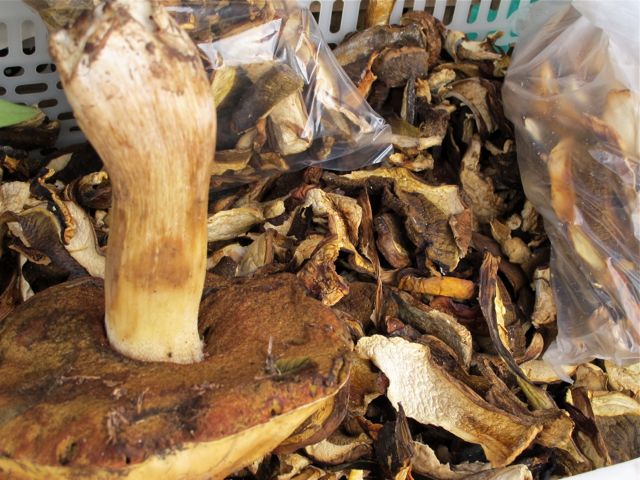
Getting up there wasn’t easy, thanks to the bumpy and winding dirt road. However, reaching our destination, the Feria Regional de Hongos Silvestres (fair of wild mushrooms) was well worth it!

Once there, baskets, buckets, and boxes filled with freshly gathered mushrooms greeted us.

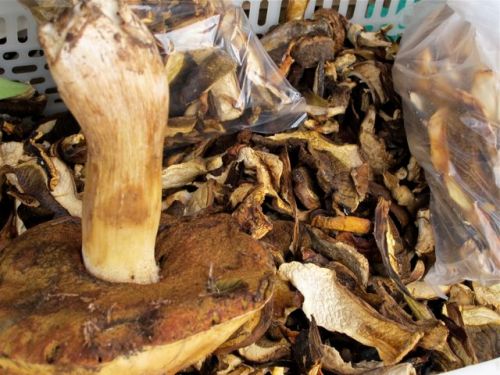


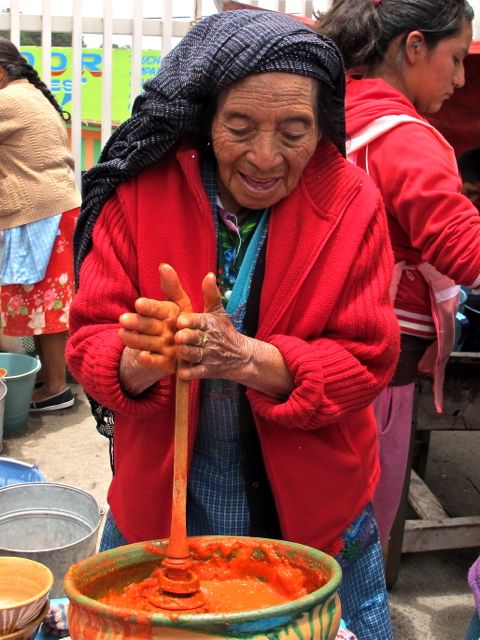
Not only was there a bounty of raw mushrooms, the aroma of sautéed mushrooms, mushroom tamales, and mushroom empanadas stimulated our appetites and we tried them all, and washed it down with an atole rojo made by this beguiling gal.

And no, these were not “magic mushrooms” but the experience was, indeed, magical.
Posted in Celebrations, Culture, Food, Travel & Tourism | Tagged Feria Regional de Hongos Silvestres, food, hongos, Mexico, mushrooms, Oaxaca, photographs, photos, popular travel destinations, San Antonio Cuajimoloyas, travel | 4 Comments »
As most of you have gathered, I love the music and people, life and color, and food and ferias, not to mention the year-round sun and warm weather of Oaxaca. However, as I’ve mentioned before, there is much going on beneath the surface and it isn’t pretty. So, even though it’s the middle of Guelaguetza (or, maybe because the spotlight is on the music, dance, and costumes of Oaxaca’s indigenous communities), I feel compelled to share today’s article by one of my favorite labor photographers and journalists, David Bacon.
Wednesday, 25 July 2012 00:00 By David Bacon, Truthout | Report Email
 An assembly last fall in Oaxaca of the Binational Front of Indigenous Organizations that called for a sustainable development policy that would support farmers as opposed to mega development projects. (Photo: David Bacon)
Oaxaca, Mexico – For over two decades in many parts of Mexico, large corporations – mostly foreign owned but usually with wealthy Mexican partners – have developed huge projects in rural areas. Called mega-projects, the mines and resource extraction efforts take advantage of economic reforms and trade treaties like the North American Free Trade Agreement.
Emphasizing foreign investment, even at the cost of environmental destruction and the displacement of people, has been the development policy of Mexican administrations since the 1970s. When the National Action Party (PAN) defeated the old governing Party of the Institutionalized Revolution (PRI) in 2000, this economic development model did not change. In fact, the PAN simply took over the administration of this development policy and even accelerated it, while in the Mexican Chamber of Deputies the two parties cooperated to advance its goals.
But while these projects enjoy official patronage at the top, they almost invariably incite local opposition over threatened or actual environmental disaster. Environmental destruction, along with accompanying economic changes, cause the displacement of people. Families in communities affected by the impacts are uprooted and often begin to migrate. Nevertheless, the projects enjoy official support and are defended against rising protests from poor farmers and townspeople by the federal government. [Please read the full article HERE]
Posted in Culture, Economics, Environment, Labor, Politics, Protests | Tagged Binational Front of Indigenous Organizations, David Bacon, environment, Mexico, mining, NAFTA, North American Free Trade Agreement, Oaxaca | 1 Comment »
« Newer Posts - Older Posts »






















 Mexican Peso Converter

 View From Casita Colibrí