Feeds:
Posts
Comments

Archive for the ‘Travel & Tourism’ Category

Several months ago, friend and longtime (35 years!) regular visitor to Oaxaca, Charles Kerns, asked me to write a review of his first work of fiction, Santo Gordo: A Killing in Oaxaca.

Cover of book, "Santo Gordo" by Charles Kerns

He sent it to me in June, when I was up in the San Francisco Bay Area, and it proved to be the perfect reading material for my SFO –> IAH –> OAX return trip.  Once back, I mentioned Santo Gordo to friends, loaned it, got it back, only to loan it again.  With Santo Gordo again in my hot little hands and after many months of delay, today I finally posted the following review on Amazon.com.

A botana of Oaxaca

Much as it has done to Charles Kerns, Oaxaca has captured my heart and three years ago I began living an expat life there. Thus, I can assure you reading Santo Gordo: A Killing in Oaxaca, will give you a botana (a small snack) of life in Oaxaca as seen and experienced by a gringo — well, not the witnessing an assassination part!

However, first time mystery writer Kerns does offer a glimpse at an underbelly few tourists are ever aware of and many expats choose to ignore – it’s history, complexity, and expression being too much to comprehend.

Kerns has crafted a mystery where place, in this case Oaxaca, is a leading character — much as Donna Leon, with her Commissario Brunetti mysteries, has done with Venice. Kerns has captured rhythms, rituals, sweetness, dangers (treacherous sidewalks, not murders, being at the top of the list), and bewildering aspects of life in Oaxaca, all the while telling a plausible tale with a very likable main character.

Now that the review has, at long last, been written, my copy of Santo Gordo: A Killing in Oaxaca, will be donated to the Oaxaca Lending Library — as I promised Chuck many months ago.  Sorry I kept you waiting and ¡Feliz cumpleaños mi amigo!

(ps)  Check out the San Jose Mercury News interview with Chuck, Alameda writer pens Oaxaca mystery.

Read Full Post »

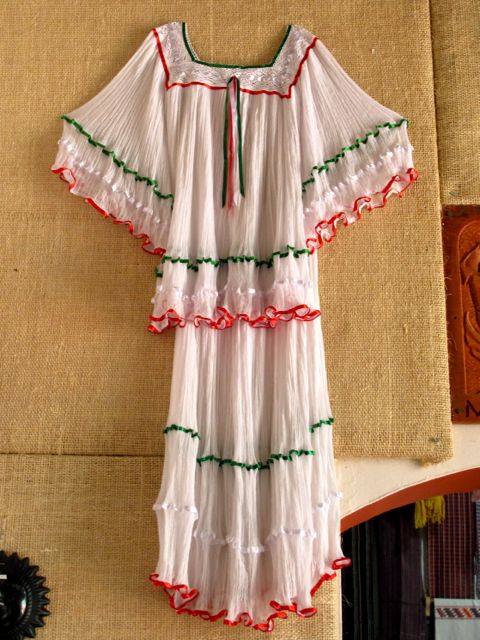
El Grito is coming, El Grito is coming!!!  Green, white and red is on display all over the city, including clothing stores, as tradition calls for wearing the colors.

Are you in the market for a traditional look?

White blouse and skirt with green and red trim.

A huipil and rebozo?

Green, white, and red dresses and shawls hanging on wall.

Or, are you leaning toward an updated mix and match style?

Green, white, and red dresses, skirs, blouses, and sash.

Do you need a sweater for going down to the zócalo on the evening of September 15?

Green, white, and red sweaters hanging on display hooks.

By all means, don’t forget to accessorize!

Green purse and red shoes.

On a more serious note:  Despite its current challenges (which are many and serious), Mexicans are extremely proud of being Mexicanos.  And, in my humble opinion, they have every right be!  They can trace their history back to ancient and highly developed civilizations, their national cuisine has been placed on the World Heritage List by UNESCO, and Mexico is considered one of the most geographically and biologically diverse countries in the world.  Plus, when was the last time you heard Mexico had invaded another country?

Read Full Post »

… and fish and turtles and ducks.  On August 31, as the rain fell, all of the above and more, assembled at Templo de Nuestra Señora de la Merced for the annual Bendición de los Animales.  Animals and their human keepers were there to celebrate the feast day of San Ramón de Nonato, patron saint of women in labor, persons falsely accused, and keeper of animals.

There were some familiar faces, both human and animal, from last year’s blessing.  However, this year the dogs were extremely vocal and, on occasion, tested the strength of the human at the other end of their leash — perhaps it was in anticipation of the evening’s “blue moon” or maybe being restrained and made to just sit or stand in the rain made them grouchy.

This slideshow requires JavaScript.

This morning’s article in Noticias covering the blessing, led off  with this quote from Benito Juárez García:

La protección de los animales forma parte esencial de la moral y de la cultura de los pueblos civilizados.  (The protection of animals is an essential part of morality and culture of civilized people.)

For more on this year’s Blessing of the Animals, head over to Oaxaca-The Year After.

Read Full Post »

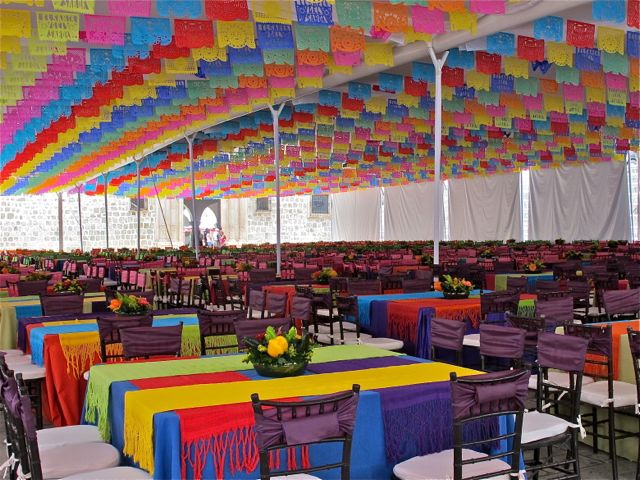
Thursday night was the kickoff event for the 5th annual El Saber Del Sabor (literally, the knowledge of flavor) Festival Gastronómico Oaxaca 2012.  Early in the day, the Plaza de la Danza had been tented and turned into a colorful banquet hall.

Interior of large tent decorated with multicolor tableclothes and papel picado on ceiling

A couple of the evening’s chefs arrived early and were cooling their heels, waiting to begin doing what they do best.  Hmmm… what’s with the bricks on top of the cantera?  (Stay tuned!)

2 chefs sitting behind brick platform

By 9:30 PM the tables had filled and cooking was well underway.

Young man in chef's toque sauteeing bananas.

Casa Oaxaca chef and event host, Alejandro Ruiz Olmedo circulated, greeted old friends and fans, and was interviewed by a crush of press.  Cameras and microphones were omnipresent — good for publicity, bad for navigating the aisles en route to food!

Chef Alejandro Ruiz Olmedo talking to a table filled with people.

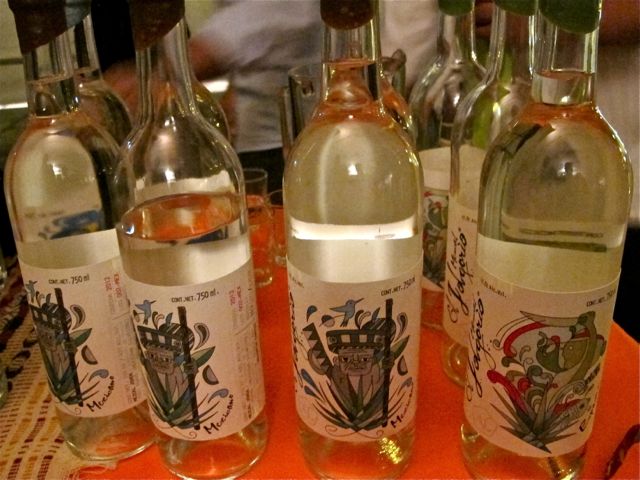
To begin the evening and ready the palate, wines, beers, aguas, and (of course!) mezcals were offered.  We sampled a couple of mezcals from El Jolgorio and all I can say is, Wow!  (BTW, that’s a good, “Wow!”)

Bottles of El Jolgorio Mezcal on a table.

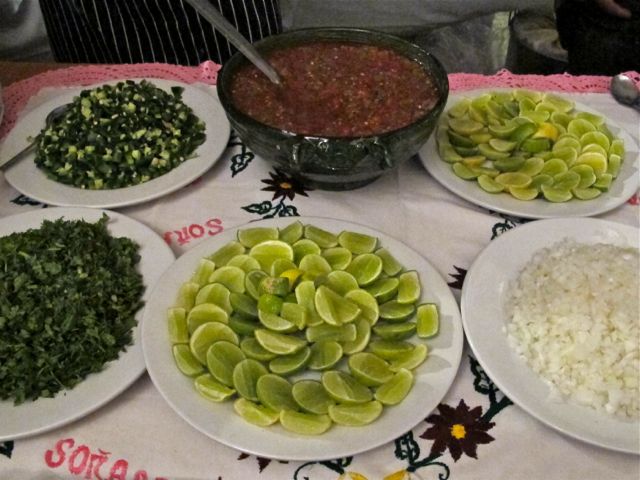
The festival seeks to promote and protect Oaxaca’s traditional cuisine and to inspire innovation.  For this evening’s event, we were invited to sample an incredible range of appetizers, side dishes, main courses, and desserts from 23 cooks, representing the 8 regions of Oaxaca.

A bowl of a stew surrounded by platters of limes, rice, cilantro, and onions.

I think I must have tasted at least 30 dishes — and this was late at night.  Needless to say, no breakfast for me the next morning.

Serving pans of food.

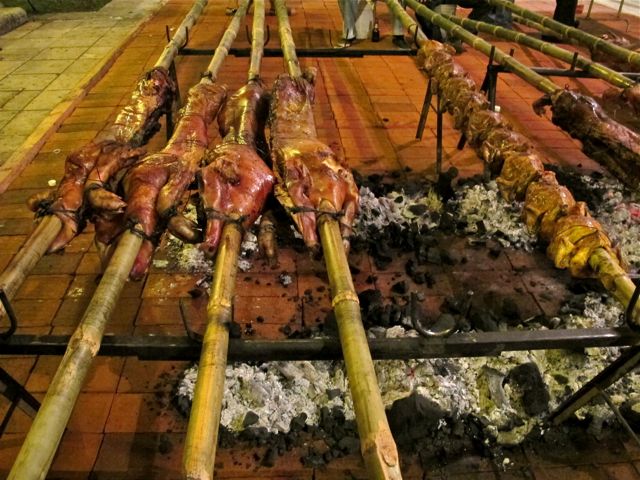
And, remember the bricks?   My favorite sight of the evening were the little piggies roasting on bamboo skewers over red and white-hot coals.  The tag line for the festival is, “tierra, fuego y cocina” (earth, fire, and kitchen).  Yes!!!

Roasting pigs on bamboo skewers over hot coals.

From the Plaza de la Danza, the festival moves to restaurants throughout the city, where 36 renowned chefs from all over Mexico have come to prepare innovative cuisine that pays homage to Oaxaqueño foodstuffs and traditions.

A big “thank you” to Henry and Rosa (Amate Books) for inviting me to share such a delightful and delicious evening!

Read Full Post »

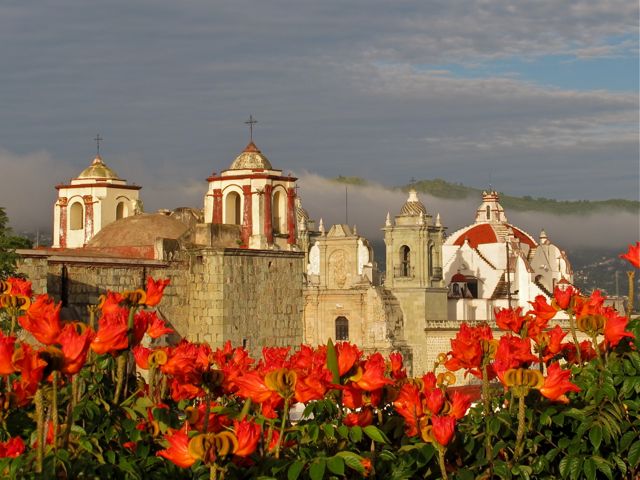
Oh, what a beautiful morning it was!

Glowing red/orange African tulip tree blossoms in foreground, church domes and bell towers in background against, tops of mountains in distance, against blue sky with bands of fog.

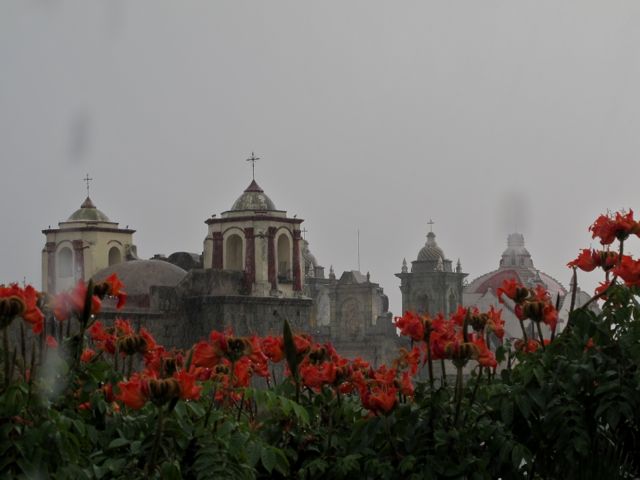
What a difference 10 hours makes.

Red/orange African tulip tree blossoms in foreground, church domes and bell towers in background against gray sky

Moisture from Tropical Storm Isaac being drawn across Oaxaca.  That’s the way the rainy season goes!

Read Full Post »

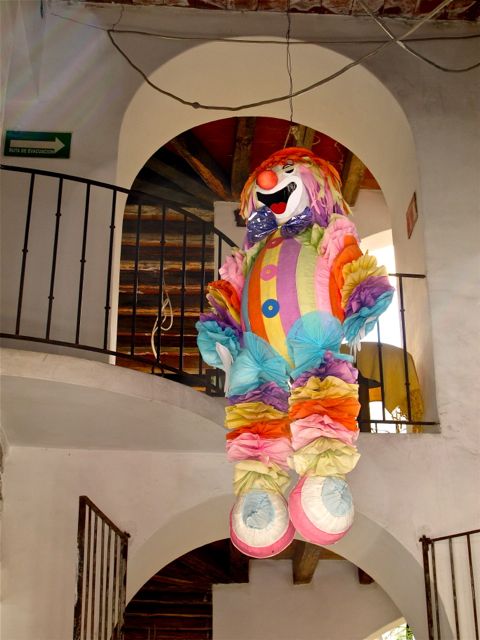
Walking down the street… an open door… can’t help but look in…

Clown piñata hanging from a ceiling

¡Feliz fin de semana!

Read Full Post »

I’ve been intending to post these photos for six months, but there has been so much going on in Oaxaca, I haven’t gotten around to it — until now.  This morning’s Guardian article, Trotsky’s murder remembered by grandson, 72 years on, caught my eye and I thought, if not today, when?  So, here goes…

When I was in Mexico City in January, I made somewhat of a pilgrimage out to the borough of Coyoacán.  Besides a lovely stroll through the Viveros de Coyoacán, being dazzled by the light and color of the Museo Frida Kahlo, and enjoying a delicious comida on the Plaza Hidalgo, I spent an incredibly moving three hours at the Museo Casa de Trotsky, the home, and now museum, of Russian revolutionary leader Leon Trotsky and his wife Natalia Sedova.  However, before getting to the photos, a very brief bit of context is necessary.

Hounded all over the world by Joseph Stalin and his agents, in 1937 Trotsky and Natalia Sedova were offered asylum by Mexican president Lázaro Cárdenas.  Trotsky’s orphaned grandson, Esteban Volkov (Seva), joined them not long after.  Seva narrowly escaped being murdered in his bed during the first attempt on Trotsky’s life in the Coyoacán house by Mexican muralist, David Alfaro Siqueiros.  It was during this attack that Trotsky guard, Robert Sheldon Harte was killed.

The house at Avenida Viena 19 was further fortified, but Stalinist agent, Ramón Mercader, under an assumed name was able to infiltrate Trotsky’s inner circle and, on August 20, 1940, under the ruse of asking Trotsky to look at something he had written, attacked him with an ice axe.  Trotsky died in hospital a little more than 24 hours later.  His ashes and those of Natalia’s reside in the peaceful garden of the Coyoacán house in a monument, designed by Irish-Mexican painter and architect Juan O’Gorman, that proudly flies a red flag and features the overlapping hammer of the worker and the sickle of the peasant.  The house and furnishings remain much as they were 72 years ago, bullet holes from the first attack and all.

This slideshow requires JavaScript.

The humanity expressed in the words below were felt as I wandered through the house and museum and I must admit, tears welled up as I stood before O’Gorman’s monument.

Trotsky’s Testament, dated 27 February 1940

My high (and still rising) blood pressure is deceiving those near me about my actual condition. I am active and able to work but the outcome is evidently near. These lines will be made public after my death.

I have no need to refute here once again the stupid and vile slanders of Stalin and his agents: there is not a single spot on my revolutionary honour. I have never entered, either directly or indirectly, into any behind-the-scenes agreements or even negotiations with the enemies of the working class. Thousands of Stalin’s opponents have fallen victims of similar false accusations. The new revolutionary generations will rehabilitate their political honour and deal with the Kremlin executioners according to their desserts.

I thank warmly the friends who remained loyal to me through the most difficult hours of my life. I do not name anyone in particular because I cannot name them all.

However, I consider myself justified in making an exception in the case of my companion, Natalia Ivanovna Sedova. In addition to the happiness of being a fighter for the cause of socialism, fate gave me the happiness of being her husband. During the almost forty years of our life together she remained an inexhaustible source of love, magnanimity, and tenderness. She underwent great sufferings, especially in the last period of our lives. But I find some comfort in the fact that she also knew days of happiness.

For forty-three years of my conscious life I have remained a revolutionist: for forty-two of them I have fought under the banner of Marxism. If I had to begin all over again I would of course try to avoid this or that mistake, but the main course of my life would remain unchanged. I shall die a proletarian revolutionary, a Marxist, a dialectical materialist, and, consequently, an irreconcilable atheist. My faith in the communist future of mankind is not less ardent, indeed it is firmer today, than it was in the days of my youth.

Natasha has just come up to the window from the courtyard and opened it wider so that the air may enter more freely into my room. I can see the bright green strip of grass beneath the wall, and the clear blue sky above the wall, and sunlight everywhere. Life is beautiful. Let the future generations cleanse it of all evil, oppression and violence, and enjoy it to the full.

For archives and bibliographies of Trotsky, the following two sites are about as comprehensive as one will find online:

Even if you are not interested in the politics, and especially if you are considering a visit to the museum, I highly recommend reading Barbara Kingsolver’s historical novel, The Lacuna, part of which takes place in Trotsky’s Mexican household and gives a flavor of life there.

By the way, the museum site (appropriately) houses the Instituto del Derecho de Asilo y las Libertades Públicas (Institute for the Right of Asylum and Public Liberties).  I wonder, are they working overtime these days?

Read Full Post »

On chairs in Reyes Etla.

On a chair: sheet music "Zapateando Istmeño xxx" for tuba

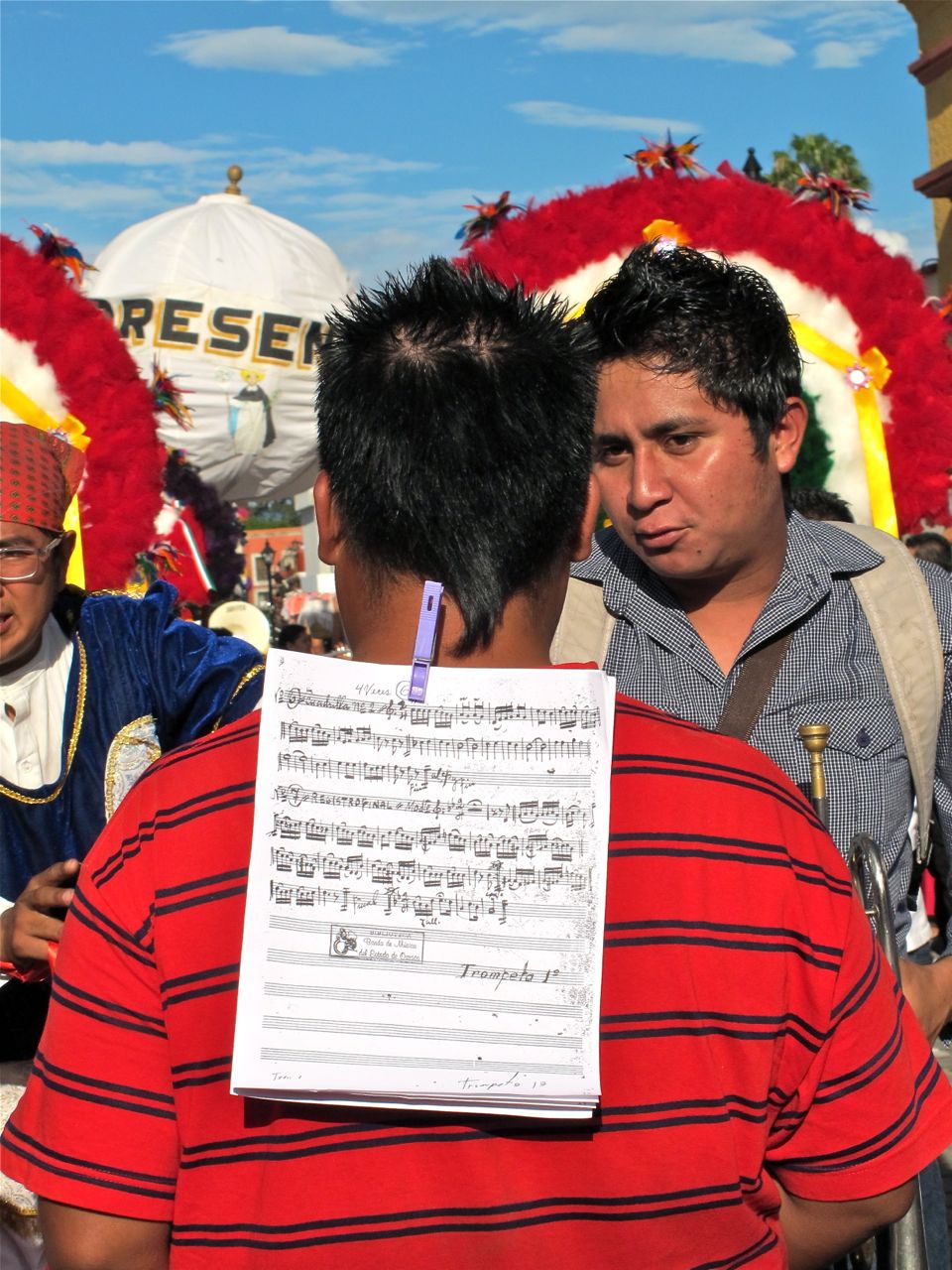
On people’s backs in the city.
"Cuadrilla no. 2" sheet music clipped on the back of a man wearing a red and black striped shirt

Wherever… especially during Guelaguetza!

Read Full Post »

Hmmm… hope you didn’t need a taxi in Oaxaca today.  It’s not that they weren’t around; they were everywhere!  August 12 is Día del Taxista and, instead of picking up fares, taxis are decorated and parade through the city, accompanied by banners, bands, monos, and the Virgen de Guadalupe.

This slideshow requires JavaScript.

I think I managed to capture one of each of the (color-coded) taxi organizations participating — 13 by my count.  However, the procession didn’t seem as long this year and I’m thinking some of the organizations were missing.  Charges of corruption, going back to the previous governor have been ramping up and the July 25th blockade that paralyzed transportation into and out of the city, by some taxistas, seemed to put the issue on the front burner.  But, who knows???  Certainly not this gringa!

Read Full Post »
Even though the Guelaguetza is over, textiles continue to be on my mind — actually I can never get enough of them!  So, a few days ago I walked down to the Museo Textil de Oaxaca to see the current exhibition, “Tormentos y Sueños” by Carolyn Kallenborn.  While not a Oaxaqueña, the respect she has for and inspiration she draws from the weavers and textile traditions of Oaxaca are obvious.

Kallenborn explains, “The pieces in this exhibit speak to the beauty and interaction between opposites.” (my translation)  The works are at once, complex and simple, using detail and negative space — much like storms and dreams.  Photographing a whole piece proved too much for my novice skills, thus I hope close-ups of these four pieces will whet your appetite.

If you are, or will be, in Oaxaca, I encourage you to see the whole!  The exhibit runs through November 9, 2012.

Read Full Post »

As that wise philosopher and Charlie Brown creator, Charles M. Schulz once wrote,

All you need is love. But a little chocolate now and then doesn’t hurt.

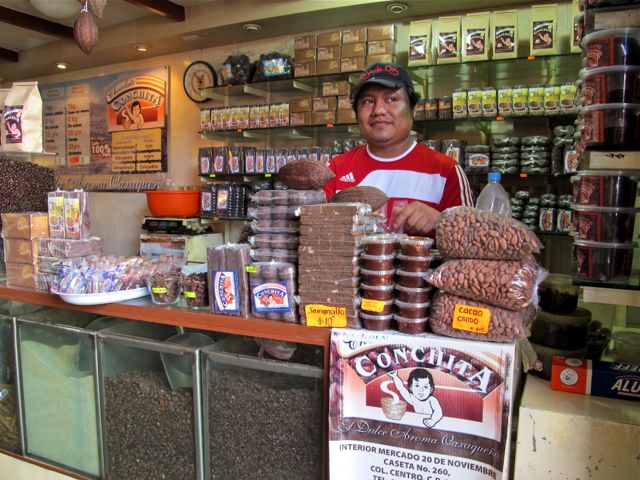
And, chocolate in Oaxaca is easy to find and is almost as well-known as Oaxaca’s cheeses and mole.  Ground almonds and cinnamon give it a distinctive and slightly spicy flavor — and everyone has their favorite.  Mayordomo and La Soledad are two of the most well-known labels, but my favorite brand (as opposed to homemade, which is in a class all by itself), is the much smaller, Conchita.

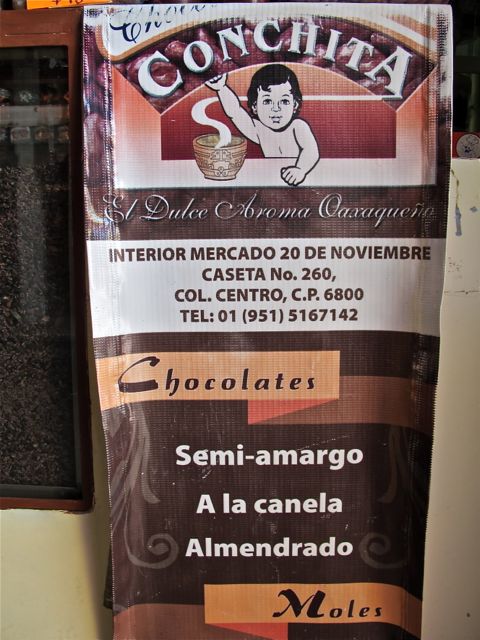
Conchita poster

Every month or so, I weave my way in and out through the crush of the always teeming sidewalks of Miguel Cabrera to the Conchita puesto immediately to the right, inside the Mercado 20 de Noviembre — the entrance between Aldama and Mina.

Sky blue entrance to the mercado 20 de noviembre.

I’m always greeted with a smile of recognition and the question, “Semi-amargo?”  Sí, I always reply!

Male sales clerk behind counter filled with chocolate products.

I buy the little semisweet chocolate chips for snacking (especially decadent and delicious when mixed with dried cranberries) and the large discs, which I grate into a fine powder to mix with hot milk to add to my morning coffee — a delectable way to jump-start the day!

Read Full Post »
Oh those beautiful braids of many of the dancers in Guelaguetza!  How do they do it?  In Reyes Etla, trapped between a yellow caution tape barrier and the folding chairs of the Tuxtepec delegation (the pineapple dancers), the answer was revealed…

Number 1:  You can’t do it yourself!

Woman standing braiding a hair extension into a seated woman's hair.

Number 2:  Hair extensions!  (Who knew???)

Close-up of hands braiding ribbons into hair

Number 3:  Practiced hands.

Hands braiding ribbons into hair.

Number 4:  Patience.

Hands braiding ribbons into hair.

But, it’s well worth the effort!

Hands finishing long braid, with red and blue ribbons, that extends beyond top of chair.

Read Full Post »

The textiles of Oaxaca are currently on center stage, both literally and figuratively, during these 10 days of Guelaguetza festivities.  And perhaps, besides drawing in much-needed tourist pesos, the Guelaguetza plays an important role in the appreciation and preservation of Oaxaca’s textile traditions.

Delegation from San Andrés Huaxpaltepec, District of Jamiltepec, in the Costa region of the state of Oaxaca.

However, the textile traditions of Lebanon have not fared so well.  According to the article, The End of the silk road, by Ana Marie Lucas and posted to Now Lebanon, silk production, which dates back to the Middle Ages, is on death’s doorstep.  Only two artisanal workshops remaining today.  However, along with the Italian Embassy, the Mexican Embassy, Alfredo Harp Helú Foundation, and Textile Museum of Oaxaca are coming to the rescue.

“We wanted to share our experience with the Lebanese,” Mexican Ambassador Jorge Alvarez Fuentes told NOW Extra. “When I saw the House of the Artisan closed and in need of more attention I thought this was the perfect place to exhibit both Mexican and Lebanese items,” he explained.

“Aside from the exhibition, we wanted to organize two conferences and a workshop of how to dye the silk with natural pigments. This way many people will be able to see how the Phoenicians could extract the purple dye from the Murex shell,” he added.

According to Héctor Meneses, head of the Textiles Museum in Oaxaca, there are surprising similarities between the Lebanese and Mexican traditions in terms of pigment extraction. Mexicans extracted the red dye from a species of snail, very similar to the purple dye extracted by the Phoenicians from the Murex shell. “The difference is that in Mexico, this process is still alive and it’s being used,” he said during a conference.  [Read full article HERE]

FYI:   Alfredo Harp Helú is a Mexican businessman who, like his cousin Carlos Slim Helú (world’s richest man), is of Lebanese extraction.  Harp Helú maintains a residence in Oaxaca and, besides his foundation funding the Textile Museum, he and his foundation are involved in several other philanthropic projects in the state of Oaxaca.

h/t to Margie Barclay for the article.

Read Full Post »

Besides mushrooms, tejate, tamales, and mole, there is cheese and mezcal… and last Monday I hopped in a colectivo bound for Etla; my destination was Reyes Etla (about 20 km. from the city) for the 2nd annual Queso y Quesillo Expo Feria.  Oaxaca is known all over Mexico for its cheese and, without a doubt, the best comes from the municipalities around Etla — and Oaxaca’s department of tourism is on a mission to promote its position globally.

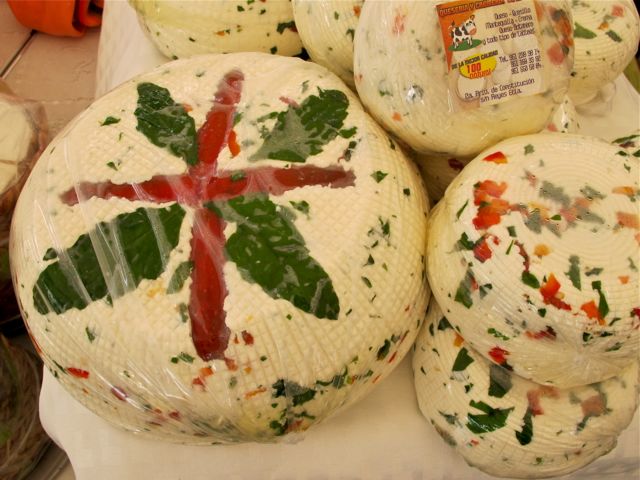
Ball of cheese decorated with basil leaves and red bell pepper strips.

Vendors tempted with artistic displays and tastings of, among others, queso fresco, queso crema, and quesillo.  Yummm….  It is a dark day around Casita Colibrí when there isn’t a ball of quesillo in the refrigerator.

Display of cheeses with woman vendor behind counter

FYI:  Quesillo (aka:  Oaxacan string cheese) was first made in Reyes Etla in 1884 — supposedly by mistake!  According to one legend, a young girl from Reyes Etla disobeyed her mother and allowed the cheese curds to expand into a spongy mass.  She attempted to correct her mistake by pouring boiling water over the curds, then she kneaded it and pulled it into the first strip of what is now known as quesillo.

Woman vendor wearing mask behind display of quesillo
And, now, we turn to the 15th annual Feria Internacional del Mezcal…  After years of languishing in tequila’s shadow, being considered a “poor relation” — that is, if it was considered at all — mezcal’s profile has risen dramatically in the past several years.

XV feria internacional del mezcal oaxaca 2012

In August 2010, none other than Eric Asimov wrote about, Mezcal, Tequila’s Smoky, Spicy Cousin in the New York Times.  A year later, a NYT ‘s article advised, Move Over, Tequila, It’s Mescal’s Turn to Shine.  (You say mescal, I say mezcal.)

And, sheesh, I was flipping channels the other night and stumbled on Tim and Tim in Oaxaca, being instructed on the art of making mezcal by my landlord, on an episode of the TV program ROAM!  Then there is the No Reservations “Obsession” episode, where  Anthony Bourdain explores Ron Cooper’s obsession with mezcal.

Back to the feria, where over 40 vendors displayed their wares…

Bottles of mezcal lined up in two shelves of a display

poured generous tasting shots…

3 guys behind counter offering shots of mezcal

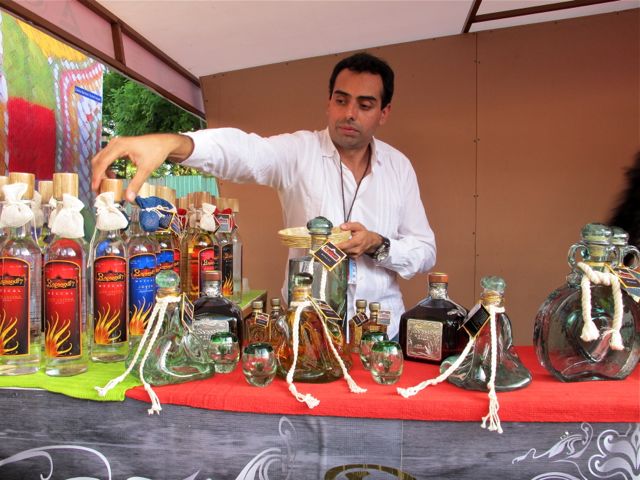
and sold their mezcals.

.Male vendor reaching for a bottle of mezcal

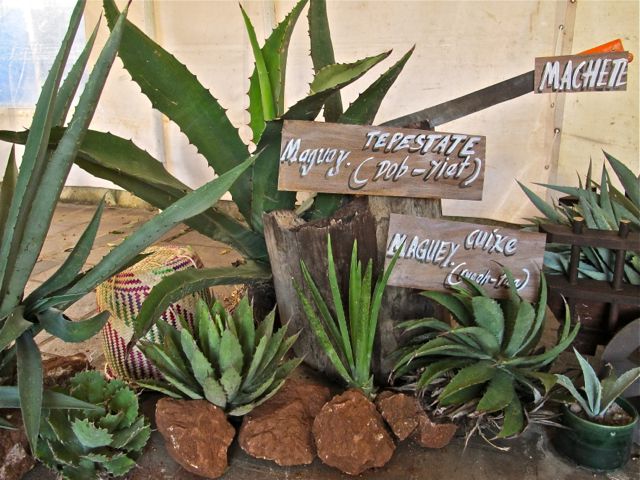
In addition, there was an exhibit showing the various types of maguey, from which mezcal is made…

Variety of agave plants with labels.

and the equipment used and processes they undergo to become this smoky and complex distilled spirit.

A mezcal still

As the old Oaxaqueño saying goes, “For everything bad, drink mezcal, and for everything good, you also should.”

Read Full Post »

Sunday, we headed up into the clouds of Oaxaca’s Sierra Norte to San Antonio Cuajimoloyas.  At 10,433 feet above sea level and nestled in a forest of pine and oak trees, the setting has an ethereal feel and seems a world apart from the valley below — almost like being in an alpine village in Switzerland.

Wood house with tin roof

Getting up there wasn’t easy, thanks to the bumpy and winding dirt road.  However, reaching our destination, the Feria Regional de Hongos Silvestres (fair of wild mushrooms) was well worth it!

Banner above municipal building, against a cloudy sky, announcing, "Bienvenidos,12va. feria regional de Hongos Silvestres"

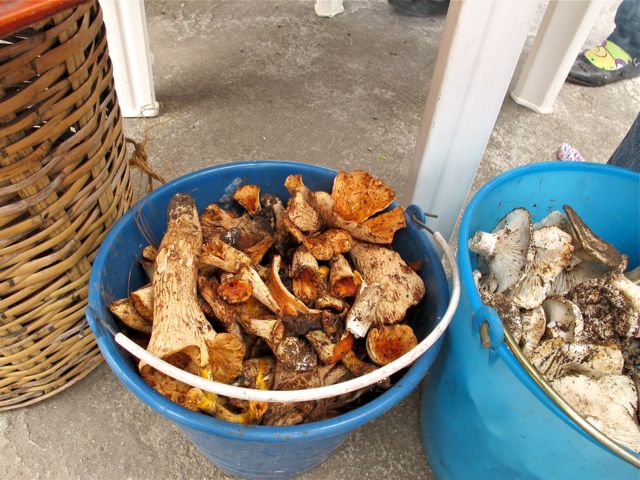
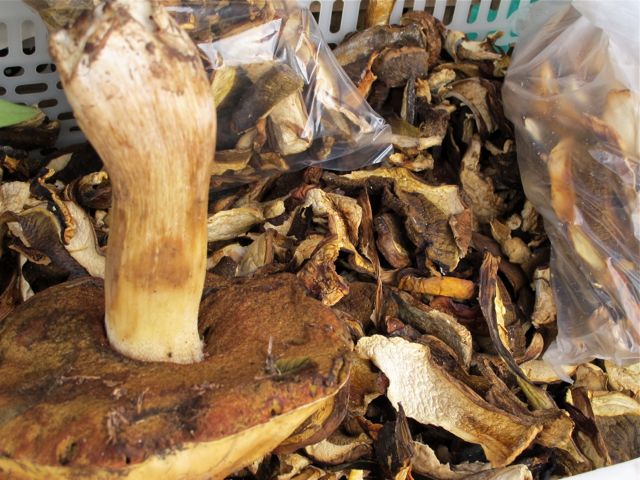
Once there, baskets, buckets, and boxes filled with freshly gathered mushrooms greeted us.

Blue plastic bucket of trumpet mushrooms

Close-up of mushrooms

Mushrooms in a box

Orange capped mushrooms in a green container

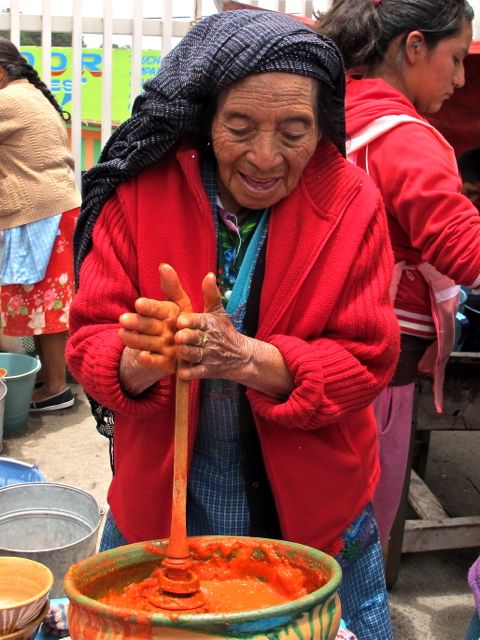
Not only was there a bounty of raw mushrooms, the aroma of sautéed mushrooms, mushroom tamales, and mushroom empanadas stimulated our appetites and we tried them all, and washed it down with an atole rojo made by this beguiling gal.

Elderly woman mixing atole rojo.

And no, these were not “magic mushrooms” but the experience was, indeed, magical.

Read Full Post »

« Newer Posts - Older Posts »