Going my way?
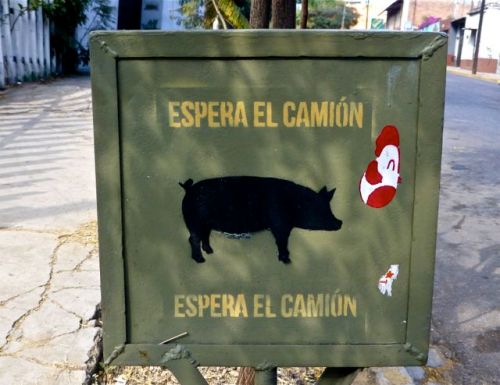
Is there gas in the car?

Yes, there’s gas in the car.

Get your motor runnin’.

Hitchin’ a ride on the class divide.
Posted in Culture, Signs, Travel & Tourism, tagged cars, Jaguar automobile, Mexico, Oaxaca, photograghs, photos, popular travel destinations, street signs, transportation on December 10, 2012| Leave a Comment »
Going my way?
Is there gas in the car?
Yes, there’s gas in the car.
Get your motor runnin’.
Hitchin’ a ride on the class divide.
Posted in Celebrations, Creativity, Culture, Holidays, Music, Parks & Plazas, Travel & Tourism, tagged festivals, Low-Fi, Mexico, music, Oaxaca, Plaza del Carmen Alto, popular travel destinations, Sexto Low-Fi 2012, Virgen de Juquila on December 9, 2012| 1 Comment »
Riotous clanging from Soledad’s bell towers at 4:45 AM yesterday rudely interrupted a peaceful sleep. Explosions of cohetes and other church bells soon joined the morning’s 2-hour long Virgen de Juquila soundtrack. Chimes, rockets, loudspeakers announcing the presence of the water and gas vendors, fried plantain wagon steam-whistles, horns honking, bus gears grinding, and booming base emanating from open car windows; it’s all part of the cacophony one comes to know and love when living in Mexico.
And, then there is the music… Looking for signs of Juquila yesterday (with all that noise, I figured there must be something going on), I stumbled upon the Sexto Festival Low-Fi 2012. (Fyi: sexto = 6th, in case you were wondering.)

There were vendors…

This definitely didn’t have anything to do with virgins!

This was a music festival that almost didn’t happen. According to event promoter, Thorvalo Pazos Hoga, they were initially denied a permit, “on the grounds of religious and traditional festivals that are celebrated in the month of December in the city.” A silly argument, was his response.

I arrived in the early afternoon and fanaticos (love that word for fans!) were just beginning to gather at the Plaza del Carmen Alto. Ska, hip hop, heavy metal, rock, electronic music, and more would be adding to Oaxaca’s soundtrack until 11 PM.

Yes, we have no marimbas; the music was not your grandparents’ sones and jarabes. The bands had names like: K-OS Party, Cayune, Pichancha, Rekto de Cerdo, Dr. Jekill y Mr. Hyde, Herpes, Coito Violento, Forever, and Survival. Probably not even your parents’ music!

Oaxacan graphic artists designed the stage set. Love how they re-imagined the traditional Navidad piñata.
Posted in Celebrations, Creativity, Culture, Holidays, Religion, Travel & Tourism, tagged Christmas, Christmas decorations, Christmas trees, Mexico, Navidad, Oaxaca, Virgen de Juquila on December 7, 2012| 7 Comments »
For the first time since I began nesting in my cozy little rooftop casita, I’m not heading north for Christmas. I admit to having decidedly mixed feelings; my family and most of my closest friends are up in El Norte and I’m already missing them and the traditions we have created. However, this year I get to share the holidays with new friends, create new traditions, and experience festivities heretofore unimagined — Noche de Rabanos (Night of the Radishes)? I can’t wait!
In the meantime, to bring a little of the familiar into the mix, I bought a Christmas tree. Not a real one (sad face) and not one of those seen below that my local supermarket has had for sale for several weeks. Mine is decidedly smaller, measuring exactly two feet, and…

too small to hang my favorite Mexican ornaments on its un-scented, wiry but green(!) boughs. These colorful and wonderfully bouncy decorations will be purchased and a place for them in and around Casita Colibrí will be found.
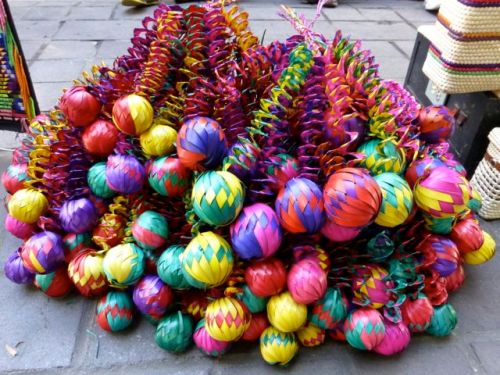
Trimming my tree will present some challenges. No cartons of ornaments, lovingly collected and stored by four generations of the family, to bring down from the attic. And, as I’ve said, the tree is tiny. I’m thinking… digging into my earring collection might be a good place to start.
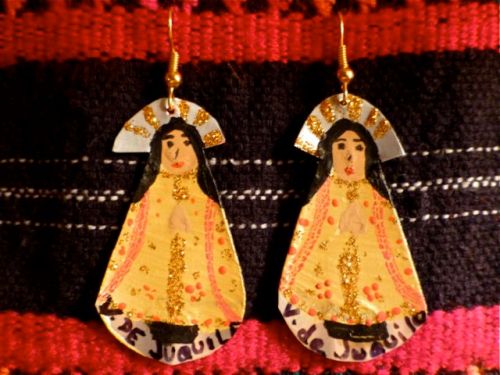
However, these earrings will have to wait to adorn the tree until after I wear them tomorrow. December 8 is the celebration of the Virgen de Juquila — the first of three Vírgenes honored by Oaxaqueños in December. There will be parades. There will be fireworks. There will be wildly clanging church bells. And, there will be an abundance of magic this month, of this I have no doubt!
Posted in Buildings, Churches, Geography, Neighborhoods, Religion, Travel & Tourism, tagged churches, iglesias, Mexico, mountains, Oaxaca, photographs, photos, popular travel destinations, Templo del Carmen Alto on December 5, 2012| 2 Comments »
Walking home today…
Besides walls of street art (which will no doubt appear here when inspiration hits or I can’t think of anything else to post), I came across this view.

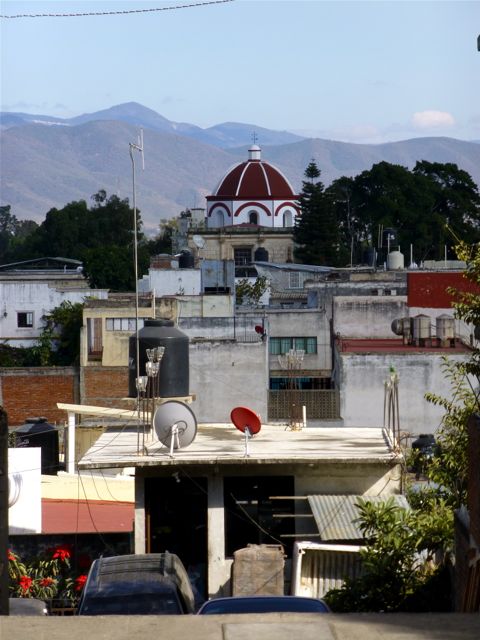
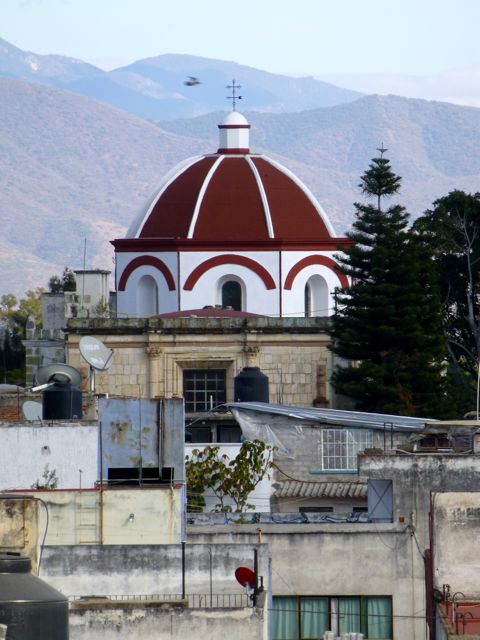
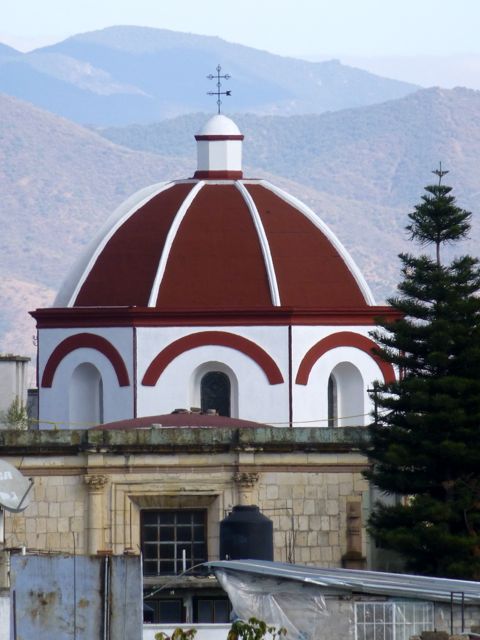
View of Templo del Carmen Alto from Crespo, near the Escaleras del Fortín.
There is beauty out there…
Posted in Buildings, Creativity, Culture, Exhibitions, Travel & Tourism, tagged art, art installation, cempasuchitl, Dream of Elpis, El Sueño de Elpis, exhibition, marigolds, Mauricio Cervantes, Mexico, Oaxaca, photographs, photos on December 3, 2012| 10 Comments »
On Saturday, thanks to MexicoRetold, I stepped through the doorway and entered El Sueño de Elpis (the dream of Elpis), an art installation by Mauricio Cervantes in one of the many abandoned buildings in the city center.


In Greek mythology, Elpis was usually depicted carrying flowers and was the spirit of hope. She alone chose to remain when Pandora opened the lid of her infamous box.
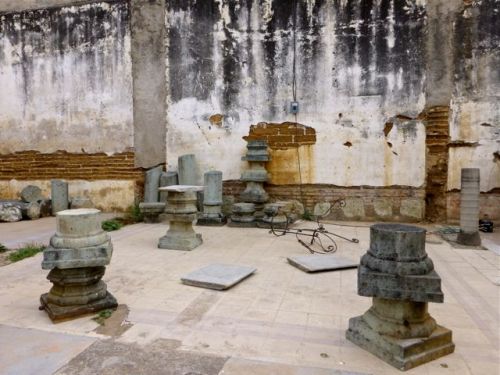

I arrived a little after 10 AM. The glow of morning light on the colors and textures of this crumbling beauty and her furnishings was captivating — and I was reluctant to leave.
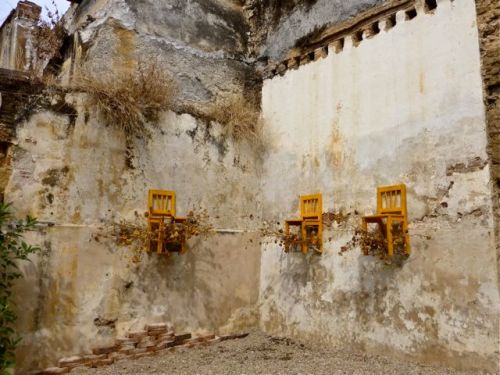

Elpis and her dream will continue to offer hope for another 3-1/2 weeks at Murguía 103 (between Macedonio Alcalá and 5 de mayo). There were candles — and according to the docent, it is especially magical at dusk.


I will return. Keep dreaming…
Posted in Celebrations, Culture, Holidays, Religion, Travel & Tourism, tagged cemetery, Day of the Dead, Día de los Muertos, Mexico, Oaxaca, panteón, photographs, photos, popular travel destinations, Zaachila on November 28, 2012| Leave a Comment »
The Y-shaped valley of Oaxaca is about 700 square kilometers, not all that big when compared to California’s Sacramento Valley, which is approximately 2,570 square kilometers. Yet, unlike the “sameness” one encounters in Sacramento Valley towns (sorry, CA), one can’t help but be struck by the unique identity of each of the Zapotec villages that are only kilometers apart. One specializes in red clay pots, another in black pottery, and another in green glazed ceramics. There are villages of woodcarvers near weavers of cotton and others of wool, never mind the fashion trends!
Thus, it should come as no surprise that Day of the Dead celebrations and cemeteries differ, often dramatically, from village to village. And so, from the whitewashed graves of Santiago Apóstol and the candlelight of Santa María Atzompa (today’s earlier post), we came to the carved wooden crosses in the Panteón Municipal of the Villa de Zaachila.
Along with livestock, produce, and household goods, wood gathered from the hills surrounding Zaachila is a major part of Zaachila’s weekly Thursday tianguis (open air market). It’s one of my favorites!
Posted in Celebrations, Culture, Holidays, Religion, Travel & Tourism, tagged cemetery, Day of the Dead, Día de los Muertos, dualism, Mexico, Oaxaca, panteón, photographs, photos, popular travel destinations, religion, Santa María Atzompa, Santiago Apóstol on November 28, 2012| 1 Comment »
With only a couple of days left in November and the Christmas holiday season already making its presence known, it’s now or never to finish sorting through this year’s Día de los Muertos photos — my thoughts and impressions will take the remains of this lifetime, and then some, to process.
To an outsider, especially one whose worldview was shaped by a Judeo-Christian culture, Day of the Dead is often seen through the lens of juxtaposition.
The “unbearable lightness of being” in Santiago Apóstol…

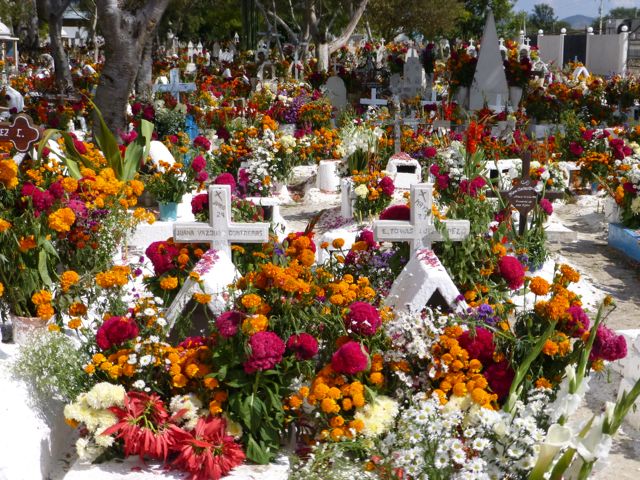
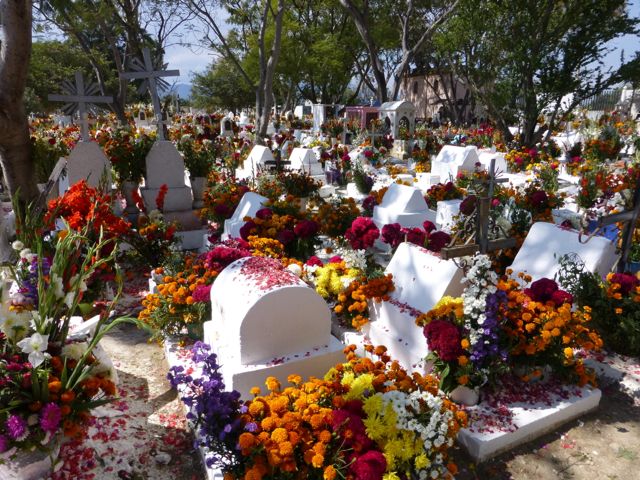

The blurred otherworldly darkness of Santa María Atzompa…

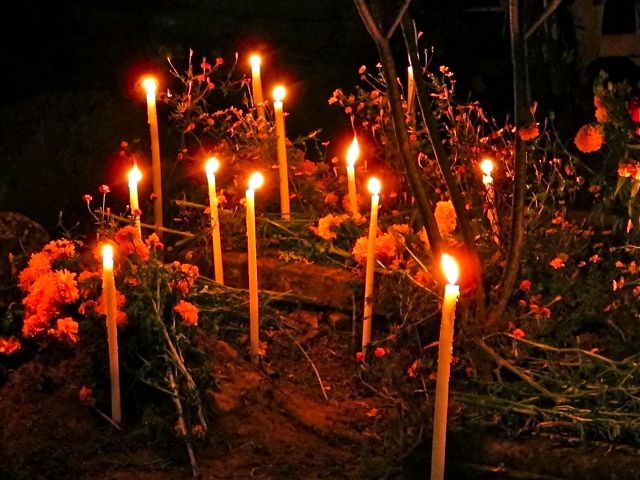

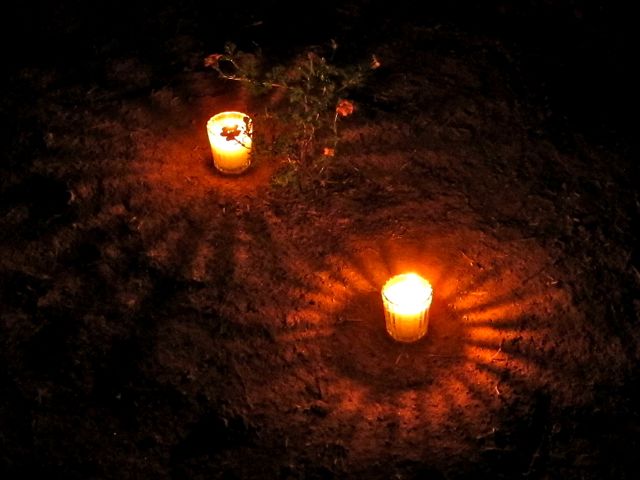
However, light becomes dark becomes light becomes dark, as day becomes night becomes day becomes night, as life becomes death becomes life becomes death… dualism beginning to vanish.
Posted in Gardens, Holidays, Parks & Plazas, Travel & Tourism, tagged Christmas, flowers, garden, gardeners, holiday decorations, Mexico, Oaxaca, photographs, photos, plants, poinsettias, popular travel destinations, zócalo on November 27, 2012| 4 Comments »
Today, the truck arrived, the wheelbarrows were loaded, and the gardening crew began filling the flower beds of Oaxaca’s zócalo…
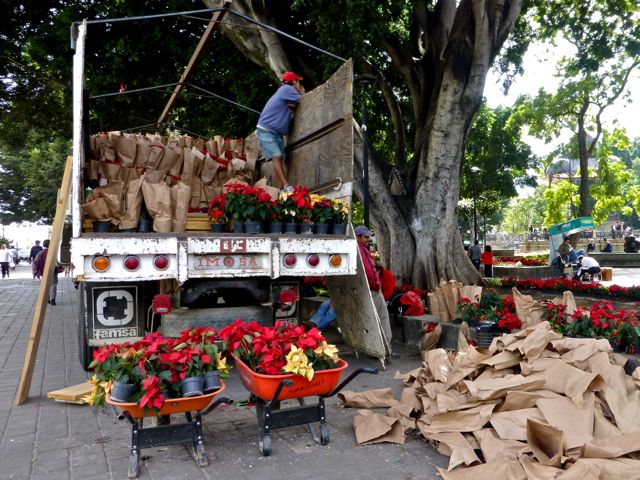
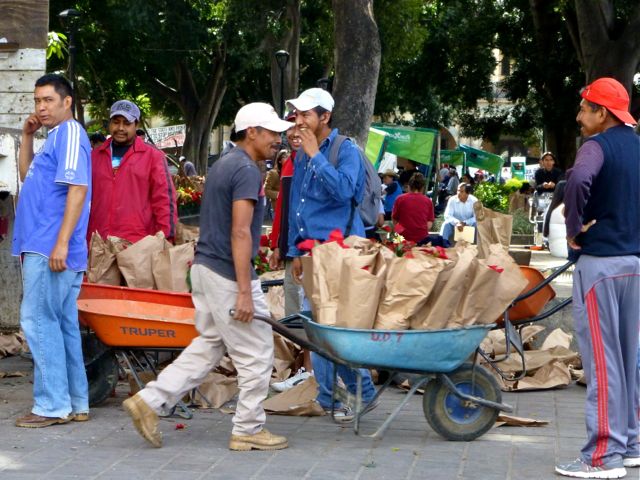
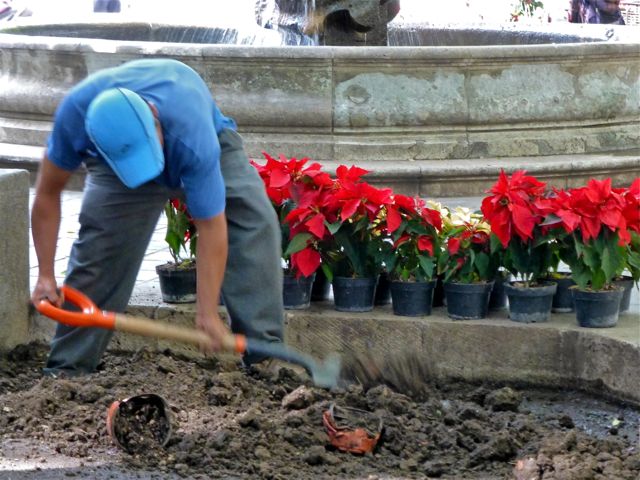
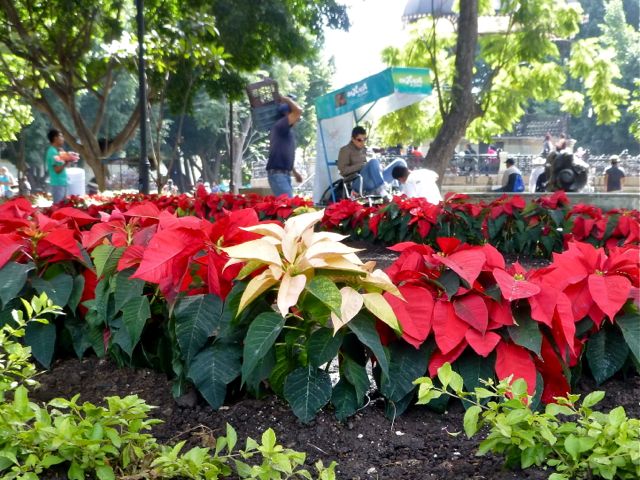
Navidad is coming to Oaxaca!
Posted in Celebrations, Culture, Economics, Holidays, Signs, Travel & Tourism, tagged Buen Fin, Mexico, Oaxaca, photography, photos, sales, shopping on November 23, 2012| 2 Comments »
Signs reading, “Buen Fin” began to appear on shop windows around town last week. How nice, I thought, with a 3-day weekend coming up (Monday, 11/19 was Mexican Revolution commemoration day), the stores are wishing one and all a “Good Weekend.”
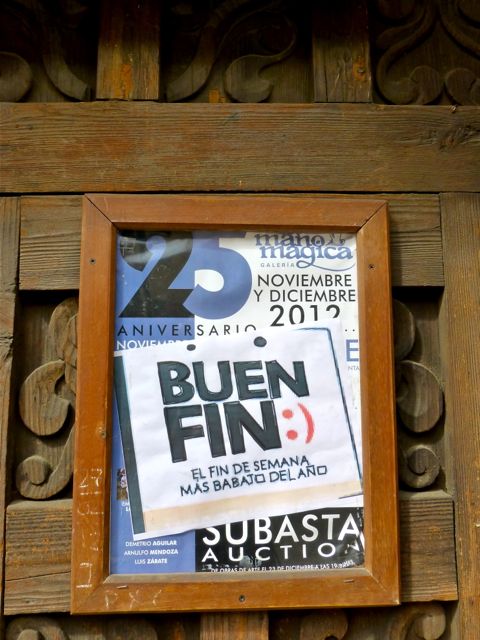
I’d only glanced and didn’t come close enough to read the smaller and more important print, “Weekend: Cheapest of the Year.” What’s it all about? Last year’s LA Times article, “A ‘Black Friday’ shopping ritual coming to Mexico?” explains it all.
Apparently, I’ve been oblivious or this newest US export has taken a while to make its way all the way down to Oaxaca. But, make its way down to Oaxaca, it has! According to Monday’s Noticias, “This weekend hundreds of Oaxacans went to department stores and shops of all kinds in the city, to stock up on essentials and electronic products, mainly taking advantage of ‘Good Weekend’ promotions.”
Depressing, is all I can say…
Posted in Buildings, Churches, Museums, Nature & Science, Neighborhoods, Politics, Restaurants, Science & Nature, Travel & Tourism, tagged churches, climate, Colorado River, Colorado River agreement, environment, environmentalism, Flor de Loto, Iglesia Evangelica Bautista, In Situ Torrentera, Mexico, mezcalería, Museo de Arte Prehispanico de Mexico Rufino Tamayo, museum, Oaxaca, photographs, photos, restaurants, water, water wars on November 20, 2012| 2 Comments »
They say, “politics makes strange bedfellow.” Rivers do too, as US, Mexico reach pact on Colorado River water sale. Hopefully, Mexico isn’t getting the short end of the stick, like Southern California’s Imperial Irrigation District is accusing its SoCal neighbor, the Metropolitan Water District, of handing it.
Having grown up and spending most of my life in Northern California and suffering through a couple of major droughts that included water rationing, while water flowed south to fill LA’s swimming pools and water its lawns, the only answer to stave off the upcoming worldwide “water wars,” is the recognition that water is a precious resource that must be conserved and not wasted.
Hmmm… I wonder how these neighbors on the 500 block of Avenida Morelos get along?


The mezcalería is the newest addition to the ‘hood and for some reason it tickled me that the vegetarian restaurant is the only thing standing between it and the Baptist church.
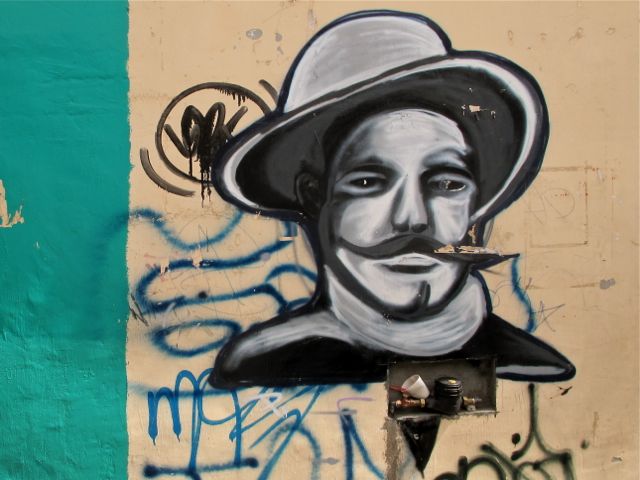
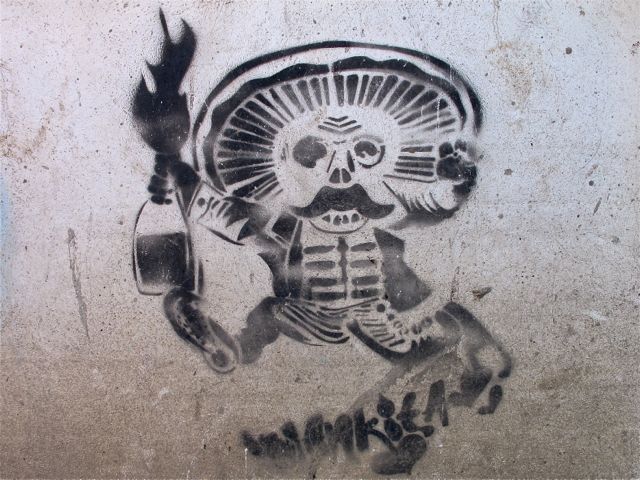
Posted in Creativity, Culture, History, People, Travel & Tourism, tagged bigote, Emiliano Zapata, graffiti, Mexico, mustache, Oaxaca, Pancho Villa, photographs, photos, popular travel destinations, street art, wall art on November 17, 2012| 6 Comments »
Posted in Buildings, Culture, History, People, Travel & Tourism, tagged art, Arturo García Bustos, Benito Juárez, Government Palace, José María Morelos y Pavón, Margarita Maza, Mexico, mural, Oaxaca, painting, Palacio de Gobierno, photographs, photos, popular travel destinations, Porfirio Díaz, Ricardo Flores Magon on November 11, 2012| 8 Comments »
Last night I walked down to Oaxaca’s Palacio de Gobierno at the south end of the zócalo. This former government palace is now a museum and I was headed up to the second floor to see two more Oaxaca FilmFest3 films. I was early, the building was mostly empty, and so I took the opportunity to really study the mural that graces the walls of the main staircase. Painted in 1980 by Arturo García Bustos, the mural depicts the history of Oaxaca.
Coming up the stairs, to the left, the customs and lifestyle of the Mixtecs, Zapotecs, and Aztecs of pre-Hispanic times unfold.

As you ascend further, on the right wall the Spanish conquest is portrayed.

However, it is the center section of the mural that grabs the attention. Best seen when one reaches the top, here Bustos, pulls out all the stops in representing the one hundred years from the War of Independence through the Reform Movement to the Mexican Revolution.

Featured in the upper right corner of this panel, wearing his signature red bandanna, is War of Independence hero, José María Morelos y Pavón. He can also be seen in the lower right with a printing press, in his role as publisher of Oaxaca’s first newspaper, El Correo del Sur. On the upper left is anarchist and Mexican revolutionary hero, Ricardo Flores Magón. He is also pictured holding a banner reading, Tierra y Libertad (Land and Liberty). Flores Magón is the namesake of the street that borders the west side of the Government Palace.
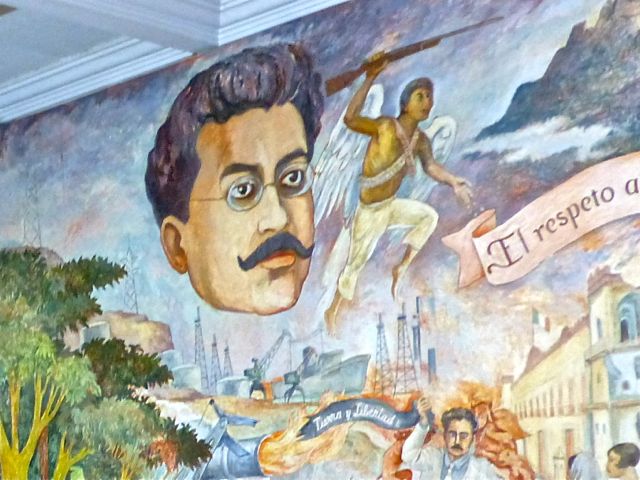
However, front and center is Oaxaca’s favorite son, Zapotec, former governor of Oaxaca, and Mexico’s much beloved five-term president, Benito Juárez. He and his Oaxaqueña wife, Margarita Maza, hover prominently above his Reform Movement cabinet. The full text of the ribbon is a quote by Juárez, “El respeto al derecho ajeno es la paz” (Respect for the rights of others is peace). It appears on the State of Oaxaca’s coat of arms.

Juárez is also pictured along with the cabinet and third from his right stands another Oaxaqueño, the young, menacing-looking, and far from beloved by the 99%, Porfirio Díaz, trademark epaulettes and all — a portend of things to come.

Following his death in 1872, the city and municipality of Oaxaca honored Benito Juárez by changing its name to Oaxaca de Juárez.
Posted in Creativity, Culture, People, Travel & Tourism, tagged entertainment, film, film festivals, Filmfest3, Matt Dunnerstick, Mexico, movies, Oaxaca, Oaxaca Film Festival, photographs, photos, popular travel destinations, Postmodern Times, Ramiz Adeeb Azar, The Game, Tilt on November 9, 2012| 2 Comments »
Still recovering from last week’s Día de los Muertos celebrations, another marathon of activities is upon us — last night the third Oaxaca FilmFest opened. With 10 days, 25 venues, 300 films, 5 days of academic programs, among many other events, I can see it’s going to be no rest for the weary!
So, with Golden Key passes (approx. US$11.50) hanging from our necks, last night my indomitable 86-year old neighbor and I walked down to the festival’s headquarters at Plaza San Jerónimo on the Alcalá for the opening night cocktail party. Gringos and international filmmakers mingled with a predominantly young and hip Oaxaqueño crowd. Needless to say, cervesas, mezcal, and horchata flowed freely, accompanied by yummy (though less plentiful) botanas.
We eventually wound our way over to Teatro Juárez to hear founder and artistic director, Ramiz Adeeb Azar, welcome an almost full house, open the festival, and introduce the three opening night films: shorts, Postmodern Times from Austria and The Game from Poland and feature length film, Tilt from Bulgaria and Germany. All three were gripping, thought provoking, and held the audience’s attention. (Chris, they all passed the Low Cough Principle test.) It was a good start!

Ramiz Adeeb Azar
During the course of the evening, we spoke with two American screenwriters, who each have scripts entered in a Script Competition, and American filmmaker Matt Dunnerstick, whose film, The Custom Mary, will be screened tonight and again later in the festival. It’s truly an international festival and (at least last night) all the films were subtitled in both Spanish and English, as is all the program material.
I can’t believe how much bigger and more professional this festival has gotten in only three years. I attended in 2010, the first year, and coming off eight years of volunteering at the Mill Valley Film Festival and attending for many more, I was underwhelmed and thus ignored last year’s Oaxaca FilmFest. All I can say is, you’ve come a long way, baby! I’m glad I’ve got my Golden Key pass and, like these folks, I will be intently studying my program booklet and scheduling grid.

I’ll see you at the movies!!!





 Mexican Peso Converter
 View From Casita Colibrí