Life and death is a family affair…
November 1 and 3, 2012 in the panteón municipal, San Antonino Castillo Velasco.
Posted in Creativity, Culture, Music, People, tagged Celso Piña, Latin Grammys, Lila Downs, Mexico, music, Oaxaca, Pecados y Milagros, singers, Totó la Momposina, video, Zapata Se Queda on November 17, 2012| 9 Comments »
Felicitaciones to Oaxaca’s favorite daughter, Lila Downs! Her CD, Pecados y Milagros, won Best Folkloric album at the Latin Grammys on Thursday night. When the album first came out, her promotional tour brought her to the Guelaguetza Auditorium, just up the hill, and we got to experience the spectacular show she put on in front of the hometown crowd.
And, at the Latin Grammys, she pulled out all the “spectacle” stops when she, Celso Piña, and Totó la Momposina performed, “Zapata Se Queda” from the album. (Yes, THAT Zapata!)
The thank you by Lila Downs, posted on her website:
¡GRACIAS por creer en el folklor! Gracias por darnos ánimos cuando andamos tristes, por hacer con su cariño y palabras de buena fe que sigamos creyendo en Zapata, en México, en la tradición, en nuestros pueblos… ¡En la magia y la fe interminable de Latinoamérica!
(Thank you for believing in the folklore! Thank you for giving us courage when we’re sad, to make with love and words of good faith that continue to believe in Zapata, in Mexico, in tradition, in our towns …In magic and the endless faith of Latin America!)
I strongly encourage you to check out the CD, Pecados y Milagros. It really conveys the life, the love, the history, and the reverence that is the essence of Oaxaca.
Also, there’s a terrific review of her Latin Grammy performance at Examiner.com.
Posted in Creativity, Culture, History, People, Travel & Tourism, tagged bigote, Emiliano Zapata, graffiti, Mexico, mustache, Oaxaca, Pancho Villa, photographs, photos, popular travel destinations, street art, wall art on November 17, 2012| 6 Comments »
Posted in Buildings, Culture, History, People, Travel & Tourism, tagged art, Arturo García Bustos, Benito Juárez, Government Palace, José María Morelos y Pavón, Margarita Maza, Mexico, mural, Oaxaca, painting, Palacio de Gobierno, photographs, photos, popular travel destinations, Porfirio Díaz, Ricardo Flores Magon on November 11, 2012| 8 Comments »
Last night I walked down to Oaxaca’s Palacio de Gobierno at the south end of the zócalo. This former government palace is now a museum and I was headed up to the second floor to see two more Oaxaca FilmFest3 films. I was early, the building was mostly empty, and so I took the opportunity to really study the mural that graces the walls of the main staircase. Painted in 1980 by Arturo García Bustos, the mural depicts the history of Oaxaca.
Coming up the stairs, to the left, the customs and lifestyle of the Mixtecs, Zapotecs, and Aztecs of pre-Hispanic times unfold.

As you ascend further, on the right wall the Spanish conquest is portrayed.

However, it is the center section of the mural that grabs the attention. Best seen when one reaches the top, here Bustos, pulls out all the stops in representing the one hundred years from the War of Independence through the Reform Movement to the Mexican Revolution.

Featured in the upper right corner of this panel, wearing his signature red bandanna, is War of Independence hero, José María Morelos y Pavón. He can also be seen in the lower right with a printing press, in his role as publisher of Oaxaca’s first newspaper, El Correo del Sur. On the upper left is anarchist and Mexican revolutionary hero, Ricardo Flores Magón. He is also pictured holding a banner reading, Tierra y Libertad (Land and Liberty). Flores Magón is the namesake of the street that borders the west side of the Government Palace.
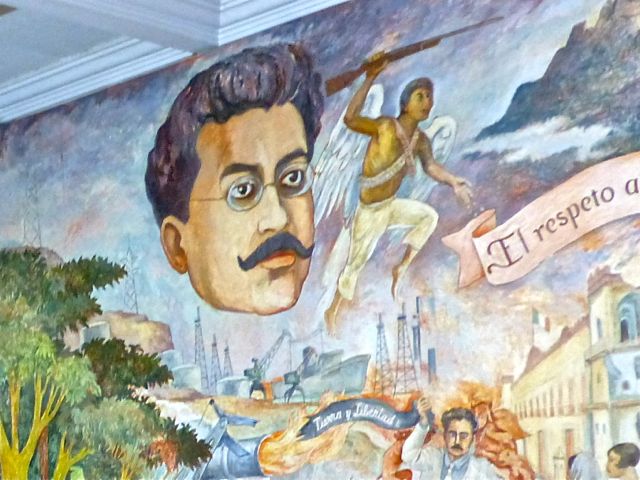
However, front and center is Oaxaca’s favorite son, Zapotec, former governor of Oaxaca, and Mexico’s much beloved five-term president, Benito Juárez. He and his Oaxaqueña wife, Margarita Maza, hover prominently above his Reform Movement cabinet. The full text of the ribbon is a quote by Juárez, “El respeto al derecho ajeno es la paz” (Respect for the rights of others is peace). It appears on the State of Oaxaca’s coat of arms.

Juárez is also pictured along with the cabinet and third from his right stands another Oaxaqueño, the young, menacing-looking, and far from beloved by the 99%, Porfirio Díaz, trademark epaulettes and all — a portend of things to come.

Following his death in 1872, the city and municipality of Oaxaca honored Benito Juárez by changing its name to Oaxaca de Juárez.
Posted in Creativity, Culture, People, Travel & Tourism, tagged entertainment, film, film festivals, Filmfest3, Matt Dunnerstick, Mexico, movies, Oaxaca, Oaxaca Film Festival, photographs, photos, popular travel destinations, Postmodern Times, Ramiz Adeeb Azar, The Game, Tilt on November 9, 2012| 2 Comments »
Still recovering from last week’s Día de los Muertos celebrations, another marathon of activities is upon us — last night the third Oaxaca FilmFest opened. With 10 days, 25 venues, 300 films, 5 days of academic programs, among many other events, I can see it’s going to be no rest for the weary!
So, with Golden Key passes (approx. US$11.50) hanging from our necks, last night my indomitable 86-year old neighbor and I walked down to the festival’s headquarters at Plaza San Jerónimo on the Alcalá for the opening night cocktail party. Gringos and international filmmakers mingled with a predominantly young and hip Oaxaqueño crowd. Needless to say, cervesas, mezcal, and horchata flowed freely, accompanied by yummy (though less plentiful) botanas.
We eventually wound our way over to Teatro Juárez to hear founder and artistic director, Ramiz Adeeb Azar, welcome an almost full house, open the festival, and introduce the three opening night films: shorts, Postmodern Times from Austria and The Game from Poland and feature length film, Tilt from Bulgaria and Germany. All three were gripping, thought provoking, and held the audience’s attention. (Chris, they all passed the Low Cough Principle test.) It was a good start!

Ramiz Adeeb Azar
During the course of the evening, we spoke with two American screenwriters, who each have scripts entered in a Script Competition, and American filmmaker Matt Dunnerstick, whose film, The Custom Mary, will be screened tonight and again later in the festival. It’s truly an international festival and (at least last night) all the films were subtitled in both Spanish and English, as is all the program material.
I can’t believe how much bigger and more professional this festival has gotten in only three years. I attended in 2010, the first year, and coming off eight years of volunteering at the Mill Valley Film Festival and attending for many more, I was underwhelmed and thus ignored last year’s Oaxaca FilmFest. All I can say is, you’ve come a long way, baby! I’m glad I’ve got my Golden Key pass and, like these folks, I will be intently studying my program booklet and scheduling grid.

I’ll see you at the movies!!!
Posted in Creativity, Culture, People, Textiles, Travel & Tourism, tagged Annie Waterman, Chiapas, Documenting the Lives of Textiles, HAND/EYE, indigenous peoples, indigenous textiles, Mexico, Oaxaca, popular travel destinations, Sheri Brautigam, textiles, traje on October 22, 2012| Leave a Comment »
For lovers of textiles and Mexico, the latest online issue of the magazine, HAND/EYE (love the title!), has a terrific interview with friend and textile designer/collector/researcher, Sheri Brautigam. The article, Documenting the Lives of Textiles, covers a wide range of topics, including preservation and revival of traditions and concerns re traditional versus modern designs. As would be expected, given the subject matter, it includes lots of photos!
BY Annie Waterman | October 10, 2012

Courtesy of Sheri Brautigam
An Interview with Sheri Brautigam
Textile expert, Sheri Brautigam, shares with HAND/EYE Online, her experience as a documenter of “living” indigenous textiles.
HAND/EYE: How did you first find yourself in Mexico and documenting “living” indigenous textiles?
Sheri Brautigam: I went to the university in Mexico City in the 60’s and that was the beginning of my lifelong relationship and many in-depth experiences with Mexico. This time, I was training Mexican English teachers through the English Language fellowship with the U.S. State Department—sort of like the English Teachers’ Peace Corps. My location was in a small town in the State of Mexico—Atlacomulco, surrounded by many different indigenous villages. When I went to a nearby village Mazahua ‘Saints Day’ festival and saw the amazing garments the ladies were wearing, I started my documentation.
H/E: How did you first get into becoming a researcher/ textile collector?
SB: I had a textiles design studio (surface design textiles) in San Francisco for about 18 years, so I had been collecting world textiles since the 1960s. That was when they were readily available from world travelers. I have loved and been involved with textiles most of my life and always want to know how these beautiful things are made … and now in Mexico, it’s even more exciting to see them in context.
H/E: What sort of future do you predict for the world of traditional textiles? What changes have you noticed over the years?
SB: I’m very hopeful that many traditional Mexican textiles will survive and become even finer. This I have seen in Oaxaca and Chiapas. When appreciation comes from the outside world and the artisans can earn money, they have an incentive to keep producing. The more money they can earn from superior work also encourages some artisans with higher skills to train their children. The more affluent indigenous people become, the more pride they have in their own culture and the continuation of their textile traditions.
Certainly some of the indigenous will leave their village and go to the towns and cities to work and wear jeans and t-shirts—but when they come home they will wear a huipil for the feast day. It’s their cultural identity.
Click HERE to read full article.
Posted in Buildings, History, Holidays, People, tagged El Grito, Grito de Dolores, José María Morelos y Pavón, Mexican Independence Day, Mexico, Municipal Building, Oaxaca, Plaza de la Danza on September 16, 2012| 1 Comment »
As I write, it is late on September 15, and all over Mexico El Grito de Dolores, also known as El Grito de la Independencia (the Shout of Independence), is echoing from government buildings throughout the country, from the Palacio Nacional in Mexico City to Oaxaca’s Palacio de Gobierno to ayuntamientos (city halls) in small towns.
Portraits of the above listed heroes of Mexico’s War of Independence from Spain hang from the Government Palace in Oaxaca, as well as from the Municipal Building facing the Plaza de la Danza.
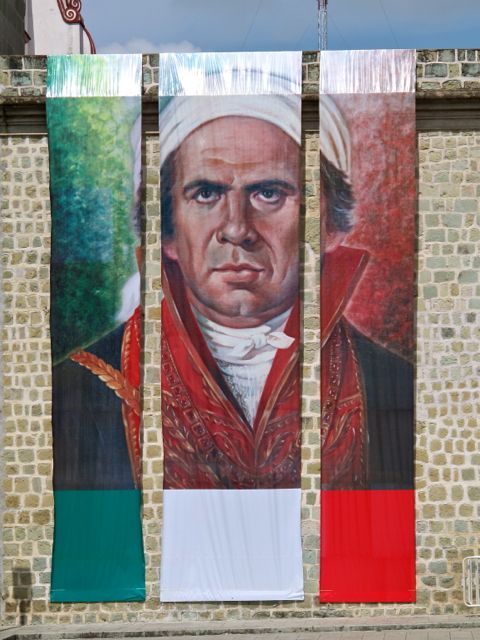
And, this year, José María Morelos y Pavón is honored with a second massive portrait on the outer wall of the Municipal Building. Last year, it was a reproduction of Orozco’s dramatic painting of Miguel Hidalgo y Costilla.
Posted in Books, People, Travel & Tourism, tagged book review, books, Charles Kerns, Mexico, Oaxaca, popular travel destinations, Santo Gordo: A Killing in Oaxaca on September 7, 2012| 4 Comments »
Several months ago, friend and longtime (35 years!) regular visitor to Oaxaca, Charles Kerns, asked me to write a review of his first work of fiction, Santo Gordo: A Killing in Oaxaca.

He sent it to me in June, when I was up in the San Francisco Bay Area, and it proved to be the perfect reading material for my SFO –> IAH –> OAX return trip. Once back, I mentioned Santo Gordo to friends, loaned it, got it back, only to loan it again. With Santo Gordo again in my hot little hands and after many months of delay, today I finally posted the following review on Amazon.com.
A botana of Oaxaca
Much as it has done to Charles Kerns, Oaxaca has captured my heart and three years ago I began living an expat life there. Thus, I can assure you reading Santo Gordo: A Killing in Oaxaca, will give you a botana (a small snack) of life in Oaxaca as seen and experienced by a gringo — well, not the witnessing an assassination part!
However, first time mystery writer Kerns does offer a glimpse at an underbelly few tourists are ever aware of and many expats choose to ignore – it’s history, complexity, and expression being too much to comprehend.
Kerns has crafted a mystery where place, in this case Oaxaca, is a leading character — much as Donna Leon, with her Commissario Brunetti mysteries, has done with Venice. Kerns has captured rhythms, rituals, sweetness, dangers (treacherous sidewalks, not murders, being at the top of the list), and bewildering aspects of life in Oaxaca, all the while telling a plausible tale with a very likable main character.
Now that the review has, at long last, been written, my copy of Santo Gordo: A Killing in Oaxaca, will be donated to the Oaxaca Lending Library — as I promised Chuck many months ago. Sorry I kept you waiting and ¡Feliz cumpleaños mi amigo!
(ps) Check out the San Jose Mercury News interview with Chuck, Alameda writer pens Oaxaca mystery.
Posted in History, Museums, People, Politics, Travel & Tourism, tagged Coyoacán, Esteban Volkov, Institute for the Right of Asylum and Public Liberties, Instituto del Derecho de Asilo y las Libertades Públicas, Leon Trotsky, Mexico, Mexico City, Museo Casa de Trotsky, museum, photographs, photos, popular travel destinations, travel, Trotsky Museum on August 20, 2012| 2 Comments »
I’ve been intending to post these photos for six months, but there has been so much going on in Oaxaca, I haven’t gotten around to it — until now. This morning’s Guardian article, Trotsky’s murder remembered by grandson, 72 years on, caught my eye and I thought, if not today, when? So, here goes…
When I was in Mexico City in January, I made somewhat of a pilgrimage out to the borough of Coyoacán. Besides a lovely stroll through the Viveros de Coyoacán, being dazzled by the light and color of the Museo Frida Kahlo, and enjoying a delicious comida on the Plaza Hidalgo, I spent an incredibly moving three hours at the Museo Casa de Trotsky, the home, and now museum, of Russian revolutionary leader Leon Trotsky and his wife Natalia Sedova. However, before getting to the photos, a very brief bit of context is necessary.
Hounded all over the world by Joseph Stalin and his agents, in 1937 Trotsky and Natalia Sedova were offered asylum by Mexican president Lázaro Cárdenas. Trotsky’s orphaned grandson, Esteban Volkov (Seva), joined them not long after. Seva narrowly escaped being murdered in his bed during the first attempt on Trotsky’s life in the Coyoacán house by Mexican muralist, David Alfaro Siqueiros. It was during this attack that Trotsky guard, Robert Sheldon Harte was killed.
The house at Avenida Viena 19 was further fortified, but Stalinist agent, Ramón Mercader, under an assumed name was able to infiltrate Trotsky’s inner circle and, on August 20, 1940, under the ruse of asking Trotsky to look at something he had written, attacked him with an ice axe. Trotsky died in hospital a little more than 24 hours later. His ashes and those of Natalia’s reside in the peaceful garden of the Coyoacán house in a monument, designed by Irish-Mexican painter and architect Juan O’Gorman, that proudly flies a red flag and features the overlapping hammer of the worker and the sickle of the peasant. The house and furnishings remain much as they were 72 years ago, bullet holes from the first attack and all.
The humanity expressed in the words below were felt as I wandered through the house and museum and I must admit, tears welled up as I stood before O’Gorman’s monument.
Trotsky’s Testament, dated 27 February 1940
My high (and still rising) blood pressure is deceiving those near me about my actual condition. I am active and able to work but the outcome is evidently near. These lines will be made public after my death.
I have no need to refute here once again the stupid and vile slanders of Stalin and his agents: there is not a single spot on my revolutionary honour. I have never entered, either directly or indirectly, into any behind-the-scenes agreements or even negotiations with the enemies of the working class. Thousands of Stalin’s opponents have fallen victims of similar false accusations. The new revolutionary generations will rehabilitate their political honour and deal with the Kremlin executioners according to their desserts.
I thank warmly the friends who remained loyal to me through the most difficult hours of my life. I do not name anyone in particular because I cannot name them all.
However, I consider myself justified in making an exception in the case of my companion, Natalia Ivanovna Sedova. In addition to the happiness of being a fighter for the cause of socialism, fate gave me the happiness of being her husband. During the almost forty years of our life together she remained an inexhaustible source of love, magnanimity, and tenderness. She underwent great sufferings, especially in the last period of our lives. But I find some comfort in the fact that she also knew days of happiness.
For forty-three years of my conscious life I have remained a revolutionist: for forty-two of them I have fought under the banner of Marxism. If I had to begin all over again I would of course try to avoid this or that mistake, but the main course of my life would remain unchanged. I shall die a proletarian revolutionary, a Marxist, a dialectical materialist, and, consequently, an irreconcilable atheist. My faith in the communist future of mankind is not less ardent, indeed it is firmer today, than it was in the days of my youth.
Natasha has just come up to the window from the courtyard and opened it wider so that the air may enter more freely into my room. I can see the bright green strip of grass beneath the wall, and the clear blue sky above the wall, and sunlight everywhere. Life is beautiful. Let the future generations cleanse it of all evil, oppression and violence, and enjoy it to the full.
For archives and bibliographies of Trotsky, the following two sites are about as comprehensive as one will find online:
Even if you are not interested in the politics, and especially if you are considering a visit to the museum, I highly recommend reading Barbara Kingsolver’s historical novel, The Lacuna, part of which takes place in Trotsky’s Mexican household and gives a flavor of life there.
By the way, the museum site (appropriately) houses the Instituto del Derecho de Asilo y las Libertades Públicas (Institute for the Right of Asylum and Public Liberties). I wonder, are they working overtime these days?
Posted in Culture, Parks & Plazas, People, Protests, tagged Bernardo Vásquez Sánchez, buskers, graffiti, Macedonio Alcalá, Mexico, Motley Crue, musicians, Oaxaca, photographs, photos, street musicians, U2 on August 20, 2012| 2 Comments »
A motley crew…

Are you, too?
They were playing Pink Floyd — “Another Brick in the Wall.”
The “writing on the wall” refers to the assassination in March 2012 of Bernardo Vásquez Sánchez, a Zapotec community activist who had spoken out against a Canadian owned gold mine in San José del Progreso, Oaxaca.
Posted in Creativity, Culture, Museums, People, Textiles, Travel & Tourism, tagged Carolyn Kallenborn, Mexico, Museo Textil de Oaxaca, Oaxaca, photographs, photos, popular travel destinations, Textile Museum of Oaxaca, textiles, travel on August 8, 2012| 3 Comments »
Even though the Guelaguetza is over, textiles continue to be on my mind — actually I can never get enough of them! So, a few days ago I walked down to the Museo Textil de Oaxaca to see the current exhibition, “Tormentos y Sueños” by Carolyn Kallenborn. While not a Oaxaqueña, the respect she has for and inspiration she draws from the weavers and textile traditions of Oaxaca are obvious.
Kallenborn explains, “The pieces in this exhibit speak to the beauty and interaction between opposites.” (my translation) The works are at once, complex and simple, using detail and negative space — much like storms and dreams. Photographing a whole piece proved too much for my novice skills, thus I hope close-ups of these four pieces will whet your appetite.


If you are, or will be, in Oaxaca, I encourage you to see the whole! The exhibit runs through November 9, 2012.
Posted in Buildings, Creativity, Culture, People, Travel & Tourism, tagged Centro Académico y Cultural San Pablo, Francisco Toledo, iron gates, Mexico, Oaxaca, photo, photographs, travel, video on July 17, 2012| 1 Comment »
Intricately designed and executed iron gates have been installed at either end of Antiguo Callejón de San Pablo, ushering visitors into the “Old meets new” grounds of the Centro Académico y Cultural San Pablo.
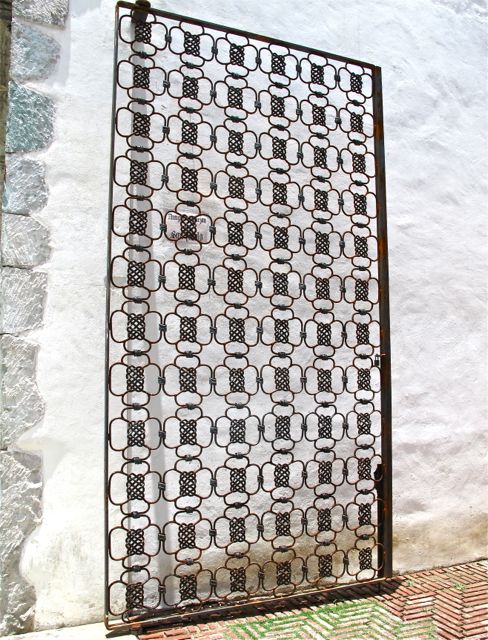
Oaxaca’s favorite son and Mexico’s foremost living artist, Francisco Toledo, narrates a video documenting the construction of the gates. It’s in Spanish, but even if you don’t understand the language, it’s worth watching, anyway.
By the way, today is Toledo’s 70th birthday. ¡Feliz cumpleaños, maestro!
Posted in Creativity, Culture, Exhibitions, Museums, People, Travel & Tourism, tagged Alejandro Santiago Ramírez, Alredo Canseco, Ariel Mendoza Baños, art, arts, exhibitions, Francisco Toledo, Jorge López García, Juan Alxázar Méndez, Justina Fuentes Zárate, Marimar Suárez Peñalva, Mexican consulate, mexican consulate in san francisco, Mexico, Oaxaca, Oaxacan surrealism hits the SF Mexican consulate, photographs, photos, Rubén Leyva, Rufino Tamayo, San Francisco, The Magic Surrealists of Oaxaca, travel on June 15, 2012| 2 Comments »
As hoped, I managed to make my way to the Mexican Consulate in San Francisco for The Magic Surrealists of Oaxaca. It’s the exhibit (I mentioned a few days ago) that celebrates the Zapotec artists of Oaxaca from Rufino Tamayo and Francisco Toledo to those they encouraged and influenced.
On the consulate’s ground floor the scene was a familiar one — signage and conversations en español; the eagle, serpent and green, white, and red of the Mexican flag prominently displayed; waiting room filled with patiently waiting people — a sliver of Mexico in San Francisco. Climbing the two flights of stairs (elevator was broken) up to the third floor, a friend and I found the exhibit…
According to the article, Oaxacan surrealism hits the SF Mexican consulate, the consulate’s cultural affairs attache, Marimar Suárez Peñalva, hopes the gallery and its exhibitions will offer Mexican expats an opportunity to connect with the creativity, not just the bureaucracy (my word), of their culture. However, I don’t know how many of those waiting on the first floor make it up to the third floor; early in the afternoon, we had the gallery to ourselves.
And yes, works by Tamayo and Toledo are included, but I thought I’d feature some of the lesser known artists. By the way, did you notice the name, Alejandro Santiago Ramírez? This is the same Alejandro Santiago of the 2501 Migrantes sculptures that I’ve previously written about.
Posted in Creativity, Exhibitions, Food, Museums, People, Travel & Tourism, tagged art, Doña Tomás, exhibitions, food, Francisco Toledo, Galería de la Raza, Mexico, Muxes, Oaxaca, restaurants, Rufino Tamayo, San Francisco, San Francisco Bay Area, Searching for Queertopia, The Magic Surrealists of Oaxaca, travel on June 13, 2012| 4 Comments »
I’m again in the San Francisco Bay Area, visiting family and friends and taking care of the odds and ends of still maintaining a presence here, while living in Oaxaca. We’ve had clear blue skies and sun and, except for the high-speed pace and exorbitant price of food, it “almost” feels like home. Hey, I even bought some resin chairs for my son’s backyard and ate some of the best Mexican food ever (in the USA) at Doña Tomás in Oakland. (FYI: The Callos con Sopa de Elote — puréed corn soup with seared day boat scallops and fingerling potatoes, roasted poblano chiles and cilantro, served with arroz achiote — was divine.)
To also keep from getting too homesick for Oaxaca, there are a currently a couple of exhibits in San Francisco I plan to see while here. I found out about The Magic Surrealists of Oaxaca, Mexico from the Oaxacan surrealism hits the SF Mexican consulate article in the SFBG, which explains…
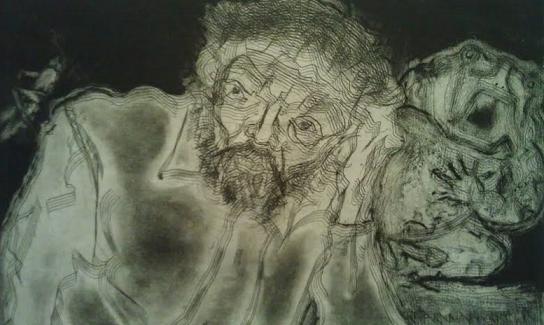
Francisco Toledo’s aquatint etching “Self Portrait”
The Zapotec identity … is one of the unifiers of the exhibit, which contains the works of not only [Rufino] Tamayo and [Francisco] Toledo but also artists who were inspired by their work like Justina Fuentes Zárate, she of the reclining mermaid and arresting red dress. Perhaps the works don’t look similar, but they represent the diversity and breadth of the work to come out of the surrealist Zapotec tradition in Oaxaca.
And, then I read the NPR story, In Mexico, Mixed Genders And ‘Muxes’, about a Galería de la Raza exhibit.

Photo from the exhibit
Searching for Queertopia revisits the experiences of Alexander Hernandez’s participation and Neil Rivas’ visual documentation of what is called, the Vela de ‘Las Intrépidas.’ This event, a 3-day celebration, is held annually in the town of Juchitán de Zaragoza, Oaxaca, México, in honor of its Muxe community.
Hmmm… maybe I’ll take the ferry over to “The City” tomorrow.
Posted in People, Politics, Protests, tagged Andrés Manuel López Obrador, campaign, elections, Enrique Peña Nieto, Gabriel Quadri de la Torre, I Am 132, Josefina Vázquez Mota, Mexican Spring, Mexico, Oaxaca, presidential election, student movement, student protest, Yo Soy 132 on May 30, 2012| 6 Comments »
Felipe Calderón’s 6-year term as president of Mexico is coming to a close and running for a second term is prohibited. Campaigning is limited to the 3-month period immediately prior to the upcoming July 1 election day. (USA, doesn’t that sound great?!!) It had a boring “business as usual” beginning. However, the new student-led, “Yo Soy 132” movement has livened things up beyond all expectations. It is already being likened to the Occupy Wall Street movement and the early days of the “Arab Spring” uprisings.
First, the cast of presidential candidates:
Next, what’s it all about?
Marta Molina
Waging Nonviolence / News Report
Published: Tuesday 29 May 2012
“They are party-less but not apolitical. The supposed apathy and individualism by which the Mexican youth have been characterized has been disproved on the streets and on the web.”
In Mexico City’s daily life — in the shops, taxicabs, cafes and lines waiting for the bus — one could hear conversations between people of all ages saying Enrique Peña Nieto would, without a doubt, win the presidential elections. “Either something huge will happen,” a taxi driver told me, “or he will win.” And when people referred to “something huge happening,” they were referring to violence, or some unbearable crisis.
But it hasn’t happened like that. Far from anything originally expected, it is the Mexican youth and university students who are doing “something huge.” They have altered the political agenda in the country to prove that no one wins an election until the election itself.
The gathering began on May 23 at the Estela de Luz, or Pillar of Light — a monument that has caused much controversy due to the billions of pesos the government invested in its construction. The students appropriated this symbol of corruption to illuminate it with their democratic demands in a key pre-electoral moment.
… In the end, twenty thousand students from different universities, public and private, marched for four hours along the main avenues of Mexico City. The protests that followed have sparked talk of a “Mexican Spring,” making reference to the uprisings that began in North Africa at the end of 2010. [Full article]
###

A university student holds the Mexican flag during a protest against Enrique Peña Nieto, presidential candidate of the opposition Institutional Revolutionary Party (PRI), and to demand balance in the media coverage of the presidential race in Mexico City May 28, 2012. The “YoSoy132” movement was organized by students to create awareness of Mexico’s current political situation and media censorship, local media reported. Reuters/Edgard Garrido
A coalition of thousands of mainly university students, unionized workers, and farmers in Mexico City have taken to the streets to demand greater freedom of speech and also to protest the possible return of power by the Institutional Revolutionary Party (PRI).
One banner read, “I have a brain, I won’t vote for the PRI.”
<snip>
Dubbed the “Yo Soy 132” movement (Twitter users can follow protest updates by searching #YoSoy132), or the “Mexican Spring” by observers, this latest wave of protests marks the third large student demonstration in less than a week.
The name “I Am 132” symbolizes the continuation of the original demonstration by 131 students during Peña Nieto’s visit to the Jesuit-run Ibero-American University (UIA).
“Our main goal is to seek greater democracy within Mexican media,” said fellow activist, Rodrigo Serrano.
The name, “YoSoy132” alludes to a group of students from the Universidad Iberamericana, who heckled PRI presidential candidate Enrique Peña Nieto during a recent visit to the university that chased him off the premises.
After the incident, PRI leaders accused the Iberoamericana students of being intolerant, inconsiderate “stooges” paid to protest against Peña Nieto by the leftist PRD party.
Students claim their heckling of Peña Nieto was a grassroots event, uninspired or funded by any political party.
In particular, students have expressed frustration with the “monopolization” of Mexican politics and media. The example New America Media provides is a company named Televisa, which along with TV Azteca, controls 95 percent of Mexico’s TV market.
Similarly, students believe PRI has a monopoly of sorts on Mexican politics. The party has ruled Mexico unchallenged for seven decades, and has a very good shot of winning the July 1 elections. [Full article with video]
###
And, lastly (for now)…
On May 26, the students of Oaxaca met in the courtyard of Santo Domingo de Guzmán to join the national effort, forming Yo Soy 132 Oaxaca. 
And, of course, a Facebook page has been set up. This is getting interesting. Vamos a ver…





 Mexican Peso Converter
 View From Casita Colibrí