Feeds:
Posts
Comments

Archive for the ‘Holidays’ Category

Day of the Dead altars and their offerings to the departed vary from region to region and, within those regions, from family to family. Ofrendas (offerings) are an integral part of Día de Muertos. They are a beacon to the departed, an ephemeral work of art, and the sum of their lovingly chosen parts. As you can see from the photos below from several in Barrio de Jalatlaco, even on public display, they are intensely personal and creative.

Galería Shadai – Flowers, papel picado, candles, incense, pan de muertos, fruit, nuts, a casserole, and beverages.

And, there is a catrina tapete de arena (sand carpet) made of sand, beans, and flowers.
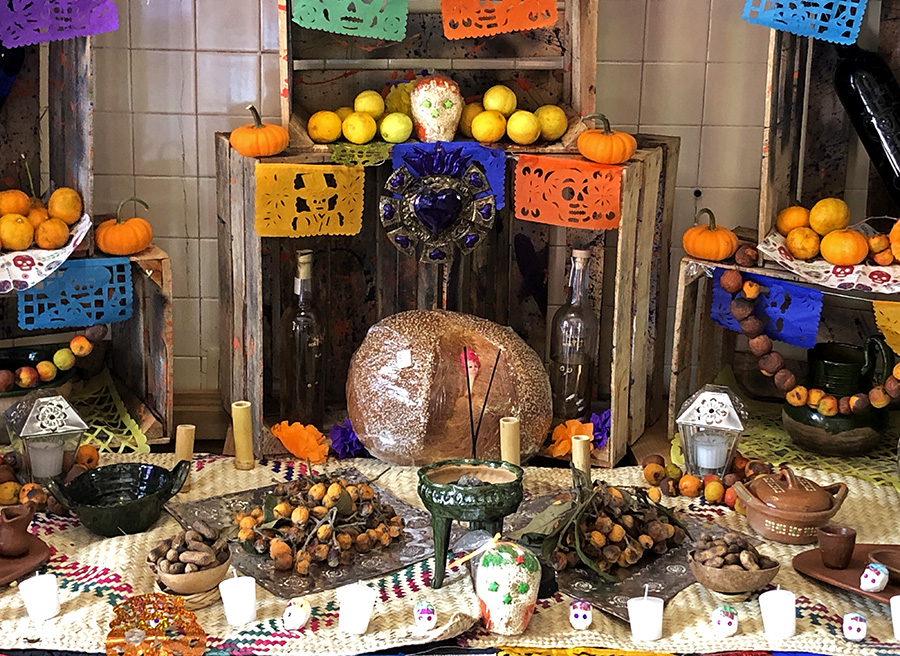
However, the only photo is of Maestro Francisco Toledo placed on a side pedestal.

Los Pilares Hotel and Restaurant – Flowers, papel picado, catrinas and catrins, candles, fruit, pan de muertos, and beverages.

And, there is a beautiful floral arch.
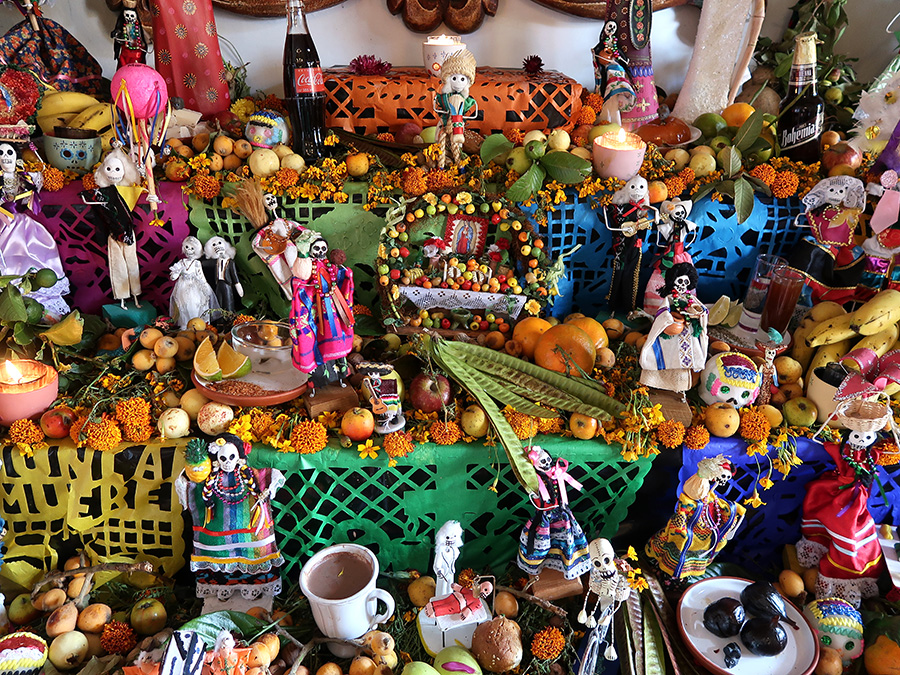
No photos of loved ones, but it’s a love story to the state of Oaxaca.

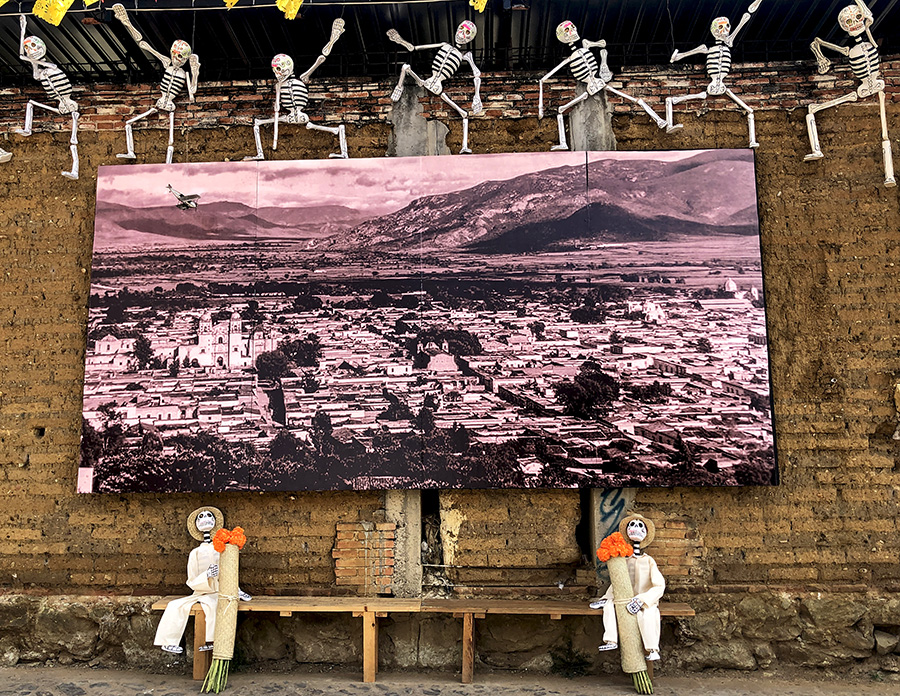
Family ofrenda – 5 de mayo at the corner of La Alianza. Family photos of the departed take center stage with papel picado, cempasúchitl (marigolds), and skeletons playing supporting roles.
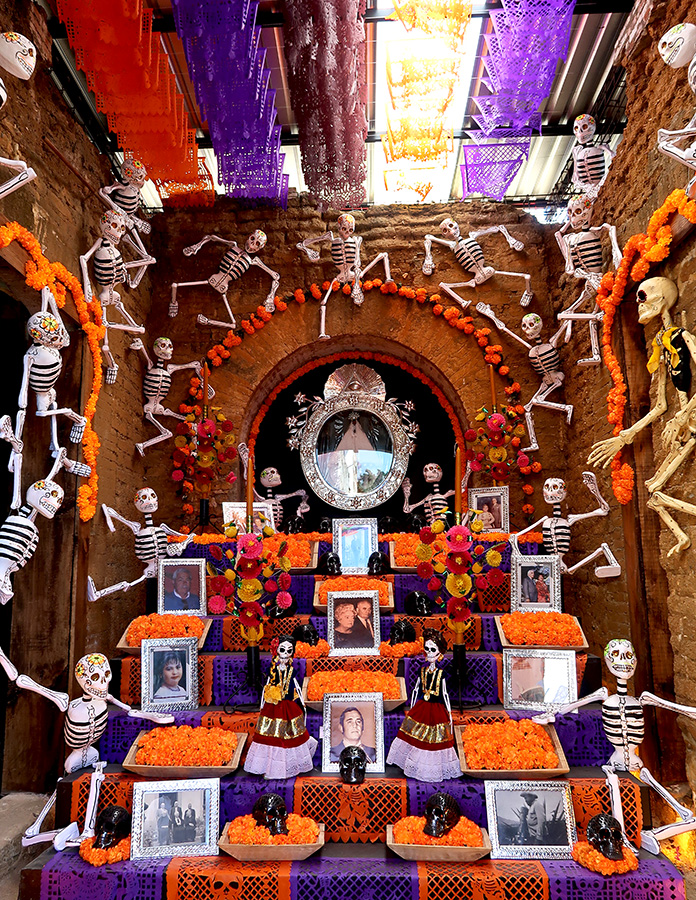
Then there are those magnificent floral candles like one sees in Teotitlán del Valle.

And, lest the departed can’t find their way home in the greatly expanded city, an old photo and skeletons await outside the altar alcove to show the way.
Last but not least, my altar and offerings. It was a creative challenge to set up in the new Casita Colibrí.

It’s smaller than previous years, but I have figured out a way to make it bigger and better next year.
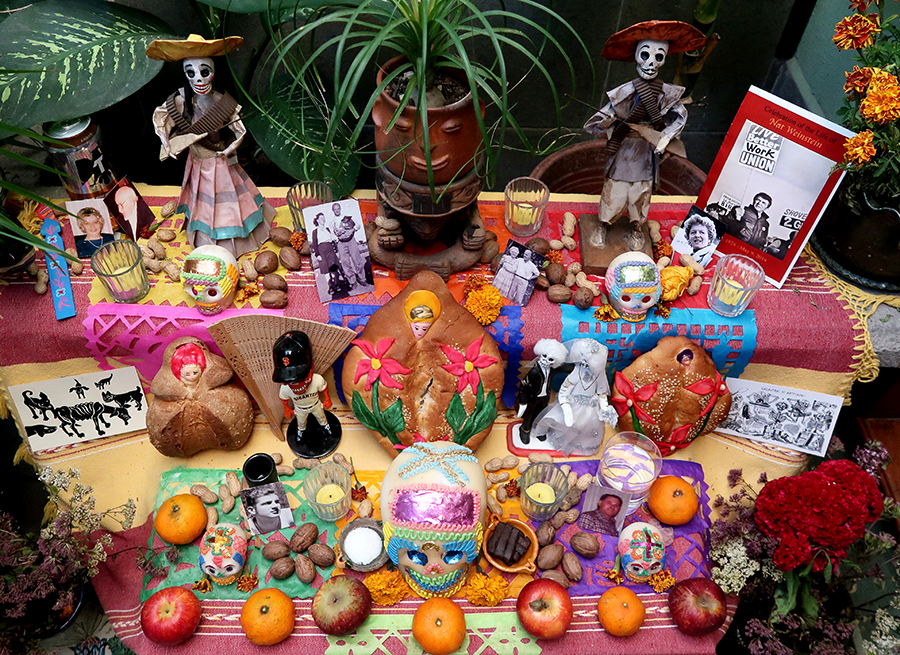
A yellow (color of death in pre-hispanic southern Mexico) tablecloth; papel picado (cut tissue paper) signifying the union between life and death; cempasúchitl (marigolds) and flor de muerto from the Sierra Norte, their scent to guide the spirits; and cresta de gallo (cockscomb) to symbolize mourning. There is salt to make sure the souls stay pure and chocolate, peanuts, pecans, apples, mandarin oranges, and pan de muertos (Day of the Dead bread) to nourish them. The sweet smell of copal incense and its smoke help guide my loved ones to the fiesta I have prepared for them. There is water to quench their thirst, as they travel between worlds, not to mention mezcal and cervesa (beer). And, there are the tangible remembrances of my departed — photos and some of their favorite things.

With candles lit and incense burning, I’m loving it and hoping my very dearly departed will find it warm, nourishing, and welcoming.

Read Full Post »

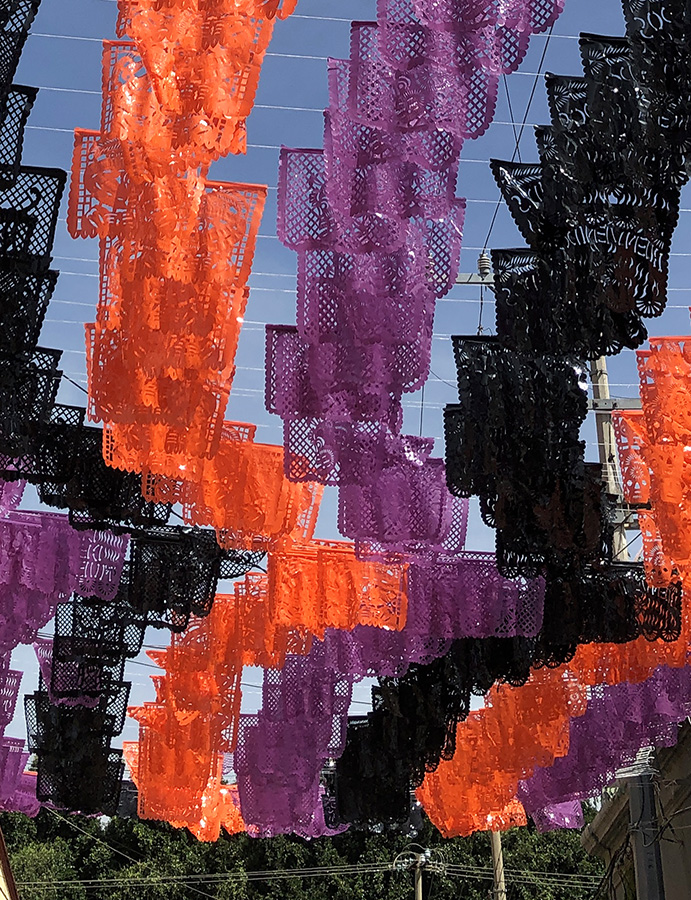
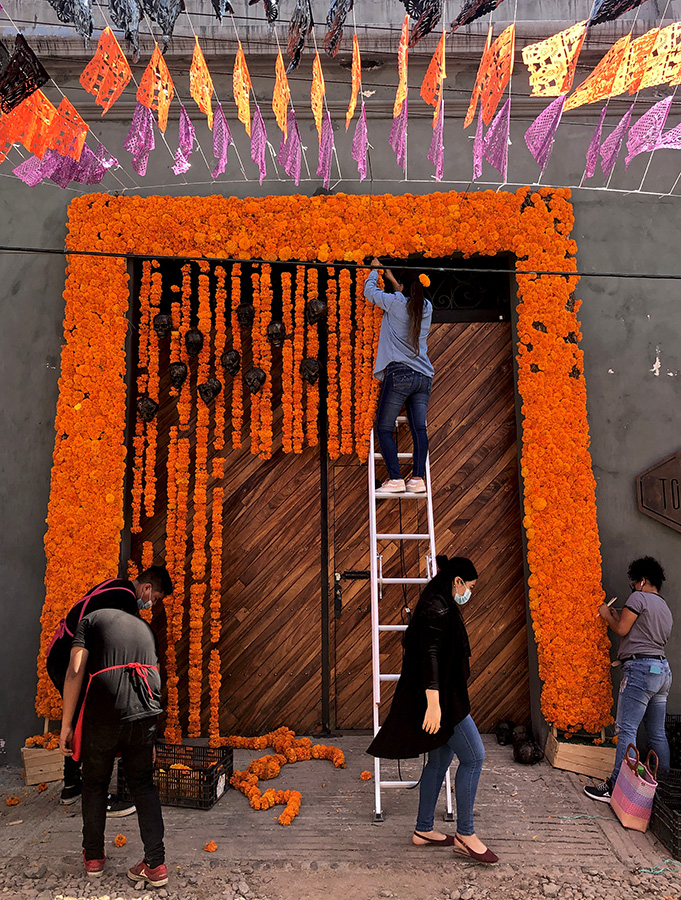
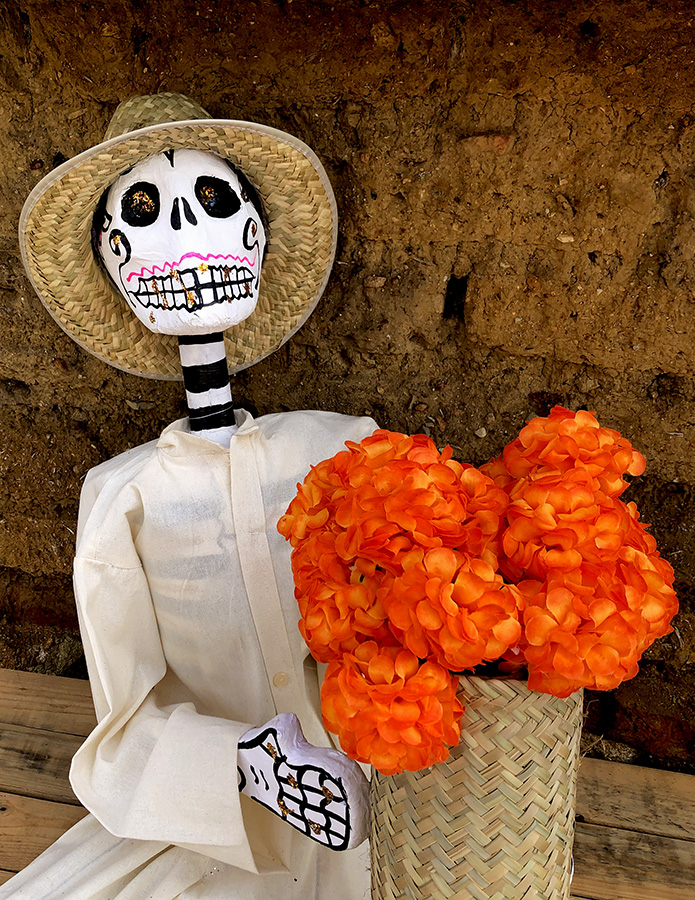
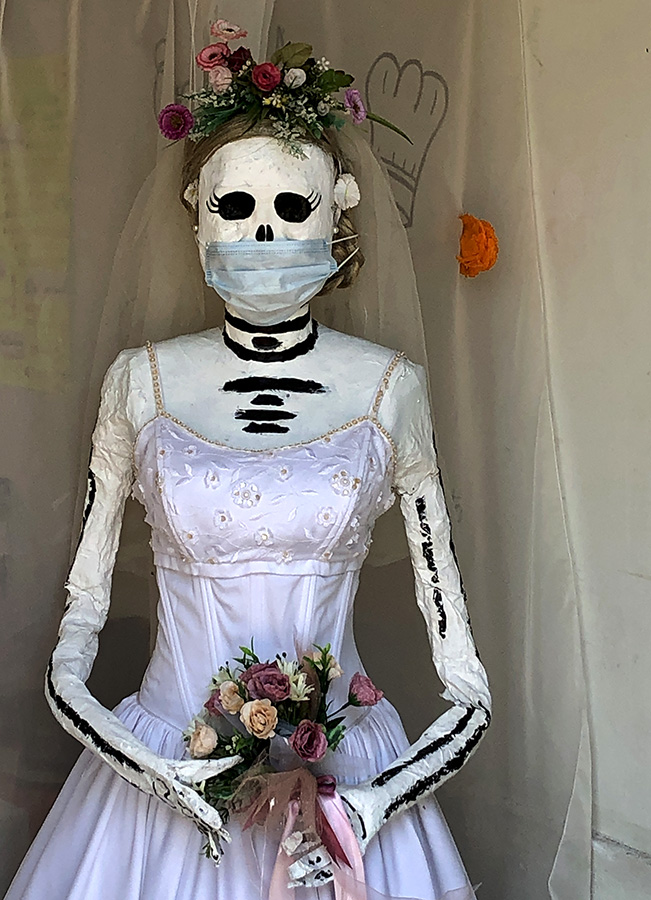
My new neighborhood, Barrio de Jalatlaco, has a long history — one that predates the arrival of the Spanish. Community spirit and traditions are strong, including making her departed feel welcome during Día de Muertos. Thus the bright orange and spicy scent of the flor de muerto, cempasúchitl (flower of the dead, marigolds) are everywhere.

Papel picado, in seasonal colors, ripple above the streets and cast fluttering shadows.

Floral arches welcome the living and the departed.

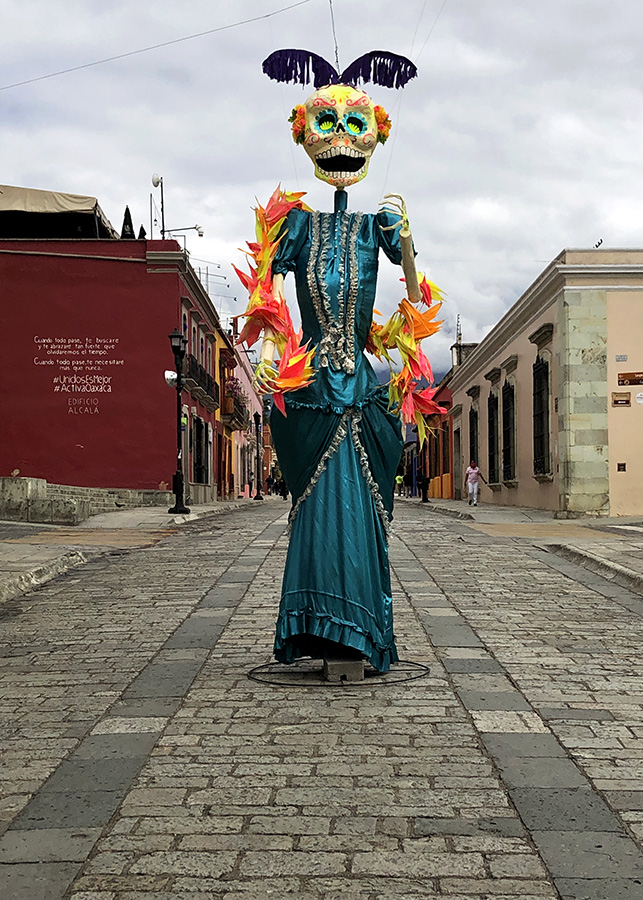
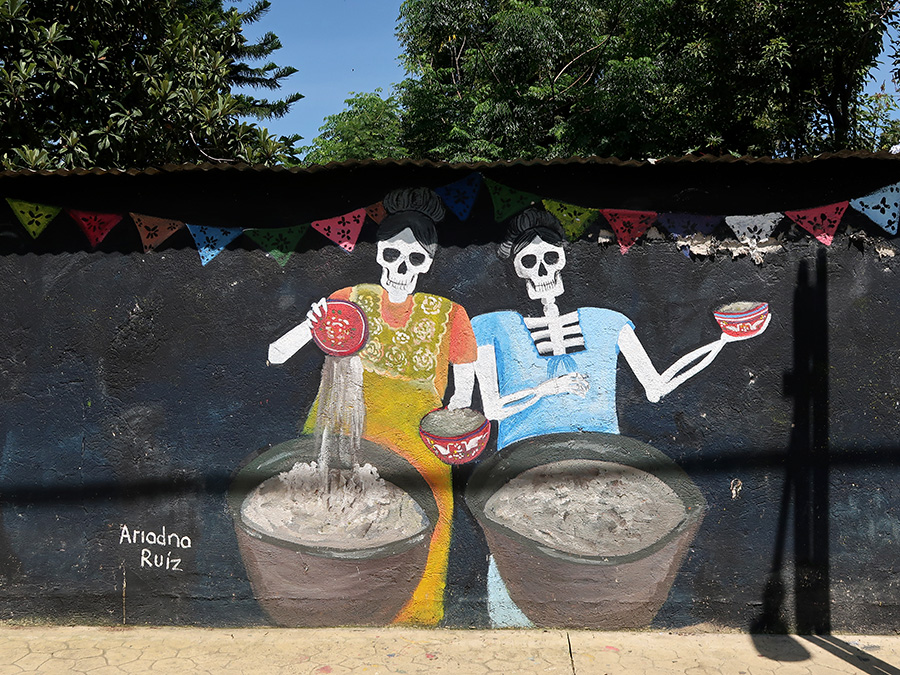
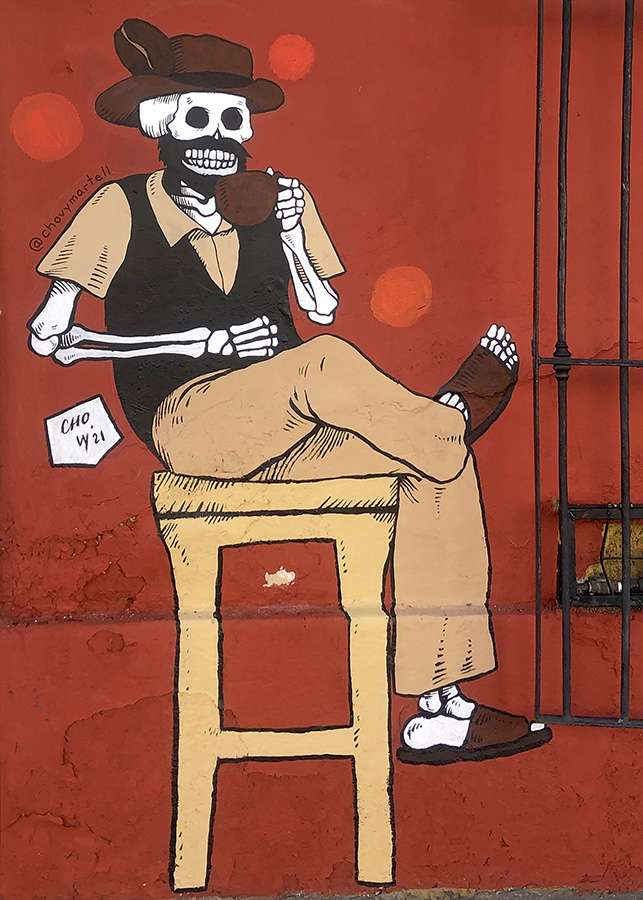
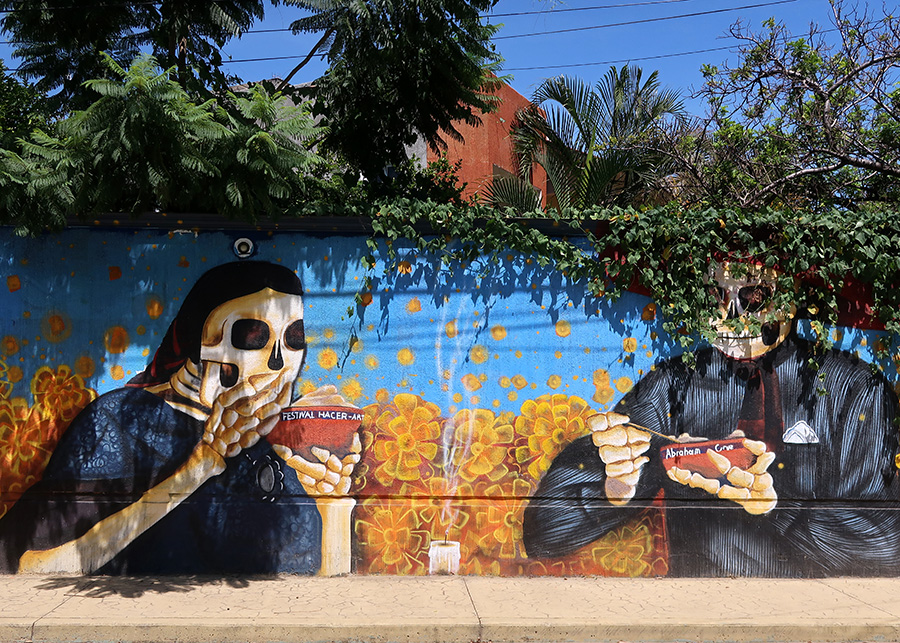
And skeletons are seen hanging out in doorways, windows, and sidewalks.

Tomorrow, altars and their offerings.

Read Full Post »

Oaxaca is getting ready for the annual arrival of her difuntos (souls of the dead), so a pause in the Day in the country posts is in order. Blue sky or grey, ran or shine, and village or city, they come…

Oaxaca City
Villa de Zaachila
Villa de Zaachila

They come to eat and drink…

Villa de Zaachila
Oaxaca City
Villa de Zaachila

They come to sing and dance, contemplate life and death, and be with loved ones.

Villa de Zaachila
Villa de Zaachila
Oaxaca City

Our hearts are filled with joy to welcome them to the fiesta we have lovingly prepared in their honor.

Read Full Post »

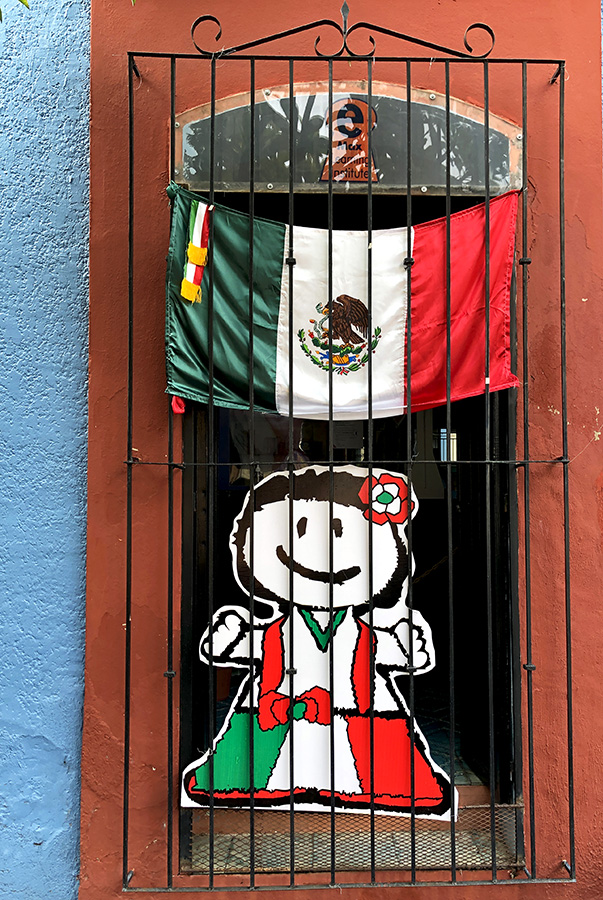
Decorations in green, white, and red began going up the first of September.

Papel picado flying above calle Ignacio Aldama in Barrio de Jalatlaco.

No, it’s not beginning to look a lot like Christmas.

Window of a school in Barrio de Jalatlaco.

The entire month of September is designated the Mes de la Patria — a month celebrating Mexico’s independence from Spain — a war which began on September 16 1810 and finally ended 200 years ago on September 27, 1821.

Mexican flag flying in the yard of one of my neighbors in Barrio de Jalatlaco.

Read Full Post »

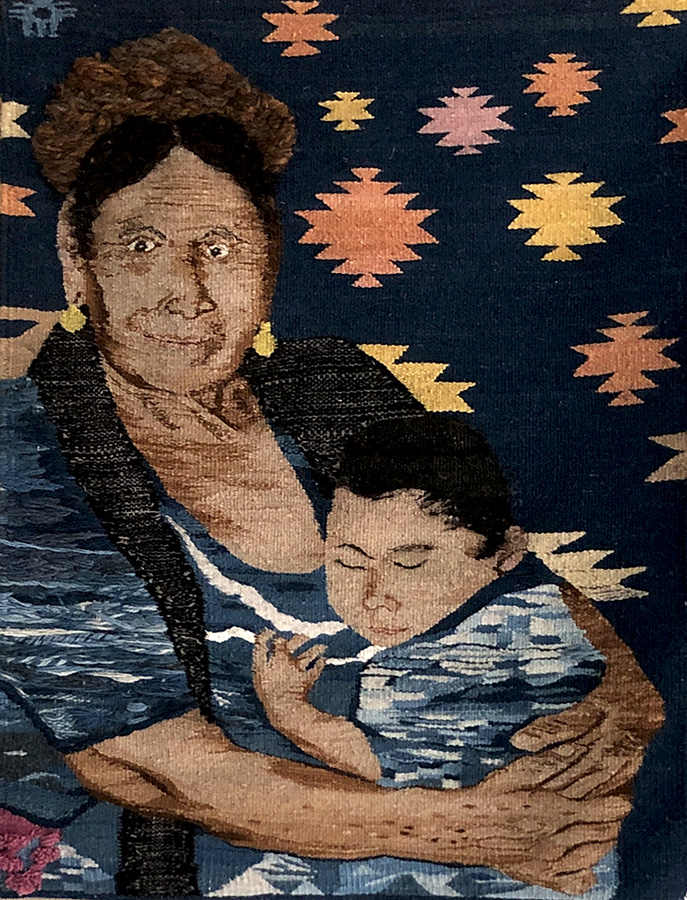
Happy Mother’s Day to all the mothers and mother figures out there!

“Mi Segunda Madre” woven by Mario González Pérez using wool dyed with natural dyes.

The above wall hanging (photographed in February 2021) was part of the art exhibition, “Sangre y Herencia” (Blood and Heritage) at Hotel CasAntica. By the way, Día de las Madres is celebrated in Mexico on May 10.

Read Full Post »

On this second Día del Trabajo during the pandemic, let us recognize and give thanks to the workers of Oaxaca and the world who continue to keep the wheels turning.
Repairing the bell tower of Templo de San José.
Digging out the roots of a fallen Indian Laurel tree on the zócalo.
Preparing to sweep the sidewalk in Barrio de Jalatlaco.

Happy International Workers’ Day!

Read Full Post »

Easter Sunday, Peter Cottontail, with a little help from his friends, hippity hopped his way to Casita Colibrí, bringing platters full of Easter joy.

Easter eggs dyed with hibiscus, chili, turmeric, and beets with designs imprinted by cilantro, parsley, epazote and bougainvillea.
Marinated and roasted pork shoulder with organic baby carrots, potatoes, and shallots from the Sierra Norte.
Peter Cottontail’s favorite salad of radishes, cucumber, bell peppers, onions, and lettuce.
Choux pastry filled with creamy coffee with caramelized peanut cream.

A muchisimas gracias to my many-times-mentioned friend, neighbor, and talented cocinera, Kalisa, who dyed the eggs and prepared all but the dessert. The latter yummy decadent delight was purchased from Masea Trigo y Maíz. To quote another rabbit, “That’s all folks!”

(ps) My alebrije rabbit is by Bertha Cruz from San Antonio Arrazola, Oaxaca.

Read Full Post »

Alas, another silent Viernes Santo in Oaxaca due to the pandemic. No early morning processions from churches throughout the city converging in front of the Cathedral to reenact the encuentro where Jesús meets María going towards Calvary. No worshipers praying and reciting appropriate devotions as they moved from one sidewalk Estación de la Cruz (Station of the Cross) to another. And, no rhythmic beat of a tambor, high-pitched tones of a chirimía, and the sputtering sounds of rachets punctuating the hush of the crowds gathered along the route for the early evening Procesión del Silencio (Procession of Silence).

Only silent sacred vignettes accompanied yesterday morning’s Good Friday walk through Barrio de Jalatlaco…

Unlike last year when church doors remained closed and services were broadcast remotely, the Archbishop announced that this year the churches will be open for liturgical acts on Palm Sunday, Holy Thursday, Good Friday and Holy Saturday, albeit with a “limited presence of the faithful.”

Read Full Post »

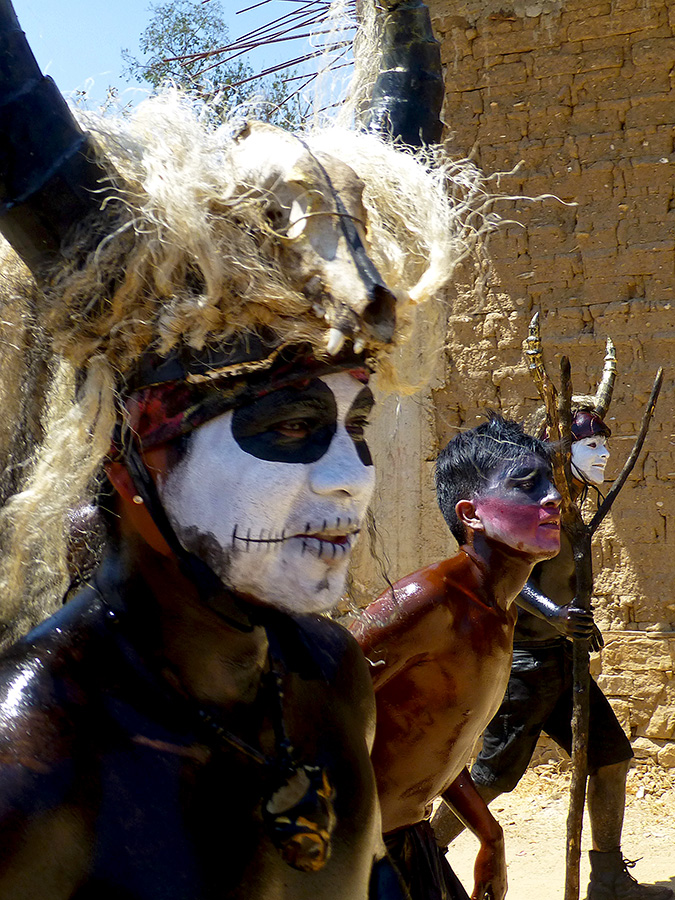
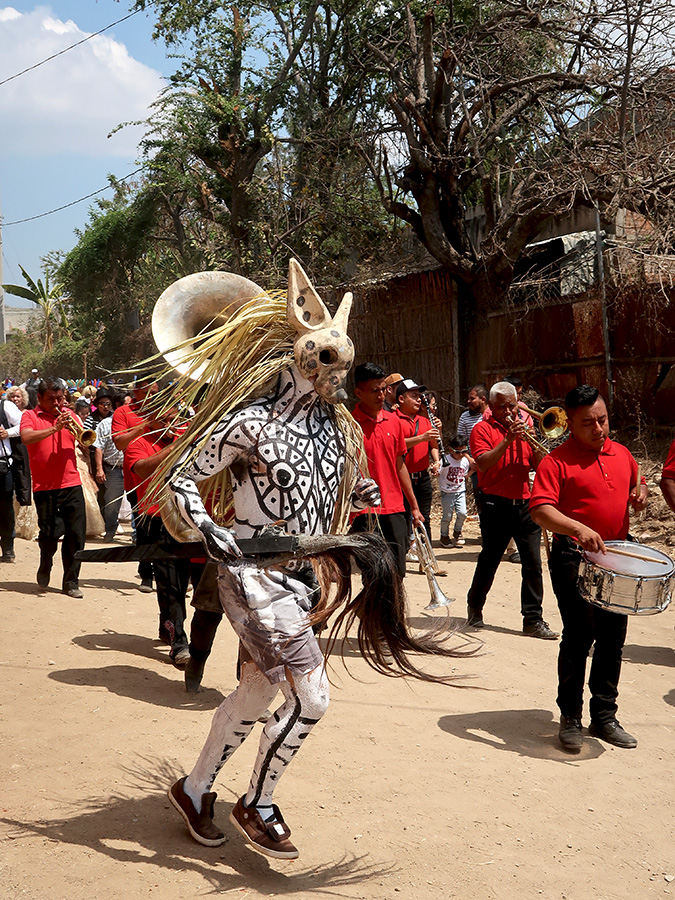
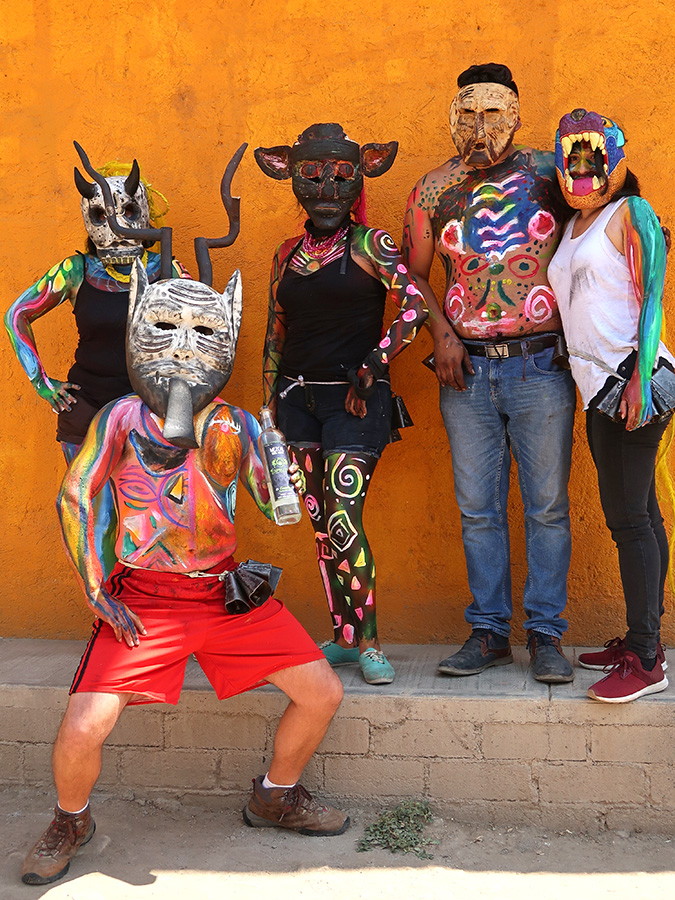
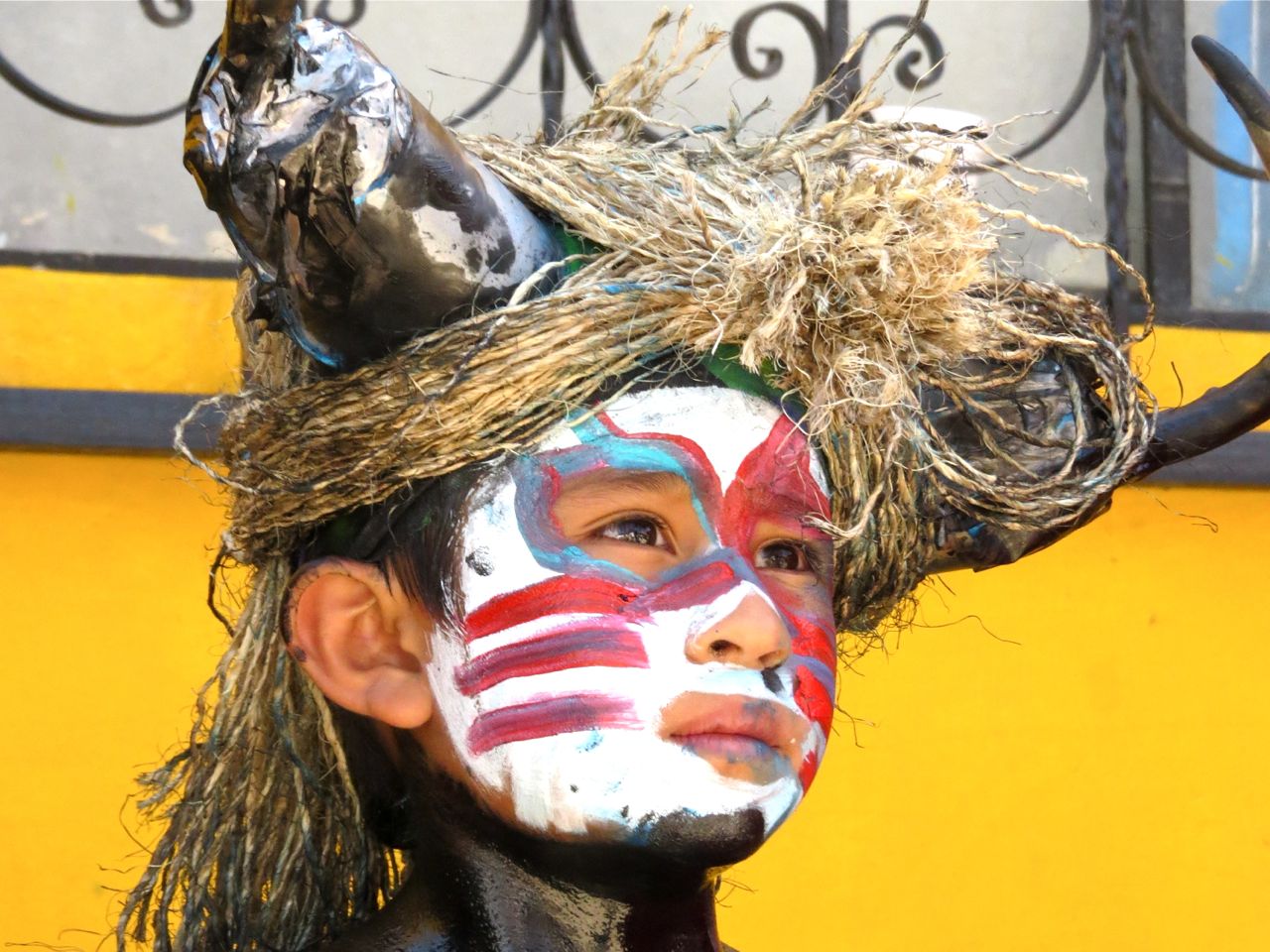
If all was right with the world, on this Día de Carnaval (aka, Carnival, Fat Tuesday, Mardi Gras, Shrove Tuesday), the day before Christians celebrate the beginning of Lent, I would be in San Martín Tilcajete — where the streets would be alive with the sound of bells, as los encabezados (guys covered in motor oil or paint and wearing cowbells tied around their waist) roam the streets startling the unaware, making mischief, and welcoming all to the festivities.

2014

2015

This predominately Zapotec village has seized on the holiday, brought to Mexico by Spanish Catholicism, to create elaborate masks to showcase its woodcarving skills. It is no coincidence that Carnival conveniently coincided with indigenous festivals celebrating the “lost days” of the Mesoamerican calendar, “when faces were covered to repel or confuse evil.” It is also no surprise that it caught on, “because it was one time when normal rules could be broken especially with the use of masks to hide identities from the authorities” — and make fun of them.

2016

2017

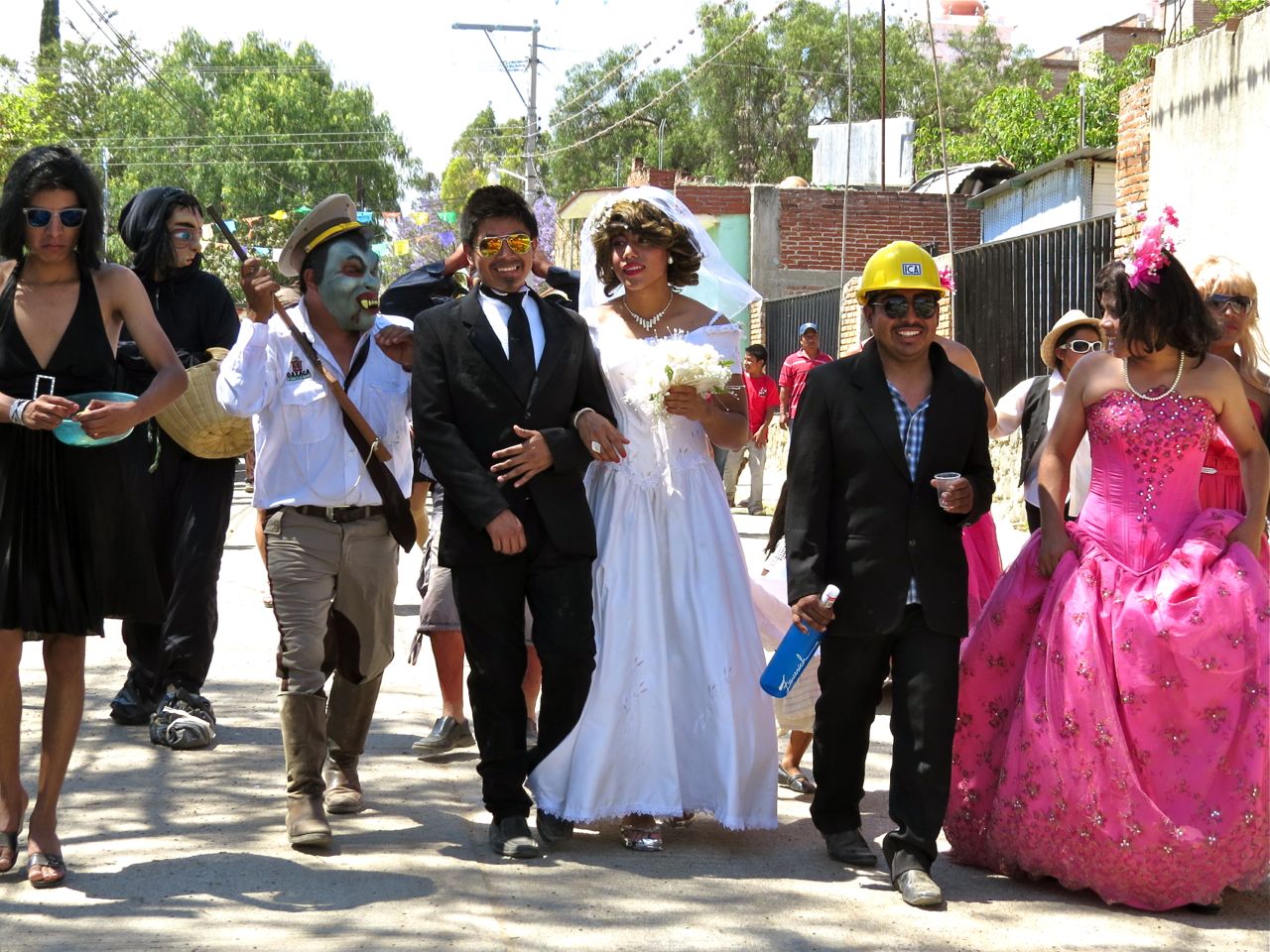
The festivities revolve around a mock wedding — a parody of a traditional village wedding. It includes much pomp and circumstance, hilarity, music, food, and fireworks. Young and old move from the houses of the principal players to City Hall for the “civil ceremony,” dancing in the plaza, followed by another procession through the streets to another house where the happy “couple” kneel before a “priest” for the religious ceremony. You might want to take a second look at those beautiful wedding guests with the smoldering eyes and modeling the gorgeous gowns.  They are not what they seem — and neither is the bride.
2018

2019

2020

San Martín Tilcajete isn’t the only village in Oaxaca that celebrates Carnaval in its own wild and wacky way. Beginning in 2019, in an effort to promote tourism to other villages, residents and visitors in Oaxaca city have been treated to a boisterous parade down the Macedonio Alcalá on the Saturday preceding Fat Tuesday sampling the pre-Lenten traditions from various parts of the state. Though festivities were canceled due to Covid-19, the city’s tourism department put together a video of celebrations from past years by several villages.

Read Full Post »

February 14th isn’t just a day for lovers. In Mexico, Valentine’s Day is known as the Día del Amor y la Amistad — Day of Love and Friendship.

By the artist known as ARCH

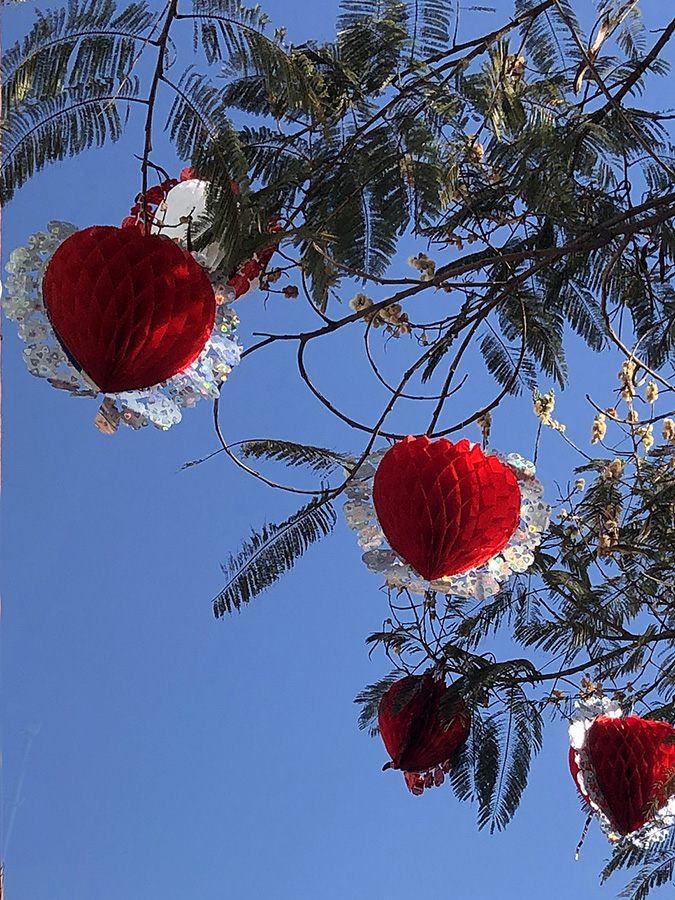
Decorations have gone up and I have no doubt kilos of chocolate, bouquets of flowers, and heart shaped balloons with confessions of amor will be purchased.

Unfortunately, with the virus continuing to rapidly spread and Oaxaca still under semáforo naranja/orange traffic light (though many think it should be rojo/red), I’m not sure restaurants will or should be filled to capacity with friends, sweethearts, and families.

By the artist known as Efedefroy

Given the trauma and uncertainty the world has experienced over the past year, I hope we have learned to cherish our friends and family and to let them know how much they mean to us every day. Let us celebrate days of love and friendship and not just limit it to one day a year.

And, if you would like to say I love you (te amo) in 7 of the 69 indigenous languages spoken in Mexico — including several spoken in the state of Oaxaca — click HERE.

Read Full Post »

Today, besides being Groundhog Day, it is the Christian holy day, Día de la Candelaria (aka, Candlemas, Presentation of Jesus at/in the Temple, and Feast of the Purification of the Virgin). In Mexico, tradition calls for families to bring their Niño Dios (baby Jesus), decked out in new clothes, to the church to be blessed. Alas, in the time of Covid-19, the Servicios de Salud de Oaxaca (health department) has called upon Oaxaqueños not to gather this year and, while the doors of the Cathedral will be open, the faithful are asked to stay home if their Niño Dios was blessed in previous years.

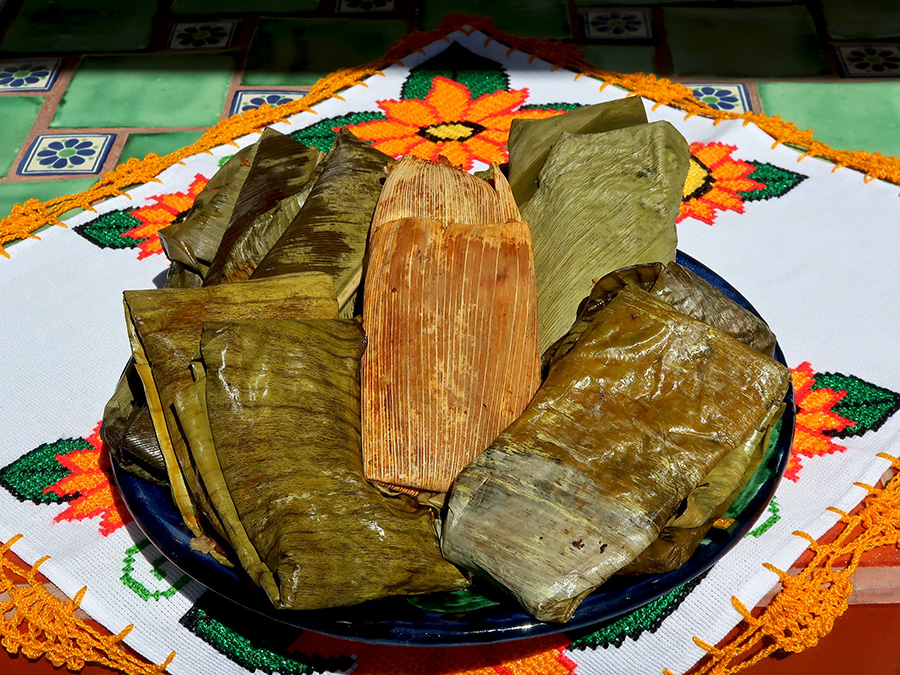
Tamales from Levadura de Olla Restaurante: Tamal Adobo, Tamal Chile Ajo, Tamal Mole Negro, Chancleta Guajolote, and Tamal de Fiesta (not in order)

Custom also calls for the person who bit into the baby Jesus figurine hidden in the Rosca de Reyes (3 Kings Cake) during Día de los Reyes Magos to host a tamalada on Candelaria. As I write, tamales are steaming all over the state. The virus will not stop the cocineras of Oaxaca from rising before the crack of dawn to make and serve tamales. As I previously mentioned, I munched down on a figurine. And I wasn’t the only one — my neighbor and friend Kalisa also had the “pleasure.” I must confess, we took the easy way out and pre-ordered our tamales from Levadura de Olla Restaurante. I can’t wait to eat them!

Read Full Post »

Feliz Día de los Reyes Magos / Happy Three Kings day! Today is the day Gaspar, Melchor, and Baltazar bring gifts to the children of Mexico. In normal, non Covid-19 times, the municipal DIF (Desarrollo Integral de la Familia) agency and private organizations sponsored a toy drive. Toys filled the Alameda to be given to the city’s disadvantaged children, along with milk and juice. Crafts, games, and music were set up to entertain. I haven’t seen or heard of any evidence it is happening this year. Let’s hope these children have not been forgotten.

In addition to kings bringing kids gifts, January 6 also calls for a special cake — the wreath shaped Rosca de Reyes (Three Kings bread). This morning, I walked up to Pan con Madre bakery to buy mine to share with apartment staff and friends.

And, surprise, there is a plastic Niño Dios figurine hidden in each Rosca de Reyes, remembering Mary and Joseph concealing baby Jesus from King Herod. If you are the “lucky” person to bite into it, you must host a tamales and atole party on February 2 — Candelaria (Candlemas).

Guess who the lucky person was? Yes, it was me!

Read Full Post »

Kalisa, my many times mentioned friend, neighbor, and cook extraordinaire, outdid herself in December.

December 4, 2020 – Chicken cutlets
December 12, 2020 – Honoring Hanukkah with sweet and savory latkes and rugelach
December 24, 2020 – Shrimp fettuccine on Christmas Eve
December 25, 2020 – Socially distanced Christmas dining on the terrace
December 25, 2020 – Pork loin for Christmas dinner
December 25, 2020 – Glazed carrots with mint
December 25, 2020 – Polenta
December 25, 2020 – My contribution of a garden greens salad
December 25, 2020 – The piece de resistance, Kalisa’s poached pear and frangipane tart
December 31, 2020 – New Year’s Eve dinner of paella with shrimp, chicken, sausage, asparagus, and fresh peas

It was a challenging but definitely delicious year!

Read Full Post »

Hindsight is the ability to understand, after something has happened, why or how it was done and how it might have been done better.

2020 was a year that most of us would like to forget but that will probably remain vividly etched in our memory banks for the rest of our lives. It was a year our worlds became smaller and forced us to see what was before us. It was a year that we will continue to examine and try to understand. It was a year that has important lessons to teach about who we are individually and collectively.

January 2020 – Visiting very dear friends and getting my Pacific Ocean fix at Avila Beach, California.
February 2020 – New resident in Casita Colibrí’s garden, an Argiope spider.
March 2020 – One of the last calendas of the year, graduation of public accountants.
April 2020 – Morning visitors at Casita Colibrí.
May 2020 – Sunday morning walk past the Xochimilco Aqueduct Arches.
June 2020 – Morning view from Casita Colibrí of Templo de San Felipe Neri.
July 2020 – Balcony garden of greens at Casita Colibrí.
August 2020 – Rainy season morning view of Basilica of Nuestra Señora de Soledad from Casita Colibrí.
September 2020 – Monday morning walk on calle Garcia Vigil, “Together in (healthy) distance.”
October 2020 – Susana Trilling discusses the foods of Day of the Dead at Casa Colonial.
November 2020 – Sunset view from Casita Colibrí of the Basilica of Nuestra Señora de Soledad.
December 2020 – Sunday morning encounter with the new sculpture on the Alcalá, “Agaves Contemporáneos Oaxaqueños” presented by the Museo de Arte Contemporáneo de Oaxaca (MACO).

With a renewed appreciation for the small things that bring joy and give life meaning, on this New Year’s Eve, I wish you all health, peace, and joy in 2021.

Read Full Post »

Poinsettia, also known as Nochebuena

While there may be no life-size nacimiento (Nativity scene) or towering Christmas tree standing in Oaxaca’s zócalo this year, mine in miniature have been retrieved from the storage closet and sit atop the sideboard of my great room.

In this challenging holiday season, may this newly remastered version of “Pancho Claus” by Chicano musical legend Eduardo “Lalo” Guerrero and sung by Irma Garza bring you a chuckle or two on this Christmas Eve — known in Mexico as Nochebuena.

Pancho Claus

‘Twas the night before Christmas and all through the casa
Mama she was busy preparing the masa
To make the tamales for the tamalada

And all the ingredients for the enchiladas

Papa in the front room with all the muchachas
Was dancing the mambo and doing the cha cha
My brothers and sisters were out in the hall
Listening to Elvis singing rock ‘n roll

When all of a sudden there came such a racket
I jumped out of bed and I put on my jacket
I looked out the window and in front of the house
Was my old uncle Pedro as drunk as a louse
He ran in the casa he grabbed the guitarra
He let out a yell and played “Guadalajara”

I was starting to wonder as I lay there alone
How old Santa Claus was to visit my home
With all of this noise they would scare him away
When all of a sudden I hear someone say
Hey Pablo, Chuchito Hey! Arriba! Gordito, Jose
Get up there you bums or you don’t get no hay

And then to my wondering eyes did appear
Eight cute little donkeys instead of reindeer
They pulled a carreta that was full of toys
For all of us good little girls and boys

The fat little driver waved his big sombrero
And said Merry Christmas! Feliz Año Nuevo!
That means “Happy New Year”
And then I hear him sing

I am Santa’s cousin from south of the border
My name’s Pancho Claus and I bring you your order
I hear him exclaim as he drove past the porches
“Merry Christmas to all and to all Buenas Noches”

Even my Olive tree is decorated with ubiquitous tin ornaments

From my home to yours, I wish you good health and Felices Fiestas!

Read Full Post »

« Newer Posts - Older Posts »