Live and direct from Oaxaca’s Guelaguetza Auditorium; see what all the fuss is about! Watch the July 23 and 30 Guelaguetza performances, along with the July 29 production of the Legend of Donají, stream live on the internet at:
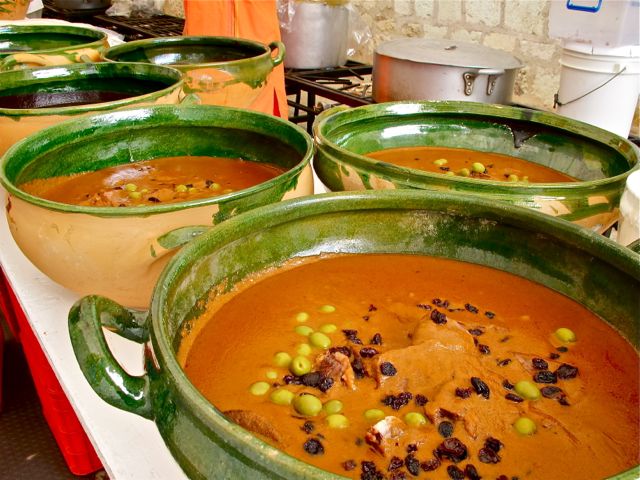
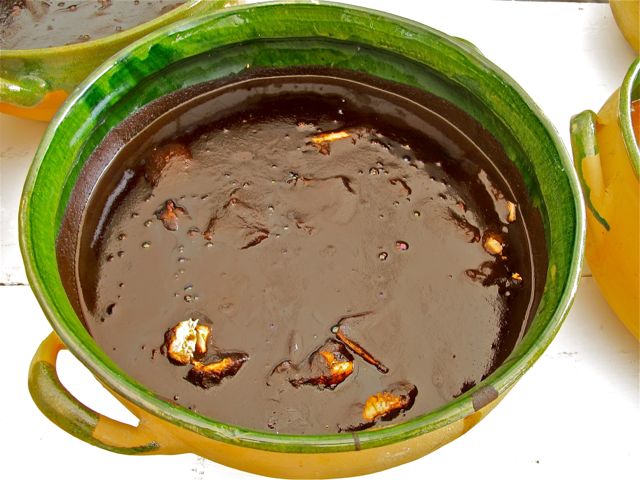
And, then there was the Festival de los 7 Moles opening buffet lunch set amidst the beauty and tranquility of the Jardín Etnobotánico. Serendipity and synchronicity brought us there… running into a friend, conversation, investigation (see pots below), and her enthusiasm and powers of persuasion (gracias, Rosa!) had us purchasing tickets on the spot.
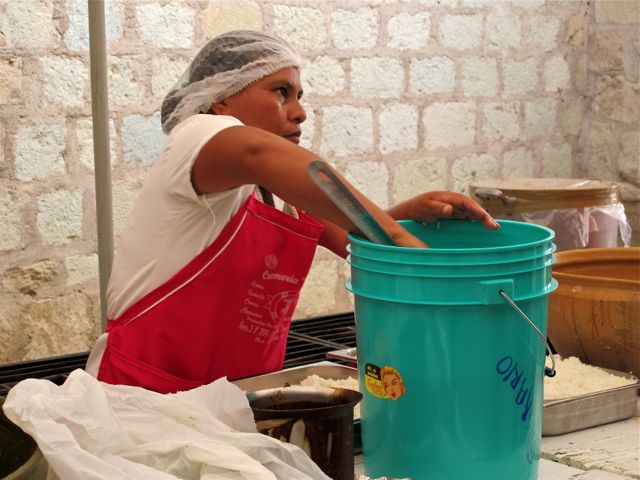
While kitchen staff prepared the serving platters and bowls…
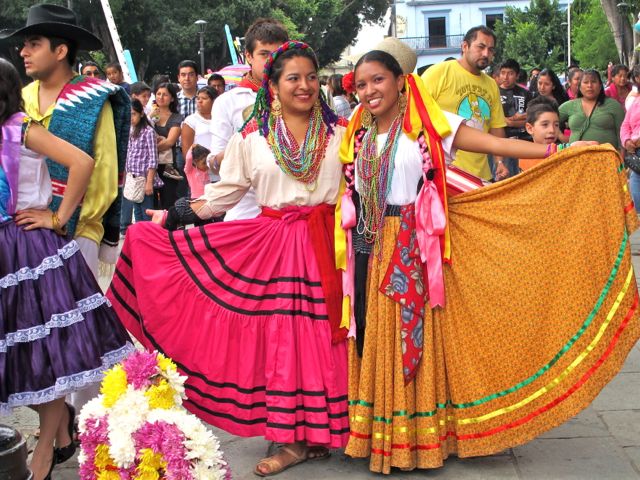
Dancers gathered on the Alameda for a calenda that would lead people the luncheon.
They included a number of small children…
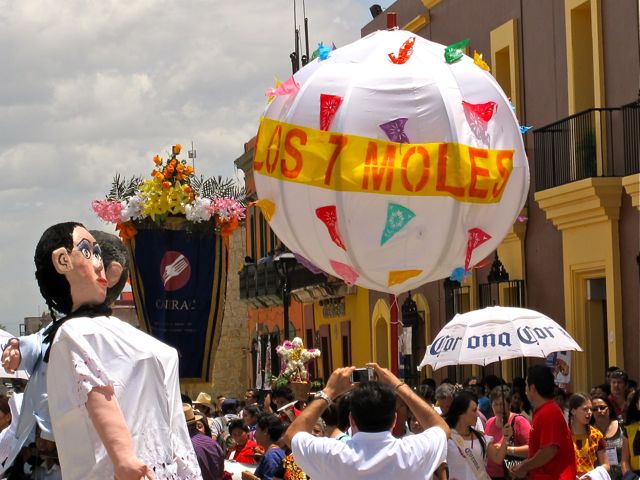
The calenda, including the requisite marmota (giant cloth balloon), monos (giant puppets), band, dancers with canastas (see yesterday’s post), and the sponsoring banner of CANIRAC (national association of the restaurant and food industries), made its way up the Alcalá…
before turning onto Constitución and entering the Jardín, where wait staff and divine moles awaited.
There was also mole chichilo, mole manchamanteles, and mole rojo. I tried them all!!! And, I haven’t even mentioned the cervesa, mezcal, aguas, and appetizers of quesillo, chicharon, and tacos filled with guacamole and chapulines (grasshoppers). You’ll have to switch over to Chris’s blog to see those and much more. Oh, and for dessert, a scoop of each of my favorite nieves (sherbet); leche quemada (burned milk) and tuna (cactus fruit).
A day filled with light, color, music, fabulous food, and, most of all, wonderful friends — the recipe for a perfect day!
(ps) There are almost 50 restaurants around town that will be featuring mole as part of this 12-day festival.
It didn’t start that way; I awoke to horrifying news from Colorado. Thank goodness blogger buddy Chris called and the heart that beats in Oaxaca beckoned.
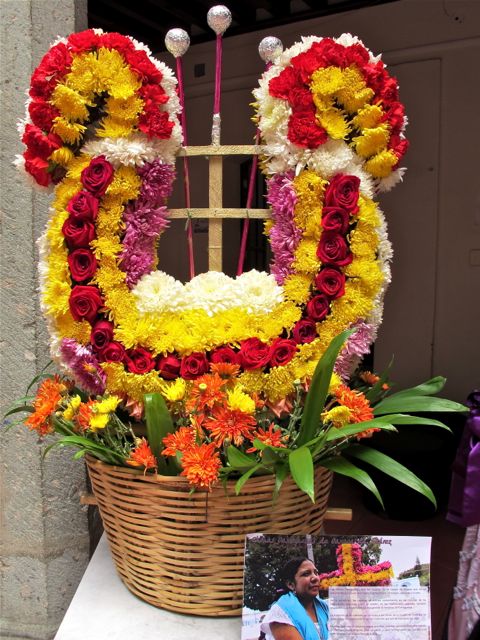
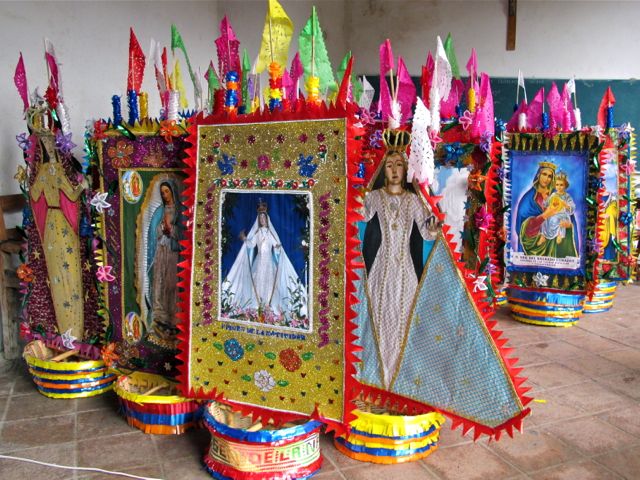
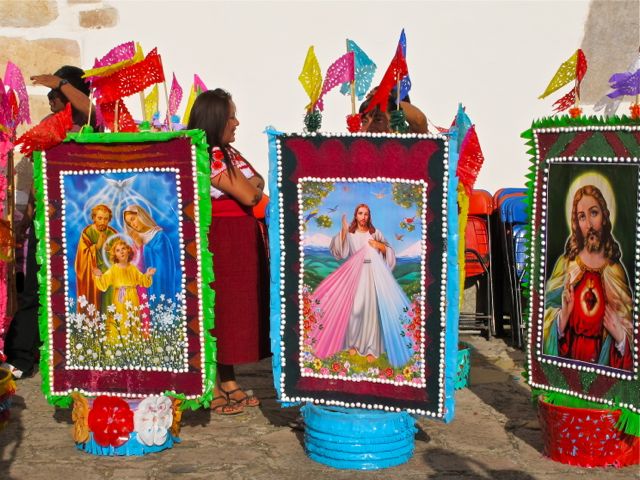
First stop was the “Al Son del Valle,” an exhibition of canastas from 17 villages in the central valleys of Oaxaca. These are baskets that are carried on the heads of women during calendas (parades); you may remember them from previous posts on the convites in Teotitlán del Valle. The art of crafting canastas and the traditions and culture they represent have been proudly and lovingly passed down through the generations.
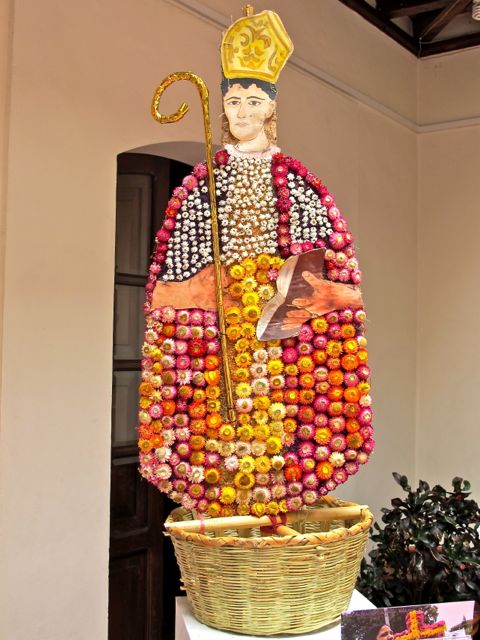
San Antonino Castillo Velasco canasta decorated with Flor Inmortal, the flower that never dies.
Canasta from San Mateo Macuilxóchitl
From San Jerónimo Tlacochahuaya, these canastas are lit and become pinwheels of fireworks at the end of a calenda.
Canasta of Las Chinas Oaxaqueñas of the city of Oaxaca
Canasta from Tlacolula de Matamoros.
Canasta from Zimatlán de Álvarez made of crepe paper.
This year marks the 80th anniversary of the modern Guelaguetza festival in Oaxaca. The calendar is filled with official Guelaguetza activities and other events that take advantage of the massive annual influx of tourists (especially from other parts of Mexico). The colorful and distinctive costumes worn by the Guelaguetza delegations from each of the 8 regions of the state of Oaxaca play a major role in wowing visitors and residents — including, me!
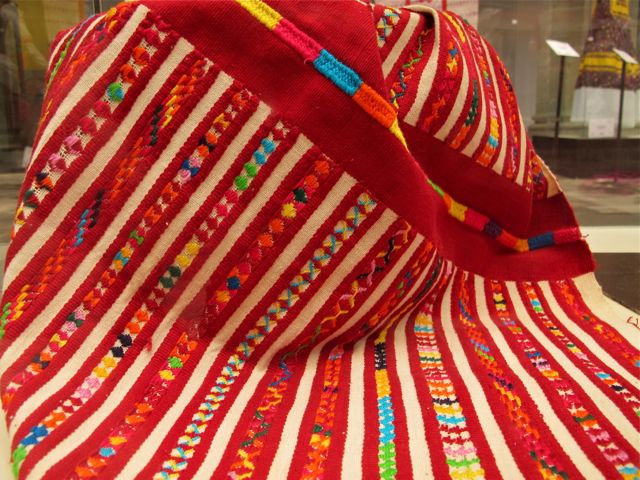
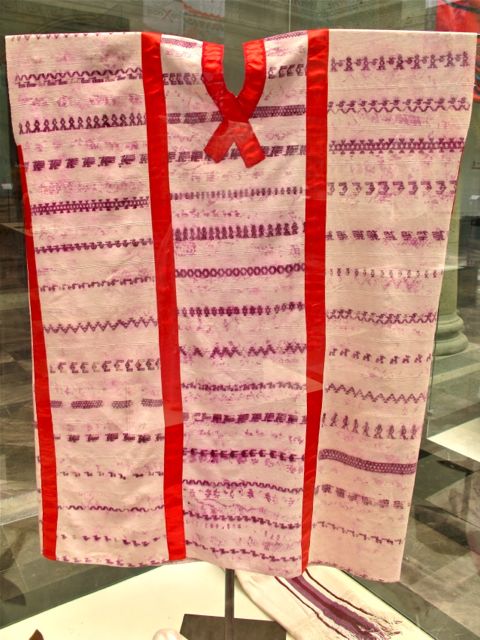
Huipil de San Andrés Chicahuaxtla, Putla Villa de Guerrero, Oax.
As a result, the “Oaxaca Xaba Lulá” exhibition has been mounted in the Government Palace.
Traje de la Villa Sola de Vega, Oax.
These are only a fraction of the items on exhibit and the photos were chosen primarily because they showed the least amount of reflection on the plexiglass display cases. It is a beautiful, but challenging to photograph, setting!
Huipil de San Bartolomé, Ayautla, Teotitlán, Oax.
The collection of trajes típicos (typical costumes) representing the 8 regions of Oaxaca runs through the end of the month.
Rebozo de San Juan Colorado, Jamiltepec, Oax.
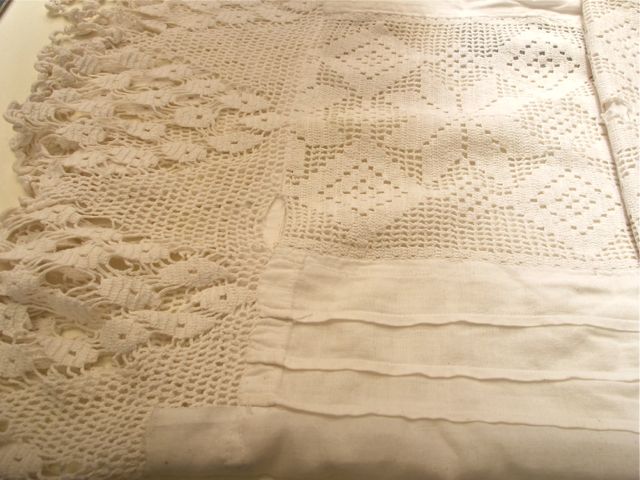
The dresses, hats and accessories were donated by Oaxacan citizens from different regions of the state and were made in the traditional way, with many using natural dyes.
Huipil de Gala de San Lucas Ojitlán, Tuxtepec, Oax.
At the July 6 opening, José Zorrilla de San Martin Diego (Minister of Tourism and Economic Development), explained that they reflect a cultural essence that has prevailed for centuries in customs and traditions of the people of Oaxaca.
Funda de San Jerónimo Tecoátl, Teotitlán. Oax.
He observed that the Oaxacan costumes are a reflection of the depth of the culture, traditions, and ancestral weaving techniques that have been passed from generation to generation of Oaxacan hands.
Traje de Santa María Tlahuitoltepec, Mixe, Oax.
“The huipiles display in all their splendor the details that form a labyrinth of colors, a tiny universe that reflects the vastness of fertile nature and the symbolism that characterizes our native land and which graces the greatest festival of Oaxacaños,” Zorrilla de San Martin Diego very poetically suggested.
Huipil de Jalapa de Díaz, Tuxtepec, Oax.
Needless to say, during the next two weeks, I’m going to try to hit as many of the fairs, parades, dances, and exhibitions as possible. Stay tuned…
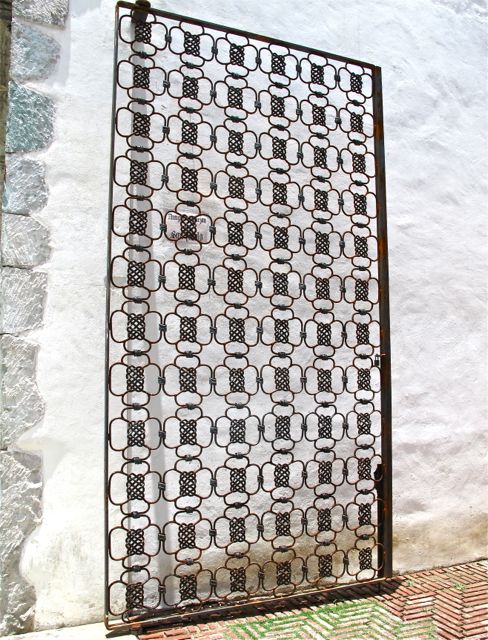
Intricately designed and executed iron gates have been installed at either end of Antiguo Callejón de San Pablo, ushering visitors into the “Old meets new” grounds of the Centro Académico y Cultural San Pablo.
Oaxaca’s favorite son and Mexico’s foremost living artist, Francisco Toledo, narrates a video documenting the construction of the gates. It’s in Spanish, but even if you don’t understand the language, it’s worth watching, anyway.
By the way, today is Toledo’s 70th birthday. ¡Feliz cumpleaños, maestro!
Early Saturday morning I was on my way to the doctor’s office, thus walking with purpose. However, turning onto Constitución, along the south side of Santo Domingo, I had to pause…
A photo shoot in progress? I didn’t actually have a doctor’s appointment, just dropping by for a consultation (common here), so I lingered.
HE was obviously modeling “glamed-up” Aztec. But SHE…
Hmmm… Japanese??? Of course not! Comparing it to images found in the codices, it, too, is an extremely stylized expression of the fashion and hair of some classes of Aztec women.
¡Muy hermosa!
Update: I think Sheri is probably correct. This may be a promotion for, or at least evoke, the annual reenactment of the Donají la leyenda, during Guelaguetza. It is the legend of Princess Donají, a Zapotec princess who was kidnapped and decapitated by rival Mixtecos. Her beautiful head was later found intact by a shepherd under a lily. The body and head were reunited and buried together near, what is now, the city of Oaxaca’s airport. The face of Donají appears on the official shield of the city of Oaxaca de Juárez.
The elevation and celebration of this story makes me wonder how today’s Mixtecos feel about it…
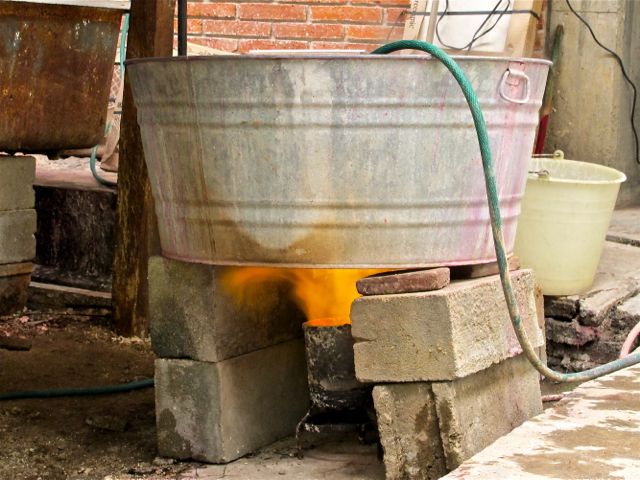
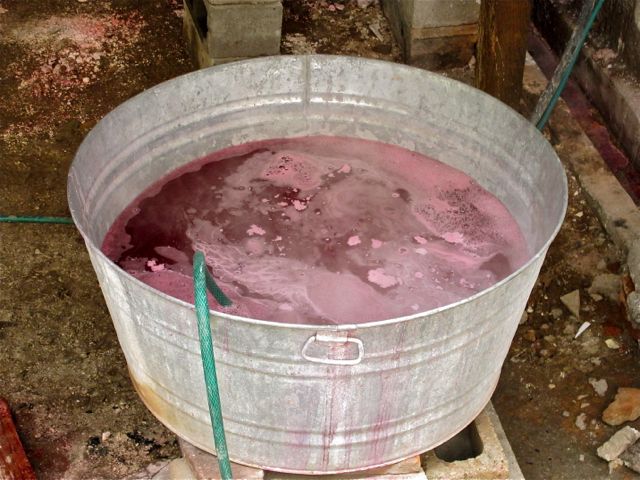
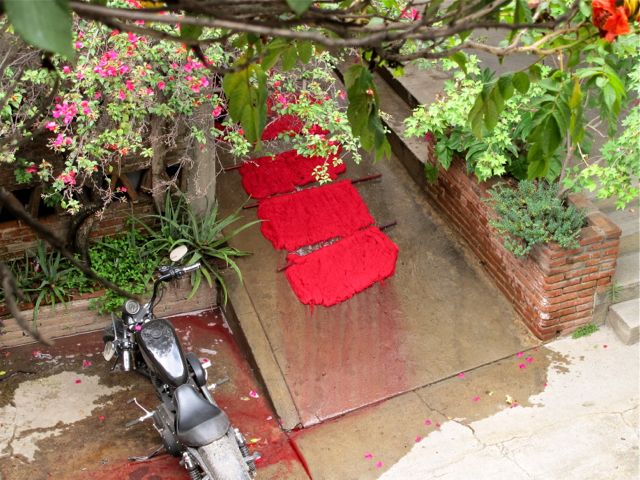
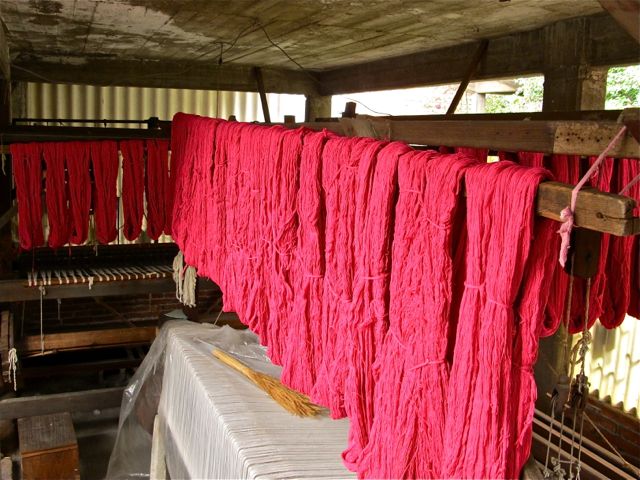
Have I mentioned there is a weaving business that operates out of the apartment complex where I live? Most of the operations have recently moved offsite — apparently, not so the dying.
I returned home on Tuesday to find a fire roaring…
A dye bath roiling…
Luci and Luís rinsing and removing excess water from newly dyed cotton yarn…
MLB All Star Game is on Cablemas (Lo siento mi maestra, el idioma es el Inglés.) and players from my San Francisco Giants are kicking “you know what!” I’d hoped to take the ferry (a very civilized way to go) to a Giants’ game when I was in the Bay Area last month, but, alas, time got away from me.
Oaxaca has a Minor League team, the Guerreros de Oaxaca, a Triple-A team in the Mexican League and their stadium is within (long) walking distance. Alas, I haven’t been to one of their games this season, either! However, last week I did wander by their office; the door was open and revealed this wonderful sculpture…
By the way, during the seventh inning stretch, fans rise and sing, “Linda Oaxaca” (Beautiful Oaxaca). It always brings a smile and I’ll take it over “God Bless America” every time!
The convite (covered in the Uplifting post) is only one of the traditions of the patronal festival of La Preciosa Sangre de Cristo. During the five days of the celebration, the church is filled with floral arrangements and believers stream in and out clutching flowers; the Danza de la Pluma (with Moctezuma, Cortez, Malinche, Doña Marina, danzantes, and soldados) is performed several times; and the cargo holders of the community preside, are honored, and presented with fresh fruits, vegetables, sacred herbs, and beverages.
This slideshow requires JavaScript.
Sunday was another amazing day in Teotitlán del Valle. And I haven’t even mentioned the tacos and tamales we devoured during our three visits this past week!
Late yesterday afternoon, we returned to Teotitlán del Valle for the convite (parade) of unmarried young women and girls, a part of the annual patronal festival of La Preciosa Sangre de Cristo. The sun was shining, the rains of two days before were nowhere to be seen, and the sacred mountain, El Picacho, gracefully, but commandingly, presided as the soldados and danzantes entered the church courtyard.
Bands also arrived to take part…
Canastas (baskets) were lined up, ready to be carried…
The young men of the village gathered…
Family and friends awaited…
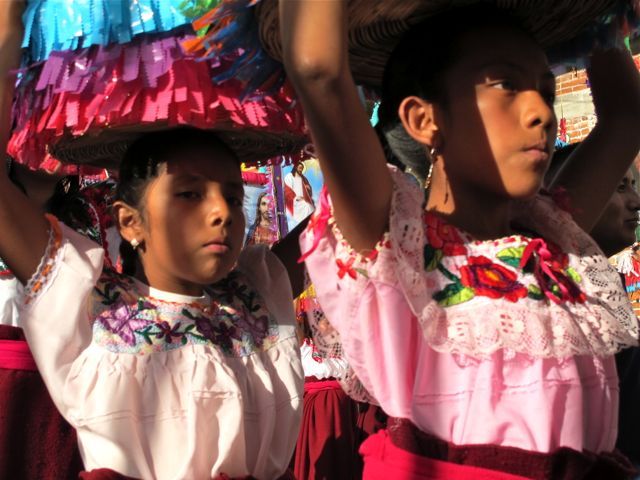
And then the young unmarried women and girls, the stars of the evening, raised the canastas over their heads…
Balancing the canastas, they processed from the courtyard, down several long and cobblestone blocks, turned left, and headed back up another street to where they had begun, to be greeted by proud family and friends, who had gathered to acknowledge and celebrate the young women and girls of Teotitlán del Valle.
For some inexplicable reason, we never cease to feel moved and uplifted by this ritual.
Yesterday, fellow blogger, Chris, and I drove out to Teotitlán del Valle for their yearly patronal festividad de La Preciosa Sangre de Cristo. The rains came and we didn’t stay long. But, as we almost always find, just being out there provides much appreciated food for the soul.
Yesterday, I walked down to the zócalo twice; once in mid-morning and again late in the afternoon. My Spanish teacher had advised her students of the probable presence of army trucks, soldiers, and federal police; but to be assured this was standard operating procedure on election day. However, all I saw were the normal transit police directing traffic and only 2 federales. From my terrace, I did watch a helicopter circle the zócalo a few times. A friend filmed a tussle re lack of ballots about the same time as my helicopter siting.
This slideshow requires JavaScript.
To begin to understand the Mexican electoral system, the Instituto Federal Electoral has a FAQ page, in English, where it answers, 30 Essential Questions. In addition, readers might be interested in Robert Pastor’s article, 8 things the U.S. election system could learn from Mexico’s. While I don’t agree with some of his points (his conclusions re the PRI and the issue of voter ID cards in the US; problematic given its troubling history), I think the article is worth a read. By the way, the Yo Soy 132 movement was present yesterday on the zócalo and vows to continue.























 Mexican Peso Converter

 View From Casita Colibrí