Last night, flipping through my Cablemas channels, I happened upon Martin Scorsese’s 2011 film, George Harrison: Living in the Material World. I’ve seen this beautiful documentary before, could watch it many more times, and how could I resist, on Black Friday night, the wonderful irony of the title? I’m sure George is chuckling somewhere.
Yesterday marked the twelfth anniversary of George’s death (no doubt the reason it was being shown) and, as I watched and listened to Olivia describe the importance George placed on preparing for one’s death, I couldn’t help but reflect on Día de los Muertos. All things must pass; death as a part of the journey of being. And, some of this year’s Muertos photos seemed to be ready to let go of most of their color…
Sunrise doesn’t last all morning A cloudburst doesn’t last all day Seems my love is up and has left you with no warning It’s not always going to be this grey
All things must pass All things must pass away
Sunset doesn’t last all evening A mind can blow those clouds away After all this, my love is up and must be leaving It’s not always going to be this grey
All things must pass All things must pass away All things must pass None of life’s strings can last So, I must be on my way And face another day
Now the darkness only stays the night-time In the morning it will fade away Daylight is good at arriving at the right time It’s not always going to be this grey
All things must pass All things must pass away All things must pass All things must pass away
I’ve always liked Thanksgiving — and not just because, after I turned 12, my aunt would pour a little red wine in a shot glass for my cousin and me. It’s one of the least commercial US holidays, if one discounts the whole “black Friday” and, now, “brown Thursday” (eww!) phenomenon. And, it isn’t wrapped in flag waving.
It’s a day set aside for a communal sharing of Mother Nature’s bounty, counting our blessings, and acknowledging and giving thanks for the assistance of the dark-skinned original human inhabitants of the Americas. What a novel idea!
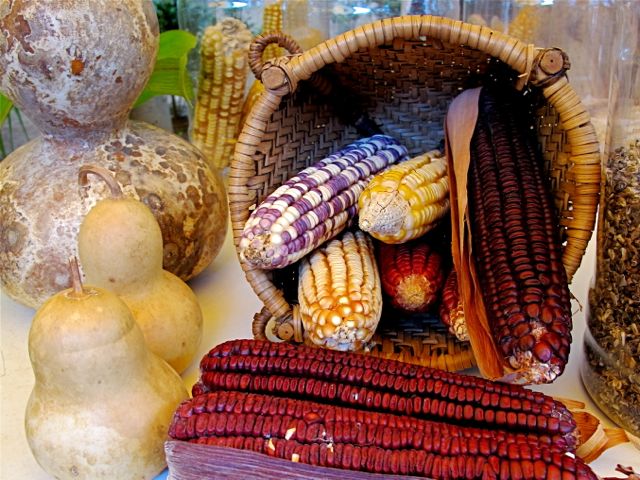
Besides being thankful for my loving and supportive family, wonderful friends (both old and new), dedicated and encouraging blog readers (Yes, you!), I’m extremely grateful for having the privilege of living among people whose ancestors first cultivated corn in this beautiful valley.
The XII World Congress of the Organization of World Heritage Cities has ended, its delegates have departed, and the ambulantes, Oaxaca’s heart and soul, have returned.
A joy to behold and the basil the gal in the upper right photo was selling smelled divine!
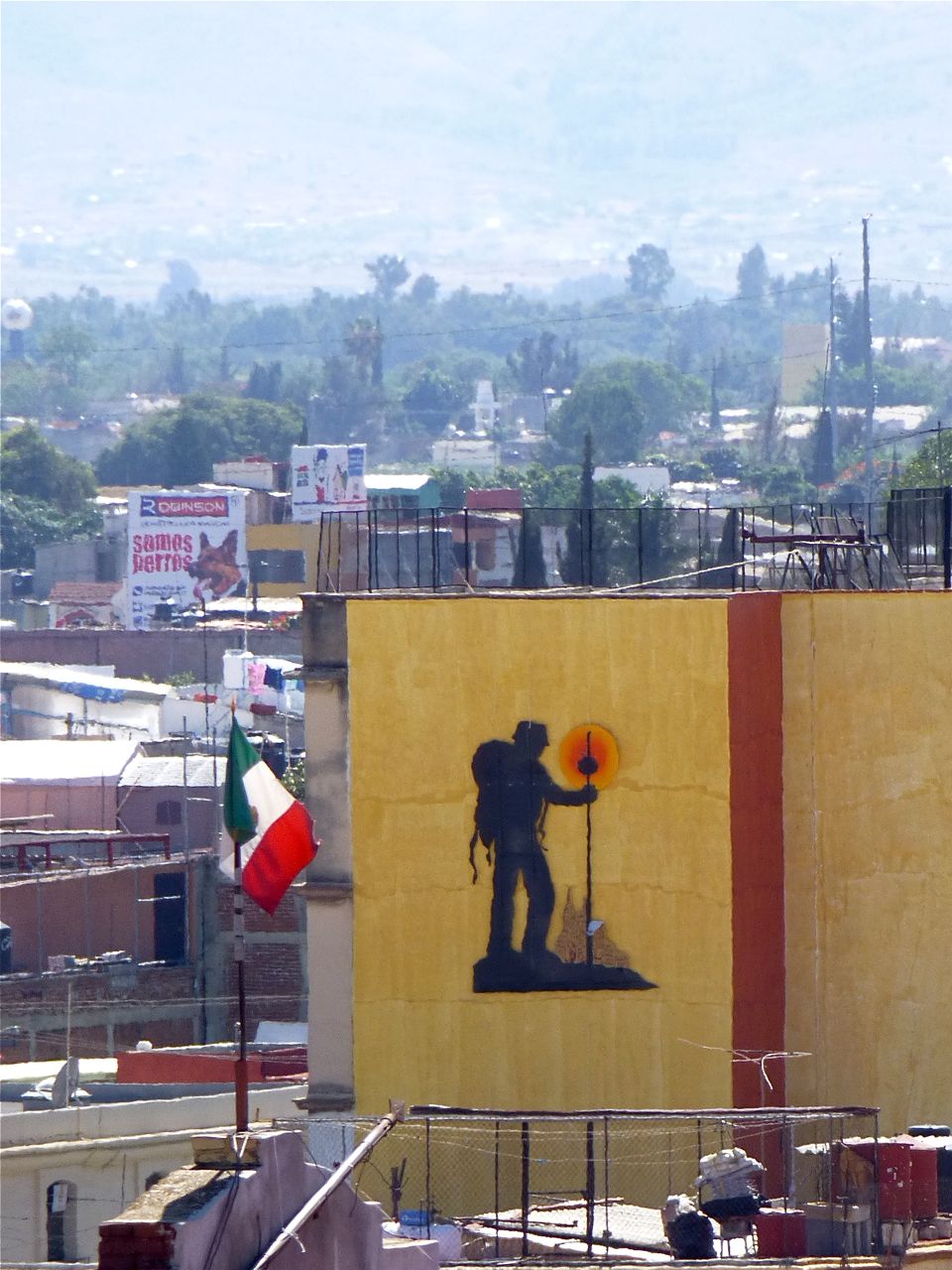
A neighbor and I were standing on the upper terrace of our apartment complex, watching the guys paint the dome of Iglesia de San José (a future blog post), when I looked to the south… Hmmm, I’d never noticed the art on the side of that tall yellow building — and neither had she. I whipped out my little Lumix and took this photo at 12:25 PM.
At 12:26 PM, I was about to take a second shot when the guy, his staff, and the little church at his feet, began climbing up the side of the building. Whoa!!!
By 12:27 PM, they were gone…
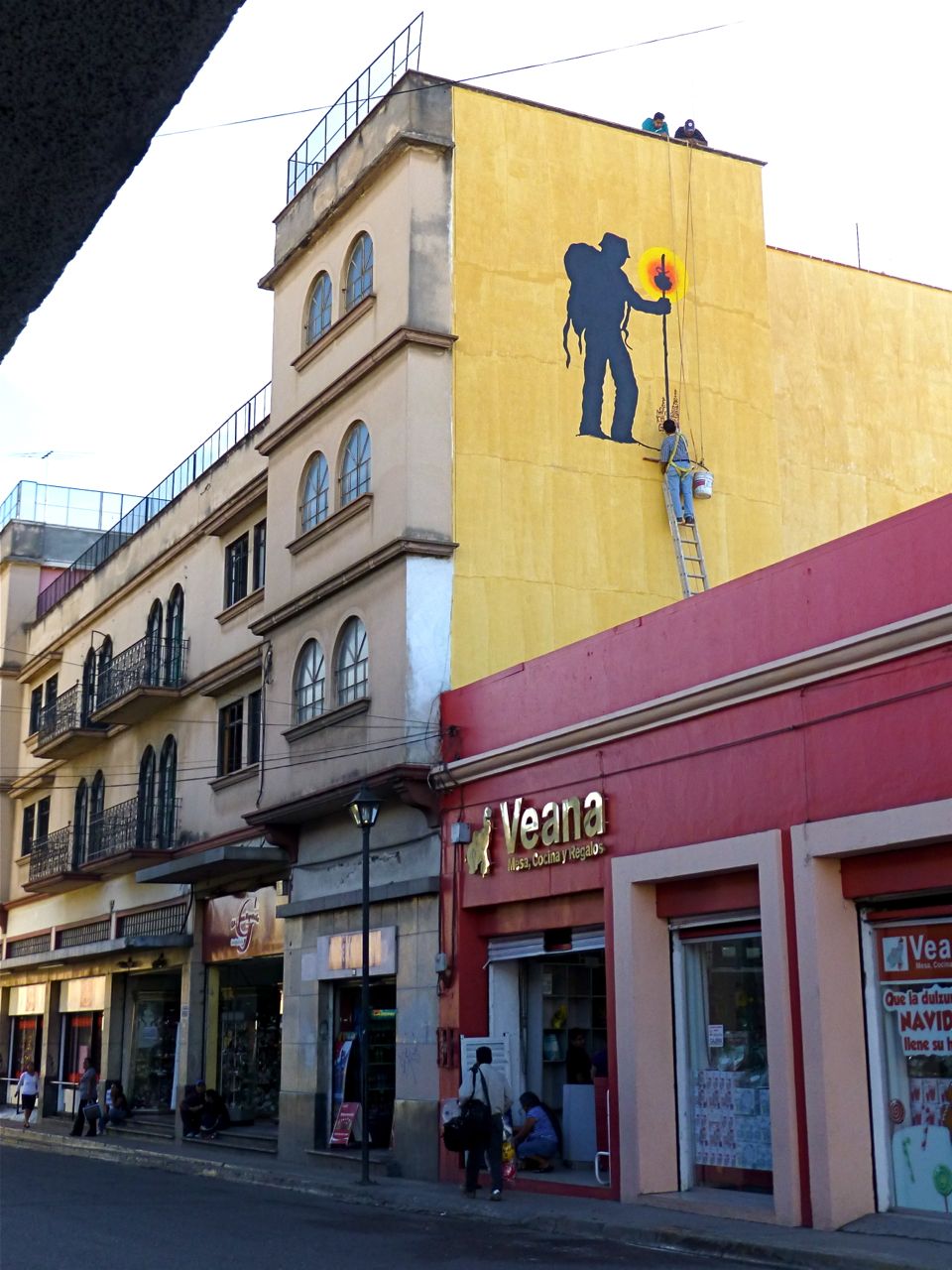
At 4:02, while composing this blog post, I got up from my desk to take a look at the building again — trying to figure out where exactly this banana yellow 3+ story building is located. Imagine my surprise when I saw the guy and his staff back on the side of the building AND his twin on the far right.
What the @#$% ??? Unable to curb my curiosity, I took off in search of my on/off/on again friend. At 4:34 PM, walking south on Tinoco y Palacios (which becomes, J. P. García), I found him at 308 J. P. García (almost to Las Casas), hanging out above Veana (one of my “go to” shops for kitchen ware).
At 4:35 PM, from across the street, I stood on the sidewalk gazing up at this reappearing painting on the side of the building. ¡Un milagro!
At 4:36 PM, I still don’t understand… What was it we saw earlier today? A stencil? Artists, can you enlighten me? All I can say is, I am VERY glad this painter is fastened to a harness. Of course, I’m hoping it’s not just being hand-held by the two guys on top of the building!
People often ask, “What do you DO all day?” This is as good an answer as I can come up with!
This morning, I awoke before the crack of dawn. I’m a morning person, but 5:00 AM is ridiculous when one doesn’t have to go to work! However, after grinding my half oscuro and half claro blend (so glad I brought my coffee grinder down), brewing, and drinking my first cup of Oaxacan coffee of the day and finally answering some long overdue emails, I looked up. Two hours had passed and the sky had turned from black to clear blue. The early morning light beckoned me and my new camera outside and I discovered, I wasn’t alone. Morning is also for the birds.
Morning has broken, like the first morning. Blackbird has spoken, like the first bird. Praise for the singing, praise for the morning, Praise for them springing fresh from the Word.
“Morning Has Broken,” by Yusuf Islam (formerly known as Cat Stevens) kept playing in my mind. It was a lovely way to begin the day.
Monte Alban and the historic center of Oaxaca are coming up on the twenty-sixth anniversary of being designated UNESCO World Heritage sites. And, as I write, the city is hosting the XII World Congress of the Organization of World Heritage Cities, with delegations from 230 other World Heritage cities in town for the 4-day conference.
It is to be expected that any host city would get out the spit and polish to show itself in the best light and Oaxaca is no exception. The city is being cleaned to the nth degree and, much to driver and passenger delight and relief, the ubiquitous baches (potholes) throughout the city have been patched.
And graffiti? It’s history, as soon as it appears.
Nov. 20, 2013, Crespo, between Morelos and Matamoros.
Nov. 21, 2013, Crespo, between Morelos and Matamoros.
Besides the much-welcome repair of treacherous streets, squeaky clean sidewalks, and pristine building facades, there is something else missing. Where have all the ambulantes (street vendors) gone? If you have ever been to Oaxaca, you will no doubt remember the indigenous vendor puestos (across from the Cathedral) that line the Alameda de León from the Post Office to the Hotel Monte Alban. They are gone, along with the ambulantes in the plaza alongside Carmen Alto. Even the lovely women from San Antonino Castillo Velasco, who sell their beautiful, intricately hand-embroidered wedding dresses and blouses along Macedonio Alcalá, have been removed from the street.
I later discovered, the latter have been temporarily relocated to the courtyard of the Biblioteca Pública Central.
But what of the other vendors? Where are they? Are they being compensated for lost revenue? According to this article in Proceso, market trader organizations, “agreed to withdraw for six days without compensation.” Hmmm….
I have to ask, why? Is it just colonial buildings and archeological sites that warrant a World Heritage site designation? I don’t think so. Oaxaca is an incredibly vibrant, living breathing city whose primary value and cultural heritage lies not in her buildings, but with her people, especially her indigenous citizens, who have given and continue to give much of what makes Oaxaca so special — their food, music, artistry, and kind, strong, and gentle presence. In 2007, on my first visit, it’s what had me at, hola!
According to the UNESCO World Heritage Centre website, regarding Oaxaca and Monte Alban, criterion IV states, “Among some 200 pre-Hispanic archaeological sites inventoried in the valley of Oaxaca, the Monte Alban complex best represents the singular evolution of a region inhabited by a succession of peoples: the Olmecs, Zapotecs and Mixtecs. The City of Oaxaca, with its design as a check board and its iconic architecture, has developed over more than four centuries as evidence of the fusion of two cultures Indian and Spanish.” [my emphasis]
Today Mexico is celebrating el Día de la Revolución (Revolution Day). It commemorates the beginning of the bloody revolution that quickly drove dictator/president Porfirio Díaz from his 31-year long reign. A November 22, 1910 headline in the Palestine [Texas] Daily Herald proclaimed, “Revolution Is Now On In Mexico: The Real Thing is Reported Under Way in State of Chihuahua, Mexico.” However, the civil war raged on for ten years, as various factions battled for power and the peasantry fought for, in the words of Emiliano Zapata, ¡Tierra y libertad! (Land and liberty!) It is estimated to have cost 1.9 to 3.5 million lives.
At least here in Oaxaca, 20 de noviembre is not celebrated with as much pomp, circumstance, and military hardware as September 16th, Independence Day. However, there were school floats…
The Government Palace was decked out in green, white, and red and the Governor, along with other dignitaries, presided from its balcony.
As always, the bomberos (firefighters) received much applause as they passed by the crowds gathered along the parade route.
Not so much love given to these guys from the Agencia Estatal de Investigaciones, an agency of Oaxaca’s Attorney General’s office.
And then there was this gal, directly across from the Government Palace…
Octavio Paz writes in The Labyrinth of Solitude, “The Revolution began as a demand for truth and honesty in the government…. Gradually the movement found and defined itself, in the midst of battle and later when in power. Its lack of a set program gave it popular authenticity and originality. This fact accounts for both its greatness and its weaknesses.” [p. 136, Grove Pr. 1985]
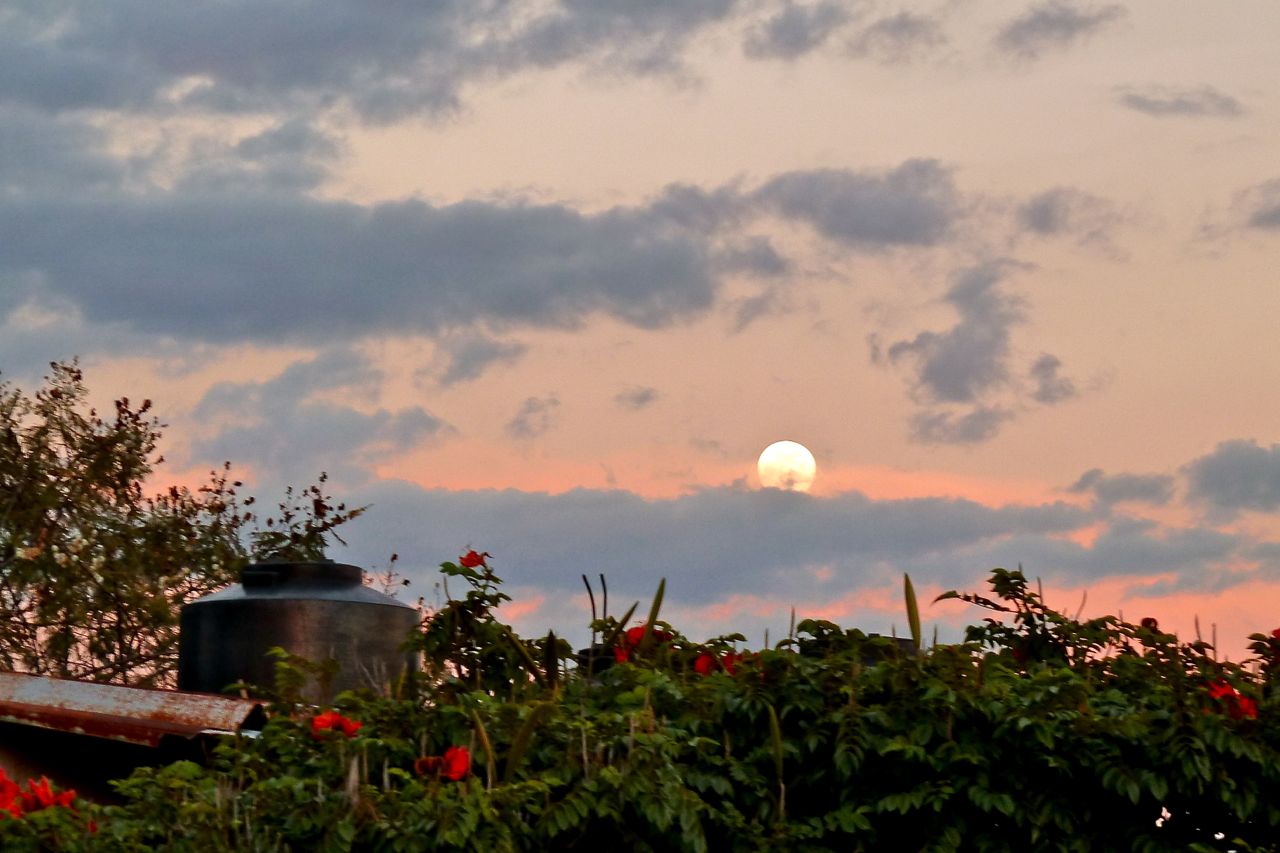
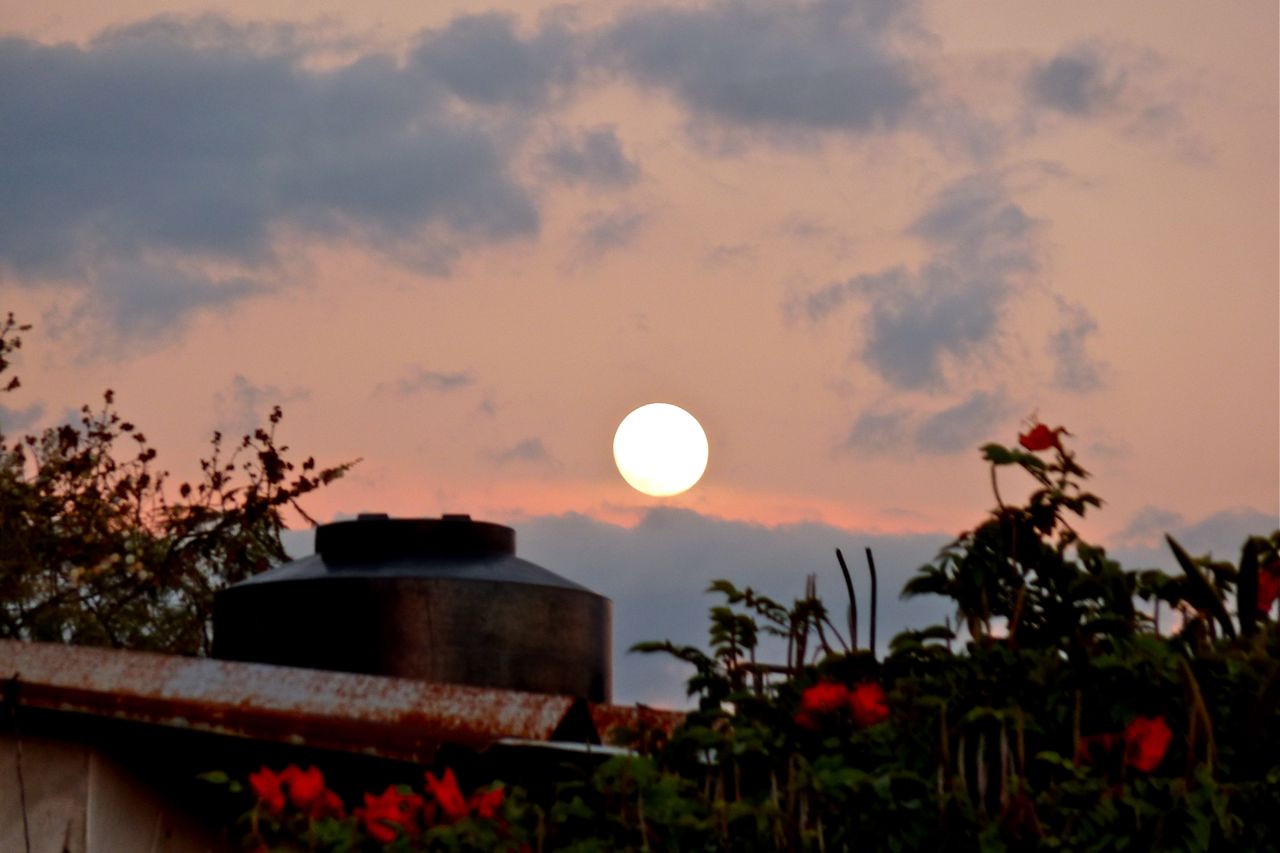
It may not be Moon Over Parador, but it was moon from my mirador…. The colors of last night’s sunset were spectacular, no matter which way one looked. It made for a beautiful full moon rising over the African tulip tree and rooftop tinaco of my old apartment.
6:56 PM (CST)
6:57 PM (CST)
Actually, the moon wasn’t officially full until 9:15 (CST) this morning, but the above was full enough for me!
As we have done in previous years, we returned to San Antonino Castillo Velasco on November 1 to watch families begin the preparation of the graves of their loved ones for Día de los Muertos. In a process unique to this pueblo known for the cultivation of flowers, family members mix the area’s very fine dirt with water; spread it on the top and sides of the grave; smooth it with a trowel, as if they were getting ready to lay tile; using a nail, they outline designs and religious imagery into the mud coating; and then use flowers (fresh and dried), to “paint” the scene.
This year’s late rainy season brought torrential rains on November 2 and it must have interrupted the decorating, because when we returned on November 3, at the same time as usual, there was still much work to be done. However, no one seemed the least perturbed; peace, tranquility, and quiet joy prevailed and, as always, it enveloped us.
(Music: Marimba band performing, “Díos Nunca Muere,” written by Oaxaqueño composer and violinist Macedonio Alcalá.)
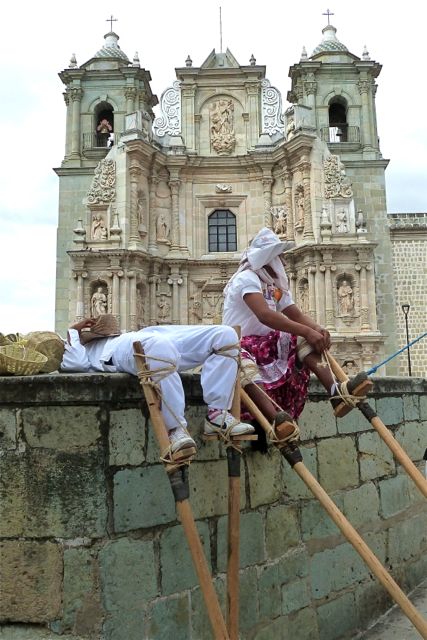
Crossing the Plaza de la Danza, on my way to the market this morning, I saw stilt people!
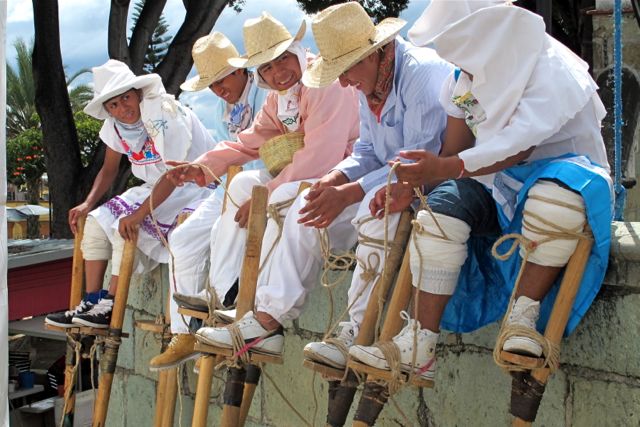
The all-male stilt dancers of Villa de Zaachila were waiting to perform the Danza de los Zancudos at the 22nd conference of the Oaxaca-Centro Alcoholics Anonymous. Once they took the stage there was much cheering and good-natured catcalls from the 75% male audience
The Dance of the Zancudos originated in the San Pedro neighborhood over 100 years ago and is one of the few places the dance can still be found. The origin of the Dance of the Zancudos is in a promise the inhabitants of Zaachila made to Saint Peter. The story behind it states that an old man encountered an apparition of Saint Peter who asked the community build a church in his name. The apparition appeared each day until it was captured by the local people and enclosed in a small church. Guards were posted at the entrance with rifles and machetes. However, the next day, it was discovered that the saint was no longer there, and he appeared again to the old man who had originally seen him, indicated that God had sent him to protect the village. Eight days remained until the feast of Saint Peter, and the saint asked that the villagers form pairs on stilts to dance. On the feast day, the men danced on stilts while the women surrounded them with candles and incense. The dancers arrived at the foot of a hill where an image of the saint was found, which was brought to the San Pedro neighborhood where a church was constructed for it. [Wikipedia. Retrieved, 11/10/2013]
They performed several dances and, to the cries from the audience of, “Otra, otra, otra,” they were ready with an encore. Baskets that had been tied to their costumes were thrown into the crowd (a la La Guelaguetza) and they exited stage right. By the way, getting down off the stage on stilts requires a lot of help from your friends. But once that complexity is navigated, you get to stroll over to a ledge high above everyone’s head, and have a seat.
Reason number 521 to never go anywhere in Oaxaca without my camera!
The souls have departed. And, following 33 hours of travel, my BFF (along with her alebrijes by Alberto Perez and the Xuana family, a traditional black and white rebozo, bottle of Del Maguey mezcal from Chichicapa, several bags of Conchita chocolate, and a fabulous mohair rug woven by Antonio Ruíz Gonzalez), has returned home to the frigid climes of Alaska. However, gal pal, souls, and the mortals with whom we shared the past, have left warm and lasting memories. They have also left an exhausted gringa, whose brain feels like one of those overloaded small trucks one (more than occasionally) sees on the roads here. With every nook and cranny filled, they move at a snail’s pace, be it along a pot-holed dirt road or the carretera, balancing their top-heavy loads.
Our week began on October 29, when the sounds of a band Pied Piper-ed us down the street and around a corner to a comparsa of high school students, who were taking part in a competition of using recycled products for their costumes and floats. Alas, the rains came and eventually chased us home.
On October 30, delectable dining (lunch at La Biznaga and dinner at Los Danzantes) nourished multiple museum visits and allowed us to join the standing-room-only crowd at the Oaxaca Lending Library (without rumbling stomachs) to watch the wonderful new documentary, La Festividad de los Muertos, chronicling Day of the Dead in Teotitlán del Valle.
Then there was Thursday, the 31st…. A shopping expedition for flowers, sugar skulls, bread (pan de muertos), and two 10-foot long stalks of sugar cane to form the arch over my altar. I carried them the 10-blocks home on my shoulder (sheesh, they are heavy) and carefully navigating the busy sidewalks. According to BFF, I provided pedestrians and passengers in buses,cars, and taxis much entertainment. I didn’t see a thing — I was just trying not to trip, fall, or whack anyone in front, behind, or to the sides of me!
Once the candles, photos, bread, chocolate, beverages (cervesa, mezcal, and water), and meaningful objects to our departed were in place; flowers arranged and cempasuchitl (marigold) petals scattered; and the arching sugar cane affixed to the wall surrounding our ofrenda, we made our way down to the beginning of the CEDART comparsa.
Later in the evening, we drove up to the panteón in Santa María Atzompa. Passing the bright lights and crush of food, flower, pottery, and other vendors that line the entrance and finally emerging from under the arched gateway, the candlelit ethereal beauty of the cemetery on this night never ceases to take my breath away. Of course, it wasn’t all exquisite and unearthly enchantment. This is Mexico and so there was also a (very loud) band and the cervesa and mezcal flowed freely. I’m sure the difuntos (deceased) enjoyed themselves and partied hardy with the living until the sun rose. And then all slept.
On the other hand, we left at a reasonable hour, as we were only at the mid-point of our Día de los Muertos marathon. More to come…
It’s been a magnificent Muertos filled with memorable moments and special people, along with a feast for ALL the senses. An initial pass through the photos has weeded them down to 450. Yikes! Lots more weeding and processing to do. In the meantime, here is a snapshot from the past 5 days.
Muerteada – San José el Mogote Etla – early morning Nov. 2, 2013.
Chapel, panteón, Teotitlán del Valle. Nov. 1, 2013
Panteón, San Antonino Castillo Velasco. Nov. 1, 2013
Panteón, San Antonino Castillo Velasco. Nov. 1, 2013
Panteón – Santa María Atzompa. Night of Oct. 31, 2013.
Comparsa in Oaxaca city. Evening of Oct. 31, 2013.
CEDART comparsa in Oaxaca city. Oct. 31, 2013.
CEDART comparsa, Oaxaca city. Oct. 31, 2013.
Tapete de arena (sand painting) in front of CEDART. Oct. 31, 2013.
Muertos flower vendors at Sanchez Pascuas. Oct. 31, 2013.
Tapete de arena (sand painting), Plaza de la Danza. Oct. 30, 2013.
Bar upstairs from Los Danzantes restaurant. Oct. 30, 2013.
Decorating Avenida M. Hidalgo entrance to San Pablo Cultural Center. Oct. 30, 2013.
High school recycled products comparsa. Oct. 29, 2013.
And the magic continues today, when we return to San Antonino Castillo Velasco.
An ofrenda is an offering, an integral part of the Day(s) of the Dead celebration, filled with meaning, a beacon to the departed, an ephemeral work of art, and the sum of its lovingly chosen parts. And so, last night my aforementioned BFF and I constructed our ofrenda.
Día de los Muertos in Oaxaca… so much to show and share with those we love.
My BFF (since age 12 — I won’t say how many decades ago that was) arrived last night from Alaska. It was her first trip to Mexico and it took 22 hours. Of course we talked late into the night, thus the morning unfolded slowly.
However, eventually we emerged into the hustle and bustle of the temporary muertos stalls near 20 de Noviembre mercado, to begin purchasing the elements for our Día de los Muertos ofrenda: Apples, oranges, and nuts to nourish the spirits, cempasuchitl (marigolds) to guide the spirits, cockscomb to symbolize mourning, and copal incense to draw the spirits home and ward off evil .
As you can see from the above chart, we have much more to buy and bring out of the storage closet. And, the above list doesn’t even mention sugar cane stalks!
h/t Chef Pilar Cabrera for posting the chart on Facebook.










 Mexican Peso Converter

 View From Casita Colibrí