Crossing the Plaza de la Danza, on my way to the market this morning, I saw stilt people!
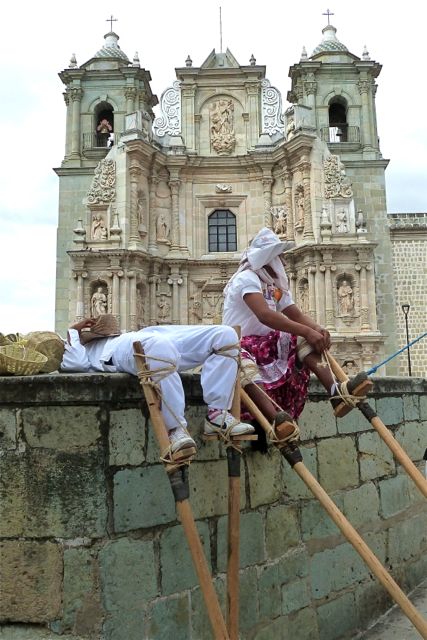
The all-male stilt dancers of Villa de Zaachila were waiting to perform the Danza de los Zancudos at the 22nd conference of the Oaxaca-Centro Alcoholics Anonymous. Once they took the stage there was much cheering and good-natured catcalls from the 75% male audience
The Dance of the Zancudos originated in the San Pedro neighborhood over 100 years ago and is one of the few places the dance can still be found. The origin of the Dance of the Zancudos is in a promise the inhabitants of Zaachila made to Saint Peter. The story behind it states that an old man encountered an apparition of Saint Peter who asked the community build a church in his name. The apparition appeared each day until it was captured by the local people and enclosed in a small church. Guards were posted at the entrance with rifles and machetes. However, the next day, it was discovered that the saint was no longer there, and he appeared again to the old man who had originally seen him, indicated that God had sent him to protect the village. Eight days remained until the feast of Saint Peter, and the saint asked that the villagers form pairs on stilts to dance. On the feast day, the men danced on stilts while the women surrounded them with candles and incense. The dancers arrived at the foot of a hill where an image of the saint was found, which was brought to the San Pedro neighborhood where a church was constructed for it. [Wikipedia. Retrieved, 11/10/2013]
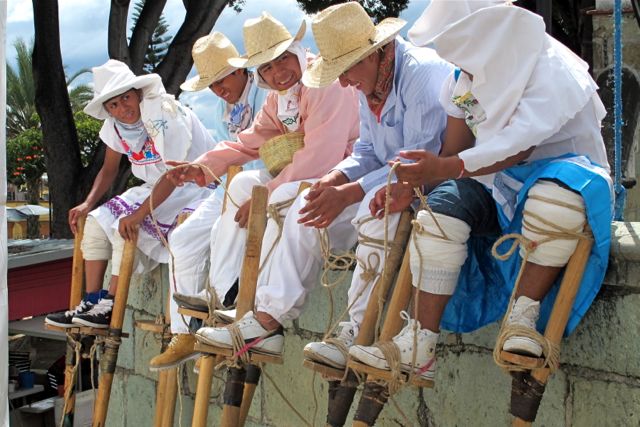
They performed several dances and, to the cries from the audience of, “Otra, otra, otra,” they were ready with an encore. Baskets that had been tied to their costumes were thrown into the crowd (a la La Guelaguetza) and they exited stage right. By the way, getting down off the stage on stilts requires a lot of help from your friends. But once that complexity is navigated, you get to stroll over to a ledge high above everyone’s head, and have a seat.
Reason number 521 to never go anywhere in Oaxaca without my camera!
The souls have departed. And, following 33 hours of travel, my BFF (along with her alebrijes by Alberto Perez and the Xuana family, a traditional black and white rebozo, bottle of Del Maguey mezcal from Chichicapa, several bags of Conchita chocolate, and a fabulous mohair rug woven by Antonio Ruíz Gonzalez), has returned home to the frigid climes of Alaska. However, gal pal, souls, and the mortals with whom we shared the past, have left warm and lasting memories. They have also left an exhausted gringa, whose brain feels like one of those overloaded small trucks one (more than occasionally) sees on the roads here. With every nook and cranny filled, they move at a snail’s pace, be it along a pot-holed dirt road or the carretera, balancing their top-heavy loads.
Our week began on October 29, when the sounds of a band Pied Piper-ed us down the street and around a corner to a comparsa of high school students, who were taking part in a competition of using recycled products for their costumes and floats. Alas, the rains came and eventually chased us home.
On October 30, delectable dining (lunch at La Biznaga and dinner at Los Danzantes) nourished multiple museum visits and allowed us to join the standing-room-only crowd at the Oaxaca Lending Library (without rumbling stomachs) to watch the wonderful new documentary, La Festividad de los Muertos, chronicling Day of the Dead in Teotitlán del Valle.
Then there was Thursday, the 31st…. A shopping expedition for flowers, sugar skulls, bread (pan de muertos), and two 10-foot long stalks of sugar cane to form the arch over my altar. I carried them the 10-blocks home on my shoulder (sheesh, they are heavy) and carefully navigating the busy sidewalks. According to BFF, I provided pedestrians and passengers in buses,cars, and taxis much entertainment. I didn’t see a thing — I was just trying not to trip, fall, or whack anyone in front, behind, or to the sides of me!
Once the candles, photos, bread, chocolate, beverages (cervesa, mezcal, and water), and meaningful objects to our departed were in place; flowers arranged and cempasuchitl (marigold) petals scattered; and the arching sugar cane affixed to the wall surrounding our ofrenda, we made our way down to the beginning of the CEDART comparsa.
Later in the evening, we drove up to the panteón in Santa María Atzompa. Passing the bright lights and crush of food, flower, pottery, and other vendors that line the entrance and finally emerging from under the arched gateway, the candlelit ethereal beauty of the cemetery on this night never ceases to take my breath away. Of course, it wasn’t all exquisite and unearthly enchantment. This is Mexico and so there was also a (very loud) band and the cervesa and mezcal flowed freely. I’m sure the difuntos (deceased) enjoyed themselves and partied hardy with the living until the sun rose. And then all slept.
On the other hand, we left at a reasonable hour, as we were only at the mid-point of our Día de los Muertos marathon. More to come…
It’s been a magnificent Muertos filled with memorable moments and special people, along with a feast for ALL the senses. An initial pass through the photos has weeded them down to 450. Yikes! Lots more weeding and processing to do. In the meantime, here is a snapshot from the past 5 days.
Muerteada – San José el Mogote Etla – early morning Nov. 2, 2013.
Chapel, panteón, Teotitlán del Valle. Nov. 1, 2013
Panteón, San Antonino Castillo Velasco. Nov. 1, 2013
Panteón, San Antonino Castillo Velasco. Nov. 1, 2013
Panteón – Santa María Atzompa. Night of Oct. 31, 2013.
Comparsa in Oaxaca city. Evening of Oct. 31, 2013.
CEDART comparsa in Oaxaca city. Oct. 31, 2013.
CEDART comparsa, Oaxaca city. Oct. 31, 2013.
Tapete de arena (sand painting) in front of CEDART. Oct. 31, 2013.
Muertos flower vendors at Sanchez Pascuas. Oct. 31, 2013.
Tapete de arena (sand painting), Plaza de la Danza. Oct. 30, 2013.
Bar upstairs from Los Danzantes restaurant. Oct. 30, 2013.
Decorating Avenida M. Hidalgo entrance to San Pablo Cultural Center. Oct. 30, 2013.
High school recycled products comparsa. Oct. 29, 2013.
And the magic continues today, when we return to San Antonino Castillo Velasco.
An ofrenda is an offering, an integral part of the Day(s) of the Dead celebration, filled with meaning, a beacon to the departed, an ephemeral work of art, and the sum of its lovingly chosen parts. And so, last night my aforementioned BFF and I constructed our ofrenda.
Día de los Muertos in Oaxaca… so much to show and share with those we love.
My BFF (since age 12 — I won’t say how many decades ago that was) arrived last night from Alaska. It was her first trip to Mexico and it took 22 hours. Of course we talked late into the night, thus the morning unfolded slowly.
However, eventually we emerged into the hustle and bustle of the temporary muertos stalls near 20 de Noviembre mercado, to begin purchasing the elements for our Día de los Muertos ofrenda: Apples, oranges, and nuts to nourish the spirits, cempasuchitl (marigolds) to guide the spirits, cockscomb to symbolize mourning, and copal incense to draw the spirits home and ward off evil .
As you can see from the above chart, we have much more to buy and bring out of the storage closet. And, the above list doesn’t even mention sugar cane stalks!
h/t Chef Pilar Cabrera for posting the chart on Facebook.
Around this time of year, the gringo and Canadian (they are adamant they are NOT gringos) population in Oaxaca begins to grow — an increase that will last for the duration of winter. Called “snowbirds” by the resident ex-pats, they are an eclectic and interesting crowd. Among them are a couple of talented people with whom I have become acquainted — San Francisco Bay Area based writer, Robert Adler (who, along with Jo Ann Wexler, publishes the invaluable, Viva Oaxaca) and Seattle photographer, Tom Feher.
Robert and Tom have embarked on an ambitious project interviewing and photographing undocumented immigrants on their arduous and dangerous journey from Mexico and Central America, en-route to El Norte. The result is to be a traveling exhibition of 24 to 30 of near life-size images on narrow aluminum sheets designed to be hung from the ceiling and accompanied by a booklet with the biography of each immigrant. The exhibition will be called, I Have a Name — the title coming from a neighbor of Tom’s, “who, having hired a Latino man to do some work, refused to call him by his right name and referred to him only as “the Mexican”, even though he was from Guatemala. ”
The decision to leave all that is known and loved for distant country and alien culture is not undertaken lightly. The creators of this project hope, in the words of Robert, that the exhibit, “will convey what we’ve been learning firsthand–that it’s one thing to have a concept such as ‘migrant,’ ‘migrant worker,’ ‘undocumented worker,’ or ‘illegal alien,’ and quite another to know people as individuals with their own names, faces, life stories and dreams.”
This is an expensive project and Robert and Tom need your help to bring I Have a Name to fruition. They have mounted a fundraising campaign on the crowd-finding site, Indiegogo. Please consider helping them raise $25,000 before their November 25, 2013 deadline.
Much like the Mark Twain line, “The report of my death was an exaggeration,” unfortunately, so too the news announcing the death of GMO corn in Mexico.
Contrary to reports, genetically modified (GMO) corn has not been banned in Mexico. On October 10, a Mexican judge from the Twelfth Federal District Court for Civil Matters in Mexico City issued an injunction suspending field trails of GMO corn, however, a complete ban was not ordered.
Federal Judge Jaime Eduardo Verdugo’s ruling does order the halting of “all activities involving the planting of transgenic corn in [Mexico] and ends the granting of permissions for experimental and pilot commercial plantings.” [Read full article, HERE]
Sometime around 8,000 years ago, corn was first domesticated in the valley where I have the privilege of living. Botanists have determined that the valley of Oaxaca was the “cradle” of maize evolution. Maíz became the lifeblood of the Mesoamerican diet and culture and it continues today.
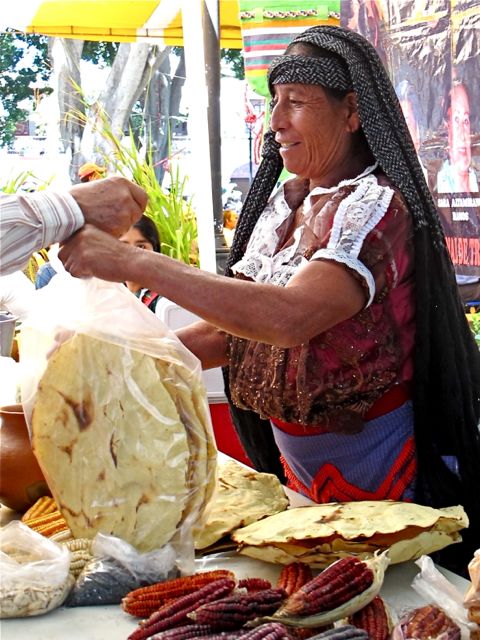
On September 29, Oaxaca celebrated el Día Nacional del Maíz Nativo (National Native Corn Day). On the zócalo, across from the Government Palace, there were displays showcasing the multiple hues of native corn…
There were tlayudas for sale…
However, there were also warnings about the dangers of genetically modified corn and the products containing them…
Genetically modified corn is a major issue in Oaxaca. There is a concern that native plants could become infected with GMOs, which would then contaminate and compromise the genetic diversity of native varieties. Speakers, at the event, discussed the importance of the community seed banks that have been established to safeguard native varieties and be used in the wake of economic and ecological crisis. Two weeks after the aforementioned event, there was good news, a Mexico judge has placed an indefinite ban on genetically engineered corn.
And so to celebrate, I am re-posting the Lila Downs video of her song “Palomo del Comalito,” paying homage to maíz, and its “granitos de cristal” (grains of crystal).
And to bring this post full circle, the video was filmed in Teotitlán del Valle, located here in the valley where corn was first cultivated.
There is a lot of work that goes into getting a marmota ready to go to the dance. Getting dressed takes a quite a crew and there is a lot of up close and personal last-minute cinching that must be done. Then there is squeezing (she does weigh over 70 kilos) through the church plaza portal, to make her grand entrance onto the street. However, once she emerges, she joins with her friends to dance through the streets of Tlacolula de Matamoros late into the night!
This slideshow requires JavaScript.
Calenda in honor of el Señor de Tlacolula, October 11, 2013. Living history from the valley where corn was first cultivated.
Expats and Mexicans alike, are watching in amazement at the nonsense (as in, making NO sense) taking place in the hallowed halls of Washington DC. And, since many of the expats are retired, we are holding our collective breath over the possibility social security checks will not be forthcoming in November and a tanking stock market that flushes our nest eggs away. Of course, Mexico is in the middle of its own mess, “educational reforms” and economic proposals that will hurt Mexico’s working class and rural populations the most.
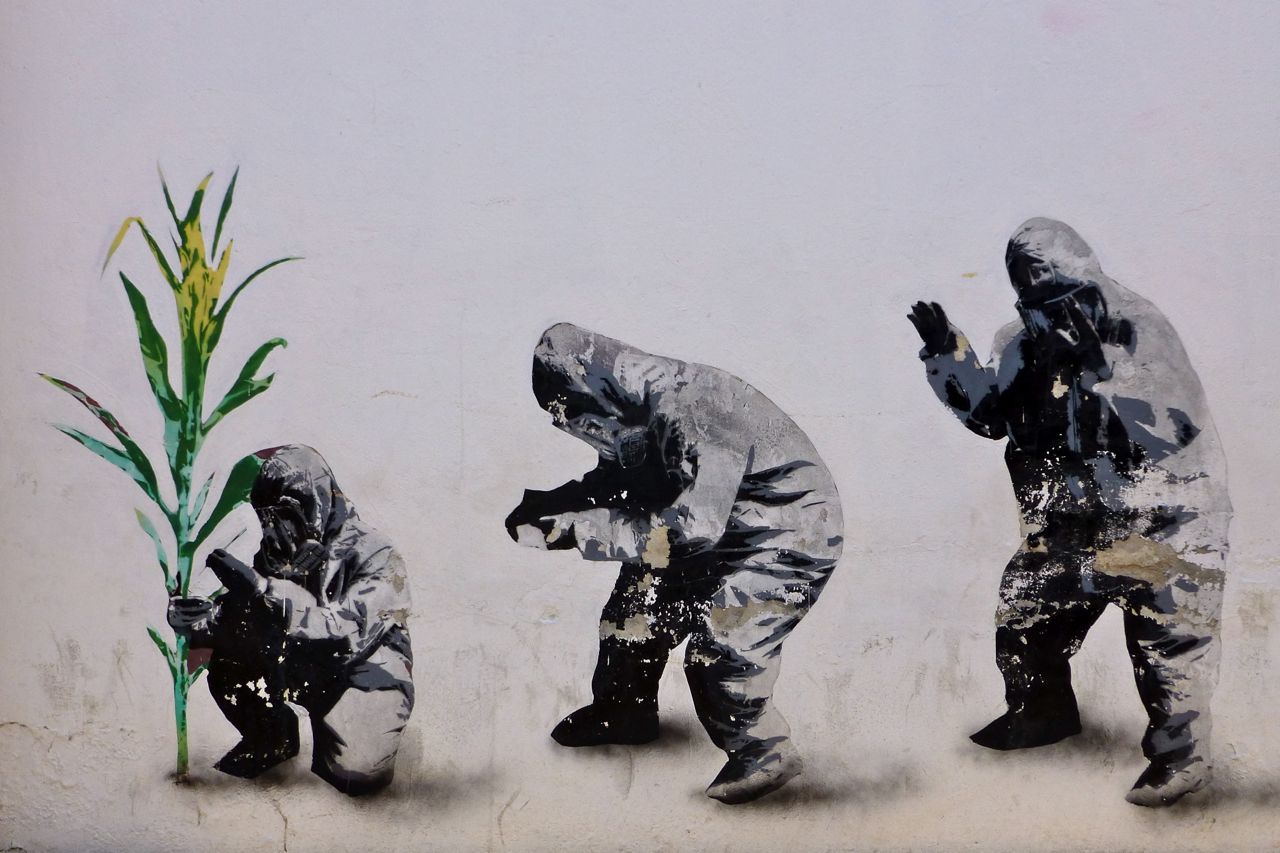
Wall in Oaxaca city.
In a New York Times article two days ago, Carlos Puig explains the reality of the material conditions that have forced the teachers of Oaxaca to take the drastic action of abandoning their classrooms to lead massive and extremely disruptive protests in Mexico City against the “No Child Left Behind” style reforms that the Peña Nieto led government has proposed and passed. (Read a critique of the US education “reform” by Diane Ravitch, former “No Child Left Behind” proponent, here.)
Oaxaca is 500 kilometers from Mexico City, yet the real distance is much bigger. The state’s G.N.P. per capita is one-quarter the average for the country. Oaxaca ranks second-to-last among all states in infrastructure. More than half its population lives in towns of fewer than 2,500 people.
Being a teacher in Oaxaca means sometimes having to travel for an entire day to reach your school in a tiny community, teach for three days — to children of all grades — and travel back home for the weekend. It means having to deal with children who speak more than 20 different dialects.
Being a teacher in Oaxaca means operating in a different universe — and under different rules.
Banner hanging in front of a school in Oaxaca city
However, as in the USA, the incomprehensible words coming out of the mouths of the 1% and their elected representatives are mind-boggling in their obliviousness to the adverse consequences their behavior and policies cause. And, we scratch our heads in amazement… McClatchy journalist, Tim Johnson, has repeatedly blogged about the exceedingly “bad” behavior exhibited by Mexico City’s rich and powerful directed at those they consider “below” them — most recently, Las Ladies, episode 7. And, just last week in Oaxaca, most were aghast to read that an indigenous woman, in the advanced stage of labor, was turned away from a hospital and forced to give birth on the hospital lawn.
Daniel Goleman had a revealing piece in the New York Times a few days ago that helps explain where this lack of empathy the ruling elite exhibit, that results in callous social policy, comes from. He explains in Rich People Just Care Less that, by necessity, “the poor, compared with the wealthy, have keenly attuned interpersonal attention in all directions…” And that, “A growing body of recent research shows that people with the most social power pay scant attention to those with little such power” and, “In politics, readily dismissing inconvenient people can easily extend to dismissing inconvenient truths about them.”
Okay, now we know why the rich care less, so what are we going to do about it?














 Mexican Peso Converter


They ARE different
October 11, 2013 by spixl
Expats and Mexicans alike, are watching in amazement at the nonsense (as in, making NO sense) taking place in the hallowed halls of Washington DC. And, since many of the expats are retired, we are holding our collective breath over the possibility social security checks will not be forthcoming in November and a tanking stock market that flushes our nest eggs away. Of course, Mexico is in the middle of its own mess, “educational reforms” and economic proposals that will hurt Mexico’s working class and rural populations the most.
Wall in Oaxaca city.
In a New York Times article two days ago, Carlos Puig explains the reality of the material conditions that have forced the teachers of Oaxaca to take the drastic action of abandoning their classrooms to lead massive and extremely disruptive protests in Mexico City against the “No Child Left Behind” style reforms that the Peña Nieto led government has proposed and passed. (Read a critique of the US education “reform” by Diane Ravitch, former “No Child Left Behind” proponent, here.)
Oaxaca is 500 kilometers from Mexico City, yet the real distance is much bigger. The state’s G.N.P. per capita is one-quarter the average for the country. Oaxaca ranks second-to-last among all states in infrastructure. More than half its population lives in towns of fewer than 2,500 people.
Being a teacher in Oaxaca means sometimes having to travel for an entire day to reach your school in a tiny community, teach for three days — to children of all grades — and travel back home for the weekend. It means having to deal with children who speak more than 20 different dialects.
Being a teacher in Oaxaca means operating in a different universe — and under different rules.
Banner hanging in front of a school in Oaxaca city
However, as in the USA, the incomprehensible words coming out of the mouths of the 1% and their elected representatives are mind-boggling in their obliviousness to the adverse consequences their behavior and policies cause. And, we scratch our heads in amazement… McClatchy journalist, Tim Johnson, has repeatedly blogged about the exceedingly “bad” behavior exhibited by Mexico City’s rich and powerful directed at those they consider “below” them — most recently, Las Ladies, episode 7. And, just last week in Oaxaca, most were aghast to read that an indigenous woman, in the advanced stage of labor, was turned away from a hospital and forced to give birth on the hospital lawn.
Daniel Goleman had a revealing piece in the New York Times a few days ago that helps explain where this lack of empathy the ruling elite exhibit, that results in callous social policy, comes from. He explains in Rich People Just Care Less that, by necessity, “the poor, compared with the wealthy, have keenly attuned interpersonal attention in all directions…” And that, “A growing body of recent research shows that people with the most social power pay scant attention to those with little such power” and, “In politics, readily dismissing inconvenient people can easily extend to dismissing inconvenient truths about them.”
Okay, now we know why the rich care less, so what are we going to do about it?
Part of a mural on Niños Heroes in Oaxaca city.
Share this:
Posted in Culture, Economics, Education, Politics, Protests | Tagged education, educational reforms, graffiti, Mexico, Oaxaca, photographs, photos, political commentary, protests, street art, Teachers union, United States legislation, wall art | 13 Comments »