Back in Oaxaca and it’s scenes like this that make me smile…

At the Tinoco y Palacios entrance to the Mercado Sanchez Pascuas. Otate waiting to be made into escobas (brooms)?
Back in Oaxaca and it’s scenes like this that make me smile…
At the Tinoco y Palacios entrance to the Mercado Sanchez Pascuas. Otate waiting to be made into escobas (brooms)?
Posted in Culture, Markets, Travel & Tourism | Tagged Mexico, Oaxaca, otate, photographs, photos, popular travel destinations | 6 Comments »
Basketball is big right now in the San Francisco Bay Area; as I write the Golden State Warriors are 35 and 2 and a new, albeit controversial, 18,000 seat arena is in the works. But, I’ll bet it won’t have views like these…
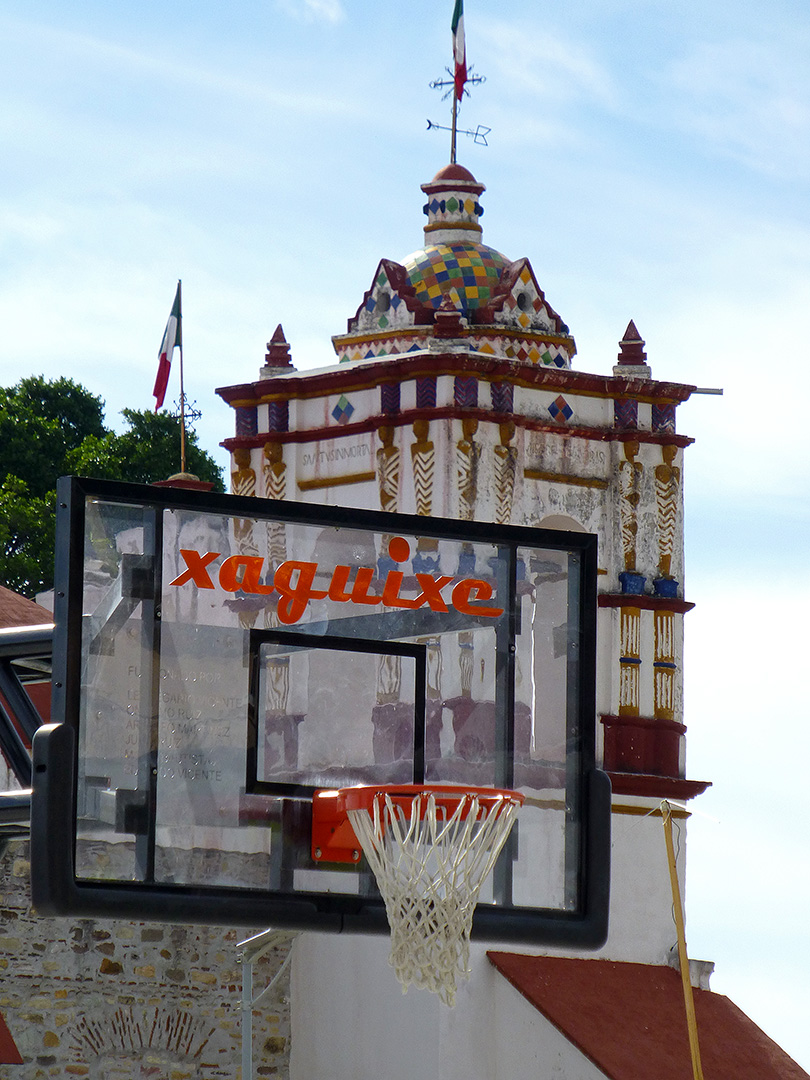

Unlike in wider mestizo Mexico, where soccer reigns supreme, in the Sierra basketball is king. The sport was introduced in the 1930s by president Lazaro Cardenas as a way to bring Oaxaca’s disparate and historically rebellious indigenous groups into the national fold.
Cardenas’ dream of a unified national identity didn’t take root in the Sierra, which has historically been isolated and impoverished, but basketball soon became tied to the region’s most significan traditions, and to indigenous identity itself. — Jorge Santiago


One of several canchas de baloncesto (basketball courts) in Teotitlán del Valle, Oaxaca.
Posted in Culture, Parks & Plazas, Sports & Recreation, Travel & Tourism | Tagged basketball, basketball courts, cancha de baloncesto, El Picacho, Mexico, Oaxaca, photographs, photos, popular travel destinations, Templo de la Preciosa Sangre de Cristo, Teotitlán del Valle | Leave a Comment »
A friend (who shall remain anonymous) was persuaded to model the mask I gave one of my sons for Christmas.

It is the work of Apolinar Sosa, the son of distinguished carver Jesus Sosa Calvo and Juana Vicente Ortega Fuentes of San Martín Tilcajete.

This mask won a prize and had actually been worn during the unique Carnaval celebration in the village.

Don’t you love the tongue of dried chiles?
Posted in Creativity, Culture, People, Travel & Tourism | Tagged Apolinar Sosa, devil mask, mascaras, masks, Mexico, Oaxaca, photographs, photos, San Martín Tilcajete, wood carving | 3 Comments »
I’m still in el norte, now on the west coast in the San Francisco Bay Area and it’s grey, raining, and cold. The rain is a much needed gift in drought stricken California, but the ground has rapidly become supersaturated and this morning’s news reported a giant ficus falling across Mission St. in San Francisco, taking down streetcar lines. I immediately flashed on Oaxaca’s ubiquitous, often topiaried, ficus trees.
However, I headed out into the storm and tuned into a Spanish language music station (I must be missing the soundtrack of my Mexican life) and was reminded today, January 6, is El Día De Los Reyes Magos (aka, Epiphany), when the Three Kings bring gifts to the children of Mexico.
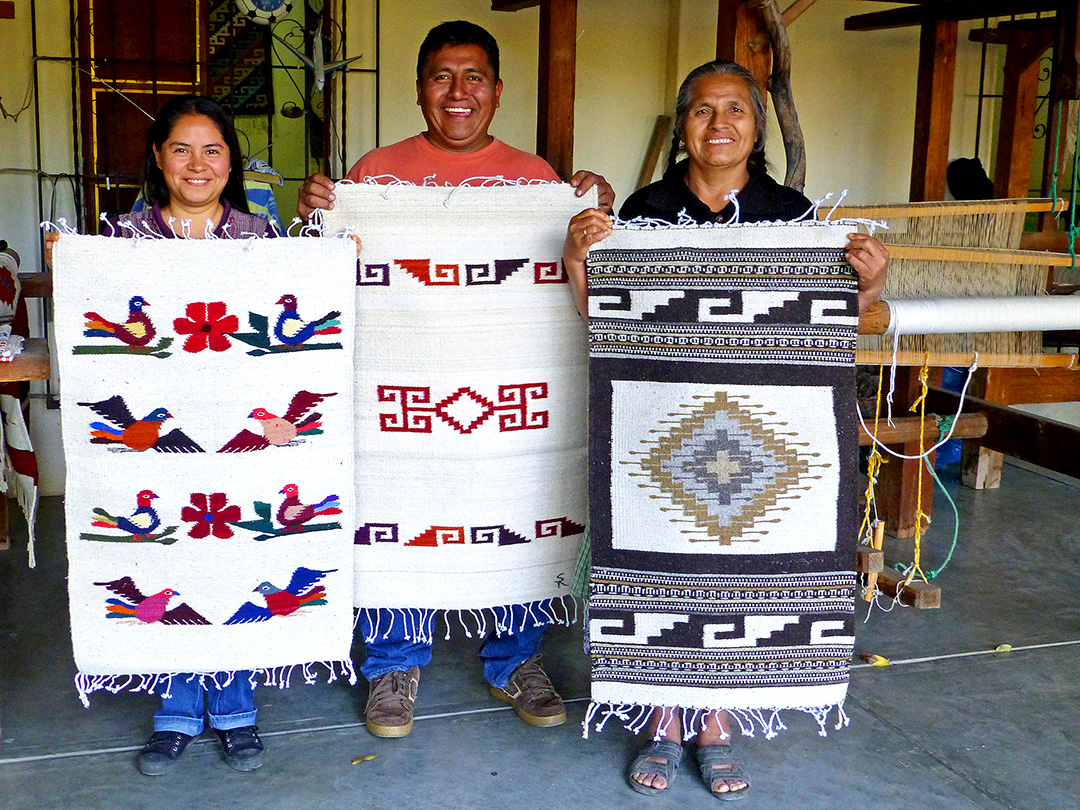
My (grown) children received their gifts on December 25, not January 6, and last year each received a tapete woven by the talented Sergio Ruiz Gonzalez — brother of Antonio, who wove my new rug. In the photo, that’s Sergio, his beautiful wife Virginia, and his lovely mother Emilia (of Lila Downs’ El Palomo del Comalito video fame).
However, I did receive an (unexpected) gift today — my former piano teacher (and forever friend) Greg Johnson stopped by to catch up. And, besides his always upbeat and delightful company, he brought me his new CD, Crystalline Thrilled. The guys of Glass Brick Boulevard are fabulous (as always) and guest artist Carlos Reyes shreds it on violin. Check out Carlos playing with Glass Brick Boulevard at the CD release party. What a great regalo I received!
Posted in Creativity, Culture, Holidays, Music, People, Travel & Tourism | Tagged Carlos Reyes, Crystalline Thrilled, El Día De Los Reyes Magos, Greg Johnson and Glass Brick Boulevard, music, photos, rugs, Sergio Ruiz Gonzalez, tapetes, Teotitlán del Valle, weavers | 7 Comments »
In the category of “your just never know,” the two-block long Callejón Hidalgo is a treasure-trove of murals.


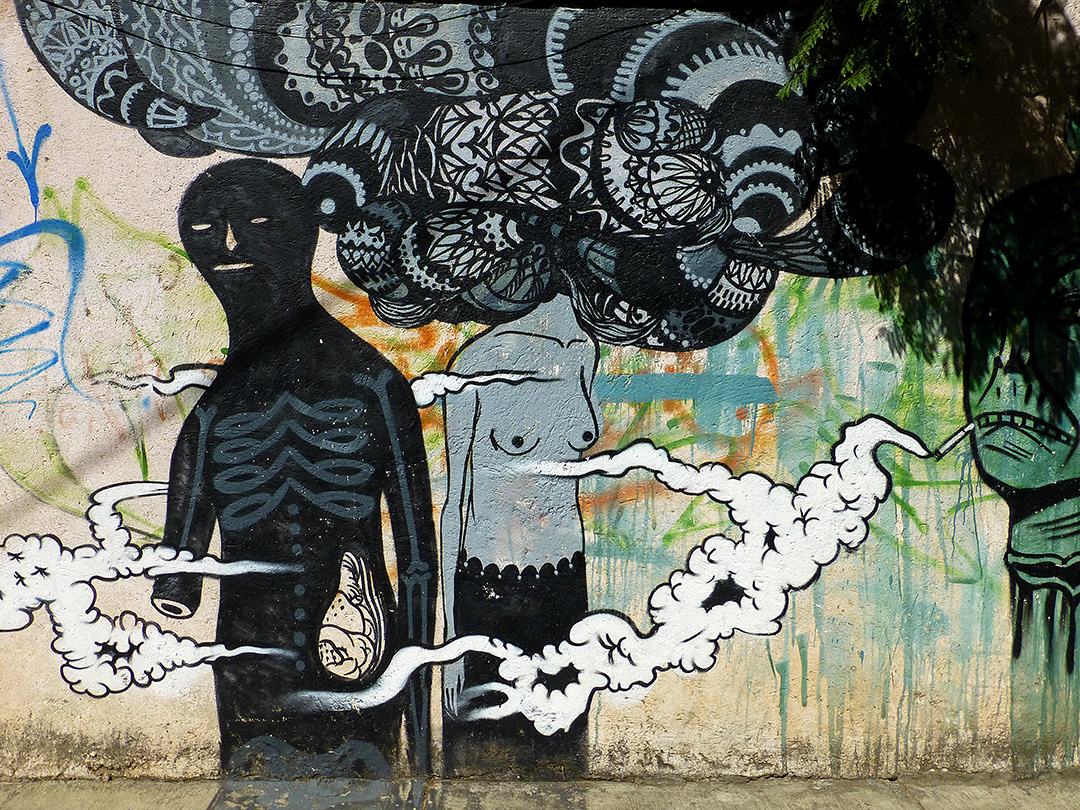
And, there are more! Located between Tinoco y Palacios and Porfirio Diaz above Calle Jesus Carranza, it’s well worth the trek up the hill.
Posted in Creativity, Culture, Travel & Tourism | Tagged Callejón Hidalgo, graffiti, Mexico, murals, Oaxaca, photos, street art, urban art | 12 Comments »
Muchisimas gracias to all my wonderful blog readers — for reading, for commenting, for sharing, for the opportunity to meet some of you, and for inspiring me to continue. A look back at Oaxaca scenes that never made it into the blog…
January – Although spring was a couple of months away, the Primavera (Tabebuia chrysotricha) was already in bloom.

February – Cattle car on the carretera outside Tlacolula de Matamoros on Sunday market day.

March – A quiet morning on Monte Albán.

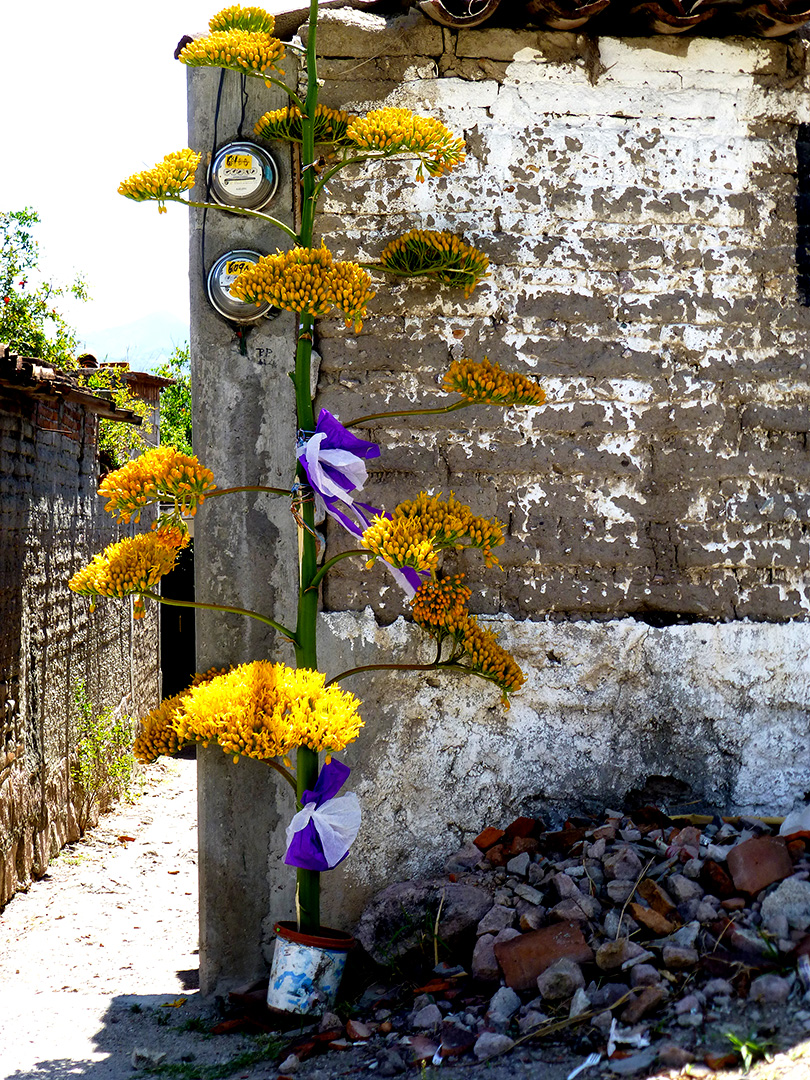
April – Decorating with agave flowers on Easter Sunday in Mitla.
May – Police temporarily remove and replace Sección 22 on the zócalo.

June – Though we arrived hours early for a festival in San Juan Guelavía, the sacred and profane were already present.

July – A favorite view from my terrace, the African tulip trees in full bloom.

August – At Casa Colonial the water lilies and hyacinths were stunning.

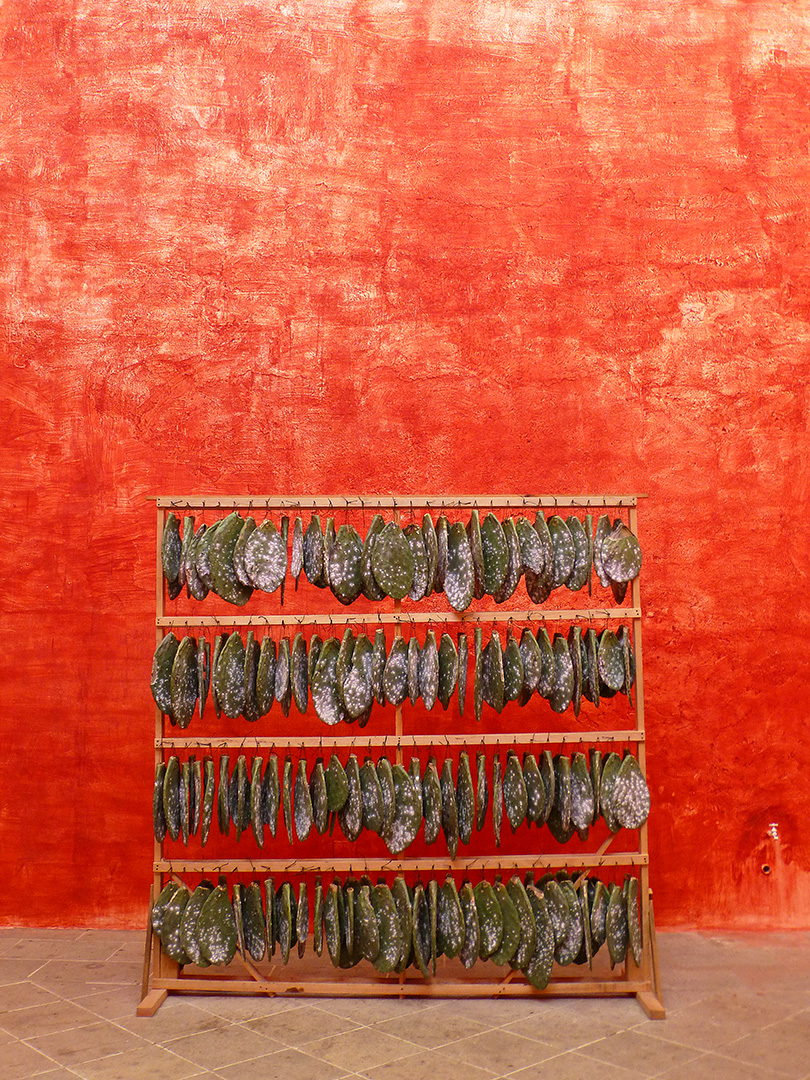
September – Cochineal (the “perfect red” dye) exhibition at Museo de Arte Contemporaneo de Oaxaca (MACO).
October – Returning from Teotitlán de Valle one morning, a globo was landing near San Mateo Macuilxochitl.

November – On the way to Mercado Hidalgo in Colonia Reforma to buy Thanksgiving groceries, Our Lady of the Wires (?).

December – Rooftop still life in El Centro.

A long, strange, and fascinating trip it continues to be. As another song says, Próspero año y felicidad!
Posted in Animals, Casita Colibrí, Celebrations, Culture, Exhibitions, Flora, Travel & Tourism | Tagged African Tulip trees, Casa Colonial, cattle, Cochineal, flowers, globos, hot air balloons, MACO, Museo de Arte Contemporáneo de Oaxaca, Oaxaca, Police riot shields, Primavera, San Juan Guelavia, San Mateo Macuilxóchitl, water lilies | 16 Comments »
This is how I feel today…

Actually, I took this a few weeks ago on Matamoros (at Tinoco y Palacios) with the intention of writing a blog post lamenting Christmas traditions (Christmas trees, Santa Claus, consumerism, etc.) migrating down from el norte. But, I think I’ll just let the image speak for itself.
Posted in Celebrations, Culture, Holidays, Travel & Tourism | Tagged Christmas, Christmas traditions, inflatable Santa Claus, Mexico, Navidad, Oaxaca, photographs, photos, popular travel destinations | 1 Comment »
‘Tis Christmas Eve in Nueva York and, while we may be dreaming of a white Christmas, there is not a snowflake in sight. However, the stockings are hung by the chimney with care, a plate of Christmas cookies is awaiting a hungry Santa Claus, and tonight I will read Pancho Claus to my grandson. It will be his first time hearing Ernie Villarreal’s version of Pancho Claus by Chicano music legend, Eduardo “Lalo” Guerrero. Hopefully, he will learn a few more words in Spanish and, whether I’m visiting or not, it will become a family tradition.

Pancho Claus
‘Twas the night before Christmas and all through la casa
Not a creature was stirring, Caramba! ¿Que pasa?
Los ninos were all tucked away in their camas,
Some in vestidos and some in pajamas.
While Mama worked late in her little cocina,
El viejo was down at the corner cantina.
The stockings were hanging con mucho cuidado,
In hopes that St. Nicholas would feel obligado
To bring all the children, both buenos y malos,
A Nice batch of dulces and other regalos.
Outside in the yard, there arouse such a grito,
That I jumped to my feet, like a frightened cabrito.
I went to the window and looked out afuera,
And who in the world, do you think que era?
Saint Nick in a sleigh and a big red sombrero
Came dashing along like a crazy bombero!
And pulling his sleigh instead of venados,
Were eight little burros approaching volados.
I watched as they came, and this little hombre
Was shouting and whistling and calling by nombre.
¡Ay, Pancho! ¡Ay, Pepe! ¡Ay, Cuca! ¡Ay, Beto!
¡Ay, Chato! ¡¡Ay, Chopo! ¡Maruca and ¡Nieto!
Then standing erect with his hand on his pecho
He flew to the top of our very own techo.
With his round little belly like a bowl of jalea,
He struggled to squeeze down our old chimenea.
Then huffing and puffing, at last in our sala,
With soot smeared all over his red suit de gala.
He filled the stockings with lovely regalos,
For none of the children had been very malos.
Then chuckling aloud and seeming contento,
He turned like a flash and was gone like the viento.
And I heard him exclaim and this is VERDAD,
Merry Christmas to all, And to All ¡Feliz Navidad!

Posted in Celebrations, Creativity, Culture, Holidays | Tagged 'Twas the Night Before Christmas, “Lalo” Guerrero, Christmas, Christmas decorations, Christmas Eve, Christmas ornaments, Christmas tree, Eduardo Guerrero, Ernie Villarreal, Mexico, Nacimiento de navidad, Navidad, Nochebuena, Oaxaca, Pancho Claus, poem | 6 Comments »
The “only in Oaxaca” Noche de Rábanos is coming! If you are in Oaxaca, the zócalo is the place to be on December 23 to watch radishes being carved into familiar and fantastical creations. Among the former, dancers from Oaxaca’s eight regions are a favorite.
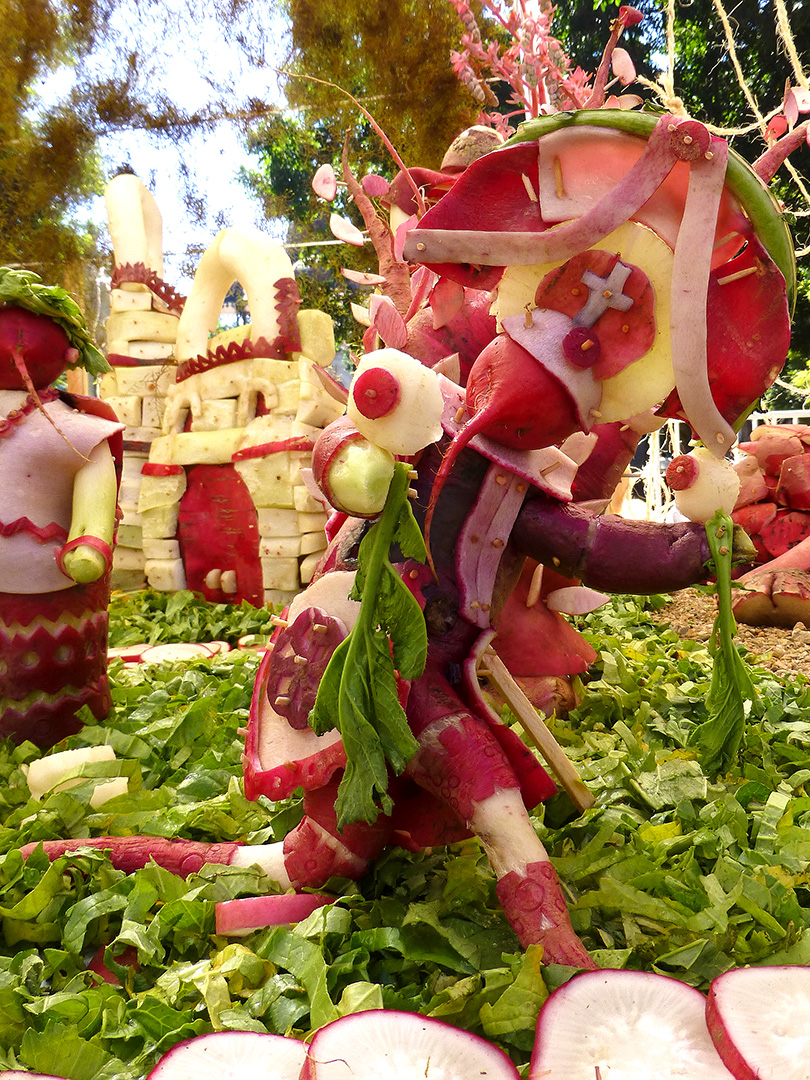
Danza de la Pluma dancer in Rábanos Tradicional category 2012

Baile del Guajolote dancer in Rábanos Libre category 2013
Despite of the name, it isn’t just about carved radishes. The artists of Oaxaca work their creative magic in several other categories, including dried flowers…
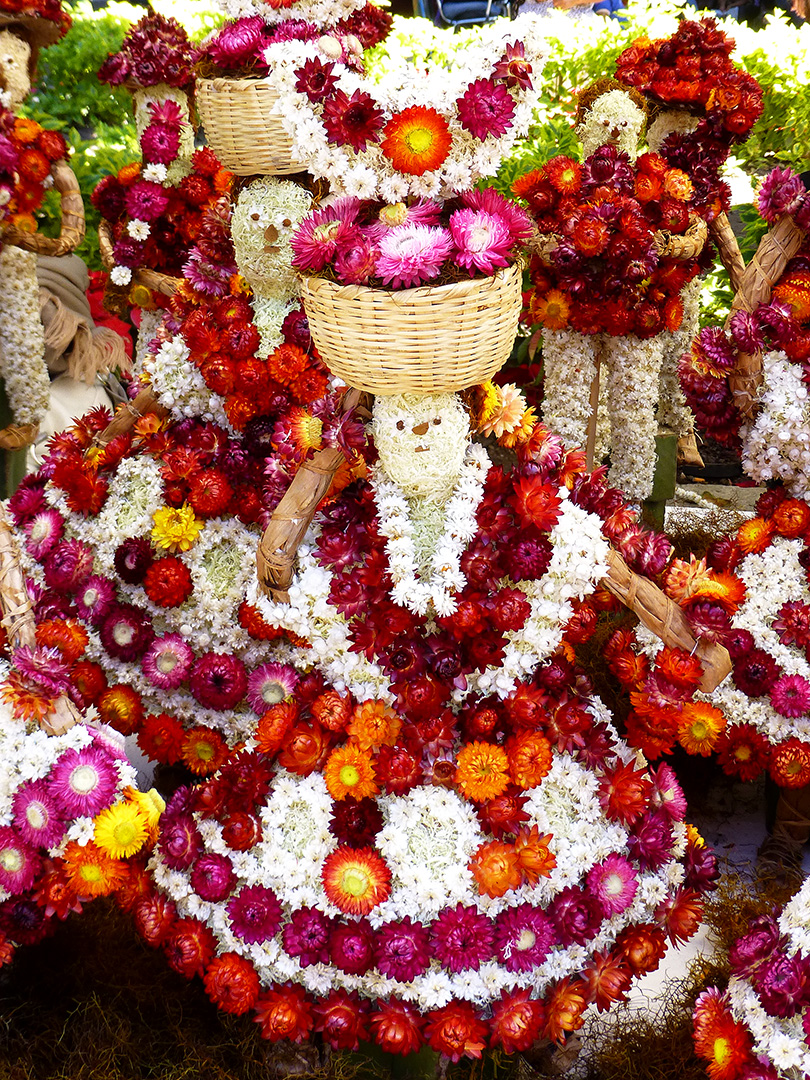
Chinas Oaxaqueñas in Flor Inmortal category 2012
… and corn husks.

Chinas Oaxaqueñas entry in Totomoxtle Natural category 2012
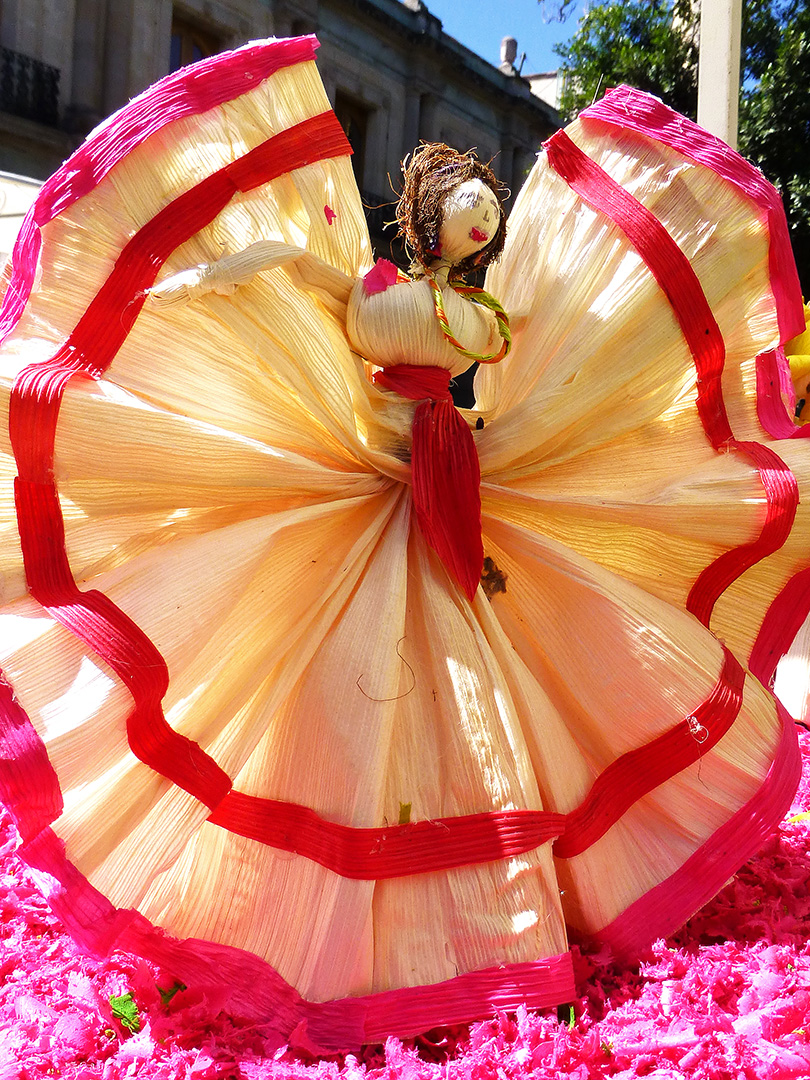
Jarabe Mixteco dancer in Totomoxtle Decorado category 2012

Danza de los Huenches Viejos de Yalalag in Totomoxtle Decorado category 2012
I wish I could be in two places at one time, so I could experience this year’s Night of the Radishes. If you are lucky enough to be there, enjoy and take lots of photos!
Posted in Celebrations, Creativity, Culture, Travel & Tourism | Tagged dancers, dried corn husks, flor inmortal, Mexico, Night of the Radishes, Noche de Rabanos, Oaxaca, photographs, photos, popular travel destinations, Totomoxtle | 3 Comments »
Yesterday was SO much fun!!! I’m spending Christmas with family in New York and was invited by my daughter-in-law to speak to her special education class. Wearing one of my huipiles from the Papaloapan region of Oaxaca, I filled them in on “life in Oaxaca.”

We looked at a map of Mexico and I pointed to where the state of Oaxaca is located.

We spoke a little Spanish and discovered that some familiar foods, like chocolate, gum (chicle), corn (maíz), and turkey (pavo), originated in Mexico. They learned that there are many artisan crafts made in Oaxaca and I showed them a tapete (rug) that was woven in Teotitlán del Valle.

We talked about festivals with processions, bands, marmotas, monos, and dancing. And, to illustrate the diversity of the indigenous peoples of Oaxaca, I created a short video from La Guelaguetza 2014.
We discussed the differences between Christmas traditions in Mexico and the USA — that Christmas trees aren’t as common, but most everyone sets up a nacimiento (nativity scene) in their home.

Of course, they loved the idea of breaking open a piñata filled with candy and trinkets.

I concluded with a video I’d made and previously posted of the castillo in Teotitlán del Valle during the festival honoring the Virgen del Rosario. Needless to say, they were awestruck by the fireworks. And then I gave them each a woven palm leaf piñata ornament. Alas, no candy inside!

I was very touched that my daughter-in-law returned home later in the afternoon bringing individualized thank-you notes from the students. However, I would like to give a big “muchisimas gracias” to her for inviting me and to her students for being such an attentive, engaged, and delightful audience!
Posted in Celebrations, Creativity, Culture, Education, Travel & Tourism | Tagged Christmas ornaments, classroom presentation, costume, dancers, Guelaguetza, Mexico map, Nacimiento de navidad, Nativity scene, Oaxaca, photos, piñata, rugs, tapetes, Teotitlán del Valle, traje | 8 Comments »
Saturday, like all Mexico, Teotitlán del Valle honored the Virgen de Guadalupe. As they do every December 12, the Danzantes de Promesa danced the Danza de la Pluma. However, this was the last performance by this group; their three-year commitment to their god, church, and community was at an end. And, as is their tradition, the dancers and their families offered the village food, drink, and a party to celebrate.


Dancers and their wives, parents, grandparents, godparents, sisters, brothers, and children came bearing fruits, candy, mezcal, and beer.


The children learn at an early age that it isn’t all about them — they are part of a community and have roles to play and contributions to make.


All ages and genders have a role. The men, more often than not, get the glory but look at these women! They radiate the strength and pride of 2000 years of Teotitlán del Valle, Zapotec history and culture.


As darkness fell and after dancing for several hours, 9-year olds, Juana Lizbeth Contreras (Malinche) and Ailani Ruiz Ruiz (Doña Marina) made the rounds of the thousands gathered on the church plaza to distribute their gifts to their community. It was then that emotion overwhelmed me.
A profound muchisimas gracias to the people of Teotitlán del Valle for being so welcoming over the years to a couple of gringo bloggers. Chris and I are so grateful for your generosity of spirit. Definitely, more to come…
Posted in Celebrations, Culture, Holidays, Travel & Tourism | Tagged Danza de la Pluma, danzantes, Día de la Virgen de Guadalupe, decorative gourds, Mexico, Oaxaca, offerings, photographs, photos, popular travel destinations, Teotitlán del Valle, Virgen de Guadalupe, Virgin of Guadalupe | 8 Comments »
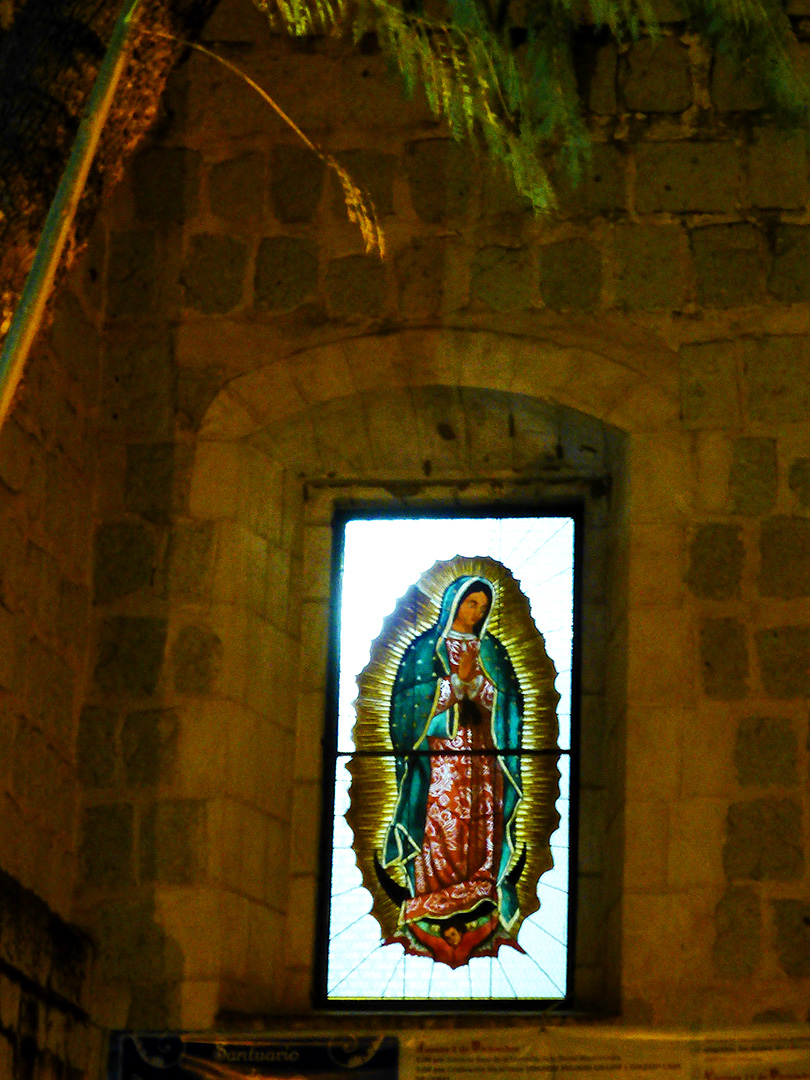
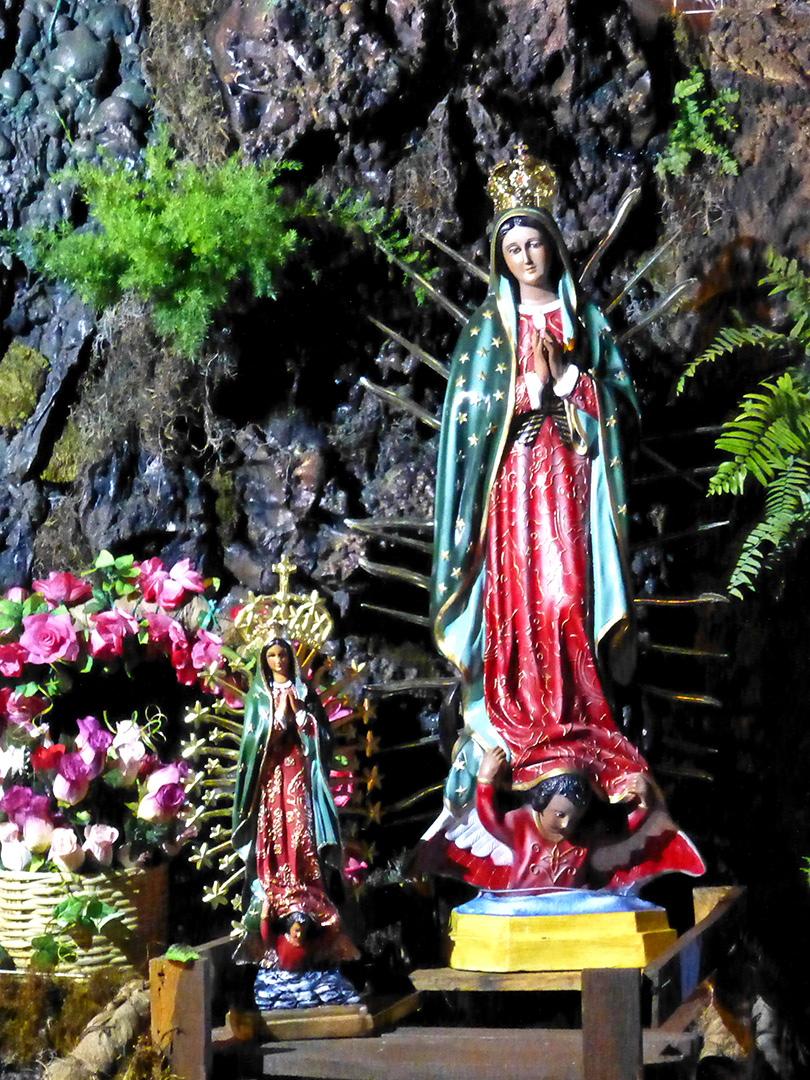
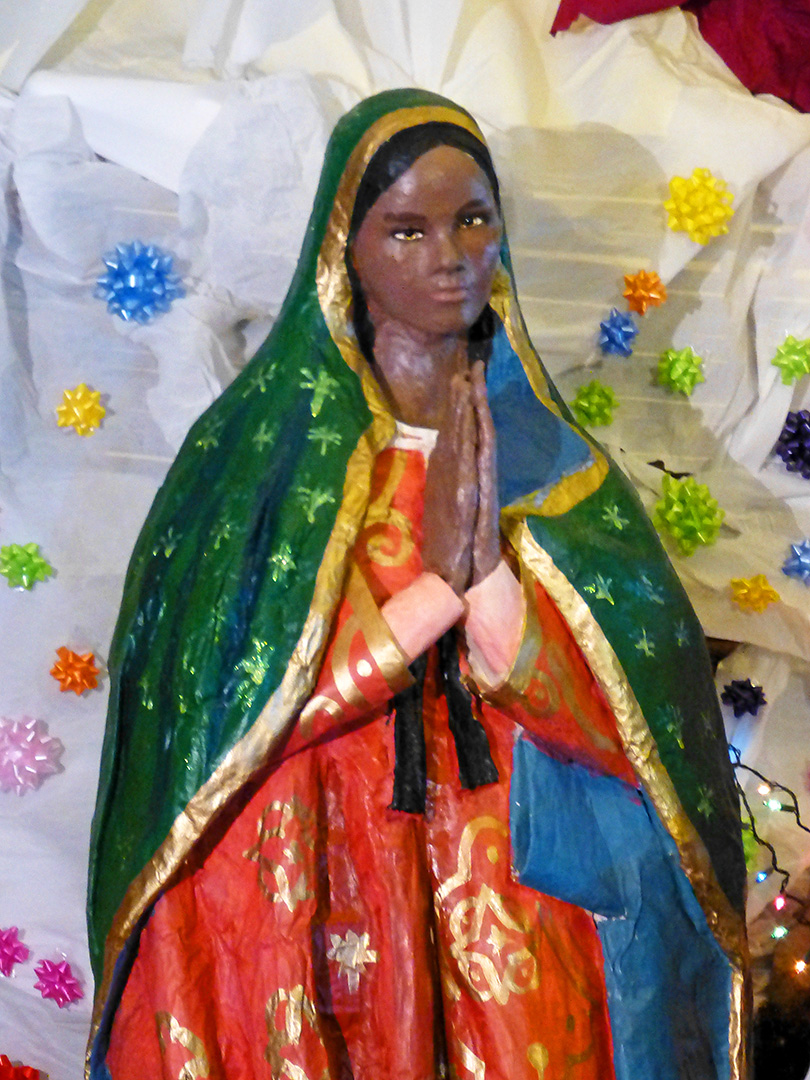
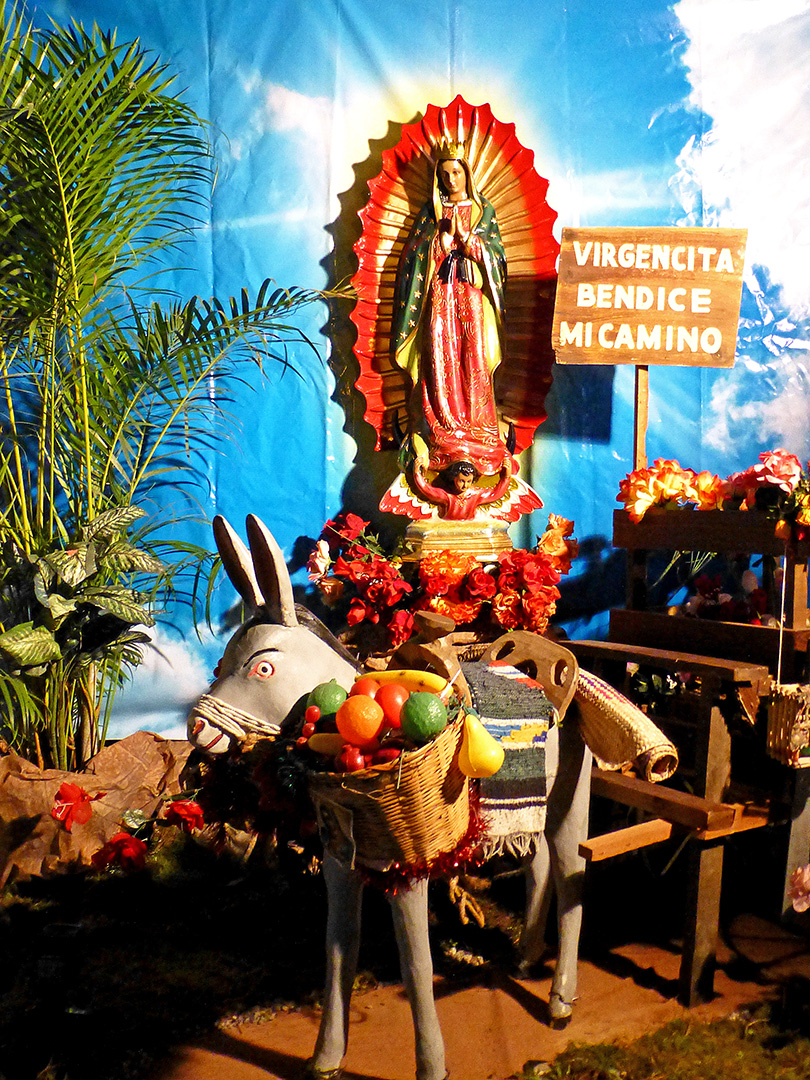
The bells, bands, and booms have been soundtrack of the city for a week — the virgins are being celebrated! First in line, on December 8, for chiming church bells, processions, and fireworks was the Virgen de Juquila and third will be Oaxaca’s patron saint, the Virgen de la Soledad on Dec. 18. However, in between the eighth and eighteenth, all of Mexico honors the Virgin of Guadalupe. Today, December 12 is her day but, like the others, the festivities began days in advance.
Scenes from last night in front of the Iglesia de Guadalupe in Oaxaca city…
Now on to Teotitlán de Valle for this afternoon’s Día de Guadalupe performance of the Danza de la Pluma. We have been told the festivities will last all night, as the community will also be saying “adios” to this group of dancers — their three-year commitment is at an end. It will be a miracle of the Virgin if we can party hardy until even midnight, but we will give it the old college try!
Posted in Celebrations, Creativity, Culture, Holidays, Religion, Travel & Tourism | Tagged Danza de la Pluma, historical photographs, Iglesia de Guadalupe, Mexico, Oaxaca, photos, popular travel destinations, Virgen de Guadalupe, Virgen de Juquila, Virgen de La Soledad, Virgin of Guadalupe, Virgin of Juquila, Virgin of Solitude | 2 Comments »
As I’ve previously written, two separate (and battling) French designers were exposed as plagiarizing the traditional embroidery designs of Santa María Tlahuitoltepec, a village in the mountainous Mixe region of Oaxaca.

However, at last there is a triumph for the embroiderers and the time-honored motifs handed down from their ancestors and inspired by the land — A Court Rules High-End French Label Doesn’t Own Rights to Indigenous Oaxacan Design.

The people of Santa María Tlahuitoltepec may not be financially wealthy, but they and their community are rich in culture and pride in their history and traditions. They are not angling for a monetary settlement — all they want is that their work and designs be recognized and respected.

While we are on the topic of disrespect of indigenous peoples, we have the recent disgraceful Coca-Cola México advertisement, showing Hipsters Bringing Soda To Indigenous Mexicans — another Mixe village, Totontepec Villa de Morelos. After an immediate social media campaign challenged the ad, Coca Cola pulled it. As this teleSUR article details, This New Coca Cola Ad Shows Mexico’s White Savior Problem. In addition, like the USA, obesity is growing problem here, thus a Reply to Coca-Cola comes in new video by the Alliance for Food Health featuring two Mixe students speaking about the health risks posed by these kinds of “soft drinks” that lack any nutritional value.
By the way, the English language Mexico News Daily is running a poll, asking if you “agree that the controversial Coca-Cola Christmas video was racist or offensive?” And, I’m appalled that as I write, the results are: 32% yes and 68% no!!!
Posted in Creativity, Culture, Textiles, Travel & Tourism | Tagged Antik Batik, Coca-Cola ad, Isabel Marant, Mexico, Mexico News Daily poll, Mixe, Oaxaca, photographs, photos, popular travel destinations, Santa María Tlahuitoltepec, Totontepec Villa de Morelos, traditional blouses, traje | 8 Comments »
Artist Fabián Calderón Sánchez (aka, Sanez) has changed the face of the building next to Hotel Azucenas again!
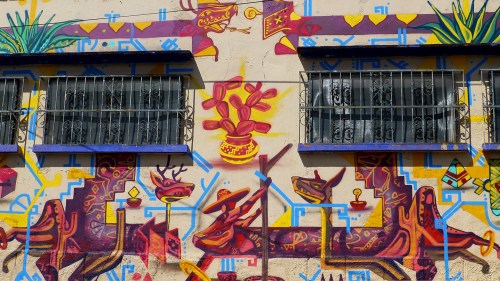
Located on calle Martiniano Aranda, in the 6-1/2 years I’ve lived in the ‘hood, the front of this building has played host to two previous murals by Sanez.


I’ve been a big fan of his distinctive work and was again captivated by his creative and powerful use of indigenous imagery.


The mural is signed, Macuilxochitl Losdelaefe — MTY (Monterrey) – OAX (Oaxaca) – GDL (Guadalajara) – www.sanez.mx – 2015.
Let us hope this doesn’t meet the same fate as other murals in my neighborhood recently have.
Posted in Creativity, Culture, People, Travel & Tourism | Tagged art, Fabián Calderón Sánchez, graffiti, Mexico, murals, popular travel destinations, Sanez |
Black Friday and Cyber Monday sales are in the rear view mirror, December is upon us — only twenty-three more shopping days until Christmas — and the shopping frenzy in el norte continues. Thanks, but no thanks, I say. I prefer this…
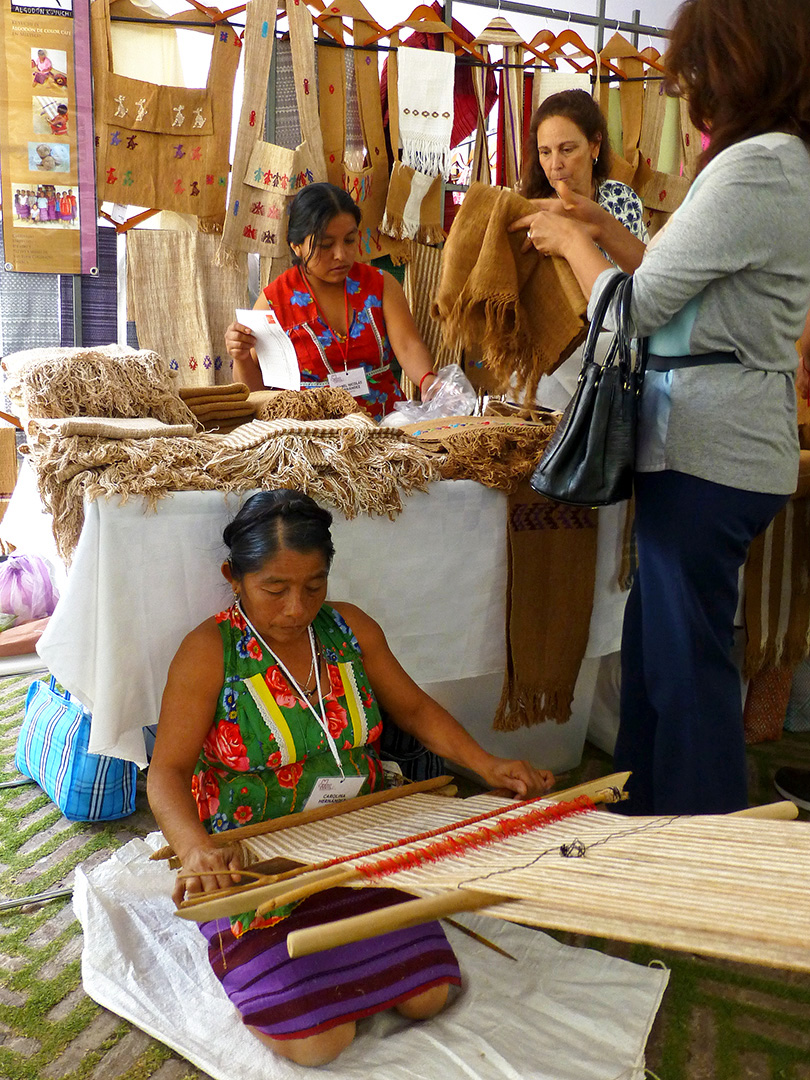
Weaver from the Katyi Ya’a Taller Colectivo de Algodón Native (Collective workshop using native cottons)
On the Friday after Thanksgiving, I took leisurely stroll down to the 2-day expo-venta (exposition and sale), sponsored by the Museo Textil de Oaxaca and held in the tranquility of the Centro Cultural San Pablo patio. After much oohing and ahhing and talking with many of the artisans, I headed up 5 de mayo to one of my favorite pocket courtyards and the shops tucked in along its garden path…
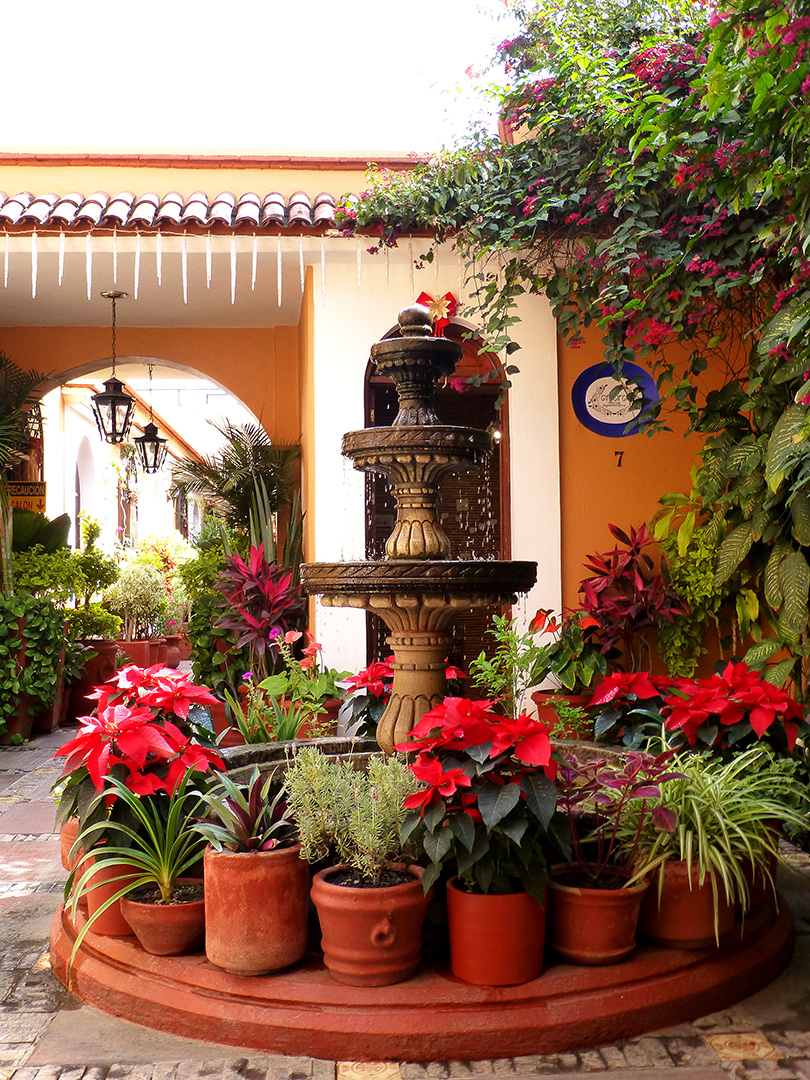
5 de mayo #408 – home to tapetes (rugs) at the Fe y Lola gallery and Seasons of My Heart retail store, among other small shops.
I won’t reveal where or if I bought anything — I wouldn’t want to spoil any Christmas surprises! What I will say is… I prefer strolling to rushing; personally meeting and paying the artisans for their work to handing over a credit card at an impersonal department store; and, perhaps most of all, experiencing the pride radiated by an item’s creator when I admire their work.
Posted in Culture, Gardens, Holidays, Markets, Textiles, Travel & Tourism | Tagged artisans, courtyard, expo-venta, Mexico, Oaxaca, photographs, photos, shopping, textiles, weavers | 5 Comments »


 Mexican Peso Converter
 View From Casita Colibrí