Feeds:
Posts
Comments

Archive for the ‘Exhibitions’ Category

The textiles of Oaxaca are currently on center stage, both literally and figuratively, during these 10 days of Guelaguetza festivities.  And perhaps, besides drawing in much-needed tourist pesos, the Guelaguetza plays an important role in the appreciation and preservation of Oaxaca’s textile traditions.

Delegation from San Andrés Huaxpaltepec, District of Jamiltepec, in the Costa region of the state of Oaxaca.

However, the textile traditions of Lebanon have not fared so well.  According to the article, The End of the silk road, by Ana Marie Lucas and posted to Now Lebanon, silk production, which dates back to the Middle Ages, is on death’s doorstep.  Only two artisanal workshops remaining today.  However, along with the Italian Embassy, the Mexican Embassy, Alfredo Harp Helú Foundation, and Textile Museum of Oaxaca are coming to the rescue.

“We wanted to share our experience with the Lebanese,” Mexican Ambassador Jorge Alvarez Fuentes told NOW Extra. “When I saw the House of the Artisan closed and in need of more attention I thought this was the perfect place to exhibit both Mexican and Lebanese items,” he explained.

“Aside from the exhibition, we wanted to organize two conferences and a workshop of how to dye the silk with natural pigments. This way many people will be able to see how the Phoenicians could extract the purple dye from the Murex shell,” he added.

According to Héctor Meneses, head of the Textiles Museum in Oaxaca, there are surprising similarities between the Lebanese and Mexican traditions in terms of pigment extraction. Mexicans extracted the red dye from a species of snail, very similar to the purple dye extracted by the Phoenicians from the Murex shell. “The difference is that in Mexico, this process is still alive and it’s being used,” he said during a conference.  [Read full article HERE]

FYI:   Alfredo Harp Helú is a Mexican businessman who, like his cousin Carlos Slim Helú (world’s richest man), is of Lebanese extraction.  Harp Helú maintains a residence in Oaxaca and, besides his foundation funding the Textile Museum, he and his foundation are involved in several other philanthropic projects in the state of Oaxaca.

h/t to Margie Barclay for the article.
Read Full Post »

It didn’t start that way; I awoke to horrifying news from Colorado.  Thank goodness blogger buddy Chris called and the heart that beats in Oaxaca beckoned.

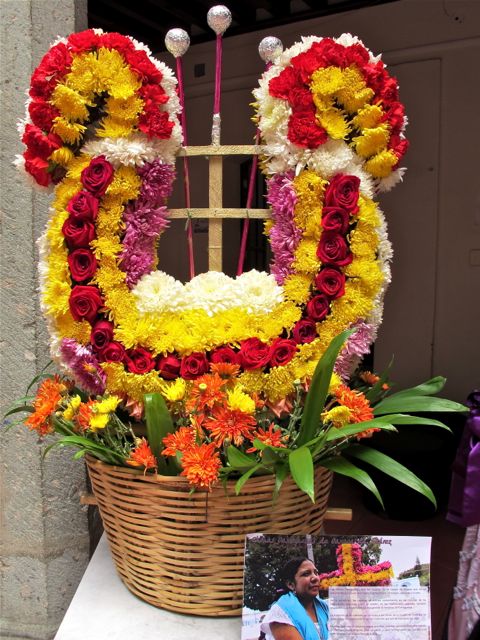
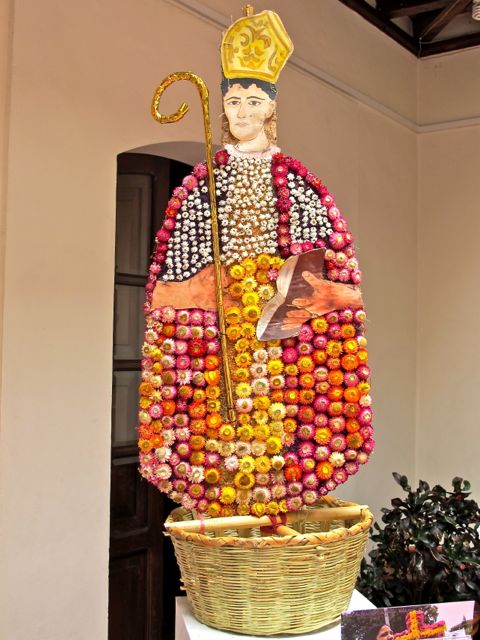
First stop was the “Al Son del Valle,” an exhibition of canastas from 17  villages in the central valleys of Oaxaca.  These are baskets that are carried on the heads of women during calendas (parades); you may remember them from previous posts on the convites in Teotitlán del Valle.  The art of crafting canastas and the traditions and culture they represent have been proudly and lovingly passed down through the generations.

San Antonino Castillo Velasco canasta decorated with Flor Inmortal, the flower that never dies.

Canasta from San Mateo Macuilxóchitl

From San Jerónimo Tlacochahuaya, these canastas are lit and become pinwheels of fireworks at the end of a calenda.

Canasta of Las Chinas Oaxaqueñas of the city of Oaxaca

Canasta from Tlacolula de Matamoros.

Canasta from Zimatlán de Álvarez made of crepe paper.

Muchas gracias, Oaxaca, I needed that!

Read Full Post »

As hoped, I managed to make my way to the Mexican Consulate in San Francisco for .  It’s the exhibit (I mentioned a few days ago) that celebrates the Zapotec artists of Oaxaca from Rufino Tamayo and Francisco Toledo to those they encouraged and influenced.

On the consulate’s ground floor the scene was a familiar one — signage and conversations en español; the eagle, serpent and green, white, and red of the Mexican flag prominently displayed; waiting room filled with patiently waiting people — a sliver of Mexico in San Francisco.  Climbing the two flights of stairs (elevator was broken) up to the third floor, a friend and I found the exhibit…

This slideshow requires JavaScript.

According to the article, Oaxacan surrealism hits the SF Mexican consulate, the consulate’s cultural affairs attache, Marimar Suárez Peñalva, hopes the gallery and its exhibitions will offer Mexican expats an opportunity to connect with the creativity, not just the bureaucracy (my word), of their culture.  However, I don’t know how many of those waiting on the first floor make it up to the third floor; early in the afternoon, we had the gallery to ourselves.

And yes, works by Tamayo and Toledo are included, but I thought I’d feature some of the lesser known artists.  By the way, did you notice the name, Alejandro Santiago Ramírez?  This is the same Alejandro Santiago of the 2501 Migrantes sculptures that I’ve previously written about.

Read Full Post »

I’m again in the San Francisco Bay Area, visiting family and friends and taking care of the odds and ends of still maintaining a presence here, while living in Oaxaca.  We’ve had clear blue skies and sun and, except for the high-speed pace and exorbitant price of food, it “almost” feels like home.  Hey, I even bought some resin chairs for my son’s backyard and ate some of the best Mexican food ever (in the USA) at Doña Tomás in Oakland.  (FYI:  The Callos con Sopa de Elote — puréed corn soup with seared day boat scallops and fingerling potatoes, roasted poblano chiles and cilantro, served with arroz achiote — was divine.)

To also keep from getting too homesick for Oaxaca, there are a currently a couple of exhibits in San Francisco I plan to see while here.  I found out about The Magic Surrealists of Oaxaca, Mexico from the Oaxacan surrealism hits the SF Mexican consulate article in the SFBG, which explains…

Aquatint etching

Francisco Toledo’s aquatint etching “Self Portrait”

The Zapotec identity … is one of the unifiers of the exhibit, which contains the works of not only [Rufino] Tamayo and [Francisco] Toledo but also artists who were inspired by their work like Justina Fuentes Zárate, she of the reclining mermaid and arresting red dress. Perhaps the works don’t look similar, but they represent the diversity and breadth of the work to come out of the surrealist Zapotec tradition in Oaxaca.

And, then I read the NPR story, In Mexico, Mixed Genders And ‘Muxes’, about a Galería de la Raza exhibit.

Parade of Muxes in traje of Juchitán

Photo from the exhibit

Searching for Queertopia revisits the experiences of Alexander Hernandez’s participation and Neil Rivas’ visual documentation of what is called, the Vela de ‘Las Intrépidas.’ This event, a 3-day celebration, is held annually in the town of Juchitán de Zaragoza, Oaxaca, México, in honor of its Muxe community.

Hmmm… maybe I’ll take the ferry over to “The City” tomorrow.

Read Full Post »

A belated Happy 20th Birthday, Museo de Arte Contemporáneo de Oaxaca!

20 MACO banner

As the theme of the birthday celebration on February 28th said, Say ‘Coma’ Twenty Times,

20 and 4 bicycles with a comma in the center of the front wheels

COMA, COMA, CO-MACO, MACO, MACO…

Large red 20 painted on window

Come say, Feliz Cumpleaños MACO, in person!

Read Full Post »

There are only a few more days left to be delighted by “Manos que crean y ojos que leen” (Hands that create and eyes that read), a whimsical exhibition of popular art at the Biblioteca Andrés Henestrosa.  The pieces were commissioned by Rosa Blum (who, with Henry Wangeman, owns Oaxaca’s bilingual bookstore Amate Books) to celebrate reading and promote the incredibly creative artisans of Oaxaca who were suffering from a drop in tourism following the social conflict of 2006.

This slideshow requires JavaScript.

So…  If you are in Oaxaca, be sure to see it before it closes at the end of this month.  If not, you might want to consider a trip down here (Oaxaca is NOT on the US State Department travel warning list), visit some of these artisans in their villages, see their work up close and personal, and perhaps purchase a few unique treasures from these talented people.

For other pieces in the exhibit, see Chris’s photos over at Oaxaca-The Year After.

Read Full Post »

… let us walk together.  And we, in Oaxaca city, have been for the past several weeks thanks to Oaxaca born artist Alejandro Santiago.

The streets and sidewalks around Santo Domingo have been peopled with “La Ruta del Migrante – Caminemos Juntos,” his heart wrenching sculptures representing the 2,501 migrantes, men and women, who have left his pueblo of San Pedro Teococuilco almost deserted.

No two sculptures are the same; each is a tribute to the unique individuals who, most certainly with great reluctance, left the homes of their families and ancestors to make their way north in search of jobs.  The pain in their contorted bodies, their faces, and their feet causes me to pause every time I pass.  I’ll let the images speak for themselves and ask the questions societies all over the world need to answer.

This slideshow requires JavaScript.

These migrantes on the streets of Oaxaca are scheduled to disappear at the end of the month and I don’t know where they are next headed.  However, two documentaries have been made about Santiago’s tribute to migrantes:  Twenty Five Hundred & One by Patricia Van Ryker and 2501 Migrants: A Journey directed by Yolanda Cruz.

Read Full Post »

… equals public art on Calzada Niños Héroes de Chapultepec, a section of the legendary Pan-American Highway in Oaxaca’s capital city.

On October 27, 2011, representatives from the groups Espantapájaros, Asaro, Bouler, Viyegax, Arte Jaguar, Lapiztola, and Uriel Marín set to work transforming a long drab wall into a work of art representing the social, cultural, and political life of Oaxaca and Mexico.  The wall of graffiti was part of the Puntos de Encuentro, Primer Festival de Artes Visuales Oaxaca 2011, previously mentioned in my mid-October blog post, Meeting Points….

This slideshow requires JavaScript.

As of a few days ago, the artwork remains to catch the eye of drivers (yikes!), passengers, and pedestrians.

Read Full Post »

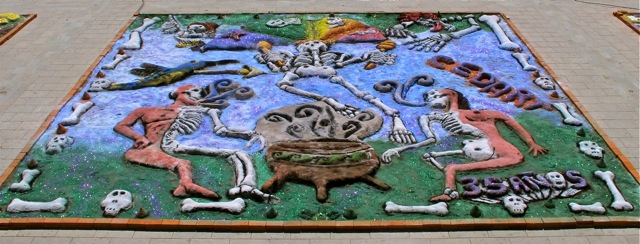
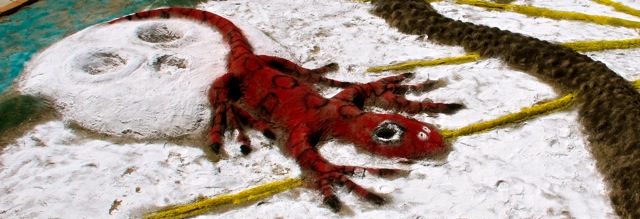
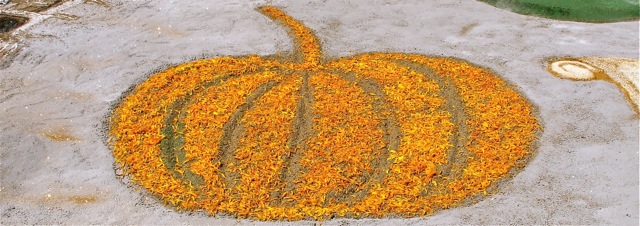
The tapetes de arena are finished and cover the stone flooring of the Plaza de la Danza.  Always difficult to photograph, the following are an experiment in cropping.

Centro de Educación Artística Miguel Cabrera

Casa de Cultura de Tlacolula de Matamoros

Escuela de Bellas Artes de la Universidad Autónoma Benito Juárez de Oaxaca

Several other organizations participated and among the unsigned are tapetes de arena from Casa de las Artesanías de Oaxaca, Sociedad Civil de Maestros Oaxaqueños del Arte Popular, and Grupo Colectivo Camaleón.

Walk with us…

And for those in el norte…

A happy and safe Halloween!


Read Full Post »

Work on the Días de Muerto tapetes de arena (sand paintings) began this morning…

This slideshow requires JavaScript.

By the way, this year they are in the Plaza de la Danza and, as I write, the music of the Orchestra Infantil Libertad (a children’s orchestra) is serenading the completed tapetes de arena, the audience gathered at the Plaza de la Danza, and yours truly, sitting comfortably at her desk.

Read Full Post »

Strolling up Macedonio Alcalá on Sunday, I stumbled on an exhibit and workshop being set up in the middle of this walking street, courtesy of Puntos de Encuentro, Primer Festival de Artes Visuales Oaxaca 2011 (Meeting Points, the First Visual Arts Festival, Oaxaca 2011).

This slideshow requires JavaScript.

Reason number ??? (I’ve lost count) why I love Oaxaca!!!

Read Full Post »

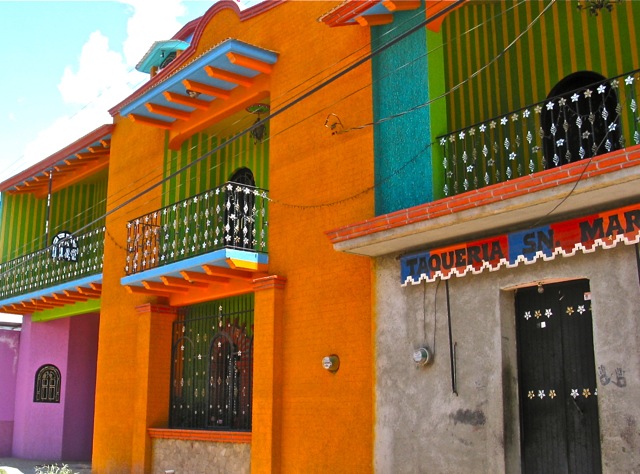
Yesterday, a couple of gal pals and I headed south of the city to San Martín Tilcajete.

Colorfully painted buildings
They were in search of alebrijes (hand-carved and intricately painted wooden creatures).  We shared the roads…

Herd of goats and goat herders on a dirt road

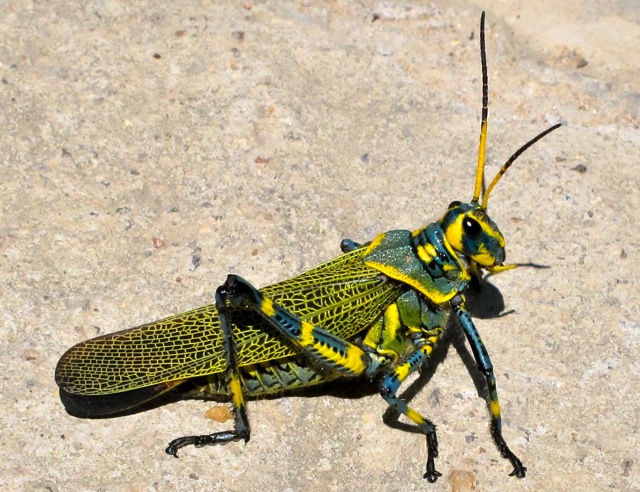
and the sidewalks with local inhabitants.

Green grasshopper with yellow and black markings on sidewalk.

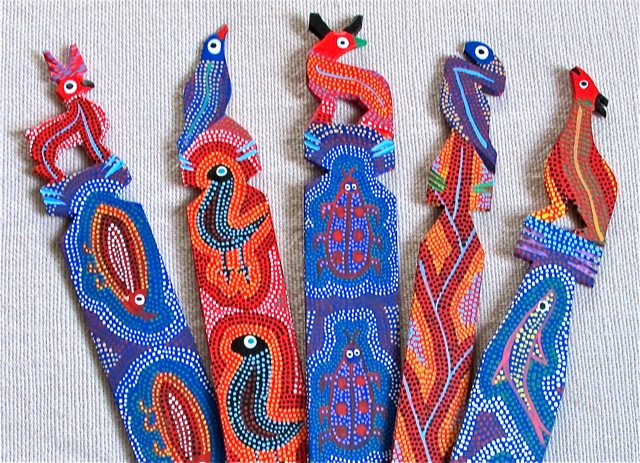
With real critters like this, it’s no wonder the carvers and painters of San Martín Tilcajete are inspired to imagine and create the beautiful and fanciful.

Intricately painted wooden bookmarks topped with colorful creatures.

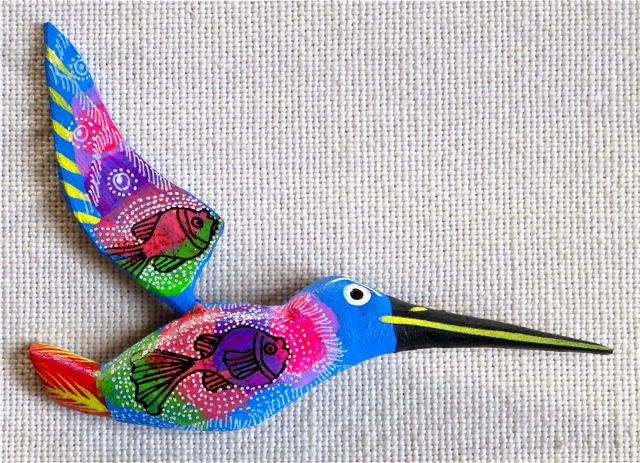
I hadn’t planned to buy anything, but couldn’t resist a colibrí refrigerator magnet, to add to my growing collection of hummingbirds… both real and imagined!

Brightly painted wooden refrigerator magnet

While there, we discovered San Martín Tilcajete will be holding an exposition at the end of the month to showcase, promote, and (hopefully) sell Oaxacan folk art.

Poster for the exposition of Oaxacan folk art on Oc. 28 - Nov. 3

In addition, the Oaxaca Lending Library will be presenting a slide show on Oaxacan Folk Art on October 26.

Read Full Post »

Seen at the Biblioteca Pública Central Margarita Maza de Juárez on Friday…

Heart on the right?  Don’t mess with this librarian!

Shhhh…

Whew!  just part of an eye-catching exhibition at the library.

Read Full Post »

Currently at the Museo Nacional de Antropología

Spanish conquest still “open wound in Mexico,” curator says

Banner for La Conquista a sangre y fuego

Mexico City, Mexico (NTN24 Wires) – The Spanish conquest continues to be “an open wound in Mexico” five centuries later, the curator of the National Museum of Anthropology’s “La Conquista a sangre y fuego” (The Conquest by Fire and Blood) exhibition, Francisco Gonzalez-Hermosillo, said.

“There have been all kinds of reactions, but, especially, there are many who leave very hurt after seeing the bloody images that speak of the violence there was during that period in history,” the researcher told Efe.

The paintings, codices and arms that make up the exhibition show the cruel methods used by the Spanish to impose their rule on Mesoamerica, Gonzalez-Hermosillo said.

The exhibition was organized to mark the 490th anniversary of the conquest of the Aztec city of Tenochtitlan, where Mexico City is situated, by Spanish conquistador Hernan Cortes.

The goal of the exhibition is not to “change perceptions of history” but to give the Indians’ view of the conquest because it is “so seldom taken into account,” Gonzalez-Hermosillo said.  [Read full article]

Fifty-three percent of Mexico’s indigenous population lives in Oaxaca (Sipaz report).  One can only hope Oaxaca is on the itinerary for this traveling exhibit.


Read Full Post »

« Newer Posts