Feeds:
Posts
Comments

Archive for the ‘Exhibitions’ Category

Calendas (parades) are already occurring on the city’s streets and banners advertising Guelaguetza events are hanging from street lights on the major calles.  Below are just a handful (or two) of the activities coming up.  (Click each poster for a larger and more readable image.)

For a more complete list, check out this schedule of events from the Secretaría de Turismo y Desarrollo Económico (Ministry of Tourism and Economic Development):

1HsFHBT

Read Full Post »

Eight months and counting… Tonight, eight months ago, 43 students from the Escuela Normal Rural Raúl Isidro Burgos teachers’ college in Ayotzinapa, Guerrero went missing.  I am sadly resigned that marking this horrific anniversary has become a regular feature on my blog.  As a mother, a guest resident of Mexico, and someone who believes that the peoples of the world deserve social justice, I can’t ignore this tragedy.

I dare you to leave Carteles por Ayotzinapa, the current exhibition at Instituto de Artes Gráficas de Oaxaca (IAGO), with a dry eye.  The 49 posters on display are only a fraction of the over 700 posters submitted to the First International Poster Biennial 2014 Convocation Ayotzinapa, an initiative of Oaxaca’s internationally renown artist, Francisco Toledo.  In addition to Mexico, artists from Argentina to Greece; Iran to Lebanon; and Poland to the USA responded to his call, recognizing as Toledo explained, the tragedy of Ayotzinapa has outraged people from beyond the borders of Mexico.

Photo courtesy of Oaxaca Media

Photo courtesy of Oaxaca Media

Irwin Homero Carreño Garnica, a graphic design student, originally from Ocotlán de Morelos, Oaxaca, was awarded first prize for his heartbreaking work, “México fracturado por Ayotzinapa” (Mexico fractured by Ayotzinapa).  As you can see above, it is a map of Mexico in the shape of a skeleton, with a break in the femur, where Ayotzinapa, Guerrero is located.  Like the work of the Tlacolulokos, the use of an iconic image (skeleton) and a primary palette of black, white, and greys, increases the emotional impact, much like Picasso’s, “Guernica.

Second place was won by Damian Kłaczkiewicz (Poland) and third place went to Daniela Diaz (Mexico).  The three winning posters will be reproduced for distribution throughout Mexico.

The exhibition runs through June 26, 2015.

Read Full Post »

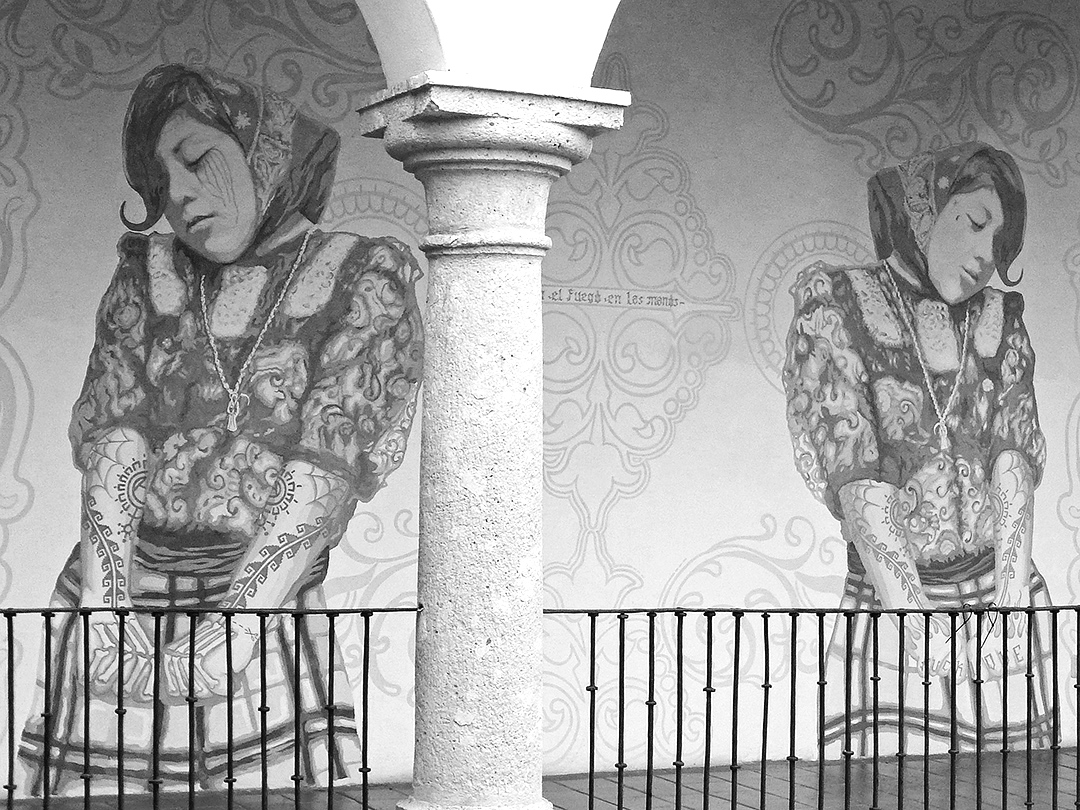
The previously mentioned Tlacolulokos collective has brought their artistry and social commentary to a wall on the upper floor of the Casa de la Ciudad.  The mural, “Con el fuego en las manos” shows two young women, almost mirror images of each other or, perhaps, two sides of the same woman.

P1090454

The young women/woman wear the traditional clothing of San Bartolome Quialana, a village near Tlacolula de Matamoros, home of the Tlacolulokos collective.  Like communities throughout Oaxaca, much of the male population has migrated to the United States, in search of work leaving the women to carry on alone.

As the introduction to the exhibit on the Casa de la Ciudad website explains, With a critical view towards the current cultural context, Tlacolulokos group, headed by Darío Canul and Cosijoesa Cernas, seeks to question the idealized images of the Oaxacan culture, tourism product discourse, and insights from the reality currently experienced by the people of Oaxaca.

There are elements in her clothing belonging to the Latina culture of the southern United States, as the cholo bandana that she wears on her head, or the tattoos on her arms that add a critical and provocative tinge to this cultural mix, a product of migration.  [ Google translation, with a little help from yours truly]

One of the trademarks of  the Tlacolulokos group is the power their images acquire and the emotion they elicit by limiting the palette to black, white, and grays.  For more background and a better understanding of the mural, a video (en español) of the artists discussing their work can be found here.

“Con el fuego en las manos”  is scheduled to run until December 2015 at the Casa de la Ciudad (Porfirio Diaz No. 115, at the corner of Morelos in Oaxaca’s Historic District).  Hours are 9:00 AM to 8:00 PM, Monday through Sunday.

Read Full Post »

Today the Museo Textil de Oaxaca is celebrating its seventh birthday with live music (of course!), nieves (ice cream), and an expo-venta of tie-dye and batik textiles from Nigerian born, Gasali Adeyemo.  The exhibition and sale culminate a week-long artist-in-residence, in which he taught a 5-day workshop — I’m kicking myself I didn’t take it — and a Friday evening presentation, “African Blues, Mi Vida en Indigo” — which I did attend!  Gasali’s work is spectacular and his face glows when he talks about the traditions, technique, and love that goes into his work.

P1080889P1080985P1080984Note the orange blouse above; it beckoned to me and I couldn’t resist buying it.  The technique is batik on a brocaded cotton that has been dyed with the bark of a tree found in Nigeria.  The name of the tree in the Yoruba language is Epo Ira, which, according to Gasali roughly translates to, “tonic iron tree,” as it is also used medicinally to cure iron deficiency.

By the way, for those of you who are going to the International Folk Art Market in Santa Fe, NM in July, Gasali and his beautiful textiles will be there.

Read Full Post »

It’s been one year since the passing of maestro Arnulfo Mendoza Ruíz.
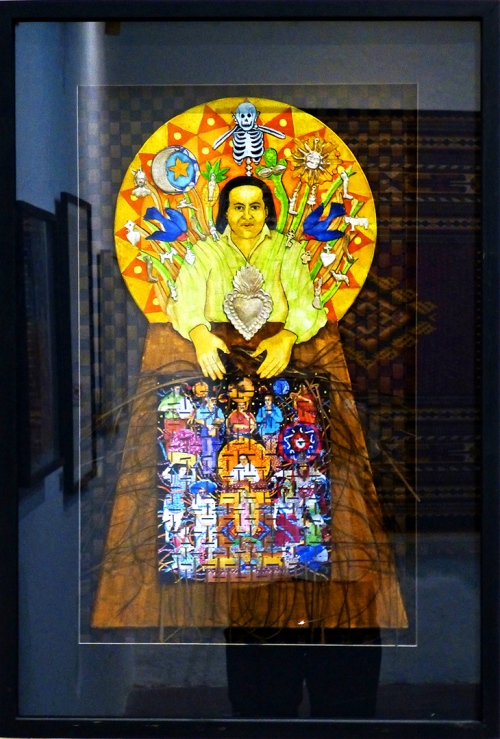
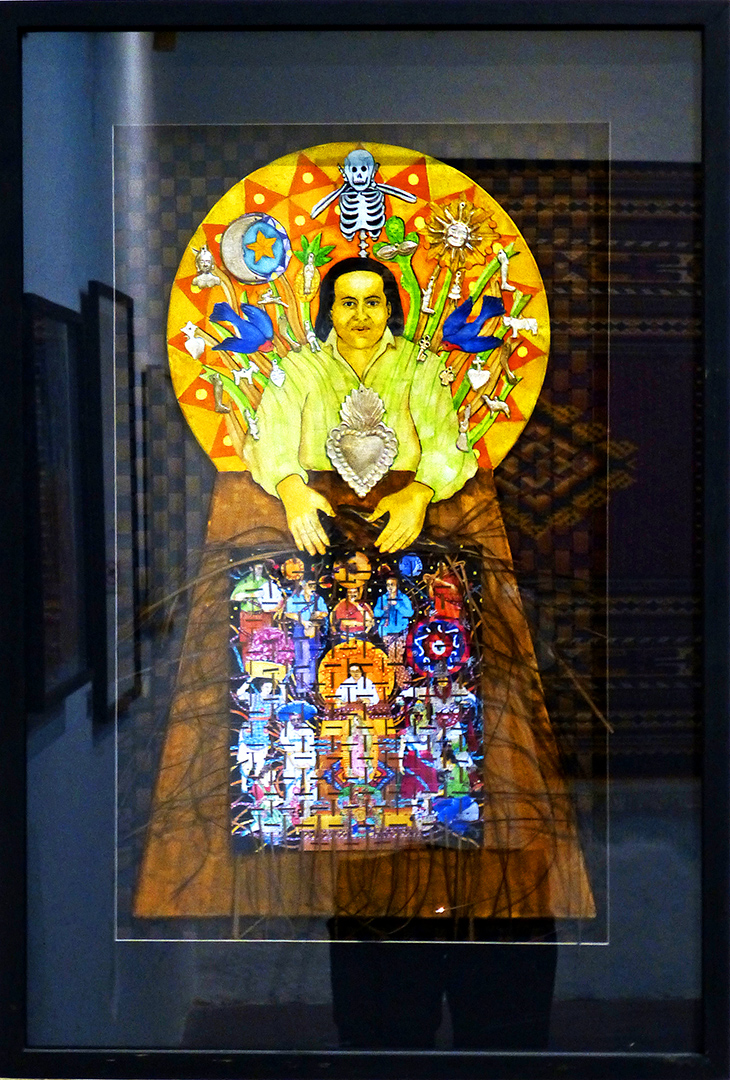
Tejedor de los sueños by Charles Barth

Tejedor de los sueños by Charles Barth (alas, with reflections from other pieces)

To honor his life, an exhibit of works by his friends, colleagues, and family was inaugurated at La Mano Mágica on March 13, 2015.
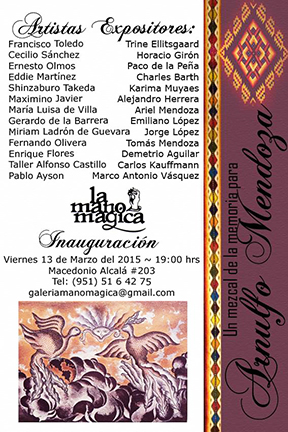
ManoMagica exhibit

His older son, Gabriel Mendoza Gagnier, curated this amazing collection of paintings, weaving, and artesanía.

Assisted by Arnulfo’s companion, Yukiko, the opening featured, not only amazing art, but also mezcal, tamales, and surprise entertainment by Carnaval dancers from San Martín Tilcajete, wearing masks carved by some of the well-known carvers from the village, including Inocenio Vásquez and Jésus Sosa Calvo.

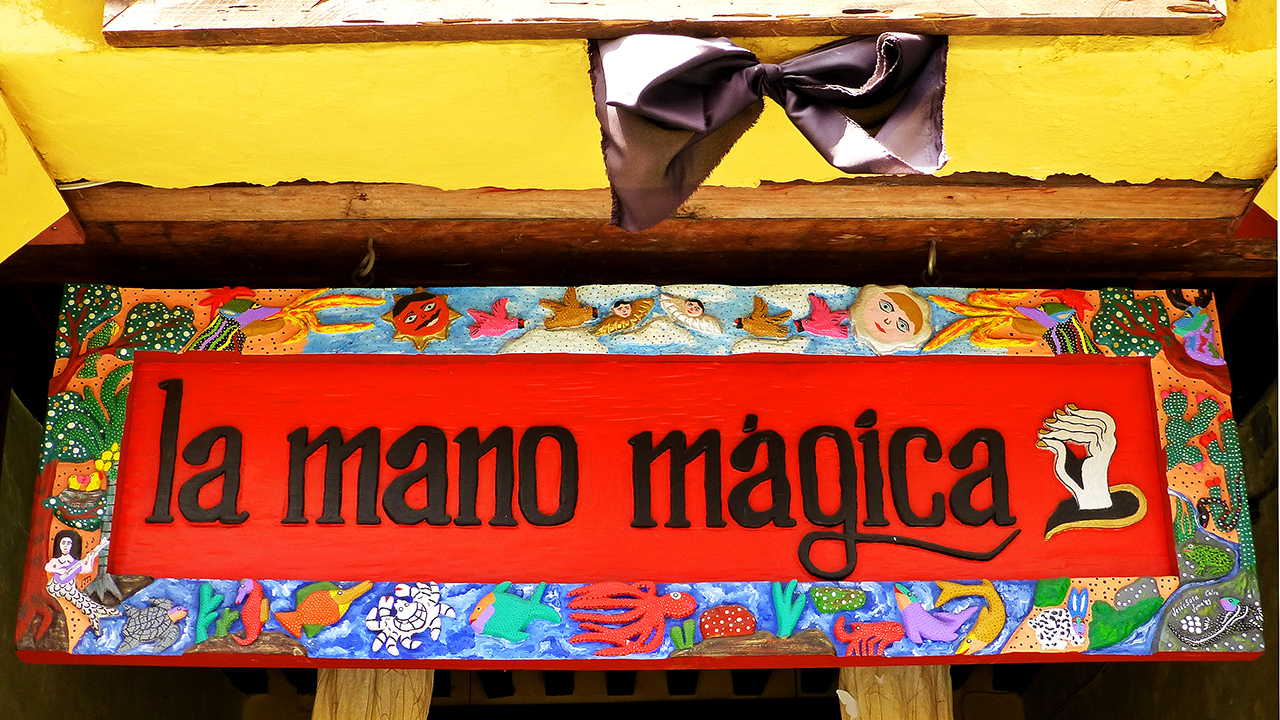
Jésus Sosa Calvo had carved the signature entry sign for La Mano Mágica and recently, unasked, came by to freshen up the paint that had faded over the years under the intense Oaxaca sun.
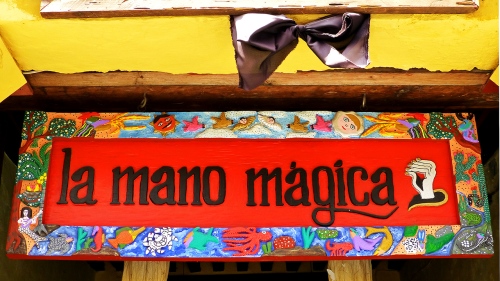
P1070473

While, in the words of Manuel Matus Manzo,  Arnulfo Mendoza may have gone on “to meet the Jaguar and the god Murcielago,” the dreams of his magical hands remain.

Finally, this beautiful poem by Alberto Blanco from the exhibit’s catalog…

Mitades a Arnulfo

I
La mitad de la tierra
no sueña con la luna.
La mitad de la luna
no sueña con el sol.

Si la luna es la trama,
y si el sol es la urdimbre,
esa tierra es la tela
donde acaso se vive.

II
La vida es la comedia
ya la muerte es el drama,
pero el textil de siempre
es la urdimbre y la trama.

La mitad de la vida,
la mitad de la muerte:
una tela tejida
con un hilo de suerte.


Read Full Post »

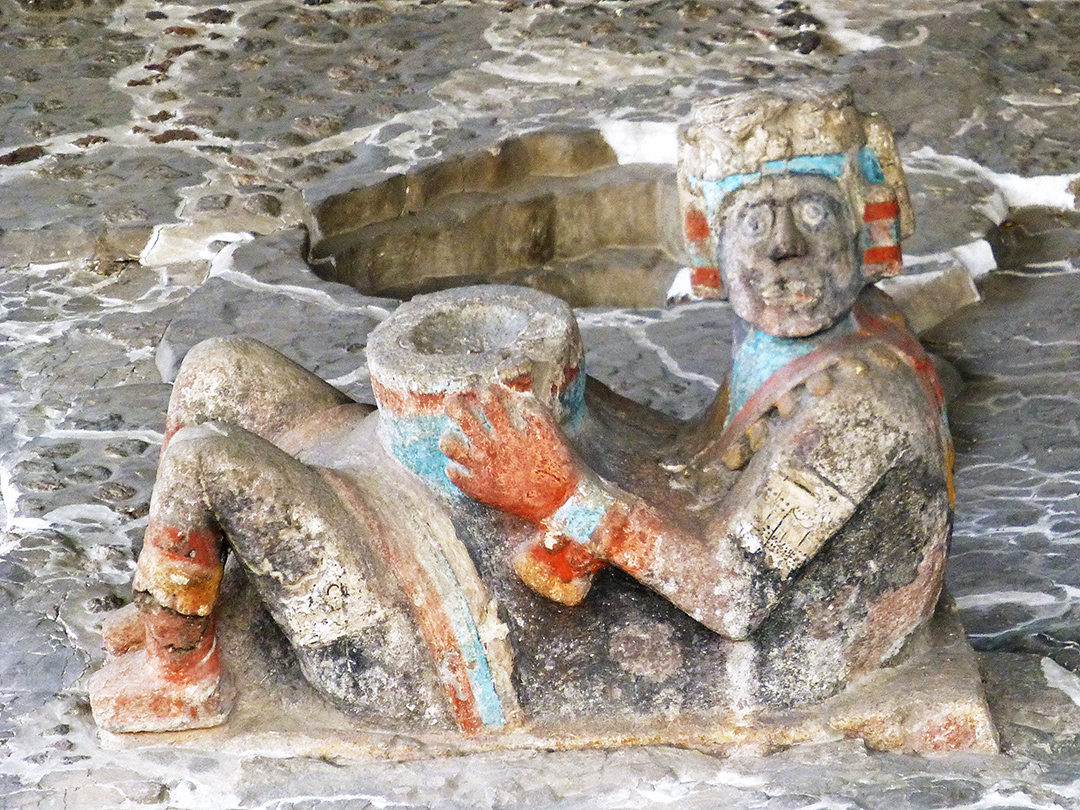
Last week, while in Mexico City, I paid my respects to Tláloc, the Aztec rain deity, both at the Templo Mayor and Museo Nacional de Antropología (National Anthropology Museum).

Templo Mayor, Mexico City

Tláloc — Templo Mayor, Mexico City

I’m now back in Oaxaca and, for the third day in a row, Tláloc is making his presence known.  And, rain is in the forecast for the next several days.

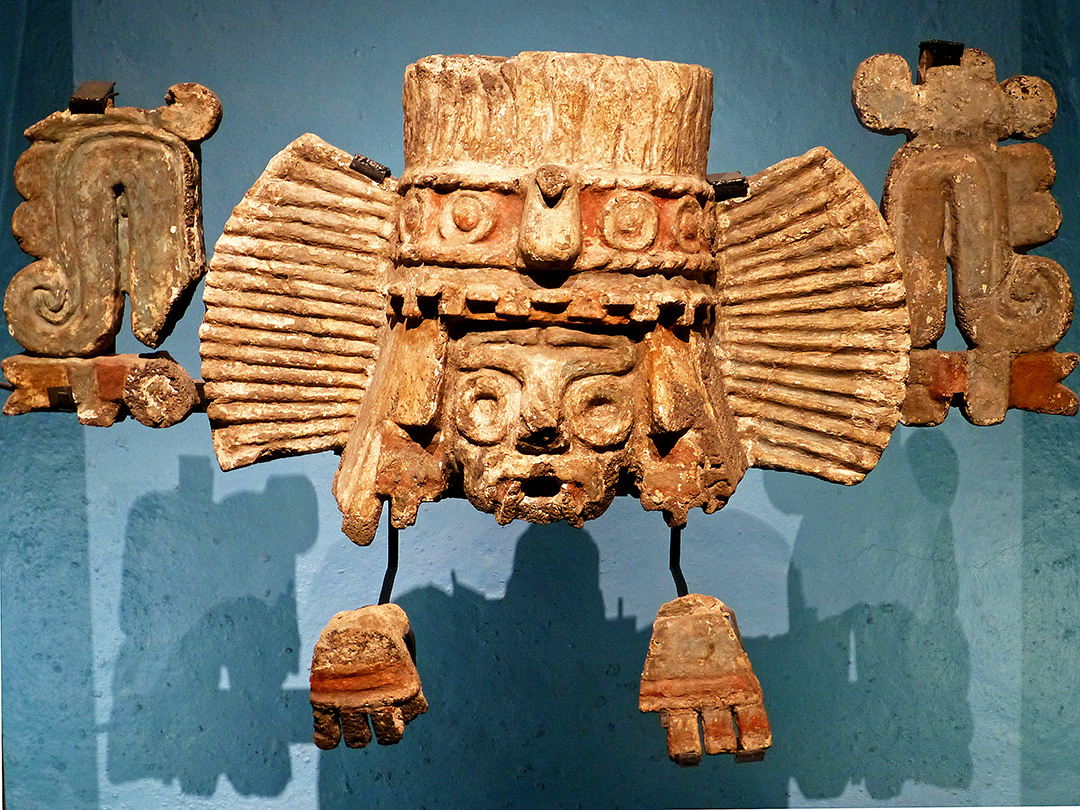
Fragments of a Tláloc brazier - Museo Nacional de Antropología, Mexico City

Fragments of a Tláloc brazier — Museo Nacional de Antropología, Mexico City

Thunder is rumbling and, out of the corner of my eye, I see flashes of lightning to the east.  It may be the “dry season,” but Tláloc is speaking and we are listening.

Pot with image of Tláloc -- Museo Nacional de Antropología, Mexico City

Pot with image of Tláloc — Museo Nacional de Antropología, Mexico City

Perhaps drought-stricken California might want to build a temple to this supreme god of the rains — not to mention, institute mandatory water rationing!

Read Full Post »

Noche de Rabanos is moving!

IMG_1381

According to an article in yesterday’s Noticias, the continued occupation of the zócalo by the teachers and the ambulantes has forced this year’s 117th annual festival to relocate.  Ahhh… only in Oaxaca!

On December 23, the 130 participants and their carved radishes, totomoxtle figures, and flor inmortal scenes will be found on the Andador Turístico (aka,Macedonio Alcalá).

Hotels are expecting an 85% occupancy rate, but the business owners along the Alcalá are concerned the Rabanos crowds will block entrances to their shops.  However, I’m wondering if it might improve the viewing traffic flow.  If you are in Oaxaca, please let me know — I headed north to the rain and snow of el norte to spend the holidays with mi familia.

Photos from last year’s Noche de Rabanos.

Update (as of Dec. 21):  Ambulantes, though not teachers, have cleared out and Rabanos WILL be held on the zócalo. 

Read Full Post »

A beautiful photo montage and song by Arturo Leyva honoring the 43 students of the Escuela Normal Rural Raúl Isidro Burgos, teachers’ college in Ayotzinapa, Guerrero.

The video uses some of the #IlustradoresConAyotzinapa illustrations, paintings, and embroidery by Mexican designers, artists, and artisans of the faces of the 43 student teachers of Ayotzinapa. 

In addition, journalist París Martínez has developed profiles of the 43 disappeared students by talking with their families and friends.

Read Full Post »
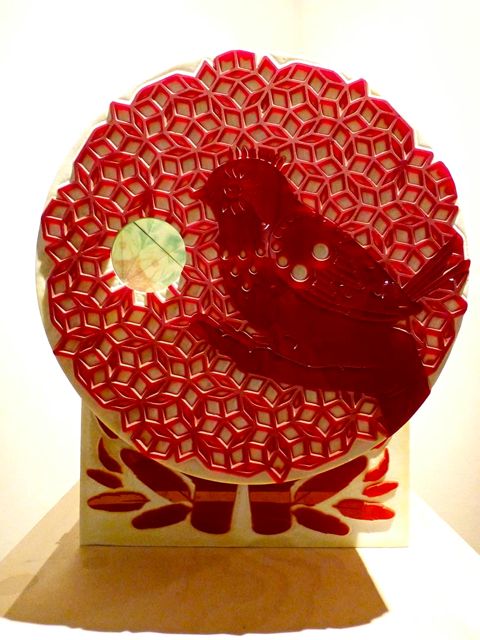
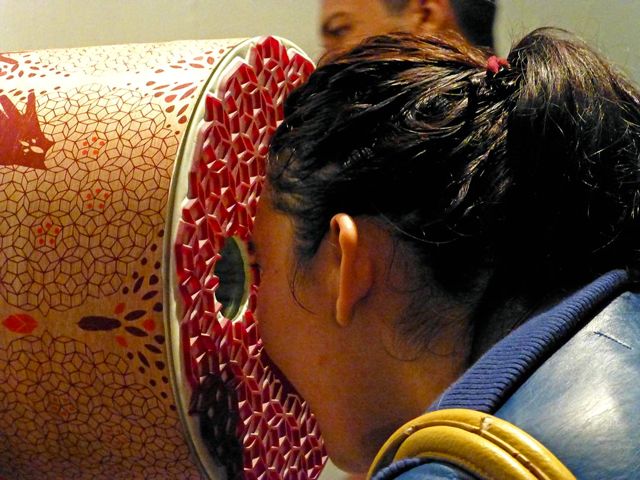
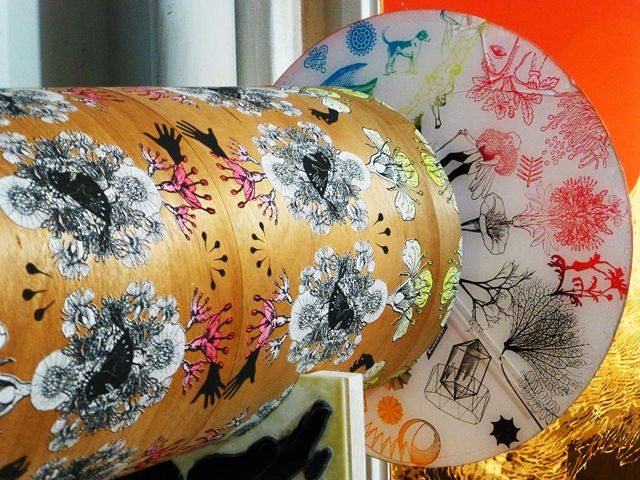
Many of you may remember Juan Martinez, mi amigo and carpenter extraordinaire of Adios mosquitos and A terrace transformed fame.  Well, he is a man of many talents — and one of them is building kaleidoscopes.  Given that his “day job” is working in the office of Gorilla Glass, he has come into contact with many of the hip, young, and talented artists currently creating in Oaxaca.  Thus, a natural collaboration ensued.   Juan + Gorilla Glass + Lapiztola stencil = an exhibition of the Lapiztola Collective’s artistry at Gorilla Gallery.

P1020733 copy

Looking into the eye of the kaleidoscope.

P1020750

What do you see?

There is the second kaleidoscope — this one a hand-crank.  Come by Gorilla Gallery on one of the next couple of Thursdays from 2 PM to 8 PM, to give it a try.

P1020742

And, be forewarned, they are working on a special Día de los Muertos kaleidoscopic project.  Prepare to be amazed!

Read Full Post »
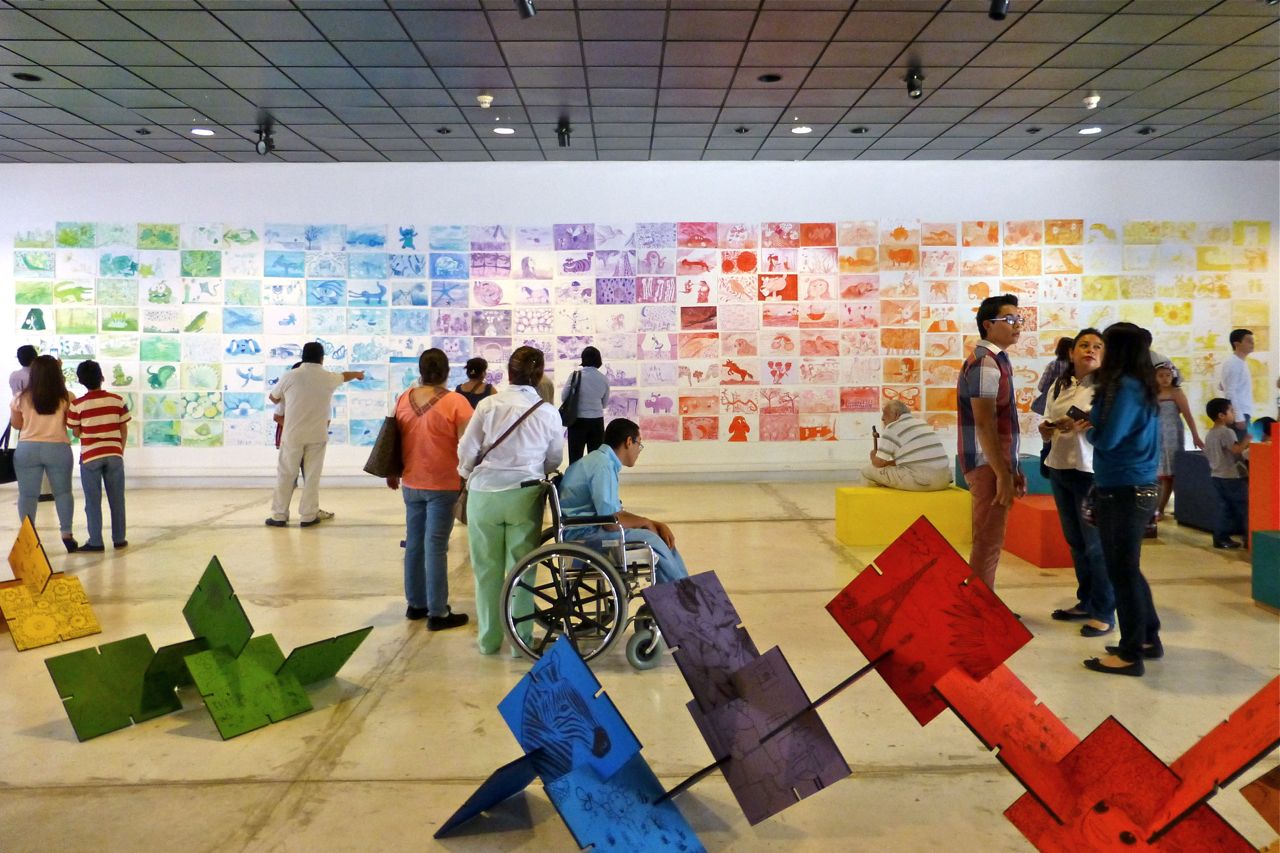
On Saturday, we drove to San Bartolo Coyotepec for the opening of the exhibition, Colorum, an exhibit of art by the children of Oaxaca, mounted as part of tomorrow’s el Día del Niño (Children’s Day) celebrations.  We went primarily to support my friend Juan, as his son Allan was one of the young artists participating in the show.  However, we stayed because it was a wonderfully inspiring and uplifting experience and I applaud the Museo Estatal de Arte Popular Oaxaca (MEAPO) for encouraging and showcasing the imagination and creativity of the children of Oaxaca.

P1030988

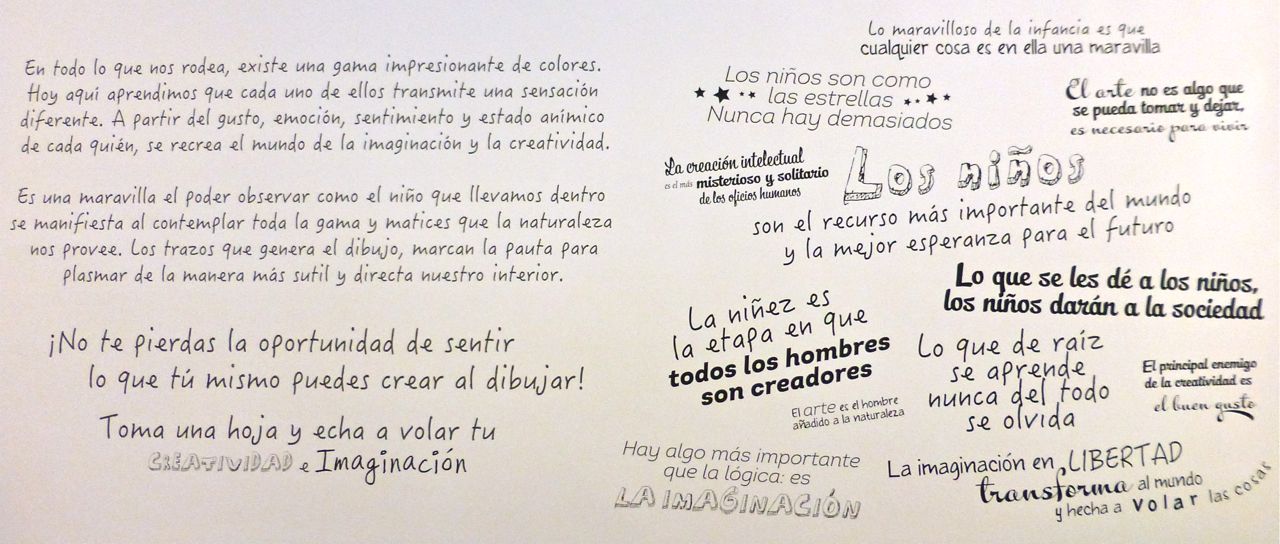
What is given to children, the children will give to society.

This slideshow requires JavaScript.

Children are the most important resource in the world and the best hope for the future.

The free imagination transforms the world and makes things fly.

P1030993

The Colorum exhibition lasts until May 20, 2014.  It is open from 10:00 AM to 6:00 PM, Tuesday through Sunday.

Read Full Post »

P1030572

No, not a newly discovered mutant killer variety — only one of the sculptures currently hanging out along the Alcalá.  It is part of a public art exhibit, “El migrante,” by Oaxaqueño artisit, Fernando Andriacci.

Read Full Post »

Urban artist, Yescka, at work on December 20, 2013 at Gorilla Gallery in Oaxaca…

Live action painting from the back of the glass, a devilish Virgen de Guadalupe emerges…

From the back and from the front, La Virgen is finished.

Yescka then turned to one of the gallery’s windows; outside looking in and inside looking out.

Like street art, these works are not forever.  In a month (or so), the virgin will be disappeared and another artist will come to Gorilla Gallery to create another ephemeral masterpiece.

Gorilla Gallery is at Crespo 213 and is open on Thursdays, from 2:00 – 8:0 PM.

Read Full Post »
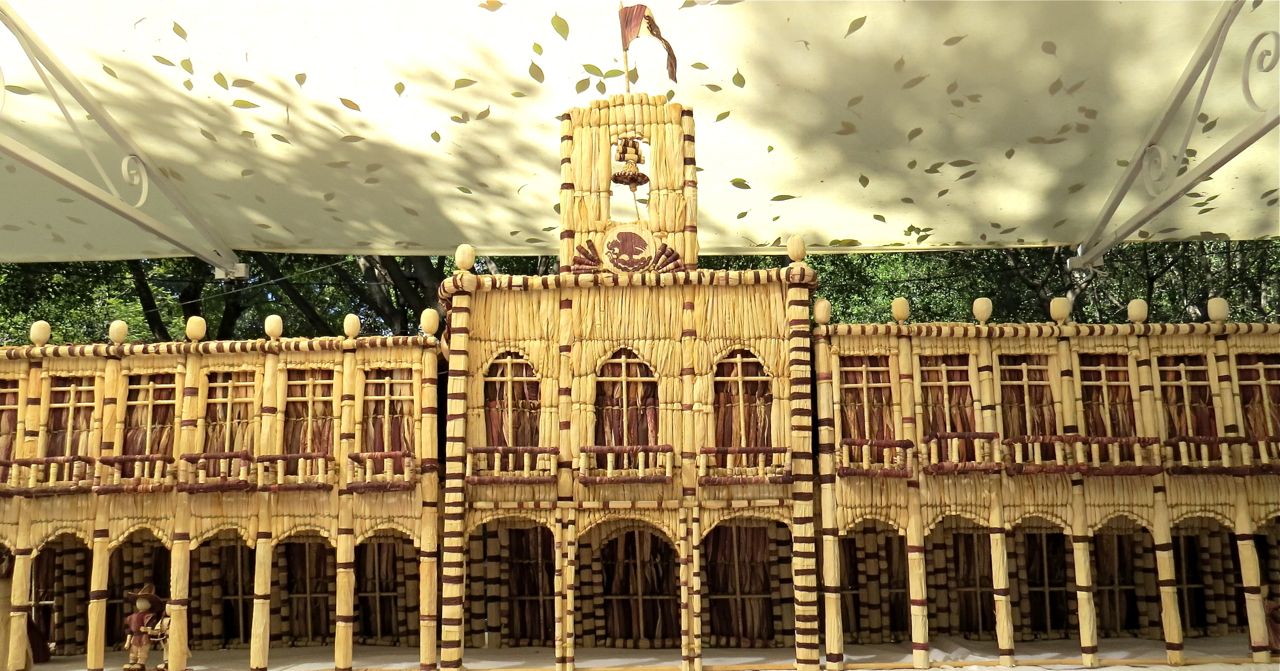
Despite of the name, Noche de Rábanos isn’t just about carving radishes.  The creativity and ingenuity of the gardeners and artisans of Oaxaca in several other categories are also on display — Flor Inmortal (dried flowers), Totomoxtle (dried corn husks) Natural, and Totomoxtle Decorated, as well as two Children’s categories.

IMG_1536

First place in the Totomoxtle Natural category went to Elpidio Adrián González López and his amazing creation, Mercado Antiguo en la Plaza de las Armas 1885.

If you missed it December 23 on the zócalo, or want to see it up close and personal, head over to CaféCafé, on the corner of Porfirio Díaz and M. Bravo.

It will be on display until January 6, 2014.

h/t Jane & Ken

Read Full Post »
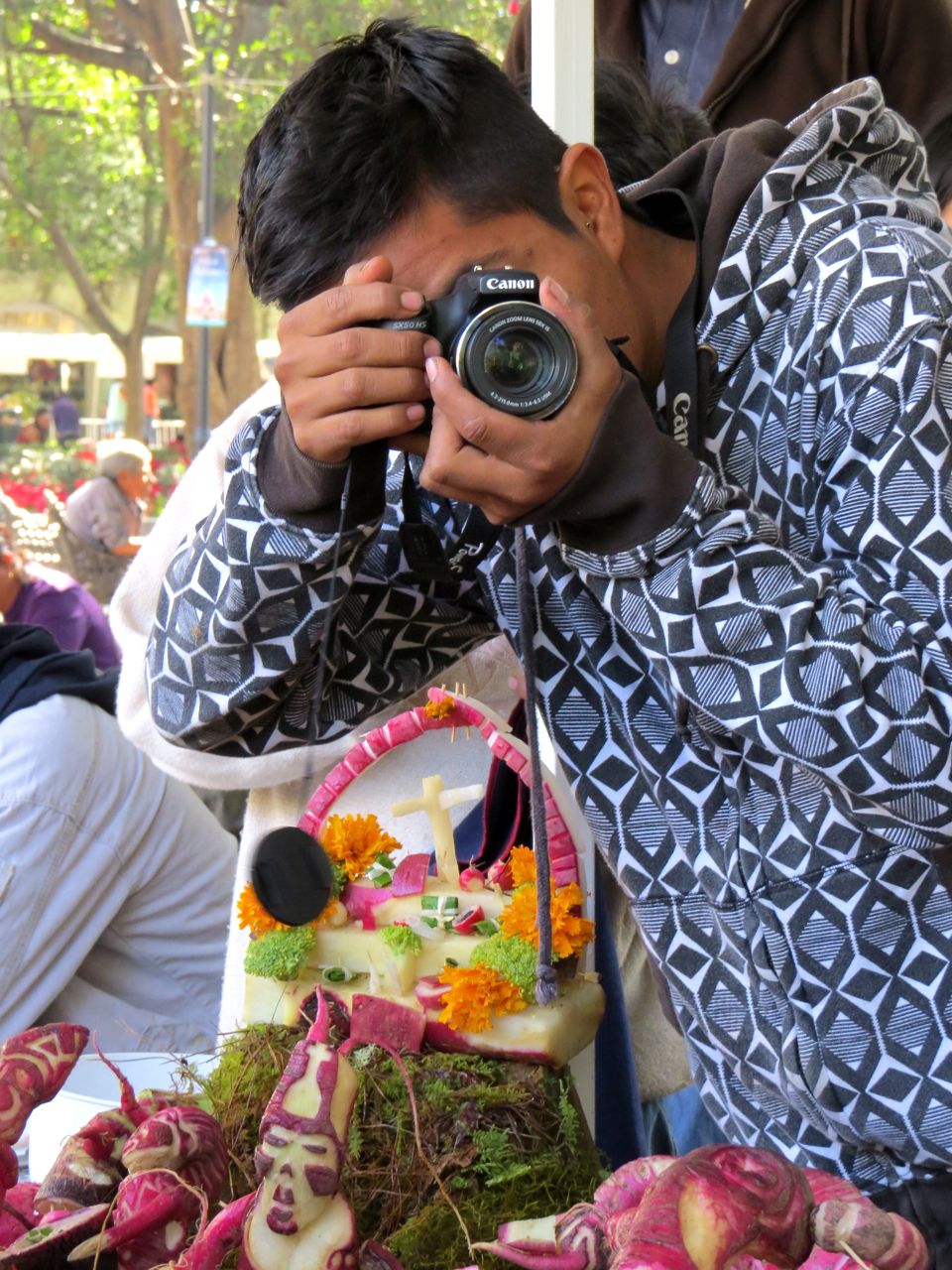
Watching the watcher…

IMG_1371

This morning at Noche de Rábanos.

Read Full Post »
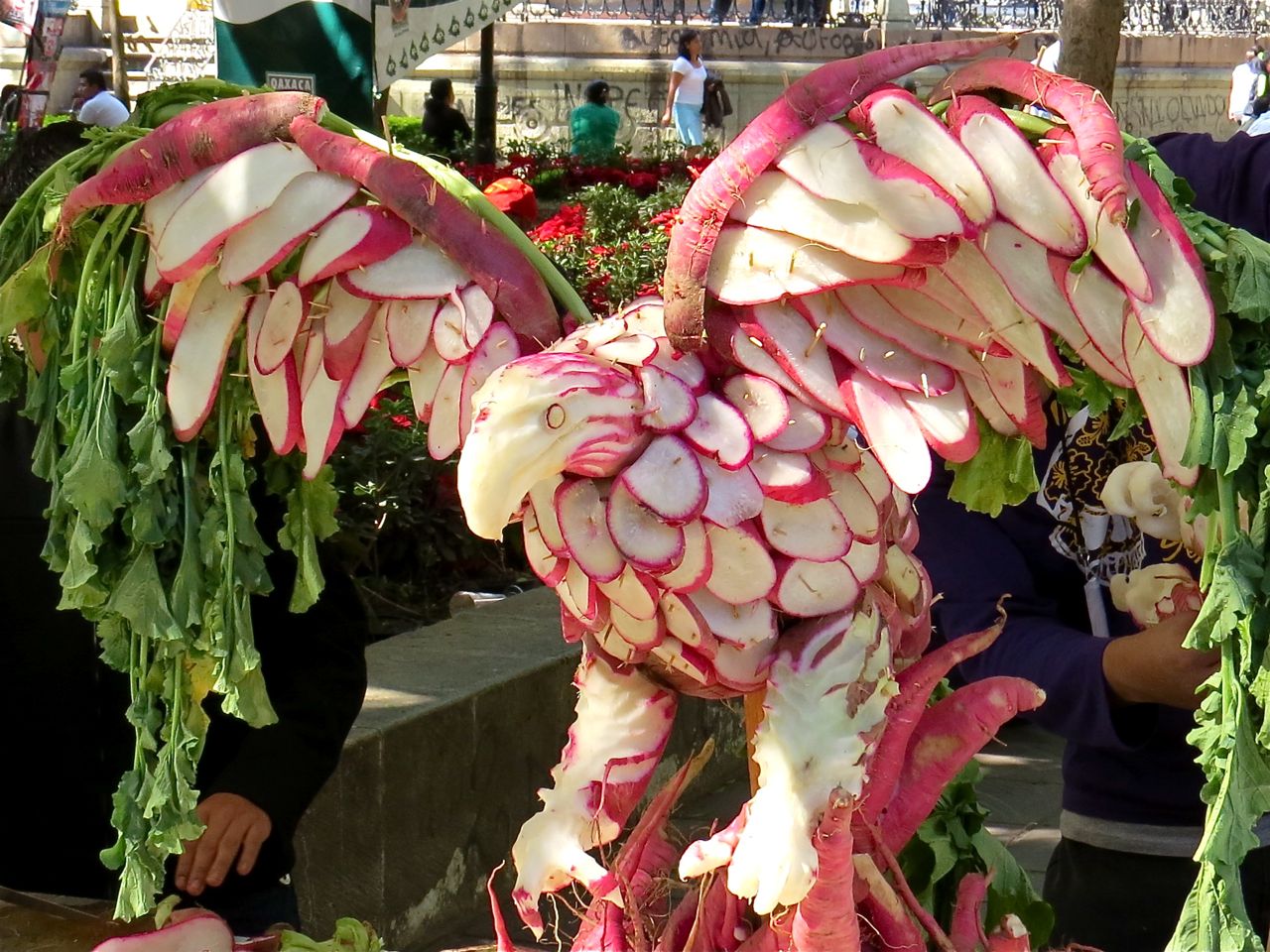
This morning I walked down to the zócalo to watch artists at work — it’s Noche de Rábanos (Night of the Radishes).   This December 23 “only in Oaxaca” tradition has been a mainstay of the holiday season since 1897.  I know, who would have thought radishes could elicit such creativity?  But, they definitely do!  Here is Adrián Antonio Flores Peña working on his piece, Quebrantahueso (bearded vulture).

IMG_1581

More to come… I just have to weed through the 300+ other photos I took!

UPDATE:  Adrián Antonio Flores Peña won first place in the “Free” (as opposed to “Traditional”) category.

Read Full Post »

« Newer Posts - Older Posts »