Feeds:
Posts
Comments

Archive for the ‘Culture’ Category

The Danza de la Pluma weapons of war consist of a small paddle (pala/macana) held in the left hand and a sonaja (rattle) held in the right (see images of danzantes in July 9 post).

The sonajas are decorated gourds attached to a deer leg or antler.  During the dance, they mark the compass points and their sound is used to scare the opponents.

Each wooden pala is uniquely carved and decorated and serves as a baton and a shield in this dance that recreates the battles between the Spanish conquistadors and Moctezuma, his warriors, and allied kings.

Even Malinche (Quetzalli del Rayo Santiago Ruiz) carries a sonaja and a pala during parts of the dance.  And, check out the reversible pala of Juan Pablo González Gutiérrez — red weaving surrounded by alebrije-like painting on one side and blue weaving and painting on the other.  You can click on images to enlarge them.  The creativity never ceases to amaze!

Read Full Post »

Yippee!!!  After an “exhaustive” (see news report) selection process that took the Comité de Autenticidad (Committee of Authenticity) to 89 communities throughout the state of Oaxaca, they announced the delegations that will be participating in this year’s Guelaguetza.  And, drum roll please, one of the 56 delegations chosen will be Teotitlán del Valle’s Danza de La Pluma Promesa 2016-2018!

IMG_8059

IMG_8199

I’m so happy for the entire group, many whom I’ve come to know, but especially for Edgar Daniel Ruiz Ruiz (above in red shirt), one of the two dancers blogger buddy Chris and I are sponsoring.  He missed out when the group performed at the Guelaguetza two years ago, as he was recovering from surgery and this is his last opportunity — their three-year “act of devotion” to dance for their community ends this year.

IMG_8300

IMG_8182

The group will be performing at La Guelaguetza on the morning of July 23.  If you can’t be up on Cerro del Fortín, it is usually broadcast live on local TV and streamed on the internet.  I’ll keep you posted!

IMG_8215

The above photos of the Danza de la Pluma Promesa 2016-2018 are from the previously mentioned and recently concluded festival honoring La Preciosa Sangre de Nuestro Señor Jesucristo — the most important annual festival in Teotitlán del Valle.

Read Full Post »

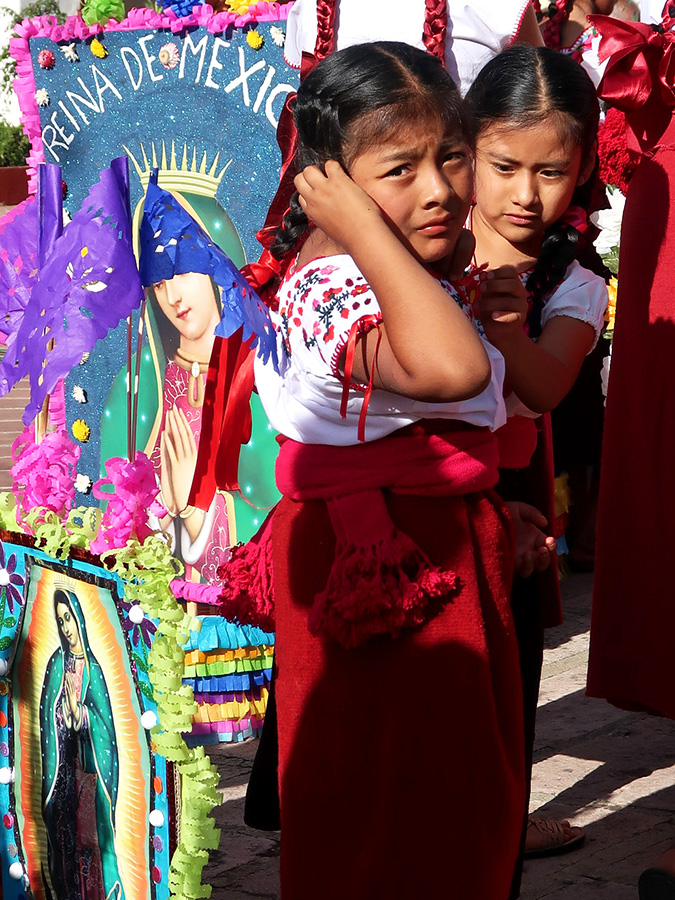
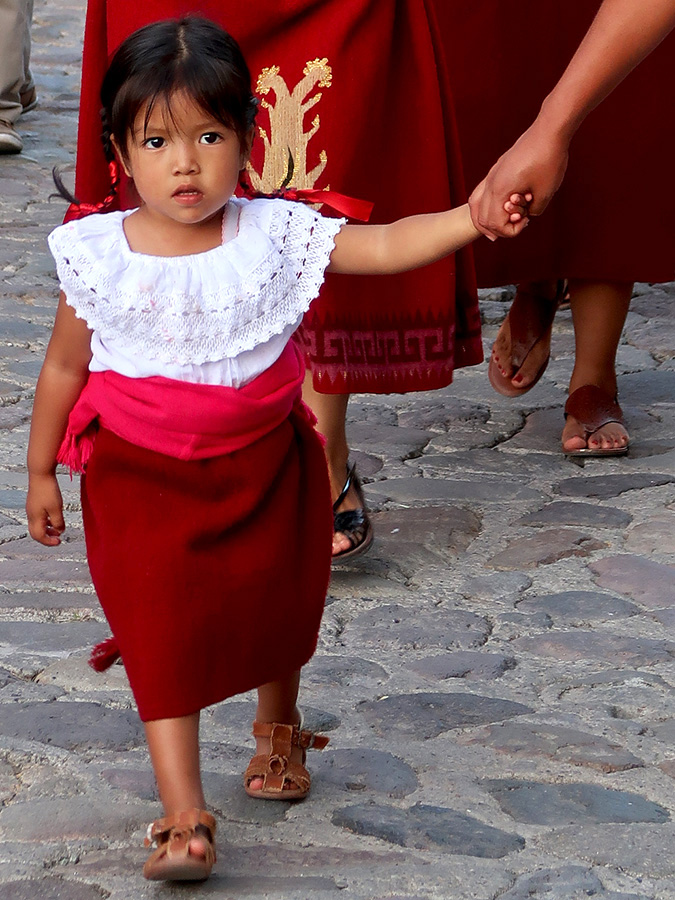
Late yesterday afternoon in Teotitlán del Valle — along with village officials, church committee members, 200 unmarried young women, Danza de la Pluma Promesa 2016-2018 dancers, players of the traditional teponaxtle (drum) and the chirimía (small oboe), pyrotechnicians, and two bands — children gathered.

IMG_7980

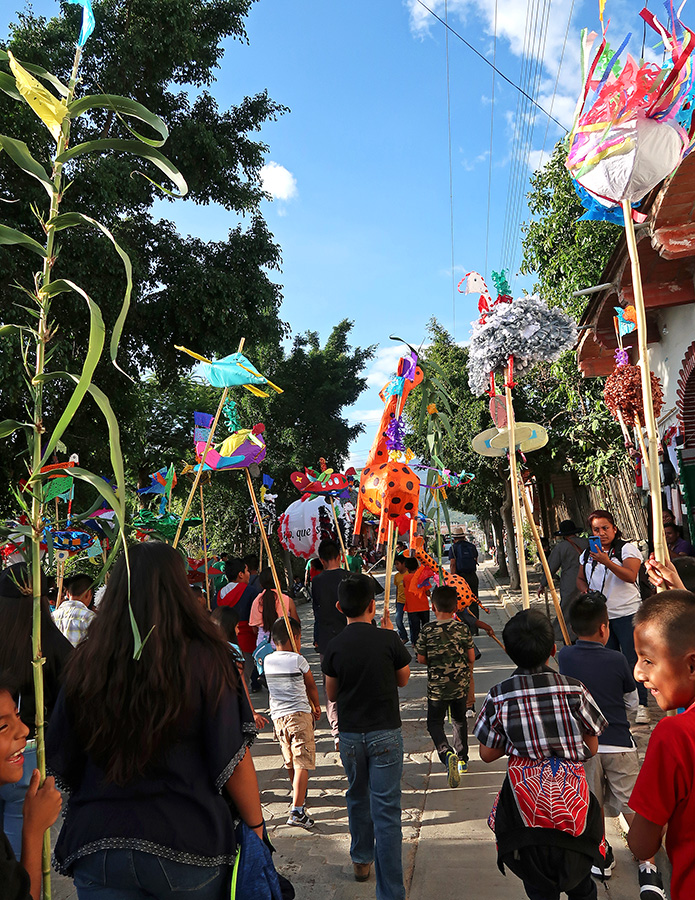
Boys came holding carrizo poles topped with mini marmotas (fabric globes), sheep, turkeys, giraffes, airplanes, and other images whose significance escapes me — though this year Quetzalcoatl made an appearance.

IMG_8031

Little girls came wearing miniature versions of the traditional red wool enredo (wrap skirt) and embroidered or crochet blouses.

IMG_8077

They assembled in the atrium of the church for the start of the *convite (special kind of procession) honoring the Preciosa Sangre de Nuestro Señor Jesucristo, the patron saint of the village and whose image, attributed to Oaxacan painter Miguel Cabrera, resides in Teotitlán’s church.

IMG_8016

The procession wound its way from the atrium, through the principal streets (mostly cobblestone) of the village, and back to the atrium — approximately two miles (3.2 km)!

IMG_7985

Giving a group of boys long poles has the potential for high jinx, but most was limited to clever ways to evade overhanging tree limbs.

IMG_8014

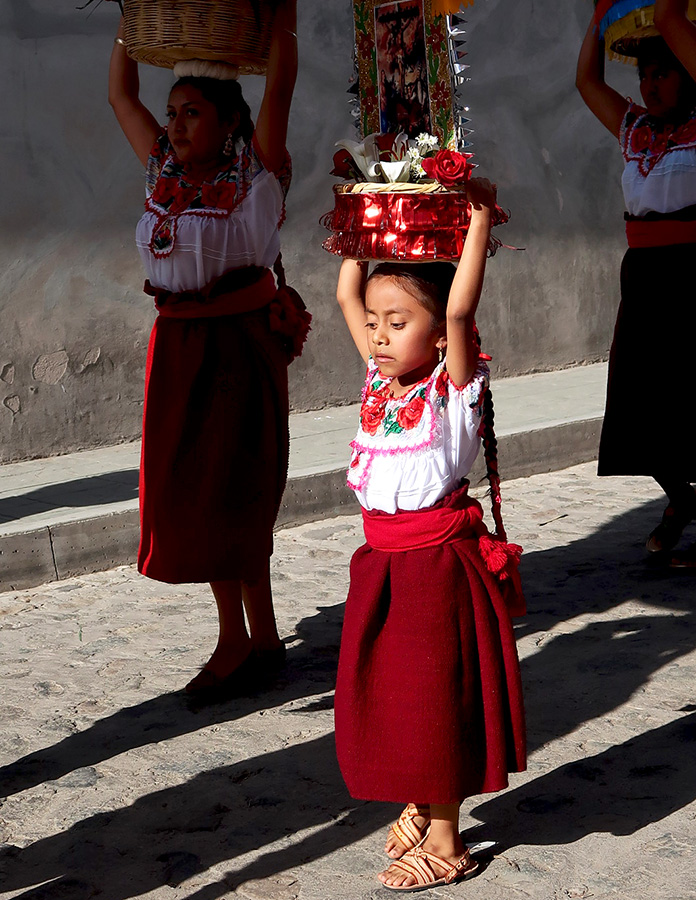
The littlest girls were beginning their years long conditioning in order to develop the arm strength needed to hold a canasta (basket) above their head for over an hour — SO much harder than it looks!

IMG_8063

And, there were boys in the band — some already affecting a cool “Blues Brothers” look.

IMG_8005

This was just the beginning of the festival — there will be the danzantes performing the Danza de la Pluma, fireworks (including toritos and castillos), and another convite.  So, stay tuned for more to come.

*Convite:  According to Harrap’s Spanish and English Pocket Dictionary, convite means reception.  Larousse Standard Diccionario translates convite to “invitation” or “banquet.”  And, if one turns to Google or Bing translation programs, a convite is a “treat.”

Read Full Post »

Last night, AMLO’s victory brought the sights and sounds of celebration to Oaxaca.

Fireworks exploding in night sky

This morning, Mexico’s World Cup loss to Brazil brought the sights and sounds of silence to the city.

Young man in Mexico soccer jersey sitting

The highs and lows of life in Oaxaca over the course of twelve hours.

Read Full Post »

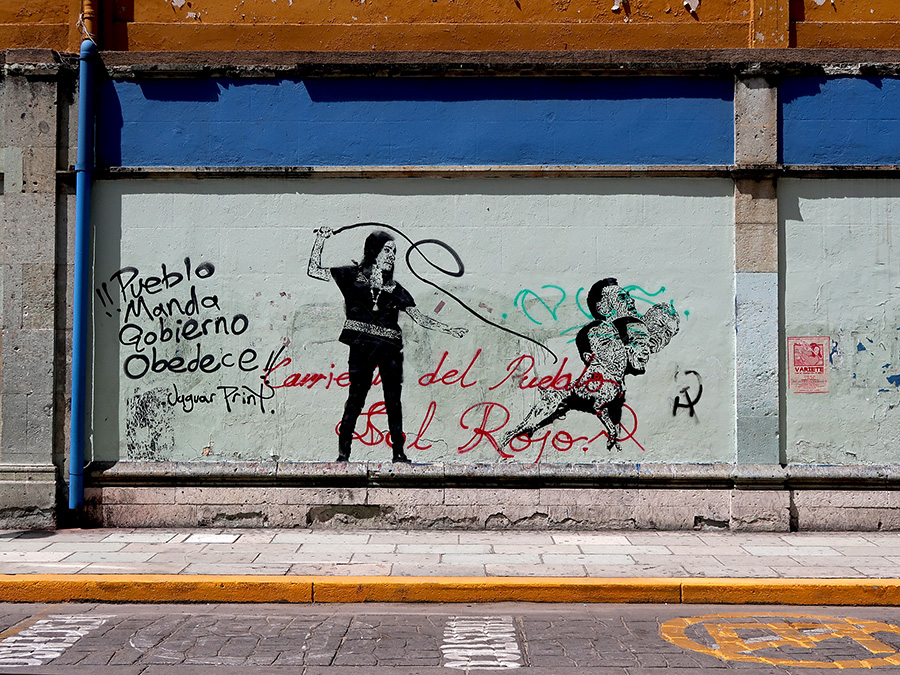
Despite Mexican elections tomorrow and the Mexico vs. Brazil World Cup elimination game on Monday, the walls of Oaxaca will not be silenced.

IMG_7907

IMG_7908

IMG_7905

The latest from the walls of Gimnasio Universitario Centro Histórico of UABJO (Universidad Autónoma Benito Juárez de Oaxaca city center gymnasium) on Av. José María Morelos.

Read Full Post »

It began this morning, as la Selección mexicana took the field in Russia for game three of their Group F stage.  Even with two victories under their belt and leading their group, the people of Mexico held their collective breath.  During the game, you could hear a pin drop in Oaxaca.  I swear, the buses that usually grind their gears and emit clouds of exhaust on Crespo, were few and far between.  El Tri held off a tenacious Swedish team in the first half, but it all fell apart in the second and the green, white, and red lost.  The Mexican World Cup team and the country had to rely on South Korea to knock Germany out of the Copa del Mundo and assure Mexico goes on to the next round.  Every tenth person I passed this afternoon seemed to still be sporting the team jersey, but nobody was smiling.

IMG_7879

Oaxaca de Juárez — June 27, 2018, 7:00 PM

Today is also the last day of electioneering in Mexico — no more campaign materials are to be distributed, no more surveys disseminated, and no more robo campaign calls (gracias a dios).  Mexicans go to the polls on Sunday, July 1 for Mexico’s biggest election in memory.  Not only is a new president to be elected, but also 500 members of the Chamber of Deputies, 128 members of the Senate, 8 governors, and the mayor of Mexico City.  And, coming on top the deadliest year in Mexico’s history, 2018 has also been one of the most violent campaign seasons in recent history.  Tonight, final campaign rallies are being held all over the country, including one next door in the Plaza de la Danza — filled with amplified speeches and heavy-on-the-bass pounding music.  Let’s hope we awaken only to World Cup scores and not rising political violence tallies.

However, in the midst of all this, gringos gathered this afternoon to attempt to come up with a plan to show our opposition to the inhumane actions by the United States government and our support for all peoples escaping violence and in search of a better life for their families.  If you are in Oaxaca, on July 5, at 3:00 PM, there will be a peaceful protest in front of the U.S. Consular Agency under the slogans, ¡Todos Somos Migrates!  ¡Familias Unidas — No Divididas!  For more details, see the ¡Engage Oaxaca! Facebook page.  By the way, for a little background on the reasons men, women, and children are risking their lives to flee their home countries, I highly recommend, So we’re gonna pretend these refugees aren’t a result of our actions in Central America?

Read Full Post »

Wishing a very happy Father’s Day to fathers, stepfathers, and father-figures throughout the world.

This slideshow requires JavaScript.

Parenting is the most valuable job you will ever have.  May you fulfill your role with great love, care, and respect.  And, may you never be separated from your children by the inhumane, unnecessary, and illegal action of a despotic government.

Read Full Post »

He had words.  I don’t.

“Do we really want to travel in hermetically sealed popemobiles through the rural provinces of France, Mexico and the Far East, eating only in Hard Rock Cafes and McDonalds? Or do we want to eat without fear, tearing into the local stew, the humble taqueria’s mystery meat, the sincerely offered gift of a lightly grilled fish head? I know what I want. I want it all. I want to try everything once.”Anthony Bourdain, Kitchen Confidential: Adventures in the Culinary Underbelly

I will miss your intelligence, honesty, passion, and respect for cultures different from your own.  Thank you.  Rest in peace, Anthony Bourdain.

How to get help: In the US, call the National Suicide Prevention Lifeline at 1-800-273-8255. The International Association for Suicide Prevention and Befrienders Worldwide also can provide contact information for crisis centers around the world.


Read Full Post »

Passing Erika Santiago‘s haunting mural along the wall outside Almacén Mexicano on Calle Valentín Gómez Farías, Sad-Eyed Lady Of the Lowlands began playing in my head.

IMG_7697

Sometimes art brings a song.  And, maybe we are all a little sad these days.

Read Full Post »

Protest art continues to paper the streets of Oaxaca.

It’s there in black and white against walls of texture and color — greeting the morning’s light and disappearing as shadows fall.

Today, the faces of rage, resistance, and anguish are not only looking down from walls, they are seen at eye level in Oaxaca’s zócalo and streets.  They’re back…  The annual occupation and blockades by Sección 22 of the CNTE (teachers’ union) has begun.

Read Full Post »

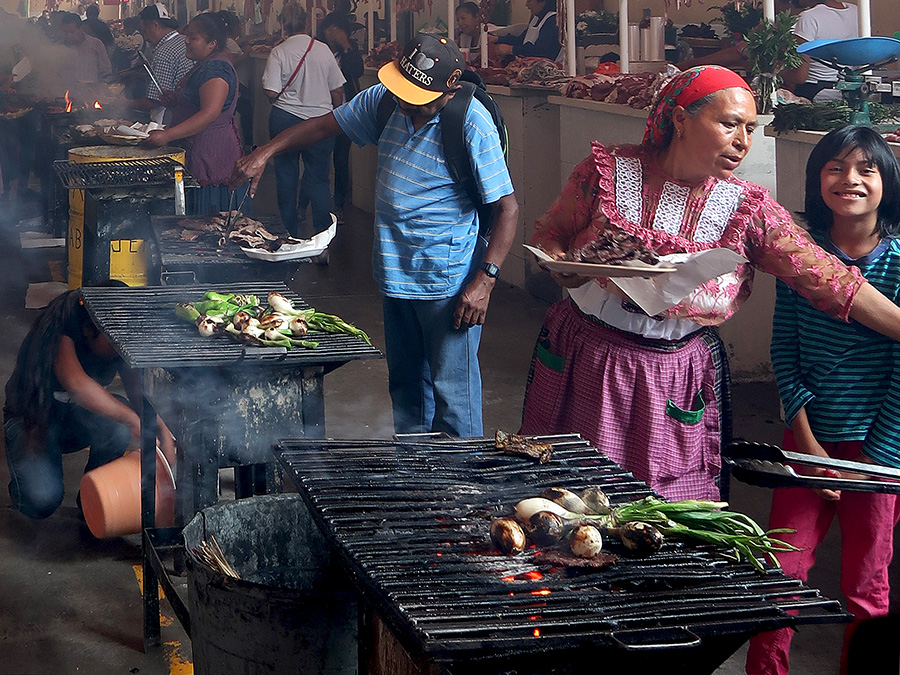
Last Sunday at the weekly market in Tlacolula de Matamoros…

IMG_7637

Chickens

IMG_7636

Rebozos

IMG_7632

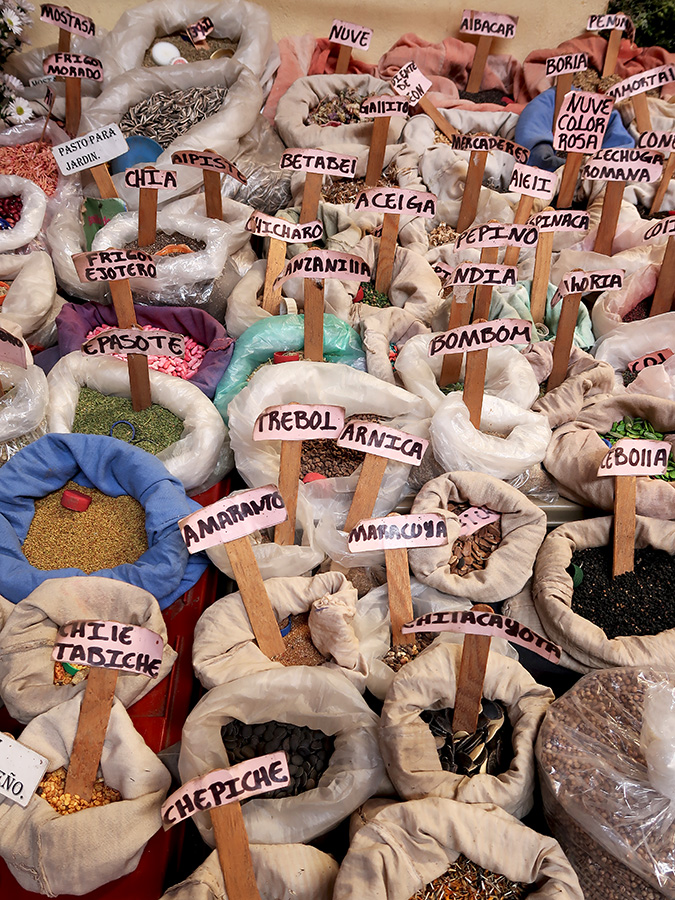
Seeds

IMG_7616_crop

Lunch

It’s not just about produce, bootleg DVDs, tools, and underwear.

Read Full Post »

I love Sunday market day in Tlacolula de Matamoros — the people, colors, food, cacophony, and frequent surprises speak to the life of Oaxaca.  So, after returning Saturday night from two weeks in el norte, I jumped at the suggestion by blogger buddy Chris that we go to Tlacolula the next day.  It did not disappoint.

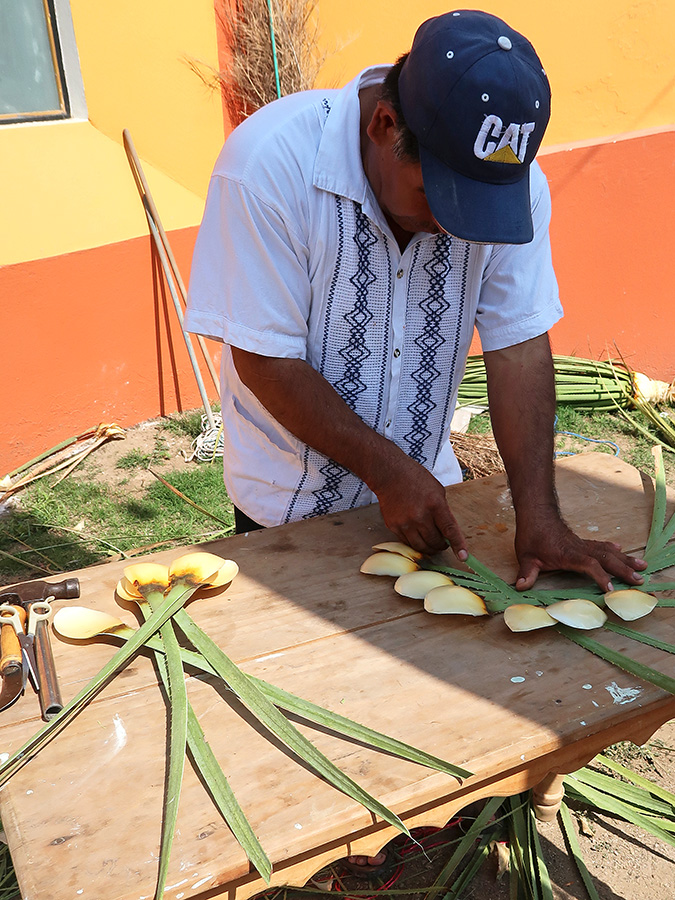
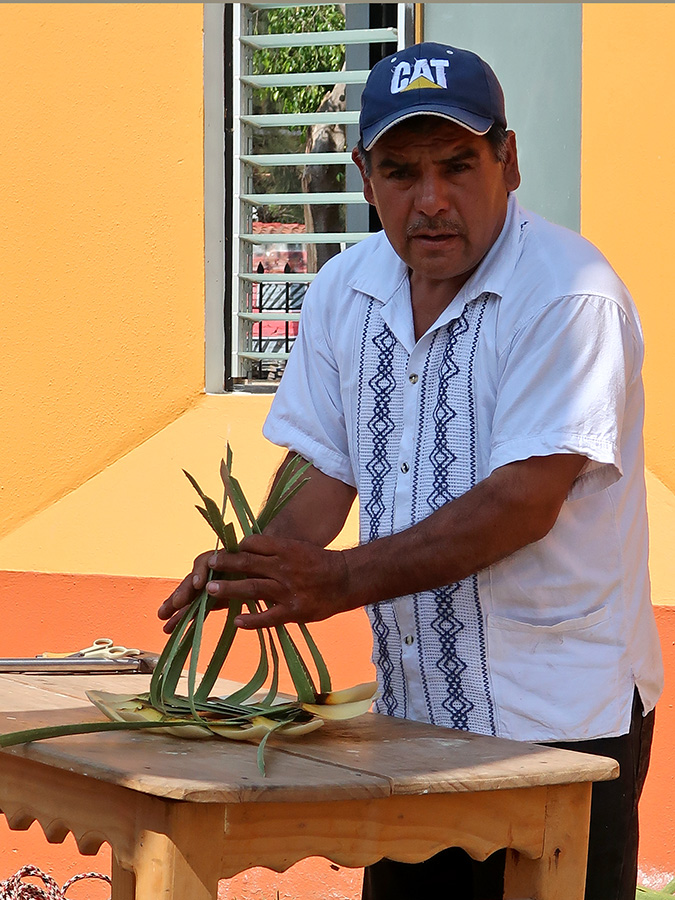
Carnival rides were being set up where we frequently park and, in the usually deserted patio of the modern chapel at the intersection, several men were hard at work fashioning decorations.  We peered from behind the wrought iron fence but were quickly invited in.  They explained they were preparing for a festival honoring the chapel, the Capilla de la Cruz, all the while continuing to weave flowers out of a spiky, sword-like plant.

Especially during the Easter season, I’ve seen these flowers sold along with woven palms, but didn’t know what they were made from.

Once home, I couldn’t resist doing a little research (I’m a librarian, after all!) and discovered it was a species of Dasylirion (aka, Sotol, cucharilla, desert spoon).  I can’t imagine what those spikes lining the sides of the leaves must do to their hands!

It was such fun talking with these guys and watching their nimble, practiced fingers at work.  After two weeks away, what better way to get back into the swing of things in Oaxaca?  And, the market was still to come.

Read Full Post »

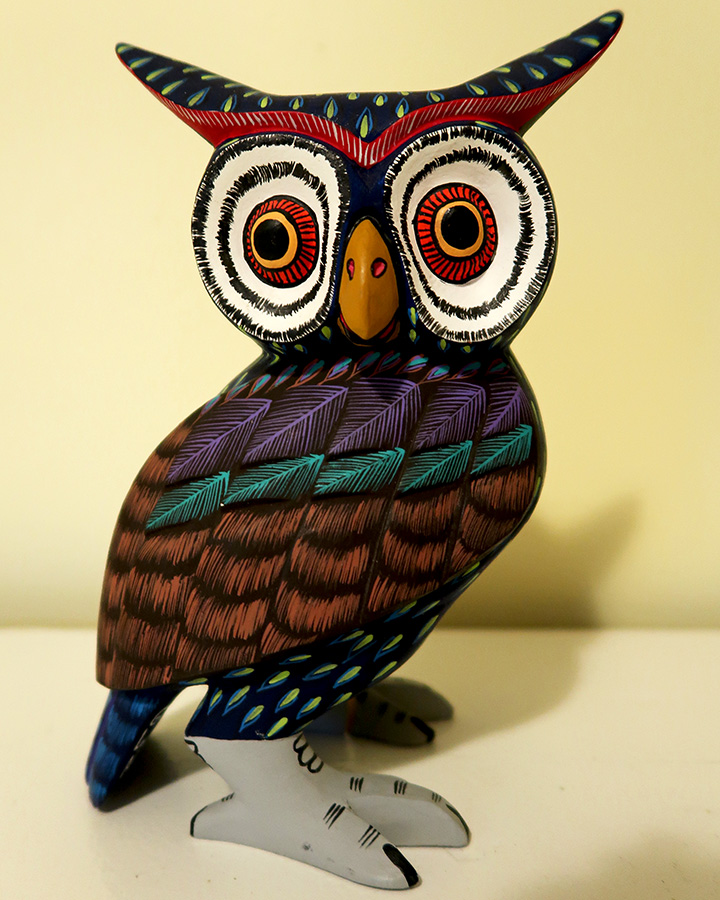
Carved from the wood of the copal, an owl for my older son.

IMG_7541

Carved by Lauro Ramírez and painted by Griselda Morales, San Antonio Arrazola, Oaxaca

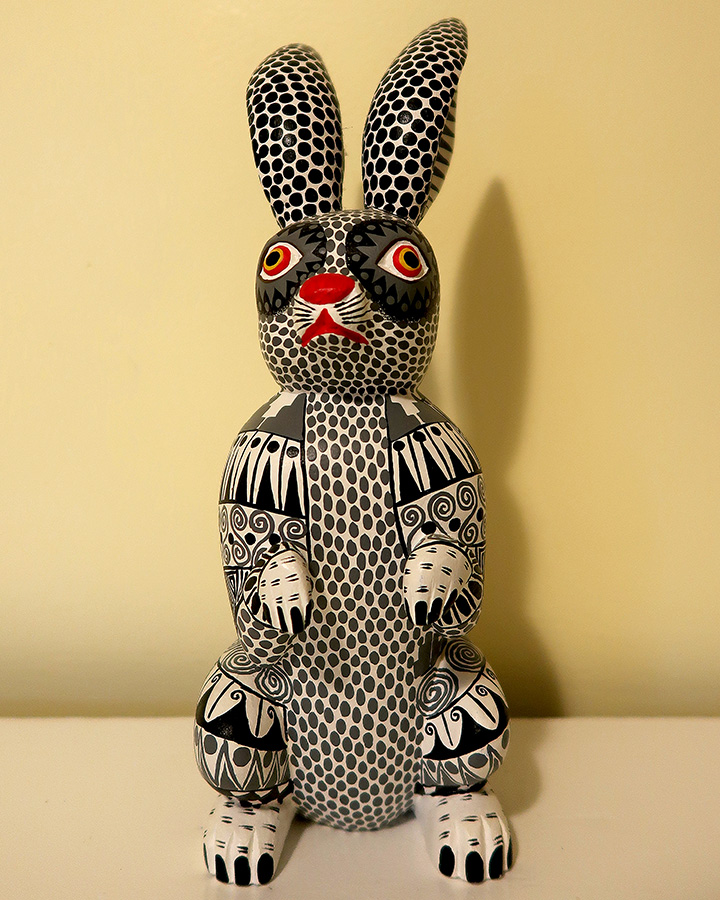
A rabbit for my daughter-in-law.

IMG_7538

Carved by Mario Castellanos and painted by Reina Ramirez, San Antonio Arrazola, Oaxaca

A lion for my grandson.

IMG_7544_copy

Carved by Zeny Fuentes Santiago and painted by Reyna Piña Ramírez, San Martín Tilcajete, Oaxaca

And, a horse for my granddaughter.

IMG_7564

Carved by Jesús Hernández Torres and painted by Roxana Fabian Ortega, San Martín Tilcajete, Oaxaca

Beautifully hand carved and painted alebrije for my family.

Read Full Post »

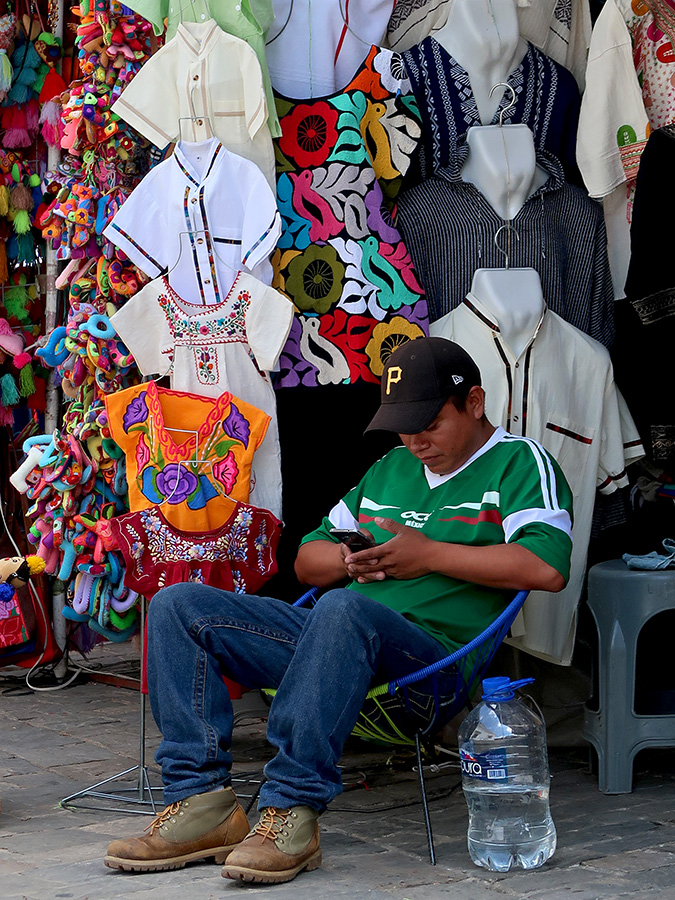
The lowly utilitarian apron has been elevated to an art form by the Zapotec women of the Tlacolula valley in Oaxaca.  Worn every day, mandiles (aprons) are an essential and practical part of their traditional dress.  Most women own several and take great pains to color coordinate them with the day’s attire.
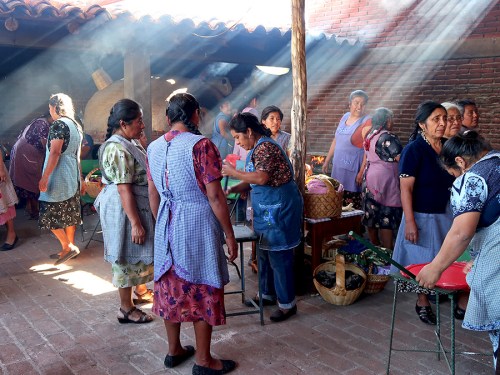
IMG_2773

Fiesta honoring the Virgen de Guadalupe at the home of Fidel Cruz and Maria Luisa Mendoza, Teotitlán del Valle.

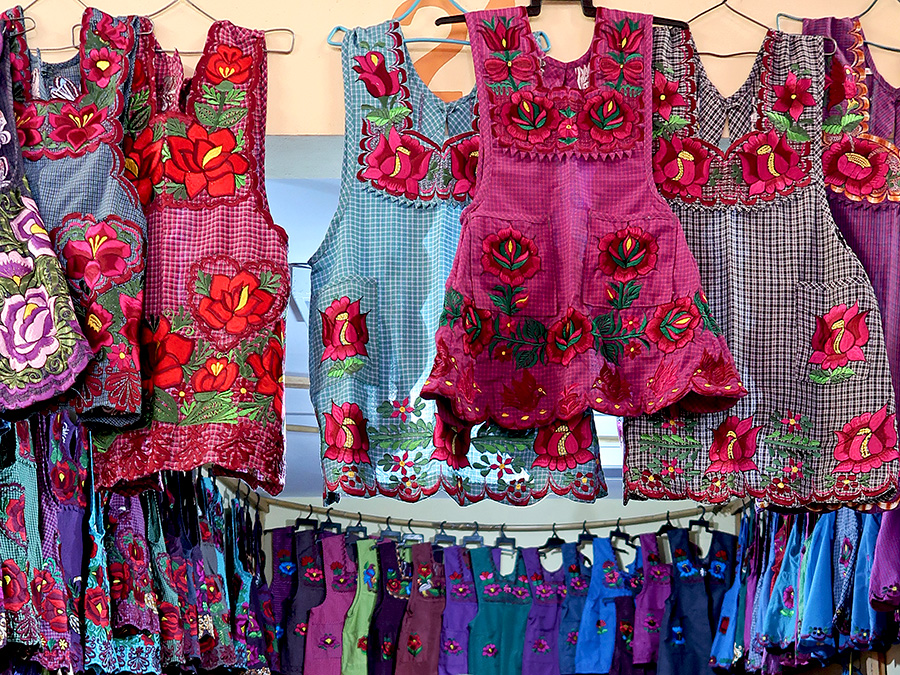
Plainer aprons are worn around the home.  However, they don one of their “Sunday best” aprons for special occasions.  These are heavily embroidered and often have necklines and hems that are scalloped and, as a fashion statement, are frequently worn to the weekly market.
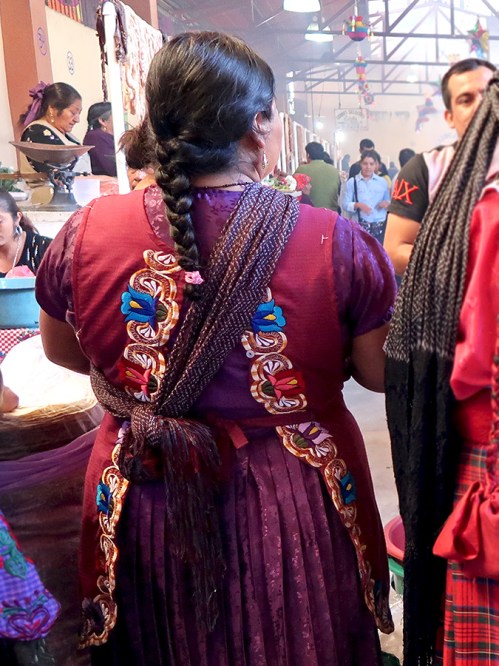
IMG_4636

Vendor at the Sunday market in Tlacolula del Valle.

Mandiles are made of store-bought poly-cotton fabric, usually in a small plaid design. While “100% cotton” sounds more desirable to many of us, the blend is undeniably more practical.  After all, who wants to iron when there is work to do and the temperatures are summery all year ’round?

P1260389

Andrea weaving in Teotitlán del Valle.

Even though the embroidery is done by sewing machine, the more elaborate designs can take from three to four days days to make.  Aprons range in price from approximately 150 to 700 pesos.

IMG_3331_Leonor

Leonor Lazo feeding a baby goat in Teotitlán del Valle.

Given that, in addition to being practical, these are also a fashion accessory,  it should come as no surprise that styles can vary from village to village.
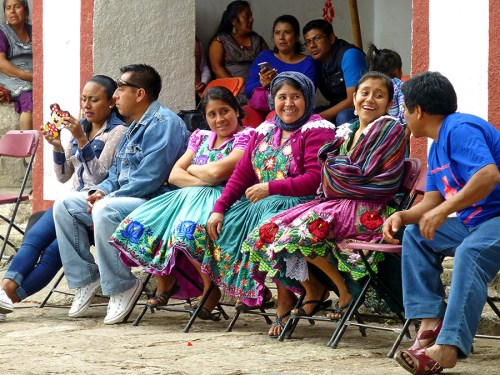
San Miguel del Valle girls

Young women from San Miguel del Valle attending a festival in Teotitlán del Valle.

I grew up with aprons.  My grandmother lived next door and could always be found wearing a “house-dress” and a pinafore style apron with front patch pockets.  Some were plain, but many she decorated with embroidery.  Thus the mandiles of Oaxaca spoke to me and I listened.

IMG_5941

Reyna Mendoza speaking to her El Sabor Zapoteco cooking class.

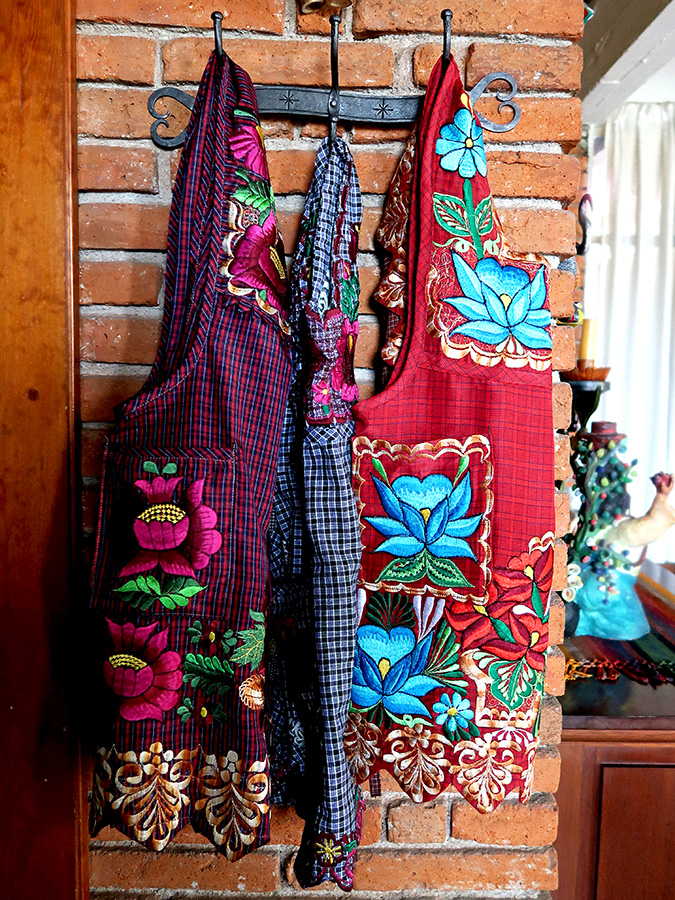
My first “Oaxaca” apron was a maroon plaid cobbler style with only a moderate amount of embroidery. After a year or two, it became so much a part of my home attire that I bought another in brown plaid.  These are my workhorses and I wear them every day while cooking, cleaning, and even gardening.  And, I proudly bring my own apron to cooking classes and make sure to pack one when I’ve been invited to a fiesta in Teotitlán del Valle — putting it on to help clear tables. I always get smiles from the women (and some of the men, too).
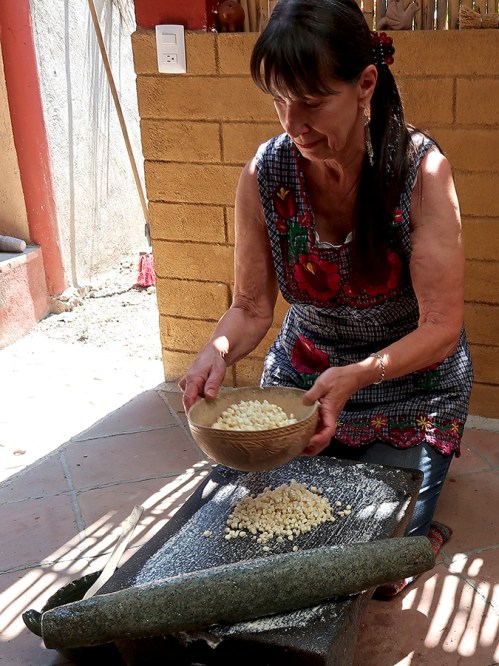
IMG_5984

Me, mi mandil, a metate, and maiz at El Sabor Zapoteco cooking class in Teotitlán del Valle.

However, after countless Sunday market day trips to Tlacolula de Matamoros, not to mention, spending a lot time over the past several years in Teotitlán del Valle, I couldn’t help but be inspired by the fashion statements women, both young and old, were making, so I bought a slightly more elaborately embroidered pinafore style and then another and another.
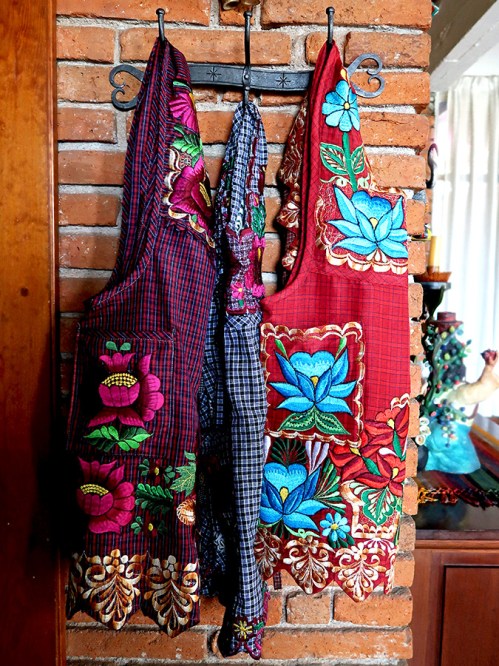
IMG_6753

Three of my mandiles; the red is the newest.

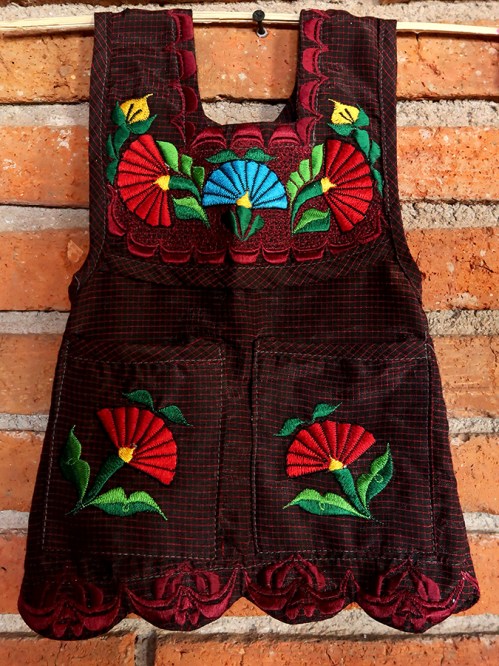
I even dared to wear one recently in New York at my granddaughter’s first birthday party.  With children ranging in age from six weeks to six years, I thought it was a very practical fashion statement on my part.  And, guess who got one for her birthday?
IMG_6757

Birthday present to my granddaughter — a toddler-size mandil.

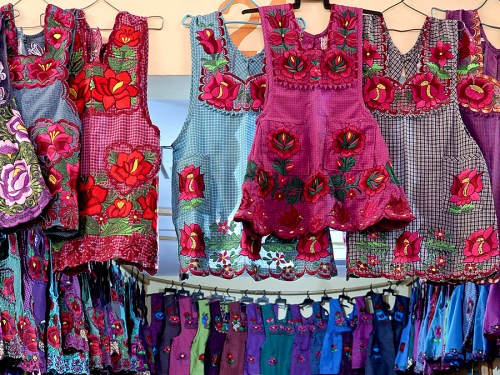
A good place to check out who is wearing what style of mandil is at Tlacolula’s Sunday market.  And, should you want to buy one for yourself and/or give one as a gift, there are at least eight apron stalls at the back of the market on Sundays.
img_4634

Apron stall at the back of the Tlacolula de Matamoros market.

Read Full Post »

I couldn’t resist posting more from the Encuentro de Cocineras Tradicionales de Oaxaca 2018 to tempt you to put next year’s gathering of traditional Oaxacan cooks on your calendar.

Amazing traditional cooks from the state of Oaxaca served up taste tempting fare in the Plaza de la Danza for four full, and I mean FULL days, April 25-28.

And, should one be inspired to immediately head to one’s own kitchen, the Mercado Oaxaca set up in the courtyard of the Facultad de Bellas Artes (across from the Plaza de la Danza) offered mouth-watering fresh fruits and vegetables, herbs, dried chiles, honeys, vinegars, and so much more.  I came away with a luscious cantaloupe.

In addition, to assist one in the preparation and serving of one’s own delicious meals, Arte de la Mesa presented vendors, next door in the courtyard of the Palacio Municipal, selling “made in Oaxaca” glassware, utensils, pottery, placemats, tablecloths, and dish towels, aprons, metates and molcajetes, among other kitchenware.

Do you see the piggy-face molcajete?  I bought it and have spent hours and hours, not to mention muscle power, seasoning it.  If you don’t believe me, use your favorite search engine to check out the various methods — there are no shortcuts!

Read Full Post »

« Newer Posts - Older Posts »