Feeds:
Posts
Comments

Archive for the ‘Creativity’ Category

Yesterday, I hibernated at home; a day spent unpacking and recovering.  Today, Carlos, now upgraded to a hurricane, is swirling off the coast of southern Mexico and bringing grey skies, chilly temperatures (it hasn’t even hit 70ºF), and a relentless drizzle.  It’s not the kind of day that draws one out into the streets.  However, the larder needed to be restocked and the cell phone needed to be reactivated, so, with umbrella in hand, I was forced to venture out.

On the upside, the rain brings out the greens of the cantera.  Though, I’m not sure where this concrete insert in the sidewalk at the corner of Independencia and Garcia Vigil came from or what it means.  (Update:  It’s Grupo: Salvando Vidas. Oaxaca — a volunteer group that has taken on the much needed task of repairing the city’s sidewalks muy peligrosas, saving lives and limbs!  h/t,  Peggy)

For some mystifying (at least to me) reason, Telcel deactivates my cell phone if I don’t use it for three weeks — this is despite the fact that I have a ridiculously high saldo (balance) in my account.  So, my first stop was to add even more pesos in order to reactivate my service.  With that chore in the rear view mirror, I crossed Independencia onto the Alameda, on my way to Mercado de Benito Juárez (or, Bennie J’s, as my friend G christened it years ago), only to find much of it covered with tents.

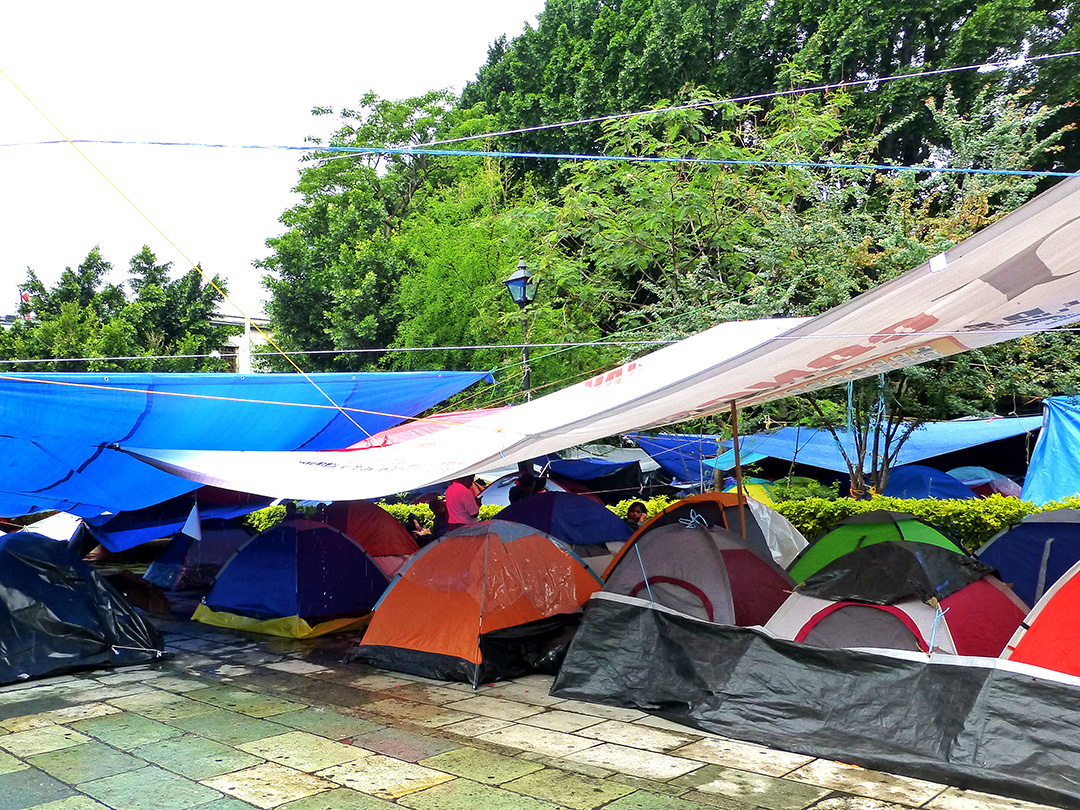
P1090803I’d read the news and had steeled myself for the return of ambulantes, but wasn’t prepared for ten times the number of Sección 22 teachers union tents from when I left in mid May.  Navigating the ropes tethering the tarps was a challenge and I had to forgo the umbrella.  The teachers looked cold and miserable and the restaurants under the portales looked mostly empty.  This is definitely not a picnic for anyone.  Continuing on to the mercado, I filled my shopping bag and headed for home.

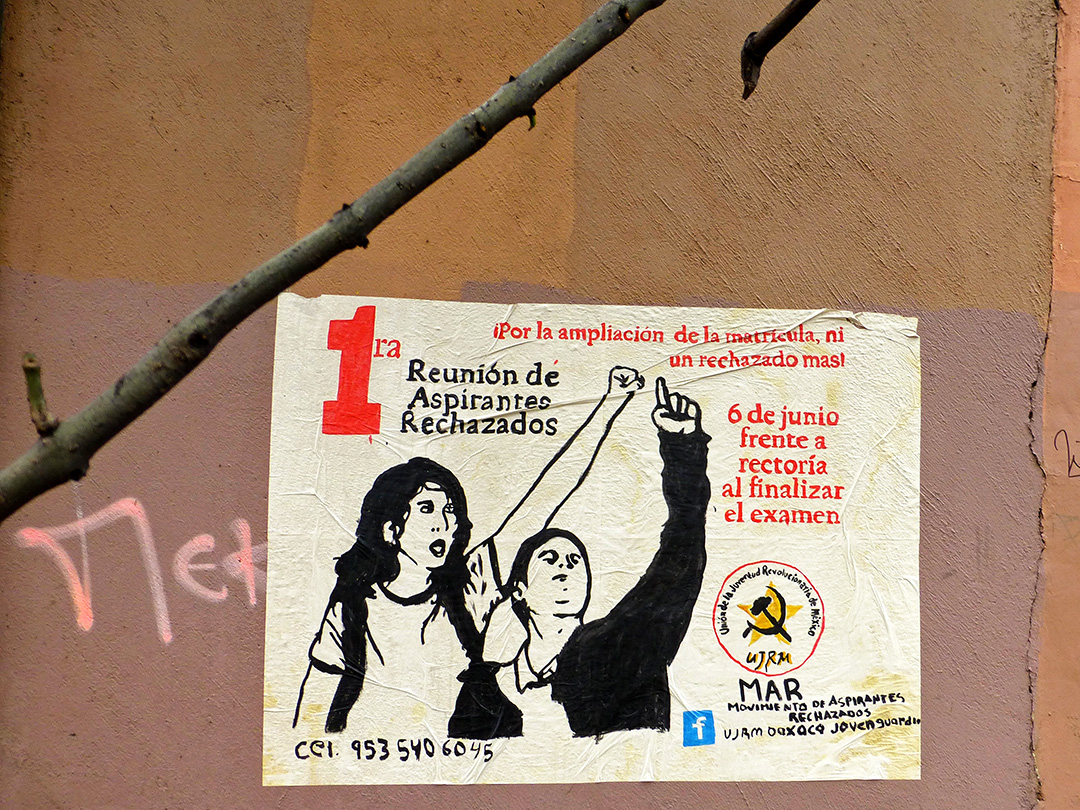
P1090816However, the signs of protest are everywhere.  In the “Emerald City,” the more things change, the more they stay the same.

Read Full Post »

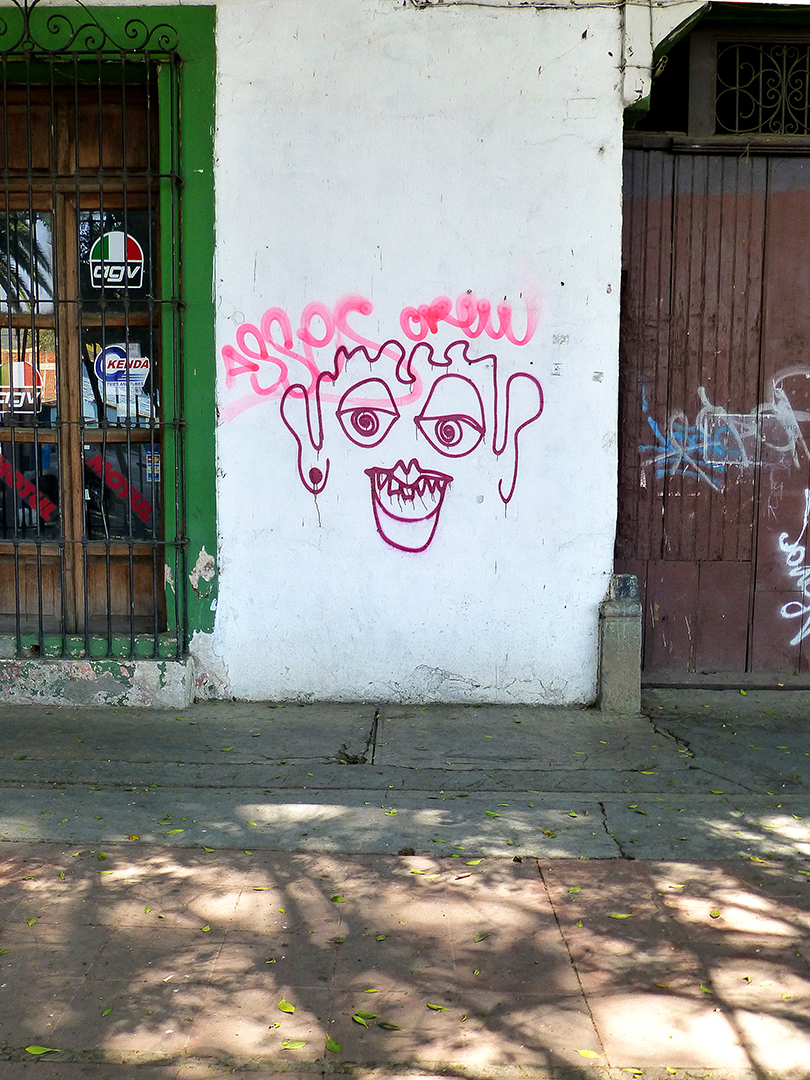
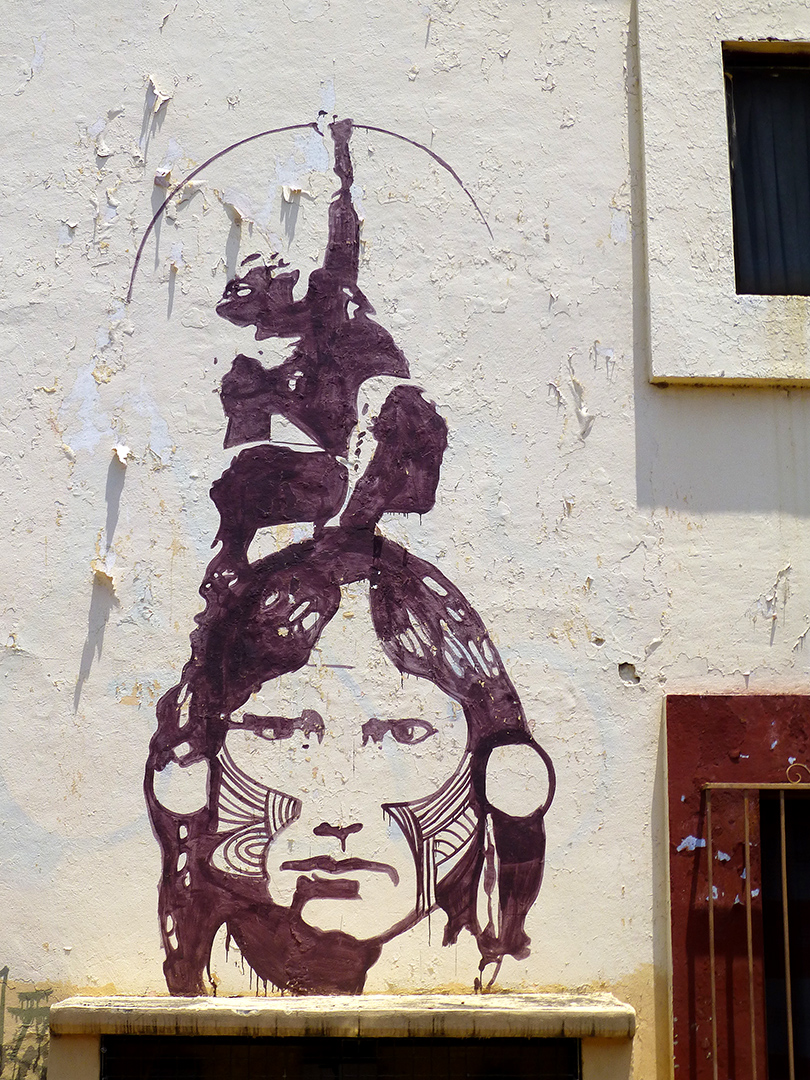
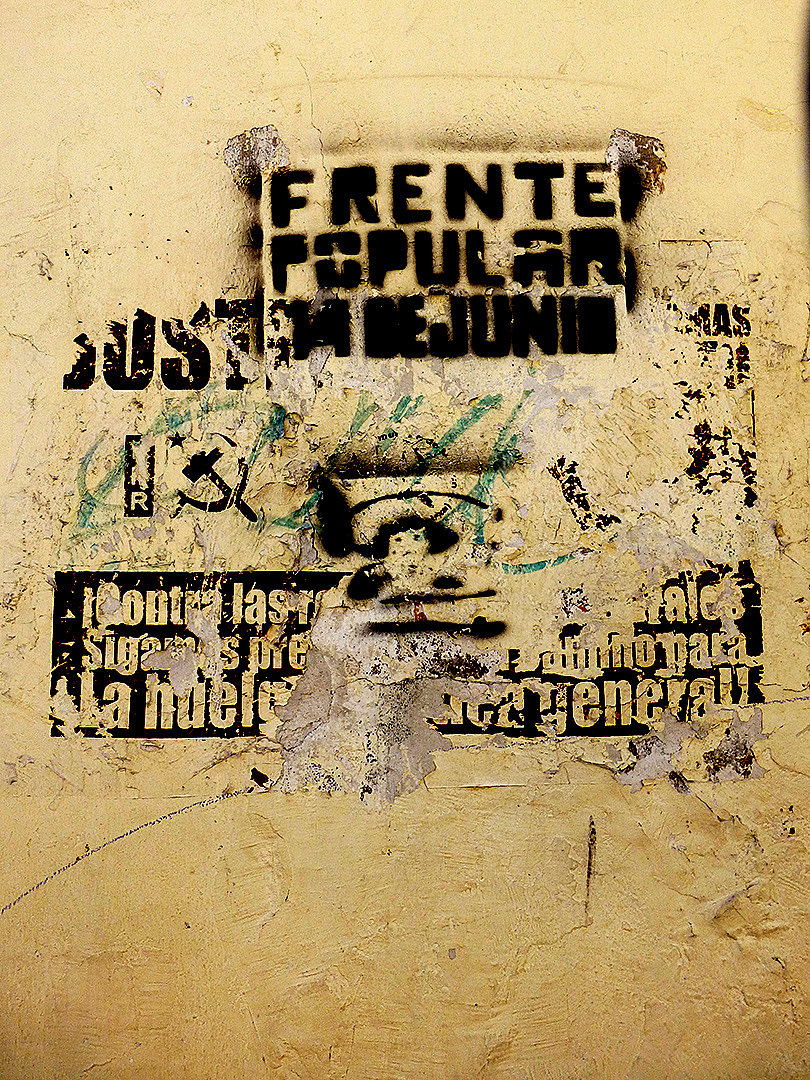
Looking forward to tomorrow’s return to Oaxaca, though not sure what I will find.  So, in preparation, a little street art, apropos of nothing…

P1060589

P1060966

P1080268

P1090304

P1080674

P1090499

… and everything.

Read Full Post »

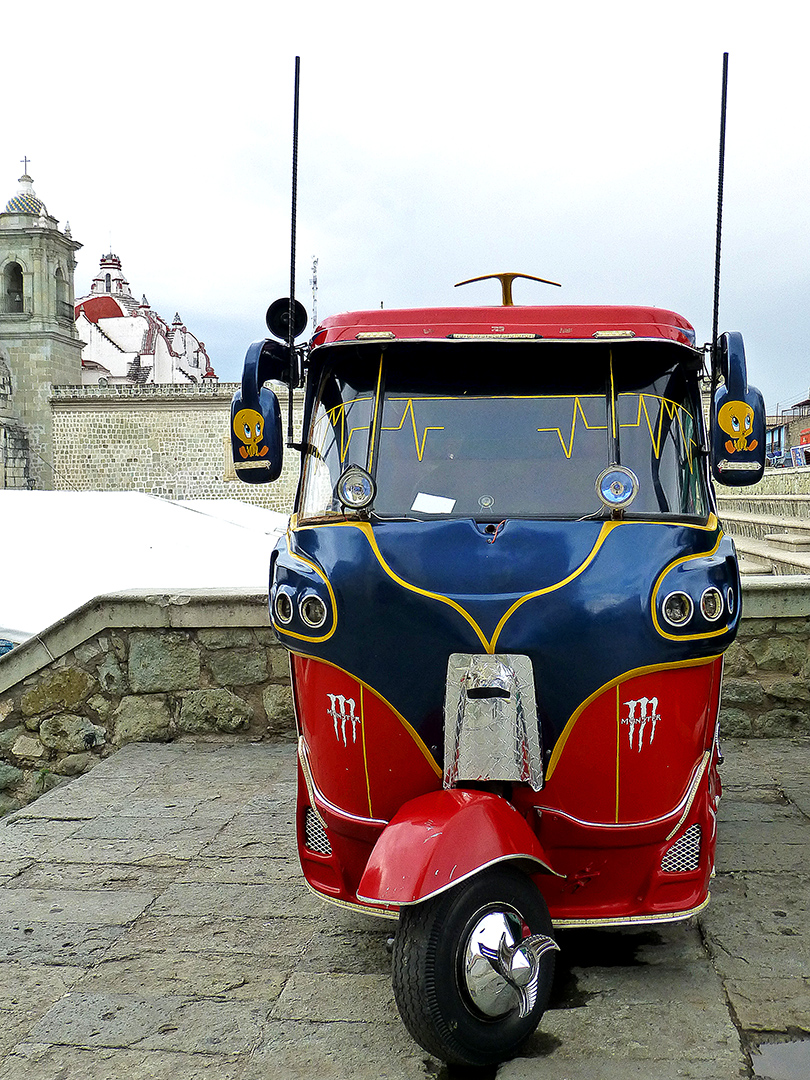
VW Beetles aren’t the only tricked out small vehicles on the road in Oaxaca.  While not allowed in the city, tuk-tuks (moto taxis) have become indispensible in ferrying passengers into the villages from bus and colectivo stops along the carreteras and up, down, and around the often narrow and dirt paved streets within villages where cars remain a luxury.  You haven’t lived until you’ve ridden one down a rocky embankment, forded a stream, and then climbed back up the bank on the other side — all without tipping over or getting one’s feet wet.  Talk about the little engine that could!

Most are utilitarian looking.  However, one day these tricked out tuk tuks appeared above the Plaza de la Danza.

P1080270

P1080271

P1080269

If you’ve got a little money and a large imagination, voilà!

Read Full Post »

High in the mountains of the Sierra Norte, the village of Santa María Tlahuitoltepec sits perched on a ridge top in Oaxaca’s Mixe region.  The terrain is rugged and unforgiving; it took rescue crews ten hours, much of it on foot, to reach the municipality following a lethal mudslide at the end of an extremely wet 2012 rainy season.  Eight months later, in May of 2013, when blogger buddy Chris and I ventured up there for their Fiesta de Mayo, we still had to detour around the remains of the slide.

P1080538 copy

Santa María Tlahuitoltepec, May 11, 2013.

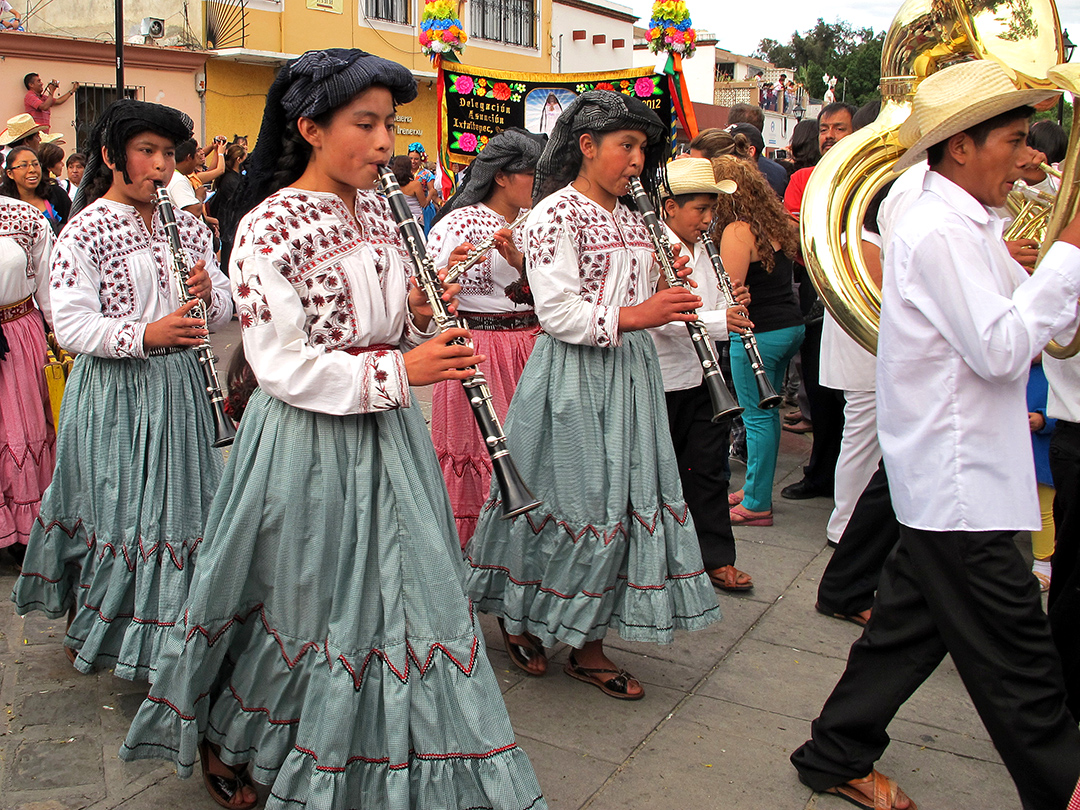
Despite the harsh conditions and its remote location, Santa María Tlahuitoltepec is home to the Center for Musical Training and Development of Mixe Culture and it is estimated that 70% of the population can read music and many who can’t, play by ear — a source of great pride.

Guelaguetza desfile, July 28, 2012

Guelaguetza desfile, July 28, 2012

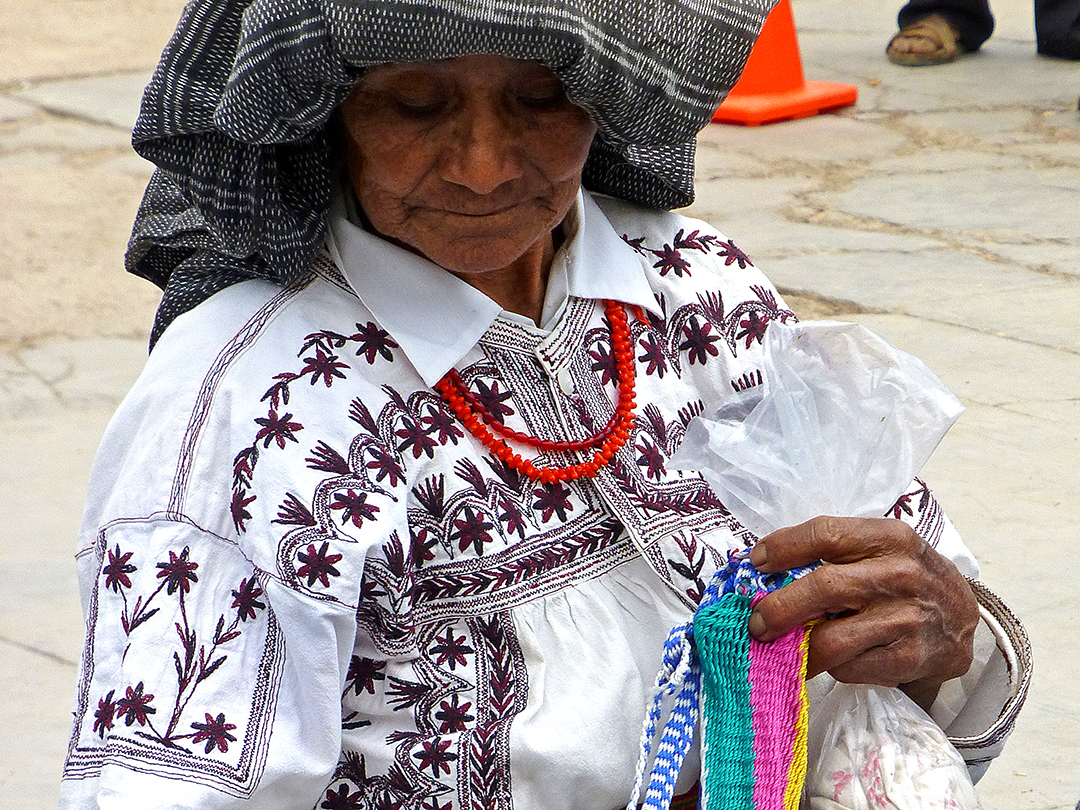
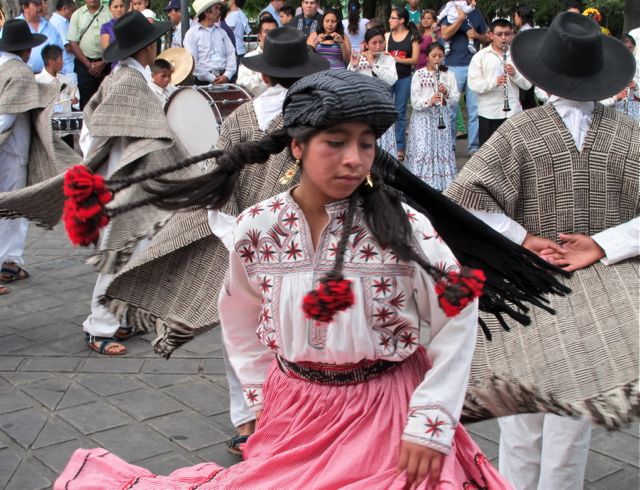
In addition to the musical talents of its residents, the village is known for the intricately embroidered blouses the women make and wear.  The design of both the cut of the blouse and the patterns of embroidery are uniquely Santa María Tlahuitoltepec.  If you see someone wearing one on the streets of Oaxaca, you know immediately where it came from.  I have a blouse and Chris bought a couple to decorate the walls of his house.

Santa María Tlahuitoltepec, May 2013.

Santa María Tlahuitoltepec, May 11, 2013.

However, in January of this year Oaxaqueña singer Susana Harp raised the alarm when she tweeted her outrage that the exclusive US department store Neiman Marcus was selling identical copies of the blouses of Santa María Tlahuitoltepec for $290 US dollars (six times what the originals cost in Oaxaca) — without even an acknowledgement of the origin of the designs.  And, last week ReMezcla (a digital publisher, creative agency, and entertainment company targeting Latino millenials) took up the issue of this kind of cultural appropriation with it’s article, The $290 Isabel Marant Huipil Rip Off That Pissed Off Oaxaca’s Mixe Community noting that, “In the case of Isabel Marant’s new ‘bohemian’ Étoile line, however, it’s hard to even muster a flimsy cultural inspiration defense, since the Oaxacan Mixe culture the clothes were ‘inspired’ by have been completely erased from the narrative.”

Dancers in action from Santa María Tlahuitoltepec

I urge you to forgo these and other high-priced knock-offs.  Instead, go to the source and buy originals from the talented artisans who created them.  And, a note to ReMezcla, especially given the subject of your article, I would have appreciated credit for your use of my photograph (above) from the Guelaguetza desfile, that I originally posted July 22, 2013.

Update:  A press conference by municipal authorities and embroiderers from Santa María Tlahuitoltepec was held on June 3 at at the Textile Museum of Oaxaca protesting the lack of respect by Isabel Marant for the creativity and work by the women of Tlahuitoltepec and the history and worldview that gave birth to their designs.

Read Full Post »

Eight months and counting… Tonight, eight months ago, 43 students from the Escuela Normal Rural Raúl Isidro Burgos teachers’ college in Ayotzinapa, Guerrero went missing.  I am sadly resigned that marking this horrific anniversary has become a regular feature on my blog.  As a mother, a guest resident of Mexico, and someone who believes that the peoples of the world deserve social justice, I can’t ignore this tragedy.

I dare you to leave Carteles por Ayotzinapa, the current exhibition at Instituto de Artes Gráficas de Oaxaca (IAGO), with a dry eye.  The 49 posters on display are only a fraction of the over 700 posters submitted to the First International Poster Biennial 2014 Convocation Ayotzinapa, an initiative of Oaxaca’s internationally renown artist, Francisco Toledo.  In addition to Mexico, artists from Argentina to Greece; Iran to Lebanon; and Poland to the USA responded to his call, recognizing as Toledo explained, the tragedy of Ayotzinapa has outraged people from beyond the borders of Mexico.

Photo courtesy of Oaxaca Media

Photo courtesy of Oaxaca Media

Irwin Homero Carreño Garnica, a graphic design student, originally from Ocotlán de Morelos, Oaxaca, was awarded first prize for his heartbreaking work, “México fracturado por Ayotzinapa” (Mexico fractured by Ayotzinapa).  As you can see above, it is a map of Mexico in the shape of a skeleton, with a break in the femur, where Ayotzinapa, Guerrero is located.  Like the work of the Tlacolulokos, the use of an iconic image (skeleton) and a primary palette of black, white, and greys, increases the emotional impact, much like Picasso’s, “Guernica.

Second place was won by Damian Kłaczkiewicz (Poland) and third place went to Daniela Diaz (Mexico).  The three winning posters will be reproduced for distribution throughout Mexico.

The exhibition runs through June 26, 2015.

Read Full Post »

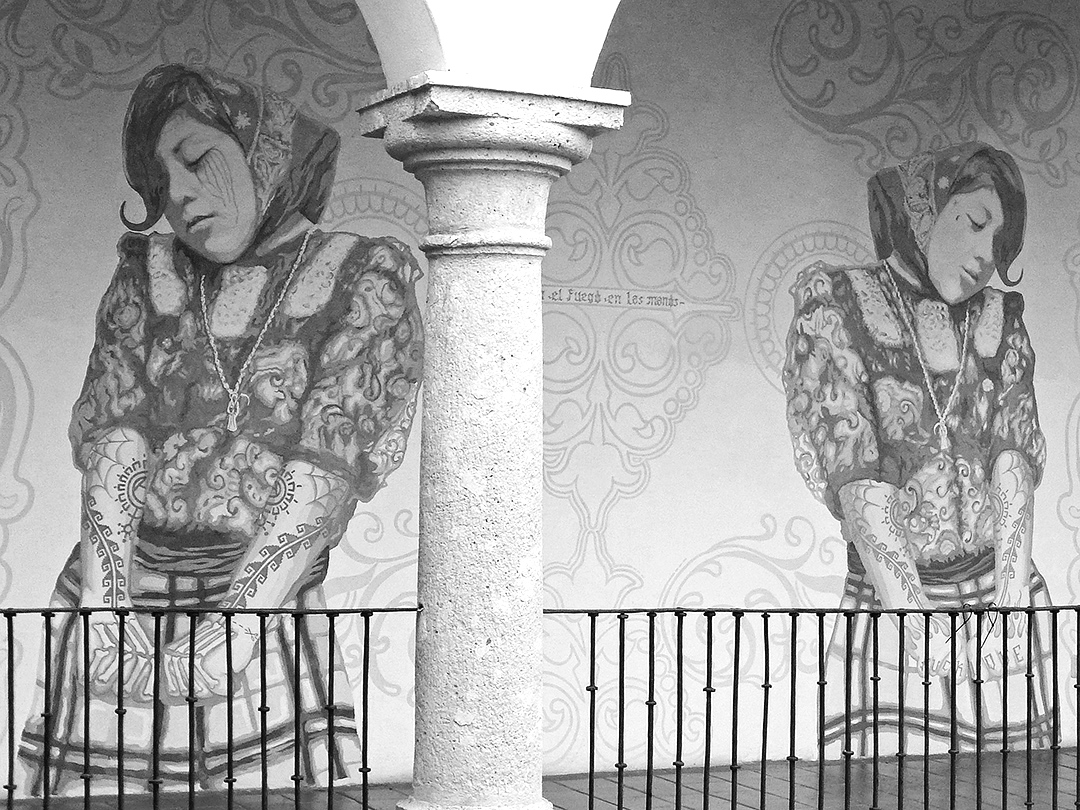
The previously mentioned Tlacolulokos collective has brought their artistry and social commentary to a wall on the upper floor of the Casa de la Ciudad.  The mural, “Con el fuego en las manos” shows two young women, almost mirror images of each other or, perhaps, two sides of the same woman.

P1090454

The young women/woman wear the traditional clothing of San Bartolome Quialana, a village near Tlacolula de Matamoros, home of the Tlacolulokos collective.  Like communities throughout Oaxaca, much of the male population has migrated to the United States, in search of work leaving the women to carry on alone.

As the introduction to the exhibit on the Casa de la Ciudad website explains, With a critical view towards the current cultural context, Tlacolulokos group, headed by Darío Canul and Cosijoesa Cernas, seeks to question the idealized images of the Oaxacan culture, tourism product discourse, and insights from the reality currently experienced by the people of Oaxaca.

There are elements in her clothing belonging to the Latina culture of the southern United States, as the cholo bandana that she wears on her head, or the tattoos on her arms that add a critical and provocative tinge to this cultural mix, a product of migration.  [ Google translation, with a little help from yours truly]

One of the trademarks of  the Tlacolulokos group is the power their images acquire and the emotion they elicit by limiting the palette to black, white, and grays.  For more background and a better understanding of the mural, a video (en español) of the artists discussing their work can be found here.

“Con el fuego en las manos”  is scheduled to run until December 2015 at the Casa de la Ciudad (Porfirio Diaz No. 115, at the corner of Morelos in Oaxaca’s Historic District).  Hours are 9:00 AM to 8:00 PM, Monday through Sunday.

Read Full Post »

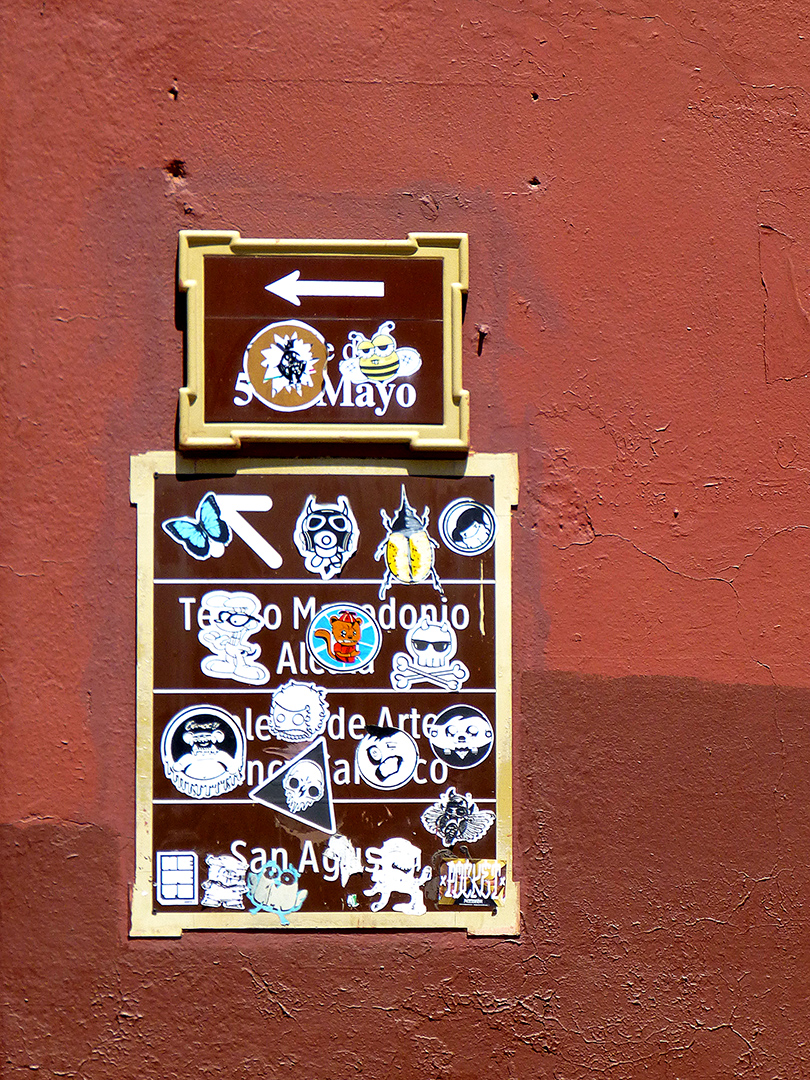
Situated metaphorically at the busy intersection of imagery and content—and informed by history, mass media, commerce, and pop culture—stickers address both the personal and the political.  — Street Art Graphics, The Richard F. Brush Art Gallery, St. Lawrence University.

P1090439 copy

Stick-to-itiveness:  the quality that allows someone to continue trying to do something even though it is difficult or unpleasant.

P1090440 copy

Street art stickers — a metaphor for Mexico, methinks.

Read Full Post »

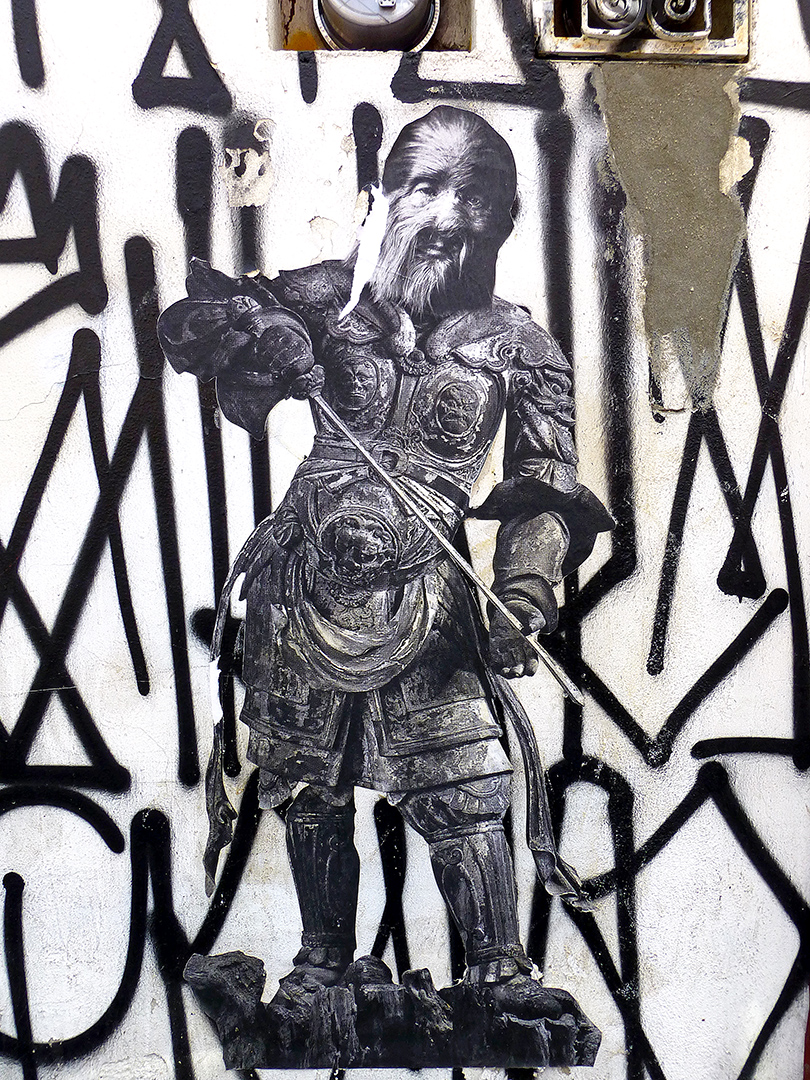
Just so you know…  The gods are watching you on Tinoco y Palacios, between Morelos and Matamoros.

P1060576 copy P1090489 copy

Hmmm…. sometime between January, when I first photographed the mural and a few days ago, when I returned, an airplane landed on the tongue.

P1090486 copy P1090490 copy

Recently, BBCtrending posted the video, Aztec to urban — Mexico’s street art explosion, highlighting the use of Mexico’s pre-Columbian imagery in contemporary street art.  I don’t know the name of the artist who painted the mural above, but seeing the “Dioses Urbanos” of Diego Alvarez (aka, Ocote) in the video, brought it to mind.

Read Full Post »

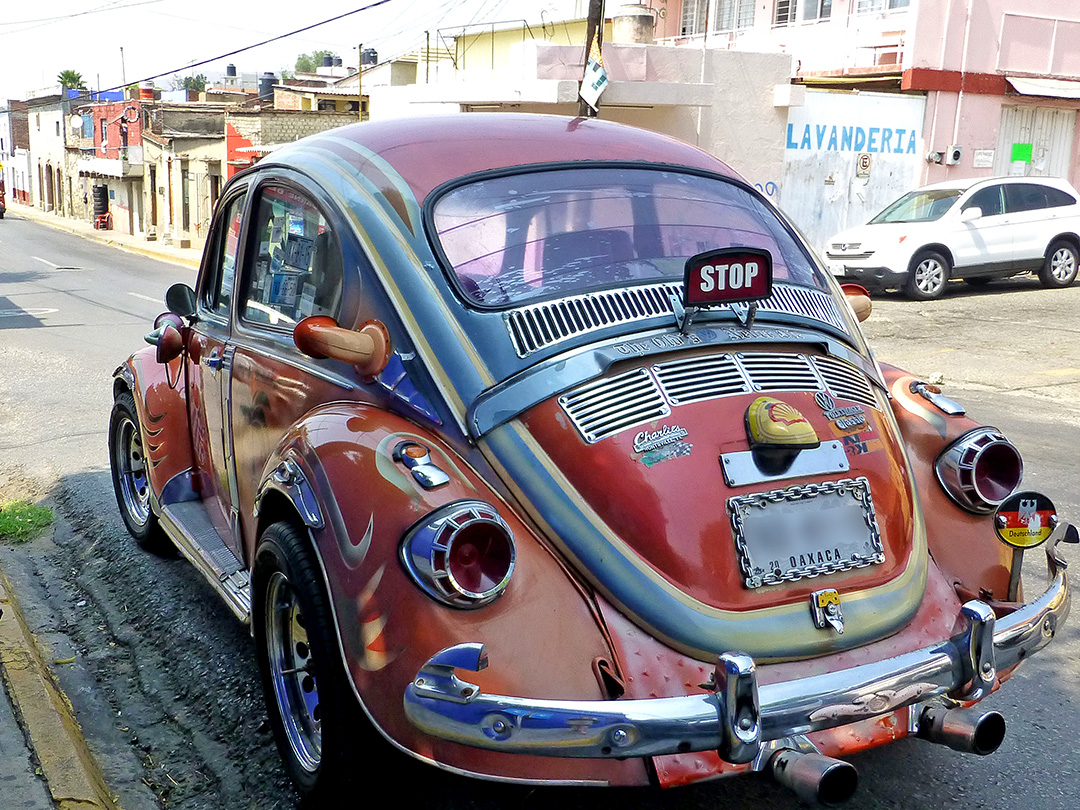
Long ago, in a land far, far away, I once had a Volkswagen Beetle.   It was so old, it didn’t even have a gas gauge, only a reserve tank.  My little bug would inevitably begin running out of gas when I was putt-putting up a hill, requiring me to take my foot off the gas pedal to kick over the reserve tank.  Needless to say, I would hold my breath and offer up silent prayers that I wouldn’t get rear-ended and that there was, indeed, gas in the reserve tank!  But, I loved that car…

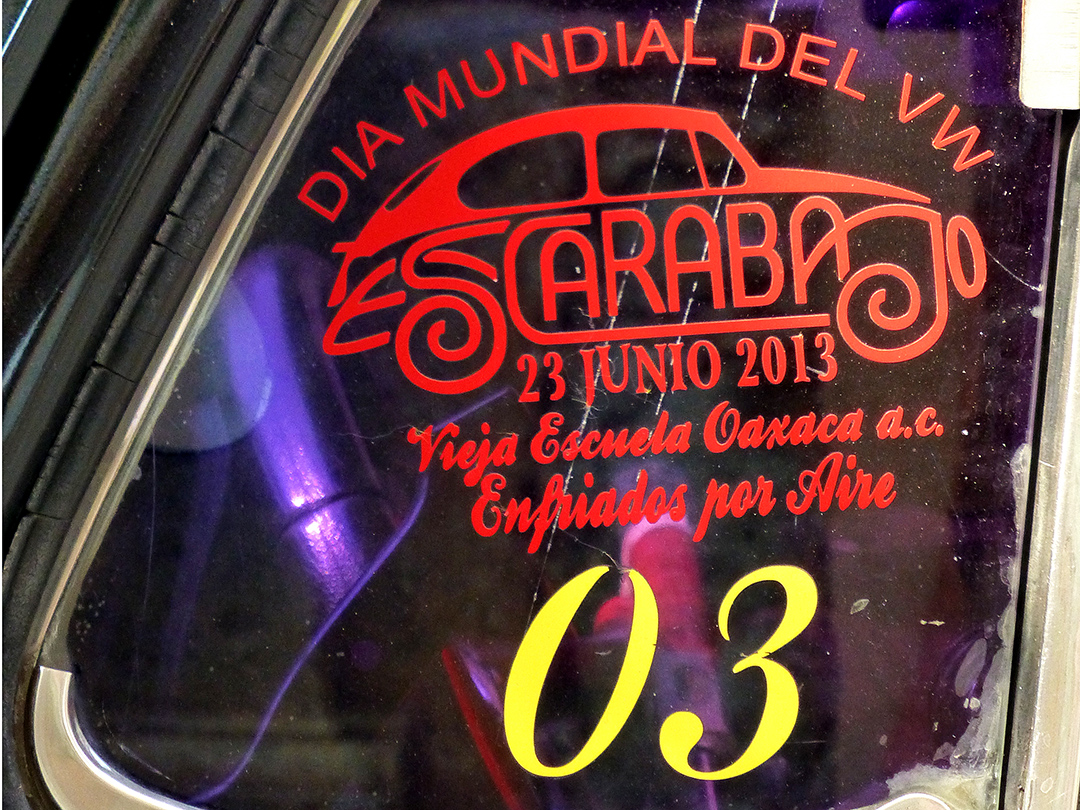
So, only a block from Casita Colibrí, how could I resist stopping to admire this beauty?

P1090401

Made in Oaxaca — or at least, tricked out in Oaxaca.

P1090402

Ready to rally again on the Pan American Highway?  It’s just up the road apiece.

P1090404_horiz

Stay calm… Doing it the old school Beetle way!

P1090406

Hmmm… last month’s Old VWs never die and now this post.  Bugs, of the VW variety, might just have to become a regular feature.

Read Full Post »

It’s Cinco de Mayo, but in Oaxaca, like most of Mexico, it’s a business as usual kind of day; schools are in session, businesses and banks are open, and deliveries are being made.  The cervesas and mezcal may be flowing and guacamole may be served, but no more than usual.  Only in Puebla, where the significantly outnumbered Mexican troops defeated the French army in the Battle of Puebla on May 5, 1862, is it a big deal.  However, most every city and village has a street named 5 de mayo and in many, like Oaxaca, a street has been named for Ignacio Zaragoza Seguín, the general who commanded the Mexican army at the Battle of Puebla.  By the way, he was born in what was the Mexican village of Bahía del Espíritu Santo, now Goliad, Texas, USA.

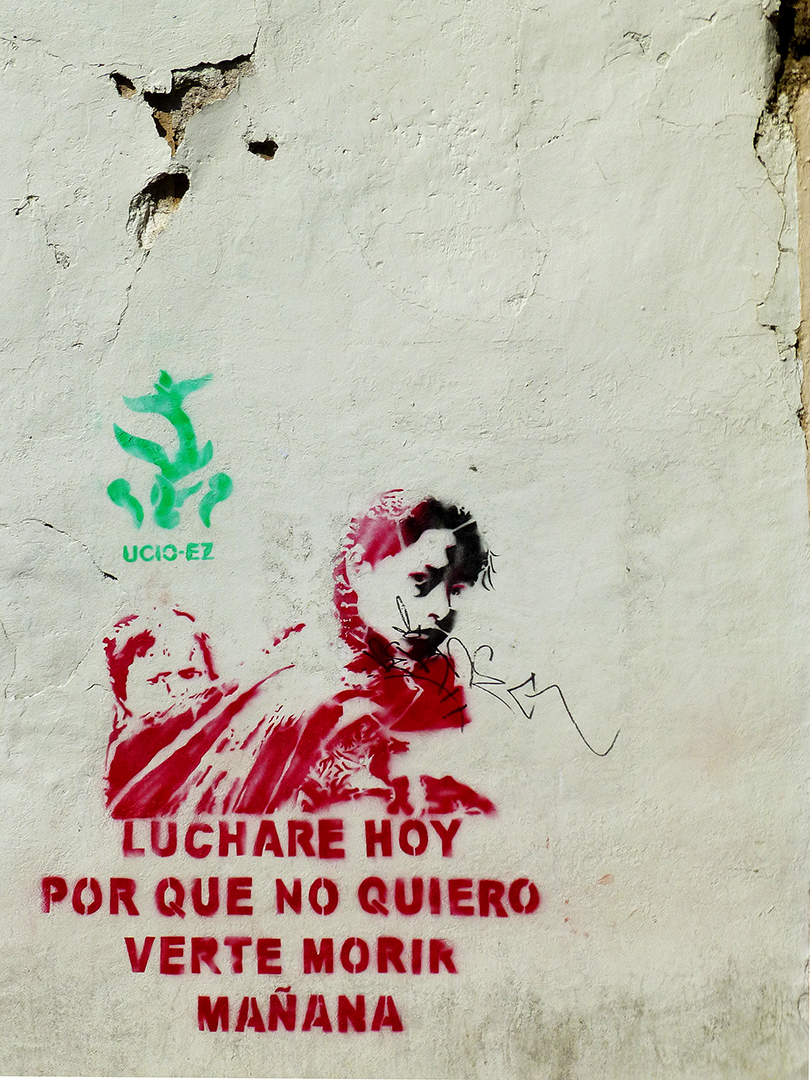
As the walls of Oaxaca continue to show, it’s the current battles that remain front and center…

P1050917 copy P1080998 copy P1080893 copy P1080997 P1050398As the mother in the stencil above explains, against the odds like her ancestors 153 years ago, “I will fight today because I don’t want to see you die tomorrow.”

Read Full Post »

Yesterday, the city of Oaxaca celebrated its 483rd birthday as a Spanish chartered city.  Early in the morning bells were rung, Las Mañanitas was sung, tamales and atole were served, an air force flyover buzzed the city several times, multiple musical events were held, a convite paraded through the streets, fireworks exploded from the Plaza de la Danza, and more, and it continues.  I was going to write about it, but…

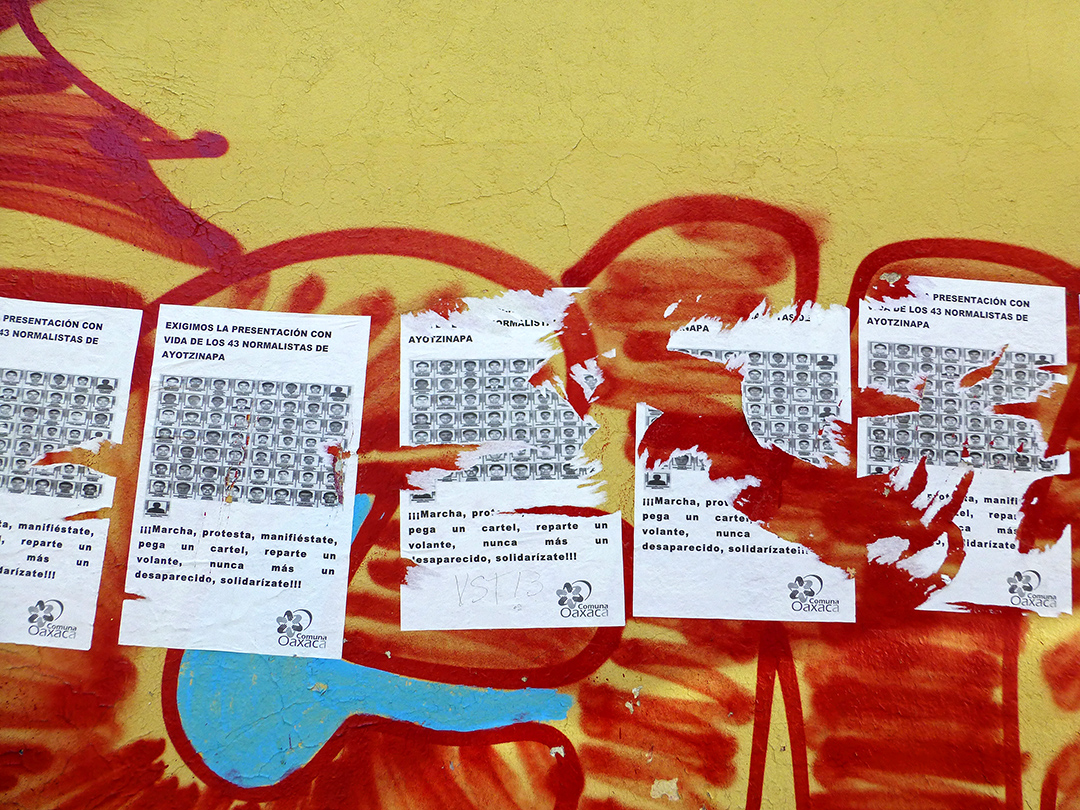
Today a more urgent anniversary requires our attention:  Mexico Marks 7 Months Since 43 Ayotzinapa Students Disappeared.  Family, fellow classmates, friends, and supporters around the world keep their names alive and cry for justice.  And artists continue to reach into our minds and hearts through their music, artwork, and film making.

In the documentary, Ayotzinapa’s 43 Disappeared: Family & Friends Remember, we hear the voices of their classmates and relatives. They don’t trust the official story and are determined to find out what happened.

Near the end of the song, “La Patria Madrina,” from her new album, Balas y Chocolate (Bullets and Chocolat), Lila Downs chants the Ayotzinapa 43 mantra that can be seen and heard all over Mexico, ¡Vivos los llevaron, vivos los queremos!  (They were taken alive, and we want them back alive!)

And, on walls throughout Mexico, our attention is called to the missing 43 students from the Escuela Normal Rural Raúl Isidro Burgos, teachers’ college in Ayotzinapa, Guerrero.

Oaxaca de Juárez

Oaxaca de Juárez

Mexico City

Mexico City

Mexico City

Mexico City

Oaxaca de Juárez

Oaxaca de Juárez

Read Full Post »

Old Volkswagens never die.

P1090066They cruise on down to Oaxaca…

P1090067Put on some bling…

P1090068copyAnd, stop traffic!

Read Full Post »

Love and adventure on Calle de Los Mártires de Tacubaya!!!

Before he plunges into the deep to do battle with the giant pulpo, one last kiss goodbye from the girl in the red car.

P1080676

Kiss the Girl Goodbye

Kiss the girl goodbye
It’s time for me to fly
Wipe the tears away
I’ll be home some day, baby
So baby, please wait for me
Don’t want no one to take my place
You’re the one for me
And that’s the way love should be We’ve been apart so many times before
One more time won’t change things
I’ll even love you more We’ve been apart so many times before
One more time won’t change things
I’ll even love you more (Kiss me) kiss the girl goodbye (goodbye) it’s time to fly
(Kiss me) wipe the tears away (goodbye)
(Kiss me) kiss the girl goodbye (goodbye) it’s time to fly
(Kiss me) wipe the tears away (bye)
(Kiss me) kiss the girl goodbye (goodbye) it’s time to fly
(Kiss me) wipe the tears away

Songwriters:  Peter Criss, S. Penridge
Kiss The Girl Goodbye lyrics © Reach Music Publishing-Digital Obo Rock Steady Music

(Not their typical fare, but still, I can’t believe I’ve posted a song from Kiss!!!)

Read Full Post »

Today the Museo Textil de Oaxaca is celebrating its seventh birthday with live music (of course!), nieves (ice cream), and an expo-venta of tie-dye and batik textiles from Nigerian born, Gasali Adeyemo.  The exhibition and sale culminate a week-long artist-in-residence, in which he taught a 5-day workshop — I’m kicking myself I didn’t take it — and a Friday evening presentation, “African Blues, Mi Vida en Indigo” — which I did attend!  Gasali’s work is spectacular and his face glows when he talks about the traditions, technique, and love that goes into his work.

P1080889P1080985P1080984Note the orange blouse above; it beckoned to me and I couldn’t resist buying it.  The technique is batik on a brocaded cotton that has been dyed with the bark of a tree found in Nigeria.  The name of the tree in the Yoruba language is Epo Ira, which, according to Gasali roughly translates to, “tonic iron tree,” as it is also used medicinally to cure iron deficiency.

By the way, for those of you who are going to the International Folk Art Market in Santa Fe, NM in July, Gasali and his beautiful textiles will be there.

Read Full Post »

“What do you do all day?”  It’s a question I’ve been asked countless times since I began my retired life down Oaxaca way and I’m not alone.  Most expats here have heard those words — a query that hints at the notion that there couldn’t possibly enough to fill the day in a place where one isn’t fluent in the language, isn’t surrounded by family and old friends, and doesn’t have a job.  A large part of the answer is, doing most everything takes longer.  And that is not a bad thing!  Perhaps, a photo diary of this morning’s grocery shopping excursion might provide an illustration.

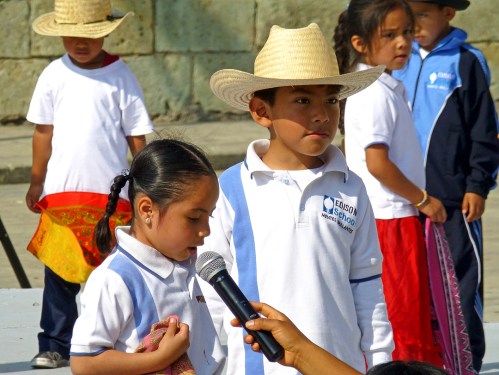
After morning coffee and breakfast, catching up on email and the news, washing dishes, showering and dressing, I grabbed a couple of shopping bags and headed out at 10 AM.  The initial plan had been to walk up to Niños Heroes (the Pan American highway) to photograph some new murals, cross the highway to the Organic Market, and then return home by way of Sánchez Pascuas mercado where I could get chicken, quesillo, and anything else that remained on my shopping list or struck my fancy.  However, for almost an hour, I’d been hearing Guelaguetza music coming from the Plaza de la Danza.  I decided a detour was in order and found kindergartners performing Oaxaca’s traditional folkloric dances, including this one  where couples take turns “dissing” each other in a rhythmic double-entendre laden dialogue.  It always gets laughs — wish I could understand the jokes!  Needless to say, I hung out watching the kids for awhile.
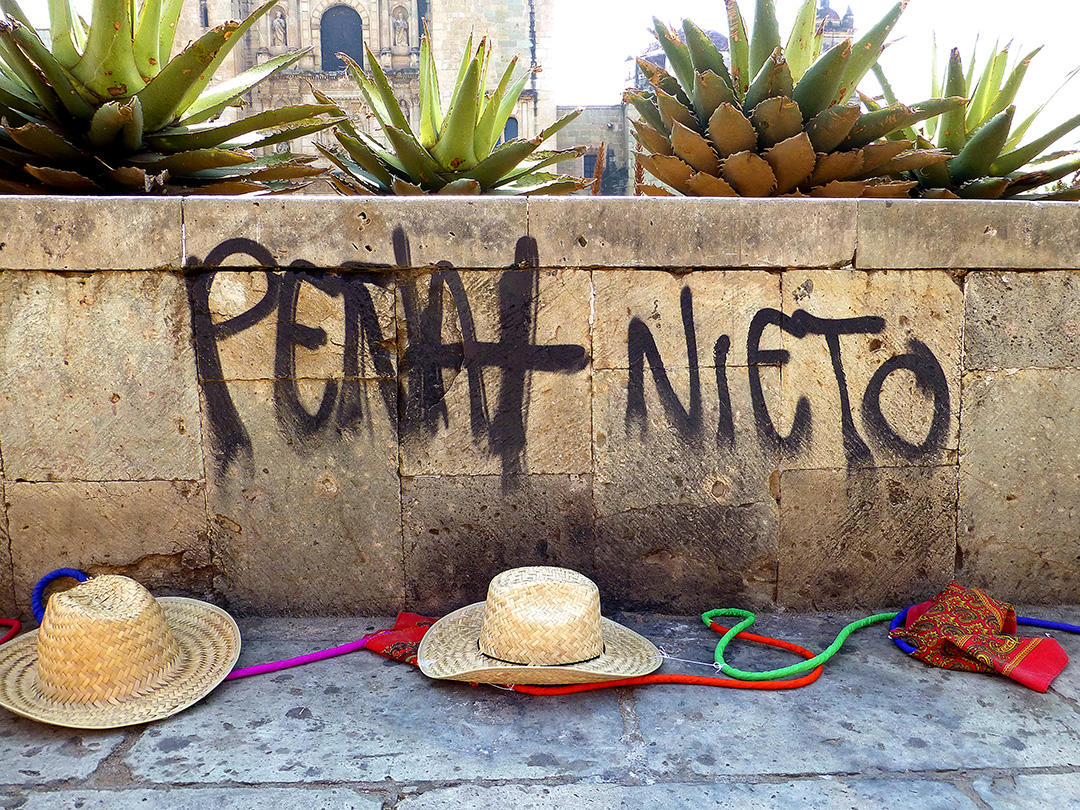
P1080705I finally tore myself away and resumed my original itinerary.  Some of the murals were east of the Pochimilco Organic Market so I decided to start at the end and work my way back — a route which took me up the Macedonio Alcalá where I saw a sidewalk vignette of hats and scarves lined up in front of Santo Domingo.  There was also a small marmota (cloth globe on a pole) laying on its side, so I’m guessing there was to be a calenda (parade) of some sort.
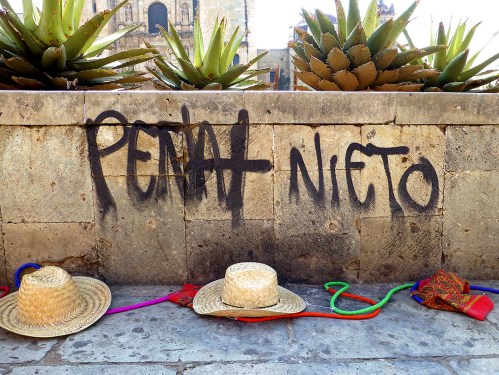
P1080715After stopping to take a few photos (how could I resist the juxtaposition with the Peña Nieto graffiti?) I found myself behind these vendors taking their merchandise up to Llano Park for its Friday market.

P1080717Deciding to speed up my slow progress on the errands I’d set forth for the morning, I passed the gals only to stop to watch Oaxaca’s version of the dog whisperer working with four Xoloitzcuintlis (Mexican Hairless Dogs).

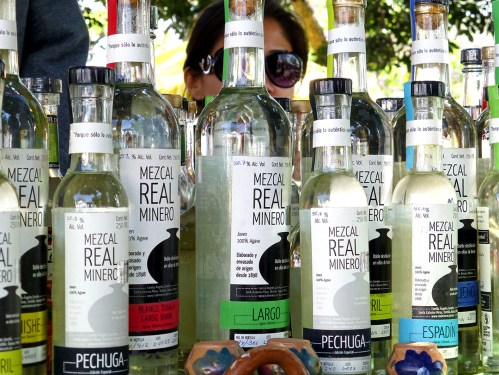
P1080722 (1)Eventually continuing north, I arrived at Niños Heroes and the murals and street art I’d come to find and photograph.  They deserve their own blog post, so I will save those photos for another day.  However, I also ran across this wonderful wall!  P1080752Crossing the highway, I found the newly built and landscaped stairs (almost didn’t recognize them) leading up to Xochimilco and the Pochimilco Organic Market.  I wandered and lingered and tasted — including a few of these mezcals, as I’ve got a US trip coming up and a stepson who probably won’t speak to me if I don’t bring him a couple of bottles.
P1080755Popping some gum in my mouth (didn’t want my breath to smell like I’m a lush), I headed south on Tinoco y Palacios to catch a couple of new murals I’d had fleeting glimpses of when returning from last Sunday’s trip to Tlacolula.  This one had particularly caught my eye.

P1080788By the time I arrived at Sánchez Pascuas, it was after 12 noon.  I found my poultry guy, paid a visit to the cheese vendor, picked up some veggies from my favorite produce gal, and, on the way out, bought some homemade salsa verde.  Yummm…  As I descended the three stairs down to the sidewalk, I turned around to admire the beautiful color of the flamboyant and jacaranda trees and the tranquility of this setting in the middle of the state’s bustling capital city.
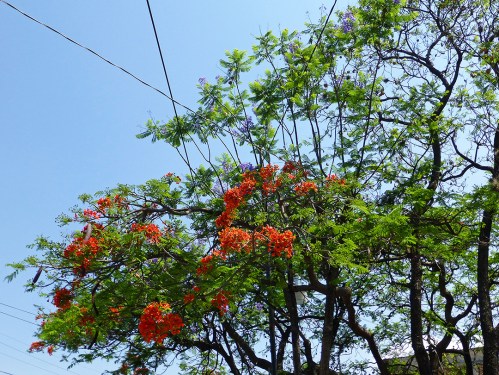
P1080815It was close to 1 PM when I unlocked the door to my apartment.  If I were in California, I would have jumped in the car, driven down to the local Friday organic market (with not a drop of mezcal in sight), browsed a bit, spent way too much money, climbed back in the car to finish shopping at Safeway, before returning to the house, probably by 11 AM.

Here in Oaxaca, I’d been gone almost three hours, walked close to fifty (often hilly) blocks, and seen some wonderful, creative, and life affirming sights.  And, that doesn’t even include the scattering of conversations with my neighbors and Luís and Luci, who work here.  Just another Friday.  Not a bad way to live one’s life!

Read Full Post »

« Newer Posts - Older Posts »