Feeds:
Posts
Comments

Posts Tagged ‘popular travel destinations’

I’ve been intending to post these photos for six months, but there has been so much going on in Oaxaca, I haven’t gotten around to it — until now.  This morning’s Guardian article, Trotsky’s murder remembered by grandson, 72 years on, caught my eye and I thought, if not today, when?  So, here goes…

When I was in Mexico City in January, I made somewhat of a pilgrimage out to the borough of Coyoacán.  Besides a lovely stroll through the Viveros de Coyoacán, being dazzled by the light and color of the Museo Frida Kahlo, and enjoying a delicious comida on the Plaza Hidalgo, I spent an incredibly moving three hours at the Museo Casa de Trotsky, the home, and now museum, of Russian revolutionary leader Leon Trotsky and his wife Natalia Sedova.  However, before getting to the photos, a very brief bit of context is necessary.

Hounded all over the world by Joseph Stalin and his agents, in 1937 Trotsky and Natalia Sedova were offered asylum by Mexican president Lázaro Cárdenas.  Trotsky’s orphaned grandson, Esteban Volkov (Seva), joined them not long after.  Seva narrowly escaped being murdered in his bed during the first attempt on Trotsky’s life in the Coyoacán house by Mexican muralist, David Alfaro Siqueiros.  It was during this attack that Trotsky guard, Robert Sheldon Harte was killed.

The house at Avenida Viena 19 was further fortified, but Stalinist agent, Ramón Mercader, under an assumed name was able to infiltrate Trotsky’s inner circle and, on August 20, 1940, under the ruse of asking Trotsky to look at something he had written, attacked him with an ice axe.  Trotsky died in hospital a little more than 24 hours later.  His ashes and those of Natalia’s reside in the peaceful garden of the Coyoacán house in a monument, designed by Irish-Mexican painter and architect Juan O’Gorman, that proudly flies a red flag and features the overlapping hammer of the worker and the sickle of the peasant.  The house and furnishings remain much as they were 72 years ago, bullet holes from the first attack and all.

This slideshow requires JavaScript.

The humanity expressed in the words below were felt as I wandered through the house and museum and I must admit, tears welled up as I stood before O’Gorman’s monument.

Trotsky’s Testament, dated 27 February 1940

My high (and still rising) blood pressure is deceiving those near me about my actual condition. I am active and able to work but the outcome is evidently near. These lines will be made public after my death.

I have no need to refute here once again the stupid and vile slanders of Stalin and his agents: there is not a single spot on my revolutionary honour. I have never entered, either directly or indirectly, into any behind-the-scenes agreements or even negotiations with the enemies of the working class. Thousands of Stalin’s opponents have fallen victims of similar false accusations. The new revolutionary generations will rehabilitate their political honour and deal with the Kremlin executioners according to their desserts.

I thank warmly the friends who remained loyal to me through the most difficult hours of my life. I do not name anyone in particular because I cannot name them all.

However, I consider myself justified in making an exception in the case of my companion, Natalia Ivanovna Sedova. In addition to the happiness of being a fighter for the cause of socialism, fate gave me the happiness of being her husband. During the almost forty years of our life together she remained an inexhaustible source of love, magnanimity, and tenderness. She underwent great sufferings, especially in the last period of our lives. But I find some comfort in the fact that she also knew days of happiness.

For forty-three years of my conscious life I have remained a revolutionist: for forty-two of them I have fought under the banner of Marxism. If I had to begin all over again I would of course try to avoid this or that mistake, but the main course of my life would remain unchanged. I shall die a proletarian revolutionary, a Marxist, a dialectical materialist, and, consequently, an irreconcilable atheist. My faith in the communist future of mankind is not less ardent, indeed it is firmer today, than it was in the days of my youth.

Natasha has just come up to the window from the courtyard and opened it wider so that the air may enter more freely into my room. I can see the bright green strip of grass beneath the wall, and the clear blue sky above the wall, and sunlight everywhere. Life is beautiful. Let the future generations cleanse it of all evil, oppression and violence, and enjoy it to the full.

For archives and bibliographies of Trotsky, the following two sites are about as comprehensive as one will find online:

Even if you are not interested in the politics, and especially if you are considering a visit to the museum, I highly recommend reading Barbara Kingsolver’s historical novel, The Lacuna, part of which takes place in Trotsky’s Mexican household and gives a flavor of life there.

By the way, the museum site (appropriately) houses the Instituto del Derecho de Asilo y las Libertades Públicas (Institute for the Right of Asylum and Public Liberties).  I wonder, are they working overtime these days?

Read Full Post »

On chairs in Reyes Etla.

On a chair: sheet music "Zapateando Istmeño xxx" for tuba

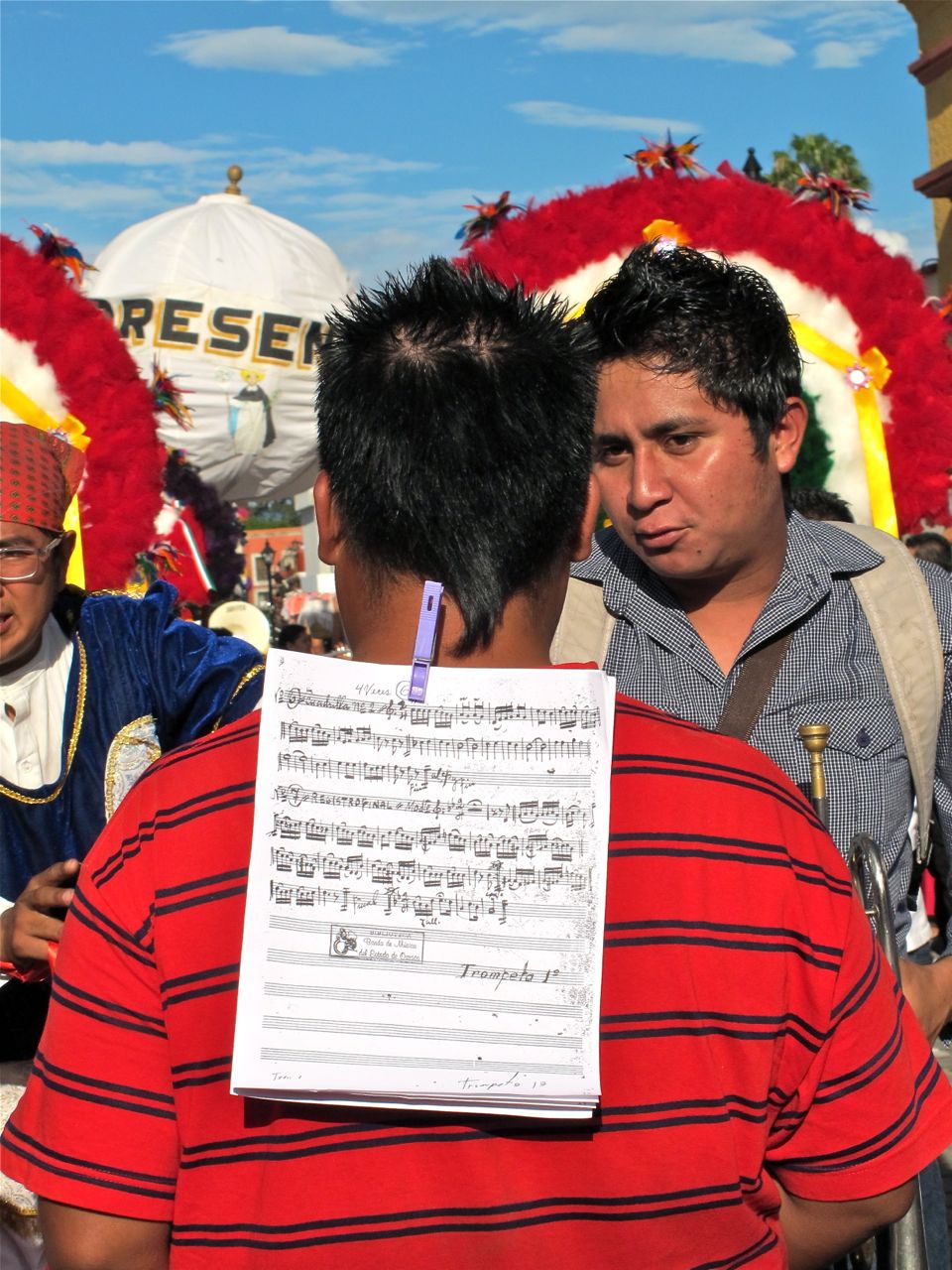
On people’s backs in the city.
"Cuadrilla no. 2" sheet music clipped on the back of a man wearing a red and black striped shirt

Wherever… especially during Guelaguetza!

Read Full Post »

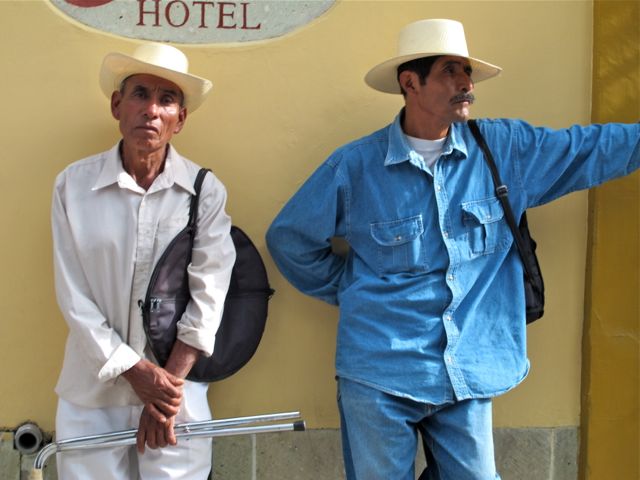
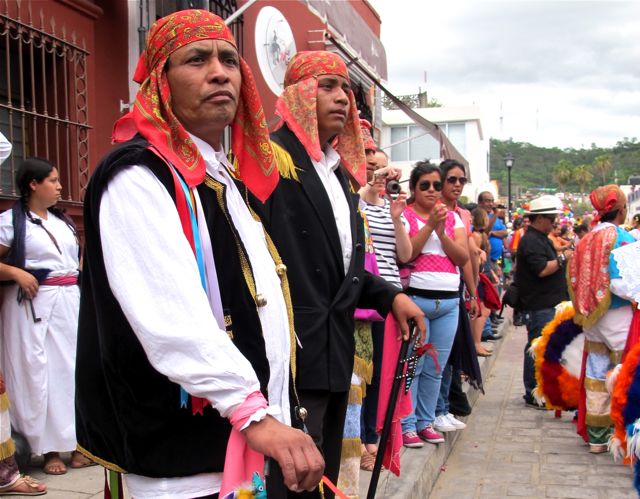
Waiting is a way of life down here and we all do it in our own way.  Right now Oaxaca is waiting for Tropical Storm Ernesto to “break on through to the other side.”  These guys were waiting to “get in step,” before the parade passes by.

Two men leaning against a wall

Two guys wearing red bandanas  on their head in foreground and crowd in background

Guy wearing costume leaning against wall

A peso for his thoughts…

(Mixing The Doors and Barbra Streisand lyrics — what was I thinking???)


Read Full Post »

Even though the Guelaguetza is over, textiles continue to be on my mind — actually I can never get enough of them!  So, a few days ago I walked down to the Museo Textil de Oaxaca to see the current exhibition, “Tormentos y Sueños” by Carolyn Kallenborn.  While not a Oaxaqueña, the respect she has for and inspiration she draws from the weavers and textile traditions of Oaxaca are obvious.

Kallenborn explains, “The pieces in this exhibit speak to the beauty and interaction between opposites.” (my translation)  The works are at once, complex and simple, using detail and negative space — much like storms and dreams.  Photographing a whole piece proved too much for my novice skills, thus I hope close-ups of these four pieces will whet your appetite.

If you are, or will be, in Oaxaca, I encourage you to see the whole!  The exhibit runs through November 9, 2012.

Read Full Post »

As that wise philosopher and Charlie Brown creator, Charles M. Schulz once wrote,

All you need is love. But a little chocolate now and then doesn’t hurt.

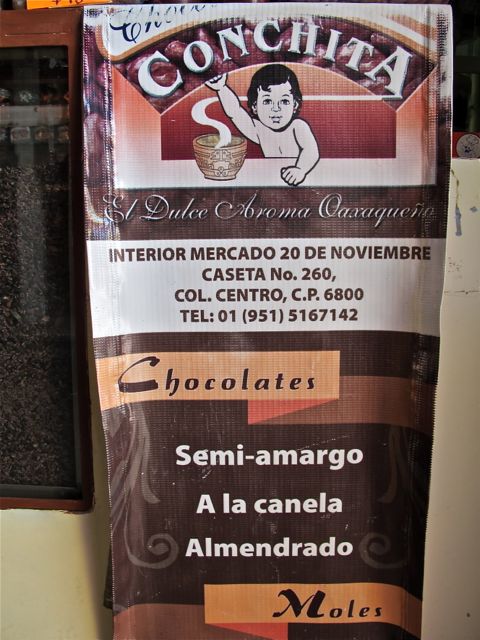
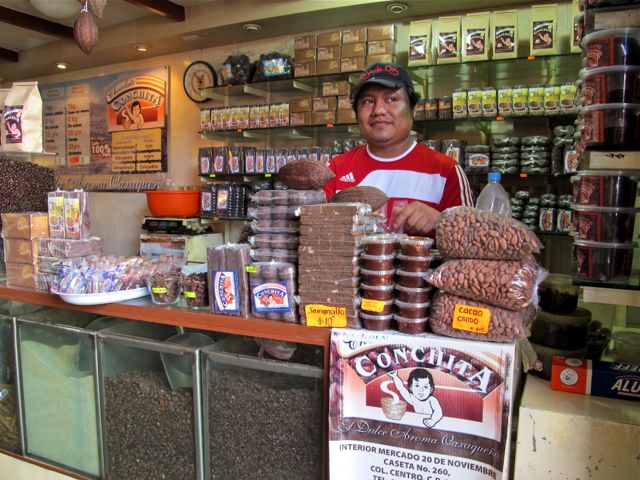
And, chocolate in Oaxaca is easy to find and is almost as well-known as Oaxaca’s cheeses and mole.  Ground almonds and cinnamon give it a distinctive and slightly spicy flavor — and everyone has their favorite.  Mayordomo and La Soledad are two of the most well-known labels, but my favorite brand (as opposed to homemade, which is in a class all by itself), is the much smaller, Conchita.

Conchita poster

Every month or so, I weave my way in and out through the crush of the always teeming sidewalks of Miguel Cabrera to the Conchita puesto immediately to the right, inside the Mercado 20 de Noviembre — the entrance between Aldama and Mina.

Sky blue entrance to the mercado 20 de noviembre.

I’m always greeted with a smile of recognition and the question, “Semi-amargo?”  Sí, I always reply!

Male sales clerk behind counter filled with chocolate products.

I buy the little semisweet chocolate chips for snacking (especially decadent and delicious when mixed with dried cranberries) and the large discs, which I grate into a fine powder to mix with hot milk to add to my morning coffee — a delectable way to jump-start the day!

Read Full Post »

Oh those beautiful braids of many of the dancers in Guelaguetza!  How do they do it?  In Reyes Etla, trapped between a yellow caution tape barrier and the folding chairs of the Tuxtepec delegation (the pineapple dancers), the answer was revealed…

Number 1:  You can’t do it yourself!

Woman standing braiding a hair extension into a seated woman's hair.

Number 2:  Hair extensions!  (Who knew???)

Close-up of hands braiding ribbons into hair

Number 3:  Practiced hands.

Hands braiding ribbons into hair.

Number 4:  Patience.

Hands braiding ribbons into hair.

But, it’s well worth the effort!

Hands finishing long braid, with red and blue ribbons, that extends beyond top of chair.

Read Full Post »

The textiles of Oaxaca are currently on center stage, both literally and figuratively, during these 10 days of Guelaguetza festivities.  And perhaps, besides drawing in much-needed tourist pesos, the Guelaguetza plays an important role in the appreciation and preservation of Oaxaca’s textile traditions.

Delegation from San Andrés Huaxpaltepec, District of Jamiltepec, in the Costa region of the state of Oaxaca.

However, the textile traditions of Lebanon have not fared so well.  According to the article, The End of the silk road, by Ana Marie Lucas and posted to Now Lebanon, silk production, which dates back to the Middle Ages, is on death’s doorstep.  Only two artisanal workshops remaining today.  However, along with the Italian Embassy, the Mexican Embassy, Alfredo Harp Helú Foundation, and Textile Museum of Oaxaca are coming to the rescue.

“We wanted to share our experience with the Lebanese,” Mexican Ambassador Jorge Alvarez Fuentes told NOW Extra. “When I saw the House of the Artisan closed and in need of more attention I thought this was the perfect place to exhibit both Mexican and Lebanese items,” he explained.

“Aside from the exhibition, we wanted to organize two conferences and a workshop of how to dye the silk with natural pigments. This way many people will be able to see how the Phoenicians could extract the purple dye from the Murex shell,” he added.

According to Héctor Meneses, head of the Textiles Museum in Oaxaca, there are surprising similarities between the Lebanese and Mexican traditions in terms of pigment extraction. Mexicans extracted the red dye from a species of snail, very similar to the purple dye extracted by the Phoenicians from the Murex shell. “The difference is that in Mexico, this process is still alive and it’s being used,” he said during a conference.  [Read full article HERE]

FYI:   Alfredo Harp Helú is a Mexican businessman who, like his cousin Carlos Slim Helú (world’s richest man), is of Lebanese extraction.  Harp Helú maintains a residence in Oaxaca and, besides his foundation funding the Textile Museum, he and his foundation are involved in several other philanthropic projects in the state of Oaxaca.

h/t to Margie Barclay for the article.

Read Full Post »

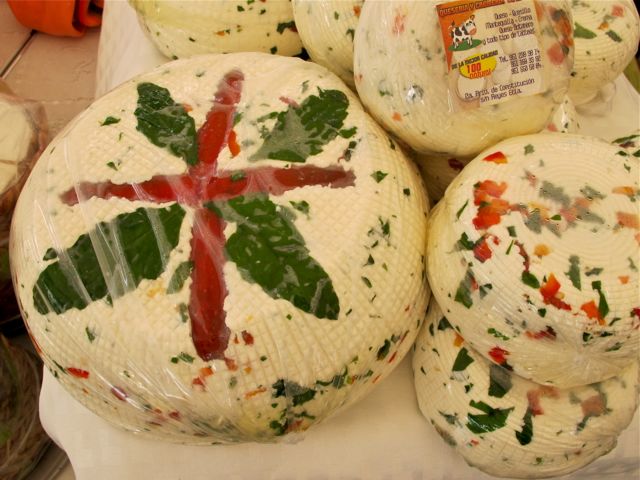
Besides mushrooms, tejate, tamales, and mole, there is cheese and mezcal… and last Monday I hopped in a colectivo bound for Etla; my destination was Reyes Etla (about 20 km. from the city) for the 2nd annual Queso y Quesillo Expo Feria.  Oaxaca is known all over Mexico for its cheese and, without a doubt, the best comes from the municipalities around Etla — and Oaxaca’s department of tourism is on a mission to promote its position globally.

Ball of cheese decorated with basil leaves and red bell pepper strips.

Vendors tempted with artistic displays and tastings of, among others, queso fresco, queso crema, and quesillo.  Yummm….  It is a dark day around Casita Colibrí when there isn’t a ball of quesillo in the refrigerator.

Display of cheeses with woman vendor behind counter

FYI:  Quesillo (aka:  Oaxacan string cheese) was first made in Reyes Etla in 1884 — supposedly by mistake!  According to one legend, a young girl from Reyes Etla disobeyed her mother and allowed the cheese curds to expand into a spongy mass.  She attempted to correct her mistake by pouring boiling water over the curds, then she kneaded it and pulled it into the first strip of what is now known as quesillo.

Woman vendor wearing mask behind display of quesillo
And, now, we turn to the 15th annual Feria Internacional del Mezcal…  After years of languishing in tequila’s shadow, being considered a “poor relation” — that is, if it was considered at all — mezcal’s profile has risen dramatically in the past several years.

XV feria internacional del mezcal oaxaca 2012

In August 2010, none other than Eric Asimov wrote about, Mezcal, Tequila’s Smoky, Spicy Cousin in the New York Times.  A year later, a NYT ‘s article advised, Move Over, Tequila, It’s Mescal’s Turn to Shine.  (You say mescal, I say mezcal.)

And, sheesh, I was flipping channels the other night and stumbled on Tim and Tim in Oaxaca, being instructed on the art of making mezcal by my landlord, on an episode of the TV program ROAM!  Then there is the No Reservations “Obsession” episode, where  Anthony Bourdain explores Ron Cooper’s obsession with mezcal.

Back to the feria, where over 40 vendors displayed their wares…

Bottles of mezcal lined up in two shelves of a display

poured generous tasting shots…

3 guys behind counter offering shots of mezcal

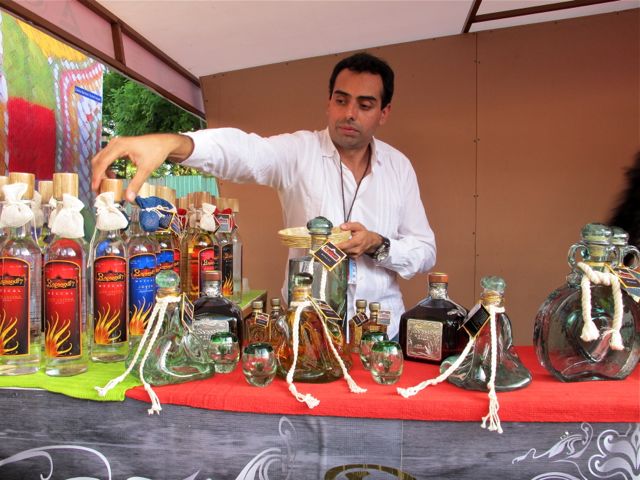
and sold their mezcals.

.Male vendor reaching for a bottle of mezcal

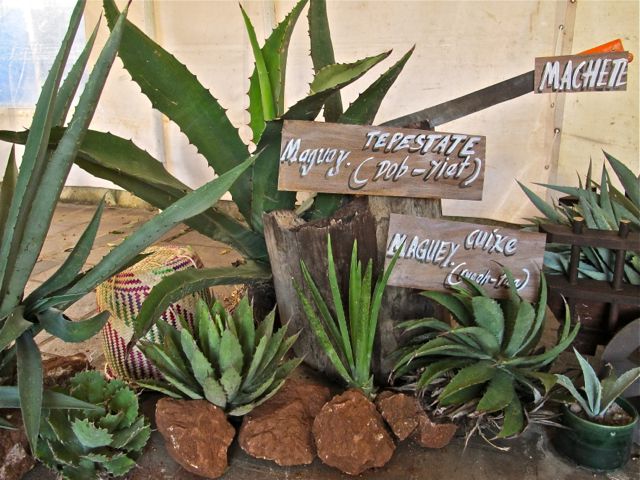
In addition, there was an exhibit showing the various types of maguey, from which mezcal is made…

Variety of agave plants with labels.

and the equipment used and processes they undergo to become this smoky and complex distilled spirit.

A mezcal still

As the old Oaxaqueño saying goes, “For everything bad, drink mezcal, and for everything good, you also should.”

Read Full Post »

Sunday, we headed up into the clouds of Oaxaca’s Sierra Norte to San Antonio Cuajimoloyas.  At 10,433 feet above sea level and nestled in a forest of pine and oak trees, the setting has an ethereal feel and seems a world apart from the valley below — almost like being in an alpine village in Switzerland.

Wood house with tin roof

Getting up there wasn’t easy, thanks to the bumpy and winding dirt road.  However, reaching our destination, the Feria Regional de Hongos Silvestres (fair of wild mushrooms) was well worth it!

Banner above municipal building, against a cloudy sky, announcing, "Bienvenidos,12va. feria regional de Hongos Silvestres"

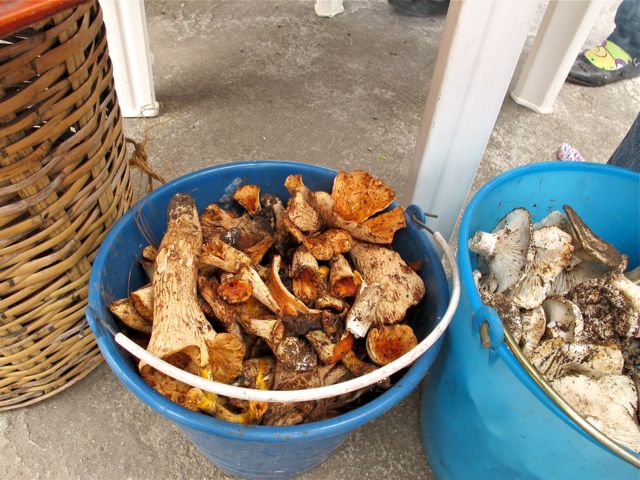
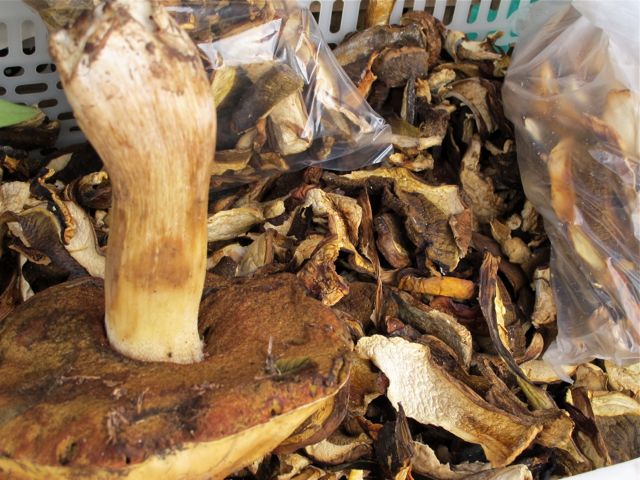
Once there, baskets, buckets, and boxes filled with freshly gathered mushrooms greeted us.

Blue plastic bucket of trumpet mushrooms

Close-up of mushrooms

Mushrooms in a box

Orange capped mushrooms in a green container

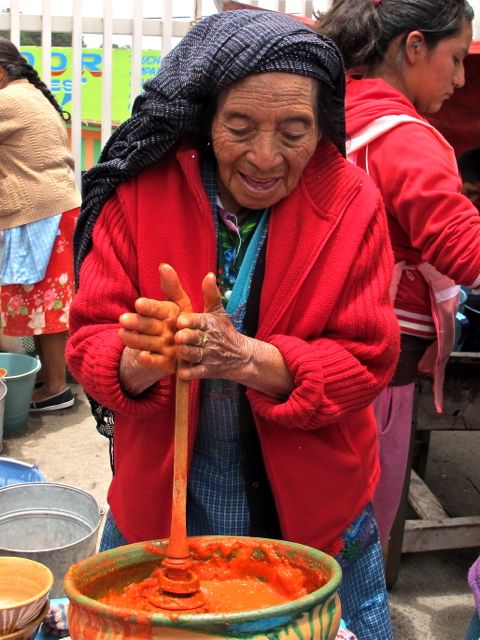
Not only was there a bounty of raw mushrooms, the aroma of sautéed mushrooms, mushroom tamales, and mushroom empanadas stimulated our appetites and we tried them all, and washed it down with an atole rojo made by this beguiling gal.

Elderly woman mixing atole rojo.

And no, these were not “magic mushrooms” but the experience was, indeed, magical.

Read Full Post »

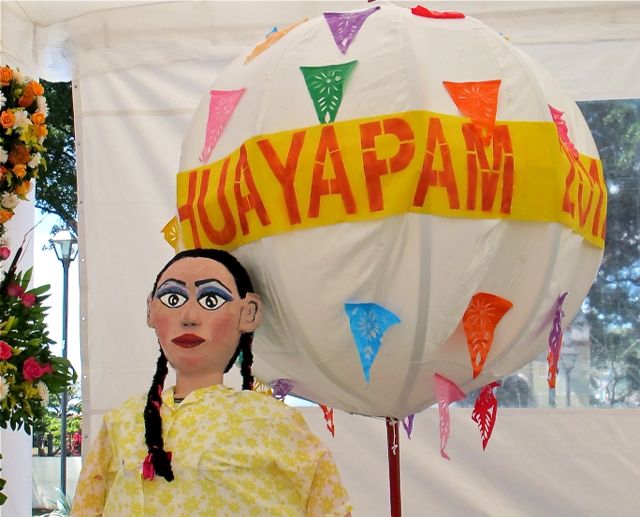
Oaxaca is a foodie paradise, in major part, because much of its cuisine draws on and honors its pre-Hispanic roots.  And, right now, during this time of Guelaguetza, various food and beverage ferias and festivals are also happening throughout the city and central valleys of Oaxaca.  Today, on the Plaza de la Danza, the Feria del Tejate y el Tamal, celebrating these specialties of San Andrés Huayapam, opened with the usual fanfare — music, monos, a marmota, and speeches.

Mono and marmota with "Huayapam" printed around it.

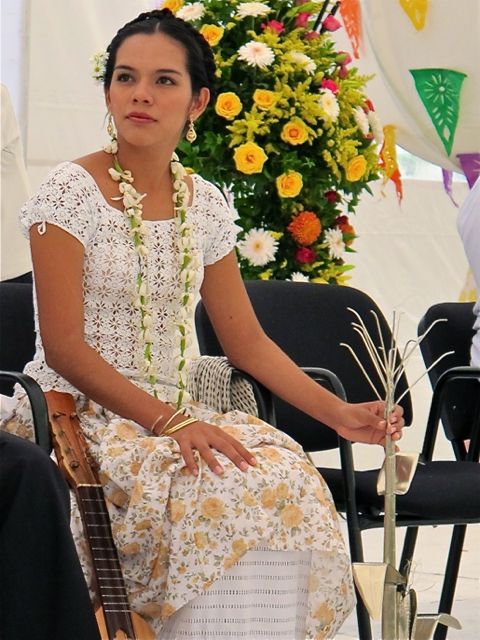
Present were a number of local dignitaries, including Evelyn Acosta López, the recently elected corn goddess, la Diosa Centéotl 2012, who presides over the Guelaguetza.

Evelin Acosta López seated.

Tejate is a foamy, refreshing, and nutritious non-alcoholic pre-Columbian beverage made from Nixtamal corn, mixed with tree ash, and toasted cacao beans, mamey seeds, and Rosita de Cacao flowers.

Rosita de Cacao blossoms.

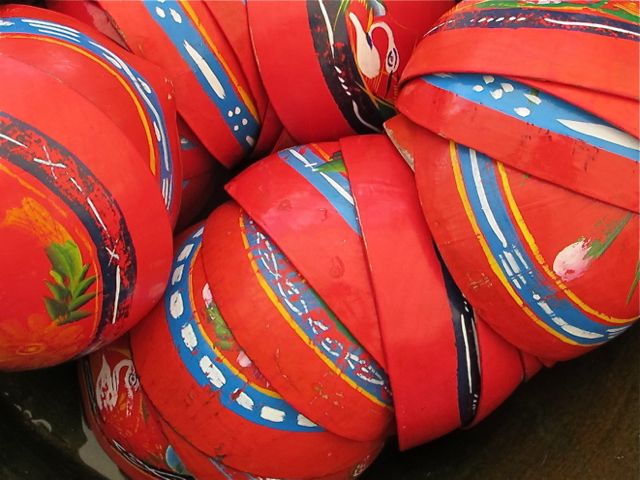
One frequently sees tejate, served in these colorfully painted gourds, in the mercados of Oaxaca, at festivals, and street side stands.

Dried and hollowed-out gourds painted red with blue, yellow, and green decoration.

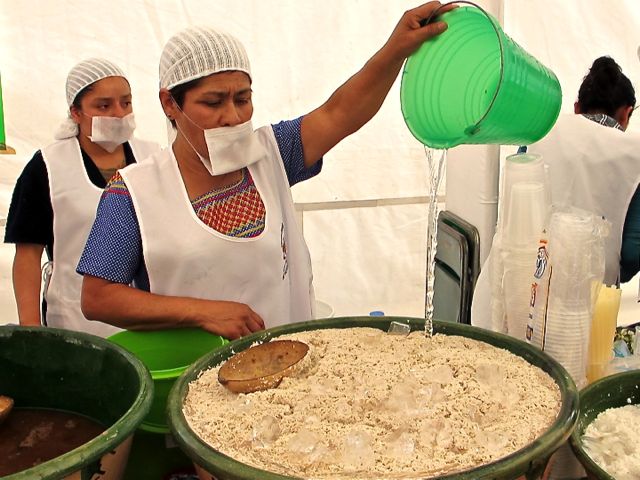
And, yes, it is safe to drink.  The water and ice that are added…

Woman with surgical mask pouring water from bucket into large pot of tejate

come from garrafons of “pure” water.

Stack of garafons (jugs) of pure water.

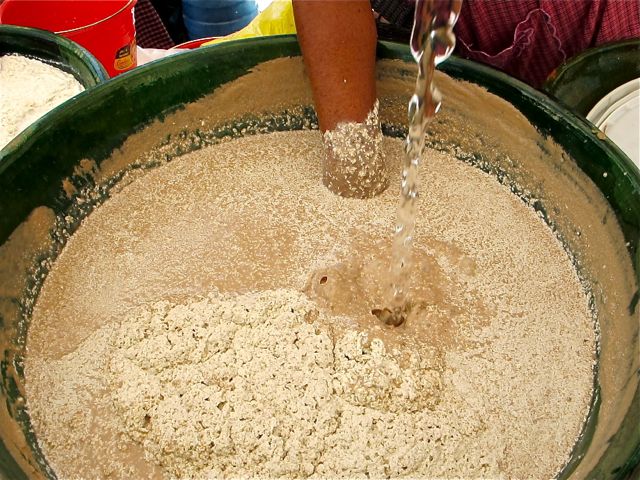
And, please, don’t be put off by the women, up to their elbows, mixing the ingredients.  Just think about it…  Chefs often use their hands when preparing food and arms are generally much cleaner than hands!  Believe me, these women take great pride in their expertise and product.

Hand and lower arm mixing tejate as water is added

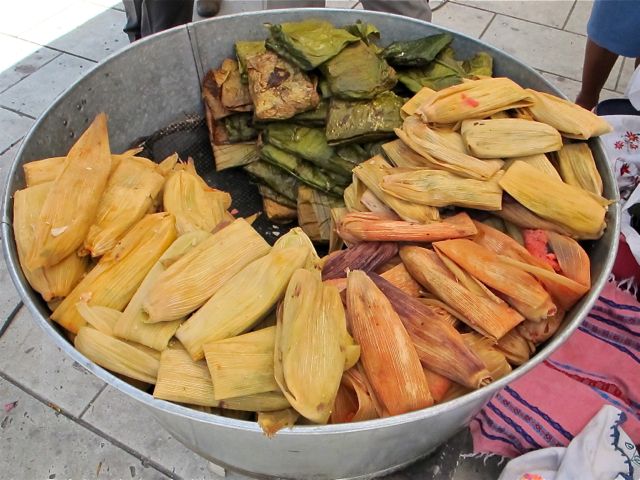
Oh, right, there were also tamales!  Once I finished taking photos and drinking a tall cup of tejate, I made my day’s tamal purchase; chepil, chichilo, and mole.  Tomorrow, I will be returning for more.

Large galvanized aluminum bucket filled with a variety of tamales wrapped in corn husks and banana leaves.s

The Feria del Tejate y el Tamal runs today and tomorrow at the Plaza de la Danza, then moves up to San Andrés Huayapam for Saturday and Sunday.  You can find a little more information about the feria in last year’s blog post, Tejate and tamales.

And, sheesh, I still haven’t blogged about the cheese feria, mushroom feria, not to mention, the Feria Nacional del Mezcal — all of which I’ve attended during the past several days!

Read Full Post »

Live and direct from Oaxaca’s Guelaguetza Auditorium; see what all the fuss is about!  Watch the July 23 and 30 Guelaguetza performances, along with the July 29 production of the Legend of Donají, stream live on the internet at:

Night shot of colored smoke billowing from Guelaguetza Auditorium.

View from the terrace…  The Guelaguetza Auditorium during last night’s Legend of Donají show.

Read Full Post »

We, who live or spend a significant amount of time here in Oaxaca, can’t say it too many times…

Are Americans safer in Mexico than at home?

Robert Reid Lonely Planet author

Every week or so I get asked, ‘Is it safe to go to Mexico?’ I had always said, if you’re thoughtful about where you go, yes. But after my most recent trip there, I’m changing my answer… to a question:

Do you think it’s safe to go to Texas?
To be clear, violence in Mexico is no joke. There have been over 47,000 drug-related murders alone in the past five years. Its murder rate – 18 per 100,000 according to this United Nations Office on Drugs & Crime report – is more than three times the US rate of 4.8 per 100,000. Though Mexican tourism is starting to bounce back, Americans appear more reluctant to return than Canadians and Brits (5.7 million Americans visited in 2011, down 3% from 2010 – and, according to Expedia, more than four of five bookings were adults going without children). Many who don’t go cite violence as the reason.

What you don’t get from most reports in the US is statistical evidence that Americans are less likely to face violence on average in Mexico than at home, particularly when you zero in on Mexico’s most popular travel destinations. For example, the gateway to Disney World, Orlando, saw 7.5 murders per 100,000 residents in 2010 per the FBI; this is higher than Cancun or Puerto Vallarta, with rates of 1.83 and 5.9 respectively, per a Stanford University report (see data visualization here, summarized on this chart, page 21). Yet in March, the Texas Department of Public Safety advised against ‘spring break’ travel anywhere in Mexico, a country the size of the UK, France, Germany, Spain and Italy combined. Never mind that popular destinations like the Bahamas, Belize and Jamaica have far higher homicide rates (36, 42 and 52 per 100,000). Why the singular focus?
Before you nix Mexico altogether, consider these five things:

[Read full article HERE]

Read Full Post »

Today, the 6th Friday of Lent, is El Día de la Virgen de Dolores, the Virgin of Sorrows.

Altar at Hotel Las Mariposas

Altars have been set-up in courtyards and businesses around town, including this one at Hotel Las Mariposas (butterflies).

Photo on altar of La Virgen de Dolores with vase of lilies in forground and palm "flowers" in background

It commemorates the pain suffered by the Virgin Mary on the death of her son.

Close up of a drawing of La Virgen de Dolores

By the way, note the “chia pets.”  This is where the US entrepreneur originally got the idea in the late 1970s for the terracotta animal figurines planted with Salvia Hispanica.

Close up of 2 "chia pets," candle, and palm flowers.

Tonight, I’m headed to a special Día de la Virgen de Dolores program, including a concert of sacred music performed by the Coro de la Ciudad (chorus of the city of Oaxaca), at the Templo del Carmen Bajo.

(ps)  Ooops!  Apparently, the concert is tomorrow night.

Read Full Post »

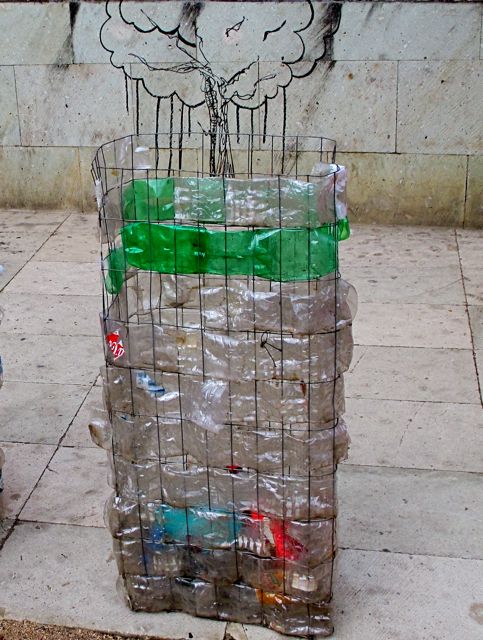
The day before I went up to Mexico City last month, crossing Llano Park, I came across a newly installed waste container encouraging plastic recycling; courtesy of Tierra Sana, a company promoting and selling environmentally friendly products.

Waste basket made from plastic bottles with a Tierra Sana sign on top

These baskets have cropped up in other parts of the city — this one in the plazuela next to Carmen Alto church.  Please know, the trees will cry if you don’t recycle.

Plastic bottle recycling bin with graffiti drawing of a tree crying in the background.

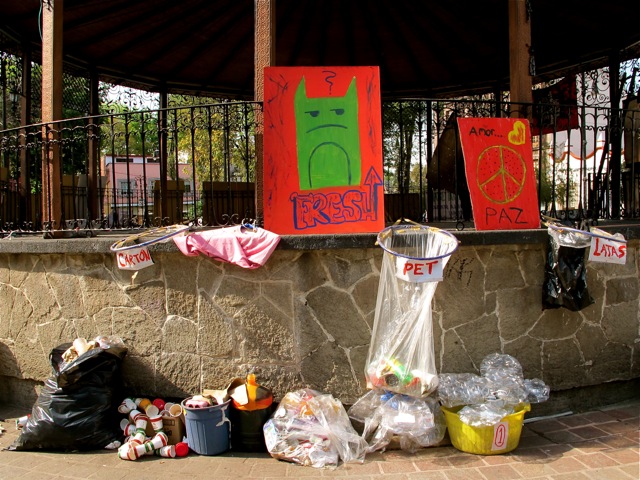
Once up in Mexico City, I noticed Occupy Coyoacán practiced recycling.

Overflowing recycling bags lined up along bandstand.

And then, we were all brought up short by this electric car…

Silver Nissan electric car getting charged at charging station in the street.

These charging stations are not far from the Templo Mayor; an appropriate juxtaposition, I think.  Automobile pollution can’t be good for the Great Temple.

GE charging station

Then there is bike-sharing — 1200 bikes at 90 Ecobici bike stations in Mexico’s capital city.

Red Ecobici bicycles lined up on bike rack.

For more on Mexico City’s Green Plan, check out 10 Highlights of Mexico City’s Climate Action Program.

Read Full Post »

I opened the front gate this morning to find the sidewalk had morphed into an Estación de la Cruz.

Station of the cross on the sidewalk with Jesus and Nuestra Señora de la Soledad.

Worshipers prayed, recited the appropriate devotions, and then slowly moved on.

Read Full Post »

« Newer Posts - Older Posts »