Feeds:
Posts
Comments

Posts Tagged ‘photos’

You might well ask, “What is a muerteada?”  It is a comparsa (parade) that is part of traditional Día de los Muertos celebrations particular to the state of Oaxaca.  According to the book, Day of the Dead: When Two Worlds Meet in Oaxaca, the muerteada allows the dead “to ‘occupy’ a living body, either a muerteada participant or an audience member, for a time, and therefore enjoy the entertainment directly rather than vicariously.”

Like Commedia dell’Arte, there are stock characters — in this case, the happy widow, the dying or dead husband, the father of the widow, a doctor, a priest, a shaman, people dressed like death, devils, and las lloronas (weeping women).  However, unlike Commedia dell’Arte, in the muerteada men play all the roles.

Last year we joined the Vista Hermosa, Etla murteado.  However, this year blogger buddy Chris decided I was ready for the big time — the “battle of the bands” when the muerteadas of San Agustín Etla and Barrio San José meet — Banda Tromba Sinaloense for San Agustín and MonteVerde Banda for San José.  FYI:  This is after participants and their bands have danced their way up and down the hills of their respective neighborhoods all night long, stopping at designated houses for food and drink — mezcal and cervesas seemed to be the beverage of choice, especially among the men!

So, early on the Nov. 2, we went in search of the San Agustín contingent, we found them, joined in the merriment, were offered food and drink along the way, and eventually came to the crossroad where mania turned to mayhem, albeit organized mayhem — courtesy of the white-shirted security for San Agustín and red-shirted security for San José.  They kept the dancers and supporters from each side apart, leaving the face-off to the two bands.  It was wild!!!  After 20+ minutes of battling bands, it was over and we and the San Agustín contingent trudged back up the hill.

You may have spotted a tall silver-haired gringo right in the middle of the action in one or two of the photos, that would be Chris.  Be sure to check out the video he put together of all the madness.

According to Organizing Committee President, Alfredo Erick Pérez, the muerteada in San Agustín Etla dates back to the 1800s, possibly to the days of Mexican President Porfirio Díaz.

Read Full Post »

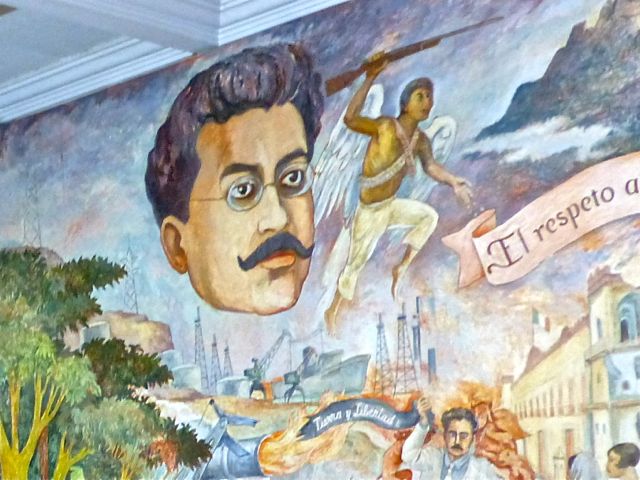
Last night I walked down to Oaxaca’s Palacio de Gobierno at the south end of the zócalo.  This former government palace is now a museum and I was headed up to the second floor to see two more Oaxaca FilmFest3 films.  I was early, the building was mostly empty, and so I took the opportunity to really study the mural that graces the walls of the main staircase.  Painted in 1980 by Arturo García Bustos, the mural depicts the history of Oaxaca.

Coming up the stairs, to the left, the customs and lifestyle of the Mixtecs, Zapotecs, and Aztecs of pre-Hispanic times unfold.

As you ascend further, on the right wall the Spanish conquest is portrayed.

However, it is the center section of the mural that grabs the attention.  Best seen when one reaches the top, here Bustos, pulls out all the stops in representing the one hundred years from the War of Independence through the Reform Movement to the Mexican Revolution.

Featured in the upper right corner of this panel, wearing his signature red bandanna, is War of Independence hero, José María Morelos y Pavón.  He can also be seen in the lower right with a printing press, in his role as publisher of Oaxaca’s first newspaper, El Correo del Sur.  On the upper left is anarchist and Mexican revolutionary hero, Ricardo Flores Magón.  He is also pictured holding a banner reading, Tierra y Libertad (Land and Liberty).  Flores Magón is the namesake of the street that borders the west side of the Government Palace.

However, front and center is Oaxaca’s favorite son, Zapotec, former governor of Oaxaca, and Mexico’s much beloved five-term president, Benito Juárez.  He and his Oaxaqueña wife, Margarita Maza, hover prominently above his Reform Movement cabinet.  The full text of the ribbon is a quote by Juárez, “El respeto al derecho ajeno es la paz” (Respect for the rights of others is peace).  It appears on the State of Oaxaca’s coat of arms.
Juárez is also pictured along with the cabinet and third from his right stands another Oaxaqueño, the young, menacing-looking, and far from beloved by the 99%, Porfirio Díaz, trademark epaulettes and all — a portend of things to come.

Following his death in 1872, the city and municipality of Oaxaca honored Benito Juárez by changing its name to Oaxaca de Juárez.

Save

Read Full Post »

Still recovering from last week’s Día de los Muertos celebrations, another marathon of activities is upon us — last night the third Oaxaca FilmFest opened.  With 10 days, 25 venues, 300 films, 5 days of academic programs, among many other events, I can see it’s going to be no rest for the weary!

FilmFest3 logo projected on screen

So, with Golden Key passes (approx. US$11.50) hanging from our necks, last night my indomitable 86-year old neighbor and I walked down to the festival’s headquarters at Plaza San Jerónimo on the Alcalá for the opening night cocktail party.  Gringos and international filmmakers mingled with a predominantly young and hip Oaxaqueño crowd.  Needless to say, cervesas, mezcal, and horchata flowed freely, accompanied by yummy (though less plentiful) botanas.

We eventually wound our way over to Teatro Juárez to hear founder and artistic director, Ramiz Adeeb Azar, welcome an almost full house, open the festival, and introduce the three opening night films:  shorts, Postmodern Times from Austria and The Game from Poland and feature length film, Tilt from Bulgaria and Germany.  All three were gripping, thought provoking, and held the audience’s attention.  (Chris, they all passed the Low Cough Principle test.)  It was a good start!

Ramiz Adeeb Azar standing at podium

Ramiz Adeeb Azar

During the course of the evening, we spoke with two American screenwriters, who each have scripts entered in a Script Competition, and American filmmaker Matt Dunnerstick, whose film, The Custom Mary, will be screened tonight and again later in the festival.  It’s truly an international festival and (at least last night) all the films were subtitled in both Spanish and English, as is all the program material.

I can’t believe how much bigger and more professional this festival has gotten in only three years.  I attended in 2010, the first year, and coming off eight years of volunteering at the Mill Valley Film Festival and attending for many more, I was underwhelmed and thus ignored last year’s Oaxaca FilmFest.  All I can say is, you’ve come a long way, baby!  I’m glad I’ve got my Golden Key pass and, like these folks, I will be intently studying my program booklet and scheduling grid.

Man and woman sitting reading program

I’ll see you at the movies!!!

Read Full Post »

In addition to graveside gatherings and decoration, altars, parades, sugar skulls, sand paintings, marigolds, and Day of the Dead bread, painted faces are another distinctive feature of Día de Muertos celebrations.  They are most likely seen hanging around cemeteries and dancing through the streets but, like everything else here, you just never know…

This slideshow requires JavaScript.

From Meaning of Dia de los Muertos Face Painting:

The day of the dead in Mexico is a fascinating mixture of Spanish Catholic and native Aztec traditions and beliefs. Skulls and skeletons were an important part of All Saints Day festivals in medieval Europe, especially since the Black Death ravaged the population of Europe in the 1300s. Across Europe artists, playwrights and poets mused on the theme of ‘memento mori’ (remember death) and the ‘dance of the dead’. Many artworks and books from the time depict dancing skeletons, or portraits with a skull to ‘remember death’.

At the same time, in Mexico, the Aztec culture believed life on earth to be something of an illusion – death was a positive step forward into a higher level of conscience. For the Aztecs skulls were a positive symbol, not only of death but also of rebirth.

Read full article here.

Read Full Post »

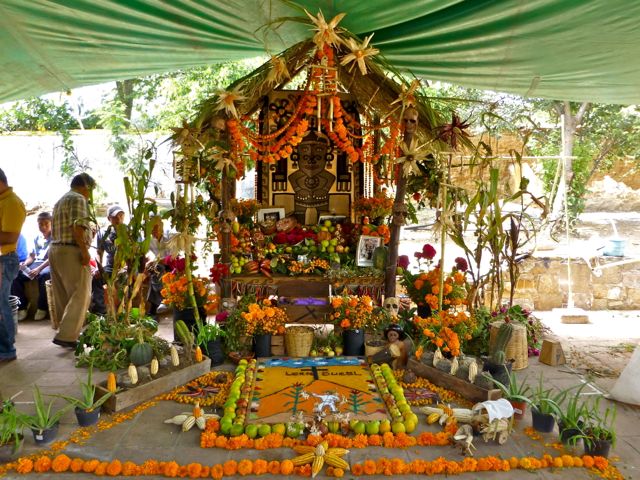
an offering.

Apples, corn, beans, pinecone turkeys, marigolds

an integral part of the Day(s) of the Dead celebration.

Sand painting surrounded with apples

filled with meaning.

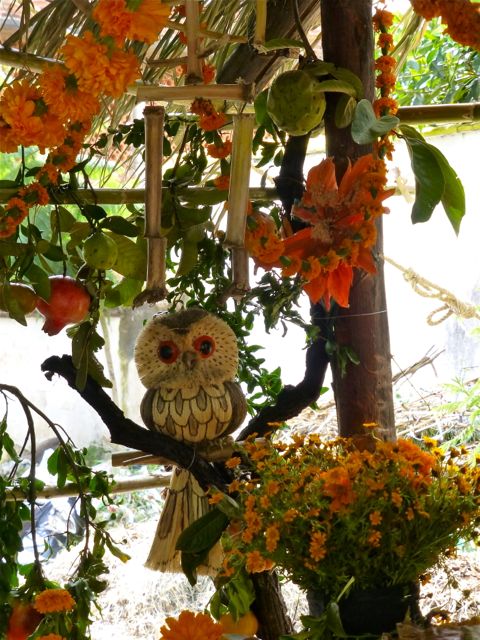
Carved owl and garlands

a beacon to the departed.

fruits, photos, flowers

an ephemeral work of art.

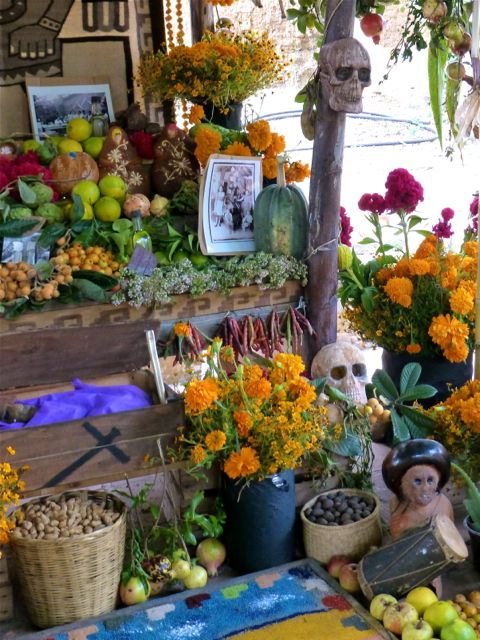
Marigolds, photos, fruit, vegetables, skulls, drum, baskets of nuts

the sum of its lovingly chosen parts.

Day of the Dead altarThis is another ofrenda from the previously mentioned “altar decorating” competition on the plaza in front of Santo Tomás in Oaxaca’s Xochimilco barrio.

Read Full Post »

Living and being in Oaxaca during the Días de los Muertos is hard to put into words.  There is so much to experience and to think about.  Sensory overload challenges the limits of heart and mind and my emotions are running the gamut from extreme exhilaration to a quiet joy to being moved to tears.

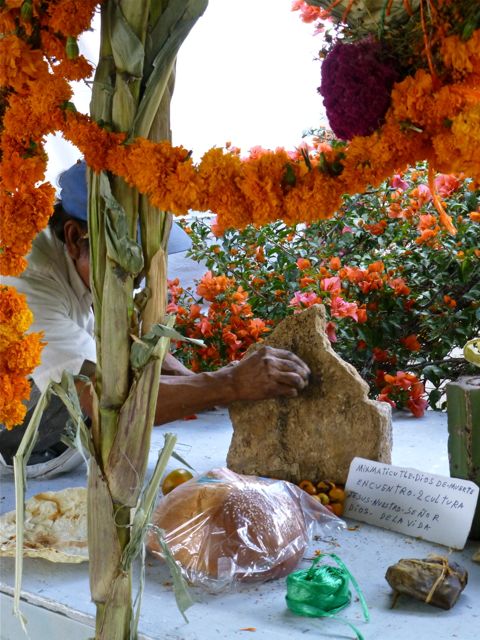
The latter occurred a few days ago, when I walked up to the Templo de Santo Tomás in Oaxaca’s Xochimilco barrio (neighborhood) where an “altar decorating” contest was in progress.  Altars were to be judged on authenticity, originality, and creativity.  When I arrived, friends and relatives were in the midst of putting the final touches on their altars.  Some were elaborate and some exhibited real artistry, but one really touched my heart.

He was alone — no one to help, no playful banter.  When I first arrived, he was carefully etching a cross with a piece of charred wood on a stone.

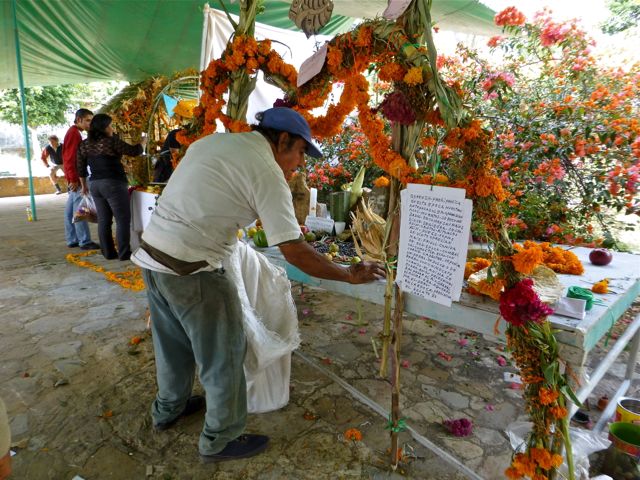
He worked silently and with purpose, pulling items out of a well-worn sugar bag and carefully placing them on his altar.

When the bag was empty, he walked over to a cart and pulled out another one.

Slowly, his vision emerged, with symbology I have only a cursory grasp of and won’t presume to explain.

I don’t know who won the 5000 peso first prize or second or third place purses, and I don’t know if he was doing it for the money (he certainly looked like he could use it).

All I do know is he and his ofrenda moved me deeply.

Read Full Post »

Last night we went to my favorite panteon (cemetery) at Atzompa, today we visited six villages, and tonight I went with out-of-town guests to the Panteon General here in Oaxaca.   First thing tomorrow morning a comparsa (parade) and then probably off to Teotitlán del Valle.  I’ve already taken hundreds and hundreds of photos, but there has been no time to even look at them!

So, in the meantime…  My pan de muerto (Day of the Dead bread) from Sunday’s trip to Tlacolula.

Four small loaves of decorated bread

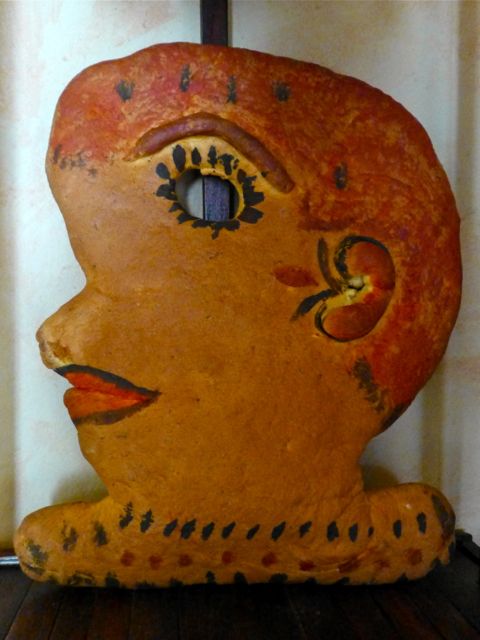
Very special pan de muerto from Restaurante La Abeja just a few blocks from Casita Colibrí.  This one will eventually get two coats of shellac and join her sister (purchased last year) hanging on the wall.

Bread in the shape of the profile of a woman's face

Last, but not least, my altar where photos of departed family and friends join apples, tangerines, pan de muerto, sugar skulls, candles, and incense of copal.

Day of Dead home altar with fruit, candles, bread, calaveras, sugar skulls, etc.

This is a magical time to be in Oaxaca.

Read Full Post »

Lighting, costumes, music, and dance combined to envelop last night’s audience at the Teatro Macedonio Alcalá in an other worldly experience.  Catrina is a magical tale where the world of the living converges with the world of the dead and the central theme is the pain of a mother losing her daughter.

This slideshow requires JavaScript.

The show is a celebration of the pre-Columbian traditions and culture of Oaxaca, especially the ritual and meaning surrounding Día de los Muertos.  Much of the music was traditional Oaxacan and most performers were Oaxaqueños, including Alejandra Robles, singing the title role.

At 48% (that’s over 1.6 million people), the state of Oaxaca has the second highest indigenous population in Mexico.  Perhaps that is why the belief systems of the ancient Mexicans Octavio Paz, cites in The Labyrinth of Solitude, remain strong today.  He writes, “Life extended into death, and vice-versa.  Death was not the natural end of life but one phase of an infinite cycle.”  Healthier, more realistic, and more comforting, I think…

Read Full Post »

Friends from the USA arrived on Friday and yesterday I played tour guide, showing them around the city.  It was great fun!  Up to Organic Market we went, pausing along the way to photograph the always amazing street art (future blog posts), stumbling on a vela in honor of San Judas Tadeo (aka, St. Jude, patron of desperate causes and hospitals) at Carmen Alta church with women in full Tehuana traje (think: Frida Kahlo), and catching a wedding at Santo Domingo, with requisite band, dancers, monos, marmota, and women wearing impossibly high heels.

lower legs of woman wearing 4+ inch high heels
I don’t think I could even stand on a smooth flat surface, let alone walk on cobblestones in stilettos like that.  If I even tried, I suspect I would wind up on the ground and severely tempted to start praying to San Judas Tadeo!

Lower legs and feet of 3 women wearing high heels

However, weddings at Santo Domingo are for the socially prominent and wealthy.

Lower legs of a woman wearing black high (4") heels.

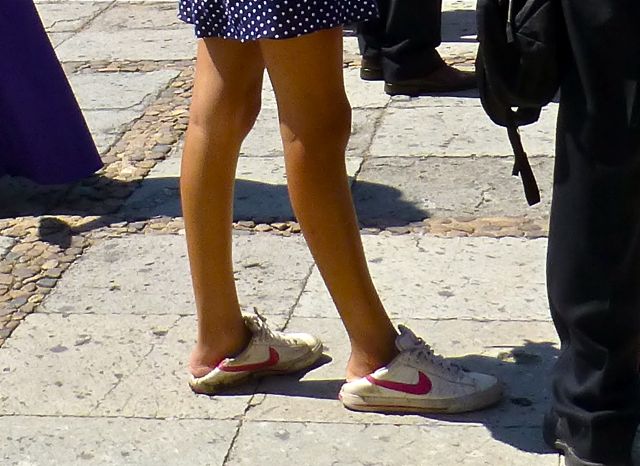
I am neither well connected nor well heeled, so I don’t think I will be called upon to go shopping for tacones (high heels) in the near future.   If such an unlikely invite were to come my way, I might be tempted to follow this young guest’s lead…

Lower legs of a young woman wearing gym shoes

Unbelievably, according to Mexico Retold’s recent humorous blog post, Tacos y Tacones, Mexico City actually played host to a 100 meter High Heel Race.  My ankles ached just watching the video and I’m inclined to think the only thing high heels are good for is reclining…

Cushioned chair in the shape of a high heeled shoe

As the old saying goes, “Come on in, take a load off!”


Read Full Post »

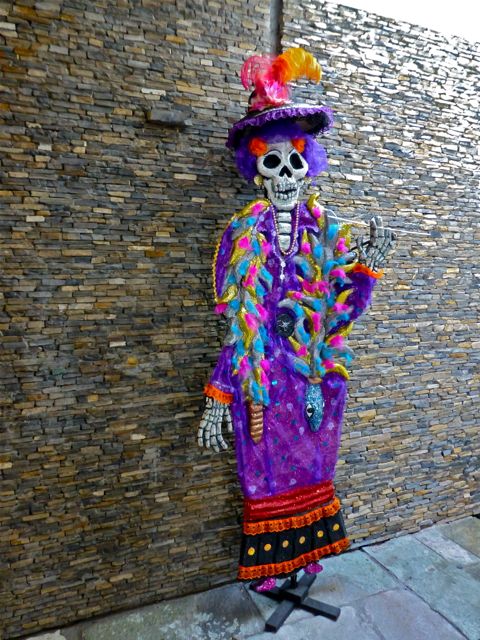
This Catrina arrived styling and ready to party.

Stylish Catrina posing in front of stone wall

Manicured fingers and toes, flower in her hair, and umbrella drink in hand, all she needs is a guy (or gal).

Seated Catrina in Tehuana traje holding cocktail glass with umbrellas.

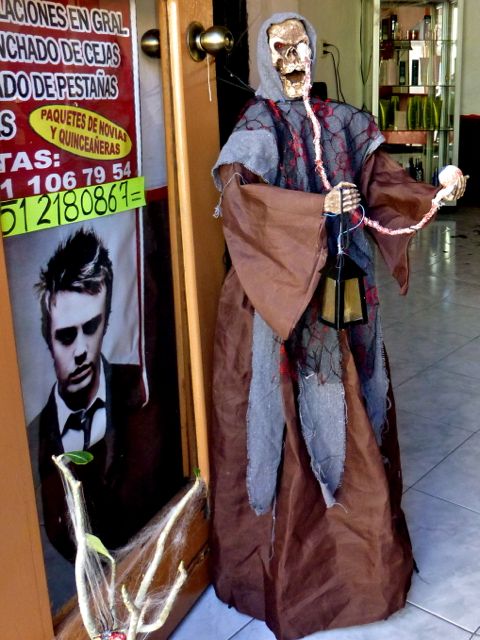
Young man beware — she has her eye on you!

Ghoulish Catrina standing next to head shot of handsome young man

Read Full Post »

And, guess who’s coming to dinner?  Catrinas, pinkies up!

Catrina in lavender dress sitting at table

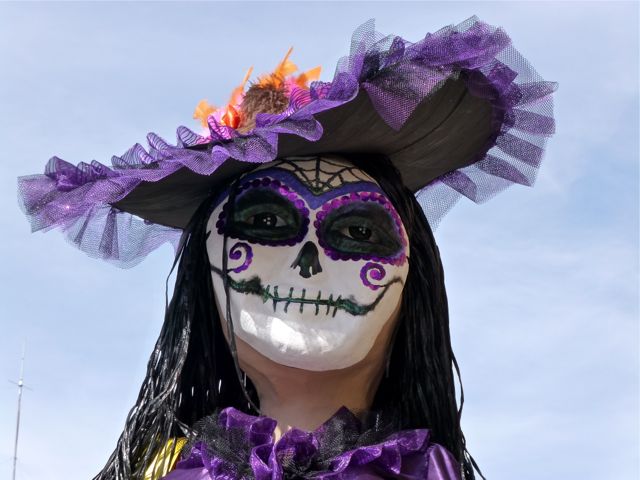
Dahling, don’t start the party without me!

Close-up of face of a Catrina with lavender hat

Lo siento mis amigas, sending regrets from Juchitán.

Close-up of Tehuana Catrina with hand raised

Decisions, decisions, decisions… Shall I take the Jetta, Crossfox, Suburban, or Express Van???

Close-up of face of Catrina standing next to a sign with a list of autos

As for these two…

Male calavera and female calavera facing each other in a doorway

I’m not sure they are coming.

Male calavera and female calavera facing away from each other in a doorway

Hmmm… a lover’s quarrel?  Sheesh, even in the afterlife??!!!

Read Full Post »

The announcement came at midnight with the ringing of the Cathedral’s bells and explosions of cohetes (rockets).  Today el Señor del Rayo is having his day!  Like Guelaguetza, Noche de Rabanós (Night of the Radishes), and Día de la Samaritana (Good Samaritan Day), this is an “only in Oaxaca” celebration.

Señor del Rayo crucifix surrounded by lilies.

The carving of Christ on the Cross was brought to Oaxaca during the 16th century and was placed in the temple of San Juan de Dios, a church which had adobe walls and a straw (or possibly wood) roof.  Legend has it that lightning struck the church and everything was destroyed, save for this figurine.  Un milagro!  It was christened Señor del Rayo (Lord of Lightning), was given its own chapel in the newly built cathedral, and has been much venerated ever since.

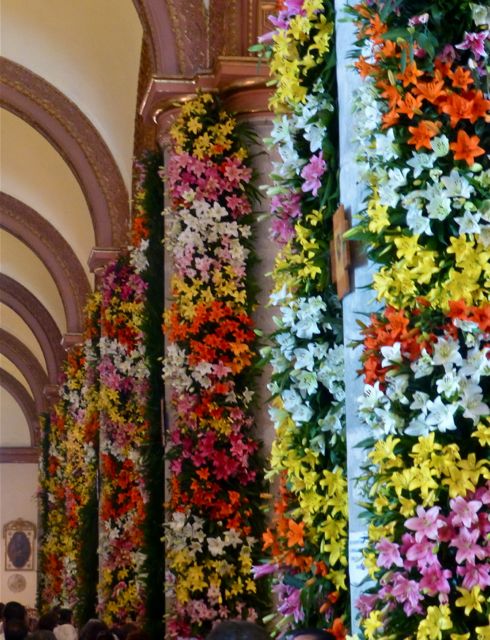
Pillars covered in multicolored lilies

On Sunday, October 21, el Señor del Rayo is moved from his capilla (last chapel on the left) to the main altar.  The cathedral fills with lilies (the scent “breathtaking”), and the faithful flock to pray before Señor del Rayo.  When one inhales the fragrance, one exhales a heavenly, “ahhhh…”

Close-up of orange, yellow, and lavender lilies covering a pillar

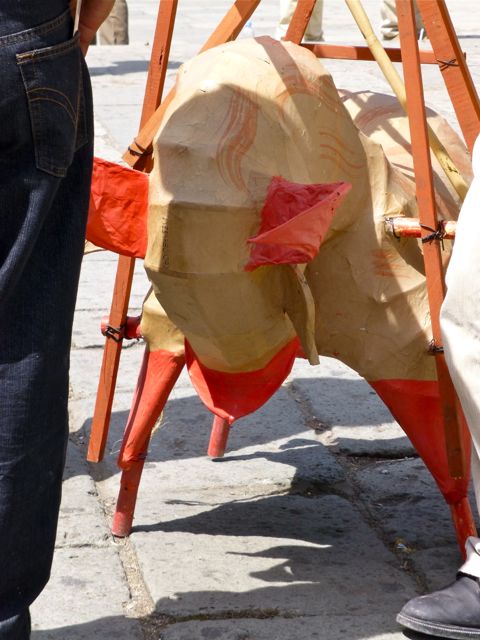
Like all good Mexican celebrations, be they religious or secular, there will be pirotécnicos tonight.  Toritos de luces (little paper-mache bulls wired with fireworks) have begun gathering.

Papermache bull (tornito)

And, as I write, the frame of the castillo below has been raised to its “upright and locked position,” its various spinning appendages have been affixed, and gunpowder tracks are waiting to be lit.

Main structure of a "castillo" laying on its side.

Alas, the action doesn’t begin until around 10:00 PM.  The spirit is willing, but it’s been a busy day, and this “too too solid flesh” is looking forward to melting into her bed.  Think I’ll just watch the fireworks from the terrace.  I know, what a wimp!!!

Read Full Post »

I’ve got my eye on you…

Decorated skeleton on top of building.

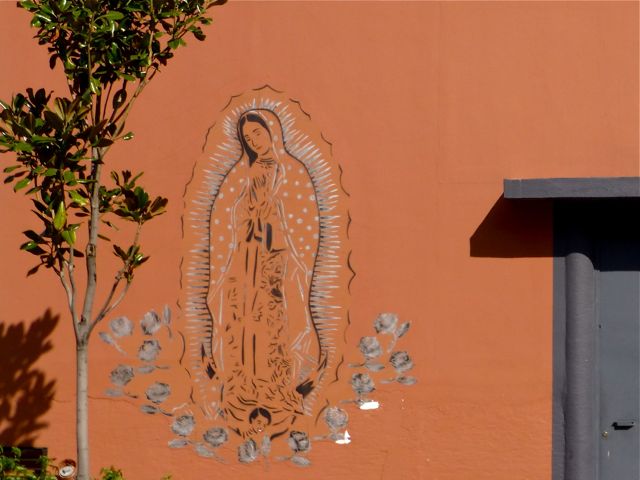
I’m praying for you…

Virgin of Guadalupe image stenciled on a wall

You just never know who might be looking over your shoulder.

Skeleton perched on rooftop above a stencil of the Virgen of Guadalupe

Días de los Muertos are coming…

Read Full Post »

At long last, and with not much fanfare, the Atzompa archeological site is open to the public!

Panoramic view of Atzompa archaeological site.

The winding road, cut into the side of the mountain, has been visible for a while and we could see platforms when we were up at Monte Alban (about 5 miles away) two weeks ago.

Winding road on side of mountain.

It’s a bit of a hike up a newly paved road from the small (temporary?) parking area under the pine trees, but we eventually reached the site and the ball court.

Ball court with mountains in background

It is small, but the setting is spectacular.

Ruins in foreground with mountains in back.

One can see a recreation of the 1,000+ year old Zapotec kiln that was uncovered 8 feet down — offering proof of continuity to today’s renown potters of Santa María Atzompa.

Kiln with shade covering.

Then there is the vegetation….  The architecture of native trees adds to aura of this ancient site.

Tree in front of side of pyramid

And, the white flowers of one of the trees has attracted the tiniest hummingbirds I’ve ever seen.

Hummingbird sitting on branch

Nopal cactus, in full fruit (tunas) at this time of year, dot the landscape.

Nopal cactus loaded with red fruit "tunas"

Archaeologists and their crews continue their work excavating and restoring, and much is blocked from amateur exploration, including the 1,100-year-old burial chamber.  Darn!

Workers restoring a building

The only “facilities” available at the site, thus far, are bathrooms (which were a trip, but I won’t go into it).  Lest you worry about comida for the workers, it arrived by motorcycle and was waiting in insulated boxes in the parking area.

6 motorcycles with soft insulated boxes.

Aside from those working at the site, we had the place to ourselves… no tour groups and no vendors.  We were left alone to listen to the birds and insects and imagine a highly developed culture, alive with the ancestors of the energetic, creative, and spiritual people we are privileged to live among.

Read Full Post »

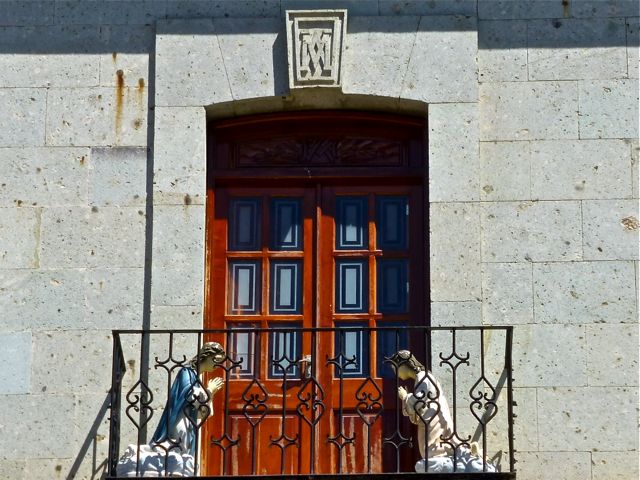
I don’t know about these two hanging out on a balcony above Independencia, yesterday.

Two kneeling statues of Mary behind balcony railing on either side of a door

But, who could resist these two???  Waiting for the convite in Teotitlán del Valle last week.

Smiling girl holding smiling small boy behind decorative iron bars

Read Full Post »

« Newer Posts - Older Posts »