Two weeks ago, as the sun was about to sink behind the mountains to the west, I glanced up from my desk.
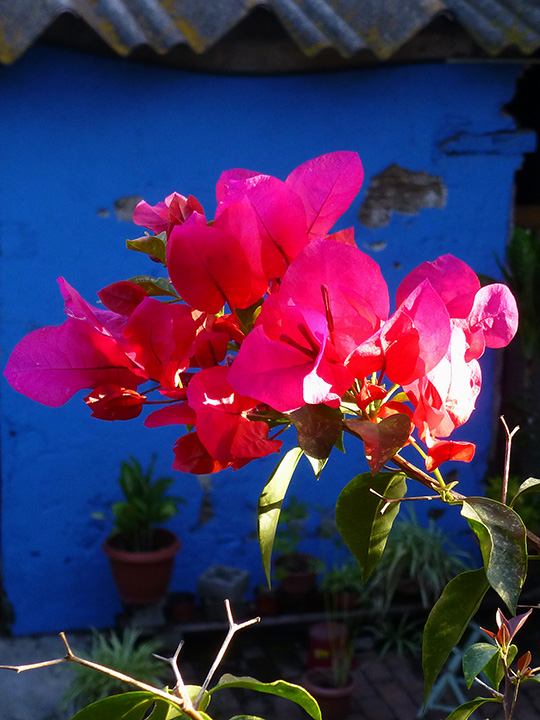
Light and shadow highlighted the Mexpost pink of the bougainvillea against the backdrop of a Frida Kahlo blue wall. Ahhh…
Posted in Casita Colibrí, Flora, Gardens, Travel & Tourism, tagged bougainvillea, bugambilia, colors of Mexico, flowers, Frida Kahlo blue, garden, Mexico, Oaxaca, photographs, photos on August 8, 2017| 4 Comments »
Two weeks ago, as the sun was about to sink behind the mountains to the west, I glanced up from my desk.
Light and shadow highlighted the Mexpost pink of the bougainvillea against the backdrop of a Frida Kahlo blue wall. Ahhh…
Posted in Celebrations, Churches, Creativity, Culture, Exhibitions, Restaurants, Textiles, Travel & Tourism, tagged calenda, Catedral Metropolitana de Nuestra Señora de la Asunción, Cathedral of Oaxaca, Centro Cultural San Pablo, Mexico, Museo de los Pintores Oaxaqueños, Museo Textil de Oaxaca, Museum of Oaxacan Painters, Oaxaca, Origen, parade, photographs, photos, popular travel destinations, Rufino Tamayo Museo de Arte Prehispanico de Mexico, Rufino Tamayo Museum of Prehispanic Art, San Pablo Academic and Cultural Center, Textile Museum of Oaxaca, Week in Oaxaca on August 3, 2017| 2 Comments »
Day four of B’s Week in Oaxaca had B relying on yours truly for the day’s sights and sounds. Where to begin? The answer, because it was near Casita Colibrí and we had just been to Mitla and Monte Albán, was the Museo de Arte Prehispánico de México Rufino Tamayo (Rufino Tamayo Museum of Prehispanic Art). The collection is spread over five rooms surrounding a courtyard in a 16th century colonial building. Each room is painted a different iconic Mexican color, chosen by the late Zapotec Oaxaqueño artist Rufino Tamayo, to highlight the pieces of his extraordinary collection.

Next we walked down to and through the iron gates, designed by Francisco Toledo, and across the brick pathway of the Centro Cultural San Pablo (Cultural Center of San Pablo). We explored the interior rooms of this ex-convent, now an academic research and cultural center, that hosts concerts, lectures, exhibitions, and houses a library. Pausing to rest, we took advantage of the cafe in the courtyard to order a couple of aguas.

Our thirst quenched, we walked around the corner to the Museo Textil de Oaxaca (Textile Museum of Oaxaca) to explore the ground floor and upstairs exhibitions of one of this textile lover’s favorite museums. One of the exhibits was the stunning “Almas bordadas, vestido y ornamento en el Istmo de Tehuantepec” — displaying the iconic embroidered clothing of the Isthmus of Tehuantepec. (Think, the dress of Frida Kahlo.)

Forty-five minutes later, we were certifiably hungry and, lucky for us, Origen, restaurant of Top Chef Mexico 2016 winner, Rodolfo Castellanos, and one of my oft recommended restaurants in Oaxaca, was only a block away. As always, its relaxing interior, attentive service, and delicious food provided a perfect respite.

Once rested and satiated, it felt good to set feet to pavement for the short walk to the Catedral Metropolitana de Nuestra Señora de la Asunción (Cathedral of Our Lady of the Assumption). The cathedral towers over the zocaló and the Alameda. The construction of this green cantera (stone) edifice began in 1535 and was consecrated on July 12, 1733. It is dominated by a spectacular altar and lined, on both sides, with chapels — the most important being that of Señor del Rayo. In addition, it is home to one of the historic pipe organs of Oaxaca.

After being wowed by the Cathedral’s soaring ceiling, altar, art, chapels, and organ, we crossed Independencia for a taste of the modern — the Museo de los Pintores Oaxaqueños (Museum of Oaxacan Painters). This, often overlooked, two-story restored colonial era mansion showcases the creativity and talent of Oaxaca’s painters. I had been to the museum only a month before, but the exhibitions are ever-changing, and new artists were on display.
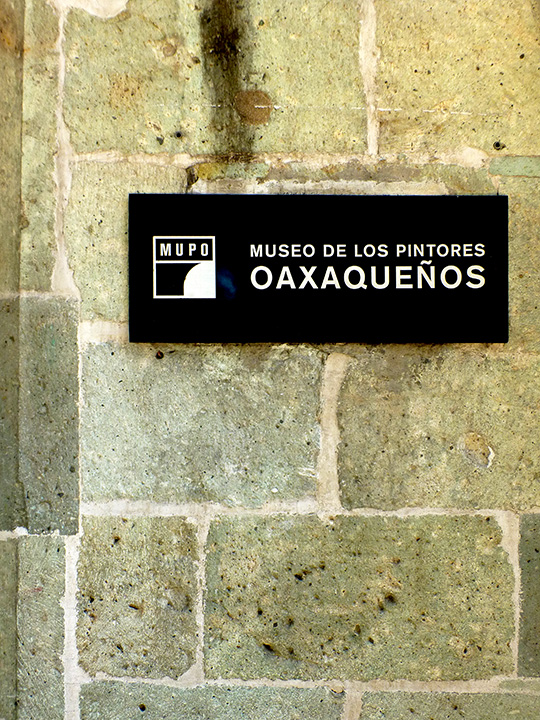
Of course, no day in Oaxaca is complete without a parade and we were not disappointed. We departed the Museo de los Pintores Oaxaqueños to be greeted with a calenda (parade) by “Ranchu Gubiña” from Union Hidalgo in the Isthmus of Tehuantepec region — attired in clothing similar to that which we had seen earlier in the day at the textile museum. We had come full circle!

Another long day’s journey into evening…. However, we weren’t finished yet; two more days await!
Posted in Archaeology, Churches, Culture, Food, Restaurants, Travel & Tourism, tagged Benito Hernández, Cuilapam de Guerrero, Discover Oaxaca, Ex-monastery of Santiago Apóstol, Mexico, Monte Albán, moto taxis, murals, Oaxaca, photographs, photos, popular travel destinations, Restaurante La Capilla de Zaachila, Villa de Zaachila, Week in Oaxaca on July 29, 2017| 2 Comments »
On day three of B’s week in Oaxaca, Benito (Discover Oaxaca) returned to pick us up a little after 9:00 AM. We wound our way up to the archeological site, Monte Albán — the imposing former capital of the Zapotecs. Construction of this commanding site, on top of an artificially flattened mountain, began around 500 B.C. By 350-550 A.D., it had become the economic, political, and religious center for the Zapotecs, and one of the first urban complexes in Mesoamerica. Though we were only there for two hours, I learned more from Benito than I had on my previous five or six unguided visits. While we were there, a specially fitted drone (archaeocopter) was being used by archaeologists — the sound was annoying, but once we figured out it was for research, it became more tolerable and rather intriguing. There is still so much to be uncovered!

Monte Albán – looking down onto the main plaza.
Coming down off the mountain, we took the scenic route, circling around the western base of Monte Albán, often bouncing along on dirt roads as we headed south to the Ex-monastery of Santiago Apóstol in Cuilapam de Guerrero. Construction began on this massive and elaborate Dominican complex in 1556 but was temporarily halted in the 1570s and never resumed — leaving behind a towering roofless basilica, ornate frescoes, and a magnificent Gothic cloister. There are several theories as to why it was never finished — lack of funds due to the extravagance, a dispute over land ownership, the decimation of the local indigenous population from 43,000 in the 1520s down to 7,000 in 1600, leaving few workers to construct it and natives left to convert. Climbing the stairs up to the second story terrace yields an impressive view and site from which to contemplate the impact of the Spanish conquest.

Murals inside the Ex-monastery of Santiago Apóstol, Cuilapam de Guerrero.
After an hour of roaming through the unfinished remains of the Ex-monastery, we returned to the van for the 4-mile drive to Villa de Zaachila. Thursday is market day and the village was alive with shoppers. From where we parked, we walked through the market, with B marveling at all there was for sale — from fresh fruits and vegetables to tools and kitchen ware to clothing and needlework to…. And, we never even made it to the livestock market.

Moto taxis taking people to and from the tianguis on market day in Villa de Zaachila.
Once through the market, we walked past the church and up a hill to the small archaeological site of the last capital of the Zapotecs and later conquered by the Mixtecs, not long before the Spanish arrived. It is mostly unexcavated, but has two small tombs that can be accessed.

Tomb 1 – The Owl (Tecolote, Búho) of Zaachila.
We were about to head to lunch, when we were waylaid by Benito’s inquiry if we knew about and would like to see the Día de Muertos (Day of the Dead) murals decorating the walls of Calle Coquiza — a street that connects the church with the municipal cemetery. Of course we responded that we would love to see them! If you are in Zaachila, they are worth checking out. You can see more of the murals on my blog post, Muertos murals in Zaachila.

Muertos mural along Calle Coquiza, Villa de Zaachila.
We were starving by the time we had walked the length and back of Calle Coquiza, so we made a beeline for the van that would take us to Restaurante La Capilla de Zaachila. It felt so good to sit, relax, and eat!

Tortilla Zachileña de guisado al horno.
It was a fairly quiet return to the city — we were satiated by food, sights, and information. However, following a few hours of rest, B and I met up again to stroll down to the zócalo, sip mezcal on rooftop terrace of Casa Crespo — though the music was a bit loud, the mezcal was good and the view of Santo Domingo couldn’t be beat.
By the way, this day’s travels took us to many of the major sites where the legend of Donaji takes place.
Posted in Celebrations, Culture, Food, Travel & Tourism, tagged Feria del Tejate y el Tamal, food festival, Mexico, Oaxaca, photographs, photos, popular travel destinations, San Andrés Huayapam, San Andrés Huayapan, tamales, tea towels on July 27, 2017| 7 Comments »
As the name implies, the Feria del Tejate y el Tamal also featured tamales, along with yesterday’s blog post subject, Tejate, “Drink of the Gods”.
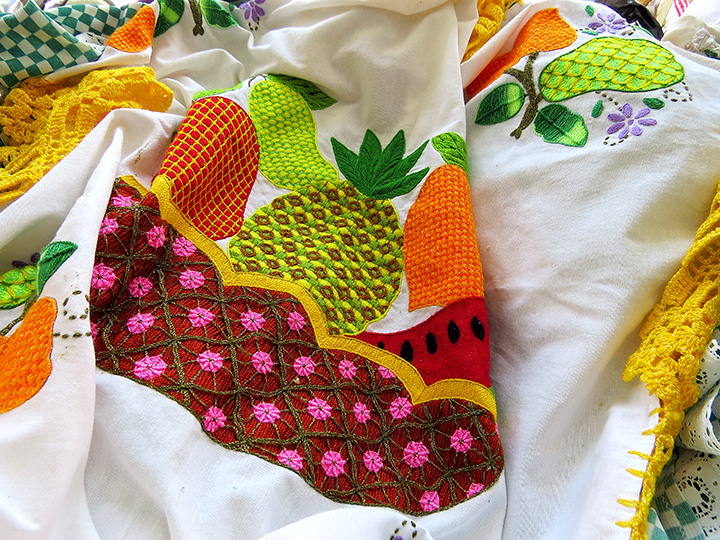
Tamal vendors from San Andrés Huayapam stood behind long tables lined with tin buckets, giant pots, and baskets covered with colorfully embroidered towels hiding every kind of tamal imaginable. There were mole negro (black mole) tamales wrapped in banana leaves…

And… flor de calabaza (squash blossom), amarillo (yellow mole), verde (green mole), chapulín (grasshopper), frijol (bean), and chepil (a wild herb) wrapped and steamed in corn husks. The local newspaper reports there were also fish and shrimp tamales. Darn, I didn’t even see them! Though not a surprise because it was quite a scene as crowds amassed in front of the vendors placing their orders. It reminded me of the lyrics from the Neil Diamond song, Sweet Caroline: Hands, touching hands, reaching out…

I don’t really have a favorite — they are all so uniquely special. However, because chichilo mole originated in San Andrés Huayapam and is only served on special occasions (weddings, christenings, harvesting of crops), I always make sure to bring home a couple. Chichilo mole is made from chilhuacle negro, mulatto, and pasilla chiles; blackened tortillas and seeds of the chiles; and avocado leaves, the latter imparting a subtle anise flavor. They are so yummy!
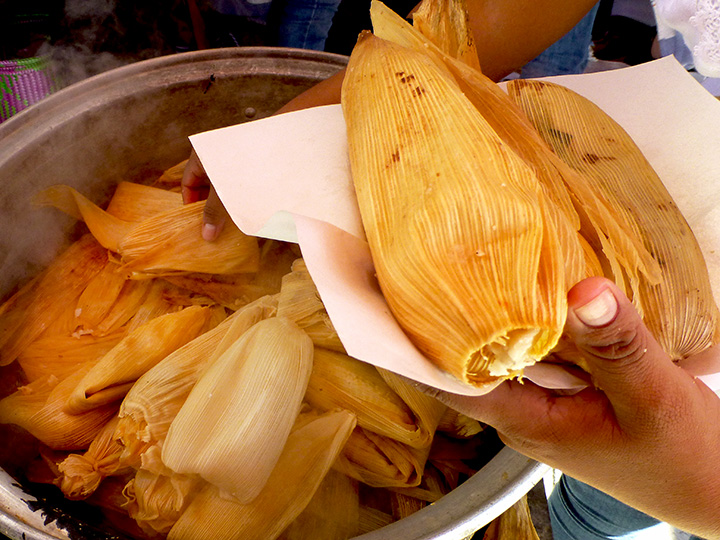
The prehispanic riches of tejate and tamales — a couple of reasons why Oaxaca is a food lovers paradise.
Posted in Beverages, Celebrations, Culture, Food, Travel & Tourism, tagged Beverages, Feria del Tejate y el Tamal, food festival, Mexico, Oaxaca, photographs, photos, popular travel destinations, San Andrés Huayapam, San Andrés Huayapan, tejate on July 26, 2017| 2 Comments »
This morning, the Feria del Tejate y el Tamal opened at the Plaza de la Danza — with live music, speeches, scores of tejate and tamal vendors, and hundreds of happy, hungry people. In the event you are unfamiliar with tejate (which is probably the case if you have never been to Oaxaca), it is a very popular frothy, refreshing, nutritious, and (supposedly) aphrodisiacal non-alcoholic prehispanic beverage. It is made from corn mixed with tree ash, cacao beans, mamey seeds, rosita de cacao (Quararibea funebris) flowers, and peanuts or pecans (depending on the season).


The preparation takes at least twelve hours, as the beans, seeds, flowers, and nuts must be toasted on a comal and corn must be nixtamalized. Ingredients are taken to a molino to be milled, then kneaded together, left to cool, eventually being hand-ground on a metate to make a thick paste — which is what one sees in the mercados being thinned with water and (literally) mixed by hand. For a blow-by-blow photo essay of the process, check out Making Tejate for the Market.


In days gone by, this exquisite beverage was reserved solely for Zapotec royalty. However, today tejate is for the masses, with tejateras and their massive clay ollas set up at almost every mercado and festival you run across. One frequently sees tejate poured into colorfully painted gourds and, of course, it tastes even better when served that way!


The sale of tejate is the main economic activitity in San Andrés Huayapam, located about 7 miles northeast of Oaxaca city. It is prepared and served by the tejateras of the Unión de Mujeres Productoras del Tejate. At the Feria, many of the tejateras were young — it is good to see the ancestral recipes and skills being passed down to the next generation.


The Feria del Tejate y el Tamal runs through tomorrow (July 26, 2017). If you are in town, don’t miss it! Oh yes, there were tamales, so stay tuned…
Posted in Celebrations, Culture, Textiles, Travel & Tourism, tagged costumes, dancers, Down's Syndrome, folkloric dance, Guelaguetza, Guelaguetza Muy Especial, Mexico, Oaxaca, photographs, photos, traje on July 24, 2017| 6 Comments »
The Guelaguetza Muy Especial, danced by Los Ángeles de Luz, gets bigger every year.
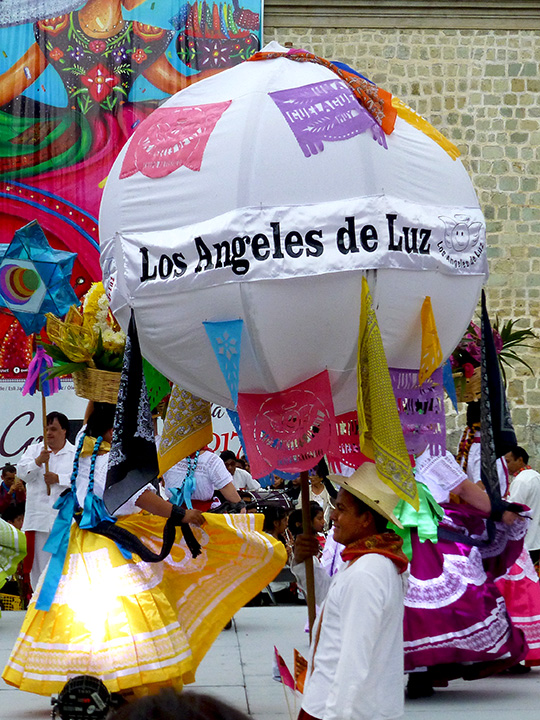
Convite – China Oaxaqueñas, City of Oaxaca
Early yesterday evening, all seating was filled and it was standing room only at the Plaza de la Danza — and that is a very good thing because Los Ángeles de Luz is group of 18 children and young people with Down’s Syndrome.

Jarabe – Ejutla de Crespo, Valles Centrales region
It was formed in 2003 with the purpose of facilitating the integration of people with Down’s syndrome and offering them creative experiences that exercise their motor skills, intelligence, language, and sensitivity in an environment of respect, trust, and love. (Ángeles le dan luz a las fiestas del Lunes del Cerro, 07/25/2016)

Jarabe – Tamazulapam Espiritu Santo, Mixe region
Their talents also extend to theatrical productions, including performances of “Snow White and the Seven Dwarfs” and “Romeo and Juliet.” In addition, they have mounted an interdisciplinary spectacular, “Ellos le bailan a México, a un México muy especial.”
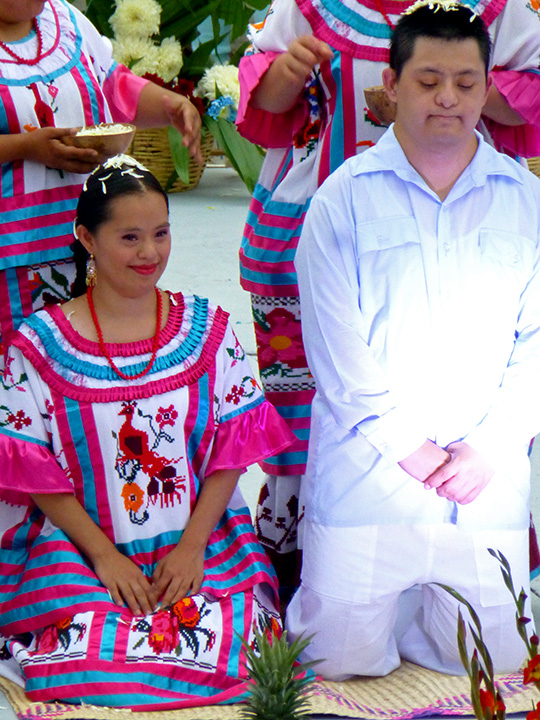
Wedding jarabe – Huautla de Jiménez, Cañada region
At the Guelaguetza Muy Especial, these young people make the requisite costume changes and perform traditional dances from the eight regions of Oaxaca.
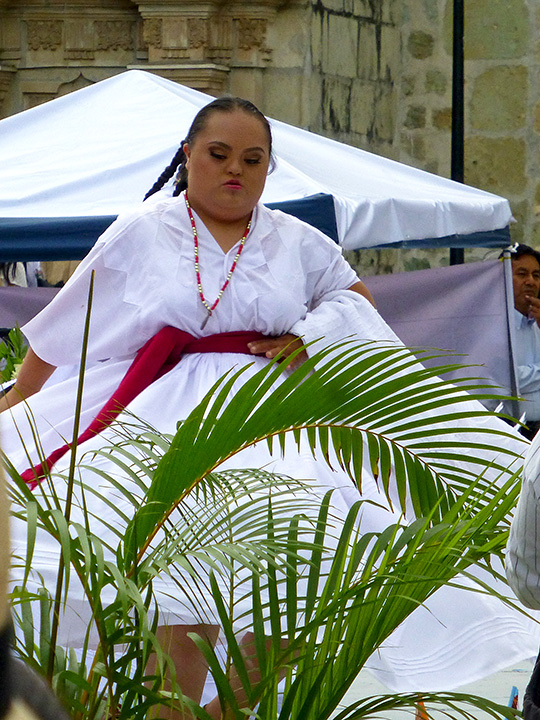
Jarabe – San Melchor Betaza, Sierra Norte region
This year’s show brought Oaxaca’s dignitaries, including Diosa Centeotl, Rebeca Itahí Ortiz Santibañez — she looked incredibly moved when they performed dances from her town of San Melchor Betaza.

Rebeca Itahí Ortiz Santibañez – Diosa Centeotl 2017
As I have mentioned before, perhaps it is because I have a special needs nephew or that both my sister-in-law and daughter-in-law are special education teachers, that I am drawn to this event every year.

Jarabe – Pinotepa Nacional, Costa region
Tears always well up in my eyes as I share in the joy and pride exhibited by the dancers from Los Ángeles de Luz.
Posted in Celebrations, Creativity, Culture, Travel & Tourism, tagged bands, calenda, dancers, Gran Calenda del Mercado de Abastos, marmotas, Mexico, monos, Oaxaca, parade, photographs, photos, popular travel destinations on July 19, 2017| 2 Comments »
Another day, another parade. Today, the Gran Calenda del Mercado de Abastos (parade of the markets) passed within a block and a half of Casita Colibrí. I couldn’t miss it — the cacophony of multiple bands, cohetes (rockets), and honking horns announced its arrival in my ‘hood! In the words of Octavio Paz, from The Labyrinth of Solitude…
“The solitary Mexican loves fiestas and public gatherings.”
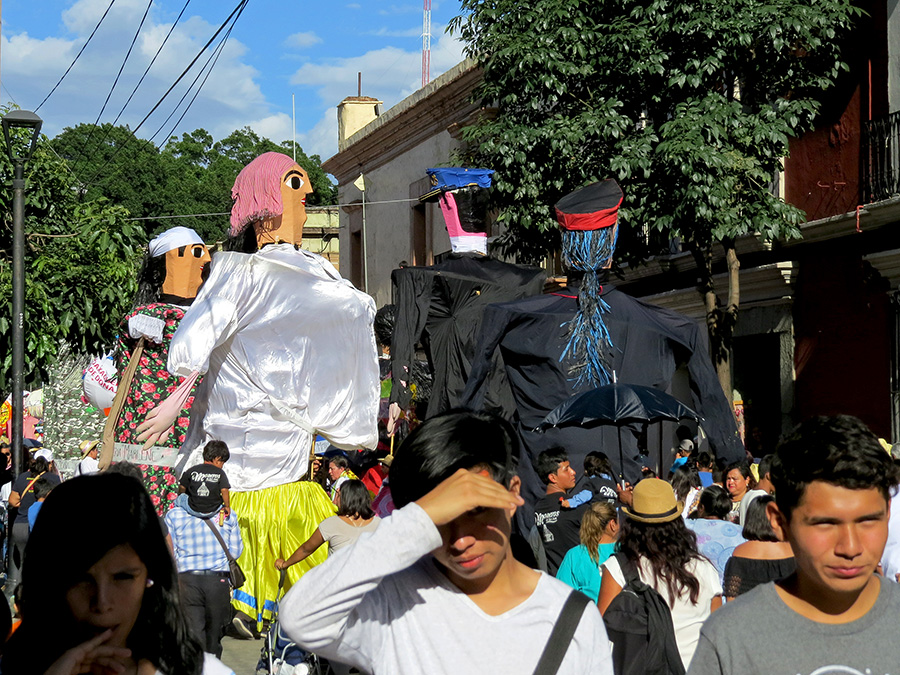
“The art of the fiesta has been debased almost everywhere else, but not in Mexico.”

“Our poverty can be measured by the frequency and luxuriousness of our holidays.”

“Do they forget themselves and show their true faces? Nobody knows. The important thing is to go out, open a way, get drunk on noise, people, colors.”
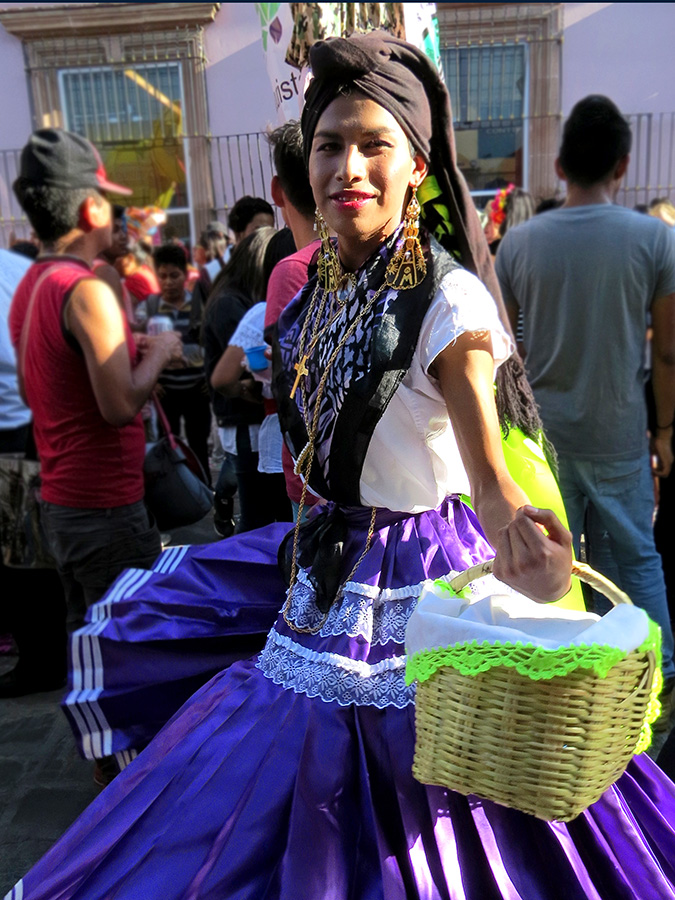
“In the confusion that it generates, society is dissolved, is drowned, insofar as it is an organism ruled according to certain laws and principles.”

“Everything is united: good and evil, day and night, the sacred and the profane. Everything merges, loses shape and individuality and returns to the primordial mass.”

“The fiesta is a cosmic experiment, an experiment in disorder, reuniting contradictory elements and principles in order to bring about a renascence of life.”
Posted in Celebrations, Culture, Music, Travel & Tourism, tagged Banda Oro Blanca, bands, Guelaguetza, Mexico, music, musicians, Oaxaca, photographs, photos, Reyes Etla on July 18, 2017| 2 Comments »
The dancers get most of the press, but the musicians are some of the unsung heroes of all the Guelaguetza performances. And, I have to say, yesterday the Banda Oro Blanco at the Guelaguetza at “Las Peñitas” in Reyes Etla played a leading role. And the view wasn’t bad either!


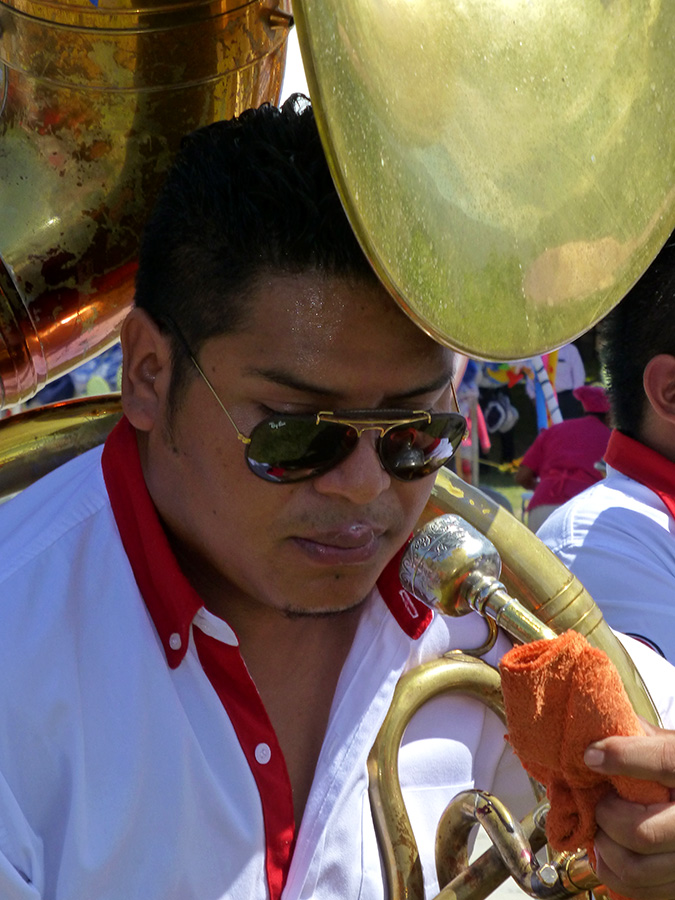
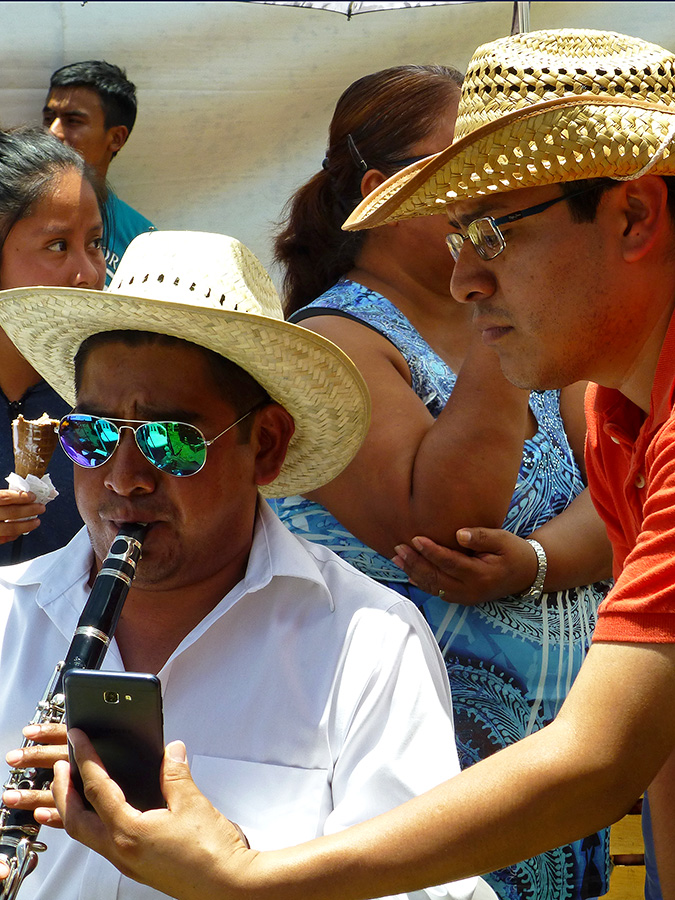
What can I say about this clarinet player? At one point he played off a fake book on a smart phone and he was on fire!!!
Posted in Celebrations, Culture, People, Textiles, Travel & Tourism, tagged competition, costumes, Diosa Centéotl, Mexico, Oaxaca, photographs, photos, popular travel destinations, Rebeca Itahí Ortiz Santibañez, traje on July 16, 2017| 13 Comments »
On Friday, Diosa Centéotl was selected to reign over the Guelaguetza festivities. The eight regions of the state of Oaxaca were all represented by the 33 contestants competing for the honor. (My photos of each of the contestants are from the morning phase of the competition.)


First a little history… According to the pamphlet that was distributed to the hundreds of locals, family and friends of contestants, and tourists attending the competition at Jardín el Pañuelito, the little “pocket” garden along the side of Santo Domingo de Guzmán:


“In the pre-Hispanic worldview, Goddess Centéotl possessed the divine power to germinate corn and all the plants of the milpa: tomato, squash, chile, quelites, beans, and other vegetables that constituted the Mesoamerican diet….”


“For that reason, prayers, dances, music and flowers were offered in each planting cycle…”


“[Later] the relationship between peoples, nature and the gods was manifested through a liturgical calendar carried out with much scrupulousness by both priests and the common people, for the survival of all was at stake, since a failed crop condemned them to famine, disease and moral suffering.”


“By contrast, an abundant harvest filled the people with happiness and they understood that the Goddess of Fertility – Centéotl – had listened to their requests.” — my translation from the Spanish


The competition to be Diosa Centéotl is not a Miss Universe/Miss America style beauty pageant. Dressed in the typical costumes of their villages or neighborhoods, these young women had to communicate their knowledge of their communities. They were required to give two 4-minute oral presentations in front of five judges: Jorge Bueno Sánchez (city chronicler), Celia Florián (chef/owner of Las Quince Letras), María Concepción Villalobos (coauthor of Centéotl en los Lunes del Cerro), María Concepción Guzmán Concha (textile expert), and Claudio Sánchez Islas (writer and journalist).


In the morning session of the competition, each was required to speak about their traditional cuisine, crafts, festivals, customs, myths and legends, or tourist attractions. During the afternoon stage, each had to discuss the history, composition, elaboration, and utility of their costumes. In addition, as Oaxaca has sixteen distinct ethnolinguistic groups, contestants from the various indigenous communities spoke several lines in their materna lengua (mother tongue).


It is in the dignity, pride, and poise expressed by each of the contestants where we see the essence of their beauty expressed. And the winner is…
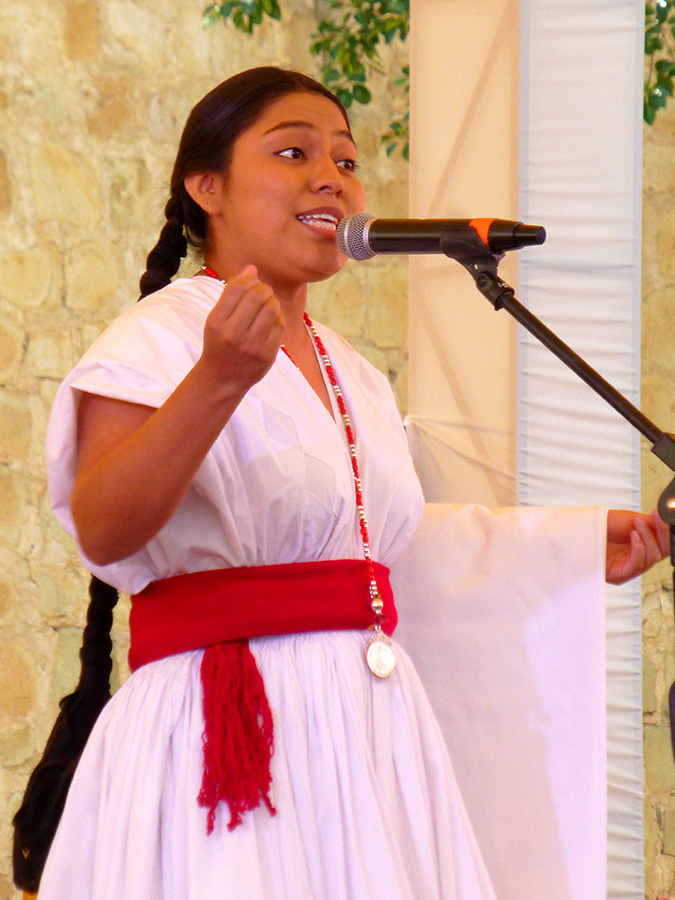
Rebeca Itahí Ortiz Santibañez, San Melchor Betaza
Rebeca Itahí Ortiz Santibañez, from San Melchor Betaza in the Sierra Norte region of the state. At being selected she exclaimed, “Doxhkenho dazhan” — Muchas gracias in Zapoteco.
(ps) If anyone has or can find a list of all the contestants, I would really love to add their names and communities to each photo. I think they all deserve to be recognized.
Posted in Celebrations, Culture, Travel & Tourism, tagged Desfile de Delegaciones, Guelaguetza, Mexico, Oaxaca, Parade of Delegations, photographs, photos, rain, rain ponchos, rainy season on July 15, 2017| 7 Comments »
This evening, the rain began falling as the delegations for the first Saturday Guelaguetza desfile began gathering. Are we having fun, yet?

However, just like last year, the show must go on and the dancing must be done.

Some even looked like they were having fun. Of course, they were well covered!

I wasn’t, so this wimpy gringa headed back to her casa and a glass of wine (insert smiley face). By the way, to add insult to injury, tonight’s press is reporting that the route was changed — and it wasn’t just me who was clueless. Ahhh… Oaxaca!!!
Posted in Celebrations, Culture, food festival, Travel & Tourism, tagged Diosa Centéotl, Festival de los Moles, Guelaguetza, Guelaguetza calendar of activities, Mexico, Oaxaca, photographs, photos, popular travel destinations on July 13, 2017| 8 Comments »
While there have been pre-Guelaguetza calendas for the past couple of weeks, for me, the festivities really begin tomorrow — with the Festival de los Moles. Last year, at least 20+ moles were presented at the “all you can eat” buffet in the Jardín Etnobotánico. Ticket in hand, I’m ready!
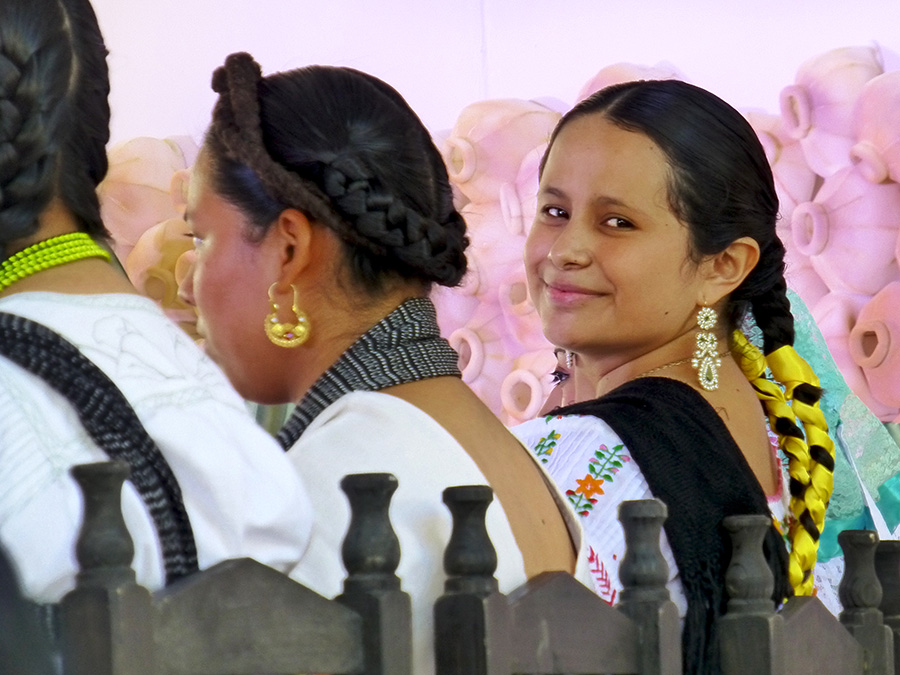
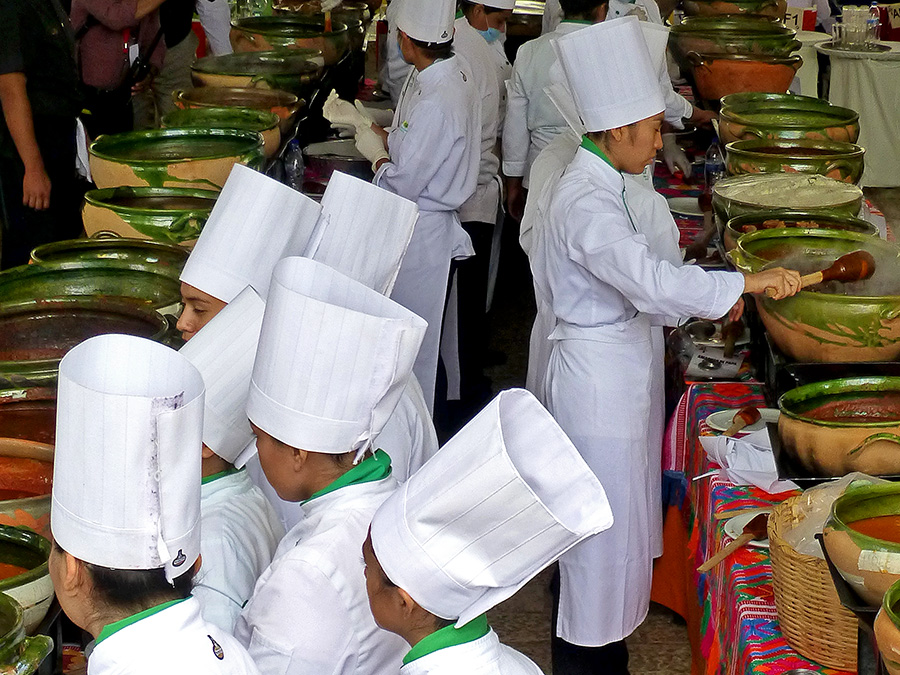 In addition, tomorrow Diosa Centéotl (Corn Goddess) will be selected to preside over La Guelaguetza. Beginning at 10:00 AM, contestants from the eight regions of the state of Oaxaca will showcase and explain the costumes and traditions of their communities, both in Spanish and their materna lengua (mother tongue).
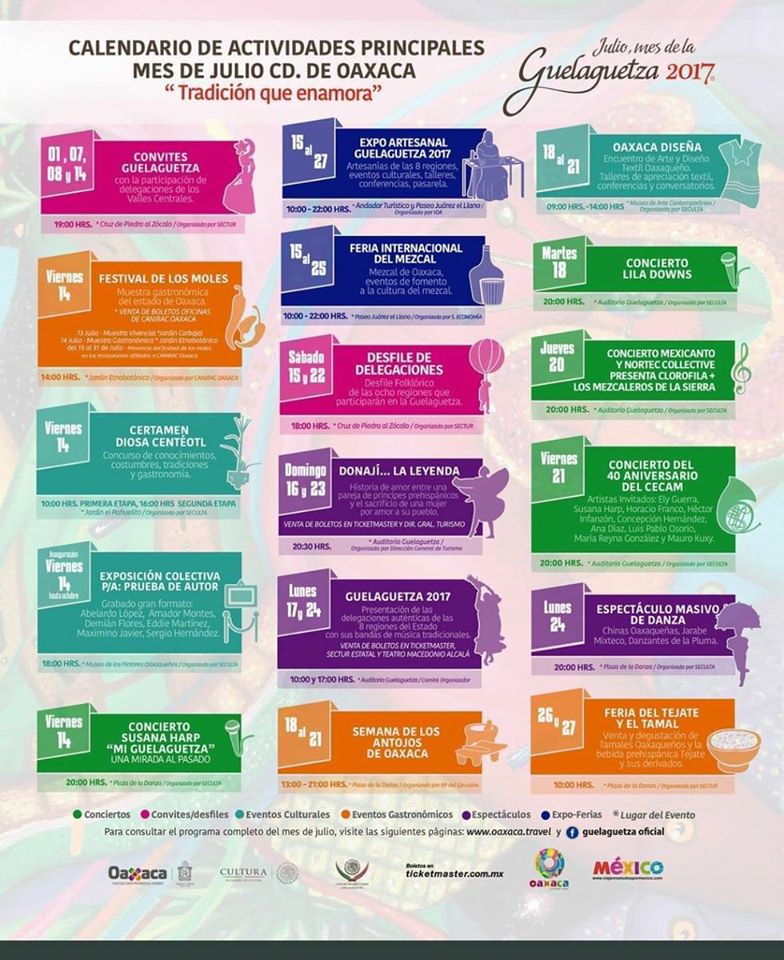
The schedule of activities during these next two weeks is always jam-packed, entertaining, and exhausting. If you don’t believe me, take a look at the official schedule below.
That’s not all, folks! There are additional Guelaguetza dance performances, expo-ventas, and fairs in the surrounding villages. And, best of all, residents and visitors will not be navigating along sidewalks piled with garbage. A temporary Guelaguetza truce to the almost two-week dispute that has prevented garbage from being delivered to dump, was agreed to last night.
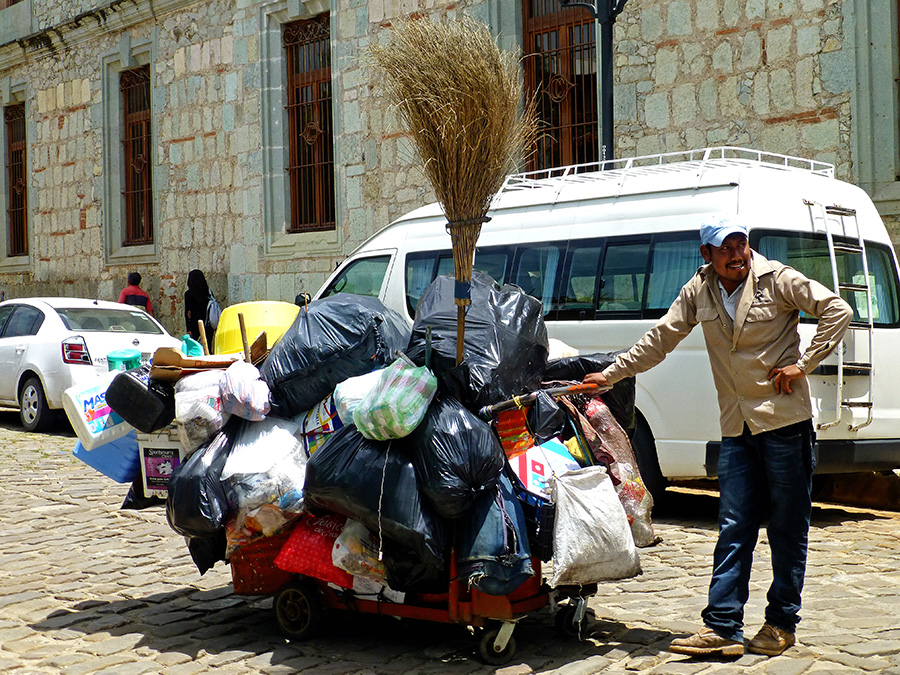
This afternoon, this guy’s garbage cart was SO full, he was having a hard time pulling it over the cobblestones. He is my hero of the day!
Posted in Archaeology, Churches, Flora, Food, People, Textiles, Travel & Tourism, tagged ahuehuete, Árbol de Tule, Benito Hernández, Discover Oaxaca, Juana Gutiérrez Contreras, Mexico, Mitla, Oaxaca, photographs, photos, popular travel destinations, Porfirio Gutiérrez Contreras, Preciosa Sangre de Cristo, Restaurante Tlamanalli, rugs, tapetes, Teotitlán del Valle, textiles, tour guides, Tule tree, Week in Oaxaca, Yagul on July 10, 2017| 2 Comments »
On day 2 of introducing B to the sights, sounds, and flavors of Oaxaca, I turned to the professionals at Discover Oaxaca for assistance. I had met the owners Suzanne Barbezat (author of Frida At Home) and her Oaxaqueño husband, Benito Hernández, several years ago through friends and knew they were licensed guides. And, as coincidence would have it, they were good friends of B’s god-daughter and her Oaxaquaño husband in California. The choice was easy and the rave reviews on TripAdvisor were icing on the cake.
Thus, Wednesday began with Benito picking us up in a comfortable, spacious, and air-conditioned van. Our day’s first destination was Mitla, the second most important archeological site in Oaxaca and home to amazingly intricate grecas (fretwork). However, as we headed east on Mexican highway 190, Benito was a fountain of knowledge — much of which was new to me. This was going to be good!
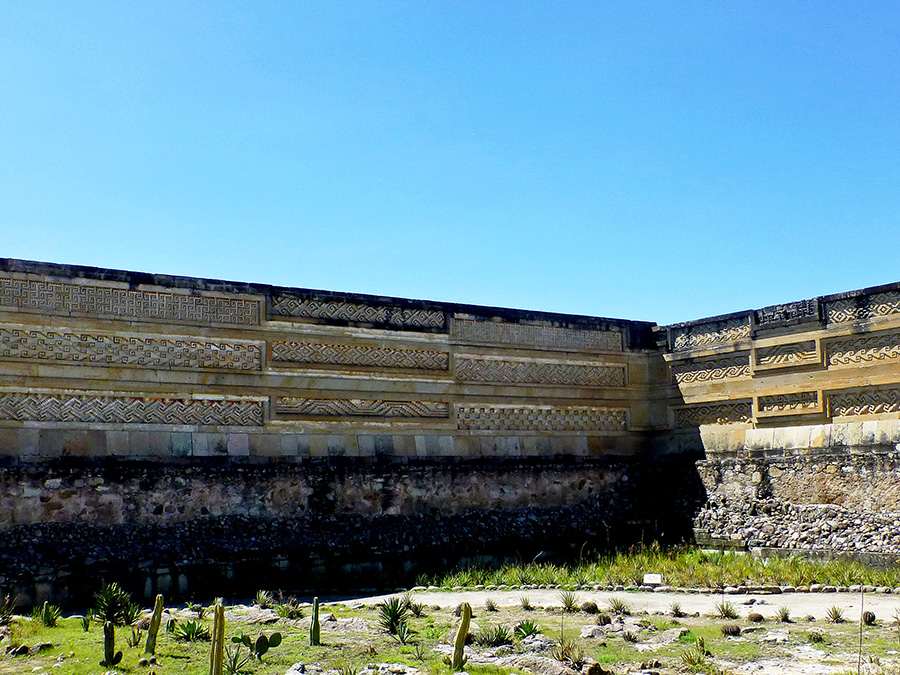
Grecas (fretwork)on the outside of the Palace at the archaeological site at Mitla.
For almost an hour and a half, Benito led us through the site — always explaining, answering our questions, and letting us marvel at what was before us. We could have stayed for at least another hour, but we headed back west on 190, to Yagul, an archeological site I had previously never visited. Several friends told me they experienced a deeply spiritual sense and that it was a must see. We barely skimmed the surface (definitely a place to return to), but the sun was hot, archeological overload was setting in, and hunger beckoned.

Ballcourt at Yagul — the biggest in the valley of Oaxaca.
Next stop, Restaurante Tlamanalli in Teotitlán del Valle — the renown restaurant of Zapotec cooks, Abigail Mendoza and her sisters. Using time honored methods and recipes refined over generations, the Mendoza sisters have elevated and brought worldwide recognition and respect for their traditional cuisine. It was a delicious and tranquil interlude.
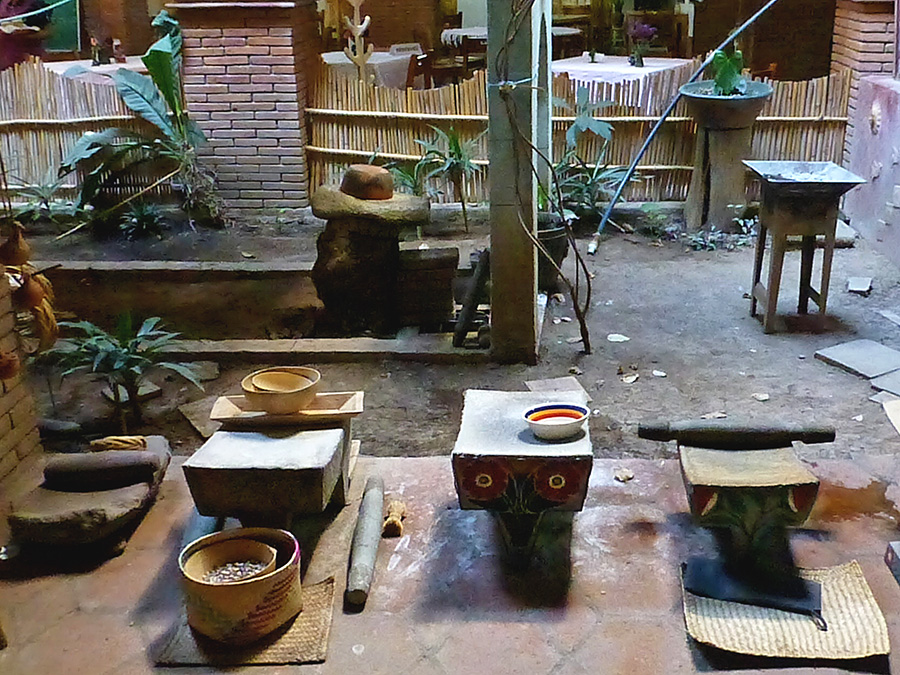
Metates used at Restaurante Tlamanalli to grind ingredients for mole and more.
Tearing ourselves away, Benito, B, and I climbed back into the van and drove to the center of the village to see Templo de la Preciosa Sangre de Cristo, another of the countless churches throughout Mexico built on top of a sacred indigenous site.
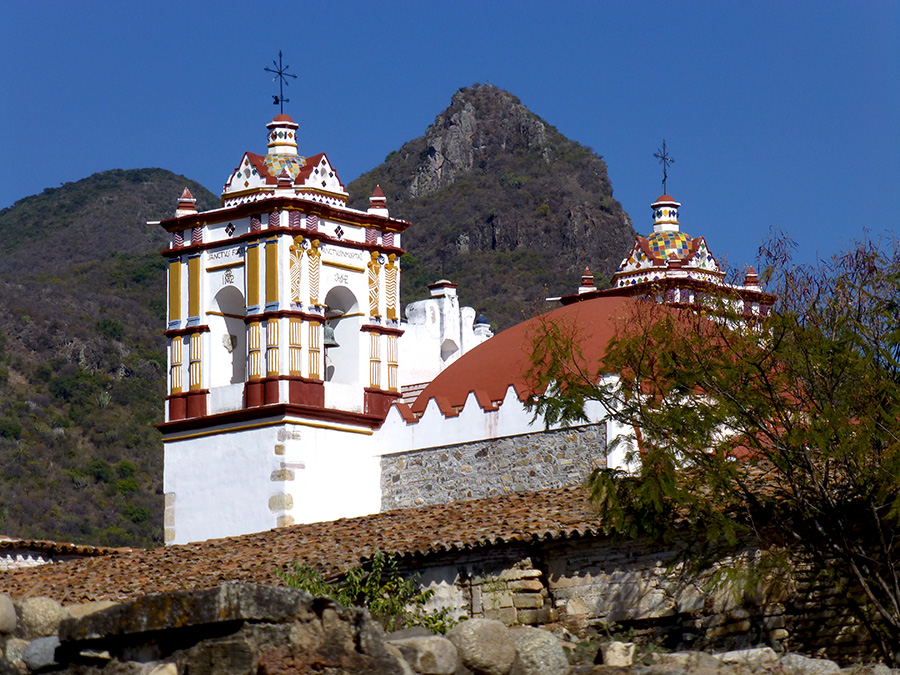
Templo de la Preciosa Sangre de Cristo, sits atop Zapotec ruins at the base of Picacho, the sacred mountain in Teotitlán del Valle.
My intent, during our visit to this village, known for its weaving with wool, had been to visit several of the weavers I know — including Fidel Cruz Lazo, Antonio Ruiz Gonzalez, his brother Sergio Ruiz Gonzalez, and the family of Samuel Bautista Lazo. However, we were running short of time, and B had been following my adventures with the family of Juana and Porfirio Gutierrez Contreras and had poured over the family’s website, so stopping at their home and workshop was a priority for him. Porfirio was back in the USA, but Juana and her husband Antoño gave their always excellent explanation and demonstration of their work with natural dyes. And, yes, B couldn’t resist purchasing a wonderful rug (though not the one pictured below)!

Woven wool tapete (rug) by Porfirio Gutiérrez Contreras.
On the way back to Oaxaca city, our last stop for the day was at Santa María del Tule to see the world famous Árbol del Tule. This Montezuma cypress (Taxodium mucronatum; Ahuehuete in Nahuatl) has the largest trunk of any tree in the world, is thought to be between 1,200 and 3,000 years old, and is home to hundreds, if not thousands, of birds. It is quite a sight to hear, let alone see.
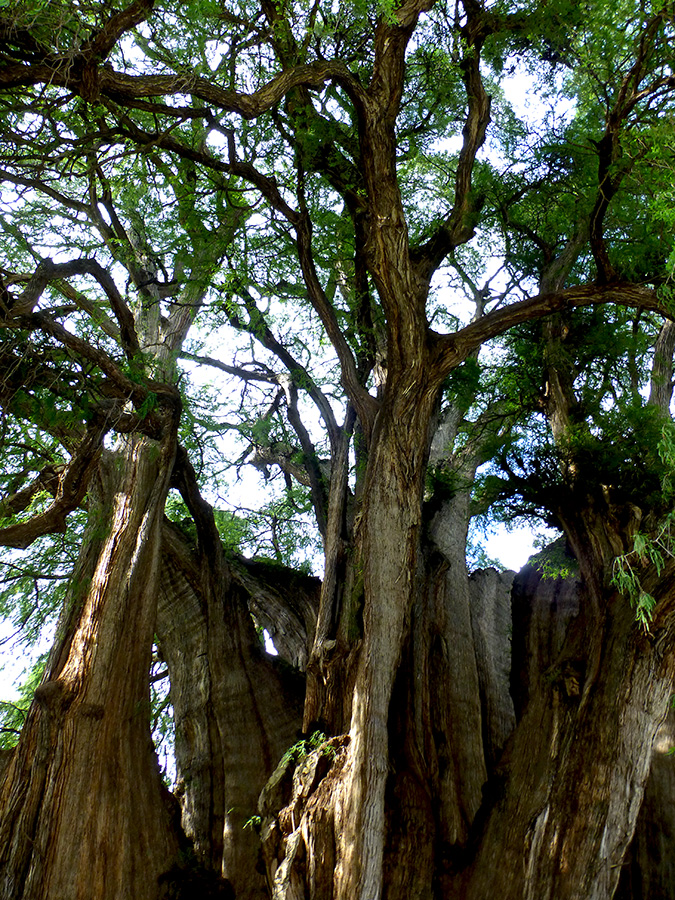
Looking up at the Árbol de Tule in Santa María del Tule, Oaxaca.
We left Oaxaca city at 9:15 AM and didn’t return until almost 6:00 PM. It was a full, informative, and terrific day. Next up, day 3 — another delightful day out of the city with Benito.
Posted in Casita Colibrí, Culture, Travel & Tourism, tagged Mexico, Mexico blogs, Oaxaca, photographs, photos, popular travel destinations, Surviving Mexico blog on July 7, 2017| 2 Comments »
Many thanks to Surviving Mexico for considering “View from Casita Colibrí” a blog about Mexico worth reading! The feeling is mutual, as I continue to enjoy reading about their “adventures and disasters” living in Mexico. 😉
Shannon writes at Casita Colibrí, another long-time favorite of mine.
 What brought you to Mexico?
Even though I grew up in California, my first trip to Mexico was in 2007, when I came to Oaxaca to visit a friend. I immediately fell in love with Oaxaca, returned a couple more times, and considered eventually retiring there. The privately funded library where I’d been the director for almost 13 years lost its funding and closed in spring 2009.Full-time jobs for librarian/archivists in the San Francisco Bay Area were almost non-existent. Faced with the choice of working multiple part-time and substitute jobs to barely keep my head above water, versus renting my house and moving to Oaxaca to live a downsized and simplified life, in a culturally rich, full of life city, I opted for the latter.
What was the inspiration behind the name of your blog?
Casita Colibrí is…
View original post 871 more words
Posted in Churches, Food, Gardens, Museums, Restaurants, Travel & Tourism, tagged Casilda Aguas Regionales, churches, Ethnobotanic Garden, Jardín Etnobotánico, Los Danzantes restaurant, Mercado Benito Juárez, Mexico, Museo de las Culturas de Oaxaca, Museum of Oaxacan Cultures, Oaxaca, photographs, photos, popular travel destinations, Santo Domingo de Guzmán, Week in Oaxaca on July 3, 2017| 3 Comments »
Recently, as previously mentioned, a friend came to visit for a week. It was B’s first time in Oaxaca and we packed a lot of sightseeing and delicious dining into just six days. B is an architect and, among other things, is an archeology buff, so those interests helped shape our itinerary (as in, not a shopping expedition). Naturally, the six days sailed by, but the sailing was so smooth and flowed so well that it occurred to me a blog post chronicling our adventures might be helpful to future visitors and hosts.
B arrived on a Monday night, so Day 1 began the next morning, when we rendezvoused on my terrace so he could begin to get his bearings as I pointed out landmarks. Our first stop was to gaze at the gold and gilt interior and up at the impressive family tree that decorates much of the ceiling of Santo Domingo de Guzmán.
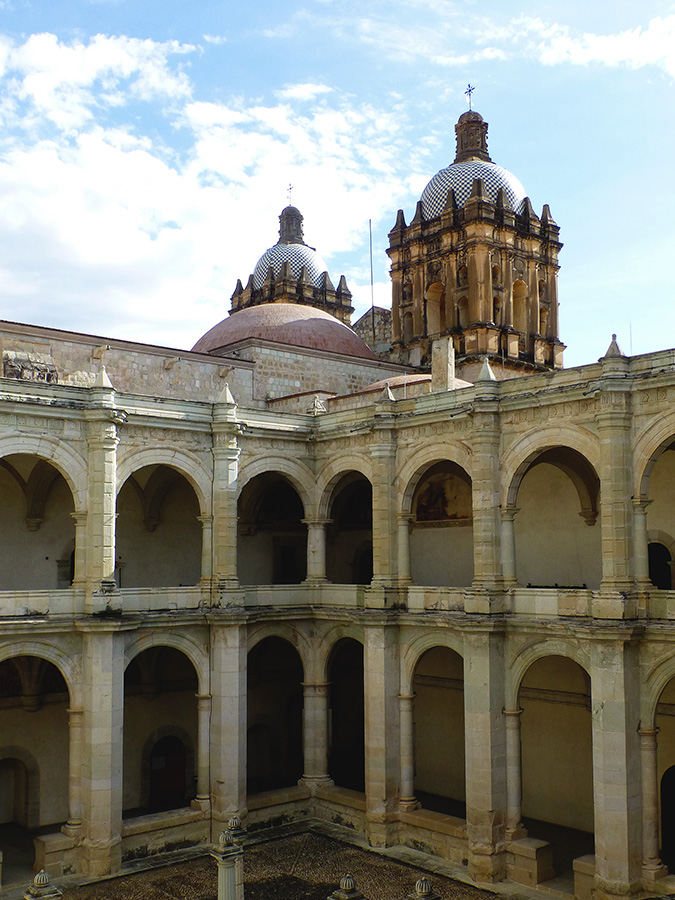
Santo Domingo de Guzmán and its former monastery.
After being thoroughly wowed, we went next door to the former monastery, now the Museo de las Culturas de Oaxaca. Arranged in historical epochs, the 20+ rooms are an historical treasure trove that include treasures excavated from Tomb 7 at Monte Albán. Also on the extensive grounds is the glorious Jardín Etnobotánico, an impressive ethnobotanic garden of plants native to the state of Oaxaca. While we had no time to take a tour of the garden (the only way to visit), the views from the museum are spectacular.
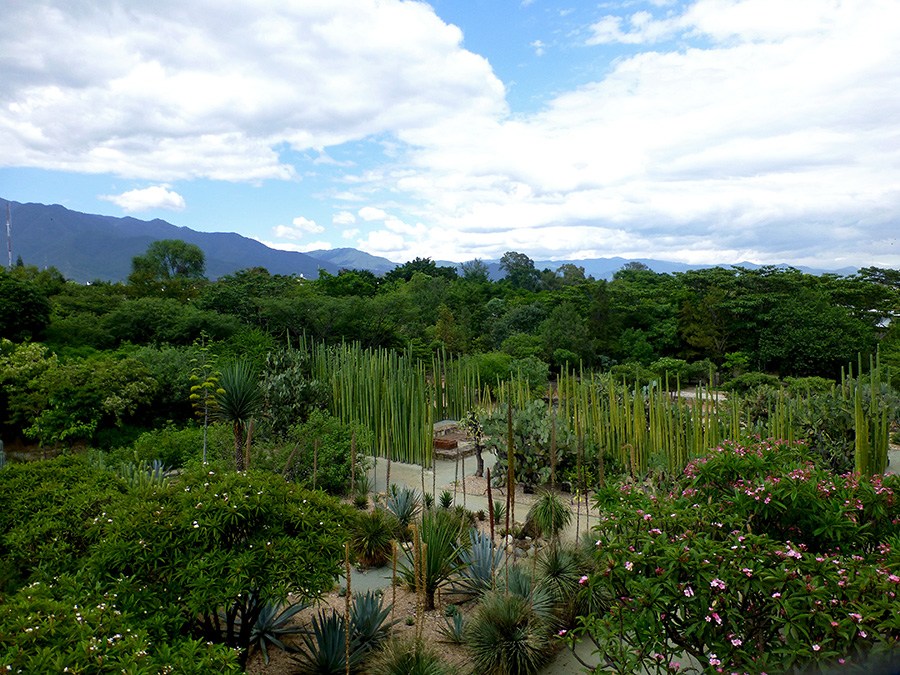
Looking down on the Jardín Etnobotánico from the Museo de las Cultures de Oaxaca
Leaving the museum, we strolled down Oaxaca’s walking street, Macedonio Alcalá (aka, Andador Turistico), across the zocaló, past the Palacio de Gobierno, to the Mercado Benito Juárez. Besides the fact that I was almost out of coffee beans and needed to stop by El Grano de Oro to replenish my supply, in my humble opinion, the mercado is a “must see” for any visitor. Feeling a bit parched and ready for a break, we pulled up stools at Casilda Aguas Regionales and had to choose from their dazzling selection of fresh aguas. Refreshed, we resumed exploring the aisles of fruits and vegetables, fish and meats, clothing and jewelry, fresh flowers and souvenirs, mezcal and quesillo, and more.

Aguas lined up on the counter of Casilda Aguas Regionales
Hungry, tired, and on sensory overload, we walked back up the Alcalá to the tranquility, innovative architectural design, and savory flavors of Los Danzantes — the complementary mezcalito was an added bonus! Our late afternoon comida was a leisurely affair, as we reviewed the day and made plans for the next. B worried that we might be lingering too long, but I assured him, unlike the USA, restaurants in Mexico don’t rush diners.

Retractable ceiling and modern take on adobe walls at Oaxaca’s Los Danzantes restaurant
It was a lovely and delicious way to end the day. Stay tuned for Day 2, as we headed out of the city….


 Mexican Peso Converter
 View From Casita Colibrí
Never a dull wall
Posted in Creativity, Culture, Travel & Tourism, tagged calaca, Mexico, Oaxaca, photographs, photos, political commentary, popular travel destinations, skeletons, stencils, street art, wall art on August 1, 2017| 2 Comments »
Whether just passing by…
Or, stopping to study…
Even black and white stencils add color commentary to the walls of Oaxaca.
Share this:
Read Full Post »