Feeds:
Posts
Comments

Posts Tagged ‘Oaxaca’

I love going to my little local mercado on Sunday mornings.  Steps leading up to it from Independencia are lined with vendors of street food, flowers, religious trinkets, herbs, you name it!  Inside, the cavernous building is teeming with more activity than on weekdays.  And, these guys are there to entertain diners and shoppers…

Man, teenage boy, and young boy playing marimba

I suspect this is a father and his two sons.  Marimba playing seems to be a (masculine) family affair.

Close up of young boy

It isn’t unusual to see these beautiful instruments being carried through the streets and sidewalks of Oaxaca…

Parquetry detail on marimba

… on their way to set up and play traditional “sones” from Oaxaca and/or old pop standards at a fiesta, in front of a shop, or inside a mercado.  Muchisimas gracias for a delightful soundtrack!

One of these days, I’m going to shoot video of some of them, but in the meantime, here are a couple from YouTube:

Read Full Post »

Strolling along Calle Prof. M. Aranda several days ago, I wondered…

maybe this was a case of…

the parts…

being greater…

than their sum.

What do you think?

Urban art by sanez.

Read Full Post »

Last night I joined a standing-room-only crowd for the book launch of Grandes Maestros del Arte Popular de Oaxaca (Grand Masters of Folk Art of Oaxaca) at the Centro Académico y Cultural San Pablo, in Oaxaca city.  This beautiful 340+ page book was the joint effort of the Fundación Alfredo Harp Helú, Fomento Cultural Banamex, the State of Oaxaca, and CONACULTA (National Council for Culture and the Arts).

Cover of the book

The press was there in full force, as was governor Gabino Cue, benefactor Alfredo Harp Helu, and a number of other movers and shakers on Oaxaca’s cultural scene.  Many of the artisans were also in attendance and several posed for photographs holding their copy of the book at the reception that followed.

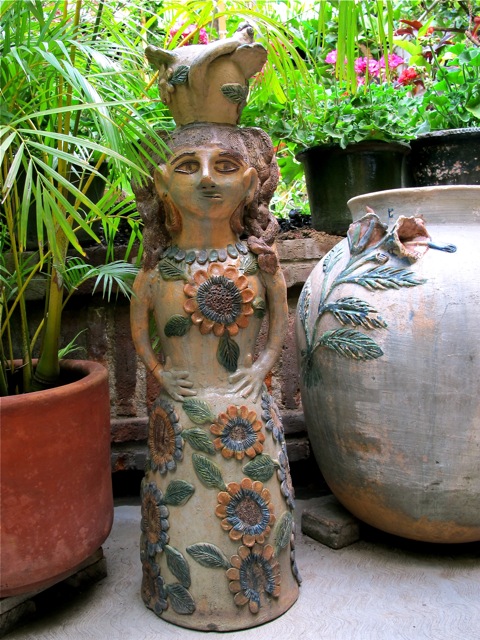
One of the artisans who was not there was the late potter, Dolores Porras from Santa María Atzompa, as Parkinson’s disease had claimed her on November 1, 2010.  Four pages in the book are devoted to this maestra of pottery and her pioneering work with glazes.  Examples of her work can be seen all around Oaxaca, including these scattered in the garden at the hotel, Las Golondrinas.

Vase in the shape of a woman's face and rounded body

Her work has inspired imitation, but as is evident in these pieces, her whimsy, creativity, and sense of proportion would be difficult to match.

Urn with the face of a woman.

I want to thank potter Michael Peed for pointing out these hidden treasures…

Tall vase in the shape of a woman.

following a showing of his loving documentary, Dolores Porras: Artista Artesana de Barro Santa María Atzompa.  (Click here for an excerpt on YouTube.)

DVD front and back covers

And then there is this one, I discovered on my own, the very next day — on a bathroom shelf, no less — at Casa Linda

Vase with image of a woman, with pointy breasts.

Read Full Post »

Southern exposure

Sunset last night…

as it unfolded.

Sometimes, looking south is the best!

Read Full Post »

Just the thought of introducing genetically modified corn and the chemicals it requires into Oaxaca, where maíz has been cultivated (Just fine, thank you very much!) for thousands of years makes me sad and angry.  Education is growing, opposition is mounting, and alternatives to the profits-before-people-and-the-environment Monsantos of this world are being set up.  By the way, “agroecology” is a new word for me… and I like it!

From the February 20, 2012 Nation of Change

Native Farmers in Mexico Help Drive Local Eco-Friendly Farming

By Emilio Godoy

The largely invisible work of small local groups of indigenous farmers in Mexico who are spearheading the defense of their territory and identity and of native seeds is strengthening ecologically sound family farming, experts say.

“For thousands of years, indigenous people have been responsible for developing agricultural biodiversity,” Narciso Barrera, a researcher at the public Autonomous University of Tlaxcala in southern Mexico, told IPS. “However, these efforts remain basically invisible, and they should be highlighted and linked with other local movements.”

Since 2000, Barrera has worked on mapping Mexican political ecology, a discipline that studies the relationships between political, economic and social factors and environmental issues and changes.

<snip>

“Agroecology is the key, because it encompasses social aspects, education, economics and farming practices,” said Barrera, who has published the results of his studies in the Spanish journal Papeles de Relaciones Ecosociales y Cambio Global (Papers on Eco Social Relations and Global Change).

I encourage you to read the full article.

Read Full Post »

There are only a few more days left to be delighted by “Manos que crean y ojos que leen” (Hands that create and eyes that read), a whimsical exhibition of popular art at the Biblioteca Andrés Henestrosa.  The pieces were commissioned by Rosa Blum (who, with Henry Wangeman, owns Oaxaca’s bilingual bookstore Amate Books) to celebrate reading and promote the incredibly creative artisans of Oaxaca who were suffering from a drop in tourism following the social conflict of 2006.

This slideshow requires JavaScript.

So…  If you are in Oaxaca, be sure to see it before it closes at the end of this month.  If not, you might want to consider a trip down here (Oaxaca is NOT on the US State Department travel warning list), visit some of these artisans in their villages, see their work up close and personal, and perhaps purchase a few unique treasures from these talented people.

For other pieces in the exhibit, see Chris’s photos over at Oaxaca-The Year After.

Read Full Post »

LA.com just posted a phone interview with Oaxaca’s own, Lila Downs,  where she discusses influences on her musical development, experiences working on the movie Frida, and future projects.  The following is the first of eleven questions asked by Paty Elias, in advance of Lila’s Los Angeles performance on Feb. 25, 2012 promoting her album, “Pecados y Milagros.”

From the interview…

LA.COM::  With such a diverse musical background, why did you decide to focus on Ranchera, style music?

Lila Downs:   I think that I have been very affected by what has been happening in Mexico. There has been a lot of violence, and I started composing a number of songs that were inspired by   retablo, the   votive art forms.

It’s about the notion of having a miracle in your life and giving thanks to the sometimes non-visible saints and elements of faith we have in Mexico. I thought it was very fascinating to somehow find the subjects in the songs and then kind of place them in the same way towards showing and giving thanks for the blessings that we have in our life but then also questioning the interpretation of each of these pieces, which are miracles and sins.

Ranchera is really a genre — it’s a form that is kind of about the profane.

There are Rancheras

Lila Downs (LilaDowns.com)

that are about the celebration of life as well as fertility and perhaps the more Indian elements in our culture.

But I would have to say that the Ranchera is mostly accompanied by tequila or mescal. And I think that’s when we will tell our sins, and that’s why I chose the Rancheras at this point — And of course because its one of the only forms were you can really spill your guts. And I think that’s what we are going through right now. We are in desperate times, and you need something with which you can really express your soul.

For the full interview and a couple of video clips, click HERE.

And for my description and photos from the Nov. 6, 2011 Lila Downs concert at Oaxaca’s Guelaguetza Auditorium, click HERE.

Read Full Post »

… let us walk together.  And we, in Oaxaca city, have been for the past several weeks thanks to Oaxaca born artist Alejandro Santiago.

The streets and sidewalks around Santo Domingo have been peopled with “La Ruta del Migrante – Caminemos Juntos,” his heart wrenching sculptures representing the 2,501 migrantes, men and women, who have left his pueblo of San Pedro Teococuilco almost deserted.

No two sculptures are the same; each is a tribute to the unique individuals who, most certainly with great reluctance, left the homes of their families and ancestors to make their way north in search of jobs.  The pain in their contorted bodies, their faces, and their feet causes me to pause every time I pass.  I’ll let the images speak for themselves and ask the questions societies all over the world need to answer.

This slideshow requires JavaScript.

These migrantes on the streets of Oaxaca are scheduled to disappear at the end of the month and I don’t know where they are next headed.  However, two documentaries have been made about Santiago’s tribute to migrantes:  Twenty Five Hundred & One by Patricia Van Ryker and 2501 Migrants: A Journey directed by Yolanda Cruz.

Read Full Post »

… and it never gets old, at least not for me!  Thus yesterday, returning from picking up a newly repaired sandal at the zapatero (shoemaker), a parade along the Alcalá had me happily stopping.

Women in embroidered black velvet costumes and wearing white lace head pieces arm in arm with men in black pants, white shirts, red neck kerchief and carrying a sombrero

Judging by the traje (costume), what is popularly known north of the border as Frida Kahlo style clothing, the elaborate multicolored embroidery on black velvet and the signature starched white lace head pieces, immediately said the Isthmus region of Oaxaca, the area along the Gulf of Tehuantepec.

A banda led off the procession with, of course, the requisite tuba.

Man carrying a shiny brass tuba

A marlin out-of-water  followed the band.  Actually, a friend and I had a discussion about what kind of fish it was.  Marlin (blue and black), sailfish, and swordfish are found in the waters of the Gulf of Tehuantepec.  After looking at this website, I’m thinking this guy is a marlin, but who knows???

Man carrying a large grey marlin on his head

Once home and photos downloaded, the detective work began; trying to figure out what this was all about.   Putting together the information I could glean from the banners and a little research, I think this was a parade by people from San Blas Atempa celebrating a traditional fiesta titular.

Woman carrying banner, surrounded by women in bright pink skirs and black emboidered huipiles.

Naturally, there weren’t just beautifully dressed adults.  Adorable little boys…

Little boy wearing black pants, white shirt, red neck kerchief, and sombrero

and girls kept up the pace on this bright sunny 80+ degree day.

Little girl in full embroidered black velvet attiren and including white lace headpiece, looking at the camera.

I wasn’t the only one watching… Alejandro Santiago’s growing army of Migrantes stood transfixed.  (Well, actually they are literally affixed to the sidewalks and streets with some sort of gooey glue.)

Tejuana women carrying banner, as they pass Migrante sculptures lining the street.

Just another day and another parade in paradise!

Read Full Post »

I knew it was going to be a good day when a colibrí greeted me on an early morning stroll up to the weekly organic market.

Black outline of a hummingbird on a white wall.

There were other critters and creatures in plain sight…

Multicolored creature painted on terracotta wall

and peering out from their hiding places.

Multicolored creature painted on wall in back; with bougainvillea in foreground

However, you must proceed with caution because, most dangerous of all…

Pile of torn up street rubble in street, with red sign:  Precaución - Hombres Trabajando

there are men at work!

Read Full Post »

Valentine’s Day, known here as Day of Love and Friendship, is in full swing.  Hearts, flowers, and balloons are everywhere.  If you forgot to buy your lover or friend a little something, there are always vendors there to remind you.  And, don’t forget to be safe.

This slideshow requires JavaScript.

¡Feliz Día del Amor y la Amistad!

Read Full Post »

Be it looking down from the windows above, strolling through the gardens on a tour, or peeking through openings in the wall on Reforma or Berriozabal on the way to someplace else, Oaxaca’s Ethnobotanical Garden is always a soothing and uplifting sight.

Looking out from window above Ethnobotanical Garden

Check out this informative and enlightening article by Jeff Spurrier discussing the origins and vision of  Oaxaca’s Ethnobotanical Garden — from the Jan/Feb 2012 issue of Garden Design:

Oaxaca’s Ethnobotanical Garden

“I am not a gardener.” Francisco Toledo is sitting in the courtyard of the graphic art institute he founded in downtown Oaxaca City, Mexico, sipping on a glass of agua de jamaica. His fingers are paint-smudged, and he moves stiffly from a sore back. Toledo, 71, is one of Mexico’s best-known living artists; his paintings, sculptures, and textiles are in galleries and museums around the world. At home in Mexico, he is identified with a fierce and outspoken defense of the indigenous arts and culture of the southern state of Oaxaca. He also, as it turns out, helped to create one of the world’s most original public gardens.

“The professionals are the people who live in the country,” he says. “The campesinos and workers — I don’t have the patience.”

Nearly 20 years ago, the Mexican military moved out of a 16th-century Santo Domingo monastery complex it had used as a base for more than 120 years. Mexico’s president gave the exit order after being lobbied by Toledo and other leading artists and intellectuals belonging to Pro-Oax, an advocacy group urging the promotion and protection of art, culture, and the natural environment in Oaxaca. Soon, a great clamor began: The state government wanted the five-acre parcel in the heart of downtown Oaxaca City to create a hotel, convention center, and parking facility. A restoration team brought in by the National Institute of Anthropology and History wanted to establish a European garden in the 17th-century baroque style. Some of Toledo’s fellow artists wanted to use the grounds for workshops and exhibition space.

n 1993, when Toledo knew the army would be leaving, he asked Alejandro de Ávila B., who had family roots in Oaxaca and training in anthropology, biology, and linguistics, what he and other advocates would propose. De Ávila suggested making the space into a botanic garden — or, more precisely, an ethnobotanic garden, one that would “show the interaction of plants and people.”

I highly recommend reading the Full Article.

h/t  Norma and Roberta

Read Full Post »

The day before I went up to Mexico City last month, crossing Llano Park, I came across a newly installed waste container encouraging plastic recycling; courtesy of Tierra Sana, a company promoting and selling environmentally friendly products.

Waste basket made from plastic bottles with a Tierra Sana sign on top

These baskets have cropped up in other parts of the city — this one in the plazuela next to Carmen Alto church.  Please know, the trees will cry if you don’t recycle.

Plastic bottle recycling bin with graffiti drawing of a tree crying in the background.

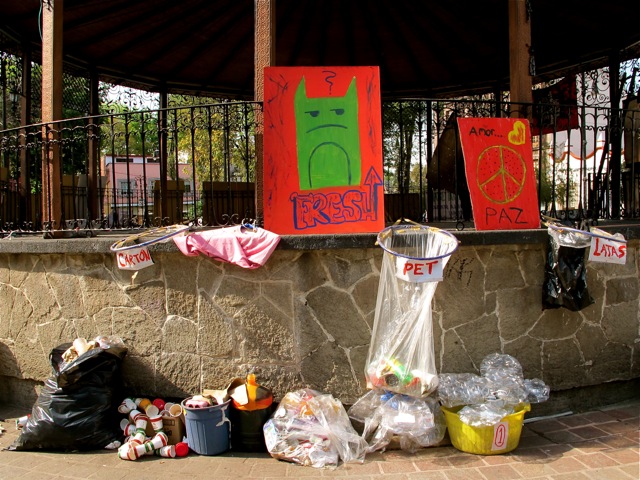
Once up in Mexico City, I noticed Occupy Coyoacán practiced recycling.

Overflowing recycling bags lined up along bandstand.

And then, we were all brought up short by this electric car…

Silver Nissan electric car getting charged at charging station in the street.

These charging stations are not far from the Templo Mayor; an appropriate juxtaposition, I think.  Automobile pollution can’t be good for the Great Temple.

GE charging station

Then there is bike-sharing — 1200 bikes at 90 Ecobici bike stations in Mexico’s capital city.

Red Ecobici bicycles lined up on bike rack.

For more on Mexico City’s Green Plan, check out 10 Highlights of Mexico City’s Climate Action Program.

Read Full Post »

With a nod to Humphrey Bogart’s character in Casablanca:  Of all the volunteer opportunities, in all of Oaxaca, why did I walk into the Oaxaca Lending Library (OLL)?   For the answer, you will have to check out my newly published (yippeee!) article on volunteering at the Oaxaca Lending Library on the Go Overseas website.

The article mentions the various and sundry activities organized by the OLL.  So, I thought I’d give you a taste:

Volunteering at the OLL has introduced me to an incredibly diverse, knowledgeable, and talented group of people from a wide variety of backgrounds.  Be they native Oaxaqueños, year round ex pat residents, or yearly “snow birds,” many have become part of my community and support system.  A library —  what better place to get your questions answered about the who, what, where, why, and how of living and thriving in an unfamiliar culture?  People and books are there to assist with navigating the challenges, celebrating the differences, and exploring the surroundings.

A couple of weeks ago, I attended a panel discussion at the library commemorating fifty years of the Peace Corps.  Two of the speakers had been among the original Peace Corps volunteers in the 1960s, one to Africa and one to South America. The third speaker is an 85-year-old woman who was a Peace Corps volunteer when she was 60+ years old!  All have been living in Oaxaca for a number of years, and credit their Peace Corps volunteer experiences with broadening their horizons and realizing their power to have a positive impact in the world, even if it is just one person at a time.  All continue to find ways to offer their time, energy, and talents to assist various people and communities of Oaxaca.

According to a recent International Community Foundation report on US retiree trends in Mexico:

• Nearly 60% of respondents volunteer their time to a charitable cause in Mexico and over 29% volunteer at least once a week or on a regular basis. Respondents engage in a wide range of volunteer activities, most prominently with education-focused charities, community projects, and the environment.

• U.S retirees in Mexico volunteer because of their strong sense of social responsibility and desire to make a difference in their adopted communities. Survey respondents reported that their volunteer efforts increase their sense of belonging in Mexico, and contribute to an increased sense of community among local neighbors and friends.

• 42% of American retirees surveyed are actively involved in at least one or two Mexican charities in their adopted communities, while another 11% are affiliated with more than three.

Ten years ago, I never dreamed I would be living an ex pat life in southern Mexico.  Funny how life’s curves can lead to opportunities….

Read Full Post »

Full moon hiding; overcast tonight.   Sheesh, I’ve been cold all day!  However, my Frangipani is blooming…

Two pink frangipani flowers

Read Full Post »

« Newer Posts - Older Posts »