Feeds:
Posts
Comments

Posts Tagged ‘Mexico’

As the promotional material for Ma (yo) en Oaxaca, Mujer (es) Arte y Cultura explains (loose translation), like a skilled weaver, women create the fabric of life… part of the history of humanity, intelligence that moves, the look that looks, which is regarded in the construction of better horizons of life for her and those who are around her.  And so, from May 3rd through 13th, the women of Oaxaca are being celebrated with workshops, exhibitions, lectures, and concerts.

Last night, under the supermoon, one of the accomplished women of Oaxaca, Alejandra Robles, gave a free concert, just a block away, in the Plaza de la Danza…

Ma (yo) en Oaxaca is a party for all of the principles of inclusion and participation to make possible the knowledge and appreciation of the cultural richness of groups which, for various reasons, have been marginalized.

¡Viva las mujeres!

Read Full Post »

A belated Happy 20th Birthday, Museo de Arte Contemporáneo de Oaxaca!

20 MACO banner

As the theme of the birthday celebration on February 28th said, Say ‘Coma’ Twenty Times,

20 and 4 bicycles with a comma in the center of the front wheels

COMA, COMA, CO-MACO, MACO, MACO…

Large red 20 painted on window

Come say, Feliz Cumpleaños MACO, in person!

Read Full Post »

We, who live or spend a significant amount of time here in Oaxaca, can’t say it too many times…

Are Americans safer in Mexico than at home?
Robert Reid Lonely Planet author

Every week or so I get asked, ‘Is it safe to go to Mexico?’ I had always said, if you’re thoughtful about where you go, yes. But after my most recent trip there, I’m changing my answer… to a question:

Do you think it’s safe to go to Texas?

To be clear, violence in Mexico is no joke. There have been over 47,000 drug-related murders alone in the past five years. Its murder rate – 18 per 100,000 according to this United Nations Office on Drugs & Crime report – is more than three times the US rate of 4.8 per 100,000. Though Mexican tourism is starting to bounce back, Americans appear more reluctant to return than Canadians and Brits (5.7 million Americans visited in 2011, down 3% from 2010 – and, according to Expedia, more than four of five bookings were adults going without children). Many who don’t go cite violence as the reason.

What you don’t get from most reports in the US is statistical evidence that Americans are less likely to face violence on average in Mexico than at home, particularly when you zero in on Mexico’s most popular travel destinations. For example, the gateway to Disney World, Orlando, saw 7.5 murders per 100,000 residents in 2010 per the FBI; this is higher than Cancun or Puerto Vallarta, with rates of 1.83 and 5.9 respectively, per a Stanford University report (see data visualization here, summarized on this chart, page 21). Yet in March, the Texas Department of Public Safety advised against ‘spring break’ travel anywhere in Mexico, a country the size of the UK, France, Germany, Spain and Italy combined. Never mind that popular destinations like the Bahamas, Belize and Jamaica have far higher homicide rates (36, 42 and 52 per 100,000). Why the singular focus?

Before you nix Mexico altogether, consider these five things:

[Read full article HERE]

Read Full Post »

Like 80+ countries in the world, International Workers’ Day is a national holiday in Mexico.  Early this morning in Oaxaca, streets were closed as contingents began gathering and then marching toward the city center.   And for hours, they poured into the Zócalo and Alameda for speeches, music, and bottle rockets, all of which will, no doubt, continue for hours more.

This slideshow requires JavaScript.

FYI:  CTM stand for the Confederación de Trabajadores de México, the largest confederation of Mexican labor unions.  Think, AFL-CIO in El Norte (though with some significant differences).

¡Feliz Día Internacional de los Trabajadores!

Update:  For a more nuanced view of yesterday’s march, see the report by longtime resident, Nancy Davies.

Read Full Post »

When I was a child and asked, “If there is a Mother’s Day and a Father’s day, why isn’t there a Children’s Day?”  My mother’s usual reply was, “Everyday is children’s day!”  Hmmm… I never did buy her explanation, until I had kids of my own.  However, here in Mexico, there is a day to celebrate children and today is that day — Día del Niño, a day when children are made to feel special.

Schools organize parties with games and treats instead of lessons, parents may give their niños y niñas gifts, and special community activities for kids are organized.  Yesterday, here in the city, the Service Workers Union threw an all day party for 5,000 children in the annex of the Eduardo Vasconcelos baseball stadium.  There were box lunches, candy (of course), a petty zoo, games, shows, and even a raffle for new bicycles.

So, here’s to the girls and boys of Oaxaca…

girl sitting and smiling with 2 front teeth missing

To their good humor.

Boy with a hat and scarf on head

Their pride in celebrating their communities…

Girl in Istmo huipi

Their beauty…

Boy in plaid shirt and red scarf

Their amazing patience…

Girl sitting and looking sad

Even when they are shy and tired.

Young child, barefoot standing next to a car

And, especially to the street children, who, despite the challenges of their lives, seem to find ways to “just be kids.”

Read Full Post »

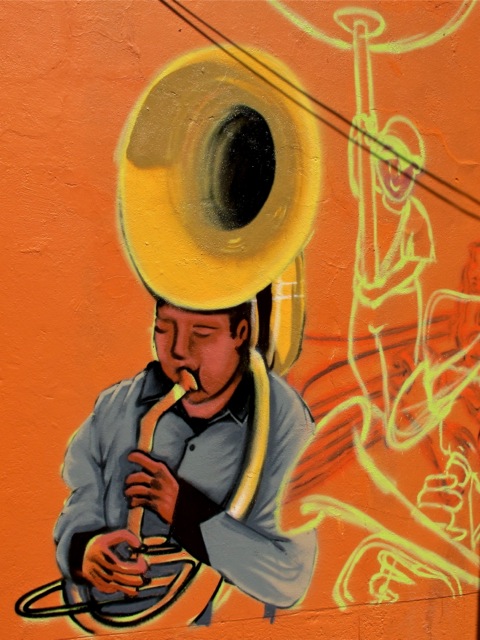
Every time I pass by the turnoff to Tlacolula de Matamoros, I break into song, “Be-bop-a-lula, she’s my baby.”  And, seeing this guy on the front of a building on one of the town’s main streets only contributes to channeling Gene Vincent.

Wall art of tuba player

I was last there early this month for the first Festival de la Nieve, Mezcal y Vinagre.  Ice cream, mezcal, and fruit and veggies in vinegar… what’s not to like?

Bottles of mezcal

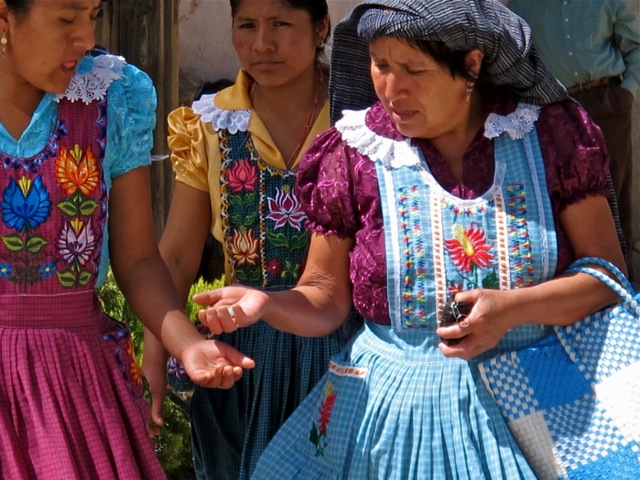
And then there is the weekly Sunday tianguis (market), where women in colorfully embroidered cotton aprons over tightly pleated polyester brocade skirts (where did that style come from?) buy and sell everything under the sun.

3 women in embroidered aprons.

As the article, The Pop-up Food Shops of Oaxaca confirms, I’m not the only one who is captivated by Tlacolula.

Read Full Post »

Tonight, instead of candles…

Fireworks blossom

Fuegos artificiales exploded from the Alameda de León…

Fireworks blossom

As Oaxaca celebrated her 480th birthday!

Fireworks

Read Full Post »

Today is Oaxaca’s 480th birthday as a colonial city .  Of course, among other events, a calenda (parade) marked the date.

This slideshow requires JavaScript.

In 1532 Spanish settlers (their bloody way paved by Hernán Cortés and his conquistadores) successfully petitioned the Queen of Spain for a land grant of 1 square league.  The colonists had already established their own town on the site of Huaxyacac, renamed it Antequera (after an old Roman city  in Spain) and received a Royal Charter from King Charles I of Spain.

However, Cortés had successfully gotten the entire Valley of Oaxaca (hundreds of thousands of acres) declared as his own private marquisate and, his greed knowing no bounds, kept trying to evict the colonial townspeople.  By obtaining the queen’s charter, this end-run around Cortés insured the rights of the townspeople to the land.

Thus, April 25th continues to be celebrated as Oaxaca’s birthday.  ¡Feliz Cumpleaños!

Read Full Post »

…fighting in Oaxaca.

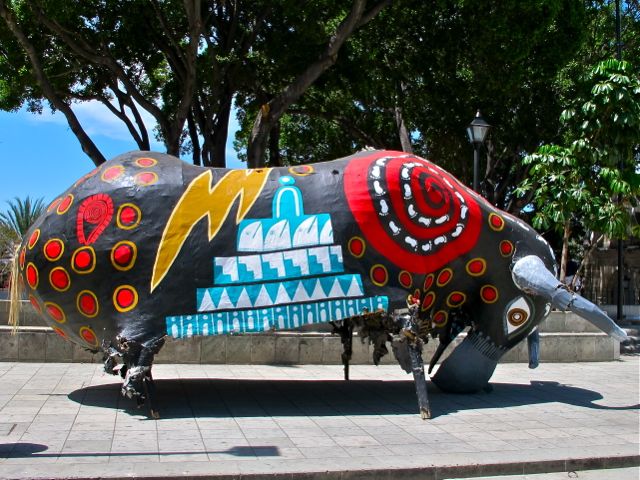
Colorful gigantic papermache bull

Corrida de Toros, as it is known in Mexico, was outlawed by, then governor of Oaxaca, Benito Juárez.  The ban was instituted throughout Mexico in 1867 by Juárez during his presidency.  Some say it was to “civilize” Mexico, but others contend it was for nationalistic reasons, as bullfighting had been a legacy of the Spanish conquest.  I tend to think the latter tipped the scales.

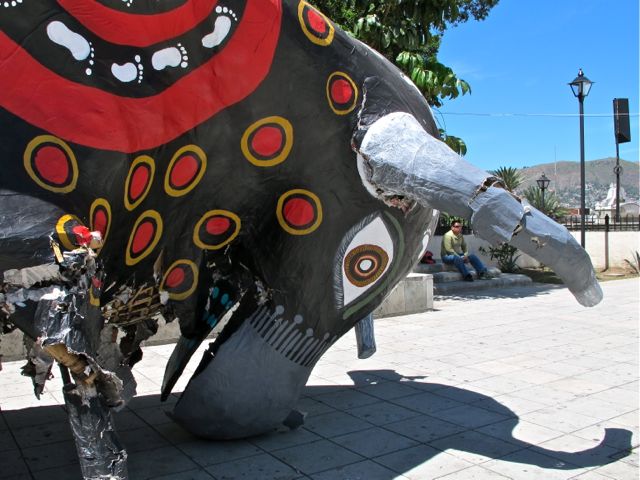
Close-up of the head of a colorful giant papermache bull

However, Porfirio Díaz reinstated it during his presidency, but the ban remained in Oaxaca in honor of her favorite son.  And thus, on the Plaza de la Danza, we have only a paper mache bull ready to charge at his shadow…

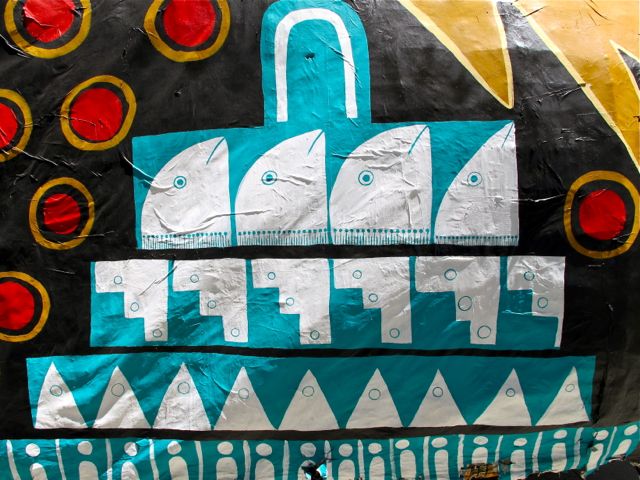
Design of fish heads, Mitla frets, triangular mountains, etc.

and serve as a canvas for imagery, ancient and contemporary.

Read Full Post »

Friday was a delightful day… a late morning and early afternoon spent in leisurely conversation with one of my closest friends over desayuno at Cocina Economica Isabel, a stop at the Merced mercado to pick up some pan dulce, and a stroll through the Zócalo, before returning home.  I envisioned a late afternoon and evening of visiting with my neighbor before she is heads north for a USA visit, catching up on email, and watching a movie.  Perfection, I thought!  Who could ask for more?

“More” came via my email inbox; notice of the 10th Guelaguetza Infantil, with a calenda (parade) from Santo Domingo de Guzmán to the Zócalo beginning at 6 PM.  This definitely called for a change of plans!  And, sure enough, as I got closer to Santo Domingo, there they were; delegations of children representing the regions of Oaxaca.

Girl and boy in costume of the Istmo.

Istmo de Tehuantepec couple (a young Frida Kahlo, perhaps?) posing for photos.

Girl in Istmo costume covering her ears

There were several bands playing and it got a little too loud for this girl from the Istmo.

Girl in Tuxtepec costume holding basket of candy.

However this girl, representing the Papaloapan, didn’t seem to mind and was ready to toss candy to the crowd. She wasn’t alone — once the calenda started, candy began flying fast and furious and the pockets of the kids watching on the sidelines began bulging!

Girl wearing a costume from the Costa regionGirls from the Costa region received last-minute instructions.

Boys in white shirts and straw cowboy hats holding school banner reading "Cervantes"

Costa boys were charged with holding up their school banner.

Close up of girls in the costumes from Tuxtepec

The girls representing the Papaloapan clutched plastic pineapples, ready for the always popular Flor de Piña dance from Tuxtepec.

2 girls standing together; one in Istmo costume and one in Tuxtepec costume

A little cross cultural comparing of notes (actually, cell phone games) was happening between the Istmo and Papaloapan.

Girl in Mixteca costume dancing.

All the while, the dancers from the Mixteca danced their way down the Álcala.

Closeup of boy with Danza de la Pluma head dress.

And, the young Danza de la Pluma danzantes, representing the Valles Centrales, carefully balanced their penachos (headdresses).

Tonight at 5 pm, these 300 kids from 52 preschools, will perform traditional regional dances in the auditorium of the Universidad Regional del Sureste, Rosario campus in San Sebastián Tutla.

Read Full Post »

Hip hop is probably not the first thing that pops to mind when you think of Oaxaca.  However, I can assure you, there is more to Oaxaca than colonial architecture, religious processions, colorful traje (costume), and traditional music.  As repeated blockades and occupations attest, and the El Silencio Mata posters illustrate, there are voices struggling to be heard.

For one of those voices, check out this trailer from the documentary film, Cuando Una Mujer Avanza (When a Woman Takes a Step Forward), about “Mare” a young Zapotec hip hop artist from Oaxaca.  As the promo states, her unique life experience is a rarely heard perspective on life and community liberation.  As an up and coming MC in a state known for popular and indigenous rebellion, Mare’s life and experience has been channeled into very powerful and conscious rapping and singing.

Update:  Check out the article, Mare Is a Rapper Hell-Bent on Equality for Women in Mexico.

Read Full Post »

Carved wood woman sitting -- back curved into chair.

“It’s not what you look at that matters, it’s what you see.”  — Henry David Thoreau

Read Full Post »

It’s been a week since the end of Semana Santa and I’m still sorting through photos and videos and reflecting on impressions and feelings.  However, I’m finding that, with too much thinking, the experience slips through the fingers and the magic vanishes.

Thus, I give you the night of Pascuas (Easter) at Carmen Alto…

And then, the hisses, bangs, and brilliant explosions of a castillo…

Flaming castillo

brought Semana Santa to a spectacular close.

Read Full Post »

I’m from the cradle of modern mountain biking; Marin County, California.  In fact, it has become so popular in Marin over the past 30+ years, traffic jams have ensued at trail heads and battles between hikers, horseback riders, and mountain bikers over safety and environmental issues frequently make the headlines of local papers.

With this recent article in the Wall Street Journal, it looks like mountain biking has “officially” come to Oaxaca.  I’m keeping my fingers crossed that the wise Zapotec elders up in Oaxaca’s Sierra Norte will find a way to keep the peace.  And, more than that, I’m hoping all you mountain bikers out there will be respectful of this beautiful land and her people.

From Friday, April 13, 2012 online Wall Street Journal…

Blazing Trails in Mexico

Mountain biking is rare in Oaxaca—but not for long

By TREVOR CLARK

[mexbike]
Mountain biking on the Tequila Trail near Oaxaca, Mexico – Trevor Clark

IT WAS EARLY. Hours from sunrise kind of early. My wimpy headlamp struggled to break through the predawn drizzle, and I could barely see my front tire or the trail ahead. Roots, rocks and stumps all seemed to be in cahoots, working together to upend me.

MEXBIKE

WHEEL WORLD | Riding out of the village of Benito Juárez in Oaxaca –  Trevor Clark 

I tried to become one with the bike. I tried to feel out the trail with my other senses. I tried to anticipate obstacles, but I am no Zen master. My mountain biking skills are rough under the best conditions, and I was in the jungle in the dark.

My mate’s more powerful headlamp suddenly provided a snapshot of a sharp turn and a wooden footbridge ahead. Then, lights out. I made an educated guess, went straight and took a hit that emptied my lungs: “Huhhhhh!” Cold water rushed into my clothes and pack as I lay in the stream, bike still on my feet, straight up in the air.

For a few moments, I laughed hysterically at my predicament and the fact that I was OK after missing the bridge. Then I picked myself up and kept moving.

We made it to the peak of Piedra Larga, a 10,761-foot-high lookout, for breakfast, corn-based hot chocolate and sunrise. As the sun slowly emerged from a thick layer of fog, we found ourselves hovering above a golden sea of clouds. The scenery was worth every blind pedal stroke.

MEXBIKE
HIGH ROAD | Taking in the view from a rock spire in the Sierra Norte – Trevor Clark

Seven of us had come to the Sierra Norte of Oaxaca, Mexico, a forested mountain range in the northern part of the state. Oaxaca is known as the country’s culinary and cultural center, and many visitors experience it through cooking classes and gallery walks in the capital city. We, instead, were mountain-biking part of an ancient Zapotec network of walking trails that have connected eight villages to each other and the rest of the world for eons.

Mountain biking is fairly new to Mexico…. [Read FULL ARTICLE]

Read Full Post »

This morning, I was awakened from a sound sleep by the insistent siren and recorded voice alerting the neighborhood of an impending earthquake.  I bolted upright, moved to the side of the bed and slipped on my flip-flops — ready to head out the door if shaking commenced.  As I’ve mentioned before, I think Mexico’s Earthquake Warning System is terrific and something the US should emulate.

However, this time, no rocking and rolling occurred, but I was left wide awake and wondering if and where an earthquake had occurred.  So I pulled out my iPod Touch and opened my iEarthquake app and found that at 5:10 this morning, there was a magnitude 5.7 earthquake about 105 miles WSW from the city of Oaxaca in the mountains near the coast.  The epicenter was 6.2 miles northwest of Pinotepa Nacional, in the Costa region of the state of Oaxaca.

So, I decided to use this event for a geography lesson.  The state of Oaxaca has 8 regions (it used to be 7, but not too long ago the Sierra Region was split into two):

These regions are home to 14 distinct ethno linguistic groups and the regions vary dramatically in topography, vegetation, and climate.  One can catch a glimpse of the unique costumes, dances, and dancers of each region during the Guelaguetza celebration in Oaxaca in July.   The city of Oaxaca is located in the Valles Centrales (“Centro” on the map below).

Color coded map of the regions and districts of Oaxaca

Map from Wikipedia

For a painless way to learn more about the geography of Mexico, you might want to take a look at the Mexican States games.

Read Full Post »

« Newer Posts - Older Posts »