Feeds:
Posts
Comments

Posts Tagged ‘Mexico’

Hurray for libraries and librarians everywhere!  Just like Oaxaca, you never know what you will find when you turn a corner in a library or archive. And, whether it’s wandering the streets or roaming the aisles, we can’t help but learn a little more about our world and ourselves. We need more occasions for big, goofy smiles. Don’t let your community cut funding to libraries!  –spixl

Photos on Flickr of Códice de Santa Catarina.

marquettehistory's avatarHistorians@Work

Laura Matthew on the secret life of primary sources and the responsibility historians have to them, and to each other, when documenting the past. 

I have been thinking about how documents are lost, then found.

A week or so ago, my friend and colleague Aims McGuiness from the History department at the University of Wisconsin, Milwaukee (UWM) left me a voice mail message. “There’s this mysterious document at the American Geographical Society Library here at UWM,” he said. “It looks colonial-era, and maybe Mexican. The librarians don’t know what it is, or how they got it. Could you come look at it?”

“Ooh, fun!” I emailed him back (yes, that’s a direct quote). “I can always make time for a lost document.”

Little did I know. A few days later, Jovanka Ristic and Kay Guilden at the AGS Library unrolled in front of me a piece of bark paper on…

View original post 1,015 more words

Read Full Post »

The back of the official 26th anniversary t-shirt for the Good Friday, Procesión del Silencio, doesn’t come close to telling the tale.

Back of T-shirt: Face of Jesus; text "1986 Procesion del silencio 2012"

Images of belief add texture to the ritual procession of mourners grieving the crucifixion and death of Jesus, as related in the New Testament of the Christian Bible.

Close up of a bleeding Jesus head and torso on a cross

But it’s the eyes of believers…

purple hooded face with only eyes showing

that gives the narrative a silent voice.

Virgin Mary statue with halo from shoulders up.

And, grieving mothers everywhere understand.

Profile of a woman wearing black veil and glasses.

No matter where one lands on the belief continuum, it’s hard not to be moved.

(ps)  For lots more terrific photos, take a look at Chris’s posting, The Procession of Silence.

Read Full Post »

And now a pause in the Semana Santa coverage…

The following article is part of the cover story project in the April 9 issue of The Christian Science MonitorWeekly magazine.  It’s long, but I encourage you to click on it and read the full article.

Home again in Mexico: Illegal immigration hits net zero

Tiny Tamaula is the new face of rural Mexico: Villagers are home again as the illegal immigration boom drops to net zero

By Sara Miller Llana, Staff writer / April 8, 2012

Tamaula, Mexico – At this time of year in this tiny rural outpost that sits on a mountainside in Guanajuato State, most able-bodied men are gone. They’re off plucking and cutting chicken in processing plants in Georgia or pruning the backyards of Seattle.

But this year, Pedro Laguna and his wife, Silvia Arellano, are clearing rocks from their yard to prepare a field for corn. They’ve returned home to Tamaula, Mexico, with their four young children, after 20 years in the United States working illegally. Pedro’s cousin Jorge Laguna and his brothers are planting garbanzo beans in the plot behind their father’s home. Their next-door neighbor Gregorio Zambrano is also home: One recent morning he badgered a visiting social worker for funds to start a honey=production enterprise.

Since the Monitor last visited here in 2007, a major demographic shift has transformed this dusty village of 230. Migrants have come home, and with them have come other important changes. In 2007, there was no running water, no high school, no paved roads. A simple water pipeline, installed in February, runs to each of the 50-some homes. On a recent day the first high school class, including eight students ages 15 to 40, was finishing up math homework. And now, the main roads are paved.

“We can turn on the water and wash our clothes,” says Pedro’s uncle, Rodolfo Laguna, who spent 12 years working illegally in a chicken plant in Athens, Ga., before returning home in 2010 after both he and his son lost their jobs.

This is the new face of rural Mexico. Villages emptied out in the 1980s and ’90s in one of the largest waves of migration in history. Today there are clear signs that a human tide is returning to towns both small and large across Mexico.

One million Mexicans said they returned from the US between 2005 and 2010, according to a new dem-ographic study of Mexican census data. That’s three times the number who said they’d returned in the previous five-year period.

And they aren’t just home for a visit: One prominent sociologist in the US has counted “net zero” migration for the first time since the 1960s.

Experts say the implications for both nations are enormous – from the draining of a labor pool in the US to the need for a radical shift in policies in Mexico, which has long depended on the billions of dollars in migrant remittances as a social welfare cornerstone.

“The massive return of migrants will have implications at the micro and macro economic levels and will have consequences for the social fabric … especially for the structure of the Mexican family,” says Rodolfo Casillas, a migration expert at the Latin American School of Social Sciences in Mexico City.   [Read full article]


Read Full Post »

Man in purple hood, leaning against large wooden cross.

Mary with praying over Jesus

Jesus seated; head leaning on hand; on arm resting on knee

In front of Preciosa Sangre de Cristo Templo on Viernes Santo (Good Friday), waiting for the Procesión del Silencio (Procession of Silence) to set off up the Álcala, down Garcia Vigil, and back up the Álcala to Sangre de Cristo.

Read Full Post »

Yesterday, under a full moon…

and clutching our “pan bendito” (blessed bread), we began our pilgrimage.  Jueves Santo (Holy/Maundy Thursday) tradition calls for visiting 7 churches (la visita de las siete casas) in the city with one’s pan bendito, which must be kept to offer to guests, should any grace our doorstep.  This all relates back to Jesus’s Last Supper, which this date commemorates.

3 buns on a plate

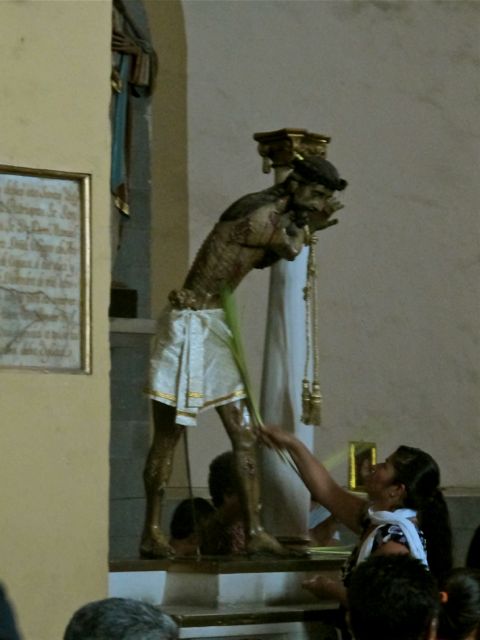
First stop was the nearby Templo de San José, where palm fronds were also distributed and believers used them to brush up and down the statue of Jesus.  Hands also ran down his legs and then were used to touch one’s face.

After emerging from the side door of the jam-packed church, we set off for Templo de San Felipe Neri (whose picturesque dome can be seen (left of center) on my blog banner-head).

Altar with candles and lights.

Next stop was Carmen Abajo

Altar with JHS on banner above altar

followed by the far right side chapel of the La Catedral de Nuestra Señora de la Asunción.  A plaque at the entrance of the chapel read, “El maestro esta aqui y te llama” (The teacher is here and calls you) and the multitude seemed to be heeding the call.

Altar with red banners reading, "De este pan no morirá; El pan de vida eterna"

We then strolled across the zócalo to the Jesuit, Templo de la Compañía de Jesus.

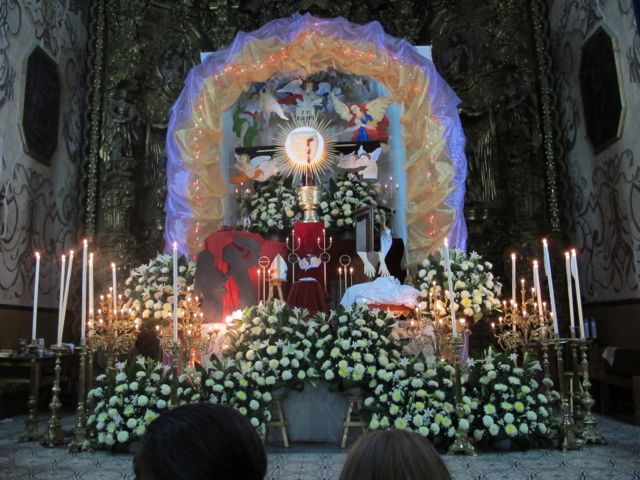
Altar with candles and flanked with yellow and white floral arrangements

We changed direction and headed north up the Álcala.  Big mistake!  A mosh pit (Chris, this WAS a mosh pit) surrounding a Tuna band that was playing in the middle of the street, causing gridlock and bringing us to an abrupt stop.  Eventually, following our blocker (my son, the lineman would be proud), we eventually found light and continued up to Preciosa Sangre de Cristo Templo, where we had earlier spent 1-1/2 hours (and it was still going on when we left!) at a mass where the priest reenacted Jesus washing the feet of his disciples at the Last Supper.

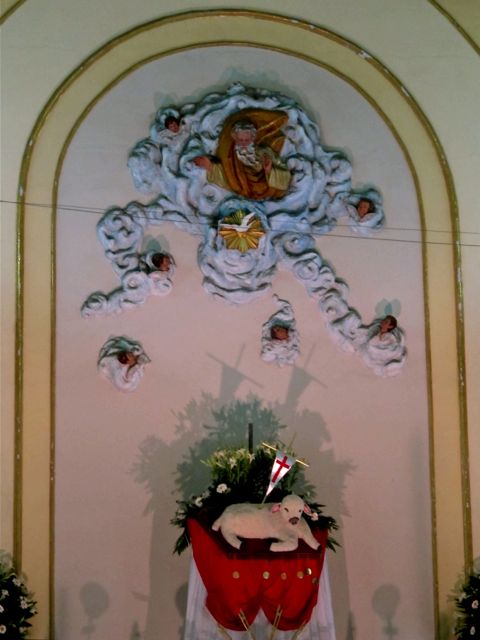
God in a cloud above a lamb on an altar, draped in red cloth.

Strolling across the Álcala to Santo Domingo was much less challenging. The aisle to Santo Domingo’s main altar was blocked and we were routed to a side chapel.  Hurray, we did it — this made seven churches visited!

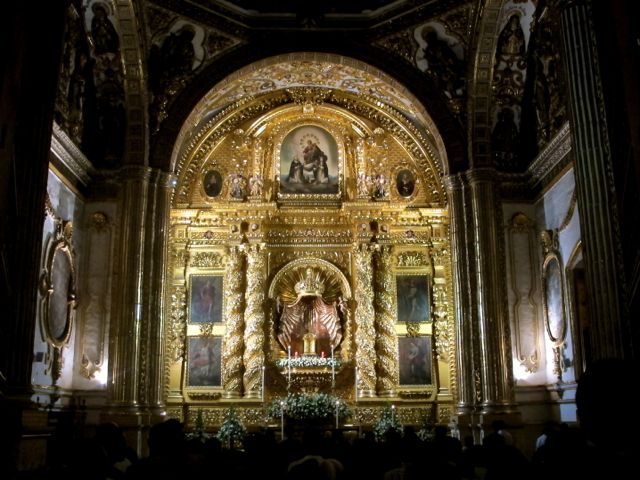
Gold encrusted altar

However, though bleary-eyed (as evidenced by the photo below), we opted for just one more, Carmen Alto.

White bearded man hovering in the clouds above lighted candles

Home beckoned…  and sleep came easily under the watch of the moon, now appropriately encircled by a halo.

Full moon with halo shining from behind clouds

Read Full Post »

Palm Sunday also brought us to the village of Santiago Apóstol and one of my favorite painted churches.

Facade of church at Santiago Apóstol

This beautiful facade was hidden behind a stage, presumably set up for outdoor masses during Semana Santa.

Large crucifix on the stage in front of the church

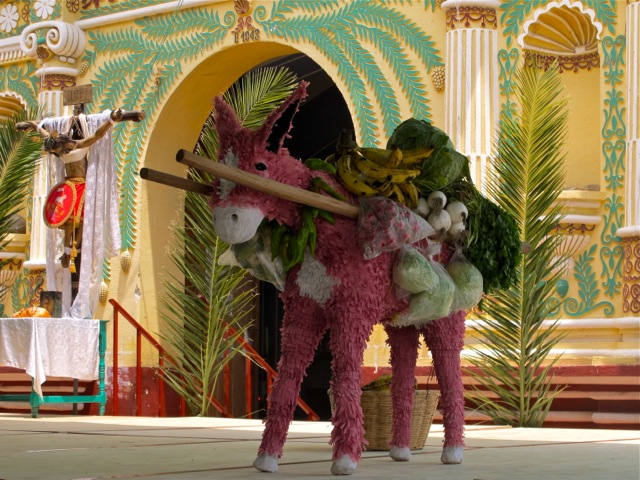
We weren’t the only ones who negotiated the dusty back roads out of San Antonino Castillo Velasco; Señor del Burrito was already there when we arrived.  Apparently, he knew a shortcut!

Señor del Burro on stage in front of church

Inside the empty church (pews had been moved outside), amidst the smoky incense filled haze, the ethereal voices of these women transported us…

7 women sitting in chairs in front of an altar, in the haze of incense.

This wasn’t the first time we had been enchanted in Santiago Apóstol.  During Días de muertos, the entire Panteón is whitewashed and filled with an explosion of red, orange, yellow, and magenta flowers.

Read Full Post »

Yesterday, I spent another magical day with friends in San Antonino Castillo Velasco (about 23 miles/1 hour  from the the city).  It was Domingo de Palmas (Palm Sunday) and San Antonino celebrates in its own unique, warm, and welcoming way.

Townspeople gather in the cemetery to decorate the “Señor del Burrito” with fruit, vegetables, flowers, and everything they sell or grow during the year.  In addition, livestock (goats, chickens, pigs, etc.), more foodstuffs, flowers, etc. are gathered and priced.  The pastor of the parish church arrives to bless the “Lord of the Little Burro” and offerings.  Palm crosses are distributed, all are invited to help carry the offerings to the church, 10-12 men hoist the burro (now laden up to his neck and weighing who knows what!), and a procession to the church commences, lead by a fast-tempo drum beat and punctuated by shouts warning the men carrying “Señor del Burrito” of upcoming topes (speed bumps) and telephone wires, which must be navigated.

This slideshow requires JavaScript.

At the church, “Señor del Burrito” has an honored place in the courtyard and the offerings are gathered and arranged.  Many then attend an hour-long mass inside the church, while others partake in yummy amarillo and pork empanadas, taste mezcal, and browse the wares of the artisan booths.  By the way, at least two of the “maestros” from the new, previously mentioned, book, Grandes Maestros del Arte Popular de Oaxaca were present:  Familia García Mendoza (ceramics)  and Antonina Cornelio, who makes the exquisitely embroidered clothing typical of San Antonino Castillo Velasco (and seen in one or two of the photos above).  Following the mass, the offerings are sold, with the proceeds going to an orphanage in the village.

Muchisimas gracias to the people of San Antonino Castillo Velasco for being so gracious and allowing us to share this special day with them.

Read Full Post »

Mazunte was the first beach on Oaxaca’s coast I visited.  The beach is stunningly beautiful and uncrowded and accommodations lean toward the small and environmentally conscious.

View of Mazunte beach from hill above.

In addition to the appeal of the warm clear waters of its beach and digging your feet in the sand as you dine on fresh fish tacos, Mazunte is home to the Natural Cosmetics Cooperative, established by Anita Roddick, founder of the Body Shop.  The cooperative’s products (soaps, lotions, oils, mosquito repellent, etc.) are available in the city of Oaxaca at the weekly Friday/Saturday Organic Market in the plaza of Santo Tomás in the Xochimilco neighborhood.

Mazunte also houses the National Mexican Turtle Center, whose successful work is the subject of Tim Johnson’s recent blog post, Turtle Hatchlings Head for the Sea.


Read Full Post »

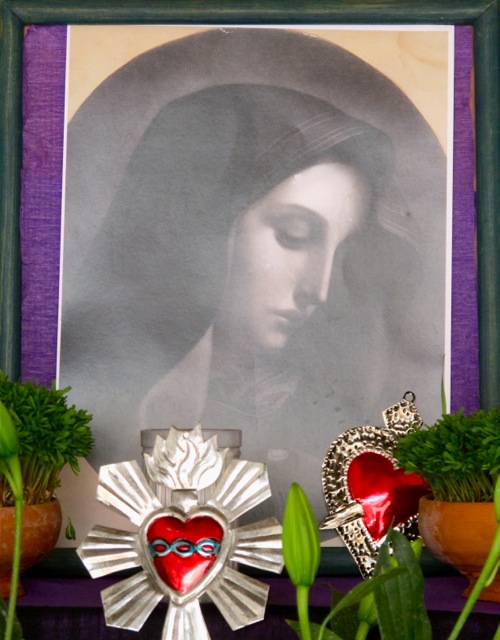
Today, the 6th Friday of Lent, is El Día de la Virgen de Dolores, the Virgin of Sorrows.

Altar at Hotel Las Mariposas

Altars have been set-up in courtyards and businesses around town, including this one at Hotel Las Mariposas (butterflies).

Photo on altar of La Virgen de Dolores with vase of lilies in forground and palm "flowers" in background

It commemorates the pain suffered by the Virgin Mary on the death of her son.

Close up of a drawing of La Virgen de Dolores

By the way, note the “chia pets.”  This is where the US entrepreneur originally got the idea in the late 1970s for the terracotta animal figurines planted with Salvia Hispanica.

Close up of 2 "chia pets," candle, and palm flowers.

Tonight, I’m headed to a special Día de la Virgen de Dolores program, including a concert of sacred music performed by the Coro de la Ciudad (chorus of the city of Oaxaca), at the Templo del Carmen Bajo.

(ps)  Ooops!  Apparently, the concert is tomorrow night.

Read Full Post »

In Coyoacán, Federal District of Mexico City

Magenta numbers 104 against bright yellow wall

San Cristóbal de las Casas, Chiapas…

Wooden number 40 against white patch on tan rock wall with terracotta geometric design

And Oaxaca…

Black Art Deco 502 against white wall

The zeros have it!

Read Full Post »

Oaxaca bound!

After a delightful, but cold and wet (4-6″ of hail!) textile intensive 6-day visit to Chiapas, I’m homeward (as in, Oaxaca) bound!

Wall art spelling OAXACA

I promise not to ever again complain about Oaxaca’s sun-filled dry season!

Read Full Post »

For a whole variety of reasons, this is so appropriate not just here, but…

all over the world…

And, given the current war on women’s hard won reproductive rights, it’s especially pertinent during this “election” season in the USA.

Silence does indeed kill!

Read Full Post »

As someone who spent most of her life in the San Francisco Bay Area and has experienced a fair share of earthquakes, including the deadly Loma Prieta quake in 1989, I think the Mexican government seems to take warning it’s population more seriously — placing a higher value on preventing the loss of life, in the case of earthquakes, than the powers-that-be in el Norte.

Though I didn’t hear the early warning siren in Oaxaca for Tuesday’s 7.4 earthquake (or, perhaps I wasn’t tuned in to what it was), I did hear it for a couple of aftershocks.

By the way, I arrived in Chiapas yesterday morning, and the talk is about the highly publicized drill that was conducted statewide, with sirens blaring, only minutes before our 7.4 terremoto hit.


Why California Lacks an Earthquake Warning System Like Mexico’s (via The Bay Citizen)

Early alerts gave people time to go to safe areas before large quake hit By John Upton, Matt Smith on March 22, 2012 – 5:43 p.m. PDT Alicia Montiel Rodriguez was in an office building in southern Mexico City Tuesday when alarms began to sound, piercing the air with beeping tones and recorded messages…

(more…)

Read Full Post »

With all the excitement about yesterday’s earthquake, I didn’t even notice the south wing of the infamous Guelaguetza auditorium velaria (cover) had been removed.

Guelaguetza auditorium without the wings; Mexican flag on the left.

According to an article in yesterday’s Noticias, the central cover will be reinforced and remain through July’s annual Guelaguetza performances.  After that???  The fate of the velaria is up in the air.  😉

And, yes, the sky is that blue today!

Read Full Post »

…under my feet.  Well, actually I didn’t feel the 7.4 terremoto (earthquake) about noon today.   I heard it!  I was walking up the Álcala and the windows on one of the university buildings started rattling and people began pouring into the streets, murmuring “un terremoto, un terremoto!”

People standing around in the Plaza de la Danza in front of the Palacio Municipal

The above photo was taken from above the Plaza de la Danza, outside the Palacio Municipal, about a half an hour after the initial shake and shortly before sirens went off and a 5.0 aftershock struck — which I also didn’t feel!

Representative of the Proteccíon Civil Municipal de Oaxaca in a yellow vest giving a press conference.

I continued on with my shopping and when I passed by the Palacio Municipal again, the media was all over the place, and more press conferences out on the sidewalk were being conducted.  The fellow above is from the Proteccíon Civil Municipal of Oaxaca.  The fellow below was speaking about the schools.

Video cameraman focused on man speaking.

Though there is concern for the rural villages closer to the epicenter, currently all is well in the city.   And one of the members of the municipal police force assured me the daughter of “my” president was fine.

Read Full Post »

« Newer Posts - Older Posts »