Feeds:
Posts
Comments

Posts Tagged ‘dancers’

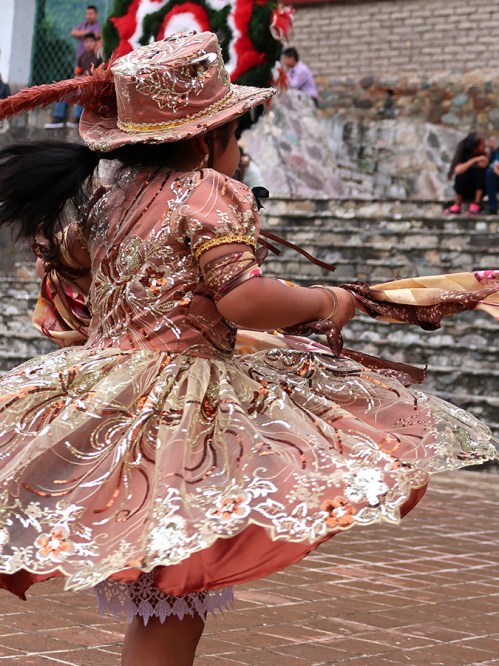
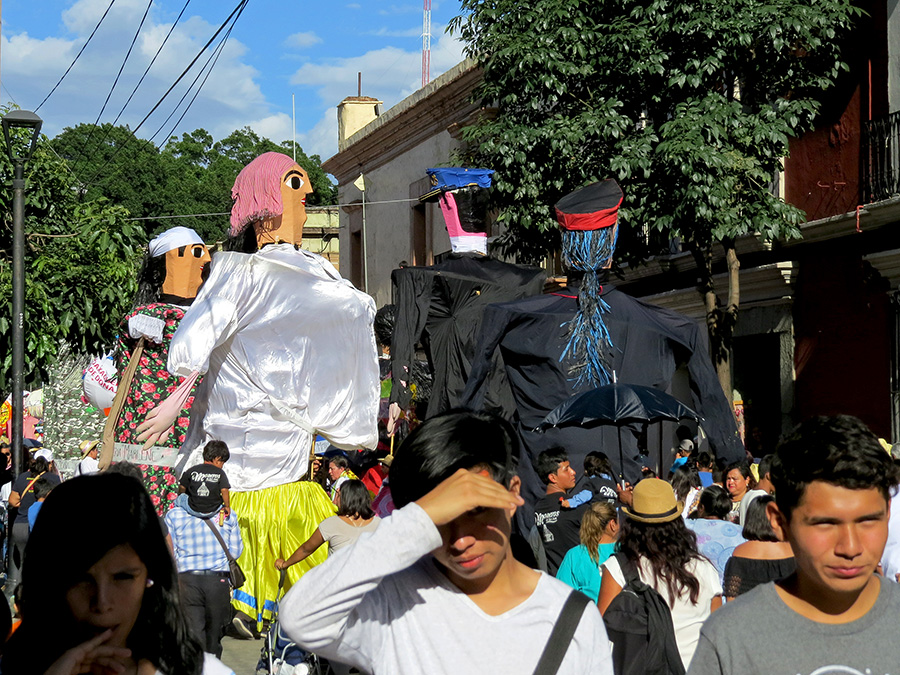
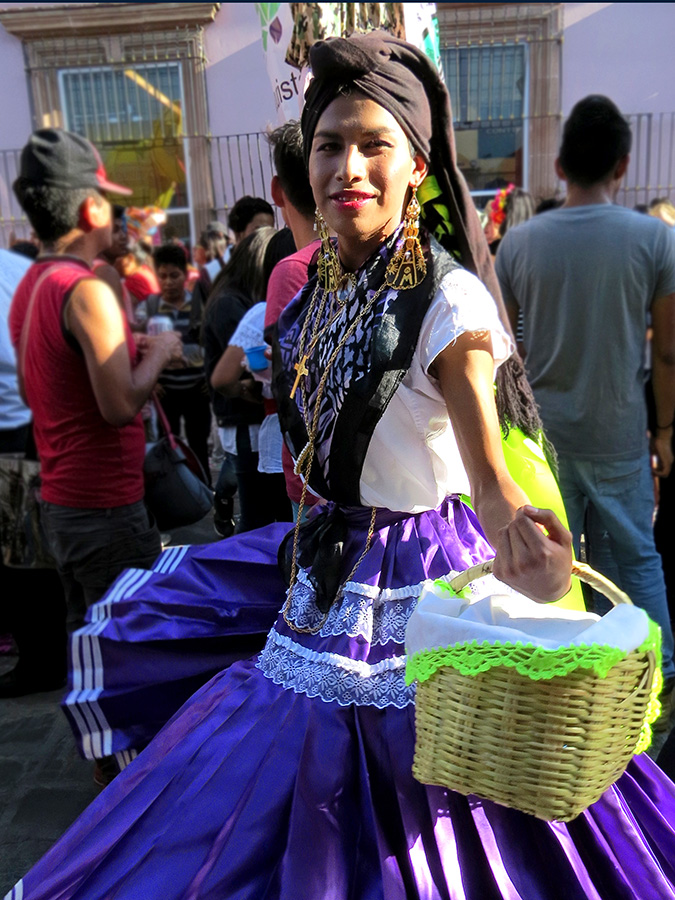
Today is the culmination of the ten days of festivities celebrating El Señor del Rayo — an only-in-Oaxaca observance.  Early Saturday evening, on my way to an event at the Museo Textil, I ran into a calenda (parade) of his.  I was going in the opposite direction and felt like I was swimming upstream.  What to do?  Stop, take a few photos, and enjoy the music and dancing until it passed by, of course!

El Señor del Rayo is a wood-carved Christ on the Cross figure that was brought from Spain in the 16th century, a gift to Oaxaca from Charles V.  The image was placed in the temple of San Juan de Dios, a church with adobe walls and a straw (or possibly wood) roof.  According to religious lore, lightning struck the church and everything was destroyed, save for this figurine.  A miracle!  The statue became known as El Señor del Rayo (the Lord of Lightning), was given his own chapel (the furthest capilla from the main entrance on the left) in the newly built Catedral de Nuestra Señora de la Asunción, and has been much venerated ever since.

El Señor has a body double as the original, given it’s importance and value, remains behind glass in his chapel (first photo above).  Today, the line of faithful waiting to worship him stretched into the aisle leading to his chapel.  Restoration work was done on his replica earlier this year, but it is back on the main altar and available to travel through the streets during this afternoon’s procession, along with the estandartes (religious banners) currently leaning up against the inner walls of the Cathedral.

Tonight, like all good Oaxaca celebrations, be they religious or secular, there will be pirotécnicos — fireworks and all things pyrotechnic, including a castillo.  For the uninitiated, a castillo is a multi-story erector set like structure with moving parts that is wired with colorful explosive charges.  Another noisy night in Oaxaca!

By the way, in previous years, the inside of the Cathedral was festooned from bottom to top with lilies — greeting all who enter with Divine beauty and fragrance.  However, this year there are many fewer floral decorations and no lilies.  I’m wondering if the lily-growing region was affected by the hurricanes and/or earthquakes….

Read Full Post »

Yesterday, after missing the Fiesta de la Natividad because I was in the middle of my 6-week cross-country sojourn in el norte, I managed (courtesy of blogger buddy Chris and his trusty VW Jetta) to make it out to Teotitlán del Valle for the last day of the Fiesta de La Virgen del Rosario and performance of the Danza de la Pluma.

IMG_0915

Sergio Gutiérrez Bautista (Moctezuma)

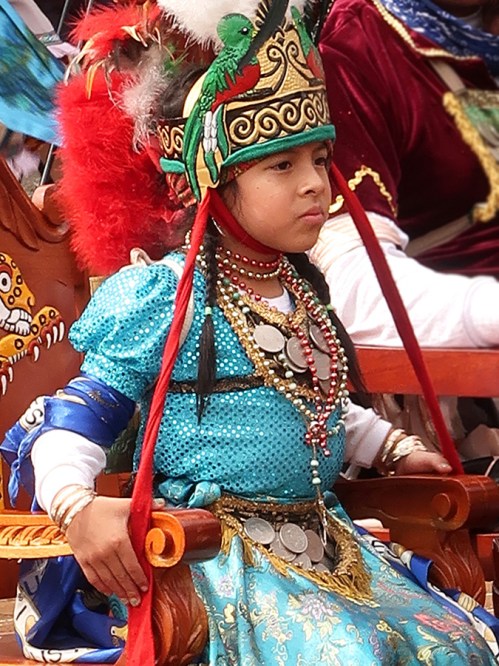
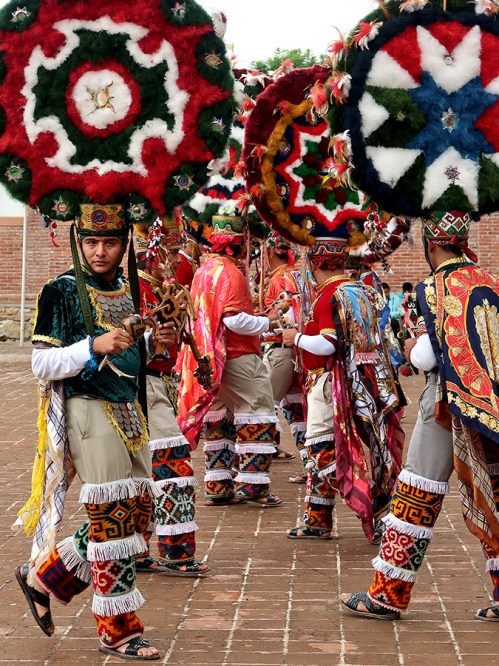
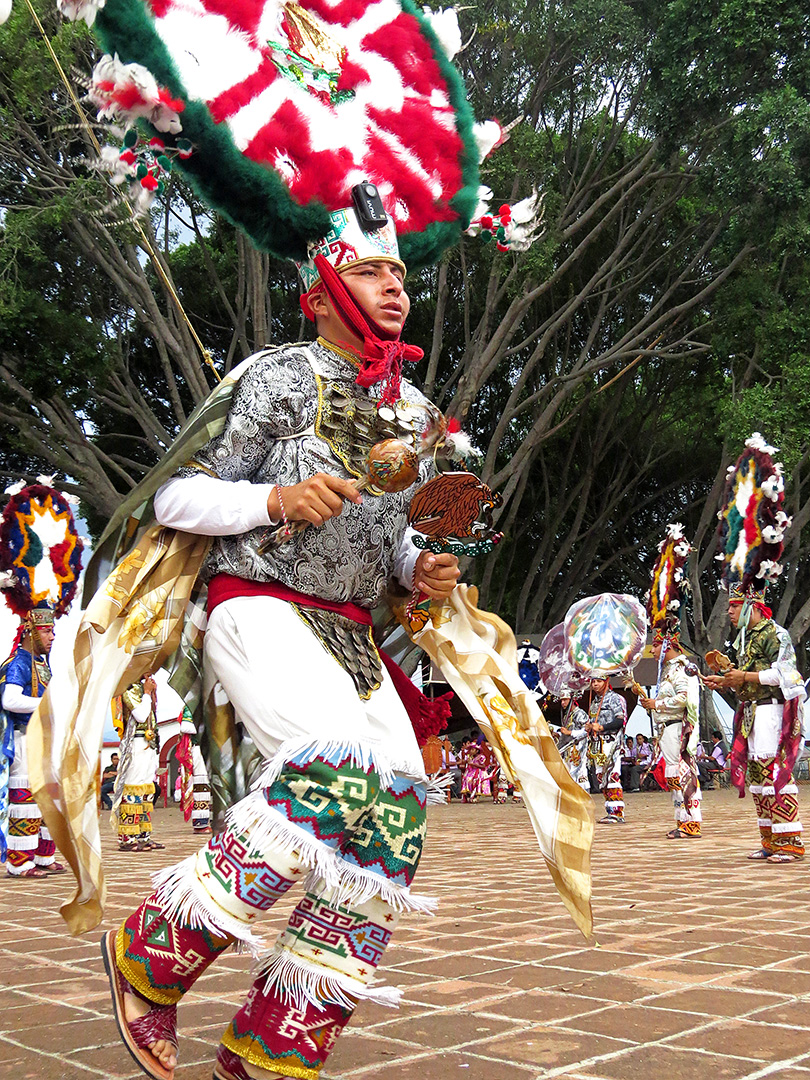
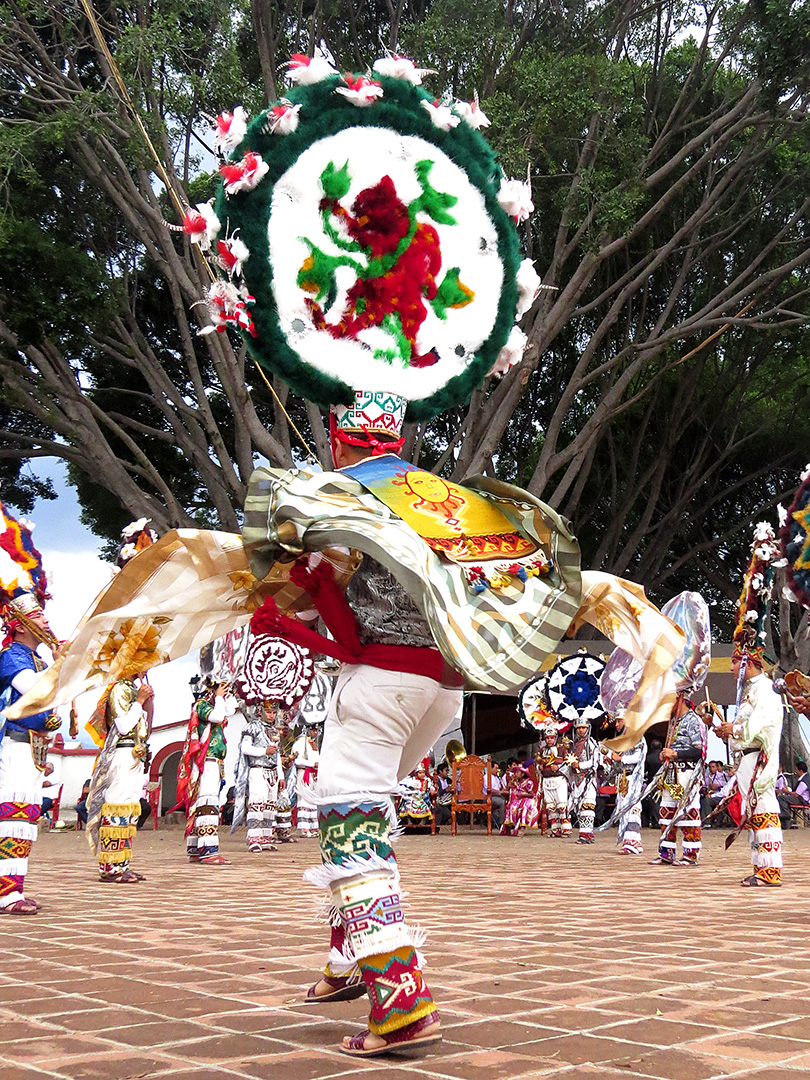
The dance is day-long and recreates the Spanish Conquest from the Zapotec point of view.

IMG_0968_copy

Quetzali del Rayo Santiago Ruiz (Malinche)

IMG_0804

Elizabeth Hernández Gutiérrez (Doña Marina)

Miracle of miracles, the rain held off, the clouds parted, and the sun made a much welcome appearance.

IMG_0905

IMG_0776

Foreground:  Marcos Vicente Gutiérrez (Capitán 1 ro.)

IMG_0876

Foreground:  Edgar Daniel Ruiz Ruiz (Vasallo 8vo.)

IMG_0906

As we approached the atrium of the Templo Preciosa Sangre de Cristo, the father of one of the Danzantes explained a venue change — due to some (hopefully) minimal earthquake damage to one of the bell towers of the church, the Danza de la Pluma was moved next door to the plaza in front of the municipal building.

IMG_0856

Juan Bautista Ruiz (Subalterno)

IMG_0811

Florentino Martínez Ruiz (Subalterno) and Señor Inocencio

A heartfelt muchisimas gracias to the people of Teotitlán del Valle, many of whom I am so lucky and grateful to call friends.  The warm welcome I received was such an incredible tonic to the grey days we have been experiencing in Oaxaca.

Save

Read Full Post »

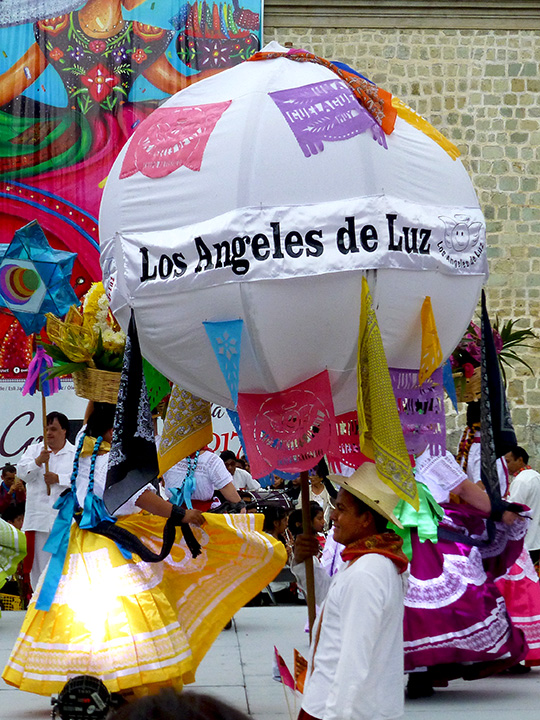
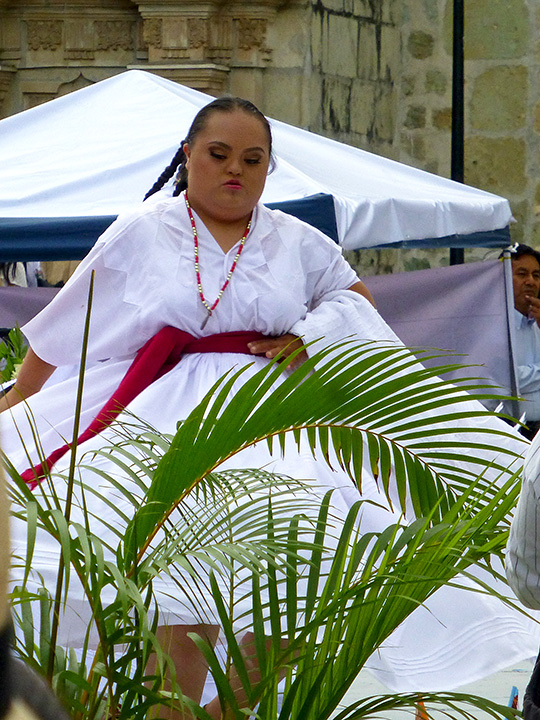
The Guelaguetza Muy Especial, danced by Los Ángeles de Luz, gets bigger every year.

Convite – China Oaxaqueñas, City of Oaxaca

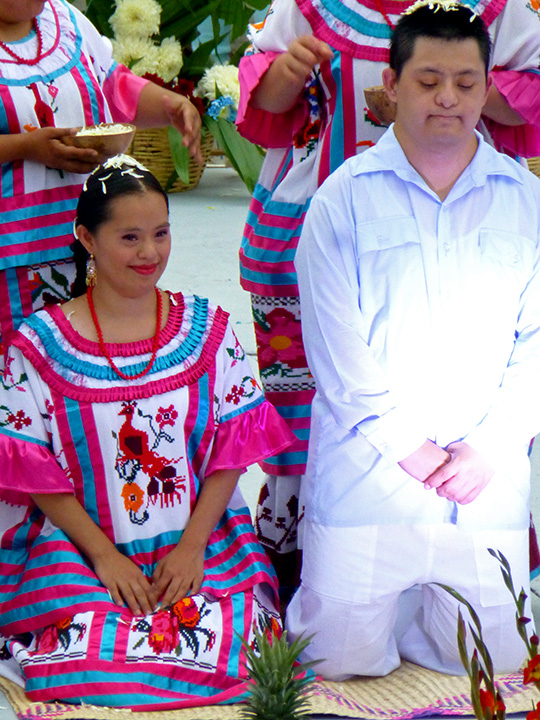
Early yesterday evening, all seating was filled and it was standing room only at the Plaza de la Danza — and that is a very good thing because Los Ángeles de Luz is group of 18 children and young people with Down’s Syndrome.

Jarabe – Ejutla de Crespo, Valles Centrales region

It was formed in 2003 with the purpose of facilitating the integration of people with Down’s syndrome and offering them creative experiences that exercise their motor skills, intelligence, language, and sensitivity in an environment of respect, trust, and love. (Ángeles le dan luz a las fiestas del Lunes del Cerro, 07/25/2016)

Jarabe – Tamazulapam Espiritu Santo, Mixe region

Their talents also extend to theatrical productions, including performances of “Snow White and the Seven Dwarfs” and “Romeo and Juliet.”  In addition, they have mounted an interdisciplinary spectacular, “Ellos le bailan a México, a un México muy especial.”

Wedding jarabe – Huautla de Jiménez, Cañada region

At the Guelaguetza Muy Especial, these young people make the requisite costume changes and perform traditional dances from the eight regions of Oaxaca.

Jarabe – San Melchor Betaza, Sierra Norte region

This year’s show brought Oaxaca’s dignitaries, including Diosa Centeotl, Rebeca Itahí Ortiz Santibañez — she looked incredibly moved when they performed dances from her town of San Melchor Betaza.

Rebeca Itahí Ortiz Santibañez – Diosa Centeotl 2017

As I have mentioned before, perhaps it is because I have a special needs nephew or that both my sister-in-law and daughter-in-law are special education teachers, that I am drawn to this event every year.

Jarabe – Pinotepa Nacional, Costa region

Tears always well up in my eyes as I share in the joy and pride exhibited by the dancers from Los Ángeles de Luz.

Read Full Post »

Another day, another parade.  Today, the Gran Calenda del Mercado de Abastos (parade of the markets) passed within a block and a half of Casita Colibrí.  I couldn’t miss it — the cacophony of multiple bands, cohetes (rockets), and honking horns announced its arrival in my ‘hood!  In the words of Octavio Paz, from The Labyrinth of Solitude

“The solitary Mexican loves fiestas and public gatherings.”

IMG_3690

“The art of the fiesta has been debased almost everywhere else, but not in Mexico.”

IMG_3707

“Our poverty can be measured by the frequency and luxuriousness of our holidays.”

IMG_3761

“Do they forget themselves and show their true faces?  Nobody knows.  The important thing is to go out, open a way, get drunk on noise, people, colors.”

IMG_3726

“In the confusion that it generates, society is dissolved, is drowned, insofar as it is an organism ruled according to certain laws and principles.”

IMG_3785

“Everything is united: good and evil, day and night, the sacred and the profane.  Everything merges, loses shape and individuality and returns to the primordial mass.”

IMG_3738

“The fiesta is a cosmic experiment, an experiment in disorder, reuniting contradictory elements and principles in order to bring about a renascence of life.”

Read Full Post »

Nuestra Señora de la Soledad is the patron saint, queen, and mother of Oaxaqueños — and she is my vecina (neighbor).  Thus, I shall not want for revelry!

Inside the Basílica, Soledad -- Dec. 17, 2016

“Inside” Soledad, in the Basílica — Dec. 17, 2016

Despite her name, there is no solitude for Soledad or her neighbors on her December 18 feast day  — or the days and nights leading up to it.  Like her sister December virgin images, Juquila and Guadalupe, she seems to thrive on the cacophony that is fiesta life here — after all they are Mexican Marías.

So, bandas playing traditional music (loudly), fireworks and rockets booming and banging, church bells urgently chiming, and lively recorridos (travels) through the streets of the city, beginning early in the morning and continuing well beyond midnight, are welcomed.

The celebrations began at 5:00 AM on December 7, with a ringing of church bells and a “dawn journey” and culminated with a grand fiesta yesterday, December 18, her feast day.  She seemed to enjoy the festivities, including these guys from the Istmo performing for her, *La Danza de los Negros.

Soledad’s fiesta will end tomorrow (Dec. 20) with a concert of Christmas carols at 7:00 PM.  It’s been great fun, but I’m already looking forward to Noche de Rabanos on December 23!

Outside Soledad in the Basílica courtyard - Dec. 18, 2016

“Outside” Soledad in the Basílica courtyard – Dec. 18, 2016

*La Danza de los Negros is another of those complex and multilayered dances traditional to specific indigenous cultures in Oaxaca.  For more information, check out the article (en español), Los Negros, tradición bixhahui, ícono de Chihuitán.

Save

Read Full Post »

Unlike last Saturday, there was no rain on yesterday’s Guelaguetza parade.  There was music, mezcal, and tepache. (Click on photos for full image.)

There were headdresses and bling.

There was awesome pride and joy.

And, there were kids to carry on the traditions.

Muchisimas gracias to the extended family of Hotel Casa Catrina who allowed me to seek shelter from last Monday’s rain and yesterday, saw me across the street and invited me for a shot of mezcal and to watch the desfile with them.  That’s Oaxaca — warm, welcoming, and wonderful!!!

Read Full Post »

Yesterday, two friends and I hailed a taxi and headed out of the city.  We disembarked at the Viguera crucero, where we crowded into blogger buddy Chris’s car enroute to the intimate Guelaguetza in Las Peñitas Reyes Etla.

The day was overcast and there were a few light sprinkles, but the welcome we received on this grey day warmed our hearts.

As they have in past years, for three and a half hours, the members of the folkloric dance group, Danza Balachi, danced, changed costumes, danced, changed costumes, and danced some more.

The sun eventually made an appearance and our day ended with very yummy estofado at our favorite restaurant, Comedor Colón in Villa de Etla.  It was a great day!

Read Full Post »

One of the much anticipated features of this year’s Fiesta Titlular a la Preciosa Sangre de Nuestro Señor Jesucristo in Teotitlán del Valle was the debut of the new Grupo de Danza de Pluma Promesa.

IMG_1307_copy

Danzantes

IMG_1447

Danzantes

Unlike in many of the other villages, where the Danza de la Pluma is danced by folkloric dance troupes, in Teotitlán del Valle nineteen young men and two little girls make a promise to their god and, thus, their community to learn and perform the dance at each of the four annual major religious festivals in the village for three years.

P1200147

Moctezuma with Malinche and Doña Marina

IMG_1387

Danzantes woven wool leggings

This is not a commitment to be taken lightly, as there are 40+ dances that comprise this Zapotec retelling of the story of Moctezuma and the Aztecs battle with Cortes and the Conquistadors.  The entire telling of the story takes almost eight hours to perform in the church plaza — in conditions that can vary from brilliant sun with sweltering temperatures to gusty winds to drizzling rain.

IMG_1379

Subalterno offering water

IMG_1360

Subalterno imitating the danzantes

It’s been almost six months since we first saw the new group at one of their early practice sessions.  In jeans, t-shirts, and gym shoes, the guys were at the beginning stages of learning the steps.

IMG_1308

Moctezuma, a danzante, and Doña Marina

IMG_1437_crop2

Moctezuma and the danzantes

They have learned well and it’s going to be an outstanding three years!


Read Full Post »

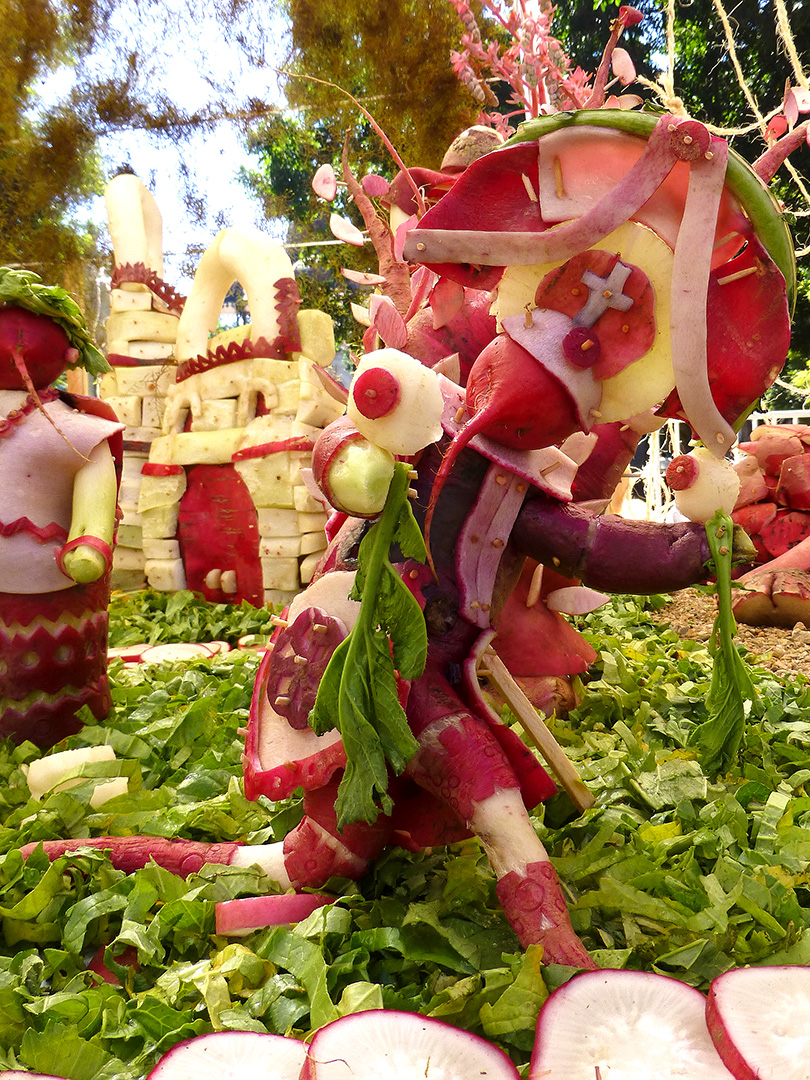
The “only in Oaxaca” Noche de Rábanos is coming!  If you are in Oaxaca, the zócalo is the place to be on December 23 to watch radishes being carved into familiar and fantastical creations.  Among the former, dancers from Oaxaca’s eight regions are a favorite.

Danza de la Pluma dancer in Rábanos Tradicional category 2012

Danza de la Pluma dancer in Rábanos Tradicional category 2012

Baile del Guajolote dancer in Rábanos Libre category 2013

Baile del Guajolote dancer in Rábanos Libre category 2013

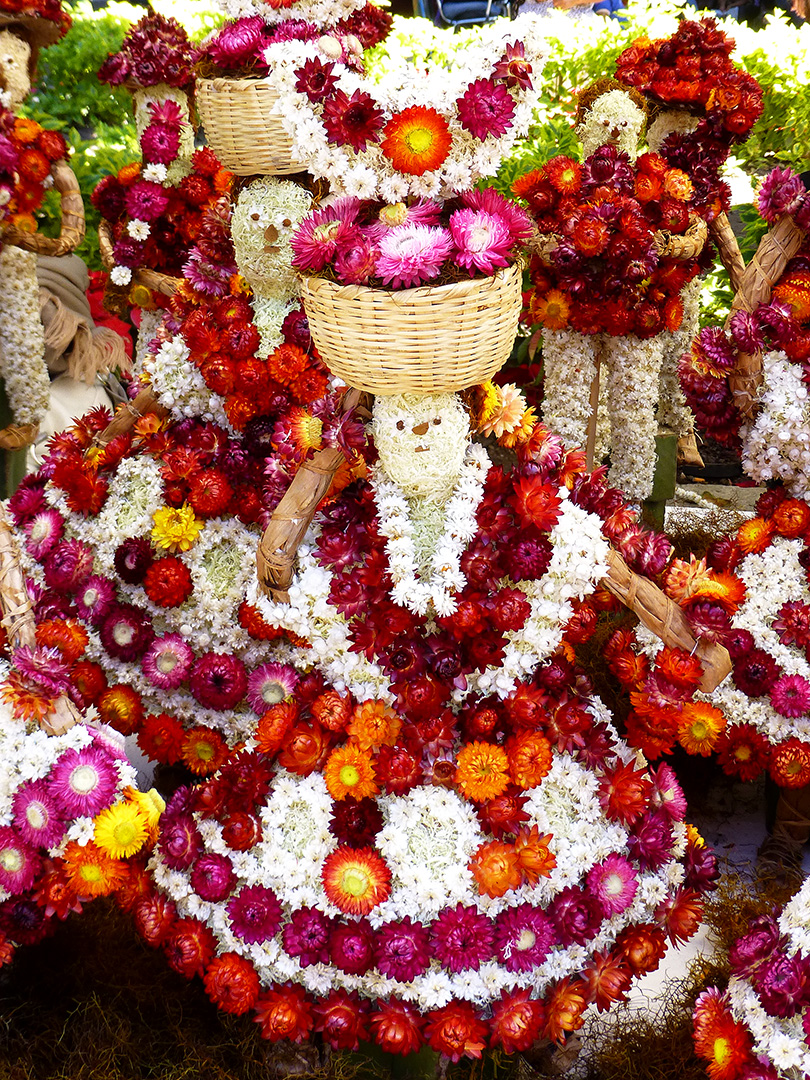
Despite of the name, it isn’t just about carved radishes.  The artists of Oaxaca work their creative magic in several other categories, including dried flowers…

Chinas Oaxaqueñas in Flor Inmortal category 2012

Chinas Oaxaqueñas in Flor Inmortal category 2012

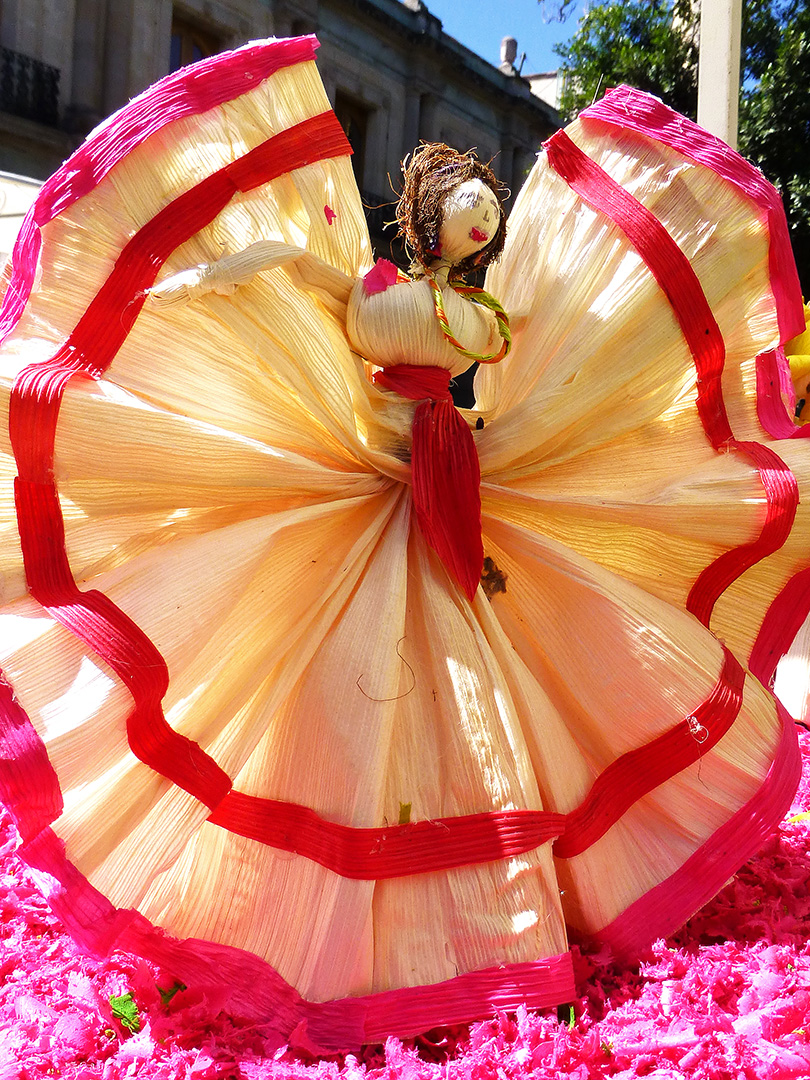
… and corn husks.

Chinas Oaxaqueñas entry in Totomoxtle Natural category 2012

Chinas Oaxaqueñas entry in Totomoxtle Natural category 2012

Jarabe Mixteco dancer in Totomoxtle Decorado category 2012

Jarabe Mixteco dancer in Totomoxtle Decorado category 2012

Danza de los Huenches Viejos de Yalalag in Totomoxtle Decorado category 2012

Danza de los Huenches Viejos de Yalalag in Totomoxtle Decorado category 2012

I wish I could be in two places at one time, so I could experience this year’s Night of the Radishes.  If you are lucky enough to be there, enjoy and take lots of photos!

Read Full Post »

Yesterday was SO much fun!!!  I’m spending Christmas with family in New York and was invited by my daughter-in-law to speak to her special education class. Wearing one of my huipiles from the Papaloapan region of Oaxaca, I filled them in on “life in Oaxaca.”

P1160001

We looked at a map of Mexico and I pointed to where the state of Oaxaca is located.

0_ Mexico map

We spoke a little Spanish and discovered that some familiar foods, like chocolate, gum (chicle), corn (maíz), and turkey (pavo), originated in Mexico.  They learned that there are many artisan crafts made in Oaxaca and I showed them a tapete (rug) that was woven in Teotitlán del Valle.

P1160003

We talked about festivals with processions, bands, marmotas, monos, and dancing.  And, to illustrate the diversity of the indigenous peoples of Oaxaca, I created a short video from La Guelaguetza 2014.

We discussed the differences between Christmas traditions in Mexico and the USA — that Christmas trees aren’t as common, but most everyone sets up a nacimiento (nativity scene) in their home.

8_Nacimiento P1040474

Of course, they loved the idea of breaking open a piñata filled with candy and trinkets.

P1150609

I concluded with a video I’d made and previously posted of the castillo in Teotitlán del Valle during the festival honoring the Virgen del Rosario.  Needless to say, they were awestruck by the fireworks.  And then I gave them each a woven palm leaf piñata ornament.  Alas, no candy inside!

P1160013crop

I was very touched that my daughter-in-law returned home later in the afternoon bringing individualized thank-you notes from the students.  However, I would like to give a big “muchisimas gracias” to her for inviting me and to her students for being such an attentive, engaged, and delightful audience!

Read Full Post »

After being rained out on Sunday, we picked ourselves and our rain gear up and returned to Teotitlán del Valle on Monday for the abbreviated version (4 hours instead of 8 hours) of the Danza de la Pluma — more of the multi-day fiesta honoring La Santísima Virgen María de la Natividad (the Sainted Virgin Mary of the Nativity).

As I’ve previously mentioned, the Danza de la Pluma is a ritual re-enactment of the Spanish conquest.  The full version is told in 41 bailes (dances) and lasts from early afternoon into the night.  It is danced by folkloric groups throughout the valley of Oaxaca.  However, in Teotitlán, Moctezuma, Danzantes, Subalternos, Malinche, and Doña Marina are selected years in advance and make a promise to the church and community to perform their roles for 3 years.  It is a great honor.

Malinche and Doña Marina

La Malinche (Juana Lizbeth Contreras Vicente), Doña Marina (Ailani Ruíz Ruíz), and Danzantes.

Moctezuma and the Danzantes.

Moctezuma (José Isaac Vasquez de Los Angeles) poised to dance the dance.

Moctezuma coming...

Moctezuma approaching… dancing the dance.

Moctezuma departing...

Moctezuma departing… dancing the dance.

Malinche (Juana Lizbeth Contreras Vicente) dancing the dance.

Malinche dancing the dance.

Doña Marina dancing the dance.

Doña Marina dancing the dance.

The Danzantes in action.

The Danzantes dancing the dance.

The rains came again and we missed the fireworks and castillo.  However, we are already plotting our return at the beginning of October for the Rosario de la Virgen María festival.

Read Full Post »

The Plaza de la Danza was filled with cheering crowds early Sunday evening as ten girls and eight boys from Los Ángeles de Luz took the stage for the 13th edition of this very special Guelaguetza.  Perhaps it is because I have a special needs nephew or that both my sister-in-law and daughter-in-law are special ed teachers that I am drawn to this event every year.  In any case, the joy and pride exhibited by these young people with Down’s Syndrome, as they make the requisite costume changes and perform traditional dances from the eight regions of Oaxaca, always lifts my heart.

I had to leave before it ended, but hopefully through this slideshow I can share a little of the professionalism and accomplishment of these performers and the emotion experienced by those of us who had the privilege of being in the audience.

This slideshow requires JavaScript.

President of Los Ángeles de Luz, Flor Verónica García Ávilan explained in El Imparcial, that the group was formed after “realizing that contact with music, dance, and the audience makes them happy, cheerful, communicative, committed and disciplined beings, facilitating their development holistically within society.” [translated from Spanish]

And, I would like to add, for those of us watching their performance, it facilitates our acceptance of those who many be a little different from us.  If you are in Oaxaca for next year’s Guelaguetza festivities, try to attend this heartwarming and uplifting event.  Also, there is always a calenda (parade) a couple of days before AND scrambling for gifts tossed into the crowd after each dance.

Read Full Post »

Last Saturday, in the end, it did not rain on the parade.  With only minutes to spare before the first desfile of the Guelaguetza delegations was to begin, the torrential downpour stopped, the rockets sounded, bands played, and the delegates danced their way down Independencia.  I can’t believe how UN-bedraggled and energetic they were!

This slideshow requires JavaScript.

Here’s hoping I managed to include one photo from each of the delegations in the slideshow above.

By the way, if you are in Oaxaca and planning to attend the second desfile tomorrow (July 25), see below for the parade route  — it has been changed!

Desfile2 ruta

Read Full Post »

Three weeks from today, despite the Never-ending tale of the velaria, the 83rd annual Guelaguetza performances on Cerro Fortín commence.  Yikes, was it really almost a year ago that one of my childhood BFFs and I walked up the hill to the auditorium to revel in the music, costumes, dances, view, fireworks, and all-around conviviality of festivities?  There is always so much going on during the last two weeks of July, that I only got around to posting a few photos from that evening.  Today, and for the following two Mondays, I’m going to attempt to remedy that.  Better late than never!

The delegation from the Cañada region of the state, Huautla de Jimenez, danced to Sones Mazatecos…
IMG_4701IMG_4707IMG_4708The dancers from Santiago Juxtlahuaca, in the Mixteca, performed the rip-roaring Danza de los Rubios…
IMG_4778P1010286IMG_4785And, from the Istmo de Tehuantepec region, the beautiful women and dashing men from Ixtepec presented Vela “Esmeralda”…
IMG_4717IMG_4724P1010283IMG_4759IMG_4761That’s all folks!  But, more to come next Monday.

Read Full Post »

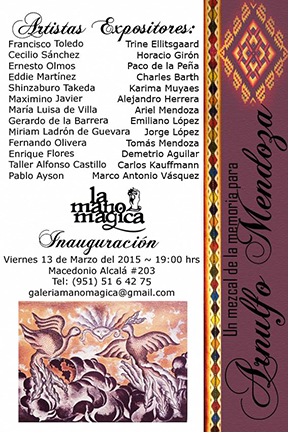
It’s been one year since the passing of maestro Arnulfo Mendoza Ruíz.

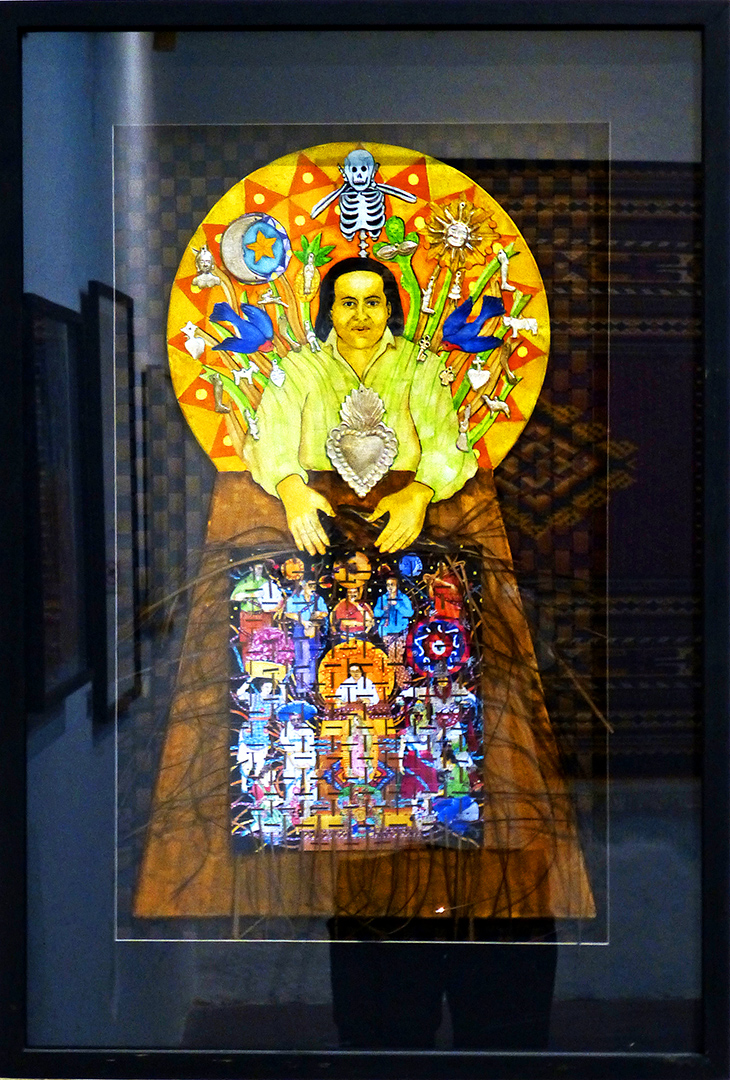
Tejedor de los sueños by Charles Barth

Tejedor de los sueños by Charles Barth (alas, with reflections from other pieces)

To honor his life, an exhibit of works by his friends, colleagues, and family was inaugurated at La Mano Mágica on March 13, 2015.

ManoMagica exhibit

His older son, Gabriel Mendoza Gagnier, curated this amazing collection of paintings, weaving, and artesanía.

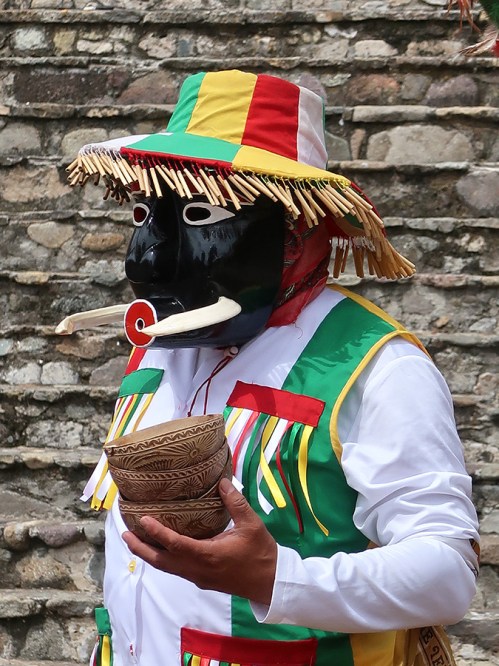
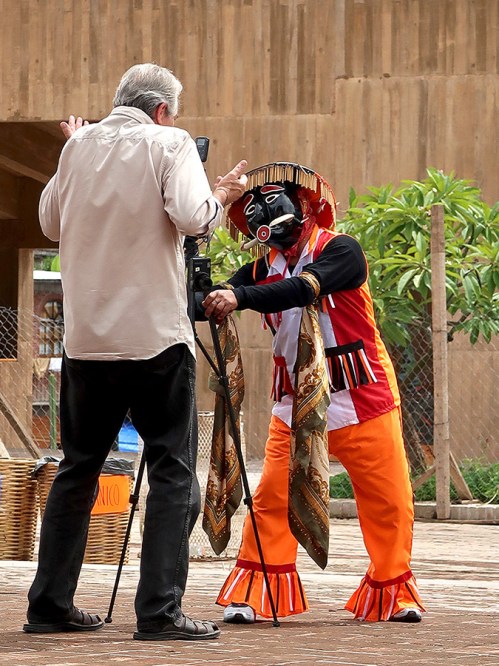
Assisted by Arnulfo’s companion, Yukiko, the opening featured, not only amazing art, but also mezcal, tamales, and surprise entertainment by Carnaval dancers from San Martín Tilcajete, wearing masks carved by some of the well-known carvers from the village, including Inocenio Vásquez and Jésus Sosa Calvo.

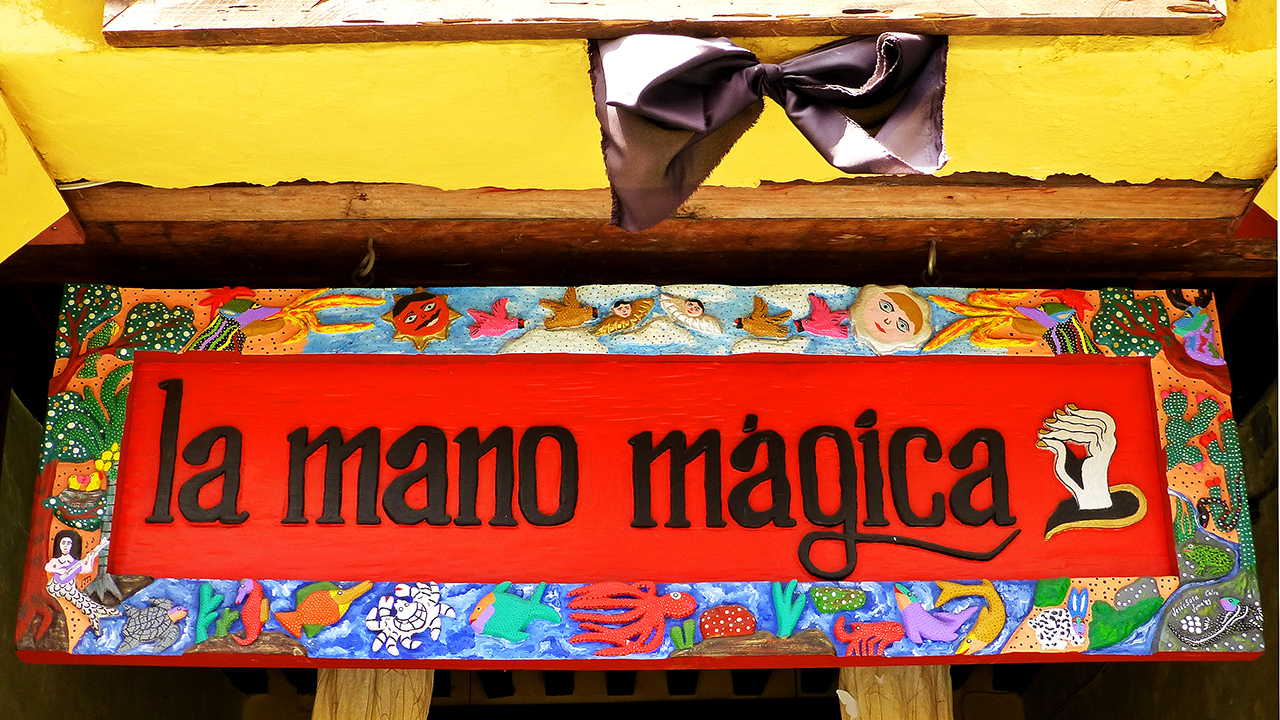
Jésus Sosa Calvo had carved the signature entry sign for La Mano Mágica and recently, unasked, came by to freshen up the paint that had faded over the years under the intense Oaxaca sun.

P1070473

While, in the words of Manuel Matus Manzo,  Arnulfo Mendoza may have gone on “to meet the Jaguar and the god Murcielago,” the dreams of his magical hands remain.

Finally, this beautiful poem by Alberto Blanco from the exhibit’s catalog…

Mitades a Arnulfo

I
La mitad de la tierra
no sueña con la luna.
La mitad de la luna
no sueña con el sol.

Si la luna es la trama,
y si el sol es la urdimbre,
esa tierra es la tela
donde acaso se vive.

II
La vida es la comedia
ya la muerte es el drama,
pero el textil de siempre
es la urdimbre y la trama.

La mitad de la vida,
la mitad de la muerte:
una tela tejida
con un hilo de suerte.


Read Full Post »

« Newer Posts - Older Posts »