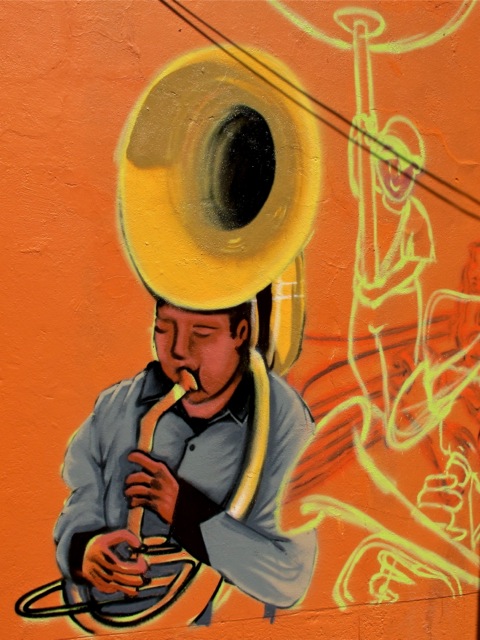
Every time I pass by the turnoff to Tlacolula de Matamoros, I break into song, “Be-bop-a-lula, she’s my baby.” And, seeing this guy on the front of a building on one of the town’s main streets only contributes to channeling Gene Vincent.
I was last there early this month for the first Festival de la Nieve, Mezcal y Vinagre. Ice cream, mezcal, and fruit and veggies in vinegar… what’s not to like?
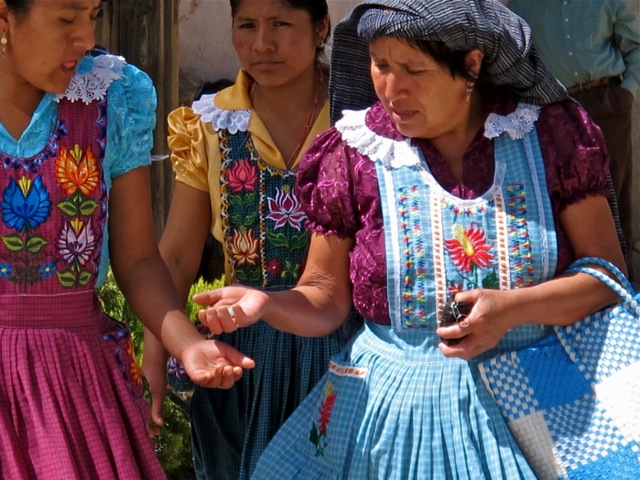
And then there is the weekly Sunday tianguis (market), where women in colorfully embroidered cotton aprons over tightly pleated polyester brocade skirts (where did that style come from?) buy and sell everything under the sun.
Today is Oaxaca’s 480th birthday as a colonial city . Of course, among other events, a calenda (parade) marked the date.
This slideshow requires JavaScript.
In 1532 Spanish settlers (their bloody way paved by Hernán Cortés and his conquistadores) successfully petitioned the Queen of Spain for a land grant of 1 square league. The colonists had already established their own town on the site of Huaxyacac, renamed it Antequera (after an old Roman city in Spain) and received a Royal Charter from King Charles I of Spain.
However, Cortés had successfully gotten the entire Valley of Oaxaca (hundreds of thousands of acres) declared as his own private marquisate and, his greed knowing no bounds, kept trying to evict the colonial townspeople. By obtaining the queen’s charter, this end-run around Cortés insured the rights of the townspeople to the land.
Thus, April 25th continues to be celebrated as Oaxaca’s birthday. ¡Feliz Cumpleaños!
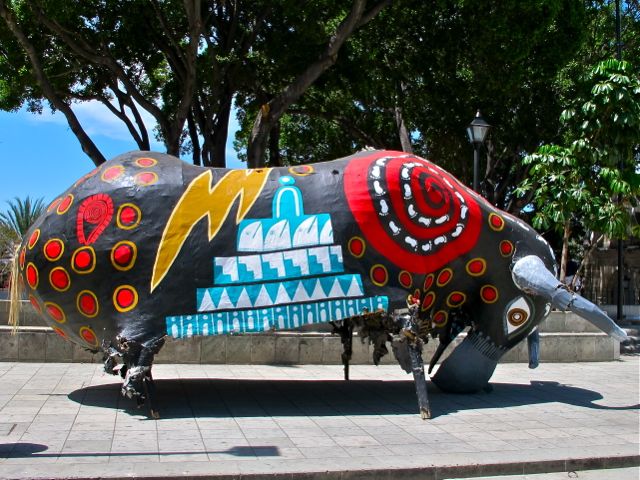
Corrida de Toros, as it is known in Mexico, was outlawed by, then governor of Oaxaca, Benito Juárez. The ban was instituted throughout Mexico in 1867 by Juárez during his presidency. Some say it was to “civilize” Mexico, but others contend it was for nationalistic reasons, as bullfighting had been a legacy of the Spanish conquest. I tend to think the latter tipped the scales.
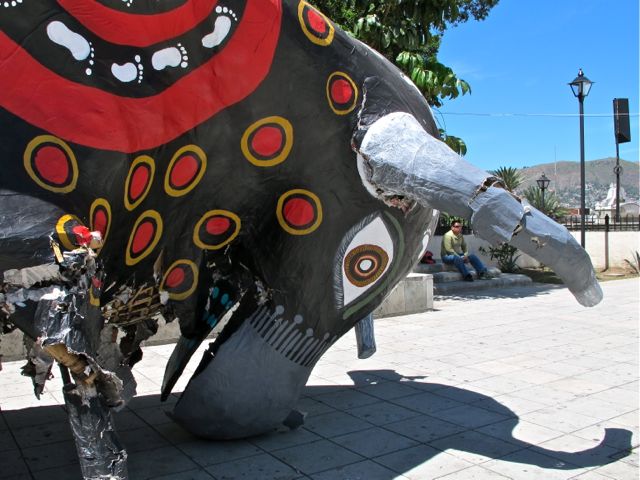
However, Porfirio Díaz reinstated it during his presidency, but the ban remained in Oaxaca in honor of her favorite son. And thus, on the Plaza de la Danza, we have only a paper mache bull ready to charge at his shadow…
and serve as a canvas for imagery, ancient and contemporary.
Friday was a delightful day… a late morning and early afternoon spent in leisurely conversation with one of my closest friends over desayuno at Cocina Economica Isabel, a stop at the Merced mercado to pick up some pan dulce, and a stroll through the Zócalo, before returning home. I envisioned a late afternoon and evening of visiting with my neighbor before she is heads north for a USA visit, catching up on email, and watching a movie. Perfection, I thought! Who could ask for more?
“More” came via my email inbox; notice of the 10th Guelaguetza Infantil, with a calenda (parade) from Santo Domingo de Guzmán to the Zócalo beginning at 6 PM. This definitely called for a change of plans! And, sure enough, as I got closer to Santo Domingo, there they were; delegations of children representing the regions of Oaxaca.
Istmo de Tehuantepec couple (a young Frida Kahlo, perhaps?) posing for photos.
There were several bands playing and it got a little too loud for this girl from the Istmo.
However this girl, representing the Papaloapan, didn’t seem to mind and was ready to toss candy to the crowd. She wasn’t alone — once the calenda started, candy began flying fast and furious and the pockets of the kids watching on the sidelines began bulging!
Girls from the Costa region received last-minute instructions.
Costa boys were charged with holding up their school banner.
The girls representing the Papaloapan clutched plastic pineapples, ready for the always popular Flor de Piña dance from Tuxtepec.
A little cross cultural comparing of notes (actually, cell phone games) was happening between the Istmo and Papaloapan.
All the while, the dancers from the Mixteca danced their way down the Álcala.
And, the young Danza de la Pluma danzantes, representing the Valles Centrales, carefully balanced their penachos (headdresses).
Tonight at 5 pm, these 300 kids from 52 preschools, will perform traditional regional dances in the auditorium of the Universidad Regional del Sureste, Rosario campus in San Sebastián Tutla.
Hip hop is probably not the first thing that pops to mind when you think of Oaxaca. However, I can assure you, there is more to Oaxaca than colonial architecture, religious processions, colorful traje (costume), and traditional music. As repeated blockades and occupations attest, and the El Silencio Mata posters illustrate, there are voices struggling to be heard.
For one of those voices, check out this trailer from the documentary film, Cuando Una Mujer Avanza (When a Woman Takes a Step Forward), about “Mare” a young Zapotec hip hop artist from Oaxaca. As the promo states, her unique life experience is a rarely heard perspective on life and community liberation. As an up and coming MC in a state known for popular and indigenous rebellion, Mare’s life and experience has been channeled into very powerful and conscious rapping and singing.
It’s been a week since the end of Semana Santa and I’m still sorting through photos and videos and reflecting on impressions and feelings. However, I’m finding that, with too much thinking, the experience slips through the fingers and the magic vanishes.
Thus, I give you the night of Pascuas (Easter) at Carmen Alto…
And then, the hisses, bangs, and brilliant explosions of a castillo…
I’m from the cradle of modern mountain biking; Marin County, California. In fact, it has become so popular in Marin over the past 30+ years, traffic jams have ensued at trail heads and battles between hikers, horseback riders, and mountain bikers over safety and environmental issues frequently make the headlines of local papers.
With this recent article in the Wall Street Journal, it looks like mountain biking has “officially” come to Oaxaca. I’m keeping my fingers crossed that the wise Zapotec elders up in Oaxaca’s Sierra Norte will find a way to keep the peace. And, more than that, I’m hoping all you mountain bikers out there will be respectful of this beautiful land and her people.
From Friday, April 13, 2012 online Wall Street Journal…
Mountain biking on the Tequila Trail near Oaxaca, Mexico – Trevor Clark
IT WAS EARLY. Hours from sunrise kind of early. My wimpy headlamp struggled to break through the predawn drizzle, and I could barely see my front tire or the trail ahead. Roots, rocks and stumps all seemed to be in cahoots, working together to upend me.
WHEEL WORLD | Riding out of the village of Benito Juárez in Oaxaca – Trevor Clark
I tried to become one with the bike. I tried to feel out the trail with my other senses. I tried to anticipate obstacles, but I am no Zen master. My mountain biking skills are rough under the best conditions, and I was in the jungle in the dark.
My mate’s more powerful headlamp suddenly provided a snapshot of a sharp turn and a wooden footbridge ahead. Then, lights out. I made an educated guess, went straight and took a hit that emptied my lungs: “Huhhhhh!” Cold water rushed into my clothes and pack as I lay in the stream, bike still on my feet, straight up in the air.
For a few moments, I laughed hysterically at my predicament and the fact that I was OK after missing the bridge. Then I picked myself up and kept moving.
We made it to the peak of Piedra Larga, a 10,761-foot-high lookout, for breakfast, corn-based hot chocolate and sunrise. As the sun slowly emerged from a thick layer of fog, we found ourselves hovering above a golden sea of clouds. The scenery was worth every blind pedal stroke.
HIGH ROAD | Taking in the view from a rock spire in the Sierra Norte – Trevor Clark
Seven of us had come to the Sierra Norte of Oaxaca, Mexico, a forested mountain range in the northern part of the state. Oaxaca is known as the country’s culinary and cultural center, and many visitors experience it through cooking classes and gallery walks in the capital city. We, instead, were mountain-biking part of an ancient Zapotec network of walking trails that have connected eight villages to each other and the rest of the world for eons.
Mountain biking is fairly new to Mexico…. [Read FULL ARTICLE]
This morning, I was awakened from a sound sleep by the insistent siren and recorded voice alerting the neighborhood of an impending earthquake. I bolted upright, moved to the side of the bed and slipped on my flip-flops — ready to head out the door if shaking commenced. As I’ve mentioned before, I think Mexico’s Earthquake Warning System is terrific and something the US should emulate.
However, this time, no rocking and rolling occurred, but I was left wide awake and wondering if and where an earthquake had occurred. So I pulled out my iPod Touch and opened my iEarthquake app and found that at 5:10 this morning, there was a magnitude 5.7 earthquake about 105 miles WSW from the city of Oaxaca in the mountains near the coast. The epicenter was 6.2 miles northwest of Pinotepa Nacional, in the Costa region of the state of Oaxaca.
So, I decided to use this event for a geography lesson. The state of Oaxaca has 8 regions (it used to be 7, but not too long ago the Sierra Region was split into two):
These regions are home to 14 distinct ethno linguistic groups and the regions vary dramatically in topography, vegetation, and climate. One can catch a glimpse of the unique costumes, dances, and dancers of each region during the Guelaguetza celebration in Oaxaca in July. The city of Oaxaca is located in the Valles Centrales (“Centro” on the map below).
Map from Wikipedia
For a painless way to learn more about the geography of Mexico, you might want to take a look at the Mexican States games.
Hurray for libraries and librarians everywhere! Just like Oaxaca, you never know what you will find when you turn a corner in a library or archive. And, whether it’s wandering the streets or roaming the aisles, we can’t help but learn a little more about our world and ourselves. We need more occasions for big, goofy smiles. Don’t let your community cut funding to libraries! –spixl
Laura Matthew on the secret life of primary sources and the responsibility historians have to them, and to each other, when documenting the past.
I have been thinking about how documents are lost, then found.
A week or so ago, my friend and colleague Aims McGuiness from the History department at the University of Wisconsin, Milwaukee (UWM) left me a voice mail message. “There’s this mysterious document at the American Geographical Society Library here at UWM,” he said. “It looks colonial-era, and maybe Mexican. The librarians don’t know what it is, or how they got it. Could you come look at it?”
“Ooh, fun!” I emailed him back (yes, that’s a direct quote). “I can always make time for a lost document.”
Little did I know. A few days later, Jovanka Ristic and Kay Guilden at the AGS Library unrolled in front of me a piece of bark paper on…
The back of the official 26th anniversary t-shirt for the Good Friday, Procesión del Silencio, doesn’t come close to telling the tale.
Images of belief add texture to the ritual procession of mourners grieving the crucifixion and death of Jesus, as related in the New Testament of the Christian Bible.
But it’s the eyes of believers…
that gives the narrative a silent voice.
And, grieving mothers everywhere understand.
No matter where one lands on the belief continuum, it’s hard not to be moved.
The following article is part of the cover story project in the April 9 issue of The Christian Science MonitorWeekly magazine. It’s long, but I encourage you to click on it and read the full article.
Tiny Tamaula is the new face of rural Mexico: Villagers are home again as the illegal immigration boom drops to net zero
By Sara Miller Llana, Staff writer / April 8, 2012
Tamaula, Mexico – At this time of year in this tiny rural outpost that sits on a mountainside in Guanajuato State, most able-bodied men are gone. They’re off plucking and cutting chicken in processing plants in Georgia or pruning the backyards of Seattle.
But this year, Pedro Laguna and his wife, Silvia Arellano, are clearing rocks from their yard to prepare a field for corn. They’ve returned home to Tamaula, Mexico, with their four young children, after 20 years in the United States working illegally. Pedro’s cousin Jorge Laguna and his brothers are planting garbanzo beans in the plot behind their father’s home. Their next-door neighbor Gregorio Zambrano is also home: One recent morning he badgered a visiting social worker for funds to start a honey=production enterprise.
Since the Monitor last visited here in 2007, a major demographic shift has transformed this dusty village of 230. Migrants have come home, and with them have come other important changes. In 2007, there was no running water, no high school, no paved roads. A simple water pipeline, installed in February, runs to each of the 50-some homes. On a recent day the first high school class, including eight students ages 15 to 40, was finishing up math homework. And now, the main roads are paved.
“We can turn on the water and wash our clothes,” says Pedro’s uncle, Rodolfo Laguna, who spent 12 years working illegally in a chicken plant in Athens, Ga., before returning home in 2010 after both he and his son lost their jobs.
This is the new face of rural Mexico. Villages emptied out in the 1980s and ’90s in one of the largest waves of migration in history. Today there are clear signs that a human tide is returning to towns both small and large across Mexico.
One million Mexicans said they returned from the US between 2005 and 2010, according to a new dem-ographic study of Mexican census data. That’s three times the number who said they’d returned in the previous five-year period.
And they aren’t just home for a visit: One prominent sociologist in the US has counted “net zero” migration for the first time since the 1960s.
Experts say the implications for both nations are enormous – from the draining of a labor pool in the US to the need for a radical shift in policies in Mexico, which has long depended on the billions of dollars in migrant remittances as a social welfare cornerstone.
“The massive return of migrants will have implications at the micro and macro economic levels and will have consequences for the social fabric … especially for the structure of the Mexican family,” says Rodolfo Casillas, a migration expert at the Latin American School of Social Sciences in Mexico City. [Read full article]
In front of Preciosa Sangre de Cristo Templo on Viernes Santo (Good Friday), waiting for the Procesión del Silencio (Procession of Silence) to set off up the Álcala, down Garcia Vigil, and back up the Álcala to Sangre de Cristo.
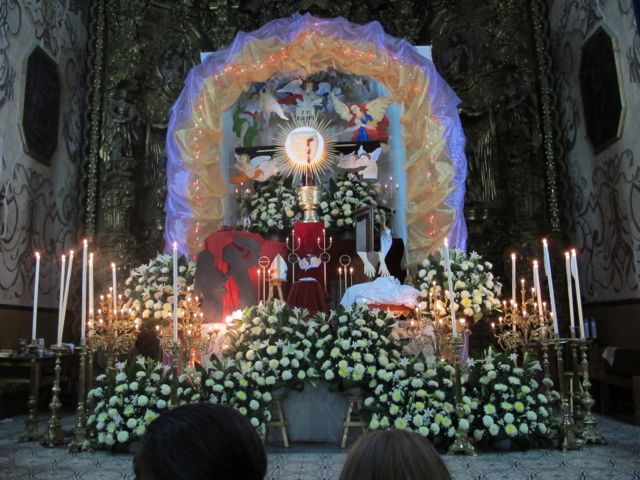
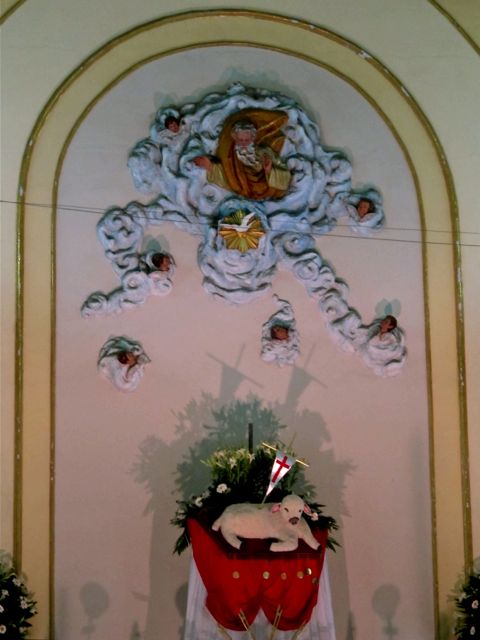
and clutching our “pan bendito” (blessed bread), we began our pilgrimage. Jueves Santo (Holy/Maundy Thursday) tradition calls for visiting 7 churches (la visita de las siete casas) in the city with one’s pan bendito, which must be kept to offer to guests, should any grace our doorstep. This all relates back to Jesus’s Last Supper, which this date commemorates.
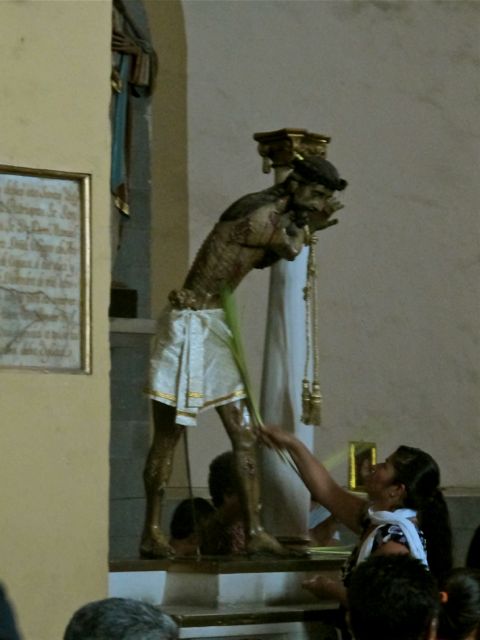
First stop was the nearby Templo de San José, where palm fronds were also distributed and believers used them to brush up and down the statue of Jesus. Hands also ran down his legs and then were used to touch one’s face.
After emerging from the side door of the jam-packed church, we set off for Templo de San Felipe Neri (whose picturesque dome can be seen (left of center) on my blog banner-head).
followed by the far right side chapel of the La Catedral de Nuestra Señora de la Asunción. A plaque at the entrance of the chapel read, “El maestro esta aqui y te llama” (The teacher is here and calls you) and the multitude seemed to be heeding the call.
We changed direction and headed north up the Álcala. Big mistake! A mosh pit (Chris, this WAS a mosh pit) surrounding a Tuna band that was playing in the middle of the street, causing gridlock and bringing us to an abrupt stop. Eventually, following our blocker (my son, the lineman would be proud), we eventually found light and continued up to Preciosa Sangre de Cristo Templo, where we had earlier spent 1-1/2 hours (and it was still going on when we left!) at a mass where the priest reenacted Jesus washing the feet of his disciples at the Last Supper.
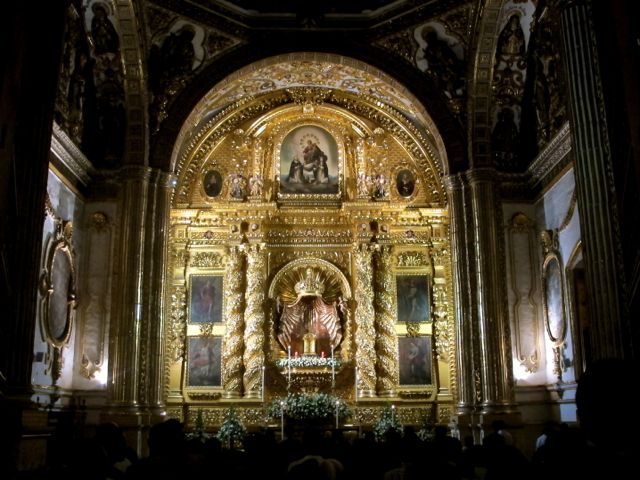
Strolling across the Álcala to Santo Domingo was much less challenging. The aisle to Santo Domingo’s main altar was blocked and we were routed to a side chapel. Hurray, we did it — this made seven churches visited!
However, though bleary-eyed (as evidenced by the photo below), we opted for just one more, Carmen Alto.
Home beckoned… and sleep came easily under the watch of the moon, now appropriately encircled by a halo.






![[mexbike]](https://i0.wp.com/si.wsj.net/public/resources/images/OD-AQ543A_mexbi_G_20120412220756.jpg)







 Mexican Peso Converter

 View From Casita Colibrí