Feeds:
Posts
Comments

A Mexican Spring?

Felipe Calderón’s 6-year term as president of Mexico is coming to a close and running for a second term is prohibited.   Campaigning is limited to the 3-month period immediately prior to the upcoming July 1 election day.  (USA, doesn’t that sound great?!!)  It had a boring “business as usual” beginning.  However, the new student-led, “Yo Soy 132” movement has livened things up beyond all expectations.  It is already being likened to  the Occupy Wall Street movement and the early days of the “Arab Spring” uprisings.

First, the cast of presidential candidates:

  • Andrés Manuel López Obrador from the PRD (Party of the Democratic Revolution).  Popular former mayor of Mexico City, favorite of the Left, and thought by many to have been the legitimate winner of the last presidential election.
  • Enrique Peña Nieto – PRI (Institutional Revolutionary Party).  Former governor of the State of Mexico and candidate of the party that ruled Mexico with an iron fist for 71 years.  He is married to a popular telenovela actress and has the support of the right-wing, PVEM (Green Party).
  • Josefina Vázquez Mota – PAN (National Action Party).  Former member of the federal House of Deputies.  She’s currently running 3rd in the poling, tarnished by the violence and failure of Calderón’s drug war.
  • Gabriel Quadri de la Torre – PANAL (New Alliance Party).   Former advisor of the National Institute of Ecology and former chief of the External Financing sector in the Bank of Mexico.  He has the support of the extremely powerful (and many say, corrupt) head of the teacher’s union, Elba Esther Gordillo.

Next, what’s it all about?

A Mexican Spring Begins to Blossom

Marta Molina
Waging Nonviolence / News Report
Published: Tuesday 29 May 2012

“They are party-less but not apolitical. The supposed apathy and individualism by which the Mexican youth have been characterized has been disproved on the streets and on the web.”

In Mexico City’s daily life — in the shops, taxicabs, cafes and lines waiting for the bus — one could hear conversations between people of all ages saying Enrique Peña Nieto would, without a doubt, win the presidential elections. “Either something huge will happen,” a taxi driver told me, “or he will win.” And when people referred to “something huge happening,” they were referring to violence, or some unbearable crisis.

But it hasn’t happened like that. Far from anything originally expected, it is the Mexican youth and university students who are doing “something huge.” They have altered the political agenda in the country to prove that no one wins an election until the election itself.

The gathering began on May 23 at the Estela de Luz, or Pillar of Light — a monument that has caused much controversy due to the billions of pesos the government invested in its construction. The students appropriated this symbol of corruption to illuminate it with their democratic demands in a key pre-electoral moment.

… In the end, twenty thousand students from different universities, public and private, marched for four hours along the main avenues of Mexico City. The protests that followed have sparked talk of a “Mexican Spring,” making reference to the uprisings that began in North Africa at the end of 2010.  [Full article]

###

Student Movement Dubbed the ‘Mexican Spring’

Allison Kilkenny on May 29, 2012 – 9:34 AM ET


A university student holds the Mexican flag during a protest against Enrique Peña Nieto, presidential candidate of the opposition Institutional Revolutionary Party (PRI), and to demand balance in the media coverage of the presidential race in Mexico City May 28, 2012. The “YoSoy132” movement was organized by students to create awareness of Mexico’s current political situation and media censorship, local media reported. Reuters/Edgard Garrido

A coalition of thousands of mainly university students, unionized workers, and farmers in Mexico City have taken to the streets to demand greater freedom of speech and also to protest the possible return of power by the Institutional Revolutionary Party (PRI).

One banner read, “I have a brain, I won’t vote for the PRI.”

<snip>

Dubbed the “Yo Soy 132” movement (Twitter users can follow protest updates by searching #YoSoy132), or the “Mexican Spring” by observers, this latest wave of protests marks the third large student demonstration in less than a week.

The name “I Am 132” symbolizes the continuation of the original demonstration by 131 students during Peña Nieto’s visit to the Jesuit-run Ibero-American University (UIA).

New America Media:

“Our main goal is to seek greater democracy within Mexican media,” said fellow activist, Rodrigo Serrano.

The name, “YoSoy132” alludes to a group of students from the Universidad Iberamericana, who heckled PRI presidential candidate Enrique Peña Nieto during a recent visit to the university that chased him off the premises.

After the incident, PRI leaders accused the Iberoamericana students of being intolerant, inconsiderate “stooges” paid to protest against Peña Nieto by the leftist PRD party.

Students claim their heckling of Peña Nieto was a grassroots event, uninspired or funded by any political party.

In particular, students have expressed frustration with the “monopolization” of Mexican politics and media. The example New America Media provides is a company named Televisa, which along with TV Azteca, controls 95 percent of Mexico’s TV market.

Similarly, students believe PRI has a monopoly of sorts on Mexican politics. The party has ruled Mexico unchallenged for seven decades, and has a very good shot of winning the July 1 elections.  [Full article with video]

###

And, lastly (for now)…

On May 26, the students of Oaxaca met in the courtyard of Santo Domingo de Guzmán to join the national effort, forming  Yo Soy 132 Oaxaca

And, of course, a Facebook page has been set up.   This is getting interesting.  Vamos a ver…
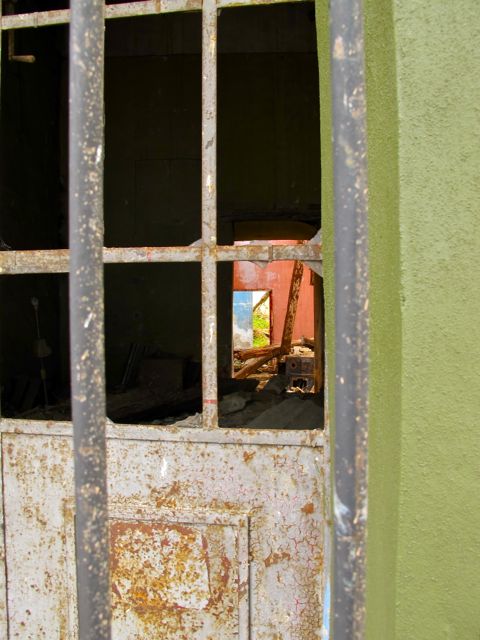
It may look like a dilapidated building on the outside, but you never know what lies behind those walls.

Sometimes, when the timing is right the massive iron gates are opened to let the residents pass in or out, one catches a glimpse of a courtyard filled with lush tropical plants, splashes of bright colors, a stone pathway winding its way through a garden, and often a burbling fountain to block the sounds of the city.

Other times, what lies beyond, is nothing more than as advertised! But, beautiful in its own way…

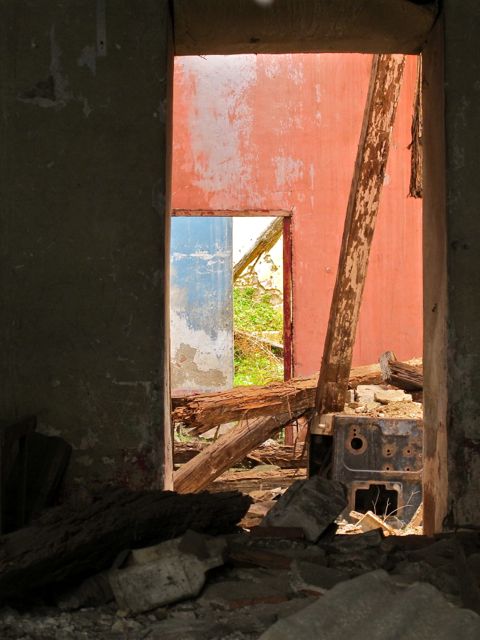
Rubble behind broken window

Closer view of rubble in room beyond

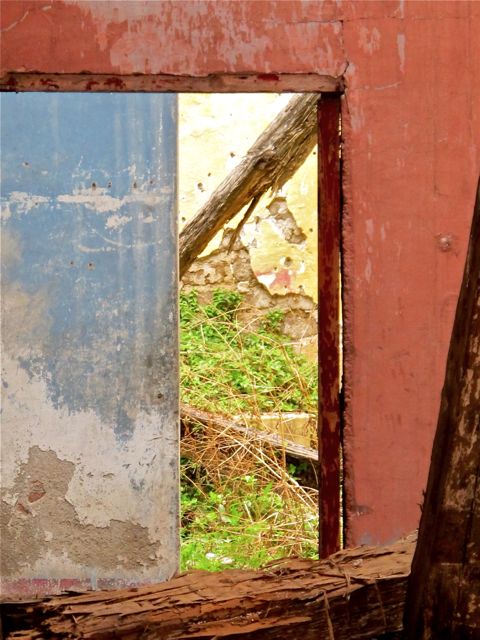
Close-up of the greenery in open space at back of abandoned building

A walk into the void

Just another day, just another walk.

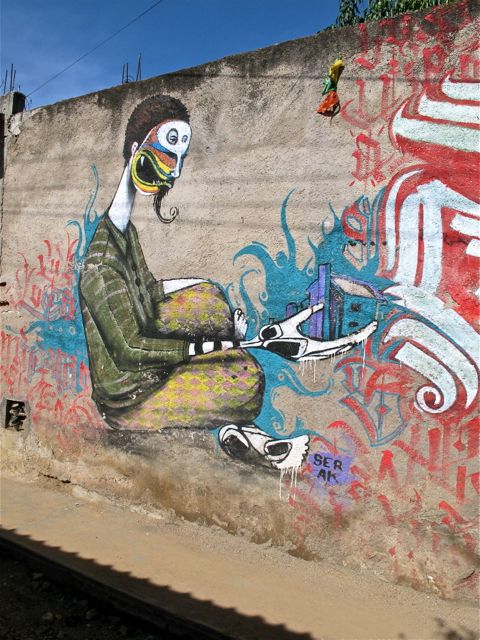
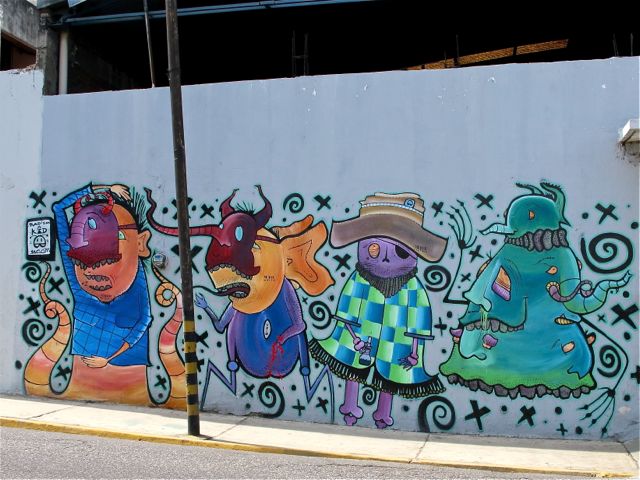
Colorful street art mural of imaginary characters

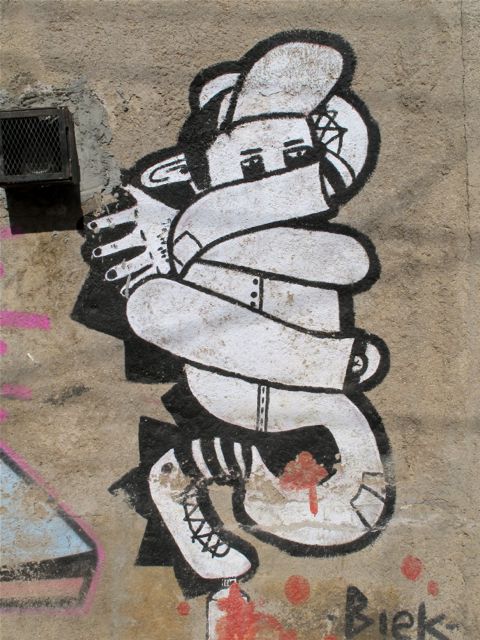
Just another wall of street art.

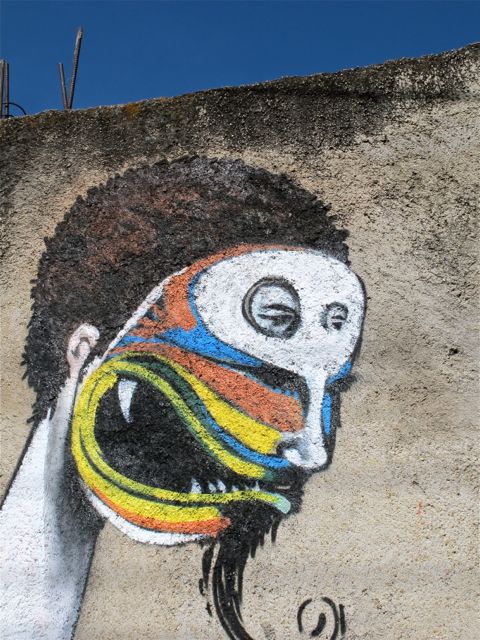
Close up of colorful street art face with mask.

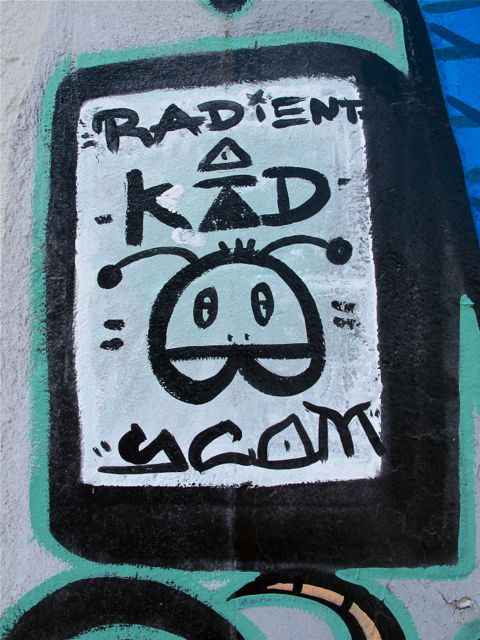
Just another April Fools Day (2012) mural.

Signature on mural:  Radient; Kad; Ycom

Muchisimas gracias, KAD, for bringing a smile…

Close up of mural with the word "void" written vertically in an oval.

and leading us into the void.

Justice for Brad Will?

It’s been almost 6 years since the October 27, 2006 day in Oaxaca when Indymedia video journalist, Brad Will, was murdered as he was filming a confrontation between APPO (Popular Assembly of the Peoples of Oaxaca) and paramilitary forces affiliated with then governor, Ulises Ruiz Ortiz, during the (at that point) 5-month long teachers’ strike.

Mexico catches suspect in death of a journalist Bradley Will

By Mark Stevenson / AP Wednesday, May 23, 2012. 1 day ago

MEXICO CITY (AP)‚ — Prosecutors in southern Mexico say they have captured a man suspected in the killing of a U.S. journalist Bradley Will during protests against the Oaxaca state government in 2006.

A spokesman for the Oaxaca state prosecutors office says suspect Lenin Osorio was captured early Wednesday.

The spokesman says he is not authorized to be quoted by name, and that he does not know which side of the conflict the suspect was on.

Bradley roland will Mexico catches suspect in death of a journalist Bradley Will

Will was shot as he videotaped a clash between protesters and government supporters.

The New York man was covering the conflict for Indymedia.org. He sympathized with the protesters, one of whom was arrested in 2008 for the killing but was later released.

The protests started as a teachers’ strike and paralyzed Oaxaca’s capital for months until federal police intervened.

###

As I write, journalists are being targeted all over the world and the teachers are again occupying Oaxaca’s zócalo, as they have every year since.  However, perhaps there will be justice for one of the 26, 2006 murder victims.  Vamos a ver….

The Revolution Next Door is a video tribute to Brad Will and includes footage shot by him, including his last tape.

To follow this news on Twitter, The Friends of Brad Will website lists the following Spanish language sites:

Oaxaca journo on the scene’s twitter feed:
https://twitter.com/#!/Jorgeopl

PGJE in Oaxaca’s feed:
https://twitter.com/#!/pgje_oaxaca

http://twitcasting.tv/Jorgeopl

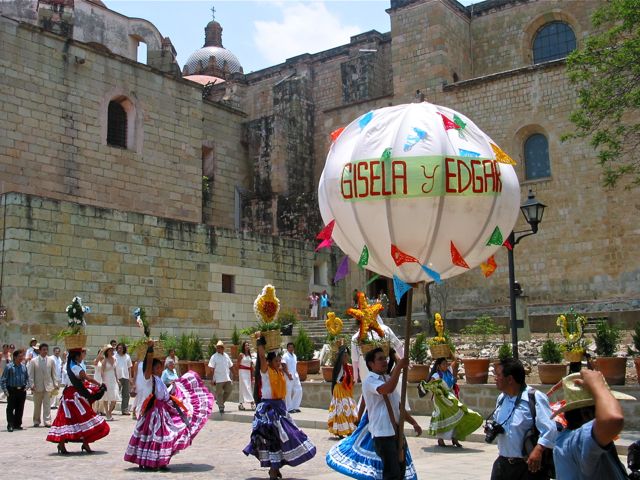
The public spaces of Oaxaca are well-used.  The cobblestone-paved Jardín del Pañuelito (Little Handkerchief Garden), that borders the south side of the Templo de Santo Domingo de Guzmán, complex is no exception.

Especially on Saturdays, when it is often used for wedding processions…

Wedding procession with dancers

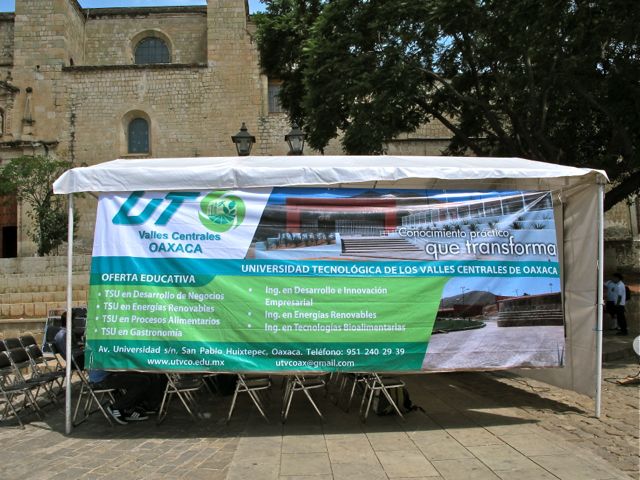
Occasionally, it is converted into a conference venue…

Folding chairs set up under a partial tent

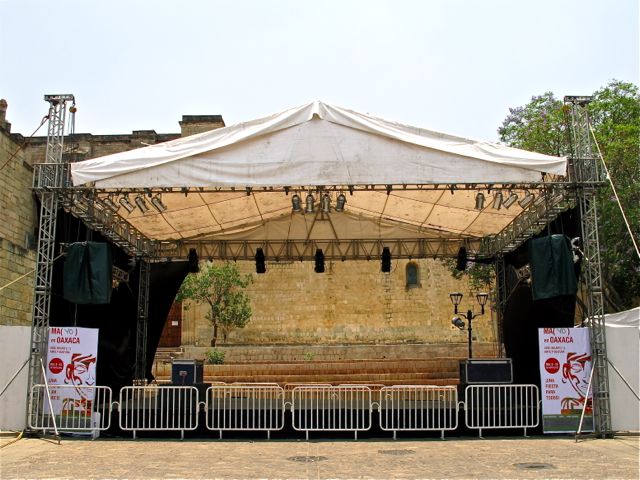
Frequently, a stage is set up and a concert ensues…

Outdoor stage

And, last year it was transformed into a movie set!

Movie set depicting early 1800s Mexican camp site

I command you to…


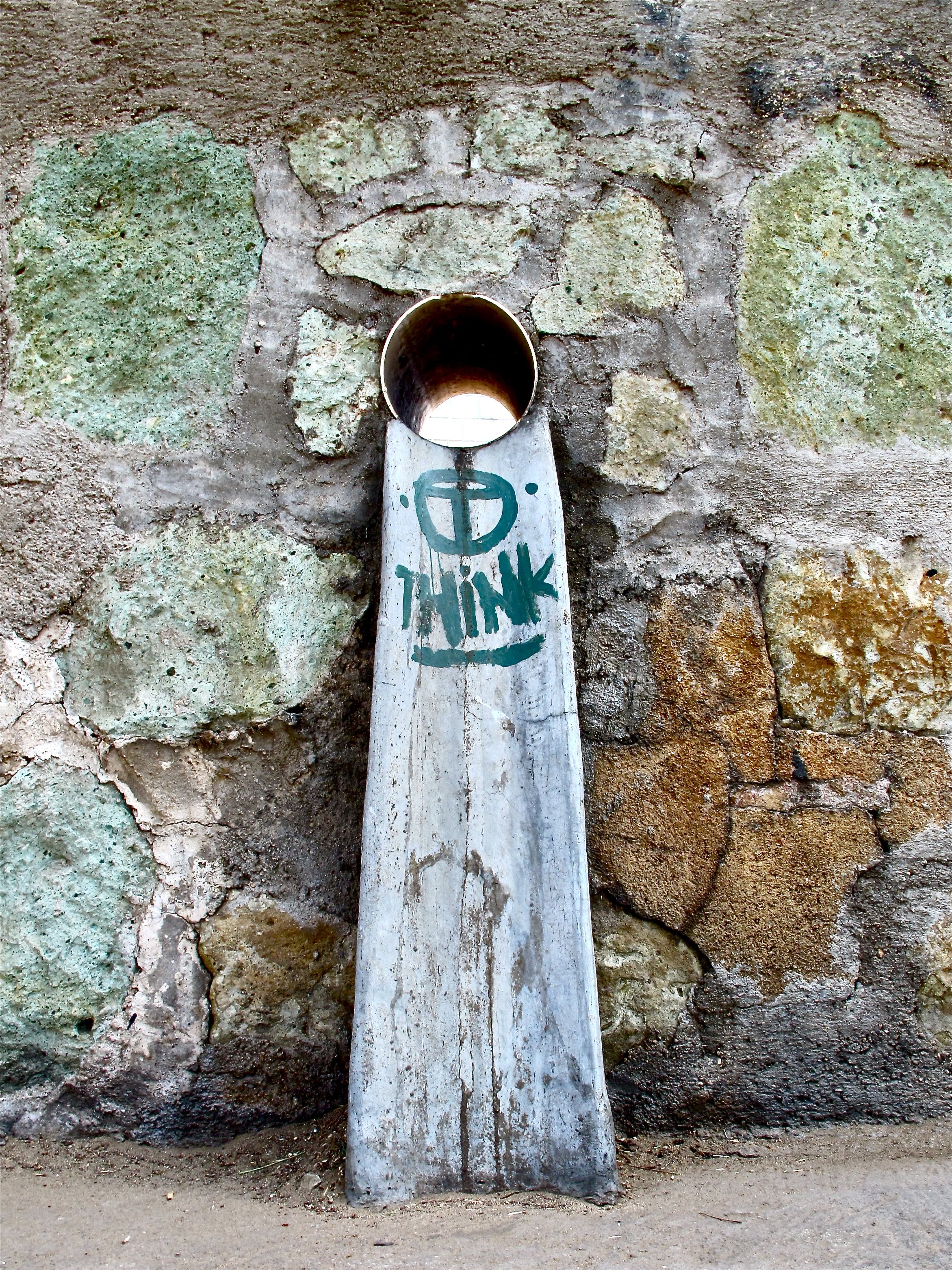
Concrete trough, coming out from stone wall. On the trough: an encircled cross with the word "Think" written under the cross.

Carlos Fuentes, one of Mexico’s most revered writers, died yesterday at the age of 83.

It was the California connection that allowed for my introduction to the writings of Fuentes.  The acquaintance came through The Old Gringo, a fictionalized story of  the disappearance in Mexico, during the Mexican Revolution, of real life writer and US Civil War veteran, Ambrose Bierce.  Following the Civil War, Bierce wound up in California, where he was a contributor to the literary journal, The Argonaut, founded and edited by one of my relatives, about whom, Bierce wrote a typically acerbic epitaphHere lies Frank Pixley — as usual.  So, in my ongoing attempt to unravel some of the mysteries surrounding living and being in Mexico, reading the The Old Gringo was a no-brainer.  As The Guardian’s obituary of Carlos Fuentes concludes,

Throughout his life, wherever he lived, Mexico was the centre of Fuentes’s artistic preoccupations. In his late 70s, he provided a typically graphic description of the attraction he felt for his own land: “It’s a very enigmatic country, and that’s a good thing because it keeps us alert, makes us constantly try to decipher the enigma of Mexico, the mystery of Mexico, to understand a country that is very, very baroque, very complicated and full of surprises.”

Carlos Fuentes is not uncontroversial, but you should see for yourself.  If you are not familiar with his writings, you might want to visit your local library and checkout a book or two.  For those in Oaxaca, the Oaxaca Lending Library has the following titles:

Fiction
Adan en Eden
Baroque Concerto
Burnt Water
Cuerpos y Ofrendas
Campaign
Cantar de Ciegos/To Sing of the Blind
Change of Skin
Christopher Unborn
Constancia: y Otras Novelas para Vírgenes
Constancia and Other Stories for Virgins
Crystal Frontier
Diana the Goddess Who Hunts: The Goddess Who Hunts Alone
The Death of Artemio Crus:  A Novel
Destiny and Desire:  A Novel
Diana o la Cazadora Solitaría
Distant Relations
The Eagle’s Throne
Good Conscience
Gringo Viejo
Hydra Head
Muerte de Artemio Cruz
El Naranjo
Old Gringo
The Orange Tree
La Region Mas Transparente
Terra Nostra
Where the Air Is Clear
Years with Laura Diaz Fuentes
Cabeza de la Hidra
Vida Está en Otra Parte

Non Fiction
Aura
The Buried Mirror: Reflections on Spain and the New World
En Esto Creo
Latin America at War with the Past
Mexico:  Una Vision de Altura:  Un Recorrido Aereo de Pasado Al Presente
Myself with Others
This I Believe
Todos los Gatos Son Pardos
The Diary of Frida Kahlo:  An Intimate Self-Portrait
New Time for Mexico

Countdown to colibríes

Just before this afternoon’s rains came, Casita Colibrí’s first African tulip tree blossom of the season.Orange red African tulip tree blossom .

And that means, colibríes (hummingbirds) won’t be far behind!

Thinking of you, mom

My mom was a folk dancer.  She had studied ballet, tap, and acrobatic dancing when she was young and brought that training and muscle memory along with her when she took up folk dancing in her mid thirties.  I spent many hours over the years watching her dance; the Kamarinskaya from Russia, Swedish Hambo, Fandango from Portugal, Mexico’s Jarabe Tapatio, and so many more.  In addition to being a talented dancer, she made her own costumes.  A dressmaker’s dummy was a permanent fixture in her bedroom, yards of colorful cotton fabric and braid were piled next to the sewing machine, and in the evenings her hands and eyes were often occupied embroidering pieces for a new costume.

Mom died in 1989, but not a day goes by that I don’t think of her.  So, on this Mother’s Day, this is for you mom…

Multicolored huipil with peacock design

Guatemala

Jewel toned embroidered huipil with peacock design

Zinacatán, Chiapas, Mexico

Black skirt embroidered on the diagonal with flowers

Zinacatán, Chiapas, Mexico

Black dress with gold-tone embroidery on sleeve and bodice.

San Antonino Castillo Velasco, Oaxaca, Mexico

Geometric yellow and red embroidery on purple skirt with lace bottom

Tehuantepec, Oaxaca, Mexico

Close up of the back of a brightly embroidered huipil on black velvet

Tehuantepec, Oaxaca, Mexico

Jaguar in the midst

These jaguars can be found all over Oaxaca…

Ceramic jaguar head

Live jaguars in the wilds of Oaxaca, not so much.  They are notoriously elusive, reclusive, and on the near-threatened list.  However, this just in…

Rare jaguar sighting in Oaxaca, Mexico

Mexican authorities have confirmed that a jaguar has been spotted for the first time near Mitla.

According to Mexico’s National Commission for Protected Areas (CONANP), the jaguar caught on camera is the first one confirmed to exist in the area of San Pablo Villa de Mitla, which is part of the 4,900-hectare Yagul and Mitla Natural Monument.

Pavel Palacios Chavez, an administrator at Yagul and Mitla Natural Monument, said the jaguar likely migrated through heavily forested and mountainous areas from Oaxaca’s Sierra Juarez mountain range.

“There hadn’t been a sighting in this area of the central valleys. It’s a high-altitude zone that is connected to the Sierra Juarez. We believe that it’s this connectivity between the forests of Sierra Juarez and the forests of this part of the valley that has facilitated the transfer of this species,” he said.

Authorities detected the jaguar – North America’s largest feline – using remote cameras which were left attached to trees and other vegetation. They allowed conservationists to observe the movement of animals throughout the night.  [Read full article and watch video HERE]

Hmmm… I wonder what brought the jaguar down from the Sierra Juárez?  I hope it stays away from local livestock and finds its way back up into the mountains.

Today, May 10, is Día de la Madre in Mexico and it is celebrated in much the same way as in el norte.

Sign under papel picados at Casa Mayordomo Restaurante: "Feliz dia mama

The celebration migrated south from the USA in the early 20th century and was embraced and promoted by the Catholic Church AND the anticlerical Revolutionaries.  As for their reasons, I will quote from Liza Bakewell’s book, Madre: Perilous Journeys with a Spanish Noun.

… around the 1850s the Liberals… were nervous about women’s growing participation in the public sphere.  Establishing motherhood as venerable and the home as sanctified… would give women a sphere of their own where they could be boss.  Also, it would keep them off the streets and out of the workplace where they had begun to compete with men for jobs.

Under their watch, everyday motherhood became an exalted madre-hood…. The twentieth-century Revolutionaries who succeeded them took the idea and ran with it, adding in 1922 a ritual, Mother’s Day… [p. 84]

Needless to say, the women of Mexico have not stayed home!  As I write, hundreds of women are marching on Mexico City, participating in the March of National Dignity: Mothers Looking for their Sons and Daughters and Searching for Justice.  And, as for the workforce, according to a report citing the 2010 census, 33.3% of women work and this doesn’t even include those working in family operated enterprises.

However distasteful the reasons behind the establishment of Mother’s Day in Mexico, it does nothing to diminish the need to honor these beautiful, hardworking, formidable, and loving women.

2 women pining veil on young woman

Woman with rebozo on her head, sitting on side of hill with 3 children

Woman at the reins with 2 boys in a horse drawn cart

Close up of woman holding a baby

¡Feliz Día de la Madre mis compañeras!

Play ball!

At the top of my Oaxaca Yahoo! Alerts today…

GW professor’s research on ancient ballgame reveals more about early Mesoamerican society

GW anthropology professor Jeffrey Blomster’s research featured in PNAS journal

WASHINGTON—George Washington University Professor Jeffrey P. Blomster’s latest research explores the importance of the ballgame to ancient Mesoamerican societies. Dr. Blomster’s findings show how the discovery of a ballplayer figurine in the Mixteca Alta region of Oaxaca demonstrates the early participation of the region in the iconography and ideology of the game, a point that had not been previously documented by other researchers. Dr. Blomster’s paper, Early evidence of the ballgame in Oaxaca, Mexico, is featured in the latest issue of Proceedings in the National Academy of Sciences (PNAS).

Dr. Blomster, GW associate professor of anthropology, has spent 20 years researching the origin of complex societies in Mesoamerica. The participation of early Mixtec societies in ballgame imagery is a new aspect of his research. For the journal publication, Dr. Blomster worked with undergraduate students Izack Nacheman and Joseph DiVirgilio to create artistic renditions of the figurine artifacts found in Mexico.

While early games used a hard rubber ball, the ballgames Dr. Blomster researches bear little resemblance to today’s Major League Baseball. The games and the costumes or uniforms participants wore were tied to themes of life and death, mortals and underworld deities or symbolizing the sun and the moon. In some instances, the ballcourt itself represented a portal to the underworld.

According to Dr. Blomster, “Because the ballgame is associated with the rise of complex societies, understanding its origins also illuminates the evolution of socio-politically complex societies.”

During the Early Horizon period, or roughly between 1400 BCE (Before the Common Era) and 1700 BCE, there was little evidence of ballgame activity in the way of artifacts in the Oaxaca region of Mexico. Dr. Blomster’s findings of a clay figurine garbed in distinctive ballgame costume, similar to both Olmec figurines and monumental sculptures from the Gulf Coast, indicate such engagement did take place in the area.

“Exploring the origins and spread of the ballgame is central to understanding the development of the Mesoamerican civilization,” he said. “We know there were earlier versions of a ballgame prior to the Early Horizon with both a ballcourt and rubber balls found in coastal Chiapas and the Gulf Coast, but the institutionalized version of the ballgame, a hallmark of Mesoamerican civilizations, developed during the Early Horizon. While there has been some limited evidence about the participation of the nearby Valley of Oaxaca in the ballgame, the Mixteca has largely been written off in terms of involvement in the origins of complex society in ancient Mexico. This discovery reemphasizes how the ancient Mixtecs were active participants in larger Mesoamerican phenomenon.”

###

By the way, there was a lot more to these ballgames than mere athletic competitions — think ritual, conflict resolution, sacrifice.  Below is the ballcourt just up the hill at Monte Alban.

Ballcourt at Monte Albán

The stories it could tell…

As the promotional material for Ma (yo) en Oaxaca, Mujer (es) Arte y Cultura explains (loose translation), like a skilled weaver, women create the fabric of life… part of the history of humanity, intelligence that moves, the look that looks, which is regarded in the construction of better horizons of life for her and those who are around her.  And so, from May 3rd through 13th, the women of Oaxaca are being celebrated with workshops, exhibitions, lectures, and concerts.

Last night, under the supermoon, one of the accomplished women of Oaxaca, Alejandra Robles, gave a free concert, just a block away, in the Plaza de la Danza…

Ma (yo) en Oaxaca is a party for all of the principles of inclusion and participation to make possible the knowledge and appreciation of the cultural richness of groups which, for various reasons, have been marginalized.

¡Viva las mujeres!

Feliz cumpleaños MACO

A belated Happy 20th Birthday, Museo de Arte Contemporáneo de Oaxaca!

20 MACO banner

As the theme of the birthday celebration on February 28th said, Say ‘Coma’ Twenty Times,

20 and 4 bicycles with a comma in the center of the front wheels

COMA, COMA, CO-MACO, MACO, MACO…

Large red 20 painted on window

Come say, Feliz Cumpleaños MACO, in person!

We, who live or spend a significant amount of time here in Oaxaca, can’t say it too many times…

Are Americans safer in Mexico than at home?

Robert Reid Lonely Planet author

Every week or so I get asked, ‘Is it safe to go to Mexico?’ I had always said, if you’re thoughtful about where you go, yes. But after my most recent trip there, I’m changing my answer… to a question:

Do you think it’s safe to go to Texas?

To be clear, violence in Mexico is no joke. There have been over 47,000 drug-related murders alone in the past five years. Its murder rate – 18 per 100,000 according to this United Nations Office on Drugs & Crime report – is more than three times the US rate of 4.8 per 100,000. Though Mexican tourism is starting to bounce back, Americans appear more reluctant to return than Canadians and Brits (5.7 million Americans visited in 2011, down 3% from 2010 – and, according to Expedia, more than four of five bookings were adults going without children). Many who don’t go cite violence as the reason.

What you don’t get from most reports in the US is statistical evidence that Americans are less likely to face violence on average in Mexico than at home, particularly when you zero in on Mexico’s most popular travel destinations. For example, the gateway to Disney World, Orlando, saw 7.5 murders per 100,000 residents in 2010 per the FBI; this is higher than Cancun or Puerto Vallarta, with rates of 1.83 and 5.9 respectively, per a Stanford University report (see data visualization here, summarized on this chart, page 21). Yet in March, the Texas Department of Public Safety advised against ‘spring break’ travel anywhere in Mexico, a country the size of the UK, France, Germany, Spain and Italy combined. Never mind that popular destinations like the Bahamas, Belize and Jamaica have far higher homicide rates (36, 42 and 52 per 100,000). Why the singular focus?

Before you nix Mexico altogether, consider these five things:

[Read full article HERE]