
Where else have you seen El Grito decorations?
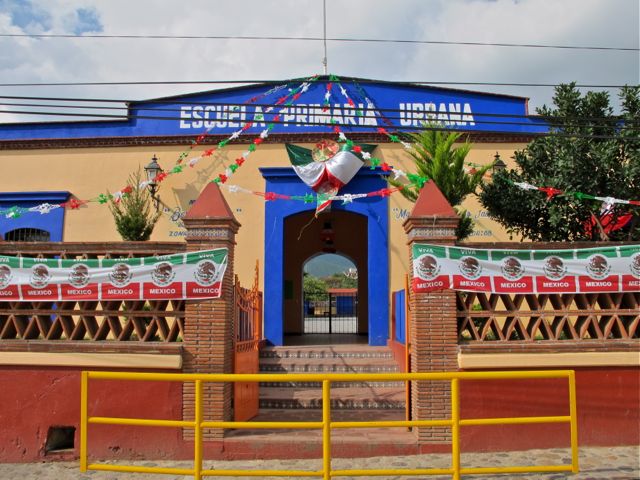
Schools, of course! This one in Teotitlán del Valle.

And, how about newsstands? You can’t miss the green, white, and red — it’s everywhere!
Where else have you seen El Grito decorations?
Schools, of course! This one in Teotitlán del Valle.
And, how about newsstands? You can’t miss the green, white, and red — it’s everywhere!
Posted in Celebrations, Culture, History, Holidays, Travel & Tourism | Tagged celebrations, El Grito, Escuela Primaria Urbana, graffiti, Grito de Dolores, holidays, Mexican Independence Day, Mexico, newsstands, Oaxaca, photographs, photos, popular travel destinations, store displays, Teotitlán del Valle, window displays | Leave a Comment »
Waiting for the convite… Fiesta a la Natividad de la Virgen María.

September 8 was a rainy day in Teotitlán del Valle.
Posted in Celebrations, Culture, Religion, Travel & Tourism, Weather | Tagged convite, El Picacho, Fiesta a la Natividad de la Virgen María, Mexico, Oaxaca, photographs, photos, popular travel destinations, Teotitlán del Valle, Virgen de la Natividad | Leave a Comment »
Several months ago, friend and longtime (35 years!) regular visitor to Oaxaca, Charles Kerns, asked me to write a review of his first work of fiction, Santo Gordo: A Killing in Oaxaca.

He sent it to me in June, when I was up in the San Francisco Bay Area, and it proved to be the perfect reading material for my SFO –> IAH –> OAX return trip. Once back, I mentioned Santo Gordo to friends, loaned it, got it back, only to loan it again. With Santo Gordo again in my hot little hands and after many months of delay, today I finally posted the following review on Amazon.com.
A botana of Oaxaca
Much as it has done to Charles Kerns, Oaxaca has captured my heart and three years ago I began living an expat life there. Thus, I can assure you reading Santo Gordo: A Killing in Oaxaca, will give you a botana (a small snack) of life in Oaxaca as seen and experienced by a gringo — well, not the witnessing an assassination part!
However, first time mystery writer Kerns does offer a glimpse at an underbelly few tourists are ever aware of and many expats choose to ignore – it’s history, complexity, and expression being too much to comprehend.
Kerns has crafted a mystery where place, in this case Oaxaca, is a leading character — much as Donna Leon, with her Commissario Brunetti mysteries, has done with Venice. Kerns has captured rhythms, rituals, sweetness, dangers (treacherous sidewalks, not murders, being at the top of the list), and bewildering aspects of life in Oaxaca, all the while telling a plausible tale with a very likable main character.
Now that the review has, at long last, been written, my copy of Santo Gordo: A Killing in Oaxaca, will be donated to the Oaxaca Lending Library — as I promised Chuck many months ago. Sorry I kept you waiting and ¡Feliz cumpleaños mi amigo!
(ps) Check out the San Jose Mercury News interview with Chuck, Alameda writer pens Oaxaca mystery.
Posted in Books, People, Travel & Tourism | Tagged book review, books, Charles Kerns, Mexico, Oaxaca, popular travel destinations, Santo Gordo: A Killing in Oaxaca | 4 Comments »
Monday morning, I went out onto the terrace to hang the wind chimes back up (too loud for sleeping), pick up spent African tulip tree blossoms (20 to 30), and say buenos días to Argiope (previously mentioned spider).
Hmmm… all was definitely not “as usual” in the spider’s web. Argiope, what in the world is going on?
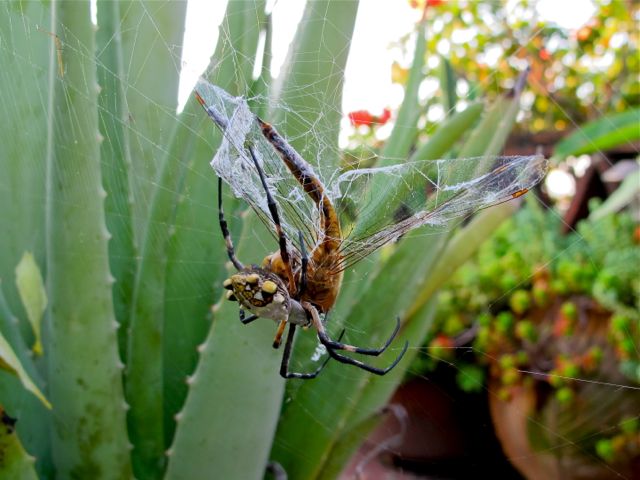
Good grief, she had caught a dragonfly! It must have been quite a battle, as her web was a mess and now she was trying to wrap it up.

This was serious business for her and she worked at it most of the day. However I had to chuckle, as sayings from childhood rose up from the cobwebs in my brain — Your eyes bigger than your stomach. Have you bitten off more than you can chew? Pick on someone your own size!

Monday evening, she finally gave up and let it loose from her clutches. When I retired for the night, the dragonfly was hanging by a thread.

By the next morning, the remains of the dragonfly had fallen onto the patio and Argiope was sitting happily in her newly repaired web with a more appropriately sized breakfast.
Mother Nature is amazing!
Posted in Animals, Gardens, Science & Nature | Tagged Araneidae, Argiope, Casita Colibrí, dragonfly, garden, Mexico, nature, Oaxaca, orb weaver, orb weaver spiders, photographs, photos, spider | 5 Comments »
El Grito is coming, El Grito is coming!!! Green, white and red is on display all over the city, including clothing stores, as tradition calls for wearing the colors.
Are you in the market for a traditional look?
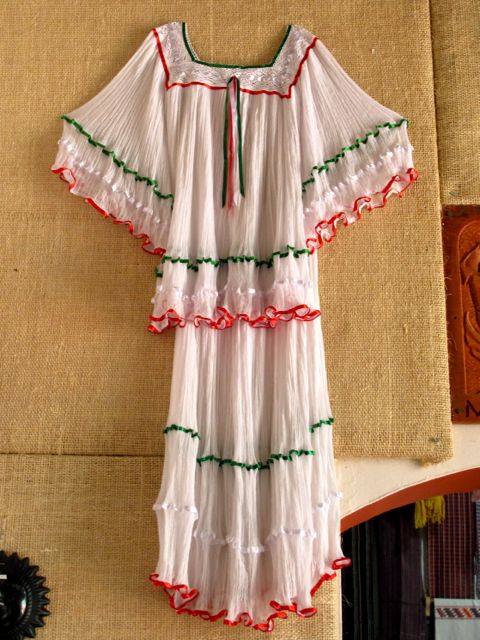
A huipil and rebozo?

Or, are you leaning toward an updated mix and match style?

Do you need a sweater for going down to the zócalo on the evening of September 15?

By all means, don’t forget to accessorize!

On a more serious note: Despite its current challenges (which are many and serious), Mexicans are extremely proud of being Mexicanos. And, in my humble opinion, they have every right be! They can trace their history back to ancient and highly developed civilizations, their national cuisine has been placed on the World Heritage List by UNESCO, and Mexico is considered one of the most geographically and biologically diverse countries in the world. Plus, when was the last time you heard Mexico had invaded another country?
Posted in Celebrations, Culture, History, Holidays, Travel & Tourism | Tagged celebrations, clothing, costumes, El Grito, Grito de Dolores, holidays, Mexican Independence Day, Mexico, Oaxaca, photographs, photos, popular travel destinations, store displays, traje | Leave a Comment »
… and fish and turtles and ducks. On August 31, as the rain fell, all of the above and more, assembled at Templo de Nuestra Señora de la Merced for the annual Bendición de los Animales. Animals and their human keepers were there to celebrate the feast day of San Ramón de Nonato, patron saint of women in labor, persons falsely accused, and keeper of animals.
There were some familiar faces, both human and animal, from last year’s blessing. However, this year the dogs were extremely vocal and, on occasion, tested the strength of the human at the other end of their leash — perhaps it was in anticipation of the evening’s “blue moon” or maybe being restrained and made to just sit or stand in the rain made them grouchy.
This morning’s article in Noticias covering the blessing, led off with this quote from Benito Juárez García:
La protección de los animales forma parte esencial de la moral y de la cultura de los pueblos civilizados. (The protection of animals is an essential part of morality and culture of civilized people.)
For more on this year’s Blessing of the Animals, head over to Oaxaca-The Year After.
Posted in Animals, Celebrations, Churches, Culture, Religion, Travel & Tourism | Tagged animals, Bendición de los Animales, Benito Juárez, Blessing of Animals, Mexico, Oaxaca, pets, photographs, photos, San Ramón de Nonato, Temple of Our Lady of Mercy, Templo de Nuestra Señora de la Merced | 5 Comments »
Thursday night was the kickoff event for the 5th annual El Saber Del Sabor (literally, the knowledge of flavor) Festival Gastronómico Oaxaca 2012. Early in the day, the Plaza de la Danza had been tented and turned into a colorful banquet hall.
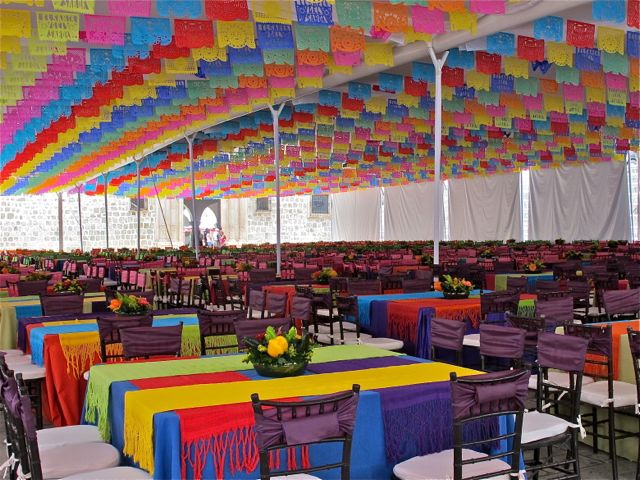
A couple of the evening’s chefs arrived early and were cooling their heels, waiting to begin doing what they do best. Hmmm… what’s with the bricks on top of the cantera? (Stay tuned!)

By 9:30 PM the tables had filled and cooking was well underway.

Casa Oaxaca chef and event host, Alejandro Ruiz Olmedo circulated, greeted old friends and fans, and was interviewed by a crush of press. Cameras and microphones were omnipresent — good for publicity, bad for navigating the aisles en route to food!

To begin the evening and ready the palate, wines, beers, aguas, and (of course!) mezcals were offered. We sampled a couple of mezcals from El Jolgorio and all I can say is, Wow! (BTW, that’s a good, “Wow!”)
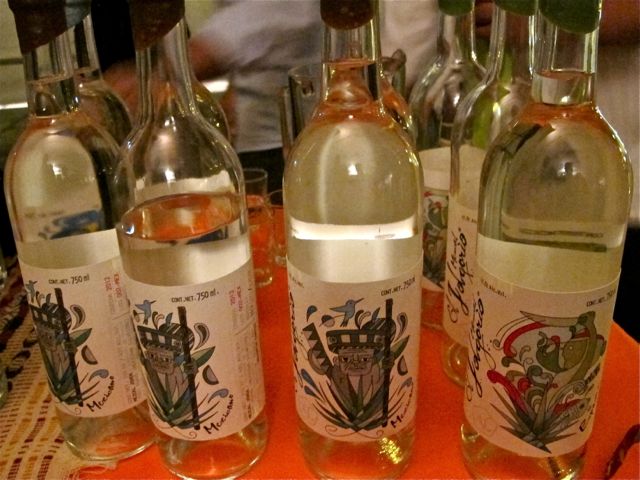
The festival seeks to promote and protect Oaxaca’s traditional cuisine and to inspire innovation. For this evening’s event, we were invited to sample an incredible range of appetizers, side dishes, main courses, and desserts from 23 cooks, representing the 8 regions of Oaxaca.
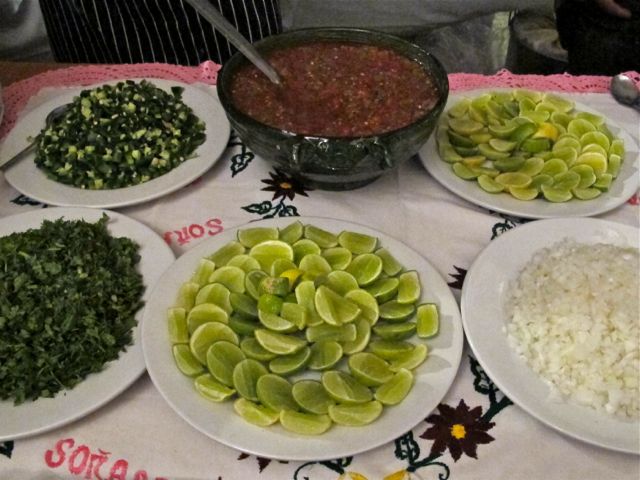
I think I must have tasted at least 30 dishes — and this was late at night. Needless to say, no breakfast for me the next morning.

And, remember the bricks? My favorite sight of the evening were the little piggies roasting on bamboo skewers over red and white-hot coals. The tag line for the festival is, “tierra, fuego y cocina” (earth, fire, and kitchen). Yes!!!
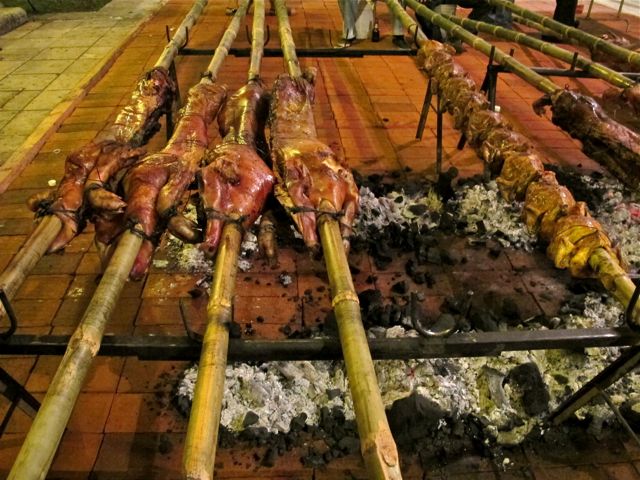
From the Plaza de la Danza, the festival moves to restaurants throughout the city, where 36 renowned chefs from all over Mexico have come to prepare innovative cuisine that pays homage to Oaxaqueño foodstuffs and traditions.
A big “thank you” to Henry and Rosa (Amate Books) for inviting me to share such a delightful and delicious evening!
Posted in Celebrations, Culture, Food, Parks & Plazas, Travel & Tourism | Tagged Alejandro Ruiz Olmedo, bamboo skewers, chefs, cuisine, culinary traditions, dining, El Jolgorio mezcal, El Saber del Sabor, food, Mexico, mezcal, Oaxaca, photographs, photos, Plaza de la Danza, popular travel destinations, restaurants, travel | 8 Comments »
Warning: If you are an arachnophobe, read no further!
Remember Argiope, one of the orb weaver spiders who hung around Casita Colibrí’s garden from September of last year through January of this year? When last seen, she was laying eggs on my screen door. Alas (or perhaps, thank goodness), a workman who was coming in and out of my apartment must have brushed her and her eggs away, thus relieving me of answering the question, “Do I really want thousands of little spiders beginning to explore the world from my screen door?”
However, I suspect that wasn’t her first attempt at motherhood. One day this past June, I was surprised to find…

Argiope’s daughter? That is what I would like to think! And she is just as beautiful as her mother…

… both back (above) and front (below).

And, she is just as good as catching her lunch! I watched as she finished wrapping up the unfortunate fly above. I guess she needs all that nourishment…
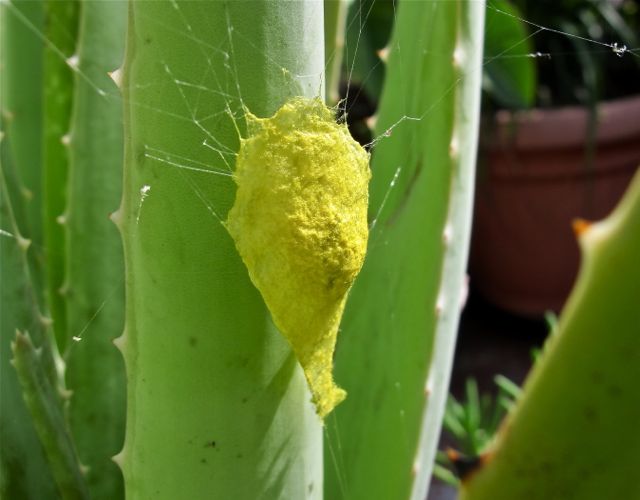
Another generation of Argiopes in waiting! And, as I write, the hunting continues…

More to come? La vida may be loca, but on it goes!
Posted in Animals, Gardens, Nature & Science | Tagged Araneidae, Argiope, argiopes, Casita Colibrí, egg sack, garden, Mexico, nature, Oaxaca, orb weaver, orb weaver spiders, photographs, photos, spider | 5 Comments »
Need a facelift?

Apparently, Casa Oaxaca and neighbor, Galeria Quetzalli, both do.

You might want to consider these guys.

They work hard.

And, all work is done with care and by hand!
Posted in Buildings, Labor, Restaurants | Tagged building renovation, Casa Oaxaca, cement mixing, construction workers, Galeria Quetzalli, labor, laborers, Mexico, Oaxaca, photographs, photos, workers | 4 Comments »
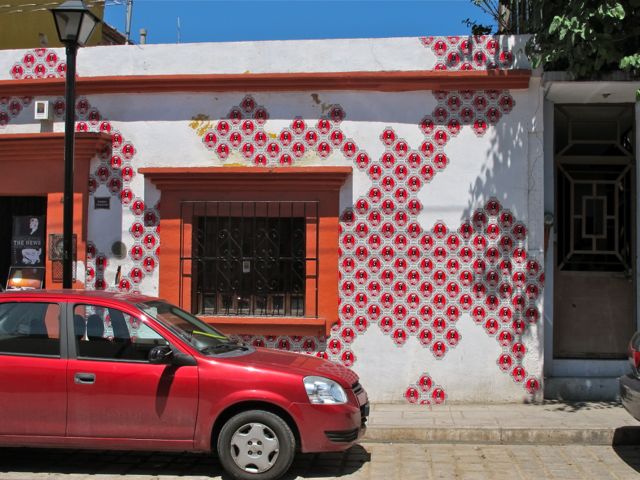
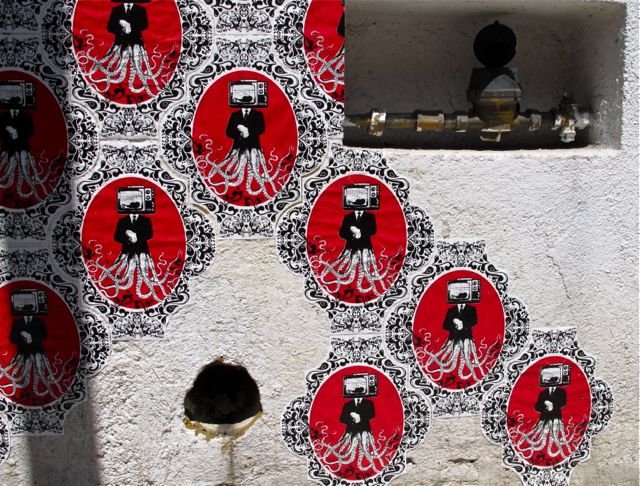


Posted in Buildings, Creativity, Culture, Politics | Tagged Lapiztola, Mexico, Oaxaca, photographs, photos, street art, urban art, wall art | 1 Comment »
Oh, what a beautiful morning it was!
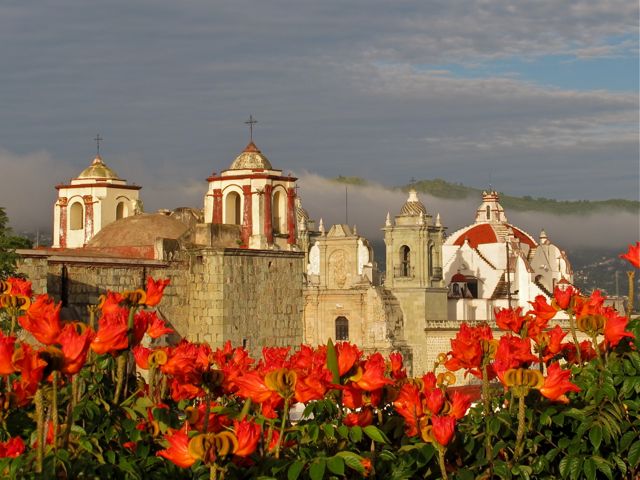
What a difference 10 hours makes.
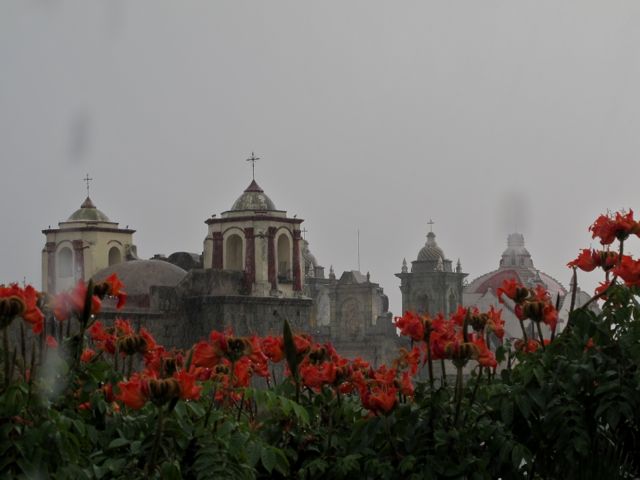
Moisture from Tropical Storm Isaac being drawn across Oaxaca. That’s the way the rainy season goes!
Posted in Buildings, Churches, Travel & Tourism, Weather | Tagged African Tulip trees, Basilica de la Soledad, Mexico, Oaxaca, photographs, photos, rainy season, Templo de San José, travel, tropical storm, weather | 2 Comments »
Walking down the street… an open door… can’t help but look in…
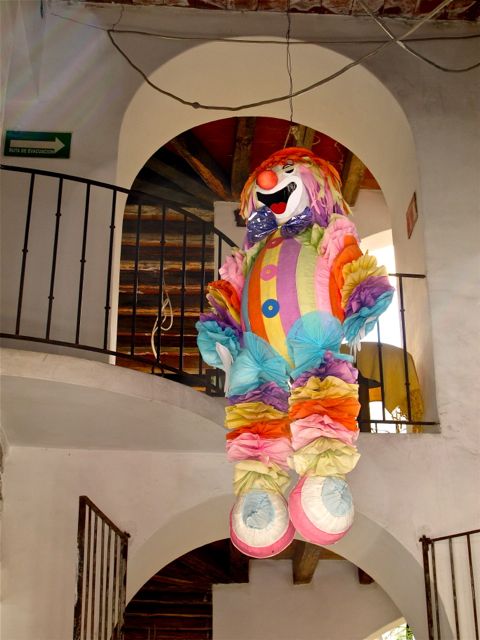
¡Feliz fin de semana!
Posted in Creativity, Culture, Travel & Tourism | Tagged clown, Mexico, Oaxaca, payaso, photographs, photos, piñata | 2 Comments »
Several days ago, Susan McGlynn of the Insider’s Guide to Oaxaca posted this photo on the Insider’s Facebook page, with the question, “Oaxaca in the 1940s or maybe 50s?. DO YOU KNOW WHICH CORNER OF OAXACA THIS IS???”

The architecture looked very familiar and then there were those trees in the distance… I was pretty sure I knew which corner this was, so off the camera and I went.
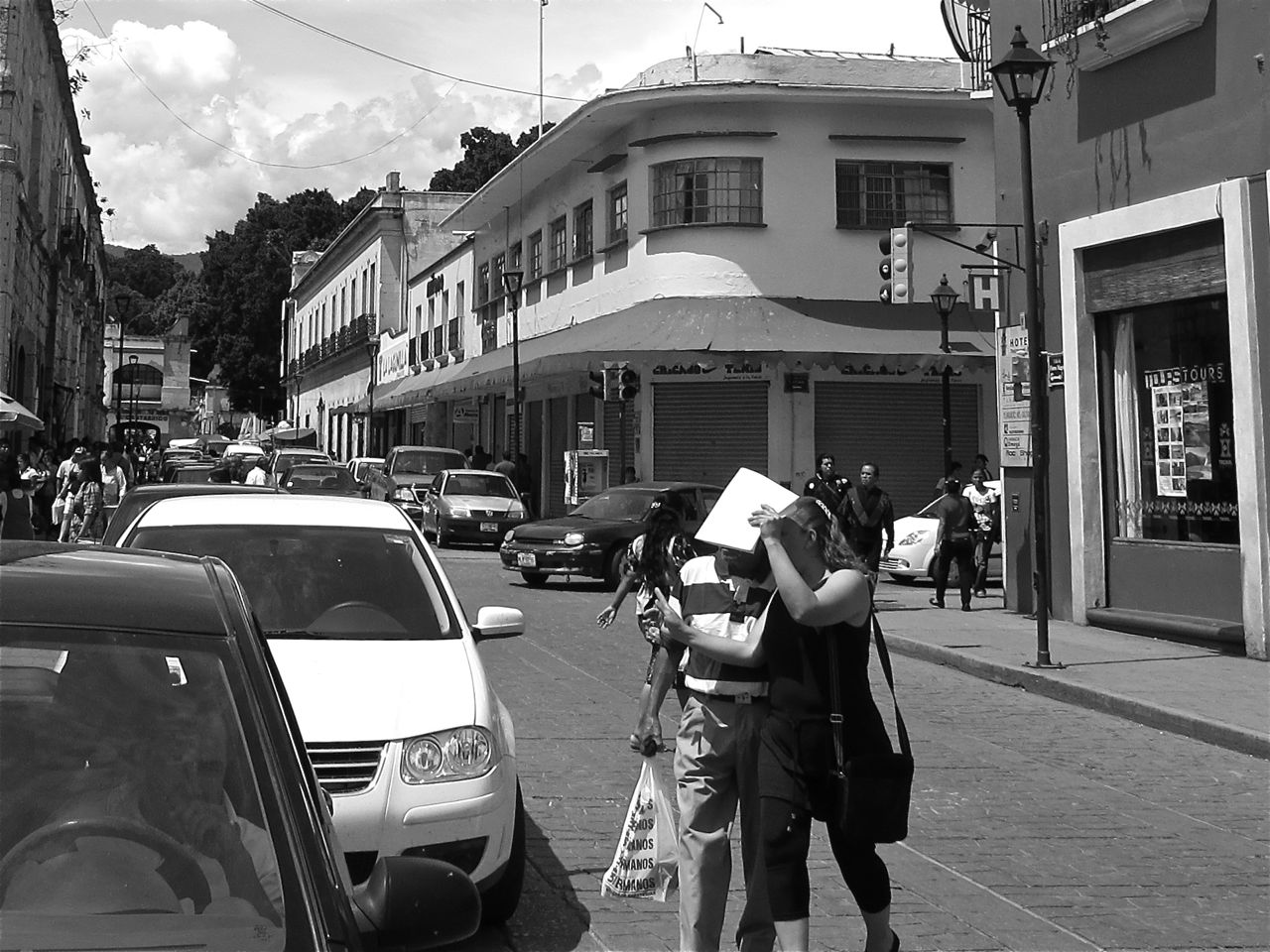
It’s looking north on Flores Magón at the intersection of Las Casas. That’s the Government Palace in front of the trees of the zócalo at the end of the street. Outside the shot and to the left of the cars in the foreground is Mercado Benito Juárez. Perhaps all is a little clearer in color…

That cinnamon colored building in the foreground is the Trebol Hotel and the single-story white building next to the Government Palace is La Lagunilla, which must have been in business when the original photograph was taken, as the sign says it was founded in 1921.

This was fun!
Posted in Buildings, Geography, History, Markets | Tagged Calle Flores Magón, Calle Las Casas, historical photographs, La Lagunilla, Mexico, Oaxaca, photographs, photos, street scene | 6 Comments »
I’ve been intending to post these photos for six months, but there has been so much going on in Oaxaca, I haven’t gotten around to it — until now. This morning’s Guardian article, Trotsky’s murder remembered by grandson, 72 years on, caught my eye and I thought, if not today, when? So, here goes…
When I was in Mexico City in January, I made somewhat of a pilgrimage out to the borough of Coyoacán. Besides a lovely stroll through the Viveros de Coyoacán, being dazzled by the light and color of the Museo Frida Kahlo, and enjoying a delicious comida on the Plaza Hidalgo, I spent an incredibly moving three hours at the Museo Casa de Trotsky, the home, and now museum, of Russian revolutionary leader Leon Trotsky and his wife Natalia Sedova. However, before getting to the photos, a very brief bit of context is necessary.
Hounded all over the world by Joseph Stalin and his agents, in 1937 Trotsky and Natalia Sedova were offered asylum by Mexican president Lázaro Cárdenas. Trotsky’s orphaned grandson, Esteban Volkov (Seva), joined them not long after. Seva narrowly escaped being murdered in his bed during the first attempt on Trotsky’s life in the Coyoacán house by Mexican muralist, David Alfaro Siqueiros. It was during this attack that Trotsky guard, Robert Sheldon Harte was killed.
The house at Avenida Viena 19 was further fortified, but Stalinist agent, Ramón Mercader, under an assumed name was able to infiltrate Trotsky’s inner circle and, on August 20, 1940, under the ruse of asking Trotsky to look at something he had written, attacked him with an ice axe. Trotsky died in hospital a little more than 24 hours later. His ashes and those of Natalia’s reside in the peaceful garden of the Coyoacán house in a monument, designed by Irish-Mexican painter and architect Juan O’Gorman, that proudly flies a red flag and features the overlapping hammer of the worker and the sickle of the peasant. The house and furnishings remain much as they were 72 years ago, bullet holes from the first attack and all.
The humanity expressed in the words below were felt as I wandered through the house and museum and I must admit, tears welled up as I stood before O’Gorman’s monument.
Trotsky’s Testament, dated 27 February 1940
My high (and still rising) blood pressure is deceiving those near me about my actual condition. I am active and able to work but the outcome is evidently near. These lines will be made public after my death.
I have no need to refute here once again the stupid and vile slanders of Stalin and his agents: there is not a single spot on my revolutionary honour. I have never entered, either directly or indirectly, into any behind-the-scenes agreements or even negotiations with the enemies of the working class. Thousands of Stalin’s opponents have fallen victims of similar false accusations. The new revolutionary generations will rehabilitate their political honour and deal with the Kremlin executioners according to their desserts.
I thank warmly the friends who remained loyal to me through the most difficult hours of my life. I do not name anyone in particular because I cannot name them all.
However, I consider myself justified in making an exception in the case of my companion, Natalia Ivanovna Sedova. In addition to the happiness of being a fighter for the cause of socialism, fate gave me the happiness of being her husband. During the almost forty years of our life together she remained an inexhaustible source of love, magnanimity, and tenderness. She underwent great sufferings, especially in the last period of our lives. But I find some comfort in the fact that she also knew days of happiness.
For forty-three years of my conscious life I have remained a revolutionist: for forty-two of them I have fought under the banner of Marxism. If I had to begin all over again I would of course try to avoid this or that mistake, but the main course of my life would remain unchanged. I shall die a proletarian revolutionary, a Marxist, a dialectical materialist, and, consequently, an irreconcilable atheist. My faith in the communist future of mankind is not less ardent, indeed it is firmer today, than it was in the days of my youth.
Natasha has just come up to the window from the courtyard and opened it wider so that the air may enter more freely into my room. I can see the bright green strip of grass beneath the wall, and the clear blue sky above the wall, and sunlight everywhere. Life is beautiful. Let the future generations cleanse it of all evil, oppression and violence, and enjoy it to the full.
For archives and bibliographies of Trotsky, the following two sites are about as comprehensive as one will find online:
Even if you are not interested in the politics, and especially if you are considering a visit to the museum, I highly recommend reading Barbara Kingsolver’s historical novel, The Lacuna, part of which takes place in Trotsky’s Mexican household and gives a flavor of life there.
By the way, the museum site (appropriately) houses the Instituto del Derecho de Asilo y las Libertades Públicas (Institute for the Right of Asylum and Public Liberties). I wonder, are they working overtime these days?
Posted in History, Museums, People, Politics, Travel & Tourism | Tagged Coyoacán, Esteban Volkov, Institute for the Right of Asylum and Public Liberties, Instituto del Derecho de Asilo y las Libertades Públicas, Leon Trotsky, Mexico, Mexico City, Museo Casa de Trotsky, museum, photographs, photos, popular travel destinations, travel, Trotsky Museum | 2 Comments »
A motley crew…

Are you, too?
They were playing Pink Floyd — “Another Brick in the Wall.”
The “writing on the wall” refers to the assassination in March 2012 of Bernardo Vásquez Sánchez, a Zapotec community activist who had spoken out against a Canadian owned gold mine in San José del Progreso, Oaxaca.
Posted in Culture, Parks & Plazas, People, Protests | Tagged Bernardo Vásquez Sánchez, buskers, graffiti, Macedonio Alcalá, Mexico, Motley Crue, musicians, Oaxaca, photographs, photos, street musicians, U2 | 2 Comments »


 Mexican Peso Converter
 View From Casita Colibrí