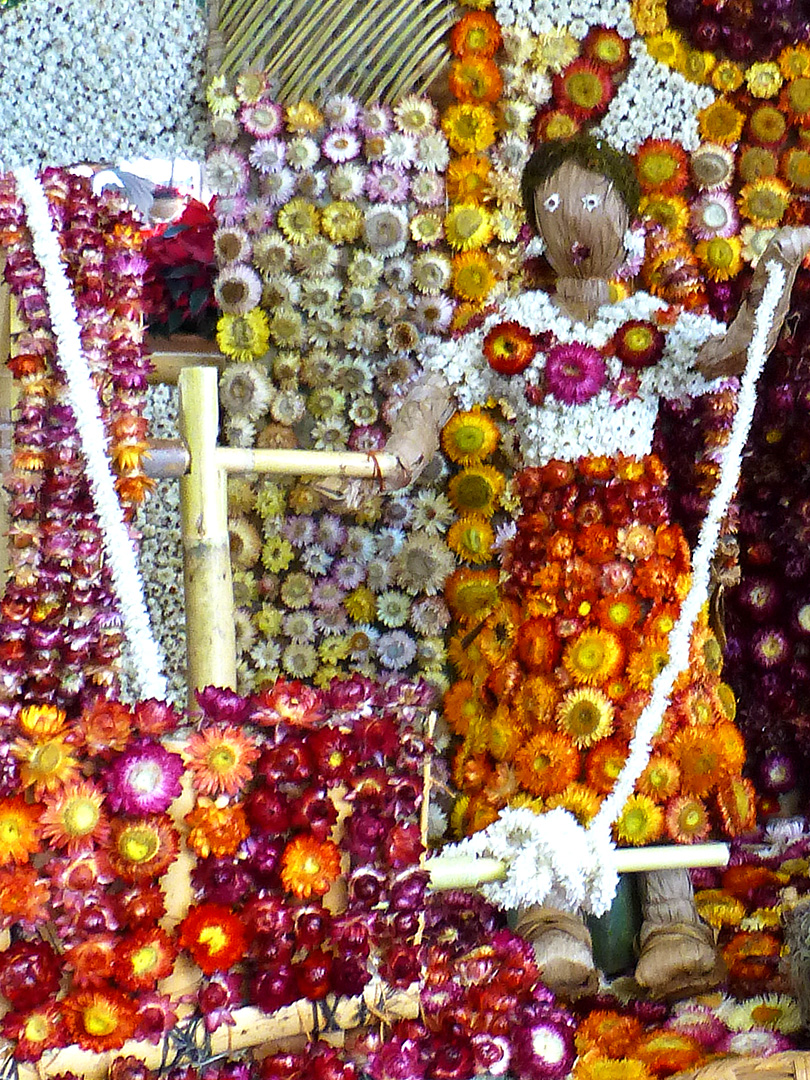
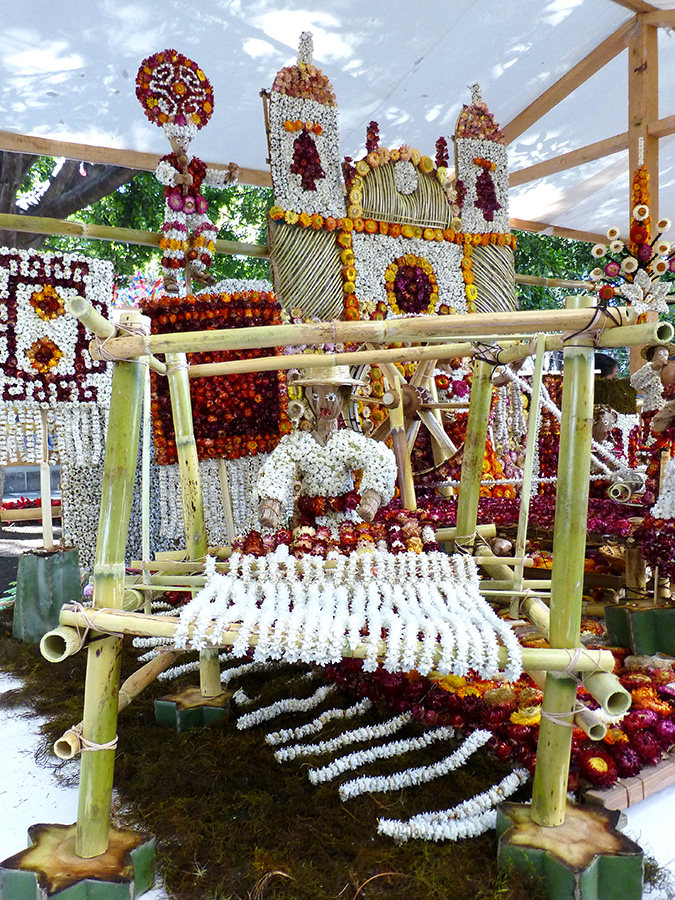
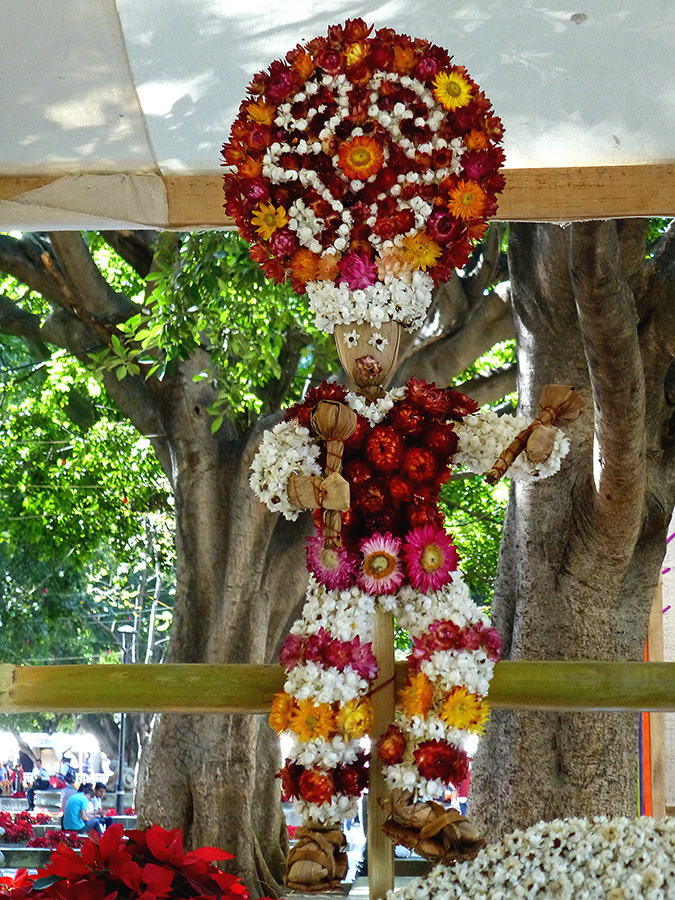
It’s December 23 in Oaxaca and Noche de Rabanos is upon us. The setting-up has begun and the spectators are gathering. Despite its name, it isn’t just about artisans working their creative magic carving radishes. There are three other categories, including the use of Flor Inmortal (a type of dried flower). I will return this evening, but in the meantime, this entry titled, “Elaborando Artesanía, Plasmando Sueños: ‘Teotitlán del Valle, Tierra de Dioses'” by Raymundo Sánchez Monserrat Maricela, is for all my friends in Teotitlán del Valle.
Spinning the wool.
Weaving tapetes from the spun wool.
Grinding corn or maybe chocolate OR maybe even cochinilla!
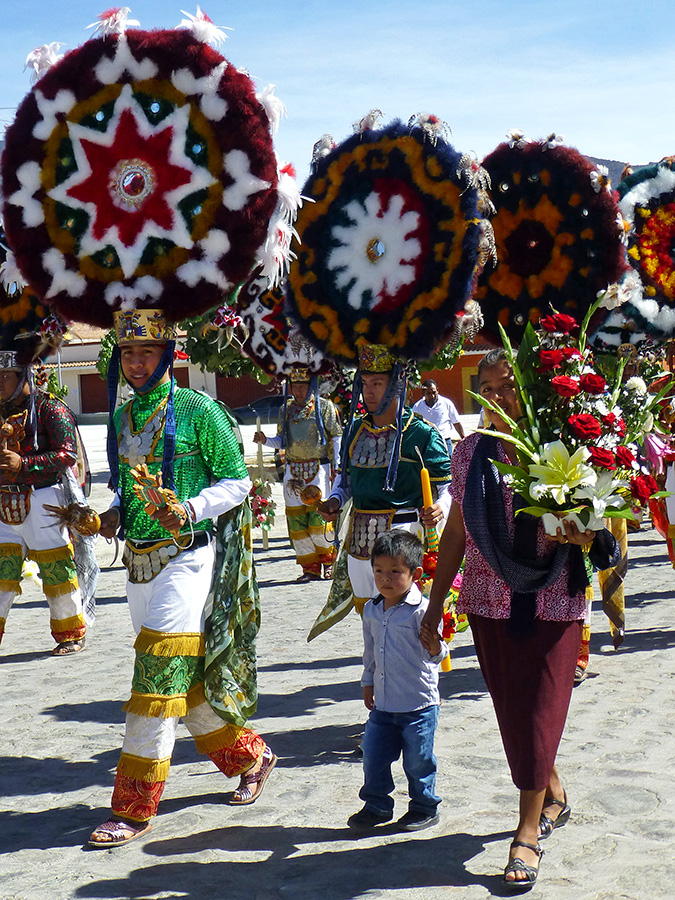
Dancing the Danza de la Pluma…
The danzantes of the Grupo de Danza de Pluma Promesa keeping their promise.
I think Raymundo did a wonderful job capturing the people of Teotitlán del Valle, the Land of the Gods, who make crafts and shape dreams.
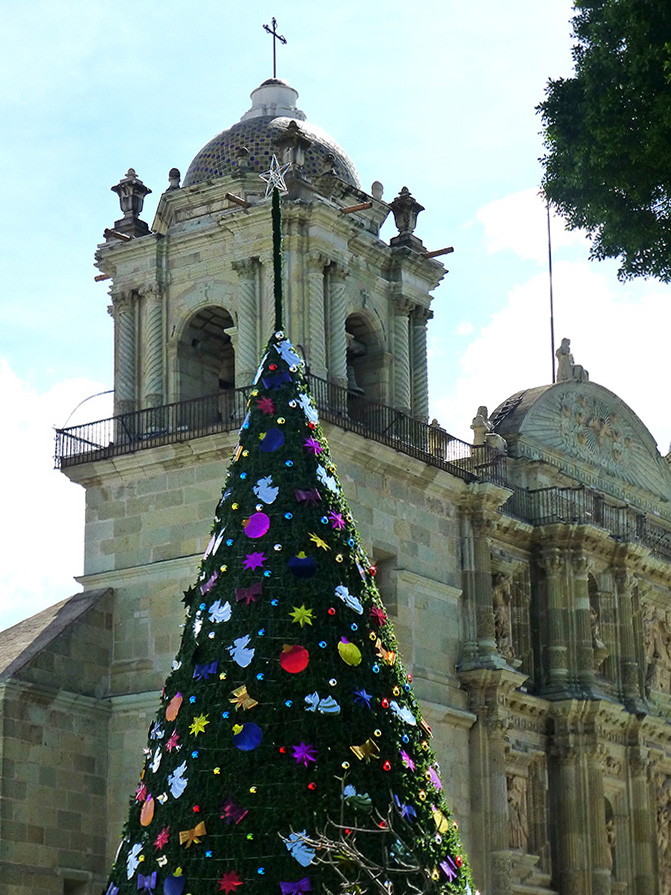
This year, a Christmas tree grows in Oaxaca. Well, not a real, living tree. This one, almost 3-stories tall, was constructed over several days alongside the Cathedral.
Adding the green panels to the frame.
Hanging the lights.
So far, so good!
All dressed up and ready to go.
Lights on; crowds assembled!
What can I say? Nacimientos (Nativity scenes) are traditional here; Christmas trees are not. However, despite what we like to think, traditions are not static, they evolve. People come and go across oceans and across borders and they bring back what captures their fancy. All I know is that the city is alive with the sound of music, energy, and lightness of being.
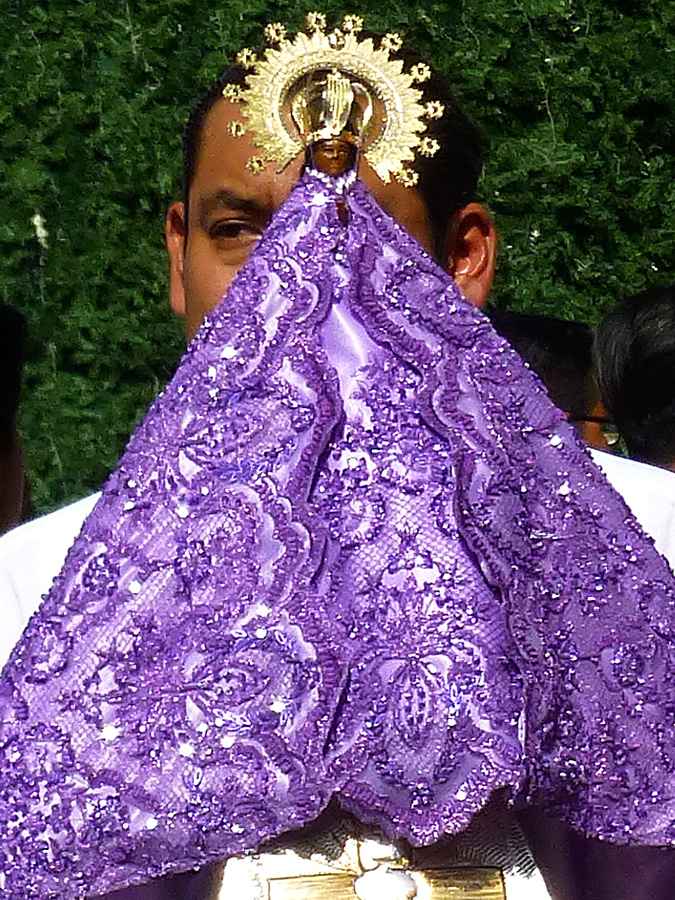
Nuestra Señora de la Soledad is the patron saint, queen, and mother of Oaxaqueños — and she is my vecina (neighbor). Thus, I shall not want for revelry!
“Inside” Soledad, in the Basílica — Dec. 17, 2016
Despite her name, there is no solitude for Soledad or her neighbors on her December 18 feast day — or the days and nights leading up to it. Like her sister December virgin images, Juquila and Guadalupe, she seems to thrive on the cacophony that is fiesta life here — after all they are Mexican Marías.
Dancing for Soledad through the streets – Dec. 16, 2016
“Child” Soledad on a flatbed truck – Dec. 16, 201616
Fireworks from the Basílica de la Soledad courtyard – Dec. 15, 2016
So, bandas playing traditional music (loudly), fireworks and rockets booming and banging, church bells urgently chiming, and lively recorridos (travels) through the streets of the city, beginning early in the morning and continuing well beyond midnight, are welcomed.
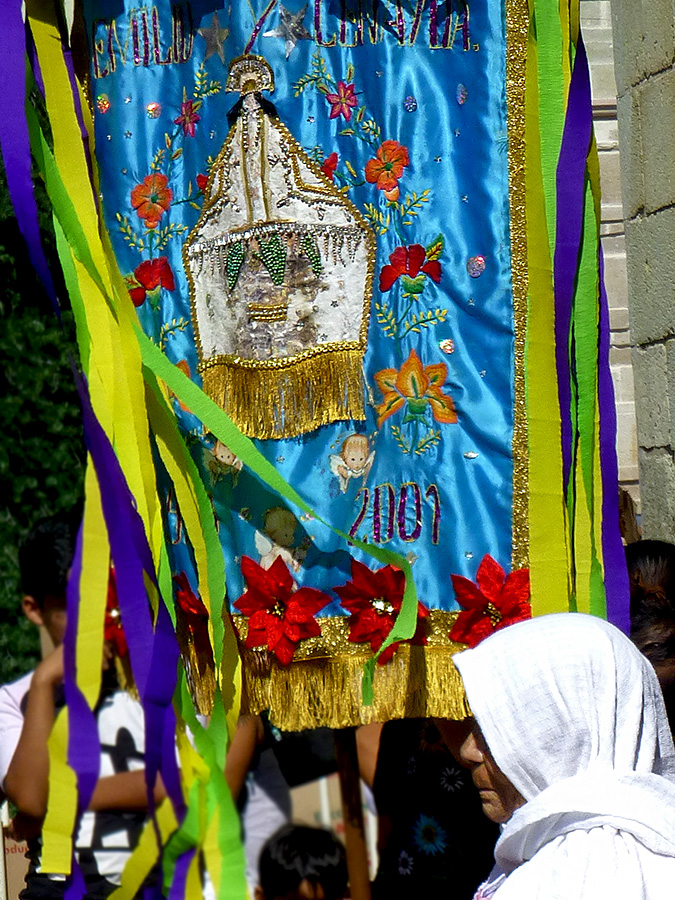
Estandartes in the Basilica awaiting another recorrido – Dec. 17, 2016
China Oaxaqueñas dancing through streets – Dec. 16, 2016
Fireworks from the Basílica de la Soledad courtyard – Dec. 17, 2016
The celebrations began at 5:00 AM on December 7, with a ringing of church bells and a “dawn journey” and culminated with a grand fiesta yesterday, December 18, her feast day. She seemed to enjoy the festivities, including these guys from the Istmo performing for her, *La Danza de los Negros.
Soledad’s fiesta will end tomorrow (Dec. 20) with a concert of Christmas carols at 7:00 PM. It’s been great fun, but I’m already looking forward to Noche de Rabanos on December 23!
“Outside” Soledad in the Basílica courtyard – Dec. 18, 2016
*La Danza de los Negros is another of those complex and multilayered dances traditional to specific indigenous cultures in Oaxaca. For more information, check out the article (en español), Los Negros, tradición bixhahui, ícono de Chihuitán.
And we thought last year’s Día de la Virgen de Guadalupe in Teotitlán del Valle was exceptional! It was, but, for blogger buddy Chris and me, this year brought even more warmth, appreciation, and the intangible of being present in the richness of more layers of being in this special village.
Edgar Daniel Ruiz Ruiz
We are patrons of two of the danzantes of the 2016-18 Grupo de Danza de Pluma Promesa in Teotitlán del Valle — and Edgar Daniel Ruiz Ruiz is one of them. As such, we were invited to the home he shares with his parents, Mario Ruiz Bautista and Victoria Ruiz, to partake in the traditions and observe the responsibilities that accompany taking on the three year commitment to being a member of the Grupo.
Mario Ruiz Bautista (on left) overseeing the offerings
From my albeit limited understanding, as part of the commitment the dancers make during their three years of service, each of their families is tasked with taking a turn hosting one of the four yearly festivals.
Victoria Ruiz watching Edgar’s dance
The day began with a breakfast of traditional breads and hot chocolate and was followed by Mole de Castilla, a mole unique to Teotitlán and served during weddings and the most important festivals. There must have been over 100 people, including Edgar’s extended family, padrinos, danzantes and their families, and band members. They gathered and were served in the courtyard of the Ruiz home, with men seated at one long table, women on the other side of the courtyard at another, and the two gringos seated with the danzantes in the altar room opening onto the courtyard.
Breakfast breads with hot chocolate
Following the meal, chairs and tables were folded and removed, the danzantes took the floor, the band began to play, and, as the sun streamed down on the courtyard, Edgar began his dance. It was a touching moment to see this young man, whom I’ve known for almost six years, since he was a gangling teenager, and Chris has known since he was a small boy, dance with such confidence and pride.
Following dances by the whole group, with band leading the way, dancers, families, and guests processed down the steep and winding streets from the house to the church.
Edgar Daniel Ruiz Ruiz en route to the church, accompanied by Victoria (his mother) and his nephew.
They filed into the church, where a special mass was celebrated, and then regrouped in the church courtyard to begin the seven hour (más o menos) Danza de la Pluma. Early in the afternoon, while the dance continued, the families and invited guests returned to the Ruiz home, where the families of the other dancers each made formal presentations of baskets of fruit and mezcal or cervesa to Mario and Victoria. This was followed by a comida (lunch) of caldo de pollo. After all were fed, the offerings were loaded into pickup trucks to be taken to the church plaza, to later be shared with the community. At night, after the dance ended, we all again returned to Casa Ruiz for barbecoa de res (beef) in a rich and flavorful sauce, cervesas, mezcal, and soda pop. I can’t even begin to imagine all the work that went into preparing all the food, orchestrating its serving, and then washing all the dishes — by hand in basins set up in the yard across the street.
Edgar Daniel Ruiz Ruiz
It’s been over twenty four hours since Chris and I returned from Teotitlán del Valle and, though we talked continuously on the drive back to the city and have spoken several times since, we are still unable to put into words how meaningful and how honored we were to share this special day with Edgar, his family, and his community. It was a precious gift. ¡Muchisimas gracias a todos!
A sign of the times… Navidad (Christmas) must be coming!
An empty bottle of Noche Buena cervesa sitting on a sill outside of Templo de San Jose. Noche Buena is the much-in-demand seasonal bock-style beer from Heineken Mexico. Its appellation, besides meaning “good night,” is also the name for the poinsettia plant and the word for Christmas Eve in Spanish. ¡Salud!
December seems to be el mes de las vírgenes (the month of the virgins) in Oaxaca. Early this morning cohetes (rockets) and church bells announced the first of the month’s three virgin days; the feast day of la Virgen de Juquila. And, this afternoon, on the Alameda in front of Oaxaca’s cathedral, a small procession gathered.
According to legend, in 1633, when a fire burned the small Chatino village of Amialtepec to the ground, a small wooden statue of the Virgin Mary was rescued amidst the ashes. She was undamaged, save for her light skin color, which was permanently darkened by the smoke, causing her to more closely resemble the Chatino people, who live in this remote mountainous region. Local priests declared her survival a miracle and she has been venerated ever since.
Alas, that wasn’t the end of the story; the priest in the village of Juquila convinced the “powers that be” that she should be moved to the bigger and better church in Juquila. She, however, had other ideas and returned to Amialtepec. This back and forth continued another three times. Finally, in 1719, La Morenita (the dear dark one), as she had come to be known, gave up her traveling ways and agreed to call Santa Catrina Juquila her permanent home.
The faithful make pilgrimages to both her old and new mountain homes (about four hours southeast of Oaxaca city). They come year round on foot, on bicycle, and in all other manner of transport, to make offerings and pray for miracles, but especially during the days leading up to December 8. October 8, 2014 marked her crowning achievement; in a grand ceremony, she received a papal coronation, joining her previously crowned (1909) Oaxaca sister, Nuestra Señora de la Soledad.
After the wretched week that was (RIP Leonard Cohen and Leon Russell, not to mention the USA elections), reviewing my Día de Muerto photos from Teotitlán del Valle was the ideal tonic.
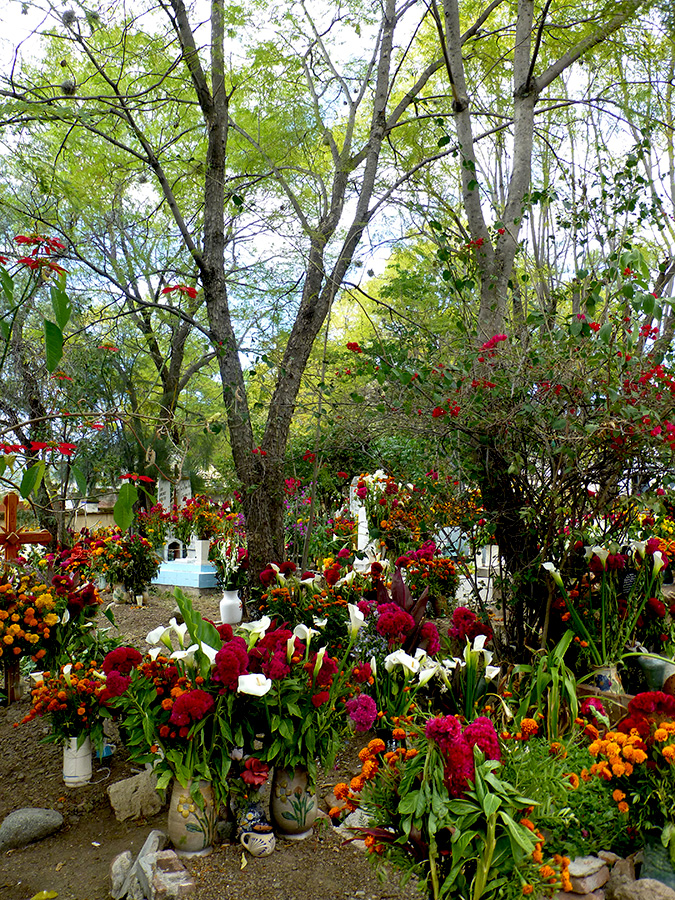
On November 1, as I previously mentioned, after strolling and sitting and contemplating and conversing our way through the panteón in Tlacolula de Matamoros, we drove to the home of friends, Zacarias Ruiz and Emilia Gonzalez, in Teotitlán. Arriving at 3:00 PM, we were just in time to join the family and other guests, as Zac gave words of welcome to the difuntos, who had also just made their appearance.
Our pan de muerto and mezcal joined the other offerings on the altar to provide nourishment to the departed while we, the living, sat down at the long table for a little cervesa, mezcal, and more than a few of the 500+ tamales Emilia had made. After lots of eating and conversation, we walked across the courtyard to give our regards to Antonio Ruiz (weaver of one of my treasured rugs), wife Claudia, and their children (the beautiful Beatriz and her lively brothers, Diego and Antonito), and to see Antonio’s new showroom (Chris has a photo in his Familia blog post) and their altar.
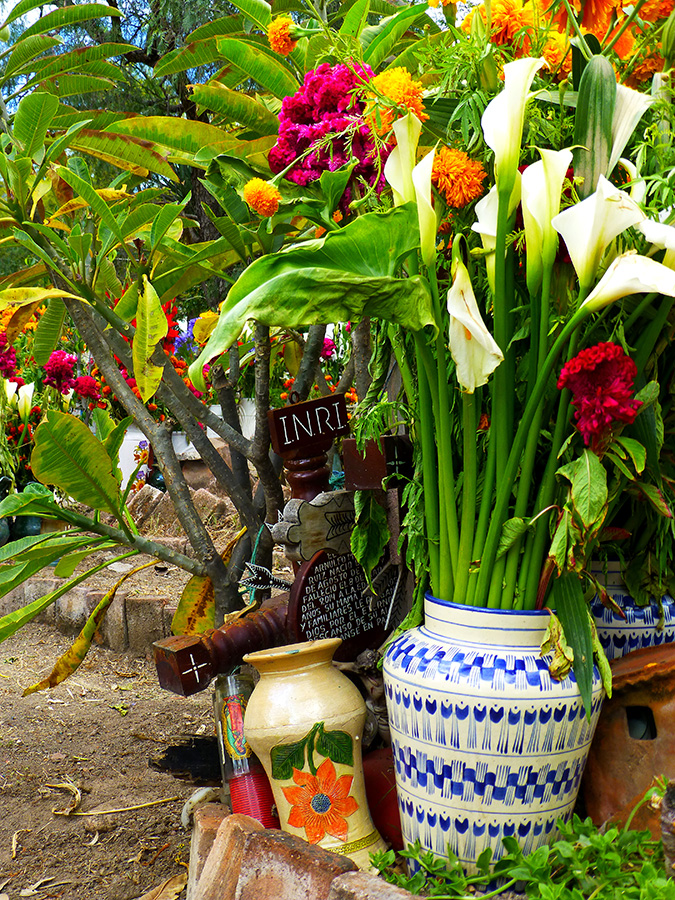
Invited to return to the Ruiz home the following day for Emilia’s famous mole negro, we also stopped at the village panteón to listen for the wind that signals the departure of the difuntos at 3:00 PM on November 2.
We also stopped to pay our respects at the grave of Arnulfo Mendoza, though it took a little searching to find it, as the large tree that stood next to it had fallen, leaving only a stump.
Both days, the drive back to the city was filled with the warmth, peace, and joy that Teotitlán del Valle always seems to impart.
Under the strong and comforting gaze of Picacho, who could ask for a better resting place.
Celebrations in Oaxaca surrounding Día de Muertos are beginning. This past week, we, members of the Mexico Travel Photography Facebook group, were issued a 5-day “Day of the Dead” photo challenge by moderator, Norma Schafer. There are always so many favorite images from so many events that I never get around to posting, so this was my opportunity. My five…
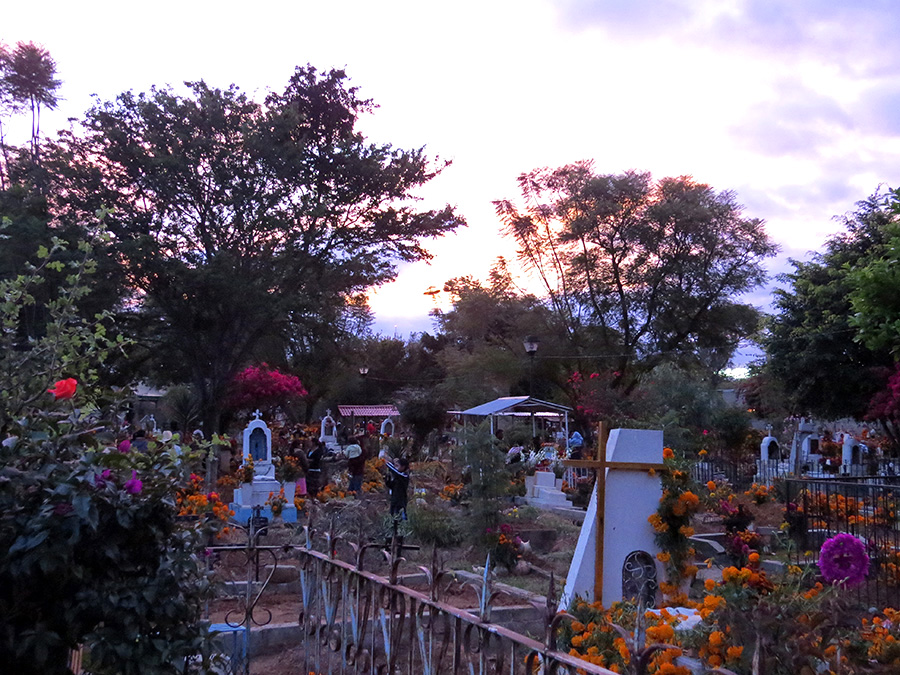
Panteón, Santa María Atzompa, Oaxaca on Oct. 31, 2015
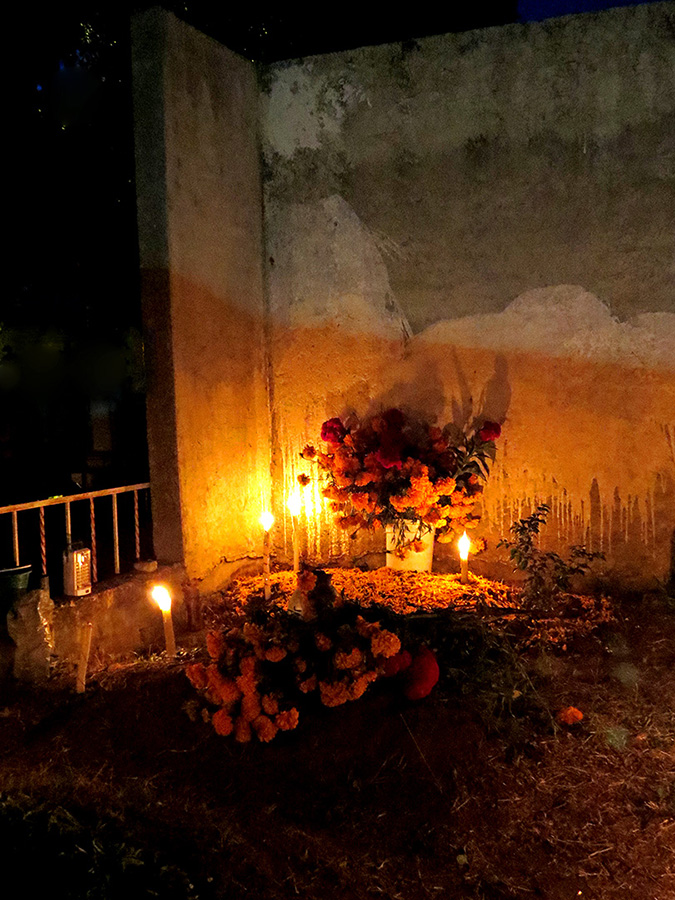
Offering on tomb in Panteón Municipal de Tlacolula de Matamoros, Oaxaca on Nov. 1, 2015
Muerteada, morning after the night before, Nov. 2, 2014, San Agustín Etla, Oaxaca
Sun sets on Santa María Atzompa panteón, Oct. 31, 2014
On the Alcalá in Oaxaca City, Oct. 31, 2014
And, five more, just because…
Santa María Atzompa, Oct. 31, 2015
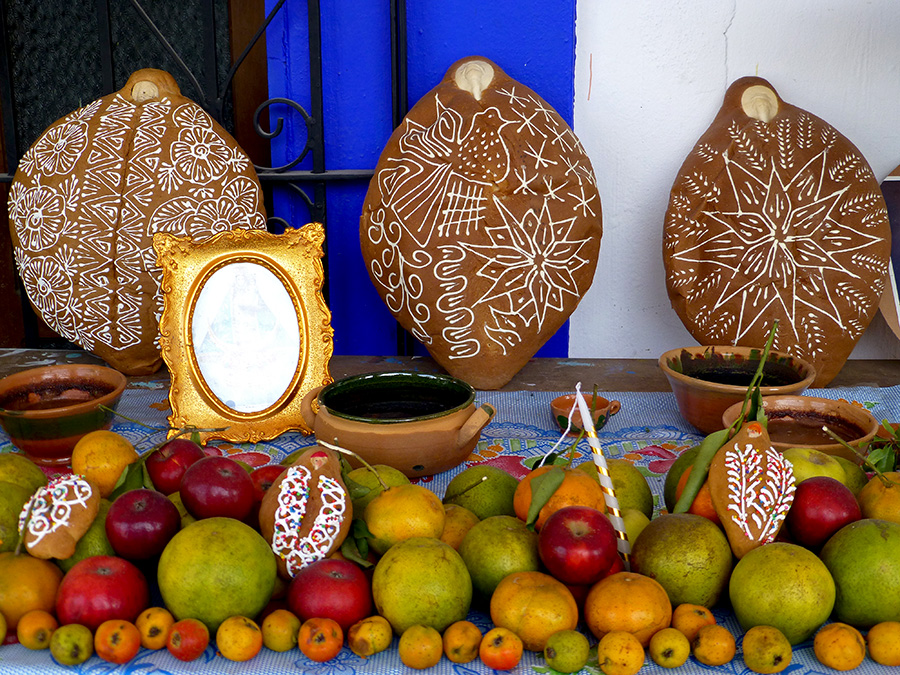
San Pablo Villa de Mitla, ofrenda with pan de muertos, Nov. 1, 2014
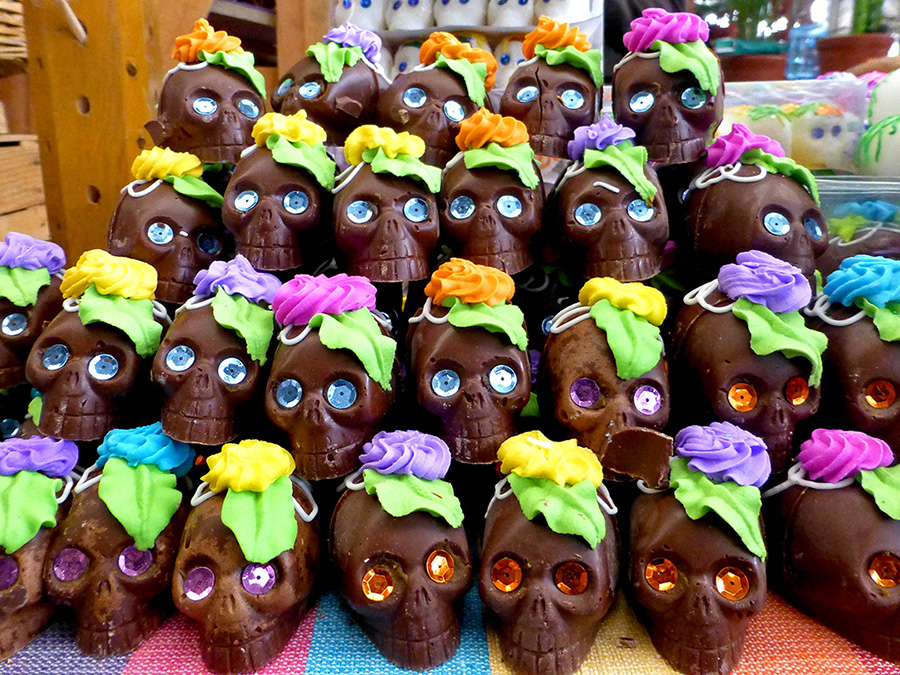
Chocolate calaveras at Villa de Etla, Oct. 31, 2014
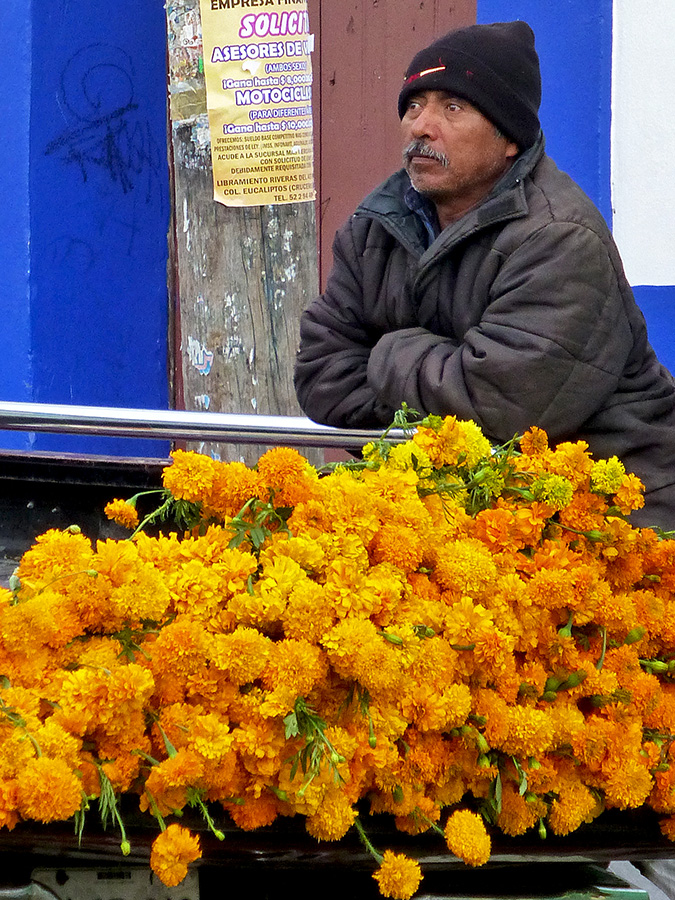
Cempasuchil (marigold) vendor at Villa de Etla, Oct. 31, 2014
Casa de las Artesanías de Oaxaca, Oct. 31, 2015
That’s all folks, for now. Stay tuned for more to come from this year.
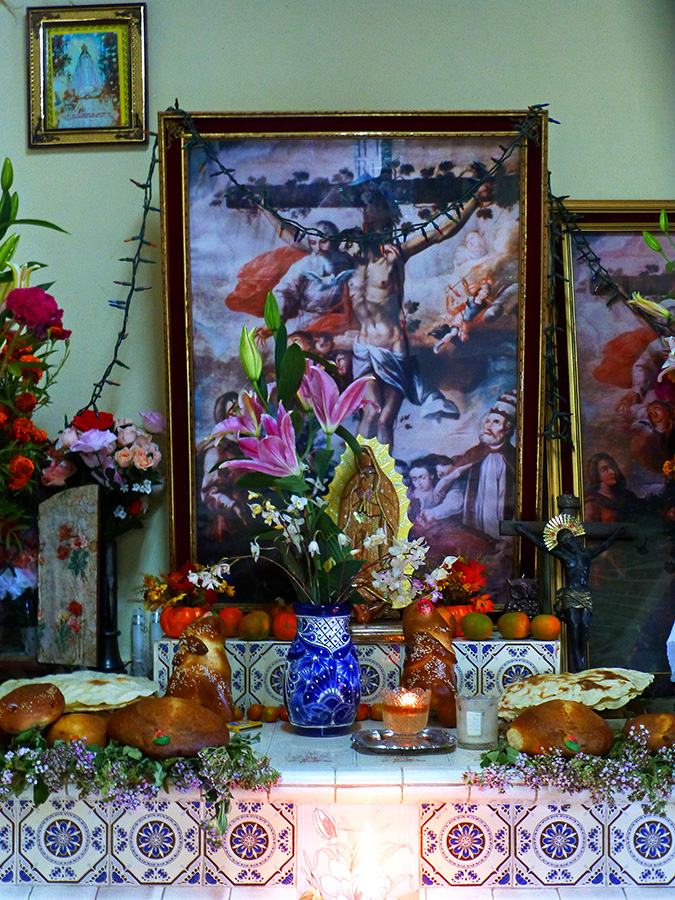
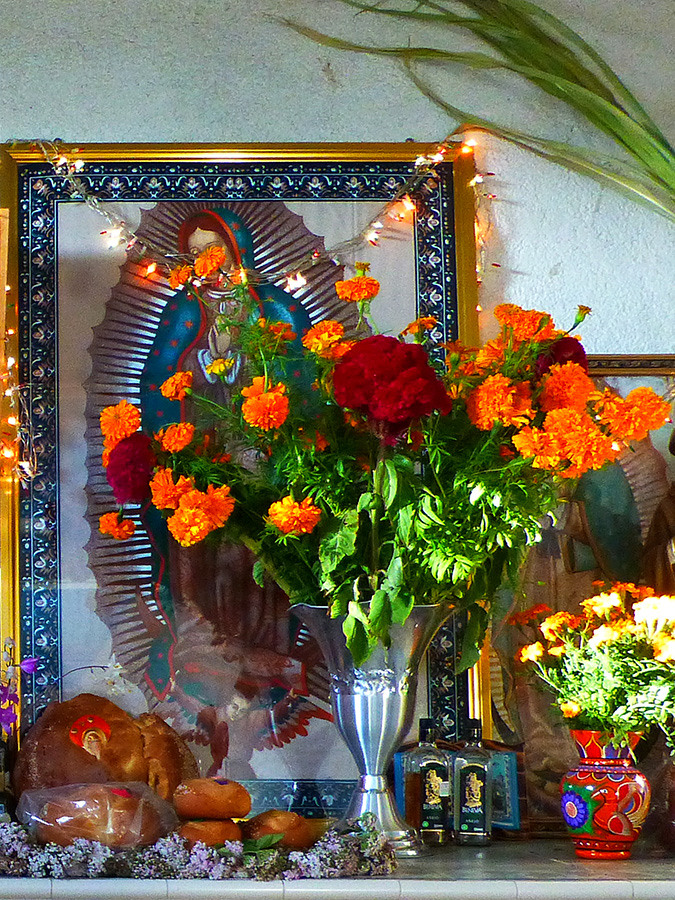
Marigolds have begun appearing in the city. The yellow of this flor de muertos (flower of the dead) will help guide the difuntos (deceased) home to feast with their families during the upcoming Día de Muertos (Day of the Dead) celebrations. Known as cempazuchil (also spelled cempasúchitl), flower pots and/or vases of marigolds may find their way onto ofrendas (the offerings on home altars for the difuntos). Some scatter the petals on their muertos altar, others in a trail leading from the street into the house and up to the ofrenda.
Next week, seasonal Day of the Dead markets will spring up and shopping will go into high gear. Needless to say, I will join in buying the traditional fruits, nuts, flowers, and sugar skulls to place on my ofrenda. And, along with friends, I will pay my respects to the difuntos of friends in Teotitlán del Valle. It’s a special time of year in Oaxaca.
Once a librarian, always a librarian, thus a few resources about Day of the Dead:
A brief note: Celebrations vary throughout Mexico and, even in the valley of Oaxaca, traditions differ from village to village, but the above articles will give you a general idea. You can also click HERE for my Día de Muertos blog posts from previous years.
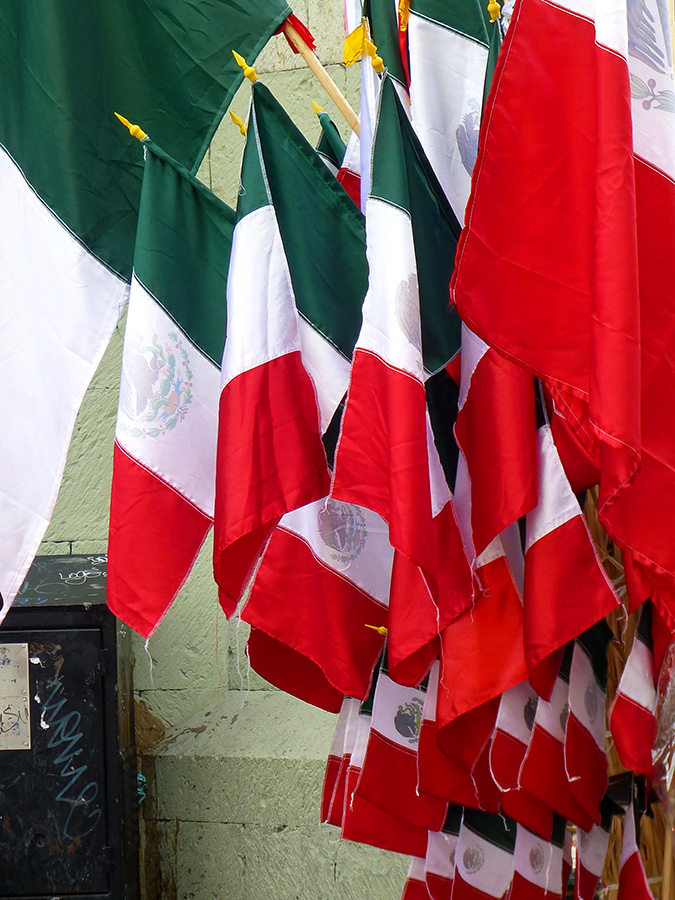
Mexico’s El Mes de la Patria (the month of the homeland) is upon us and overnight, as August turned to September, the streets erupted in green, white, and red.
Mexico celebrates September 16, 1810 as the beginning of its fight for independence from Spain.
Flags are flying everywhere and are for sale on every other street corner, along with all manner of patriotic tchotkes.
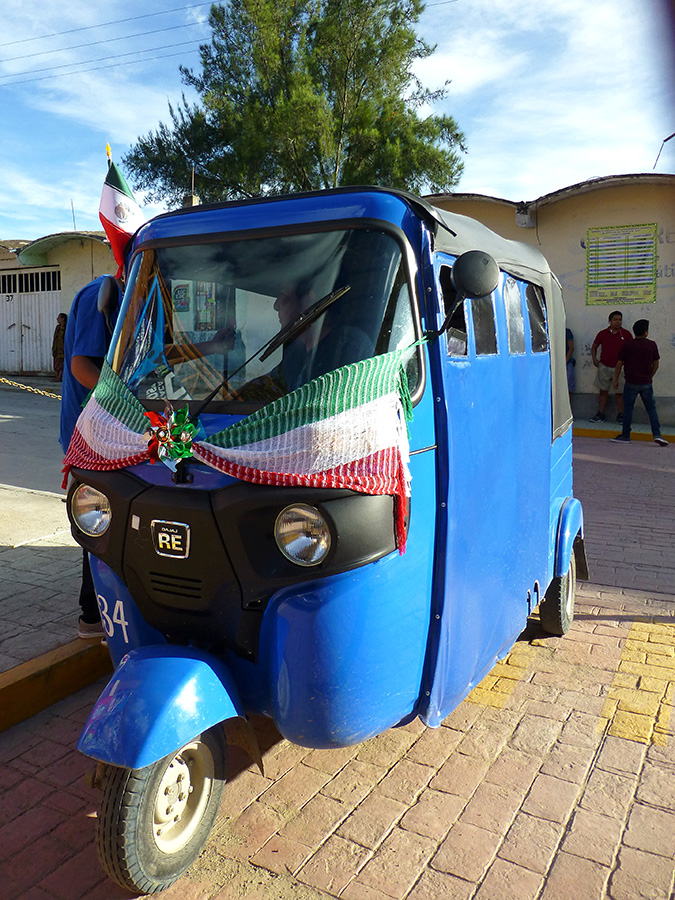
From buses in the city to moto-taxis in the villages, everything is decked out in the green, white, and red of the Mexican flag.
As for Oaxaca? The five-month renovation project at Mercado Benito Juárez has been completed and vendors have moved from their temporary stalls on the surrounding streets back into the market; Sección 22 teachers have returned to their classrooms and 80% of the encampment in the zócalo has been disassembled; the governor will give his final Grito de DoloresGrito de Dolores at 11:00 PM on September 15th; and the annual patriotic parade will fill the streets of the Historic District with participants and observers on the 16th.
The morning of August 12: Almost continuous explosions of cohetes (rockets), shrill incessant traffic whistles, honking horns, and the distant sounds of a band (or two or three). What in the world? I had errands to run, so out into the cacophony to confront the unknown, I went. It only took walking to the end of my block to realize what I’d forgotten.
It’s Día del Taxista, the day when cab drivers and their families decorate their taxicabs and process en mass through the streets of the city, accompanied by bands, monos, and pirotecnicos (hence the booms and bangs).
I not only forgot what day it was, but I also forgot my never-leave-home-without-it little Lumix, so the above were taken with my iPhone — something I almost never do and which explains the “creative” image below.
I have NO idea how it happened, but I’ve got to say, it does illustrate what riding in a taxi in Oaxaca often feels like!
One of the much anticipated features of this year’s Fiesta Titlular a la Preciosa Sangre de Nuestro Señor Jesucristo in Teotitlán del Valle was the debut of the new Grupo de Danza de Pluma Promesa.
Danzantes
Danzantes
Unlike in many of the other villages, where the Danza de la Pluma is danced by folkloric dance troupes, in Teotitlán del Valle nineteen young men and two little girls make a promise to their god and, thus, their community to learn and perform the dance at each of the four annual major religious festivals in the village for three years.
Moctezuma with Malinche and Doña Marina
Danzantes woven wool leggings
This is not a commitment to be taken lightly, as there are 40+ dances that comprise this Zapotec retelling of the story of Moctezuma and the Aztecs battle with Cortes and the Conquistadors. The entire telling of the story takes almost eight hours to perform in the church plaza — in conditions that can vary from brilliant sun with sweltering temperatures to gusty winds to drizzling rain.
Subalterno offering water
Subalterno imitating the danzantes
It’s been almost six months since we first saw the new group at one of their early practice sessions. In jeans, t-shirts, and gym shoes, the guys were at the beginning stages of learning the steps.
Moctezuma, a danzante, and Doña Marina
Moctezuma and the danzantes
They have learned well and it’s going to be an outstanding three years!
Happy Father’s Day (Día del Padre) to the loving fathers (biological, adoptive, and step), grandfathers, and father figures everywhere.
This slideshow requires JavaScript.
Color Him Father (click on link for Keb Mo performing The Winstons old song)
There’s a man at my house he’s so big and strong He goes to work each day, stays all day long He comes home each night looking tired and beat He sits down at the dinner table and has a bite to eat Never a frown always a smile When he says to me how’s my child I’ve been studying hard all day in school Tryin’ to understand the golden rule
Think I’ll color this man father I think I’ll color him love Said I’m gonna color him father I think I’ll color the man love, yes I will
He says education is the thing if you wanna compete Because without it son, life ain’t very sweet I love this man I don’t know why Except I’ll need his strength till the day that I die My mother loves him and I can tell By the way she looks at him when he holds my little sister Nell I heard her say just the other day That if it hadn’t been for him she wouldn’t have found her way My real old man he got killed in the war And she knows she and seven kids couldn’t of got very far She said she thought that she could never love again And then there he stood with that big wide grin He married my mother and he took us in And now we belong to the man with that big wide grin
Think I’ll color this man father I think I’ll color him love Said I’m gonna color him father
This morning, I awoke to the familiar, if startling, sounds of cohetes (rockets). Oh right, it’s Día de la Santa Cruz (Day of the Holy Cross). Alas, no pilgrimage hike up Cerro Picacho for us this year; we are still in recovery from our island adventure AND, more importantly, even at 7:30 AM, it is too darn hot! Have I mentioned Oaxaca has been experiencing 90º – 96º F temperatures for the past month? That’s 10º F above average. Exhausting it is and sweltering we are.
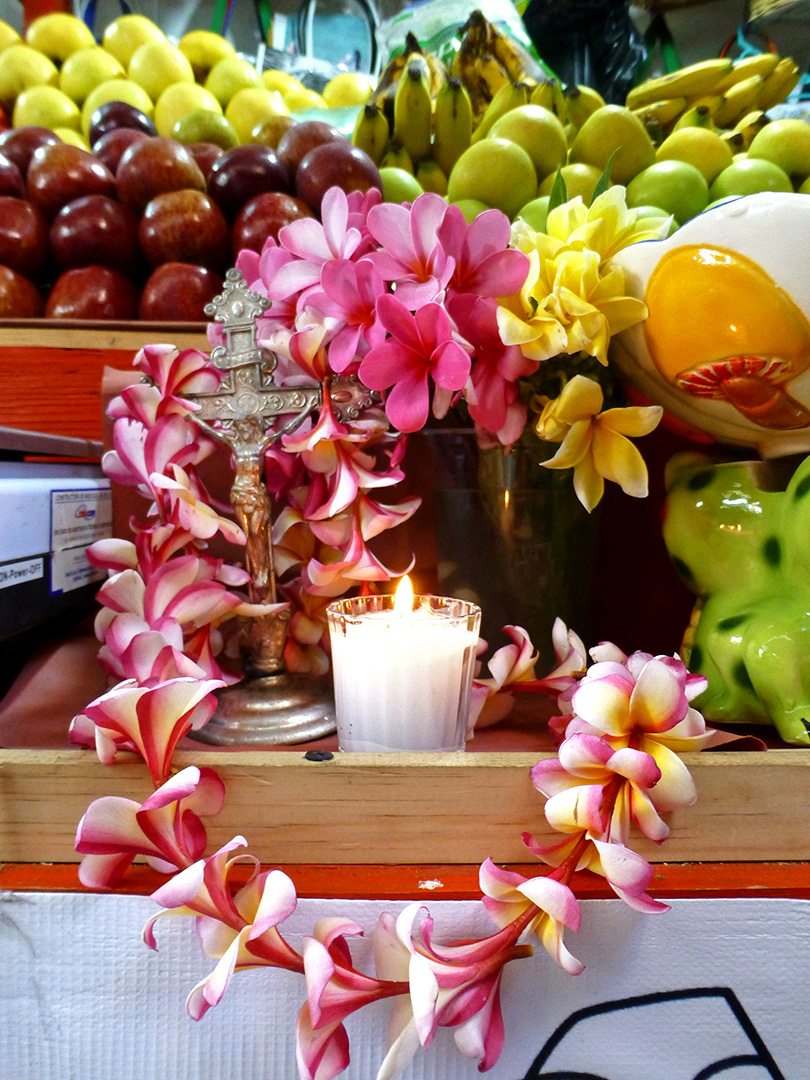
However, before the sun was directly overhead, I returned to Benito Juárez mercado hoping my coffee guy would be there. He wasn’t, but many of the stalls had beautifully decorated alters, fragrant with the sweet scent of flor de mayo (plumeria) blossoms.
In Mexico, it is also Día del Albañil, the feast day of the stonemason/bricklayer/builder because, according to this article (en español):
Before the Conquest, the indigenous Mesoamerican related to the cross with the cardinal directions of the Indian cosmography north, south, east, west and central graphically formed the cross.
With the arrival of the Spaniards, this evocation was eradicated and replaced by religious symbolism of the Holy Cross.
Since then the celebration of this feast with the construction of houses, churches, monasteries, and other buildings with Indian labor was established.
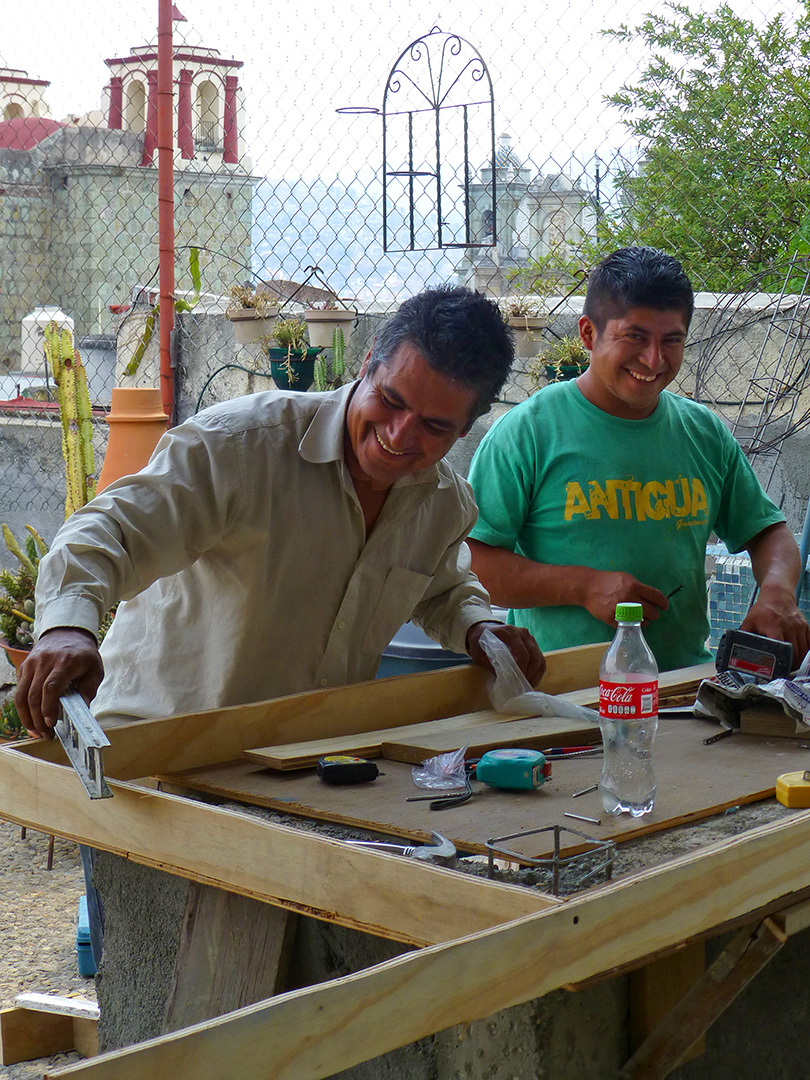
However, Sebastián and Leonardo continued working on my new counter. And, yes, there will be tile!






















 Mexican Peso Converter

 View From Casita Colibrí