Feeds:
Posts
Comments

Archive for the ‘Food’ Category

Sunday, we headed up into the clouds of Oaxaca’s Sierra Norte to San Antonio Cuajimoloyas.  At 10,433 feet above sea level and nestled in a forest of pine and oak trees, the setting has an ethereal feel and seems a world apart from the valley below — almost like being in an alpine village in Switzerland.

Wood house with tin roof

Getting up there wasn’t easy, thanks to the bumpy and winding dirt road.  However, reaching our destination, the Feria Regional de Hongos Silvestres (fair of wild mushrooms) was well worth it!

Banner above municipal building, against a cloudy sky, announcing, "Bienvenidos,12va. feria regional de Hongos Silvestres"

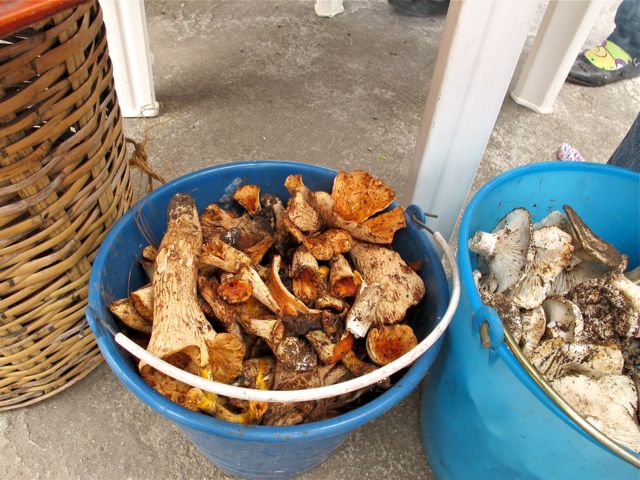
Once there, baskets, buckets, and boxes filled with freshly gathered mushrooms greeted us.

Blue plastic bucket of trumpet mushrooms

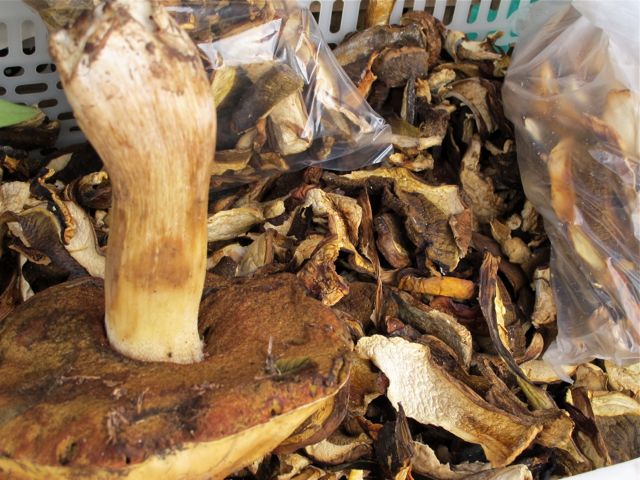
Close-up of mushrooms

Mushrooms in a box

Orange capped mushrooms in a green container

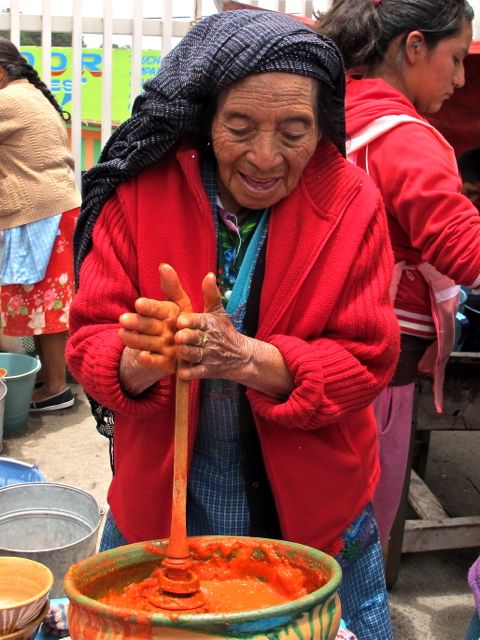
Not only was there a bounty of raw mushrooms, the aroma of sautéed mushrooms, mushroom tamales, and mushroom empanadas stimulated our appetites and we tried them all, and washed it down with an atole rojo made by this beguiling gal.

Elderly woman mixing atole rojo.

And no, these were not “magic mushrooms” but the experience was, indeed, magical.

Read Full Post »

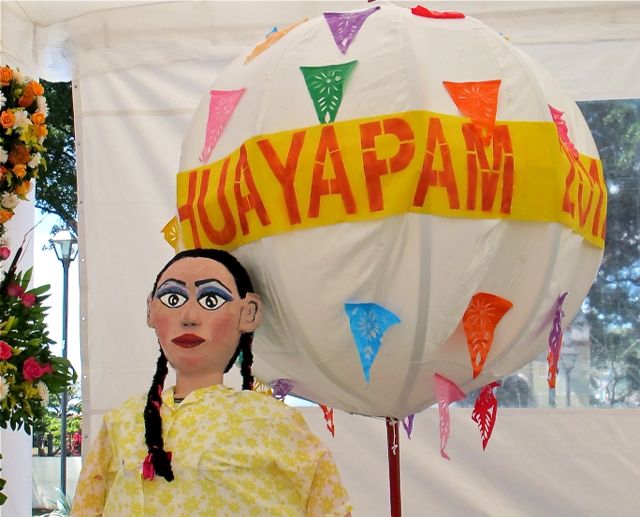
Oaxaca is a foodie paradise, in major part, because much of its cuisine draws on and honors its pre-Hispanic roots.  And, right now, during this time of Guelaguetza, various food and beverage ferias and festivals are also happening throughout the city and central valleys of Oaxaca.  Today, on the Plaza de la Danza, the Feria del Tejate y el Tamal, celebrating these specialties of San Andrés Huayapam, opened with the usual fanfare — music, monos, a marmota, and speeches.
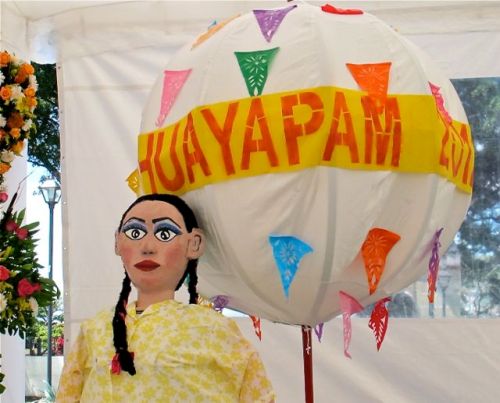
Mono and marmota with "Huayapam" printed around it.

Present were a number of local dignitaries, including Evelyn Acosta López, the recently elected corn goddess, la Diosa Centéotl 2012, who presides over the Guelaguetza.

Evelin Acosta López seated.

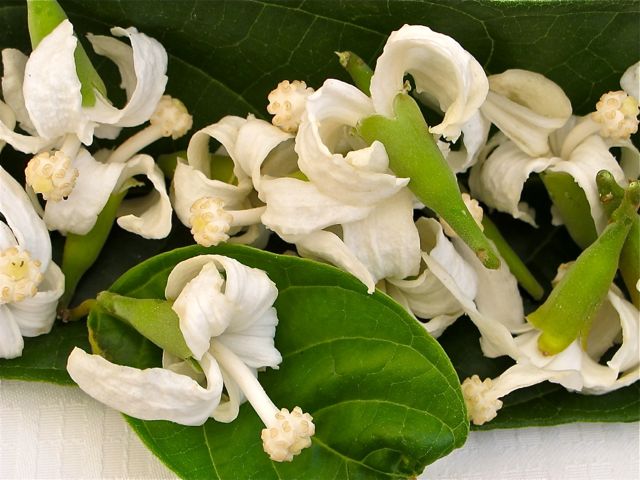
Tejate is a foamy, refreshing, and nutritious non-alcoholic pre-Columbian beverage made from Nixtamal corn, mixed with tree ash, and toasted cacao beans, mamey seeds, and Rosita de Cacao flowers.
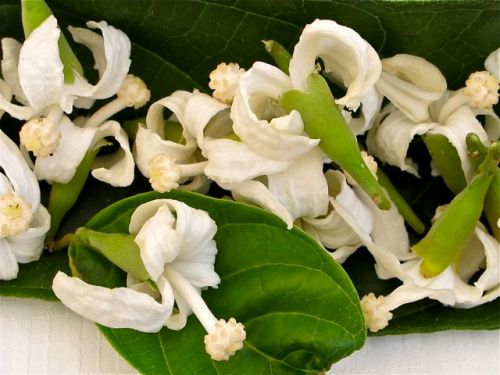
Rosita de Cacao blossoms.

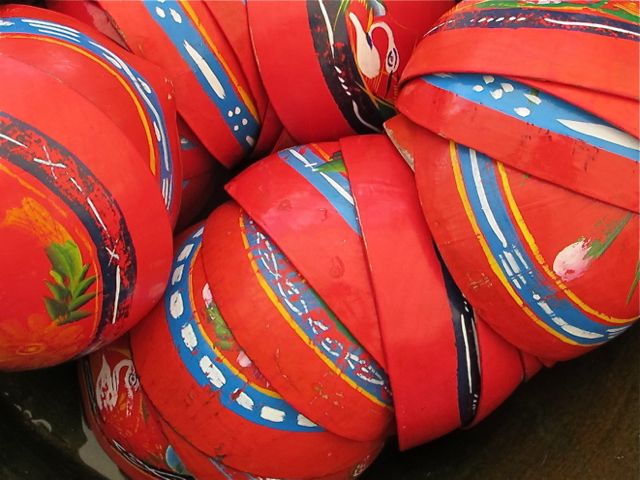
One frequently sees tejate, served in these colorfully painted gourds, in the mercados of Oaxaca, at festivals, and street side stands.
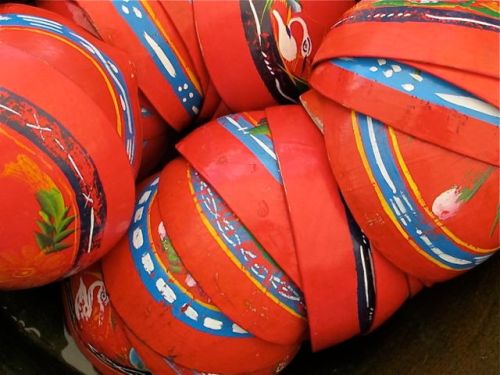
Dried and hollowed-out gourds painted red with blue, yellow, and green decoration.

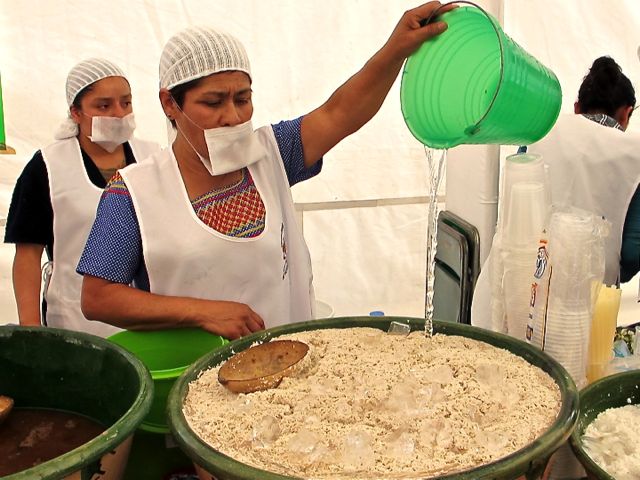
And, yes, it is safe to drink.  The water and ice that are added…
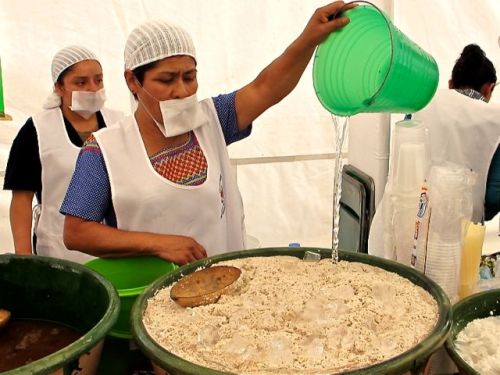
Woman with surgical mask pouring water from bucket into large pot of tejate

come from garrafons of “pure” water.

Stack of garafons (jugs) of pure water.

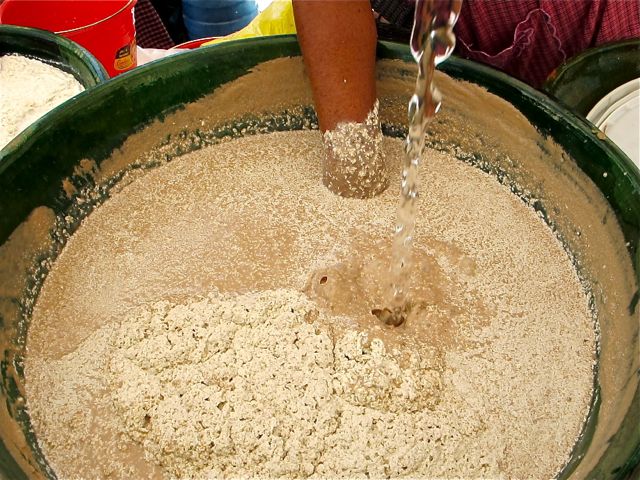
And, please, don’t be put off by the women, up to their elbows, mixing the ingredients.  Just think about it…  Chefs often use their hands when preparing food and arms are generally much cleaner than hands!  Believe me, these women take great pride in their expertise and product.
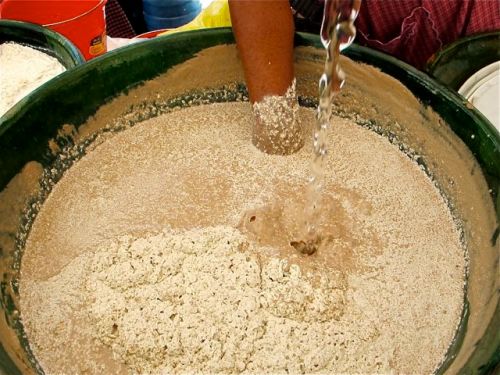
Hand and lower arm mixing tejate as water is added

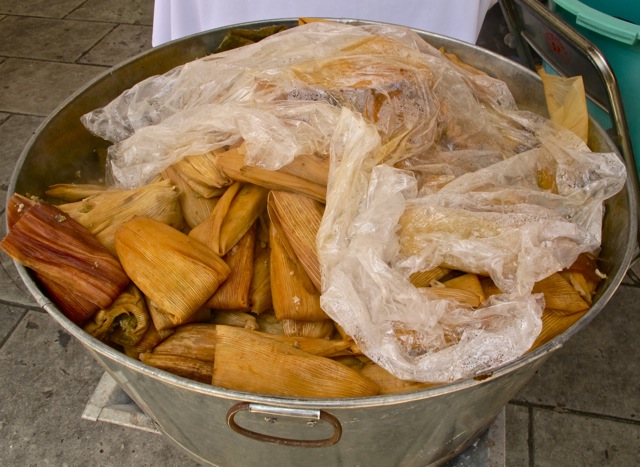
Oh, right, there were also tamales!  Once I finished taking photos and drinking a tall cup of tejate, I made my day’s tamal purchase; chepil, chichilo, and mole.  Tomorrow, I will be returning for more.
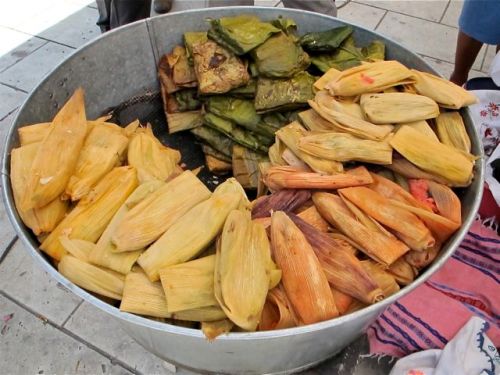
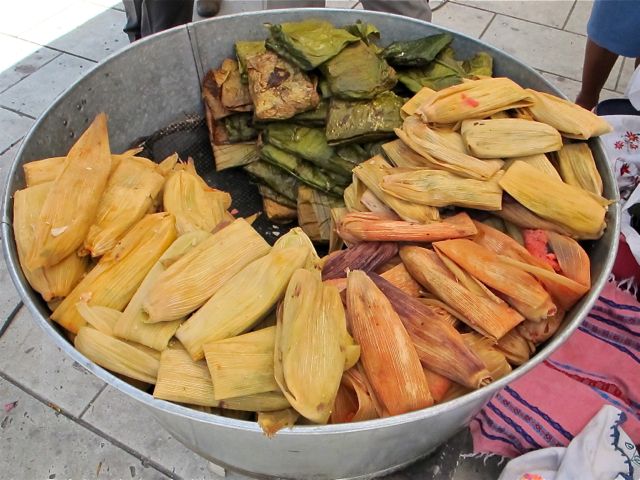
Large galvanized aluminum bucket filled with a variety of tamales wrapped in corn husks and banana leaves.s

The Feria del Tejate y el Tamal runs today and tomorrow at the Plaza de la Danza, then moves up to San Andrés Huayapam for Saturday and Sunday.  You can find a little more information about the feria in last year’s blog post, Tejate and tamales.

And, sheesh, I still haven’t blogged about the cheese feria, mushroom feria, not to mention, the Feria Nacional del Mezcal — all of which I’ve attended during the past several days!

Read Full Post »

And, then there was the Festival de los 7 Moles opening buffet lunch set amidst the beauty and tranquility of the Jardín Etnobotánico.  Serendipity and synchronicity brought us there… running into a friend, conversation, investigation (see pots below), and her enthusiasm and powers of persuasion (gracias, Rosa!) had us purchasing tickets on the spot.

While kitchen staff prepared the serving platters and bowls…

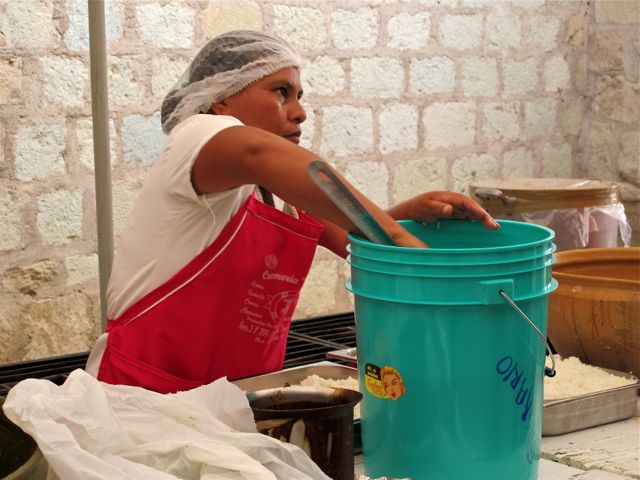
Woman in apron and wearing hairnet, scoops cooked rice out of a large bucket.

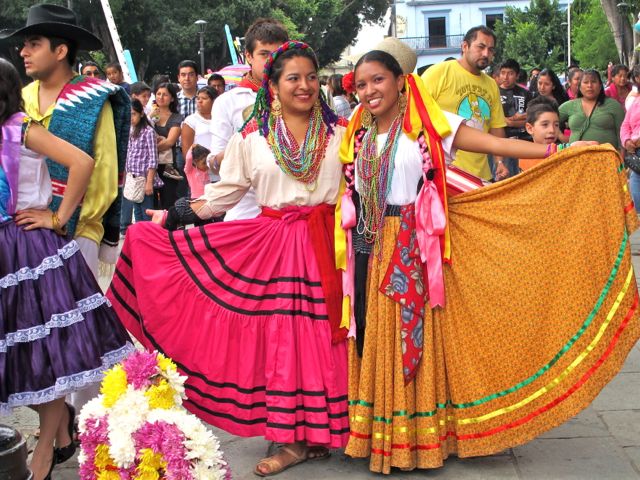
Dancers gathered on the Alameda for a calenda that would lead people the luncheon.

Two women displaying their long  colorful full skirts

They included a number of small children…

Woman squatting down and clasping hands with a toddler-age boy - both in indigenous dress

The calenda, including the requisite marmota (giant cloth balloon), monos (giant puppets), band, dancers with canastas (see yesterday’s post), and the sponsoring banner of CANIRAC (national association of the restaurant and food industries), made its way up the Alcalá…

Procession with marmota, monos, and banner

before turning onto Constitución and entering the Jardín, where wait staff and divine moles awaited.

Wait staff, wearing black, white, and grey gathered next to table.

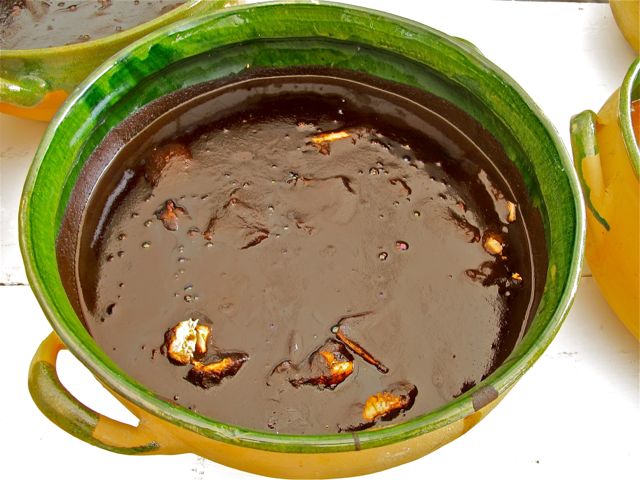
Yummm, mole negro

Large green pottery bowls filled with black mole.

Mole amarillo

Green pottery bowls of red colored moles

Mole coloradito

Green ceramic pot with red mole.

Mole verde

Green mole in green ceramic pot

There was also mole chichilo, mole manchamanteles, and mole rojo.  I tried them all!!!  And, I haven’t even mentioned the cervesa, mezcal, aguas, and appetizers of quesillo, chicharon, and tacos filled with guacamole and chapulines (grasshoppers).  You’ll have to switch over to Chris’s blog to see those and much more.  Oh, and for dessert, a scoop of each of my favorite nieves (sherbet); leche quemada (burned milk) and tuna (cactus fruit).

A day filled with light, color, music, fabulous food, and, most of all, wonderful friends — the recipe for a perfect day!

(ps)  There are almost 50 restaurants around town that will be featuring mole as part of this 12-day festival.

Read Full Post »

One of the pleasures of living here, is grocery shopping at the traditional mercados.   As the map from my local Mercado IV Centenario shows, the variety of items sold rivals any US supermarket chain.

Color coded map of Mercado IV Centenario stalls painted on wall.

The freshness and quality far exceeds anything the chains have to offer and you can’t beat the personal attention.

Woman vendor in her produce stall.

There is something comforting about being recognized and greeted by favorite vendors and gratifying about purchasing tamales proudly sold by the loving hands that made them.

White-haired woman sitting behind two plastic buckets full of tamales

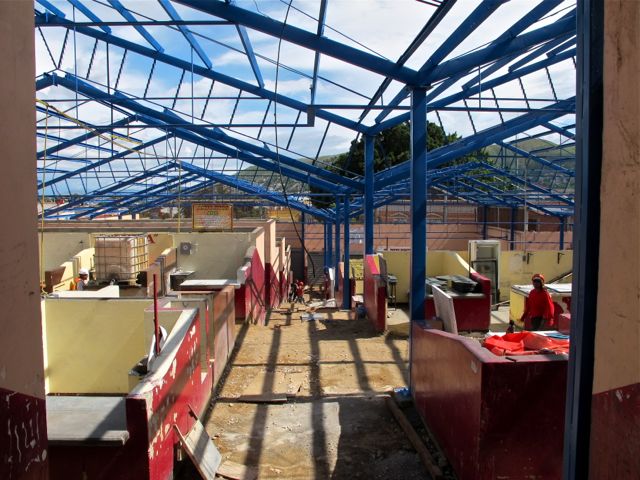
However, on May 14, 2012, Mercado IV Centenario, operated by the municipio of Oaxaca de Juárez, began a much-needed major renovation.  The doors have been locked…

Chains locking double doors.

and demolition has begun.

Construction workers demolishing interior of mercado

According to a May 25th article, the project includes a new roof and bathrooms, waterproofing, installing tile floors, interior and exterior painting, and rehabilitation of the water, sanitation, and electrical systems.  In addition, an access door on the busy avenida Independencia will be constructed.

For the duration of the renovation, the merchants and their stalls have been relocated under a big blue tent in Jardín Morelos on Independencia, across from the chain supermarket, Soriana.  Rather than hurting business, the vendors report sales have increased at the temporary site and are hoping to bring the new customers along when they move into the newly renovated Mercado IV Centenario.

Read Full Post »

Last night, under starry skies, I returned to Casita Colibrí.  The streets were wet and potholed (more than usual) and even in the dark, my garden looked green and lush, all thanks to the rains Hurricane Carlotta brought and a storm track that continues to have Oaxaca in its sights.

After a verrry slow morning spent renewing my apartment’s acquaintance (remember, no TP in the toilet), gazing at the view, and unpacking, armed with two shopping bags, I headed down to Mercado IV Centenario (my local mercado) for some much-needed restocking, only to find doors locked.   Ooops!  I’d forgotten, as of mid May it was temporarily relocated to Jardín Morelos, due to a long overdue renovation project.  So, down the stairs and across Independencia to the new site, I went.  How nice it was to see the familiar faces of my favorite vendors and what warm greetings I received.   Ahhh… it’s good to be back!

The route home took me up through the Plaza de la Danza.  And, what to my wondering eyes did appear?   A boxing ring, boxing fans, and a boxing match in progress.  Darn, I neglected to bring my camera.  Hey, it was just supposed to be a grocery shopping trip!  However, this from my iPod Touch camera.

2 boxers in boxing ring with referee in background.

Concerts, dance exhibitions, fireworks staging site, ferias and now boxing in the Plaza de la Danza.  As I’ve said, the public spaces in Oaxaca are well used!

Read Full Post »

I’m again in the San Francisco Bay Area, visiting family and friends and taking care of the odds and ends of still maintaining a presence here, while living in Oaxaca.  We’ve had clear blue skies and sun and, except for the high-speed pace and exorbitant price of food, it “almost” feels like home.  Hey, I even bought some resin chairs for my son’s backyard and ate some of the best Mexican food ever (in the USA) at Doña Tomás in Oakland.  (FYI:  The Callos con Sopa de Elote — puréed corn soup with seared day boat scallops and fingerling potatoes, roasted poblano chiles and cilantro, served with arroz achiote — was divine.)

To also keep from getting too homesick for Oaxaca, there are a currently a couple of exhibits in San Francisco I plan to see while here.  I found out about The Magic Surrealists of Oaxaca, Mexico from the Oaxacan surrealism hits the SF Mexican consulate article in the SFBG, which explains…

Aquatint etching

Francisco Toledo’s aquatint etching “Self Portrait”

The Zapotec identity … is one of the unifiers of the exhibit, which contains the works of not only [Rufino] Tamayo and [Francisco] Toledo but also artists who were inspired by their work like Justina Fuentes Zárate, she of the reclining mermaid and arresting red dress. Perhaps the works don’t look similar, but they represent the diversity and breadth of the work to come out of the surrealist Zapotec tradition in Oaxaca.

And, then I read the NPR story, In Mexico, Mixed Genders And ‘Muxes’, about a Galería de la Raza exhibit.

Parade of Muxes in traje of Juchitán

Photo from the exhibit

Searching for Queertopia revisits the experiences of Alexander Hernandez’s participation and Neil Rivas’ visual documentation of what is called, the Vela de ‘Las Intrépidas.’ This event, a 3-day celebration, is held annually in the town of Juchitán de Zaragoza, Oaxaca, México, in honor of its Muxe community.

Hmmm… maybe I’ll take the ferry over to “The City” tomorrow.

Read Full Post »

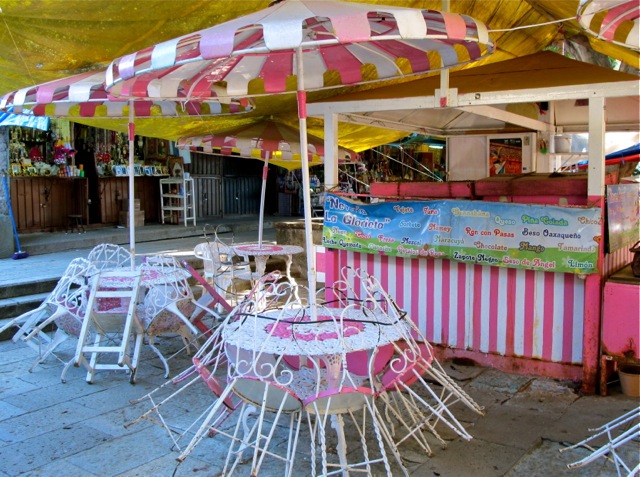
On my first visit to Oaxaca, I was introduced to Jardín Sócrates, part of the Templo de la Soledad/Plaza de la Danza complex, between Independencia and Morelos.  The original Jardín Sócrates was constructed as a public garden in 1881 and remodeled for its 100th birthday.

Pink and white iron chairs and umbrella in front of a neveria stand.

I have a weakness for ice cream, sherbet, and gelato and, thus, was completely “in heaven” being surrounded by stands selling the most amazing flavors of  milk and water based frozen desserts.

Green and yellow iron chairs and umbrellas in front of a neveria stand.

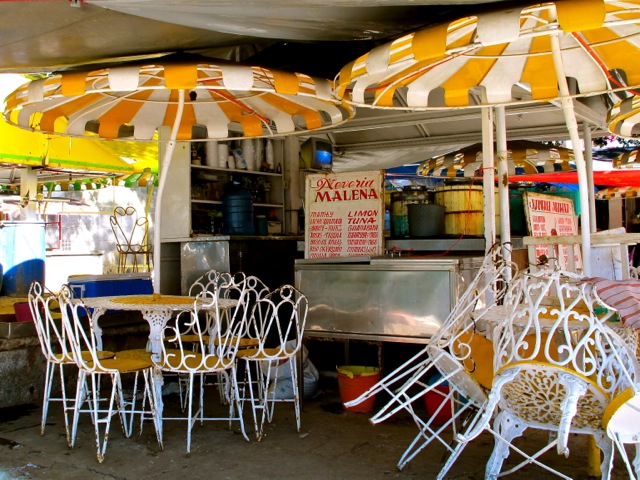
Everyone has their favorite vendor, my friend G was partial to Nevería Malena, and so we sat down at one of their yellow and white iron tables.

Yellow and white iron chairs and umbrellas in front of the Nevería Malena stand.

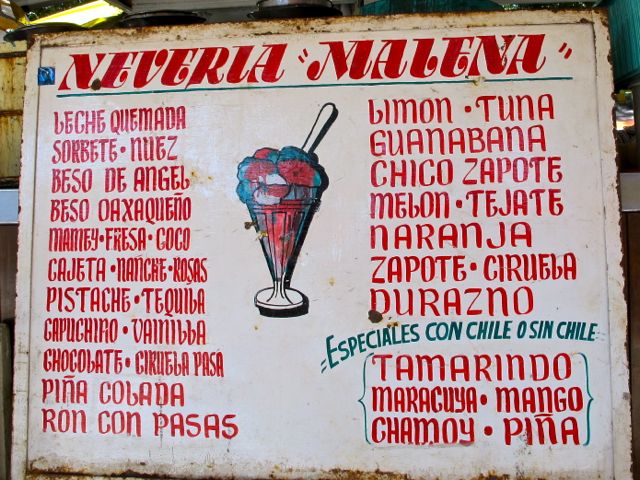
It was SO hard to decide what to order; being tempted by too many choices and being mystified by what many of the flavors actually were.

Nevería Malena sign listing 34 flavors

What in the world is Beso de Angel?  I settled on a scoop of Leche Quemada (burnt milk) with a scoop of Tuna (fruit of the nopal cactus NOT the fish) on top.  I was hooked!

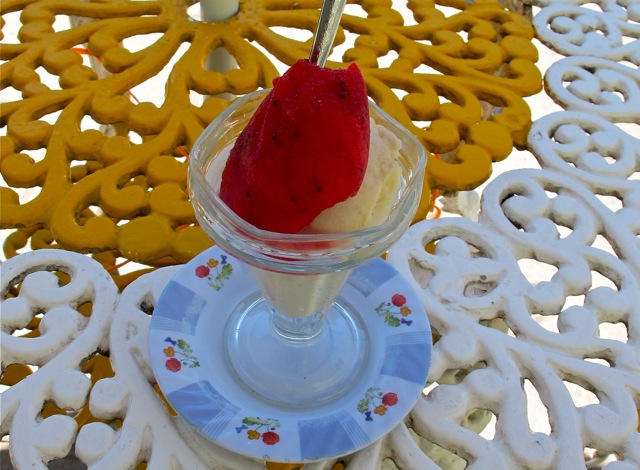
Bowl of leche quemada and tuna nieve on yellow and white iron table.

As it worked out, two years later I moved into an apartment only a block away and I pass by Jardín Sócrates at least a couple of times a week.   However, in mid October 2011, carpenters began constructing wooden puestos along Independencía below the Jardín.  Ready for a feria?  I wondered.  Then they were painted!  These took on a semi-permanent character.  Hmmm…

Wooden puestos lining sidewalk.

Soon, a sign went up explaining the Jardín Sócrates was undergoing an “image enhancement,” courtesy of the federal and municipal governments.

Programa Habitat 2011; Gobierno Federal sign.

Demolition soon began, including the removal of the original green cantera (stone) pavement.

Pile of old paving stones

And, the neverías began moving down to the temporary puestos on Independencia.  I found Nevería Malena, ordered my usual, and asked how long the relocation was going to last.  “No sé.”  (“Don’t know.”) was the answer.

Iron tables, chairs, and puestos on sidewalk.

Eight new stalls were constructed, the cantera was replaced with red terracotta tile, and new tables, chairs, and umbrellas materialized.  After five months,  the newly “enhanced” Jardín Sócrates opened on March 29, 2012.

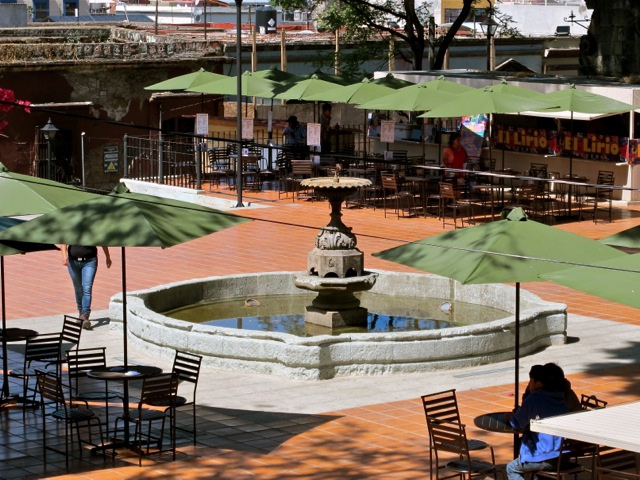
Fountain and green umbrellas on terracotta paved terrace.

It does look lovely — orderly and coordinated — but I kind of miss the color and funkiness of the old.

Read Full Post »

Just the thought of introducing genetically modified corn and the chemicals it requires into Oaxaca, where maíz has been cultivated (Just fine, thank you very much!) for thousands of years makes me sad and angry.  Education is growing, opposition is mounting, and alternatives to the profits-before-people-and-the-environment Monsantos of this world are being set up.  By the way, “agroecology” is a new word for me… and I like it!

From the February 20, 2012 Nation of Change

Native Farmers in Mexico Help Drive Local Eco-Friendly Farming

By Emilio Godoy

The largely invisible work of small local groups of indigenous farmers in Mexico who are spearheading the defense of their territory and identity and of native seeds is strengthening ecologically sound family farming, experts say.

“For thousands of years, indigenous people have been responsible for developing agricultural biodiversity,” Narciso Barrera, a researcher at the public Autonomous University of Tlaxcala in southern Mexico, told IPS. “However, these efforts remain basically invisible, and they should be highlighted and linked with other local movements.”

Since 2000, Barrera has worked on mapping Mexican political ecology, a discipline that studies the relationships between political, economic and social factors and environmental issues and changes.

<snip>

“Agroecology is the key, because it encompasses social aspects, education, economics and farming practices,” said Barrera, who has published the results of his studies in the Spanish journal Papeles de Relaciones Ecosociales y Cambio Global (Papers on Eco Social Relations and Global Change).

I encourage you to read the full article.

Read Full Post »

Yesterday, El Día de Reyes (aka, Three Kings Day and Epiphany) was celebrated all over Oaxaca (and the rest of the Hispanic world).  Letters having been written, children went to bed on January 5th in anticipation…

Young girl with face painted

of a visit by los Reyes Magos; though, something tells me they didn’t ask for gold, frankincense, and myrrh.  If these Three Kings are truly wise, they visited the toy department of a local store.

Three teenagers (2 boys and 1 girl) dressed as the Three King.

Yesterday morning, children awoke to find their very own gifts from the Magi.  However, the day’s excitement didn’t end there.  Rosca de Reyes, a wreath of sweet bread had been made or purchased.

Woman putting powdered sugar on top of a Rosca de Reyes

This innocent looking dessert has a secret; a tiny plastic “bebé Jesús.”  Family and friends take turns with a knife, each slicing their own piece, and the one who finds the figurine must host a tamale party on February 2, Día de la Candelaria (Candlemas), for all those gathered.

Rosca de Reyes

However, Laura (my Spanish teacher) and her friend Manuel, just couldn’t leave it at that.  Last night, one by one, guests cut into the above cake and, lo and behold, we all bit into a baby Jesus.  Needless to say, there was much joking about fertility drugs!  It should be some tamale fiesta on February 2nd.

Read Full Post »

Pan de muerto is the traditional Days of the Dead sweet yeast bread.  It is decorated and placed on ofrendas (altars), along with candles, flowers, fruit, pictures, mementos, other foodstuffs, and beverages, as offerings to the departed.

This slideshow requires JavaScript.

The intricately decorated pan de muerto are from the Tlacolula Valley, and reference the geometric designs and mosaic fretwork found in the archeological sites in and around Mitla, a photo of which I’m using as browser background on this blog.

Read Full Post »

From today’s NYT…

Market Driven, Oaxaca-Style

By PETER CATAPANO

A vendor at Mercado de la Merced in Oaxaca, Mexico, where produce grown on small local farms is sold throughout the city.

OAXACA, Mexico — “The market is not for shopping,” Pilar Cabrera said.

¿Qué?

We were walking around Oaxaca’s Mercado de la Merced, a covered market where Cabrera, a well-known chef and owner of the popular La Olla Restaurant, does some of her food gathering for a class she teaches at La Casa de los Sabores, a cooking school she runs to which chefs on pilgrimages and food-curious tourists have been flocking for several years. Students who sign up and pay for the class (about $70) gather up the goods with her at one of the town’s markets in the morning, then bring them back to a big, bright, picture-perfect kitchen, where they proceed to cook and consume the meal, a five-course Oaxacan lunch based on Pilar’s recipes, including a taste of mezcal and dessert. (Coloradito, a red mole, was the main event at the class I attended.) They also get to pepper her with questions about the food, recipes and region.

Pilar knows her stuff: she was born and raised here and has a background in food science, as well as decades of cooking experience. La Olla serves a modern menu based on traditional Oaxacan recipes in a modest, clean setting that attracts both tourists and well-heeled locals. Apart from the restaurant and cooking school, she has gained some fame as a sort of ambassador for Oaxacan cuisine, traveling abroad to teach her classes, even making an appearance on “Iron Chef.”

In both the restaurant and the class, Pilar hammers home the main theme of Oaxacan food: an uncompromising devotion to fresh, unprocessed local ingredients (the squash blossoms she chose for the meal that day were still open when the vendor handed them to her). And she can switch from speaking Spanish to English with ease, making it easy for monolingual pilgrims like me to get what’s going on.  [Read full article]

h/t:  gg

Read Full Post »

¡Un milagro!

It’s a Saturday miracle; my favorite vendor is back!!!

She and her little crate-and-basket stand, usually positioned at the foot of the two stairs outside Pan y Co on García Vigil, have been missing in action for the past two weeks and I was worried.  I kept asking the clerks at Pan y Co if they knew what had happened to her, but they merely shrugged.  However, today there she was…

Vendor and her stand.

I came away with sliced mango, papaya, jicama, a bag of roasted peanuts with dried chiles, and, best of all, kisses and hugs!!!

(ps)  Apparently, she has been sick, but she assured me that she is okay now.

Read Full Post »

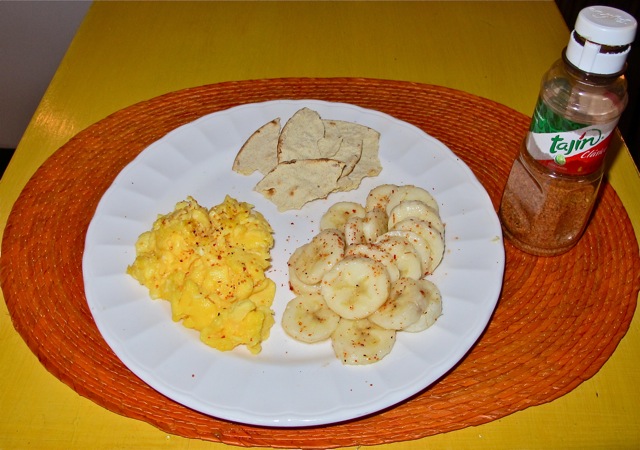
Tajín Clásico seasoning has become my absolute, cannot do without, favorite seasoning.  It’s a mix of dried chiles, salt, and lime juice and it can be used to flavor just about everything.  This morning’s breakfast…

Plate with scrambled eggs and bananas sprinkled with Tajin and bottle of Tajin seasoning

Scrambled eggs and bananas with Tajín sprinkled on top.

I use it to season chicken, veggies, egg dishes, sauces, salads, guacamole, and all kinds of fresh fruit.  You name it, Tajín will enhance it!  And, amazing discovery…  When I stopped by my local gelateria recently, the gal behind the counter offered me Tajín to sprinkle on my cucumber and lime gelato.  At first I declined, then thought, what the heck.  ¡¡¡Muy sabroso!!!

Read Full Post »

No, I didn’t have to ford a raging river… just make a harrowing 5+ second dash, while dodging speeding cars in an effort to cross Calzada de la República, which used to be a river that formed the natural boundary between Oaxaca and the village of Jalatlaco.

Today, Jalatlaco (“sandy embankment” in the Aztec language of Nauhatl) is a barrio (neighborhood) of Oaxaca, but República and its traffic continue to provide a daunting barrier and some colorful street art.

Colorful street art on wall with female skeleton, bird, and serpent

However, once beyond República, the atmosphere changes.  Cobblestones from the old riverbed line the streets and slow the pace;

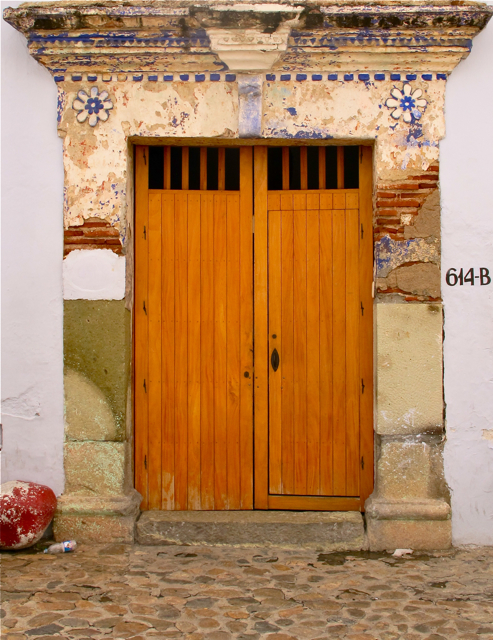
Doorway on a cobblestone street.

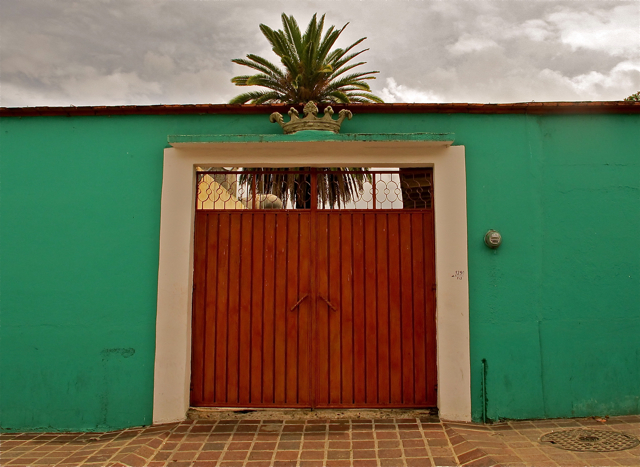
color and foliage, not to mention crowns, add to the character;

Green wall with gate with crown and palm tree.

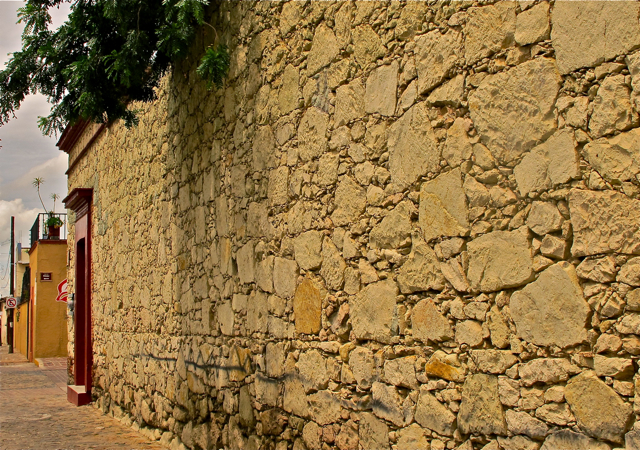
and stone walls line the narrow streets, shielding the neighborhood from the bustle beyond.

Stone wall

By the way, my breakfast of huevos divorcíados at El Biche Pobre was colorful and delicious!

Read Full Post »

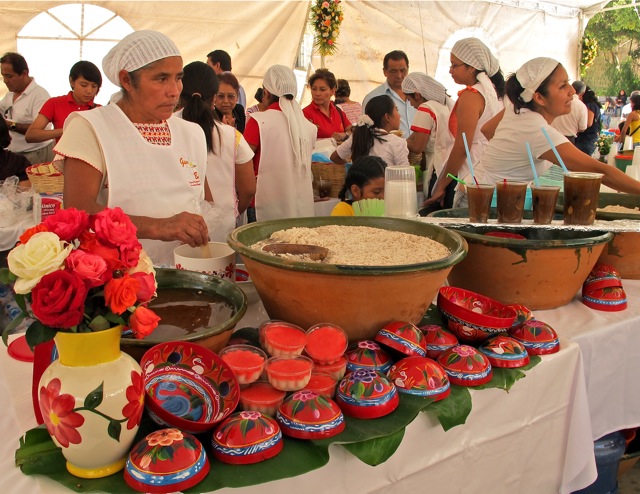
And now we have the sixth annual Festival del Tejate y el Tamal de San Andrés Huayapam!  A large tent covers half of the Plaza de la Danza and over 100 “tejateras” who belong to the Unión de Mujeres Productoras del Tejate set up shop early this morning to sell refreshing cups of this pre-Hispanic beverage made from corn and cacao.

The festival is part of an effort to preserve the food culture of the Zapotec.  San Andrés Huayapam (aka, San Andrés Huayapan) is about 7 miles north of the city and its main economic activity is the sale of tejate.

Packages of tejate lined up on a table

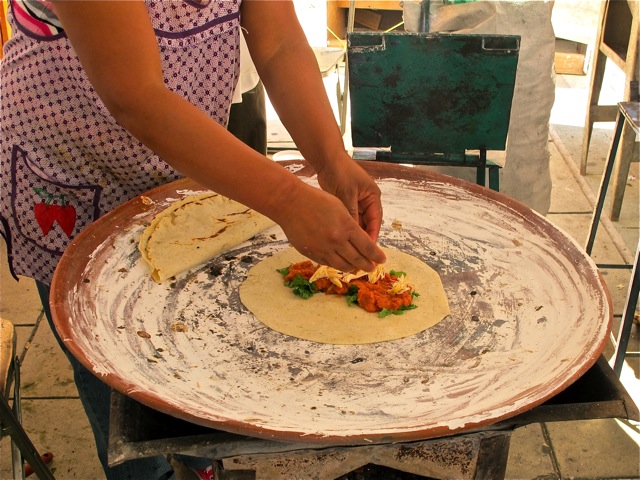
The festival also features empanadas, hot off the comal…

Empanada being cooked on a comal

and six kinds of tamales:  Salsa verde, Amarillo, Rajas, Verde, Chichilo, and Tamal de mole.A variety of tamales in a metal bucket

I wanted them all!  However, for today’s comida, I opted for chichilo from this gal…

Woman serving tamales

Why chichilo?  The answer is, because I’ve never had that kind before!  Chichilo is one of the seven moles of Oaxaca and is only served on special occasions, such as weddings and christenings, or when the crops have been harvested.  Chilhuacle negro, mulatto, and pasilla chiles; blackened tortillas and seeds of the chiles; and avocado leaves, the latter imparting a subtle anise flavor, give it its distinctive flavor.

Woman reaching into steaming hot cauldron of tamales

She picked out a good one… it was delicious!

People sitting and eating at long tables.

¡Buen provecho!

Read Full Post »
« Newer Posts - Older Posts »