Feeds:
Posts
Comments

Archive for the ‘Food’ Category

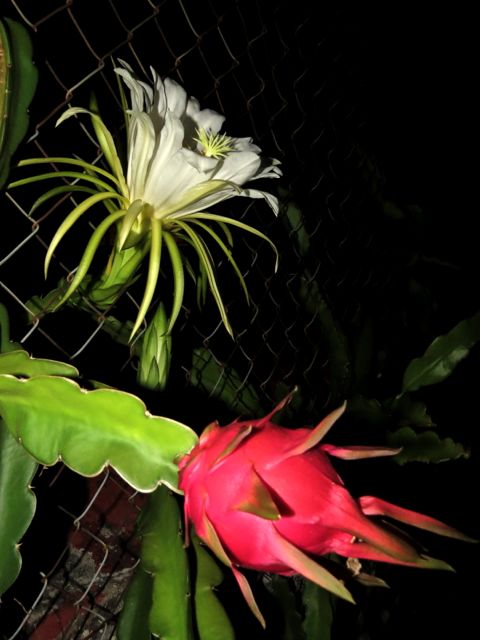
Remember the night my Pitahaya (aka, Dragon fruit) blossom was ready for her close-up?  Three months later, here she is…

Pitahaya fruit

Though there is fruit, flowers continue to put on their bloomin’ after-dark show.

Pitahaya flower and fruit

Their beauty never ceases to enchant.

Pitahaya flower

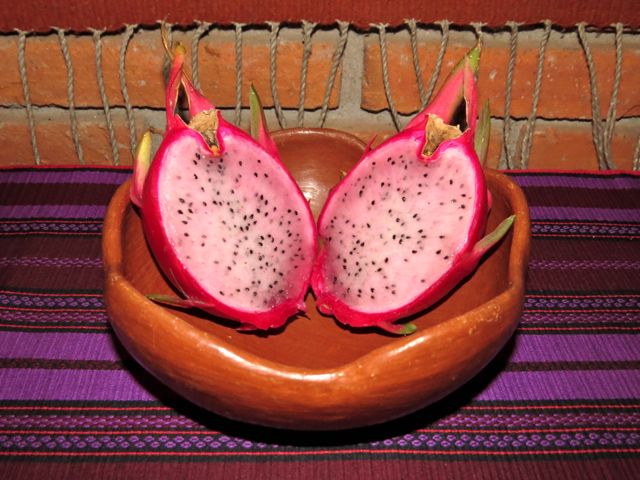
From terrace to table…

2 halves of Pitahaya fruit

My version of “farm fresh.”

Read Full Post »

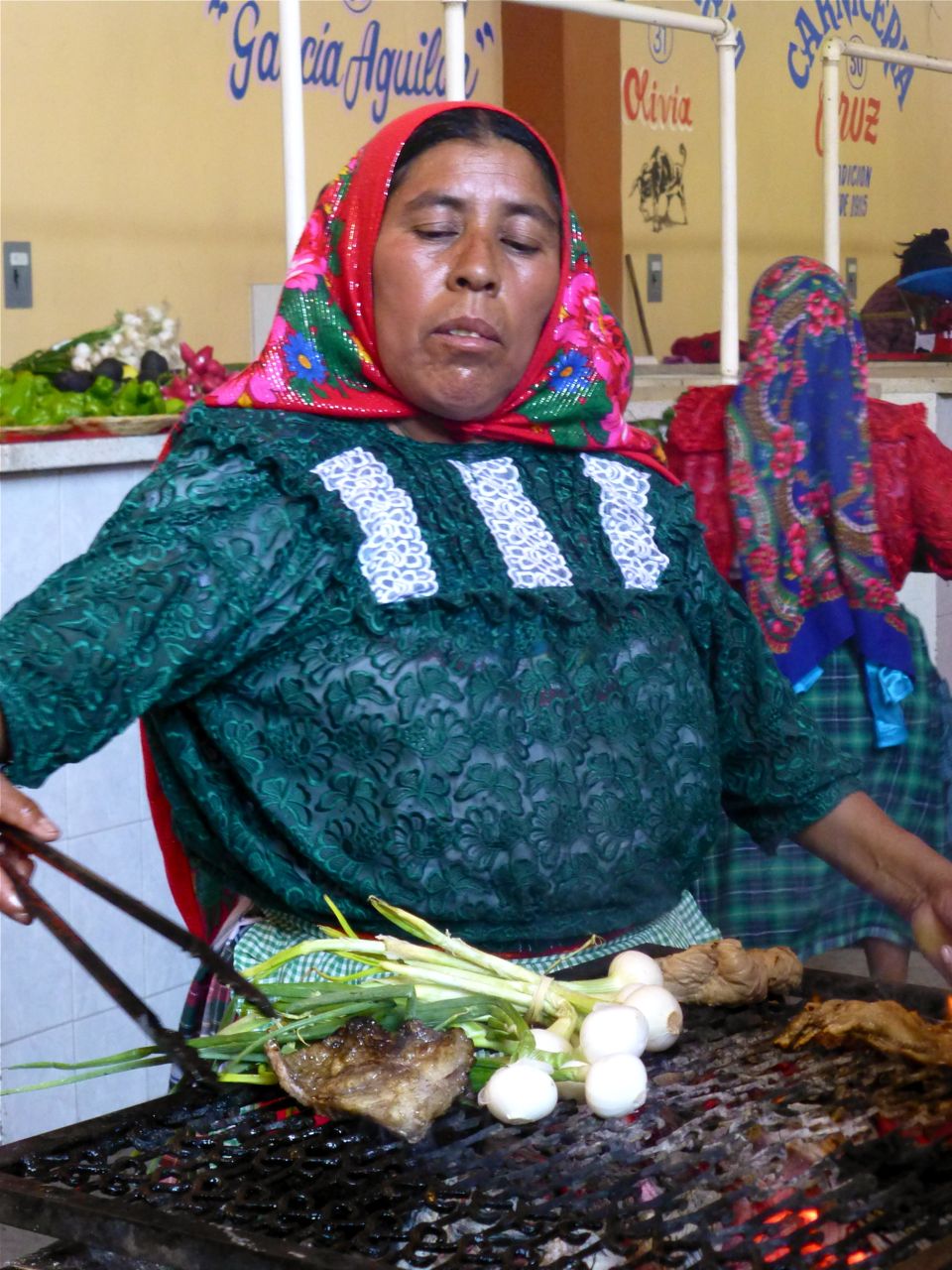
One of my favorite things…

Woman at grill behind smoke

The women and their grills in el pasillo de humo (the hall of smoke).

Woman grilling grilling onions & meat

Another Sunday market day in Tlacolula de Matamoros.

Read Full Post »

Yesterday, as I was walking home, the eyes of these guys caught my eye.

P1020046

More eyes beckoned me across the large driveway/parking area, that separated the mural filled walls from the sidewalk.

P1020048

A sign for Okupa Visual Oaxaca was pointing the way, so I figured I must not be trespassing and might even be welcome.

P1020052

More eyes drew me toward an open door…

P1020054

I peered inside the Taller de Grafica Experimental de Oaxaca and was greeted with the warm smile of artist, Guillermo Pacheco López.  He showed me around the light airy gallery and studio and explained the programs they offer.  We then proceeded through an open doorway into a another multipurpose space.

P1020059

Besides more gallery and workshop space, it is home to Café Panartesano and where his delightful wife, Kate, along with an assistant, bake brownies, blondies, chocolate chip cookies, oatmeal cookies, and other yummy looking sweets.  In addition, they make homemade pizza and tortas.

P1020055

As you may have guessed from the above menu, Kate is from the USA — San Francisco to be geographically precise.  We had much in common and I stayed for almost half an hour chatting with her.  Naturally, I couldn’t resist buying a chicken with zucchini and red bell pepper torta on focaccia, which was muy sabrosa!

P1020057

If you are in town, I highly recommend stopping by Taller de Grafica Experimental de Oaxaca and Café Panartesana.  They are located at La Noria 305 (at the corner of Melchor Ocampo).

Nourishing body and soul — that’s Oaxaca!

Read Full Post »

I’m eating my way through the Guelaguetza festivities.  It all began on Friday with the kickoff banquet for the Festival de los Moles.  Remember the chicatanas from last month?  They were there.  Check out the mole on the middle left.  Giving the mole a little “crunch,” it was muy sabroso!

Then yesterday, we ventured out to Reyes Etla for the Expo Feria del Queso y Quesillo (cheese fair), followed by comida at Comedor Colon in Villa de Etla.

Today, we were supposed to go into the mountains of the Sierra Norte to San Antonio Cuajimoloyas for the Feria Regional de Hongos Silvestres.  Alas, bloqueos blocked our way and so L and I were “forced” to browse (and shop) our way through the countless artesan stalls at the top of the Alcalá and in Llano Park.  Of course, this required major nourishment.  At a time like this, nothing beats street food!

Tacos with roasted onions and chopped pork

Tacos with roasted onions and chopped pork

All I can say is, yummmm!  And, next weekend, we will again attempt to venture up into the mountains for the wild mushrooms festival.

Read Full Post »

I’m back in Oaxaca — and I’m not the only one!  The city’s streets and sidewalks are more congested than usual as tourists, both national and international, have begun pouring in.  Why? you ask.  They have come for the annual Guelaguetza folkloric performances the next two Mondays on Cerro Fortin in Oaxaca city.  And, a few might even venture out to join locals at the more intimate Guelaguetzas in many of the villages that surround the city.

There will be food and drink ferias and festivals…

There will be calendas (parades), expo-ventas (artisan sales), and exhibitions…

There will be concerts, including this one by Lila Downs…

lila downs concierto guelaguetza 2014

And, SO much more!  The above posters illustrate just a fraction of the activities surrounding the Lunes del Cerro (Mondays on the hill).  For a more comprehensive, though not by any means complete, list of events, check out the calendar below.

Manteleta Final 43x28

Sheesh, it seems like they add more things to do and see every year.  However, I’m looking forward to showing and sharing as much of it as possible with friends.

Click on each poster for a larger (more readable) image.

Read Full Post »

The rainy season has definitely arrived in the city, bringing several hours of lluvia every night for the past five nights.  The first rains of the season also bring (drum roll, please) chicatanas!  Early this morning, I went out onto the terrace with my coffee to be greeted with these not-so-little insects.  Flying (into my hair, eeek!) and crawling all over the place!

Female chicatana on blue oilcloth

Female chicatana on a very wet table.

What, you may ask are chicatanas?  They are giant flying ants that emerge with the first rains of the season — and by giant, I mean about 4 cm from the head to the tip of the wings for the females.  (As in much of the insect world, males are smaller and wingless.)

Male chicatana on wood deck

Male chicatana on the deck.

This occurs early one morning each year and lasts only a few hours.  My first experience with them was a couple of years ago, when I arrived at Oaxaca’s airport for my 8:30 AM flight one May morning, to find, yikes(!) an infestation of insects.  I had no idea what they were, but nobody seemed to mind, and kids were running around collecting them.  The answer came after I boarded the plane and began talking with a Oaxaqueña across the aisle.  She explained that the arrival of the chicatanas was a much-anticipated event because they are a delicacy.  As the video below documents, they are soaked, cleaned, toasted on a comal, ground, seasoned, and made into a salsa.

According to this post in a Chicago based culinary chat site, it has been almost “500 years since Bernardino de Sahagun reported to Europe on the tzicatana [chicatana in Nahuatl] in his Nueva Historia, from its divine associations to its swarm ethology (mirroring the movements of the Aztecan armies) to its apparent deliciousness to the Nahuan-speaking people in the region.”  And, long before that, tzicatanas were mentioned in the Florentine Codex.

Female chicatana on her back

Female chicatana doing the back stroke on the table.

By 9:30 this morning, they were gone.  However, should you find yourself in Oaxaca during a brief visit by the chicatanas, here is a recipe for Chicatana Salsa.

Read Full Post »

According to the Indigenous Farmworker Study (IFS), there are approximately 165,000 indigenous Mexican farmworkers and their children living  in California — with a significant percentage coming from the state of Oaxaca.  Writer and photographer David Bacon has been photographing and interviewing indigenous Mexican migrants working in California’s agricultural fields for many years.  The following Truthout article is from his photo-documentary project, Living Under the Trees, sponsored by the California Council for the Humanities and California Rural Legal Assistance.

Young, at Work in the Fields

by David Bacon

(Photo: Bacon/After Image)

(Photo: Bacon/After Image)

Most young farm-workers in California are migrants from Mexico, especially the south of the country, where many people share an indigenous culture and language. Ricardo Lopez, living in a van with his grandfather in a store parking lot in Mecca, a tiny farmworker town in the Coachella Valley, says working as a migrant without a formal home was no surprise:

This is how I envisioned it would be working here with my grandpa and sleeping in the van. It’s hot at night, and hard to sleep well. There are a lot of mosquitoes, very few services, and the bathrooms are very dirty. At night there are a lot of people here coming and going. You never know what can happen; it’s a bit dangerous. But my grandfather has a lot of experience and knows how to handle himself. With the money I earn I’m going to help my mother and save the rest. I’ll be attending college in the fall at Arizona Western College—my first year. I want to have a good job, a career. I’m not thinking of working in the fields. Not at all. I look at how hard my grandfather has worked. I don’t want to do field work for the rest of my life because it’s so hard and the pay is so low.

Lopez describes the reality for farmworkers in California in a way that gives tangible meaning to the facts and numbers describing farmworker life. There are about 120,000 indigenous Mexican farmworkers in California. Counting the 45,000 children living with them, that is a total of 165,000 people. They are the most recent migrants from Mexico. They speak twenty-three languages, come from thirteen different Mexican states, and have rich cultures of language, music, dance, and food that bind their communities together.

<snip>  Click HERE to read full article.

This project is therefore a reality check. The idea is to give indigenous migrant communities a vehicle they can use to find support for dealing with the social problems they face, such as housing, low wages, and discrimination. This documentary work is not neutral. Its purpose is to help provide a means for people to organize and win support in a world that, at best, treats them as invisible, and at worst demonizes them. I used to be a union organizer, and this work is very similar. Social documentation not only has to have an engagement with reality, but should try to change it.

Click HERE to read full article.

Read Full Post »

If you are in Oaxaca and it’s the fourth Friday of Lent, it must be Día de la Samaritana (AKA, el Día de las Aguas) — a uniquely Oaxacan celebration.  It is inspired by the Gospel of John story in the New Testament:  At noon, a tired and, apparently, thirsty Jesus, on his way to Galilee, asks a Samaritan woman at Jacob’s Well in Sychar for some water.  His request was highly unusual because, according to the Old Testament, “Jews regarded the Samaritans as foreigners and their attitude was often hostile.”  The woman complied with his request and the rest is history.

By noon, this past Friday in Oaxaca, the thermometer had already reached 90º F in El Centro Histórico and people of all ages, from small children to abuelos, were already lined up at bougainvilla and palm decorated booths in front of churches, schools, and businesses for the traditional Día de la Samaritana free aguas.  It wasn’t just plain water they were waiting on, it was for divinely flavored aguas frescas made with fresh fruits and flowers — jamaica, horchata, chilacayota, tamarindo, sandia, and others.  However in front of the churches, prior to the offering of aguas, there was a reenactment of Jesus and the Samaritana, as well as a priestly blessing — and an article in Noticias reported that, given the blazing hot sun, some in the crowd became a little impatient.

This slideshow requires JavaScript.

All were eventually served and the streets were filled with smiling people drinking a rainbow of aguas.  Within an hour the serving pots, pitchers, bowls, and buckets were empty and all that remained were garbage containers filled to overflowing with plastic cups.

By the way, talking to my friend Sam, who teaches at Universidad José Vasconcelos de Oaxaca, they had an aguas frescas contest — memorable combinations of watermelon with strawberries and lime; atole with tuna nieve; and coconut with strawberries.  However, I was informed the day’s winner was the piña colada — alas, minus the rum, I’m thinking.

Read Full Post »

Eight hours today in Oaxaca…

Tuna band in Llano Park

Tuna band in Llano Park

A queen and her consort at Viernes in Llano.

A queen and her consort at Viernes del Llano

Huevos Divorciados at Cocina Economica Isabel

Huevos Divorciados at Cocina Economica Isabel

Día de la Samaritana agua on the Alcalá

Día de la Samaritana agua on the Alcalá

PRI march and rally at Plaza de la Danza

PRI march and rally at Plaza de la Danza

Read Full Post »

Domingo’s escape from the city out into the countryside of Oaxaca brought back one of my fondest childhood memories:  Sunday drives with my grandparents into the golden hills of northern California.  Two-lane winding roads with only the occasional car or pickup truck; farms, fields, and roadside stands outside my rolled down window always brought a sense of adventure mixed with freedom and serenity.  And, it still does…

Oaxaca city to Teotitlán del Valle, where we yielded to a herd of cattle.

Close-up white bull

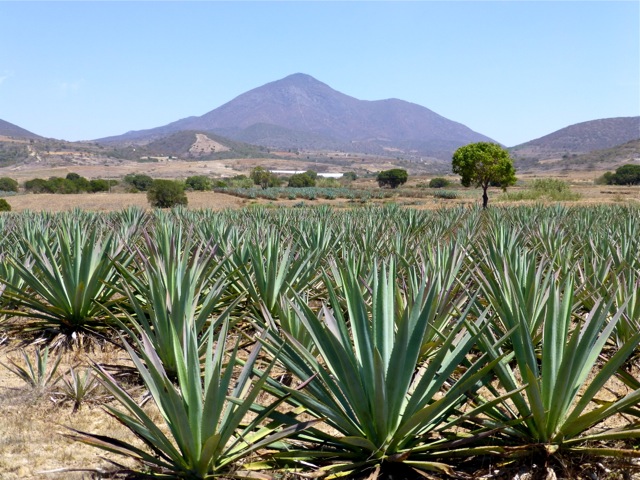
Santiago Matalán past fields of agave to San Baltazar Chichicapam.

Agave fields with mountain in distance

We continued on the mostly deserted road  towards Octotlán de Morelos.

Tile roof lean-to on rocky outcrop

Onto Hwy. 175 and a lunch stop at the roadside restaurant, between Santo Tomás Jalieza and San Martín Tilcajete, from almost two weeks earlier.

Sign for Los Huamuches with tables in background

And this time we noted the name:  Los Huamuches.  Another delicious comida… a perfect way to end our meandering and head for home.

Read Full Post »
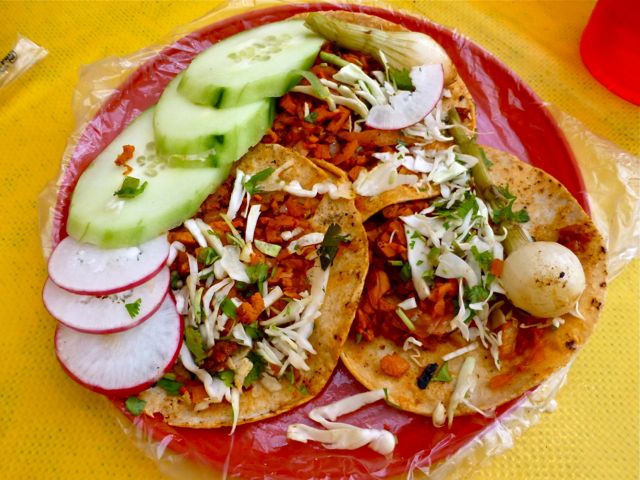
Tuesday, not only brought the previously mentioned Carnaval, San Martín Tilcajete style, it also provided comida, muy sabrosa.  No, not one of the 4 restaurants in Oaxaca recently listed in the 101 Best Restaurants in Latin America and the Caribbean.  I’m talking about al fresco dining in a roadside restaurant.  Sitting under the branches of a large shade tree on plastic chairs, around a plastic table, with cars and trucks speeding by, it was surprisingly tranquil.

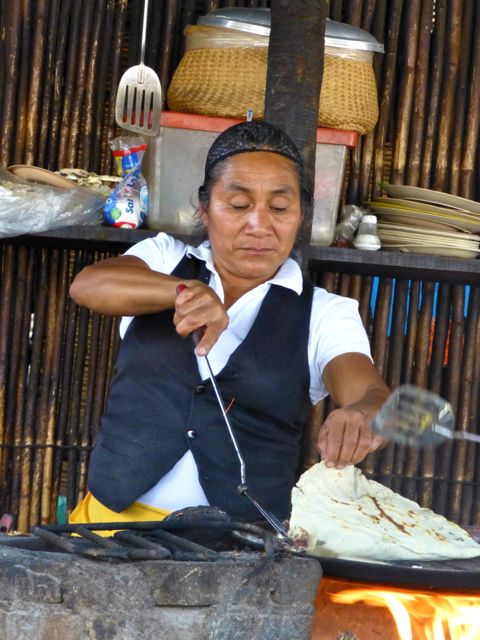
Woman cooking on comal

We had ringside seats as our lunch was prepared on a well seasoned comal.  I couldn’t help thinking as we sat at this unpretentious restaurant, in the middle of the fields that yielded the ingredients for our lunch, prepared according to culinary traditions passed down through generations of Zapotecos, this is quintessential “slow food.”

Woman lifting tlayuda off comal

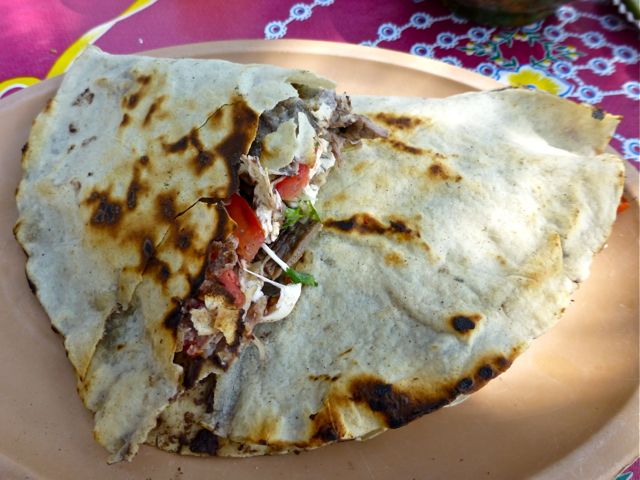
That’s my tlayuda (sometimes spelled, clayuda) being lifted off the comal — and it was one of the best I’ve eaten!  Fyi, tlayudas are one of the 10 Essential Things To Eat And Drink In Oaxaca.

P1020181

For more on our yummy lunch, see Chris’s blog post, Fat Tuesday done right.  Alas, neither one of us took note of the name of the restaurant — all I know is it’s on the east side of Hwy 175, between San Martín Tilcajete and San Tomás Jalieza.

Read Full Post »

After more than two weeks of frente fríos (cold fronts) sweeping down from el norte, the weather has turned downright hot, with temperatures in the mid 80s (F).  What’s a person to do?  Today, this person headed to her favorite ice cream parlor, Nevería Malena at Jardín Socrates.

I previously mentioned this nevería when the Jardín underwent an image enhancement a year and a half ago.  And, as before I ordered leche quemada (burnt milk) and tuna (nopal cactus fruit).  It may not have been the most nutritious lunch, but it hit the spot!

Parfait glass with leche quemada and tuna

As you can see from the photo, Nevería Malena now sports spiffy new seat covers for the backs of their wrought iron chairs.  And, on the back of the laminated menu of flavors, the story of Malena and the “tradition that flatters your palate” is told.  (My translation follows.)

Placard with an image of Señora Malena and a granddaughter

Señora Malena is the 5th child of Ángel Armengol and Anacieta Hernández.  They taught her the craft and soon she became one of the most prestigious and famous for the seasoning and flavors of her frozen dessert.  

Initially, Malena walked around the Zócalo, offering her frozen dessert in glasses.  Later she relocated next to the Cathedral where she continued to offer her delicious frozen dessert.  (Note:  At that time natural ice was brought from the community of “La Nevería” in the Sierra Juárez.)  She then moved to the Alameda de León to a space which already had a laminated roof.  It was here she affectionately began to be called, “Malenita” and the stall was named Malena.

Malena became famous for traditional flavors like burnt milk, sorbet, walnut, pear, and lemon.  Fame grew with an invitation by the Secretariat of Tourism to participate in the “Week of Oaxaca in Mexico,” at which Malena participated for 15 years.  The stall subsequently was transferred to “Socrates Garden” where it is currently run by her children and grandchildren, with love and affection — to continue the tradition and increase the variety of flavors.

Hanging plaques listing flavors

And, increase the flavors they have!  So many to choose from.  Hmmm… next time, Beso de Ángel or Diablo???

Read Full Post »

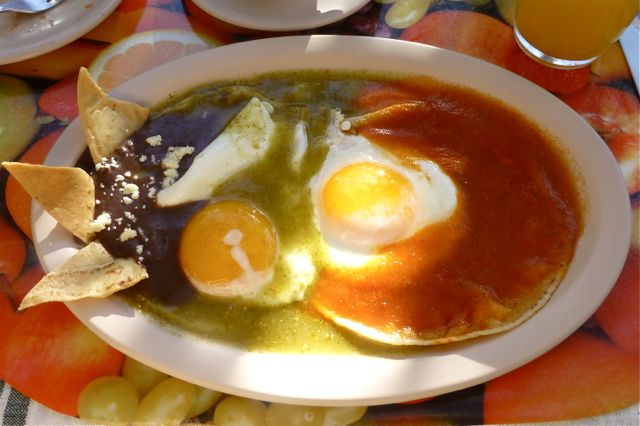
Sí, huevos divorciados!  A little food porn to begin the day…

Plate of huevos divorciados

Early morning walk up to Hotel las Golondrinas yesterday morning for breakfast.  Surrounded by the distinctive pottery of Dolores Porras, it was the perfect setting to meet Michael Peed, filmmaker of the documentary, Dolores Porras: Artista Artesana de Barro.

Read Full Post »

We are still enjoying the Christmas merry-go-round in Oaxaca.  Lucky for “children” young and old, the San Pablo Cultural and Educational Center has even provided a real (not just metaphorical) carousel to hop on during this holiday season.  And today, along with riding the merry-go-round, in honor of Día de Reyes, all were welcome to partake in the traditional Rosca de Reyes (Three Kings cake) — served by none other than Tato, the birdbrain (after all he is an ostrich) Oaxaca Guerreros team (baseball) mascot (though I think he was doing more eating than serving).  Thankfully, on this chilly night, there was also hot chocolate (with milk or water, your choice) with which to warm hands and dip cake.

Whew!!!  A baby Jesus figurine was not found in my piece of Rosca de Reyes, so I won’t have to throw a tamale and atole party on Candlemas, February 2nd, for everyone present at this evening’s festivities.

Read Full Post »

I’ve always liked Thanksgiving — and not just because, after I turned 12, my aunt would pour a little red wine in a shot glass for my cousin and me.  It’s one of the least commercial US holidays, if one discounts the whole “black Friday” and, now, “brown Thursday” (eww!) phenomenon.  And, it isn’t wrapped in flag waving.

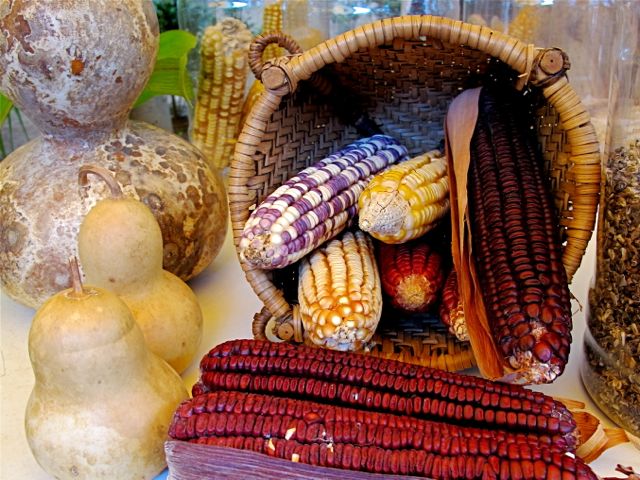
Multicolored corn in basket

It’s a day set aside for a communal sharing of Mother Nature’s bounty, counting our blessings, and acknowledging and giving thanks for the assistance of the dark-skinned original human inhabitants of the Americas.  What a novel idea!

Corn stalks in foreground, El Picacho mountain in background

Besides being thankful for my loving and supportive family, wonderful friends (both old and new), dedicated and encouraging blog readers (Yes, you!), I’m extremely grateful for having the privilege of living among people whose ancestors first cultivated corn in this beautiful valley.

2 turkeys

“love
iz
a
big
fat
turkey
and
every
day
iz
thanksgiving”
Charles Bukowski, What Matters Most is How Well You Walk Through the Fire

Now off to the kitchen to make the stuffing.  ¡Feliz Día de Acción de Gracias!

Read Full Post »

« Newer Posts - Older Posts »