Feeds:
Posts
Comments

Archive for the ‘Food’ Category

After more than two weeks of frente fríos (cold fronts) sweeping down from el norte, the weather has turned downright hot, with temperatures in the mid 80s (F).  What’s a person to do?  Today, this person headed to her favorite ice cream parlor, Nevería Malena at Jardín Socrates.

I previously mentioned this nevería when the Jardín underwent an image enhancement a year and a half ago.  And, as before I ordered leche quemada (burnt milk) and tuna (nopal cactus fruit).  It may not have been the most nutritious lunch, but it hit the spot!

Parfait glass with leche quemada and tuna

As you can see from the photo, Nevería Malena now sports spiffy new seat covers for the backs of their wrought iron chairs.  And, on the back of the laminated menu of flavors, the story of Malena and the “tradition that flatters your palate” is told.  (My translation follows.)

Placard with an image of Señora Malena and a granddaughter

Señora Malena is the 5th child of Ángel Armengol and Anacieta Hernández.  They taught her the craft and soon she became one of the most prestigious and famous for the seasoning and flavors of her frozen dessert.  

Initially, Malena walked around the Zócalo, offering her frozen dessert in glasses.  Later she relocated next to the Cathedral where she continued to offer her delicious frozen dessert.  (Note:  At that time natural ice was brought from the community of “La Nevería” in the Sierra Juárez.)  She then moved to the Alameda de León to a space which already had a laminated roof.  It was here she affectionately began to be called, “Malenita” and the stall was named Malena.

Malena became famous for traditional flavors like burnt milk, sorbet, walnut, pear, and lemon.  Fame grew with an invitation by the Secretariat of Tourism to participate in the “Week of Oaxaca in Mexico,” at which Malena participated for 15 years.  The stall subsequently was transferred to “Socrates Garden” where it is currently run by her children and grandchildren, with love and affection — to continue the tradition and increase the variety of flavors.

Hanging plaques listing flavors

And, increase the flavors they have!  So many to choose from.  Hmmm… next time, Beso de Ángel or Diablo???
Read Full Post »

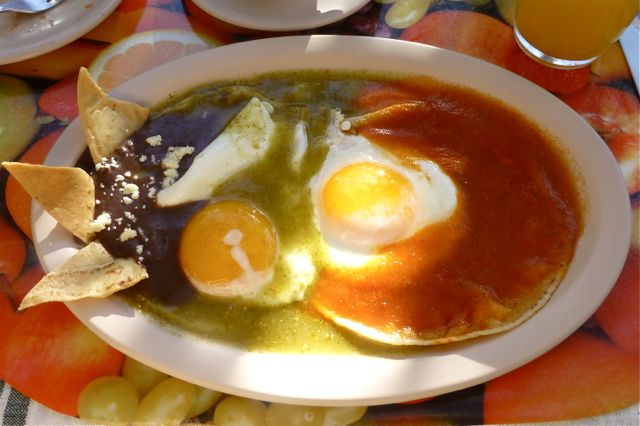
Sí, huevos divorciados!  A little food porn to begin the day…

Plate of huevos divorciados

Early morning walk up to Hotel las Golondrinas yesterday morning for breakfast.  Surrounded by the distinctive pottery of Dolores Porras, it was the perfect setting to meet Michael Peed, filmmaker of the documentary, Dolores Porras: Artista Artesana de Barro.

Read Full Post »

We are still enjoying the Christmas merry-go-round in Oaxaca.  Lucky for “children” young and old, the San Pablo Cultural and Educational Center has even provided a real (not just metaphorical) carousel to hop on during this holiday season.  And today, along with riding the merry-go-round, in honor of Día de Reyes, all were welcome to partake in the traditional Rosca de Reyes (Three Kings cake) — served by none other than Tato, the birdbrain (after all he is an ostrich) Oaxaca Guerreros team (baseball) mascot (though I think he was doing more eating than serving).  Thankfully, on this chilly night, there was also hot chocolate (with milk or water, your choice) with which to warm hands and dip cake.

Whew!!!  A baby Jesus figurine was not found in my piece of Rosca de Reyes, so I won’t have to throw a tamale and atole party on Candlemas, February 2nd, for everyone present at this evening’s festivities.

Read Full Post »

I’ve always liked Thanksgiving — and not just because, after I turned 12, my aunt would pour a little red wine in a shot glass for my cousin and me.  It’s one of the least commercial US holidays, if one discounts the whole “black Friday” and, now, “brown Thursday” (eww!) phenomenon.  And, it isn’t wrapped in flag waving.

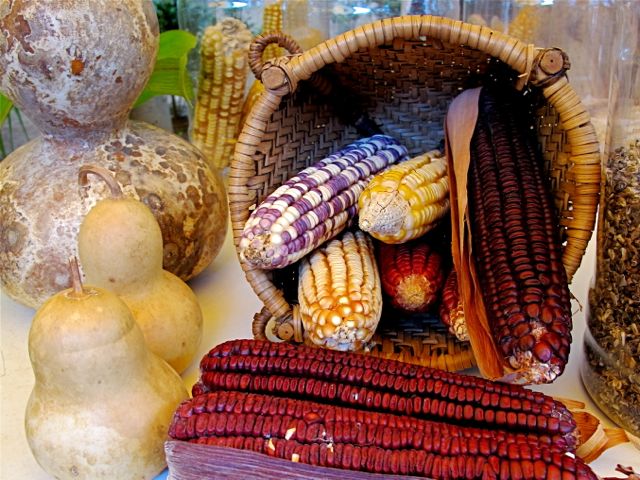
Multicolored corn in basket

It’s a day set aside for a communal sharing of Mother Nature’s bounty, counting our blessings, and acknowledging and giving thanks for the assistance of the dark-skinned original human inhabitants of the Americas.  What a novel idea!

Corn stalks in foreground, El Picacho mountain in background

Besides being thankful for my loving and supportive family, wonderful friends (both old and new), dedicated and encouraging blog readers (Yes, you!), I’m extremely grateful for having the privilege of living among people whose ancestors first cultivated corn in this beautiful valley.

2 turkeys

“love
iz
a
big
fat
turkey
and
every
day
iz
thanksgiving”
― Charles Bukowski, What Matters Most is How Well You Walk Through the Fire

Now off to the kitchen to make the stuffing.  ¡Feliz Día de Acción de Gracias!

Read Full Post »

Much like the Mark Twain line, “The report of my death was an exaggeration,” unfortunately, so too the news announcing the death of GMO corn in Mexico.

P1080309_crop

According to the post by Think Mexican, The Fight Continues: GMO Corn Not Yet Banned in Mexico:

Contrary to reports, genetically modified (GMO) corn has not been banned in Mexico. On October 10, a Mexican judge from the Twelfth Federal District Court for Civil Matters in Mexico City issued an injunction suspending field trails of GMO corn, however, a complete ban was not ordered.

Federal Judge Jaime Eduardo Verdugo’s ruling does order the halting of “all activities involving the planting of transgenic corn in [Mexico] and ends the granting of permissions for experimental and pilot commercial plantings.” [Read full article, HERE]

From a large mural on the wall outside the Comisión Nacional para el Desarrollo de los Pueblos Indígenas, Delegación Oaxaca

La lucha continúa…

Read Full Post »

When you are caught in stop and go (mostly stopped) traffic and getting hungrier by the minute, the only thing to do is turn off onto a side street and find an Irish pub.

Hamburger and French fries = comfort food to soothe the traffic-challenged soul.  But, in Oaxaca???  Yes, McCarthy’s Irish Pub in Reforma!  Probably wasn’t the best dining decision we have ever made.  French fries were pretty good, but hamburgers left a lot to be desired.  However, by the time we left, the traffic had thinned and it was smooth sailing home!

Read Full Post »

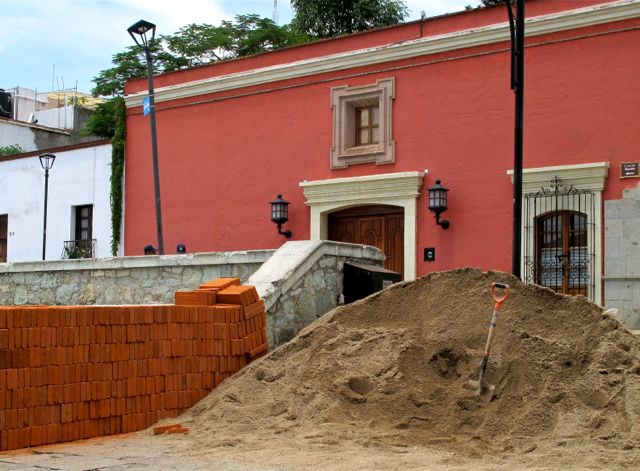
A couple of days ago, above the Plaza de la Danza, a mound of sand and a pile of bricks.

IMG_4953

There were guys doing the heavy lifting — bricks on their shoulders and buckets of sand in hand — carrying load after load down the ramps and stairs to the plaza below.

IMG_4945

The sand was spread and leveled and the bricks were carefully laid in a herringbone pattern.

IMG_4946

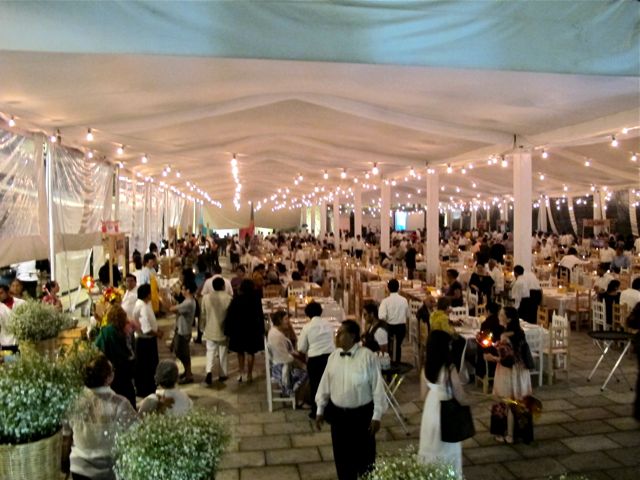
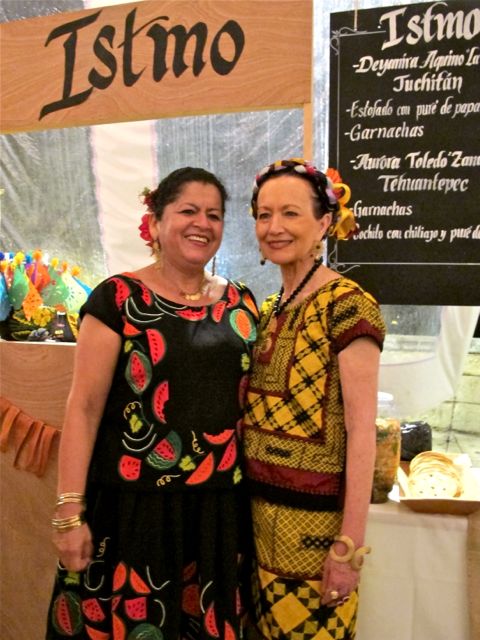
What were they up to?  Preparing a barbecue platform for last night’s gastronomic festival, El Saber del Sabor Oaxaca 2013, opening night buffet.  The entire Plaza de la Danza was tented, tables and chairs were set up, lights were strung, and by yesterday afternoon, all was ready.

IMG_4955

Last year we missed out on the barbecue — spit roasted lamb and pork — it looked and smelled divine, but the line was too long and then it was gone.  This year, we were not to be denied and so our strategy was to be first in line.

IMG_4957

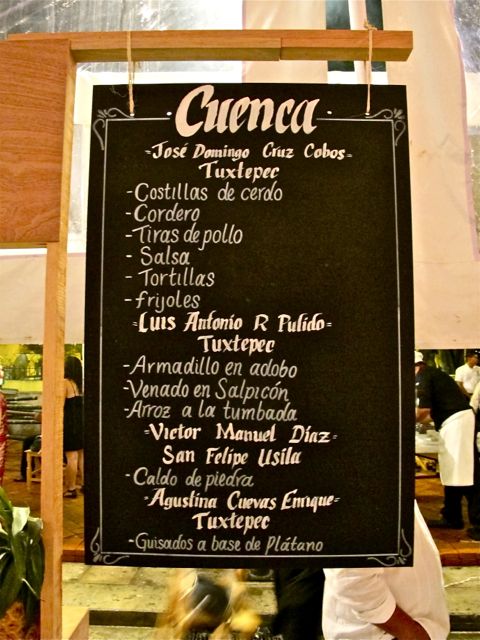
That meant standing for at least 20 minutes in front of the newly constructed barbecue at the Cuenca station, where we had plenty of time to study the menu and salivate, as smoke from the BBQ permeated our clothes and burned our eyes.

IMG_4966

José Domingo Cruz Cobos from Tuxtepec did not disappoint.  I can’t even begin to describe how succulent the meat and how crispy the skin.  It was well worth the wait!

IMG_4999

However, this was only the beginning.  Cooks from the other 7 regions of Oaxaca were also there, preparing their signature dishes.

Aurora Toledo of Zandunga restaurant with chef and evening honoree, Patricia Quintana.

Aurora Toledo of Zandunga restaurant with chef, teacher, author, and the evening’s special honoree, Patricia Quintana.

Gluttony makes for a hazy memory, but in addition to the above, I had mole negro and tamalitos from the famed Mendoza sisters of Tlamanalli in Teotitlán del Valle, garnachas from Aurora Toledo of Zandunga in the city, and ???  Oh, and then there was wine, mezcal, and a cajeta flavored paleta for dessert.

IMG_4996

All this, and much, much, much more for only 350 pesos (about $27 US).  It was a lovely and delicious night.

And for those with deeper pockets, multi-course lunches and dinners with wine and mezcal pairings are being prepared by the top chefs from all over Mexico, at select restaurants throughout the city, including Alejandro Ruíz of Casa Oaxaca and Jose Manuel Baños Rodriguez of Pitiona, each recently named to Latin America’s 50 Top Restaurants.

¡Buen provecho!

Read Full Post »

I’m back up in el norte for a brief “taking care of business” trip.   And, sheesh, it’s SO quiet on this western front.  No fireworks.  No clanging chains of the propane tank vendor.  No bands playing in the streets.  No loudspeakers.  And, no shrill sound of the steam whistle heralding the arrival of the camote man.

Camote vendorEvery evening, he wheels his cart through the streets of Oaxaca selling sweet potatoes and plantains sweetened with sugar and drizzled with condensed milk.  They are cooked in a pressure-cooker-like contraption that is heated by a small wood fire in the metal drum below.  The iconic sound comes from the hot steam being released from the cooker.

If you have a sweet tooth, follow the whistle for a yummy dessert treat!

Read Full Post »

I kind of have an unwritten rule for this blog of not promoting commercial enterprises.  However, being an alumna of the sixties, I wholeheartedly subscribe to the rule that rules (especially unspoken ones) were made to be broken.  Thus I encourage you to click on the “Behind the Scenes” videos of season 9 of Rick Bayless, Mexico: One Plate at a Time in Oaxaca.  Start with episode 13 and work your way backwards.  These “Behind the Scenes” clips really do give a flavor of the culinary culture, traditions, and scenery of Oaxaca.

If you are in El Norte, watch the shows.  What’s not to like?  Come on down!!!

h/t: Margie B.

Read Full Post »

As a current article says, mezcal seems to have wormed (oh, that’s bad!) its way into the hearts, minds, and media of el norte.  And, all I can say is, it’s about time!  I’m not really much of a drinker; mostly just wine with dinner, the occasional beer on a hot day, and a mixed drink a couple of times a year.  However, I have to say, mezcal has been a pleasant surprise.  The smoky complexity is quite a treat, especially if one ventures beyond the mass-produced brands and into the artisanal varieties.

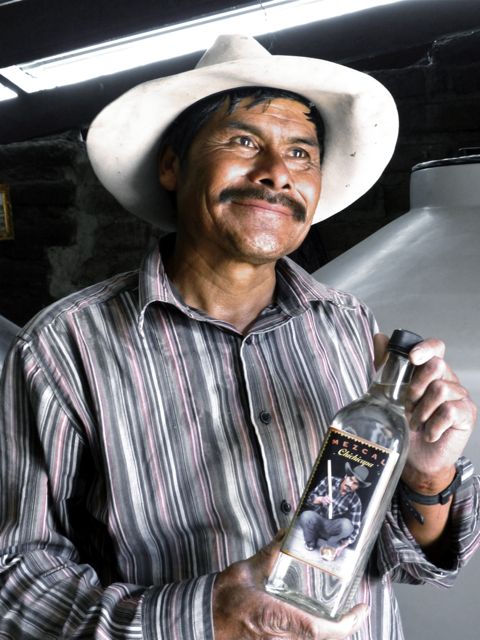
Here in Oaxaca, mezcal is offered to welcome visitors, served at celebrations of all kinds, plays a role in most traditional ceremonies, and audiences always enthusiastically join in when Lila Downs sings, Mezcalito.  Oaxaqueño families have been harvesting agaves and hand crafting mezcal for generations.  The following photos are from an afternoon spent at one such palenque in San Baltazar Chichicapa(m).

Agave piñas (hearts) are stripped of leaves & roots and placed in a large outdoor pit oven.

P1060398_2

They are covered with agave leaves, fiber, mats and dirt and cooked over red-hot rocks for three to four days.

P1060400

The roasted agave is crushed with a gigantic stone wheel pulled by a horse.

P1060415_2

The roasted and mashed agave is then placed in large wooded vats to ferment.

P1060413_2

The liquid is extracted and twice distilled.  Next it is either bottled, if it is to be sold as blanco (aka, joven), or placed in barrels to age.  Reposado is aged for less than a year and añejo is aged from one to twelve years.  Needless to say, I returned home with my 4 L plastic gas can (no, it had never been used for gas!) filled with reposado made by our host and master mezcalero, Faustino.

P1060432

As the old Oaxaqueño saying goes, “For everything bad, drink mezcal and for everything good, you also should!”

And, please note:  This is a drink to be savored not chugged!

Read Full Post »

“But one day we shall be rich, and the next poor. One day we shall dine in a palace and the next we’ll sit in a forest and toast mushrooms on a hatpin….” — Katherine Mansfield, The Aloe.

Last Sunday, via a narrow winding road, we drove up into the Sierra Norte for the 13th Regional Wild Mushroom Fair (Feria Regional de Hongos Silvestres) in San Antonio Cuajimoloyas.  The village is part of the Pueblos Mancomunados, a union of seven villages formed to protect the forest, preserve local traditions, and promote ecotourism, in order to provide employment. Thirty-seven miles northeast of Oaxaca city, 10,433 feet above sea level, and often in the clouds, Cuajimoloyas has an ethereal feel and seems a world apart from the valley below.

“I am… a mushroom on whom the dew of heaven drops now and then” — John Ford, The Broken Heart (1633).

Entering the plaza in front of the portales of the municipal building, we were surrounded by the 20 species of wild mushrooms endemic to the region.  There were mushrooms with shiny orange caps; mushrooms resembling coral, trumpets, a head of cauliflower, flower petals; baskets of freshly dug mushrooms, baggies of dried mushrooms, a bowl of spores; mushrooms sauteed, grilled on hot coals, stuffed in empanadas and tamales, and made into candy.

“Nature alone is antique, and the oldest art a mushroom.” — Thomas Carlyle, Sartor Resartus.

And there were the people of Cuajimoloyas…  I quickly found the enchanting abuela from last year, again selling Atole Rojo and it hit the spot!  Another abuela was selling fragrant fresh herbs, most I’d never heard of.  I forgot about a sprig she gave me and it was a pleasant surprise when I returned home and emptied my pockets.

I’m already looking forward to next year…

Read Full Post »

There is SO much going on in Oaxaca right now that the doing isn’t leaving much time for the writing!

However, I’ll give it a try with today’s Feria del Tejate y el Tamal.  The festival is part of an effort to preserve the food culture of the Zapotec.

IMG_3345

What, you may ask, is tejate?  It’s a frothy, refreshing, and nutritious non-alcoholic pre-Columbian beverage made from Nixtamal corn mixed with tree ash, toasted cacao beans, mamey seeds, and Rosita de Cacao flowers.  The sale of tejate is the main economic activitity in San Andrés Huayapam, located about 7 miles north of the city, and it is prepared and served by the tejateras of the Unión de Mujeres Productoras del Tejate.

Then, of course, there were the tamales — in tin buckets and giant pots covered in layers of tea towels, many colorfully embroidered.  So many vendors anxious to reach into the steaming buckets and so many varieties to choose from.  Where does one start?

Blogger buddy Chris recommended the Rajas and Verde from the gal “down at that end,” a taste of a friend’s Flor de Calabaza added that to the list, Mole is a given, and I had to find Chichilo.  The latter is one of the seven moles of Oaxaca, it is only served on special occasions, such as weddings and christenings, or when the crops have been harvested.  Chilhuacle negro, mulatto, and pasilla chiles; blackened tortillas and seeds of the chiles; and avocado leaves (the latter imparting a subtle anise flavor) give it its distinctive flavor.  After three unsuccessful attempts, eureka, I found it!  And so I returned home with five mouth-watering tamales.

Platter with 5 tamales

Speaking of ingredients like corn, cacao, chiles, and calabaza, for a graphic of foods Mexico gave to the world, click HERE.

¡Buen provecho!

Read Full Post »

Yesterday, we began the marathon than is Guelaguetza in Oaxaca.  First on the day’s agenda was a morning trip to Reyes Etla.

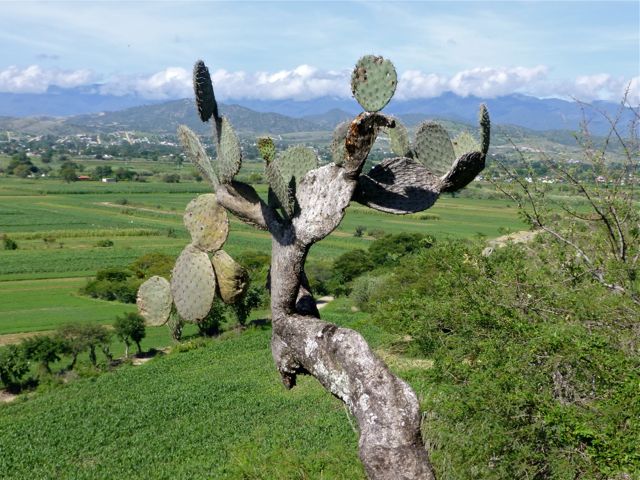
The Señor de las Peñas church sits atop at hill and views of the lush green fields (gracias, rainy season) and the mountains were breathtaking.

Cactus, farmland, mountains

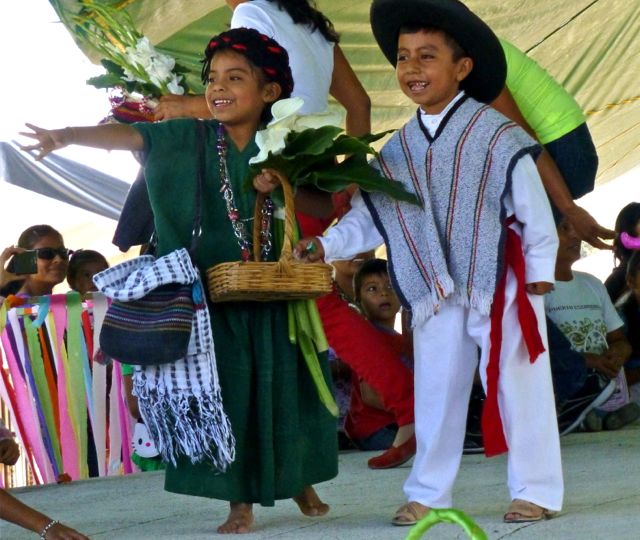
Impossibly adorable children danced and shared, in the spirit of Guelaguetza.

Boy and girl in traje throwing candy to audience

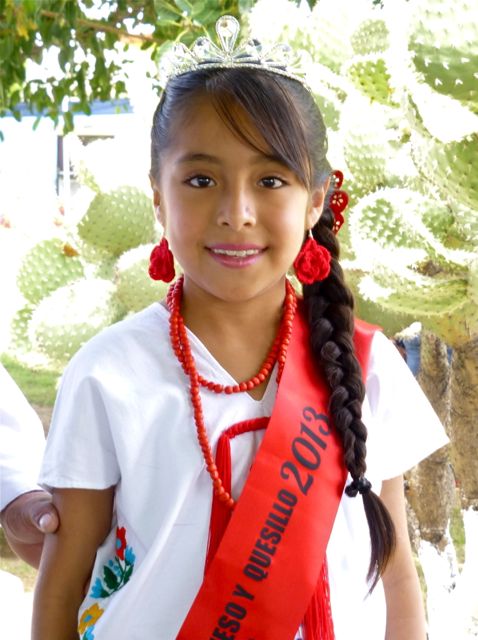
We were in the heartland of Oaxaca cheese country for the crowning of  Jimena Santiago Vasquez, as queen of the third Expo Feria de Queso y Quesillo.

Girl with crown and red sash

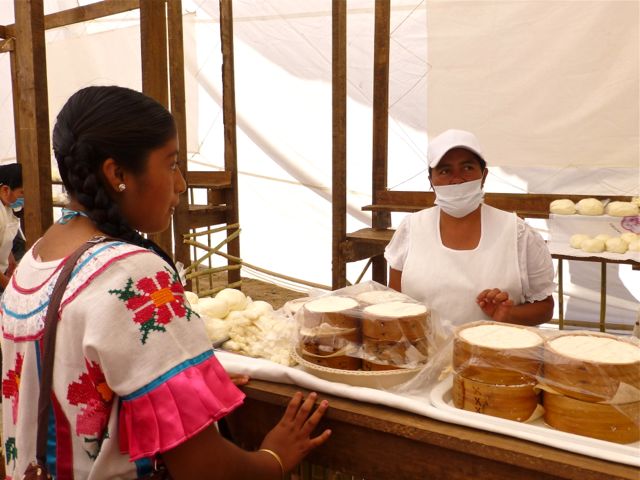
Did I say cheese?  Oh, yes — stalls and stalls of yummy cheese.  The fair runs through Monday and we will be back!

Woman selling cheese

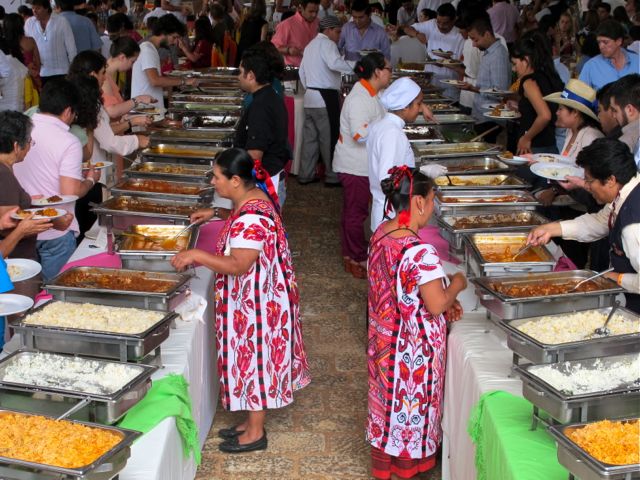
Next on our itinerary was a return to the city for a little (?) gluttony — the Festival de los 7 Moles opening banquet on the grounds of the Jardín Etnobotánico de Oaxaca.  Botanas Oaxaqueña (cheese, chicharrón, chiles rellenos), followed by Sopa de Fandango, 15 (not 7) Moles, 4 Tipos de Arroz, followed by a platter of pastries and scoops of Leche Quemada and Tuna nieves (sorbets).  Oh, and did I mention, cervesas and mezcal?

Lines of serving platters and people

We even got a little culture, as author, Laura Esquivel (Like Water for Chocolate) spoke, though it was a little hard to hear her, with all the eating, drinking, and related conversations!

Profile of Laura Esquivel

Moving rather slowly, we pushed back from the table and headed down to the Alameda (oh, it felt good to walk!) to take in the last stage of the Diosa Centéotl competition — the chosen “Goddess” presides over Guelaguetza.  However, the area surrounding the tented stage was a mass of people by the time we arrived and the best I could do was see the backs of the magnificent traje.  (See Chris’s blog for close-ups from the stage one competition.)  And, the winner is…  Dulce Yanet Grijalba Martínez, from the Zapotec community of San Pablo Villa de Mitla.

Backs of women sitting in traditional dress

After a brief siesta, I rendezvoused with some young friends and we walked over to the Plaza de la Danza for a free performance by Alejandra Robles, one of my favorite Oaxaqueña singers.  (For video from the last time I saw her, click HERE.)

Alejandra Robles

The night was still young for my young friends and they were off to get a nieve at Jardín Socrates.  I was off to bed, because I’d already had my day’s allowance of nieve AND we’ve only just begun!

Read Full Post »

Sunday is market day in Tlacolula.  The sounds and sights…

piles of gourds

The smells and tastes…

Chicken on a grill

And, most of all, the people…

Woman carrying tlayudas on head

Much needed chicken soup for my soul.

Read Full Post »

In Oaxaca, a molino is an indispensable business in every village.  Dried corn, cacao beans, chiles, herbs, spices, nuts, and seeds are brought to the molino to be ground so they can be turned into the staples found on Oaxaca’s tables — tamales, tortillas, tlayudas, tejate, mole, Oaxacan chocolate, and much mouth-watering more!  Below is a miller of corn in Tamazulápam del Espíritu Santo, in the Mixe region of Oaxaca.

Sign painted on side of building "Molino de Nixtamal"

In Mill Valley, Molino is a colorful place-name, a street and a park, that recalls California’s Spanish and Mexican past.

Wooden sign: "Welcome to Molino Park"

“Suburbia is where the developer bulldozes out the trees, then names the streets after them. ”  —Bill Vaughan

Read Full Post »

« Newer Posts - Older Posts »