Feeds:
Posts
Comments

Archive for the ‘Culture’ Category

Wall art from here…

Multicolor mountain lion wall art.

Wall of 142 Throckmorton theatre on Madrona,  Mill Valley, CA by Zio Ziegler

to there.

Wall of Espacio Zapata on Porfirio Díaz, Oaxaca de Juárez, OAX

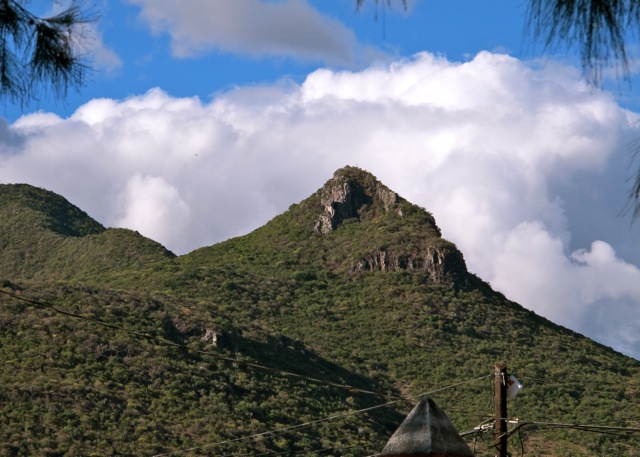
And, sacred mountains from here…

Mt. Tamalpais

to there.

Green rocky top mountain against white cloud and blue sky

Transition time… Mill Valley back to Oaxaca.

Save

Read Full Post »

A little craziness from the November 2, 2011 comparsa in Vista Hermosa…

Muchisimas gracias to all my readers.  Thank you for stopping by, your perceptive comments, and your encouragement.  Peace and joy in 2012, if not in the world, at least in your heart!

Read Full Post »

Fascinating and revealing… from Upside Down World.  I encourage you to read the full article.

Defying the Myth of Native Desolation: Cultural Continuity in Oaxaca
Written by Kathleen Melville
Friday, 09 December 2011 15:56

Woman grinding masa on stone matate

“There is no remedy, and the Indians are coming to an end.” – Don Felipe Huamán Poma de Ayala, 1615 (quoted in Restall, 100)

Despite the passage of nearly four hundred years, Huamán Poma’s dismal pronouncement remains the sad ending to many popular narratives of the conquest. In classrooms throughout the United States, students learn that the arrival of Columbus spelled the end of Native American civilization and that the Spanish conquest obliterated indigenous culture and society in the Americas. As Matthew Restall notes in “The Seven Myths of the Conquest”, this pervasive “myth of native desolation” (102) obscures the strength and vitality of indigenous people throughout history and into the present.

In Oaxaca, Mexico, the lives and work of indigenous people belie the myth of native desolation and attest to thousands of years of continuous, evolving culture. In July, over 30 educators from the United States convened in Oaxaca for a summer institute funded by the National Endowment of the Humanities. Our goal was to better understand the histories and cultures of indigenous people in the region so that we might help illuminate and preserve them through our teaching. With unit plans that we designed and shared, we hope to disturb and diminish the myth of native desolation and to enrich our students’ perspectives on native culture.

<snip>

Globalization and transnational corporations also pose a significant threat to indigenous cultural continuity. Artisans in Oaxaca complained that Asian companies have been mass-producing textiles and wood carvings abroad and then undercutting the tourist market locally. As documented in several articles on this site, the agricultural corporation Monsanto aims to expand its reign into Oaxaca and eliminate small maize farms like the Vicente family’s. Drug cartels, their own breed of transnational organization, also jeopardize indigenous culture by increasingly luring young people into lives of violence far from home. These giants make for formidable foes in the fight for cultural survival, but the indigenous communities of Oaxaca have faced formidable foes in the past. From the Aztec conquest to the Spanish conquest to the present day, indigenous communities in Oaxaca have endured and evolved, defying the myth of native desolation and defining a culturally sustainable future for themselves.  [Full article]

(FYI:  I just had first-hand experience with the threat cheap imports pose to the livelihoods of Oaxaca’s artisans.  I do all my Christmas shopping in Oaxaca (so much more enjoyable than hitting the malls in the USA) and purchased backscratchers for stocking-stuffers that “looked” like they were made from the ubiquitous carrizo found anywhere a trickle of water is found in Oaxaca.  However, there they were in a bin at one of the chain drug stores here in el norte!  I’m thinking they were made in China.  Wood carvers, potters, and weavers, the conversation is the same; business is down and these creative and talented folks are being forced to return to work in the fields.)  — casitacolibrí

Read Full Post »

Apparently, I’m not the only one who has made the journey from Oaxaca to California.  The San Francisco Bay Area has been basking in sun and Oaxacan-blue-skies.  Even though the temps don’t match-up, the coast beckoned…

Wall art on sea wall

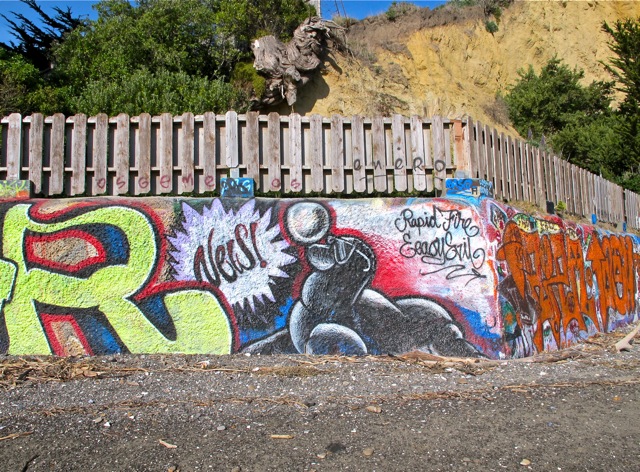
And, wall art greeted us in Bolinas.

Wall art of surfer in wetsuit carrying surfboard

Gosh, except for the subject matter, I felt like I was in Oaxaca!

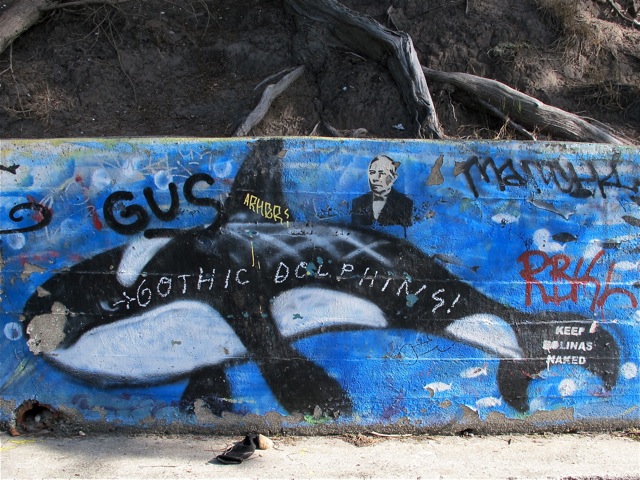
Wall art of whale on seawall

Wait!  Who is that I see?

Wall art of Benito Juárez on seawall

None other than Oaxaca’s favorite son, Benito Juárez.  The subject matter IS the same!!!

Read Full Post »

And the juxtapositions continue; the annual nativity scene set up on the zócalo in Oaxaca across from the Government Palace and the ongoing occupation by the women of San Juan Copala, not to mention the ubiquitous banners of  Section 22 of the Teachers’ Union.

This slideshow requires JavaScript.

Then there were the impossibly cute kids and a rapid request from them.  “Mas despacio, por favor,” sez I.  A slow motion reply followed, “To-ma nu-es-tra fo-to,” sez the older girl.  And, so I did!

Read Full Post »

As promised…

And, there is SO much more!!!

Read Full Post »

… in all manner of ways; there’s a lot of that here.  Successful meetings between old and new are a matter of debate.  The newly renovated Centro Académico y Cultural San Pablo is no exception.  It was acquired, designed by architect Mauricio Rocha, renovated, and repurposed by the Alfredo Harp Helú Foundation.

Located in the heart of the historic district, between the Museo Textil and the Teatro Macedonio Alcalá, this former Dominican convent, originally established in 1529, has been one of those ubiquitous crumbling and peligrosos buildings for a long time.  In addition, to the features of the original cloister, archeological remains from 2,500 years ago were uncovered and have been preserved.

This slideshow requires JavaScript.

The buildings will house a research center (including a library), dedicated to the study of the languages and cultures of the indigenous of Oaxaca, serve as a venue for cultural presentations, and provide exhibit space for the philanthropic endeavors of the Alfredo Harp Helú Foundation, which (among several others) includes the Textile Museum, Museum of Philately (stamps), Institute of Oaxacan Historic , and Children’s Library.

The grand opening, with all the requisite fanfare and dignitaries, was November 26.  Alas, I missed it!  However, the courtyard provided the setting for several performances during the Instrumenta Oaxaca 2011, a 2-week long chamber music festival that ran from November 3rd to the 18th; two of which I attended.  I was dazzled by the setting (and the acoustics weren’t bad, either) and was especially gratified that the library, which the seating faced, presented a prominent and dramatic architectural feature.

Written on the wall of the building housing a small collection from the BS: Biblioteca Infantil (Children’s Library), a quote from Dostoyevsky (of all people):  Los libros son mi aliento, mi vida y mi futuro.  In English:  Books are my breath, my life and my future.

For more (in English) about the Centro Académico y Cultural San Pablo, see Norma Hawthorne’s article, Oaxaca Center Promotes Indigenous Language and Culture, Opens November 26, 2011.

Update:  Read how this cultural and historical gem, lost in plain sight.

Read Full Post »

In August 2011, Vive Oaxaca launched a campaign to showcase the best of the state through a series of video shorts.  Two have already been released online:

Esto es Zaachila

and, Esto es Guelaguetza

I’m looking forward to Monday night’s online release of, Esto es Oaxaca de Juárez.  I guess you know what my Tuesday morning blog post will be!

Read Full Post »

… equals public art on Calzada Niños Héroes de Chapultepec, a section of the legendary Pan-American Highway in Oaxaca’s capital city.

On October 27, 2011, representatives from the groups Espantapájaros, Asaro, Bouler, Viyegax, Arte Jaguar, Lapiztola, and Uriel Marín set to work transforming a long drab wall into a work of art representing the social, cultural, and political life of Oaxaca and Mexico.  The wall of graffiti was part of the Puntos de Encuentro, Primer Festival de Artes Visuales Oaxaca 2011, previously mentioned in my mid-October blog post, Meeting Points….

This slideshow requires JavaScript.

As of a few days ago, the artwork remains to catch the eye of drivers (yikes!), passengers, and pedestrians.

Read Full Post »

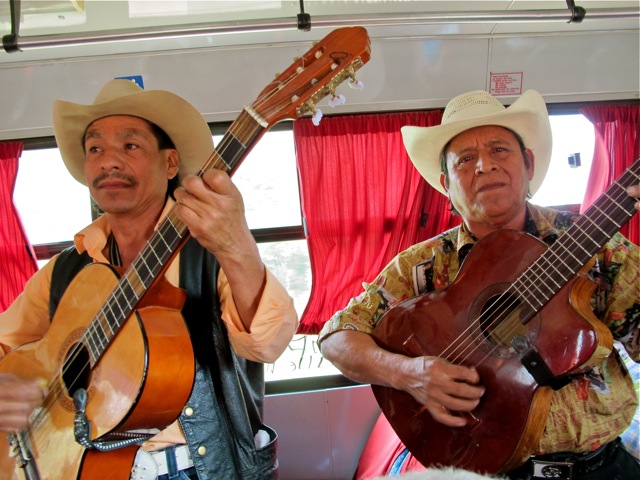
Being serenaded on the bus from Zaachila back to Oaxaca…

Two guitarists on bus.

What’s not to love???

Read Full Post »

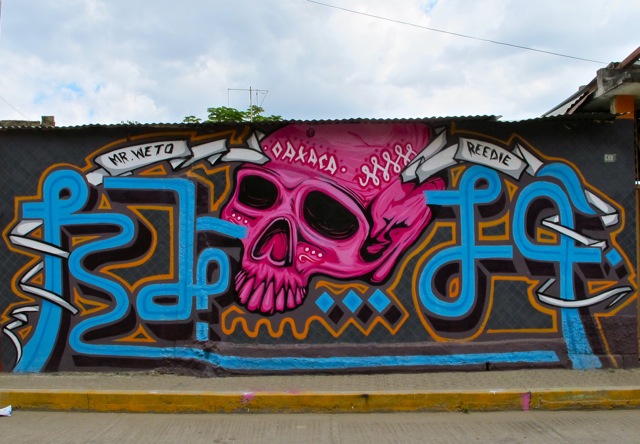
… in Zaachila

Wall mural: magenta skull with writing: Mr. Weto; Oaxaca; Reedie

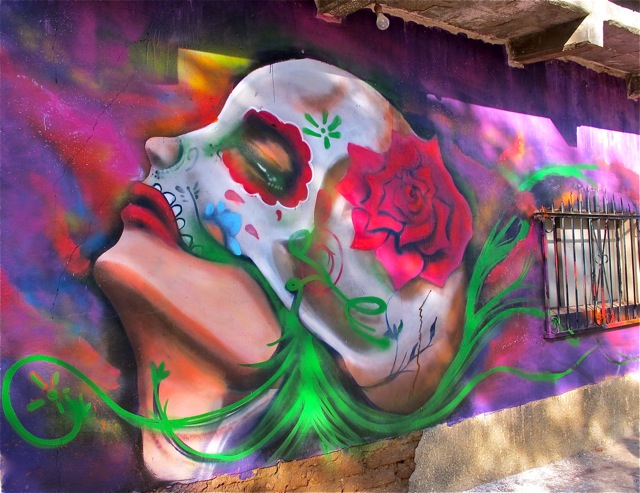
and Zimatlán de Lázaro Cárdenas.

Woman's head with 3/4 white mask with large red flower

I have no idea what they mean…  But, who cares?

Read Full Post »

Today is Thanksgiving in los Estados Unidos de América… and besides my wonderful family and friends, I am so grateful to see and experience places like San Antonino Castillo Velasco during los Días de Muertos.

This slideshow requires JavaScript.

¡Feliz Acción de Gracias a todos!

Read Full Post »

San Antonino Castillo Velasco, a Zapotec community near Ocotlán, is a village known for its flowers.  They are, no doubt, the inspiration for beautifully embroidered linens and clothing sold in the mercados and found in museum collections.  And, a specialty is the “flor inmortal” (immortal flower), so named because, even when dried, it retains its brilliant colors.  They are used to create intricately designed figures on display December 23 in the city of Oaxaca, during Noche de Rábanos and to decorate the graves of  loved ones during Días de Muertos in San Antonino.

This slideshow requires JavaScript.

As I’ve previously mentioned, each village seems to have its own unique traditions for the Days of the Dead.  Villagers here mix the area’s very fine dirt with water, cover the graves, use a trowel to smooth it, outline designs and religious imagery into the dried coating, and then use flowers (fresh and dried), to paint the scene.  Entire families are involved, young and old, and the atmosphere is filled with joy, purpose, and most of all… Love.

For a very special moment, that is a metaphor the two days spent at San Antonino, see Chris’s post, Moments make a life..

Read Full Post »

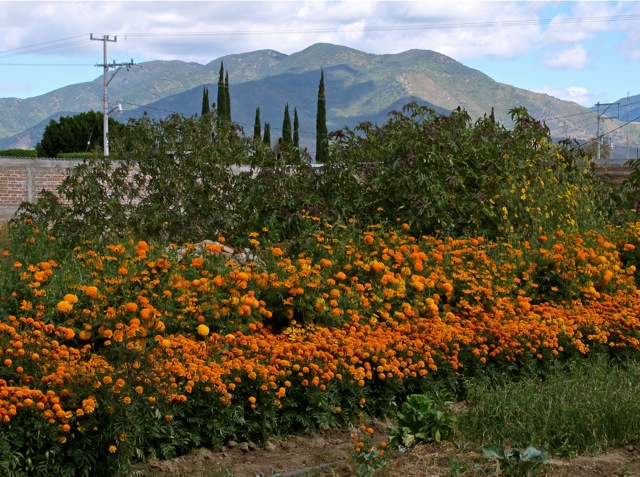
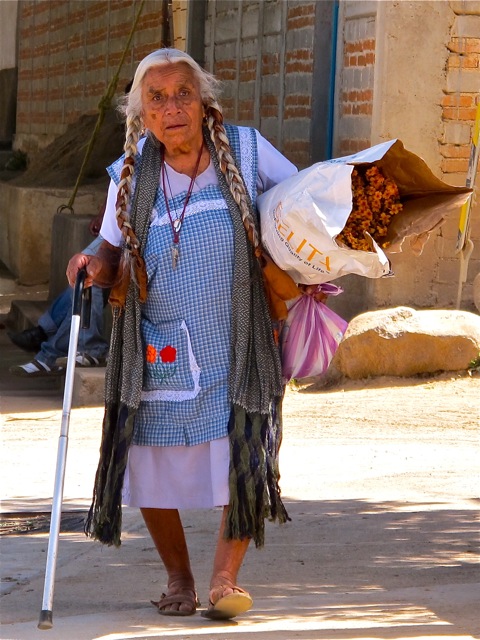
San Antonino Castillo Velasco, to be precise. Young and old converged on the municipal cemetery to decorate the graves with the magenta of cockscomb and yellow to orange to rust of marigolds (cempazúchil or zempoalxochitl) grown in nearby fields.

Field of marigolds with mountains in background

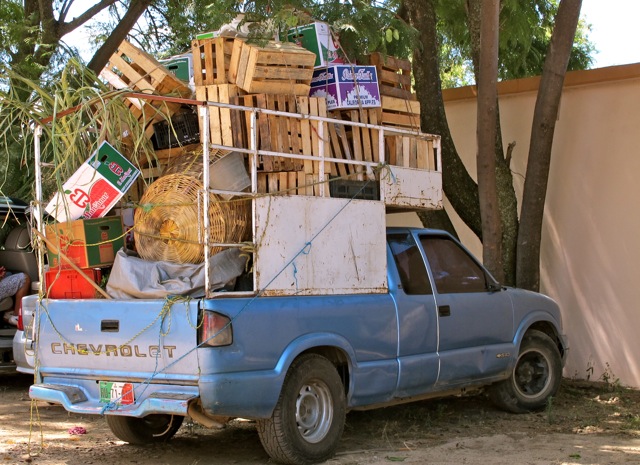
They came by car and truck…

Blue pick-up truck piled high with empty crates and baskets

By horse (note wooden saddle)…

Horse with saddle tied to a tree

By pedal-powered cart…

Green cart powered by a bicycle

By horse-powered cart.

Young girl riding in a horse pulled cart.

And, on foot…

Elderly woman walking with cane and carrying a bundle of flowers

Laughter, artistry, and pride followed.  Stay tuned for images of their meticulous labors of love.

Read Full Post »

Mexico’s favourite singer-songwriter dishes on development, gender, indigenous issues, peace and music.  An interview with Lila Downs (in English) from the IFAD social reporting blog:

http://blip.tv/ifad/lila-downs-reverence-hope-change-5672813

By the way, Chris, over at Oaxaca-The Year After has posted more from the recent concert at the Guelaguetza Auditorium, covered in my Sublime sounds and spectacle post.

Read Full Post »

« Newer Posts - Older Posts »