Feeds:
Posts
Comments

Archive for the ‘Culture’ Category

Samuel Bautista Lazo is one of the smartest, joyous, and Zen-like people I know.

Sam sitting cross-legged in a natural alcove in the mountain

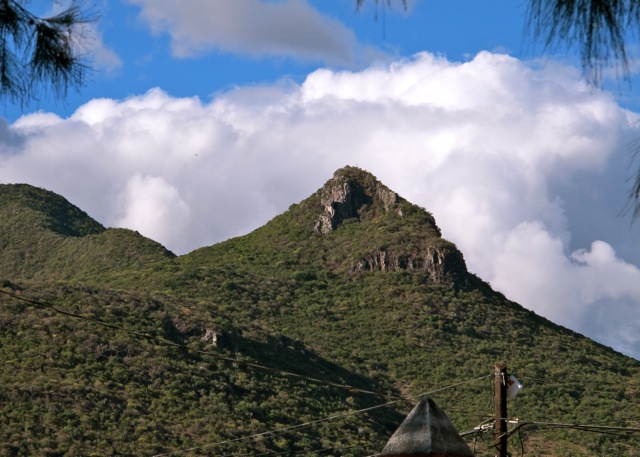
Sam is my young, previously mentioned, Zapotec friend who is getting his Ph.D. in Sustainable Manufacturing at the University of Liverpool.  Sam is from Teotitlán del Valle in Oaxaca, a village watched over by El Picacho, the sacred mountain — whose presence is unmistakable and palpable.

El Picacho

The village is known for its traditional performances of the Danza de la Pluma (about which I’ve posted on numerous occasions) and their skillful and creative weavings with wool.  Like a majority of its Zapotec residents, Sam and his family weave — father, Mario Bautista Martínez; mother, Leonor Lazo González; and brother, Celestino Bautista Lazo.

Sam and his family pose in their yard

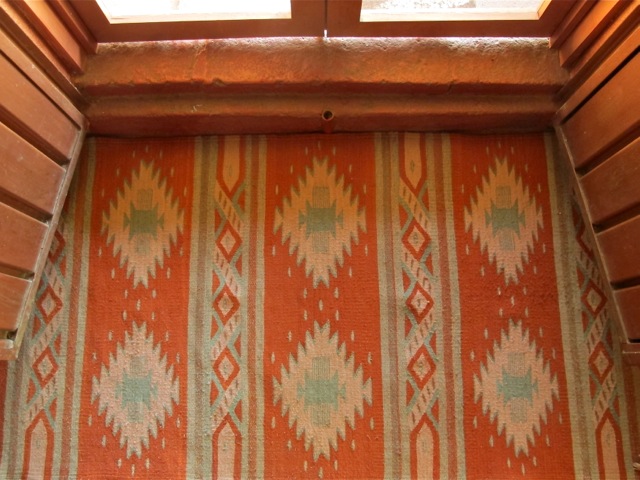
The family was featured last year in an article, The Crafts of Oaxaca, posted on the Lark Crafts website.  Like many others, on my first visit in 2007, I couldn’t resist buying a couple of tapetes (rugs), including this one, which now serves as a welcome to all who enter my little casita.

Tapete on floor: geometric patterns in rust, beige, agua

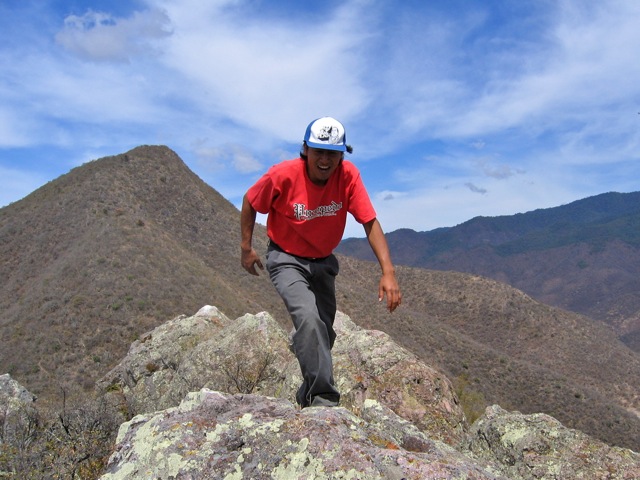
A friend and I returned six months later and had the privilege of climbing to the top of El Picacho with Sam.

Sam on top of El Picacho

And no, I did not join Sam in leaping from one rocky peak to the other!

Looking forward to your return, Sam!

(ps)  Here is a Dixza video of  Sam from 2008, where he discusses the interpretation of the symbols and patterns woven into Zapotec rugs.  You might also want to check out others in his Dixza series from Teotitlán del Valle.

Read Full Post »

I love going to my little local mercado on Sunday mornings.  Steps leading up to it from Independencia are lined with vendors of street food, flowers, religious trinkets, herbs, you name it!  Inside, the cavernous building is teeming with more activity than on weekdays.  And, these guys are there to entertain diners and shoppers…

Man, teenage boy, and young boy playing marimba

I suspect this is a father and his two sons.  Marimba playing seems to be a (masculine) family affair.

Close up of young boy

It isn’t unusual to see these beautiful instruments being carried through the streets and sidewalks of Oaxaca…

Parquetry detail on marimba

… on their way to set up and play traditional “sones” from Oaxaca and/or old pop standards at a fiesta, in front of a shop, or inside a mercado.  Muchisimas gracias for a delightful soundtrack!

One of these days, I’m going to shoot video of some of them, but in the meantime, here are a couple from YouTube:

Read Full Post »

Last night I joined a standing-room-only crowd for the book launch of Grandes Maestros del Arte Popular de Oaxaca (Grand Masters of Folk Art of Oaxaca) at the Centro Académico y Cultural San Pablo, in Oaxaca city.  This beautiful 340+ page book was the joint effort of the Fundación Alfredo Harp Helú, Fomento Cultural Banamex, the State of Oaxaca, and CONACULTA (National Council for Culture and the Arts).

Cover of the book

The press was there in full force, as was governor Gabino Cue, benefactor Alfredo Harp Helu, and a number of other movers and shakers on Oaxaca’s cultural scene.  Many of the artisans were also in attendance and several posed for photographs holding their copy of the book at the reception that followed.

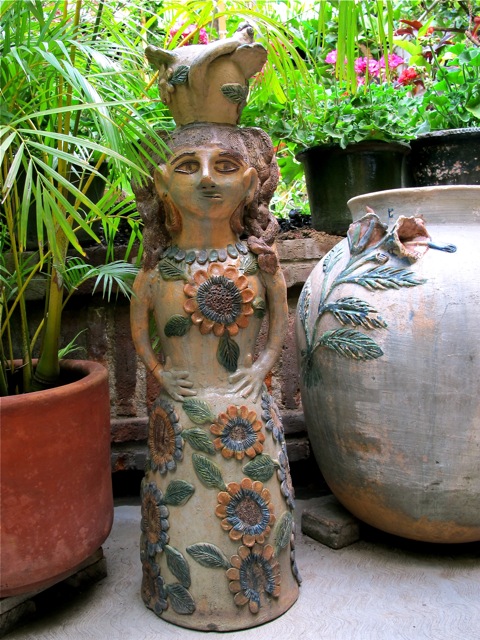
One of the artisans who was not there was the late potter, Dolores Porras from Santa María Atzompa, as Parkinson’s disease had claimed her on November 1, 2010.  Four pages in the book are devoted to this maestra of pottery and her pioneering work with glazes.  Examples of her work can be seen all around Oaxaca, including these scattered in the garden at the hotel, Las Golondrinas.

Vase in the shape of a woman's face and rounded body

Her work has inspired imitation, but as is evident in these pieces, her whimsy, creativity, and sense of proportion would be difficult to match.

Urn with the face of a woman.

I want to thank potter Michael Peed for pointing out these hidden treasures…

Tall vase in the shape of a woman.

following a showing of his loving documentary, Dolores Porras: Artista Artesana de Barro Santa María Atzompa.  (Click here for an excerpt on YouTube.)

DVD front and back covers

And then there is this one, I discovered on my own, the very next day — on a bathroom shelf, no less — at Casa Linda

Vase with image of a woman, with pointy breasts.

Read Full Post »

There are only a few more days left to be delighted by “Manos que crean y ojos que leen” (Hands that create and eyes that read), a whimsical exhibition of popular art at the Biblioteca Andrés Henestrosa.  The pieces were commissioned by Rosa Blum (who, with Henry Wangeman, owns Oaxaca’s bilingual bookstore Amate Books) to celebrate reading and promote the incredibly creative artisans of Oaxaca who were suffering from a drop in tourism following the social conflict of 2006.

This slideshow requires JavaScript.

So…  If you are in Oaxaca, be sure to see it before it closes at the end of this month.  If not, you might want to consider a trip down here (Oaxaca is NOT on the US State Department travel warning list), visit some of these artisans in their villages, see their work up close and personal, and perhaps purchase a few unique treasures from these talented people.

For other pieces in the exhibit, see Chris’s photos over at Oaxaca-The Year After.

Read Full Post »

LA.com just posted a phone interview with Oaxaca’s own, Lila Downs,  where she discusses influences on her musical development, experiences working on the movie Frida, and future projects.  The following is the first of eleven questions asked by Paty Elias, in advance of Lila’s Los Angeles performance on Feb. 25, 2012 promoting her album, “Pecados y Milagros.”

From the interview…

LA.COM::  With such a diverse musical background, why did you decide to focus on Ranchera, style music?

Lila Downs:   I think that I have been very affected by what has been happening in Mexico. There has been a lot of violence, and I started composing a number of songs that were inspired by   retablo, the   votive art forms.

It’s about the notion of having a miracle in your life and giving thanks to the sometimes non-visible saints and elements of faith we have in Mexico. I thought it was very fascinating to somehow find the subjects in the songs and then kind of place them in the same way towards showing and giving thanks for the blessings that we have in our life but then also questioning the interpretation of each of these pieces, which are miracles and sins.

Ranchera is really a genre — it’s a form that is kind of about the profane.

There are Rancheras

Lila Downs (LilaDowns.com)

that are about the celebration of life as well as fertility and perhaps the more Indian elements in our culture.

But I would have to say that the Ranchera is mostly accompanied by tequila or mescal. And I think that’s when we will tell our sins, and that’s why I chose the Rancheras at this point — And of course because its one of the only forms were you can really spill your guts. And I think that’s what we are going through right now. We are in desperate times, and you need something with which you can really express your soul.

For the full interview and a couple of video clips, click HERE.

And for my description and photos from the Nov. 6, 2011 Lila Downs concert at Oaxaca’s Guelaguetza Auditorium, click HERE.

Read Full Post »

… let us walk together.  And we, in Oaxaca city, have been for the past several weeks thanks to Oaxaca born artist Alejandro Santiago.

The streets and sidewalks around Santo Domingo have been peopled with “La Ruta del Migrante – Caminemos Juntos,” his heart wrenching sculptures representing the 2,501 migrantes, men and women, who have left his pueblo of San Pedro Teococuilco almost deserted.

No two sculptures are the same; each is a tribute to the unique individuals who, most certainly with great reluctance, left the homes of their families and ancestors to make their way north in search of jobs.  The pain in their contorted bodies, their faces, and their feet causes me to pause every time I pass.  I’ll let the images speak for themselves and ask the questions societies all over the world need to answer.

This slideshow requires JavaScript.

These migrantes on the streets of Oaxaca are scheduled to disappear at the end of the month and I don’t know where they are next headed.  However, two documentaries have been made about Santiago’s tribute to migrantes:  Twenty Five Hundred & One by Patricia Van Ryker and 2501 Migrants: A Journey directed by Yolanda Cruz.

Read Full Post »

… and it never gets old, at least not for me!  Thus yesterday, returning from picking up a newly repaired sandal at the zapatero (shoemaker), a parade along the Alcalá had me happily stopping.

Women in embroidered black velvet costumes and wearing white lace head pieces arm in arm with men in black pants, white shirts, red neck kerchief and carrying a sombrero

Judging by the traje (costume), what is popularly known north of the border as Frida Kahlo style clothing, the elaborate multicolored embroidery on black velvet and the signature starched white lace head pieces, immediately said the Isthmus region of Oaxaca, the area along the Gulf of Tehuantepec.

A banda led off the procession with, of course, the requisite tuba.

Man carrying a shiny brass tuba

A marlin out-of-water  followed the band.  Actually, a friend and I had a discussion about what kind of fish it was.  Marlin (blue and black), sailfish, and swordfish are found in the waters of the Gulf of Tehuantepec.  After looking at this website, I’m thinking this guy is a marlin, but who knows???

Man carrying a large grey marlin on his head

Once home and photos downloaded, the detective work began; trying to figure out what this was all about.   Putting together the information I could glean from the banners and a little research, I think this was a parade by people from San Blas Atempa celebrating a traditional fiesta titular.

Woman carrying banner, surrounded by women in bright pink skirs and black emboidered huipiles.

Naturally, there weren’t just beautifully dressed adults.  Adorable little boys…

Little boy wearing black pants, white shirt, red neck kerchief, and sombrero

and girls kept up the pace on this bright sunny 80+ degree day.

Little girl in full embroidered black velvet attiren and including white lace headpiece, looking at the camera.

I wasn’t the only one watching… Alejandro Santiago’s growing army of Migrantes stood transfixed.  (Well, actually they are literally affixed to the sidewalks and streets with some sort of gooey glue.)

Tejuana women carrying banner, as they pass Migrante sculptures lining the street.

Just another day and another parade in paradise!

Read Full Post »

With a nod to Humphrey Bogart’s character in Casablanca:  Of all the volunteer opportunities, in all of Oaxaca, why did I walk into the Oaxaca Lending Library (OLL)?   For the answer, you will have to check out my newly published (yippeee!) article on volunteering at the Oaxaca Lending Library on the Go Overseas website.

The article mentions the various and sundry activities organized by the OLL.  So, I thought I’d give you a taste:

Volunteering at the OLL has introduced me to an incredibly diverse, knowledgeable, and talented group of people from a wide variety of backgrounds.  Be they native Oaxaqueños, year round ex pat residents, or yearly “snow birds,” many have become part of my community and support system.  A library —  what better place to get your questions answered about the who, what, where, why, and how of living and thriving in an unfamiliar culture?  People and books are there to assist with navigating the challenges, celebrating the differences, and exploring the surroundings.

A couple of weeks ago, I attended a panel discussion at the library commemorating fifty years of the Peace Corps.  Two of the speakers had been among the original Peace Corps volunteers in the 1960s, one to Africa and one to South America. The third speaker is an 85-year-old woman who was a Peace Corps volunteer when she was 60+ years old!  All have been living in Oaxaca for a number of years, and credit their Peace Corps volunteer experiences with broadening their horizons and realizing their power to have a positive impact in the world, even if it is just one person at a time.  All continue to find ways to offer their time, energy, and talents to assist various people and communities of Oaxaca.

According to a recent International Community Foundation report on US retiree trends in Mexico:

• Nearly 60% of respondents volunteer their time to a charitable cause in Mexico and over 29% volunteer at least once a week or on a regular basis. Respondents engage in a wide range of volunteer activities, most prominently with education-focused charities, community projects, and the environment.

• U.S retirees in Mexico volunteer because of their strong sense of social responsibility and desire to make a difference in their adopted communities. Survey respondents reported that their volunteer efforts increase their sense of belonging in Mexico, and contribute to an increased sense of community among local neighbors and friends.

• 42% of American retirees surveyed are actively involved in at least one or two Mexican charities in their adopted communities, while another 11% are affiliated with more than three.

Ten years ago, I never dreamed I would be living an ex pat life in southern Mexico.  Funny how life’s curves can lead to opportunities….

Read Full Post »

News of this discovery was posted on Facebook this morning by Sam, my young Zapotec friend from Teotitlán del Valle, who is currently getting his Ph.D. in Sustainable Manufacturing at the University of Liverpool.  A global village, it is!

By the way, Santa María Atzompa (mentioned below) is where I experienced a Magical and Mystical October 31st.  The article and photo are from today’s, Hispanically Speaking News.

1,300 Year Old Kiln Used by Ancient Zapotecs Discovered in Mexico

Mexican archaeologists have discovered in the southern part of the country a kiln used by the ancient Zapotecs to make ceramics more than 1,300 years ago, the National Anthropology and History Institute, or INAH, said.
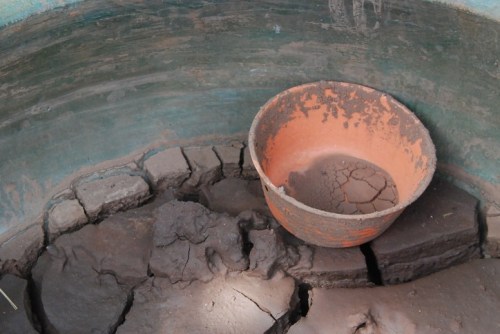
Clay pot in ancient kiln

The pre-Columbian kiln was discovered in the Atzompa Archaeological Zone in Oaxaca state, which will be opened to the public this year, INAH said in a communique.

It added that this is one of the best preserved ceramic kilns ever found in the Zapotec area, and noted Oaxaca’s long tradition in making pottery.

According to Wednesday’s communique, the kiln “is a link between the pre-Columbian pottery tradition and the artisanal ceramics currently made in the community of Santa Maria Atzompa, establishing the connection between today’s inhabitants and their ancestors.”

Archaeologist Jaime Vera, head of the excavation, said the kiln “is thought to date back to the first years of the pre-Columbian settlement of the area, in other words, more than 1,300 years ago, which is deduced from the ceramics found with it.”

Another element that allows the kiln to be dated is the depth at which it was found – 2.2 meters (7 feet 2 1/2 inches) – “far below the layer of stucco that covered it, and which corresponds to that era, the archaeologist said, adding that further studies will be made to confirm its antiquity.

It was in the excavation period between March and December 2011 that the kiln was completely uncovered allowing its principal characteristics to be observed: a cylindrical adobe wall and shelves for placing the objects to be fired.

The kiln consists of a cylindrical adobe wall measuring 2.1 meters (6 feet 11 inches) from the surface to the firing shelves arranged in convergent lines toward the center, and a downdraft vent in the lower part approximately 20 centimeters (8 inches) wide,” Vera said.

He said that “while today’s kilns are not identical in dimensions or shelf arrangement, they do perserve certain basic elements and the function as a space for firing ceramics.”

The Atzompa Archaeological Zone, approximately 4 square kilometers (1 1/2 square miles), existed as a small satellite village of the Zapotec city of Monte Alban during the Late Classic period (650 B.C.to 900 B.C.) when the latter’s growing population expanded beyond its boundaries.

The work to provide the Atzompa Archaeological Zone with the necessary infrastructure will continue, since it is one of the pre-Columbian sites that will be opened to the public this year, INAH said.

Read Full Post »

As you may have gathered, one of the things I love about living down here is the pervasiveness of public art.  So, on a recent trip up to Mexico City, it should have come as no surprise to see the city is filled with heroic sculptures and abstract modern pieces, both serious and whimsical, for all to see, contemplate, and enjoy.

Even benches are an excuse to let the creativity flow.  (S)he is ready and willing to talk or just listen…

Vertigris ostrich bench

He will provide shelter from the storm OR scorching sun, as the case may be!

Aluminum bench topped with a whimsical red chair with lounging figure.

When it’s been an upside down kind of day, have a seat here.

Green metal bench with bottom of torso with legs "seated" on top.

Or, on a Sunday, when the Paseo de la Reforma is closed to traffic, you can park your bike and put a song in your heart!

Smiling young woman sitting on a black iron bench with musical notations; her lavender bike in front.

¡Buen día!

Read Full Post »

Wall art from here…

Multicolor mountain lion wall art.

Wall of 142 Throckmorton theatre on Madrona,  Mill Valley, CA by Zio Ziegler

to there.

Wall of Espacio Zapata on Porfirio Díaz, Oaxaca de Juárez, OAX

And, sacred mountains from here…

Mt. Tamalpais

to there.

Green rocky top mountain against white cloud and blue sky

Transition time… Mill Valley back to Oaxaca.

Save

Read Full Post »

A little craziness from the November 2, 2011 comparsa in Vista Hermosa…

Muchisimas gracias to all my readers.  Thank you for stopping by, your perceptive comments, and your encouragement.  Peace and joy in 2012, if not in the world, at least in your heart!

Read Full Post »

Fascinating and revealing… from Upside Down World.  I encourage you to read the full article.

Defying the Myth of Native Desolation: Cultural Continuity in Oaxaca
Written by Kathleen Melville
Friday, 09 December 2011 15:56

Woman grinding masa on stone matate

“There is no remedy, and the Indians are coming to an end.” – Don Felipe Huamán Poma de Ayala, 1615 (quoted in Restall, 100)

Despite the passage of nearly four hundred years, Huamán Poma’s dismal pronouncement remains the sad ending to many popular narratives of the conquest. In classrooms throughout the United States, students learn that the arrival of Columbus spelled the end of Native American civilization and that the Spanish conquest obliterated indigenous culture and society in the Americas. As Matthew Restall notes in “The Seven Myths of the Conquest”, this pervasive “myth of native desolation” (102) obscures the strength and vitality of indigenous people throughout history and into the present.

In Oaxaca, Mexico, the lives and work of indigenous people belie the myth of native desolation and attest to thousands of years of continuous, evolving culture. In July, over 30 educators from the United States convened in Oaxaca for a summer institute funded by the National Endowment of the Humanities. Our goal was to better understand the histories and cultures of indigenous people in the region so that we might help illuminate and preserve them through our teaching. With unit plans that we designed and shared, we hope to disturb and diminish the myth of native desolation and to enrich our students’ perspectives on native culture.

<snip>

Globalization and transnational corporations also pose a significant threat to indigenous cultural continuity. Artisans in Oaxaca complained that Asian companies have been mass-producing textiles and wood carvings abroad and then undercutting the tourist market locally. As documented in several articles on this site, the agricultural corporation Monsanto aims to expand its reign into Oaxaca and eliminate small maize farms like the Vicente family’s. Drug cartels, their own breed of transnational organization, also jeopardize indigenous culture by increasingly luring young people into lives of violence far from home. These giants make for formidable foes in the fight for cultural survival, but the indigenous communities of Oaxaca have faced formidable foes in the past. From the Aztec conquest to the Spanish conquest to the present day, indigenous communities in Oaxaca have endured and evolved, defying the myth of native desolation and defining a culturally sustainable future for themselves.  [Full article]

(FYI:  I just had first-hand experience with the threat cheap imports pose to the livelihoods of Oaxaca’s artisans.  I do all my Christmas shopping in Oaxaca (so much more enjoyable than hitting the malls in the USA) and purchased backscratchers for stocking-stuffers that “looked” like they were made from the ubiquitous carrizo found anywhere a trickle of water is found in Oaxaca.  However, there they were in a bin at one of the chain drug stores here in el norte!  I’m thinking they were made in China.  Wood carvers, potters, and weavers, the conversation is the same; business is down and these creative and talented folks are being forced to return to work in the fields.)  — casitacolibrí

Read Full Post »

Apparently, I’m not the only one who has made the journey from Oaxaca to California.  The San Francisco Bay Area has been basking in sun and Oaxacan-blue-skies.  Even though the temps don’t match-up, the coast beckoned…

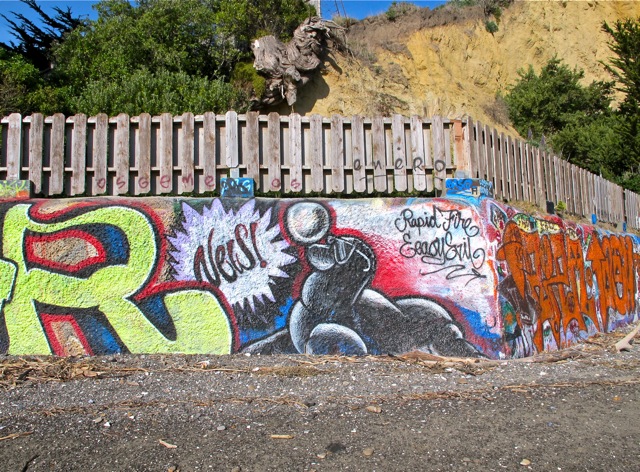
Wall art on sea wall

And, wall art greeted us in Bolinas.

Wall art of surfer in wetsuit carrying surfboard

Gosh, except for the subject matter, I felt like I was in Oaxaca!

Wall art of whale on seawall

Wait!  Who is that I see?

Wall art of Benito Juárez on seawall

None other than Oaxaca’s favorite son, Benito Juárez.  The subject matter IS the same!!!

Read Full Post »

And the juxtapositions continue; the annual nativity scene set up on the zócalo in Oaxaca across from the Government Palace and the ongoing occupation by the women of San Juan Copala, not to mention the ubiquitous banners of  Section 22 of the Teachers’ Union.

This slideshow requires JavaScript.

Then there were the impossibly cute kids and a rapid request from them.  “Mas despacio, por favor,” sez I.  A slow motion reply followed, “To-ma nu-es-tra fo-to,” sez the older girl.  And, so I did!

Read Full Post »

« Newer Posts - Older Posts »