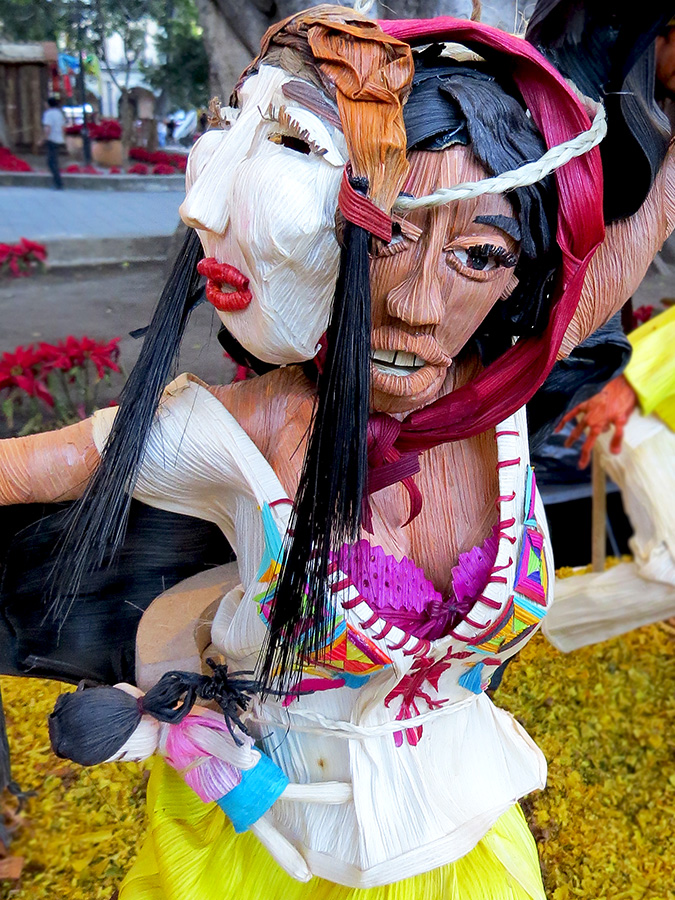
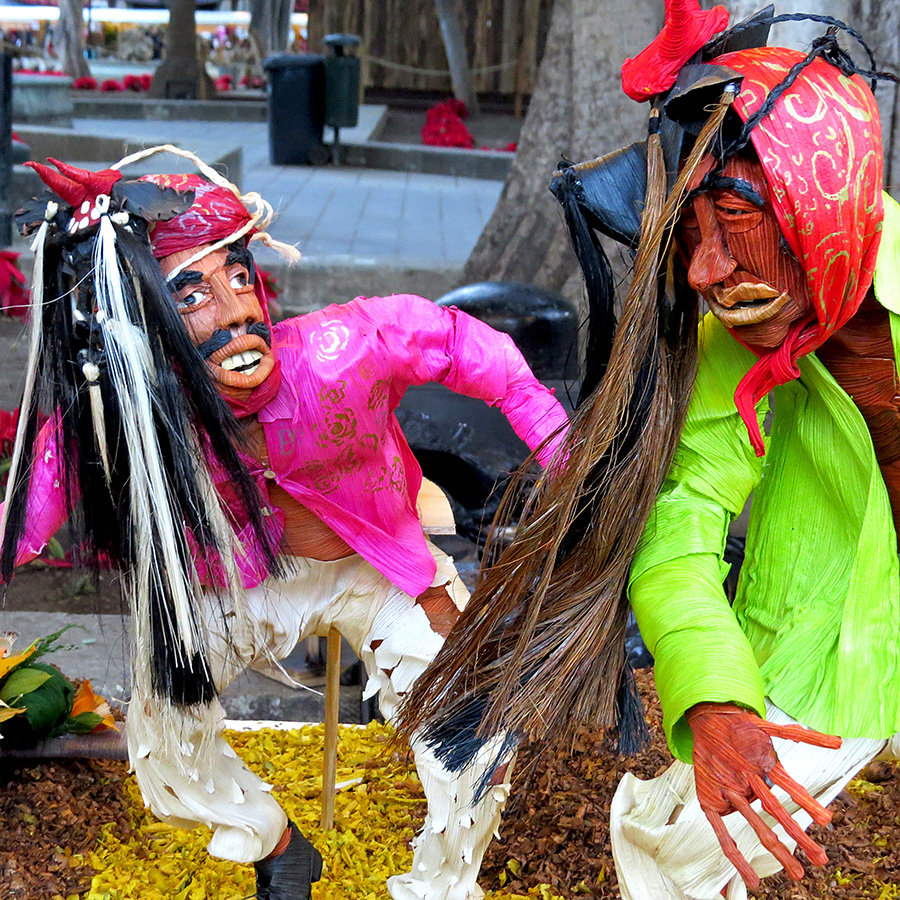
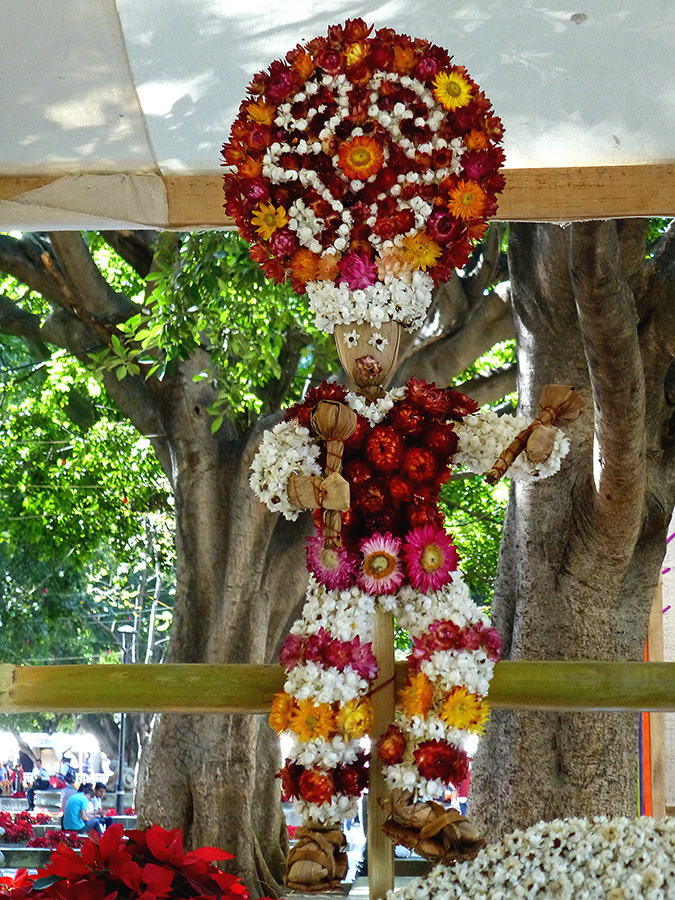
As I previously explained, Noche de Rabanos isn’t just about radishes. One of the other categories of entries is Totomoxtle Decorado. And the winner was Moisés Ruíz Sosa, with his dyed cornhusk depiction of Día de Muertos on the Costa Chica of Oaxaca.
Descendants of slaves, the Afromexicano population of Oaxaca is located in 16 municipalities, with 11 of these municipalities located in the Costa Chica, Oaxaca’s far western coastal region, bordering the state of Guerrero.
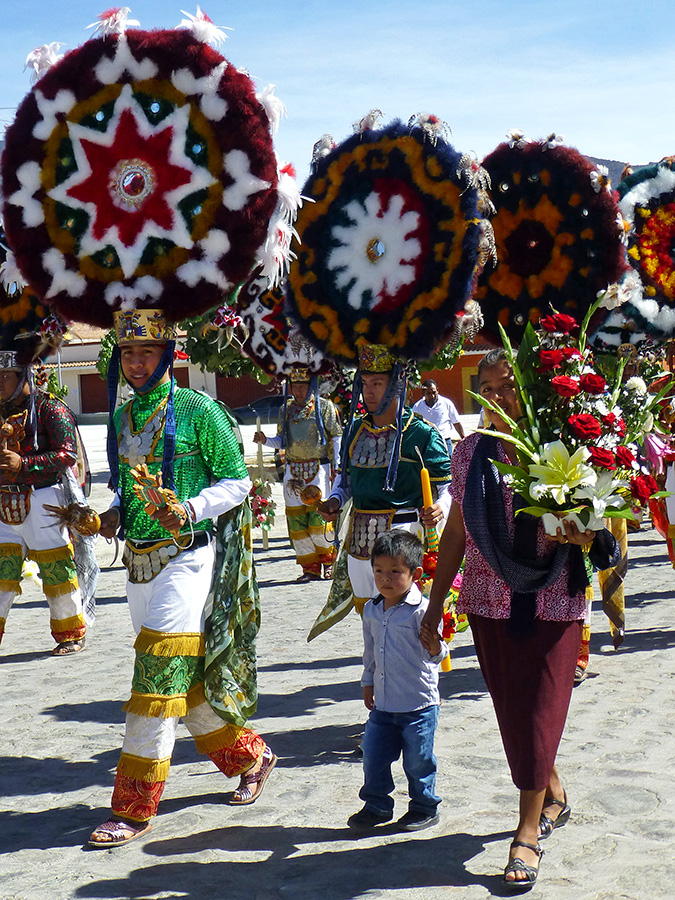
During Day of the Dead, the Danza de los Diablos (Dance of the Devils) is performed in these communities.
Dancers wear devil masks, and are led by a colonial ranch foreman with a whip, who “struts around, while his buxom ‘white’ wife – played by a black man – flirts outrageously with the ‘devils’ and even the audience.” [The black people ‘erased from history’]
To see the Noche de Rabanos 2013 entry by Moisés Ruíz Sosa, click HERE.
By the way, the “Elaborando Artesanía, Plasmando Sueños: ‘Teotitlán del Valle, Tierra de Dioses’” by Raymundo Sánchez Monserrat Maricela, which I wrote about in Noche de Rabanos, pt. 1, took first prize in the Flor Inmortal Adulto category!
‘Tis Nochebuena in Oaxaca and all is well. The sun is shining and goodwill is felt on the streets and in the mercados. Casita Colibrí is festooned with seasonal decorations both outside and in.
Tonight, posadas from throughout the city will converge on the zócalo with Josés, Marías holding baby Jesús, and angels on flatbed trucks; pinwheels, sparklers, and fireworks will light the night sky; brass bands will play; and China Oaxaqueñas will dance. I can’t wait! In the meantime, may Ernie Villarreal’s version of Pancho Claus by Chicano music legend, Eduardo “Lalo” Guerrero, bring the gift of joy to those near and far.
Pancho Claus
‘Twas the night before Christmas and all through la casa Not a creature was stirring, Caramba! ¿Que pasa?
Los ninos were all tucked away in their camas, Some in vestidos and some in pajamas. While Mama worked late in her little cocina, El viejo was down at the corner cantina.
The stockings were hanging con mucho cuidado, In hopes that St. Nicholas would feel obligado To bring all the children, both buenos y malos, A Nice batch of dulces and other regalos.
Outside in the yard, there arouse such a grito, That I jumped to my feet, like a frightened cabrito.
I went to the window and looked out afuera, And who in the world, do you think que era?
Saint Nick in a sleigh and a big red sombrero Came dashing along like a crazy bombero!
And pulling his sleigh instead of venados, Were eight little burros approaching volados.
I watched as they came, and this little hombre Was shouting and whistling and calling by nombre.
Then standing erect with his hand on his pecho He flew to the top of our very own techo. With his round little belly like a bowl of jalea, He struggled to squeeze down our old chimenea.
Then huffing and puffing, at last in our sala, With soot smeared all over his red suit de gala.
He filled the stockings with lovely regalos, For none of the children had been very malos.
Then chuckling aloud and seeming contento, He turned like a flash and was gone like the viento.
And I heard him exclaim and this is VERDAD, Merry Christmas to all, And to All ¡Feliz Navidad!
May you all find peace and joy every day of the year.
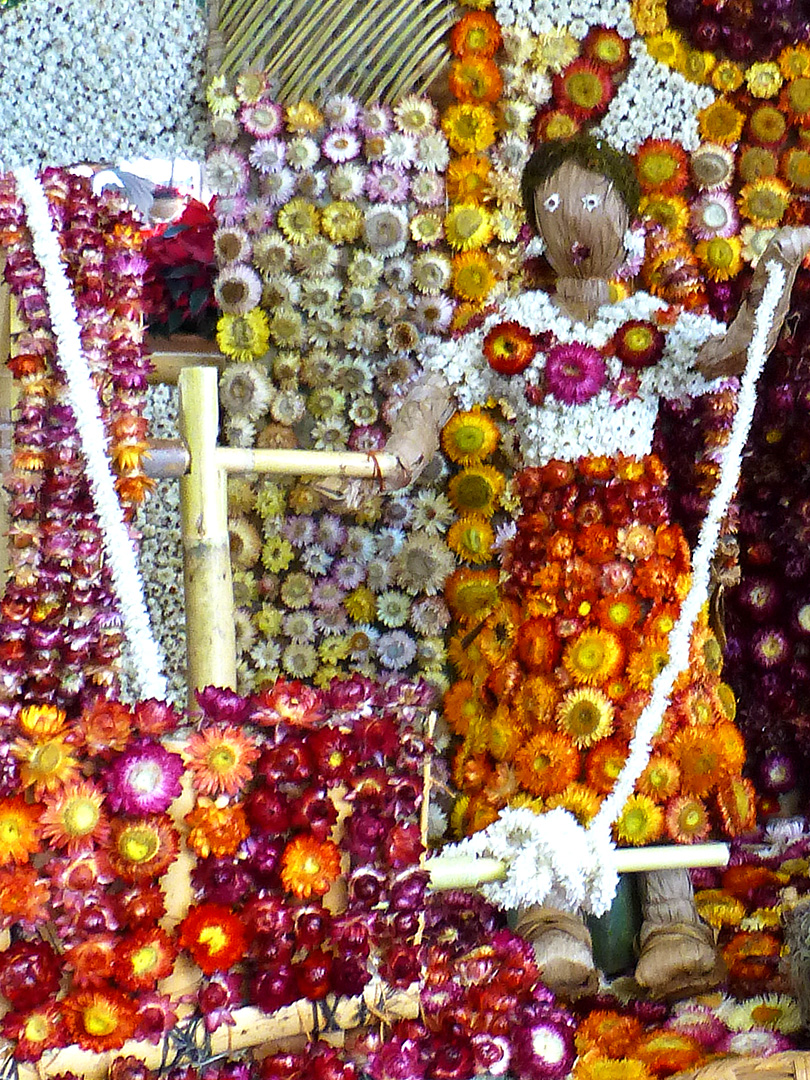
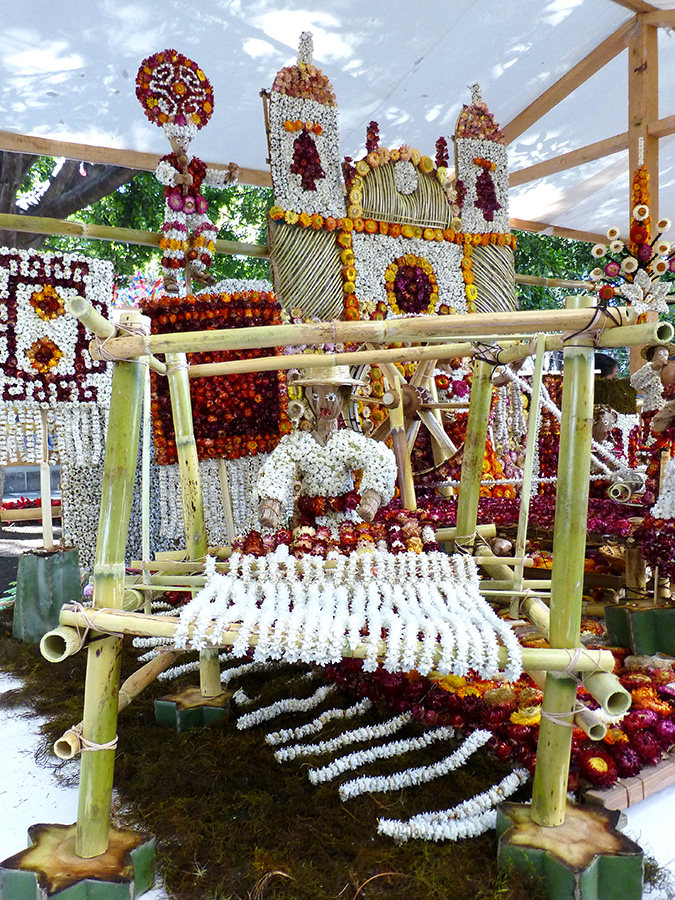
It’s December 23 in Oaxaca and Noche de Rabanos is upon us. The setting-up has begun and the spectators are gathering. Despite its name, it isn’t just about artisans working their creative magic carving radishes. There are three other categories, including the use of Flor Inmortal (a type of dried flower). I will return this evening, but in the meantime, this entry titled, “Elaborando Artesanía, Plasmando Sueños: ‘Teotitlán del Valle, Tierra de Dioses'” by Raymundo Sánchez Monserrat Maricela, is for all my friends in Teotitlán del Valle.
Spinning the wool.
Weaving tapetes from the spun wool.
Grinding corn or maybe chocolate OR maybe even cochinilla!
Dancing the Danza de la Pluma…
The danzantes of the Grupo de Danza de Pluma Promesa keeping their promise.
I think Raymundo did a wonderful job capturing the people of Teotitlán del Valle, the Land of the Gods, who make crafts and shape dreams.
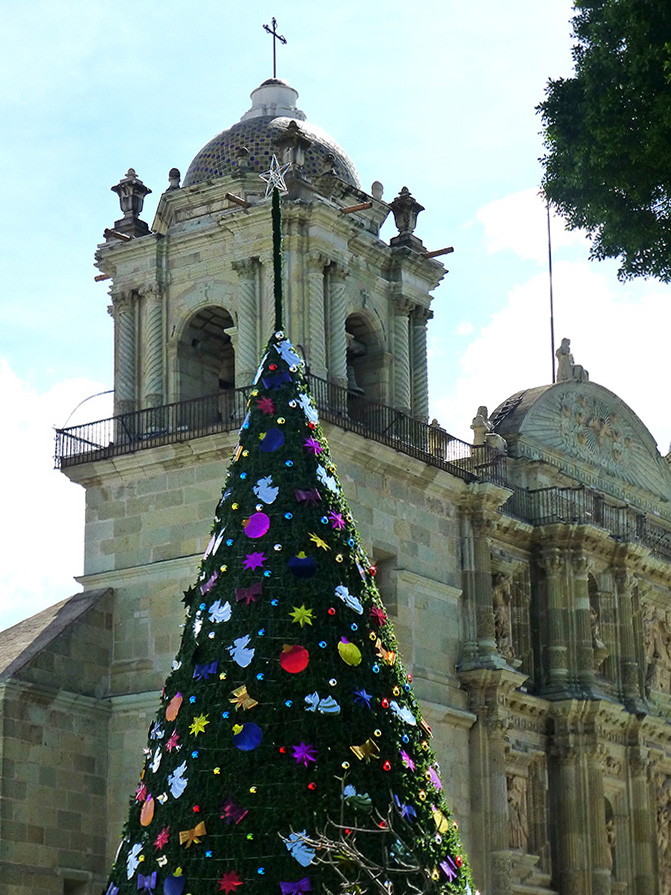
This year, a Christmas tree grows in Oaxaca. Well, not a real, living tree. This one, almost 3-stories tall, was constructed over several days alongside the Cathedral.
Adding the green panels to the frame.
Hanging the lights.
So far, so good!
All dressed up and ready to go.
Lights on; crowds assembled!
What can I say? Nacimientos (Nativity scenes) are traditional here; Christmas trees are not. However, despite what we like to think, traditions are not static, they evolve. People come and go across oceans and across borders and they bring back what captures their fancy. All I know is that the city is alive with the sound of music, energy, and lightness of being.
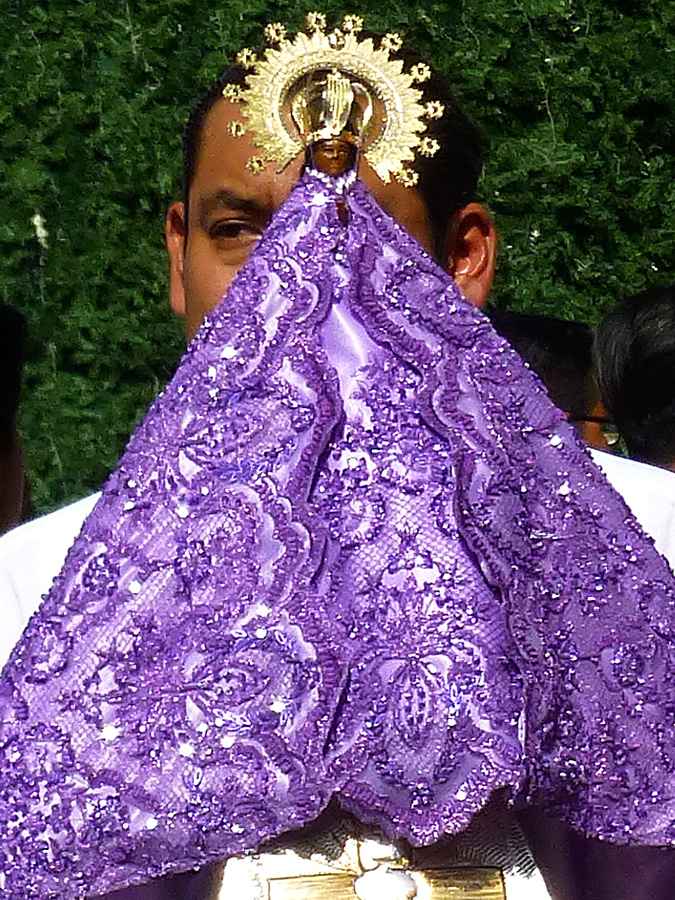
Nuestra Señora de la Soledad is the patron saint, queen, and mother of Oaxaqueños — and she is my vecina (neighbor). Thus, I shall not want for revelry!
“Inside” Soledad, in the Basílica — Dec. 17, 2016
Despite her name, there is no solitude for Soledad or her neighbors on her December 18 feast day — or the days and nights leading up to it. Like her sister December virgin images, Juquila and Guadalupe, she seems to thrive on the cacophony that is fiesta life here — after all they are Mexican Marías.
Dancing for Soledad through the streets – Dec. 16, 2016
“Child” Soledad on a flatbed truck – Dec. 16, 201616
Fireworks from the Basílica de la Soledad courtyard – Dec. 15, 2016
So, bandas playing traditional music (loudly), fireworks and rockets booming and banging, church bells urgently chiming, and lively recorridos (travels) through the streets of the city, beginning early in the morning and continuing well beyond midnight, are welcomed.
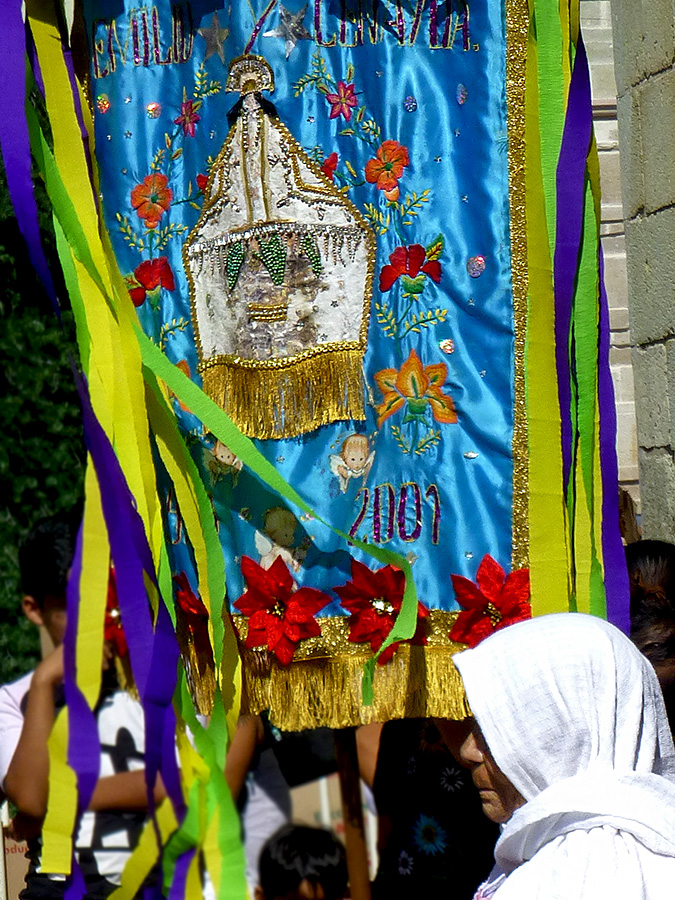
Estandartes in the Basilica awaiting another recorrido – Dec. 17, 2016
China Oaxaqueñas dancing through streets – Dec. 16, 2016
Fireworks from the Basílica de la Soledad courtyard – Dec. 17, 2016
The celebrations began at 5:00 AM on December 7, with a ringing of church bells and a “dawn journey” and culminated with a grand fiesta yesterday, December 18, her feast day. She seemed to enjoy the festivities, including these guys from the Istmo performing for her, *La Danza de los Negros.
Soledad’s fiesta will end tomorrow (Dec. 20) with a concert of Christmas carols at 7:00 PM. It’s been great fun, but I’m already looking forward to Noche de Rabanos on December 23!
“Outside” Soledad in the Basílica courtyard – Dec. 18, 2016
*La Danza de los Negros is another of those complex and multilayered dances traditional to specific indigenous cultures in Oaxaca. For more information, check out the article (en español), Los Negros, tradición bixhahui, ícono de Chihuitán.
And we thought last year’s Día de la Virgen de Guadalupe in Teotitlán del Valle was exceptional! It was, but, for blogger buddy Chris and me, this year brought even more warmth, appreciation, and the intangible of being present in the richness of more layers of being in this special village.
Edgar Daniel Ruiz Ruiz
We are patrons of two of the danzantes of the 2016-18 Grupo de Danza de Pluma Promesa in Teotitlán del Valle — and Edgar Daniel Ruiz Ruiz is one of them. As such, we were invited to the home he shares with his parents, Mario Ruiz Bautista and Victoria Ruiz, to partake in the traditions and observe the responsibilities that accompany taking on the three year commitment to being a member of the Grupo.
Mario Ruiz Bautista (on left) overseeing the offerings
From my albeit limited understanding, as part of the commitment the dancers make during their three years of service, each of their families is tasked with taking a turn hosting one of the four yearly festivals.
Victoria Ruiz watching Edgar’s dance
The day began with a breakfast of traditional breads and hot chocolate and was followed by Mole de Castilla, a mole unique to Teotitlán and served during weddings and the most important festivals. There must have been over 100 people, including Edgar’s extended family, padrinos, danzantes and their families, and band members. They gathered and were served in the courtyard of the Ruiz home, with men seated at one long table, women on the other side of the courtyard at another, and the two gringos seated with the danzantes in the altar room opening onto the courtyard.
Breakfast breads with hot chocolate
Following the meal, chairs and tables were folded and removed, the danzantes took the floor, the band began to play, and, as the sun streamed down on the courtyard, Edgar began his dance. It was a touching moment to see this young man, whom I’ve known for almost six years, since he was a gangling teenager, and Chris has known since he was a small boy, dance with such confidence and pride.
Following dances by the whole group, with band leading the way, dancers, families, and guests processed down the steep and winding streets from the house to the church.
Edgar Daniel Ruiz Ruiz en route to the church, accompanied by Victoria (his mother) and his nephew.
They filed into the church, where a special mass was celebrated, and then regrouped in the church courtyard to begin the seven hour (más o menos) Danza de la Pluma. Early in the afternoon, while the dance continued, the families and invited guests returned to the Ruiz home, where the families of the other dancers each made formal presentations of baskets of fruit and mezcal or cervesa to Mario and Victoria. This was followed by a comida (lunch) of caldo de pollo. After all were fed, the offerings were loaded into pickup trucks to be taken to the church plaza, to later be shared with the community. At night, after the dance ended, we all again returned to Casa Ruiz for barbecoa de res (beef) in a rich and flavorful sauce, cervesas, mezcal, and soda pop. I can’t even begin to imagine all the work that went into preparing all the food, orchestrating its serving, and then washing all the dishes — by hand in basins set up in the yard across the street.
Edgar Daniel Ruiz Ruiz
It’s been over twenty four hours since Chris and I returned from Teotitlán del Valle and, though we talked continuously on the drive back to the city and have spoken several times since, we are still unable to put into words how meaningful and how honored we were to share this special day with Edgar, his family, and his community. It was a precious gift. ¡Muchisimas gracias a todos!
A sign of the times… Navidad (Christmas) must be coming!
An empty bottle of Noche Buena cervesa sitting on a sill outside of Templo de San Jose. Noche Buena is the much-in-demand seasonal bock-style beer from Heineken Mexico. Its appellation, besides meaning “good night,” is also the name for the poinsettia plant and the word for Christmas Eve in Spanish. ¡Salud!
December seems to be el mes de las vírgenes (the month of the virgins) in Oaxaca. Early this morning cohetes (rockets) and church bells announced the first of the month’s three virgin days; the feast day of la Virgen de Juquila. And, this afternoon, on the Alameda in front of Oaxaca’s cathedral, a small procession gathered.
According to legend, in 1633, when a fire burned the small Chatino village of Amialtepec to the ground, a small wooden statue of the Virgin Mary was rescued amidst the ashes. She was undamaged, save for her light skin color, which was permanently darkened by the smoke, causing her to more closely resemble the Chatino people, who live in this remote mountainous region. Local priests declared her survival a miracle and she has been venerated ever since.
Alas, that wasn’t the end of the story; the priest in the village of Juquila convinced the “powers that be” that she should be moved to the bigger and better church in Juquila. She, however, had other ideas and returned to Amialtepec. This back and forth continued another three times. Finally, in 1719, La Morenita (the dear dark one), as she had come to be known, gave up her traveling ways and agreed to call Santa Catrina Juquila her permanent home.
The faithful make pilgrimages to both her old and new mountain homes (about four hours southeast of Oaxaca city). They come year round on foot, on bicycle, and in all other manner of transport, to make offerings and pray for miracles, but especially during the days leading up to December 8. October 8, 2014 marked her crowning achievement; in a grand ceremony, she received a papal coronation, joining her previously crowned (1909) Oaxaca sister, Nuestra Señora de la Soledad.
I returned to Oaxaca late Sunday night, a little dazed and confused. Of course, getting the dreaded “red light” at customs didn’t help. All was fine, though the word “bagels” didn’t register until someone behind me offered the word “pan” (bread), I nodded my assent, and the customs officer smiled and nodded hers. Whew!
First on Monday morning’s “to do” list was a trip to my local market, Mercado Sánchez Pascuas. It felt SO good to be walking again, even up hill! Reaching my destination, completely unbidden, an “expletive deleted” popped out. How could I have forgotten? The mercado was in the midst of a month and a half renovation!
This is a three million peso project that includes replacement of the roof, waterproofing of the slab area, and structural maintenance. Most of the approximately 100 stalls have been relocated to the patio in front of the Tinoco y Palacios entrance and the parking lot at the Porfirio Díaz entrance. The latter, I was pleased to see, found room for the annual display of poinsettia. I will return!
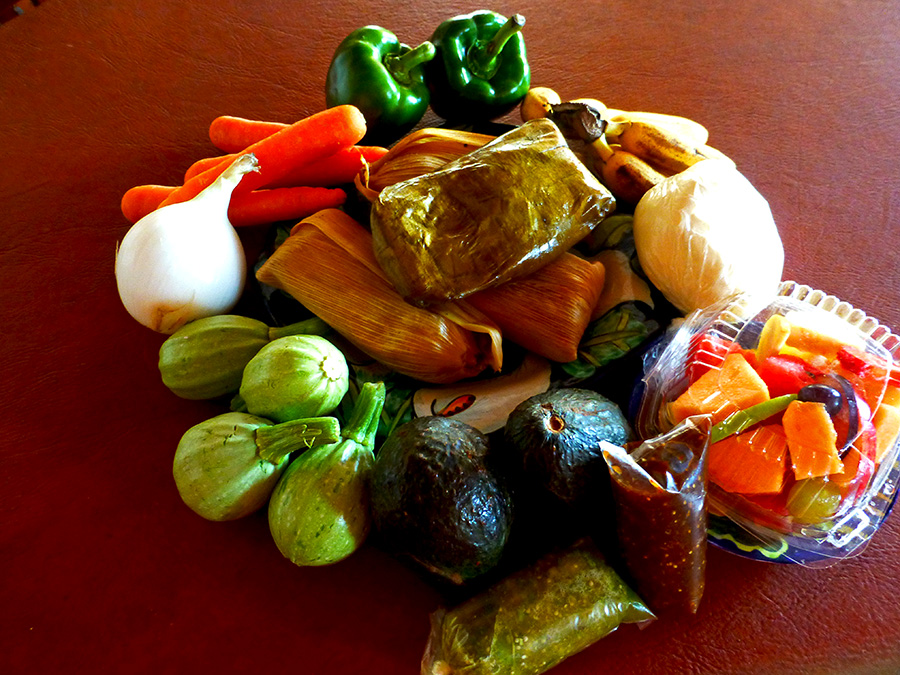
But first and foremost, food! I found (or they found me) my favorite vendors. They may not know my name, but they recognized and called to their gringa customer, who they haven’t seen for almost a month. Quesillo (Oaxaca string cheese), verduras (vegetables), fruta (fruit), tamales (mole, verde, amarillo, and rajas), and salsas (green and chipotle) were purchased.
My two shopping bags filled, I headed back down the hill to home, sweet, Oaxaca home. It’s great to be back! The icing on the cake, especially coming on top of the sticker shock of el norte, was the above, plus 8 bottles of beer, came to a grand total of 335 pesos — that’s $16.42 (US dollars), at today’s exchange rate.
Prior to heading to el norte, I stumbled on the delightful exhibition, Ciudad BICible, at the Casa de la Ciudad. It is a glimpse into the history of the bicycle — its role in society, culture, and its importance today as a means of transportation in the city.
The exhibition invites visitors to reflect on how the bike has managed to point cities towards a more tolerant, healthy, equitable, and human way of living, and how we can make Oaxaca a “Bike City.”
Ciudad BICible opened October 7, 2016 and runs until January 29, 2016. The Casa de la Ciudad is located at Porfirio Díaz 115, at the corner of Morelos in Centro Histórico, Oaxaca.
I’m still on the East Coast, now outside of Boston. It’s cold (not freezing, thank goodness), dark by 4:30 PM, and colors are bland. Today, as we dashed down an alley, dodging raindrops, from parking lot to restaurant, I caught a brief glimpse of a mural on the side of a building, but it seemed rather lackluster compared to the walls of Oaxaca.
Calle de Tinoco y Palacios, Oaxaca de Juárez — Oct. 31, 2016
Calle de Ignacio López Rayón, Oaxaca de Juárez — Nov. 9, 2016
Emiliano Zapata (corner of I. López Rayón), Oaxaca de Juárez — Nov. 9, 2016
While I LOVE (I think that’s what the last one says) seeing my family and appreciate (more than a little) paper towels that don’t disintegrate, drinking water from the tap, and plumbing that can handle toilet paper, I’m homesick for Oaxaca. Soon!
It was early evening last Monday, all my bags were packed and I was ready to go, when the the sounds of a parade began getting closer and closer. I grabbed the little Lumix and headed into the streets.
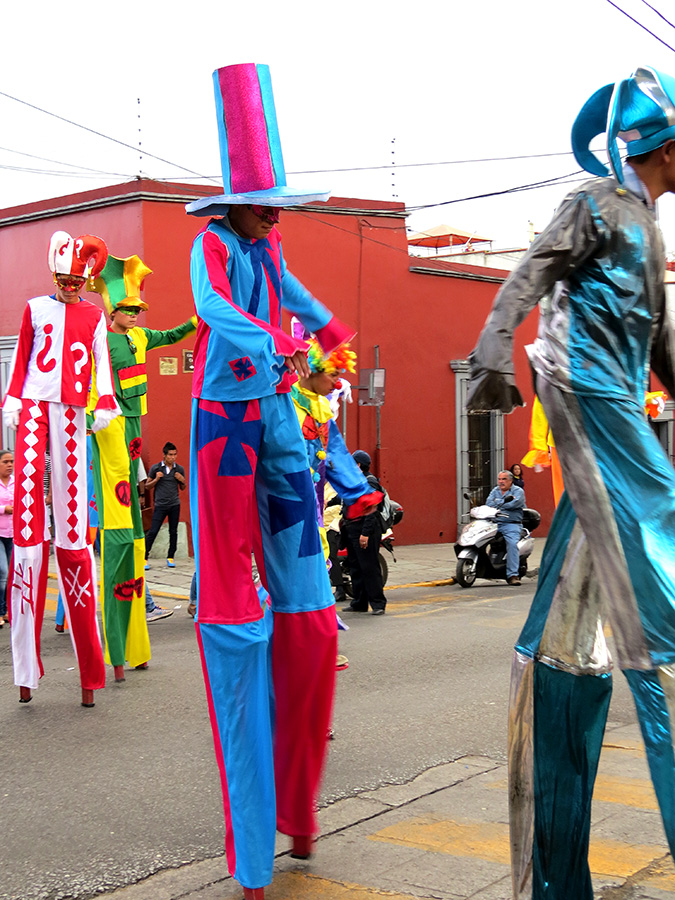
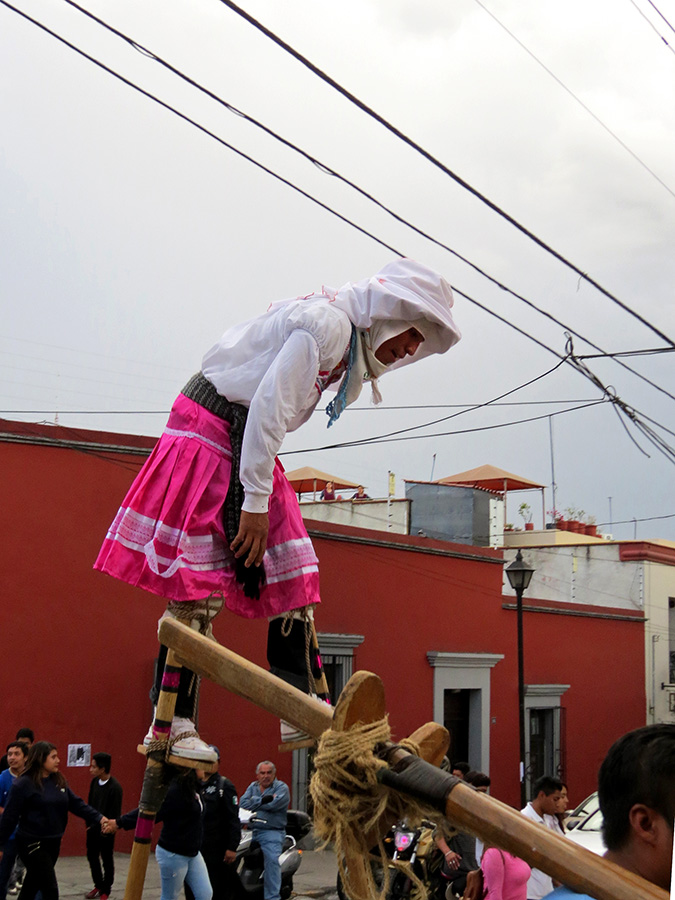
Zancudos, not autos, on Av. Morelos
Yikes, Zancudos had taken over the street.
Low bridge!
As you can see, we are not talking about mosquitoes; these Zancudos are stilt walkers.
Approaching the Plaza de la Danza
The two contingents of Zancudos were part of a calenda kicking off UABJO (Universidad Autónoma Benito Juárez de Oaxaca), Semana Cultural, Deportiva y Científica (Culture, Sport, and Science Week).
About to tackle the stairs
The five-day program of events included competitions in singing, chess, oratory, and science experiments; film and theater presentations; along with zumba, self defense, and aerobics demonstrations.
Dancing and prancing on the Plaza de la Danza
Reason #980 why I love Oaxaca: You just never know when a calenda will break out!
Rest time, after walking and dancing their way through the streets
It was a great memory to carry with me, as I boarded the plane the next morning en route to el norte.
The US election results had come in and, with mixed feelings, I was preparing for a trip up into the belly of the beast, to visit family. A mural seen shortly before I left, on the wall of contemporary art space La Curtiduria on 5 de mayo in Jalatlaco, seemed to speak to me.
Today, after hearing of the death of Mose Allison, another musical great I had the privilege of seeing in person several times, I’m thinking the wall could very well have been singing…
You’re sitting there yakkin’ right in my face I guess I’m gonna have to put you in your place Y’know if silence was golden You couldn’t raise a dime Because your mind is on vacation and your mouth is Working overtime
You’re quoting figures, you’re dropping names You’re telling stories about the dames You’re always laughin’ when things ain’t funny You try to sound like you’re big money If talk was criminal, you’d lead a life of crime Because your mind is on vacation and your mouth is Working overtime
You know that life is short and talk is cheap Don’t be making promises that you can’t keep If you don’t like the song I’m singing, just grin and Bear it All I can say is if the shoe fits wear it If you must keep talking please try to make it rhyme ‘Cause your mind is on vacation and your mouth is working Overtime
After the wretched week that was (RIP Leonard Cohen and Leon Russell, not to mention the USA elections), reviewing my Día de Muerto photos from Teotitlán del Valle was the ideal tonic.
On November 1, as I previously mentioned, after strolling and sitting and contemplating and conversing our way through the panteón in Tlacolula de Matamoros, we drove to the home of friends, Zacarias Ruiz and Emilia Gonzalez, in Teotitlán. Arriving at 3:00 PM, we were just in time to join the family and other guests, as Zac gave words of welcome to the difuntos, who had also just made their appearance.
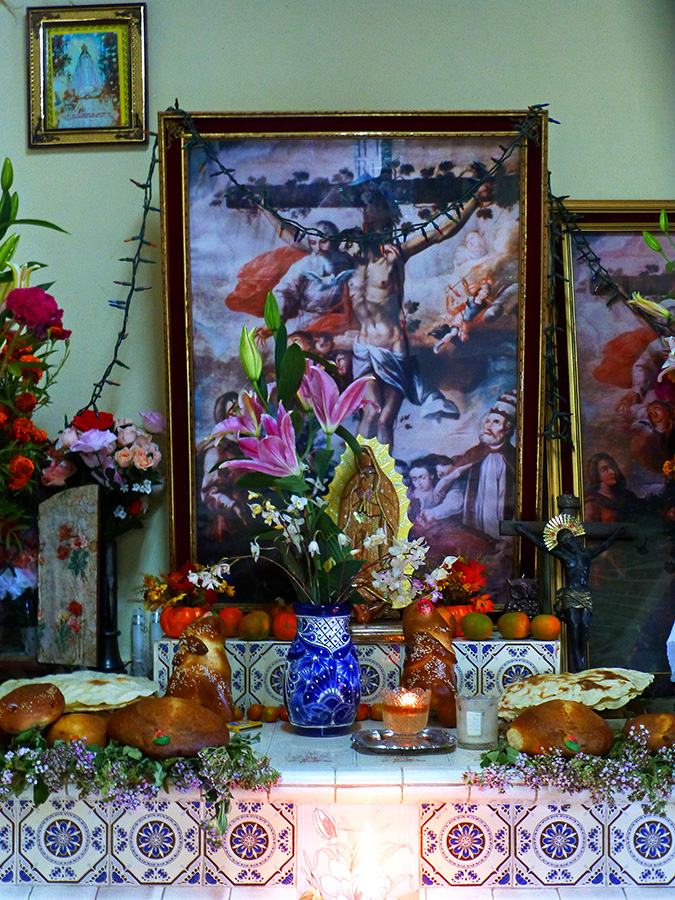
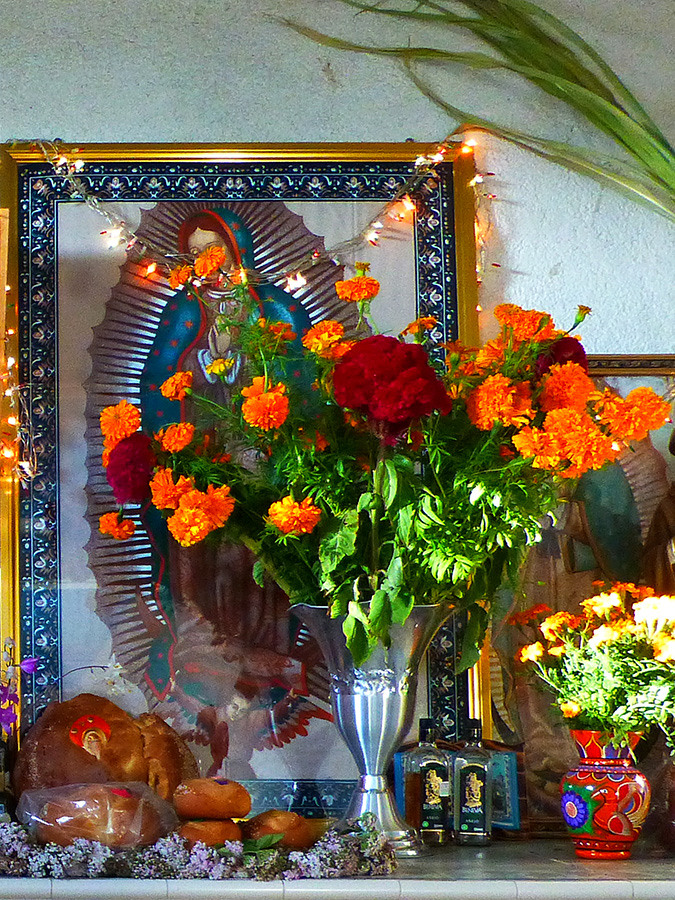
Our pan de muerto and mezcal joined the other offerings on the altar to provide nourishment to the departed while we, the living, sat down at the long table for a little cervesa, mezcal, and more than a few of the 500+ tamales Emilia had made. After lots of eating and conversation, we walked across the courtyard to give our regards to Antonio Ruiz (weaver of one of my treasured rugs), wife Claudia, and their children (the beautiful Beatriz and her lively brothers, Diego and Antonito), and to see Antonio’s new showroom (Chris has a photo in his Familia blog post) and their altar.
Invited to return to the Ruiz home the following day for Emilia’s famous mole negro, we also stopped at the village panteón to listen for the wind that signals the departure of the difuntos at 3:00 PM on November 2.
We also stopped to pay our respects at the grave of Arnulfo Mendoza, though it took a little searching to find it, as the large tree that stood next to it had fallen, leaving only a stump.
Both days, the drive back to the city was filled with the warmth, peace, and joy that Teotitlán del Valle always seems to impart.
Under the strong and comforting gaze of Picacho, who could ask for a better resting place.
The dead don’t arrive in the valley of Oaxaca all at once. The cosmic difunto air traffic controller has scheduled their arrival at different times on different days, from October 31 through November 3, to avoid celestial congestion.
Santa María Atzompa’s departed are among the first to return, arriving on the night of October 31. Flower and food vendors line the walkway leading to the panteón as grandparents, parents, teens, and small children stream in with arms full of flowers, candles, buckets, and brooms. Because is built on a slope and there are almost no paths, footing can be treacherous, especially in the dark when only candles on the graves light the way. At one time, perhaps tombs were positioned on a grid, but no more and it seems to be filled to capacity. I guess that’s why one side of the panteón has been opened up (one of the walls removed), the field beyond leveled, and a new wall around the field, connected to the old, constructed. (You can click on images for a larger view.)
On November 1, in the early afternoon, it has become our custom to visit the cemetery in Tlacolula de Matamoros, before bringing pan de muerto and mezcal to the home of friends in Teotitlán del Valle. In contrast to the higgledy-piggledy of Atzompa, the panteón in Tlacolula emanates a sense of order and serenity. I wonder, could the tranquility come from the 500 year old ahuehuete trees (hijos of el Tule, we were told) that reign over the tombs of the departed and make for an amazing play of light and shadow throughout?
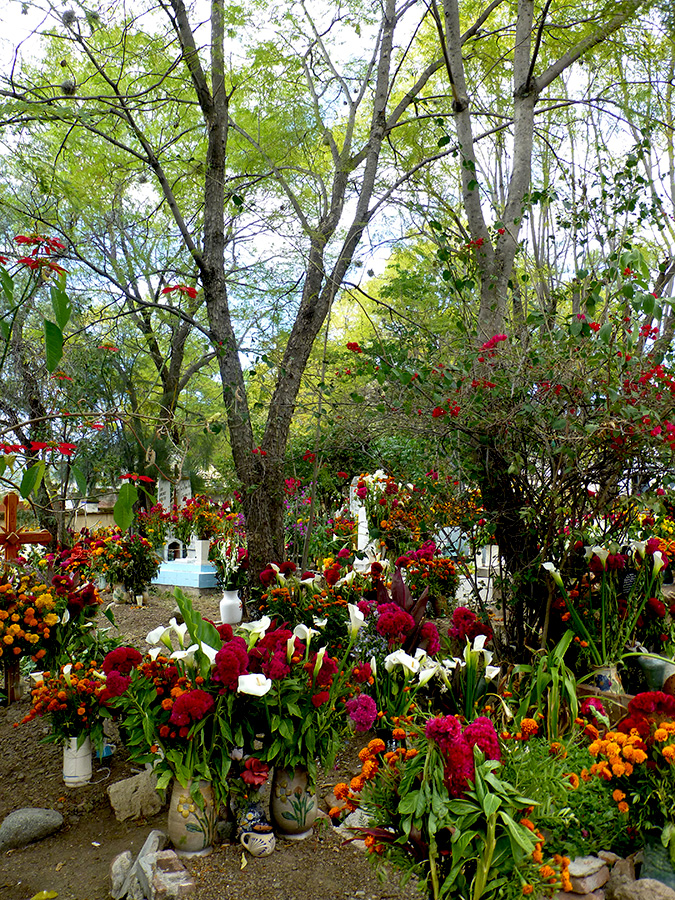
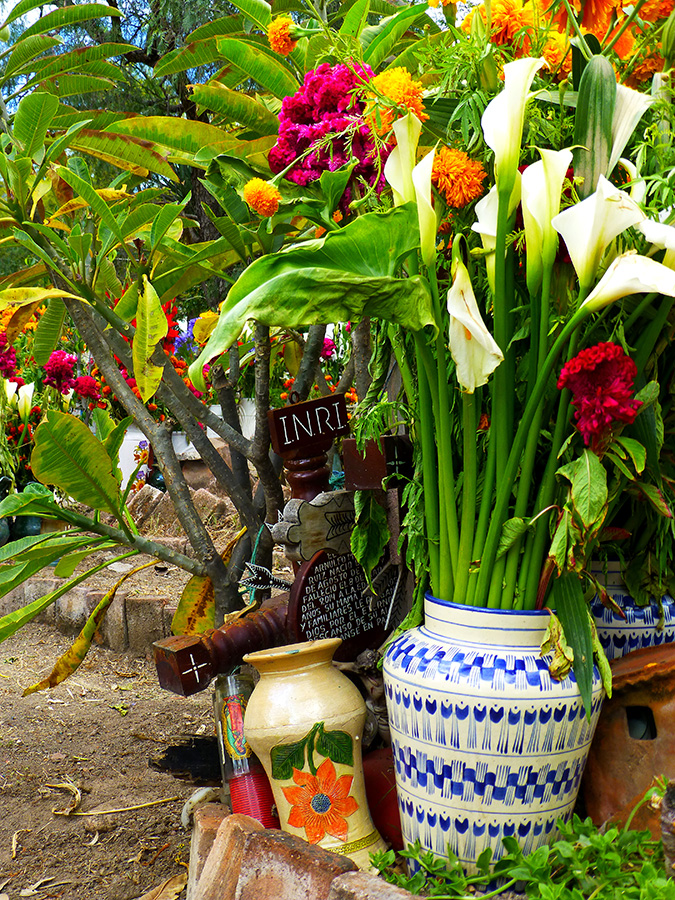
On November 2, we returned to Teotitlán, but I will save that for another blog post. However, that was not the end of the road. In the category of, no rest for the living, the following day we drove south to San Antonino Castillo Velasco. This is the village known for their beautiful flowers and exquisite floral embroidery. And, it is said that because the living are so busy providing flowers to other parts of the valley, the departed wait until November 3 to return. (See the book, Day of the Dead: When Two Worlds Meet in Oaxaca by Shawn D. Haley and Curt Fukuda.) I’m sure, like we, the difuntos are dazzled by the intricacy of floral designs that family members have created to decorate their tombs in welcome.
Octavio Paz writes in The Labyrinth of Solitude, “Life extended into death, and vice-versa. Death was not the natural end of life but one phase of an infinite cycle.”




















 Mexican Peso Converter

 View From Casita Colibrí