Feeds:
Posts
Comments

Archive for the ‘Creativity’ Category

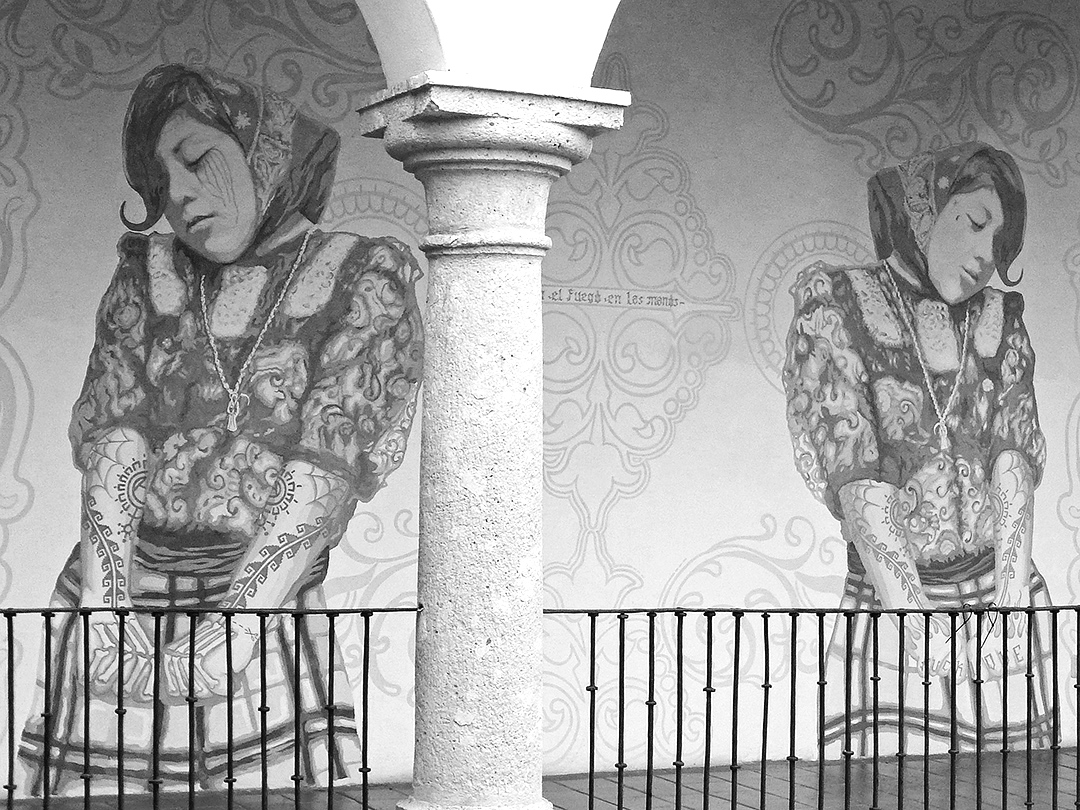
The previously mentioned Tlacolulokos collective has brought their artistry and social commentary to a wall on the upper floor of the Casa de la Ciudad.  The mural, “Con el fuego en las manos” shows two young women, almost mirror images of each other or, perhaps, two sides of the same woman.

P1090454

The young women/woman wear the traditional clothing of San Bartolome Quialana, a village near Tlacolula de Matamoros, home of the Tlacolulokos collective.  Like communities throughout Oaxaca, much of the male population has migrated to the United States, in search of work leaving the women to carry on alone.

As the introduction to the exhibit on the Casa de la Ciudad website explains, With a critical view towards the current cultural context, Tlacolulokos group, headed by Darío Canul and Cosijoesa Cernas, seeks to question the idealized images of the Oaxacan culture, tourism product discourse, and insights from the reality currently experienced by the people of Oaxaca.

There are elements in her clothing belonging to the Latina culture of the southern United States, as the cholo bandana that she wears on her head, or the tattoos on her arms that add a critical and provocative tinge to this cultural mix, a product of migration.  [ Google translation, with a little help from yours truly]

One of the trademarks of  the Tlacolulokos group is the power their images acquire and the emotion they elicit by limiting the palette to black, white, and grays.  For more background and a better understanding of the mural, a video (en español) of the artists discussing their work can be found here.

“Con el fuego en las manos”  is scheduled to run until December 2015 at the Casa de la Ciudad (Porfirio Diaz No. 115, at the corner of Morelos in Oaxaca’s Historic District).  Hours are 9:00 AM to 8:00 PM, Monday through Sunday.

Read Full Post »

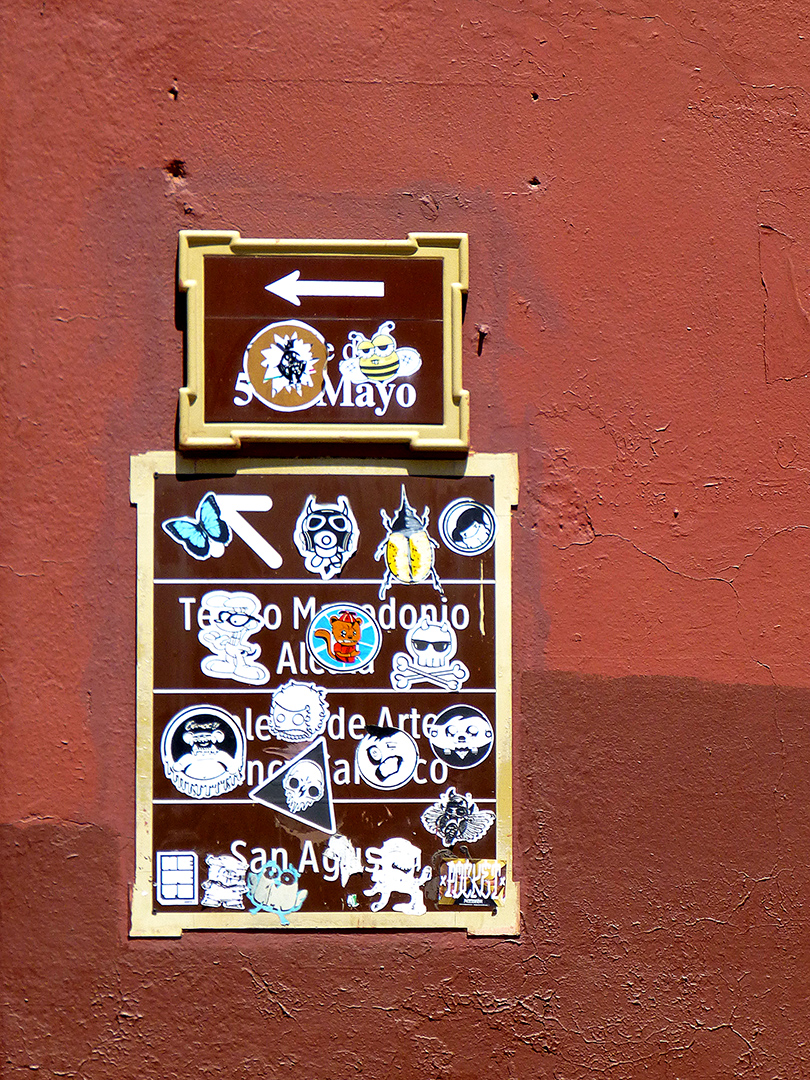
Situated metaphorically at the busy intersection of imagery and content—and informed by history, mass media, commerce, and pop culture—stickers address both the personal and the political.  — Street Art Graphics, The Richard F. Brush Art Gallery, St. Lawrence University.

P1090439 copy

Stick-to-itiveness:  the quality that allows someone to continue trying to do something even though it is difficult or unpleasant.

P1090440 copy

Street art stickers — a metaphor for Mexico, methinks.

Read Full Post »

Just so you know…  The gods are watching you on Tinoco y Palacios, between Morelos and Matamoros.

P1060576 copy P1090489 copy

Hmmm…. sometime between January, when I first photographed the mural and a few days ago, when I returned, an airplane landed on the tongue.

P1090486 copy P1090490 copy

Recently, BBCtrending posted the video, Aztec to urban — Mexico’s street art explosion, highlighting the use of Mexico’s pre-Columbian imagery in contemporary street art.  I don’t know the name of the artist who painted the mural above, but seeing the “Dioses Urbanos” of Diego Alvarez (aka, Ocote) in the video, brought it to mind.

Read Full Post »

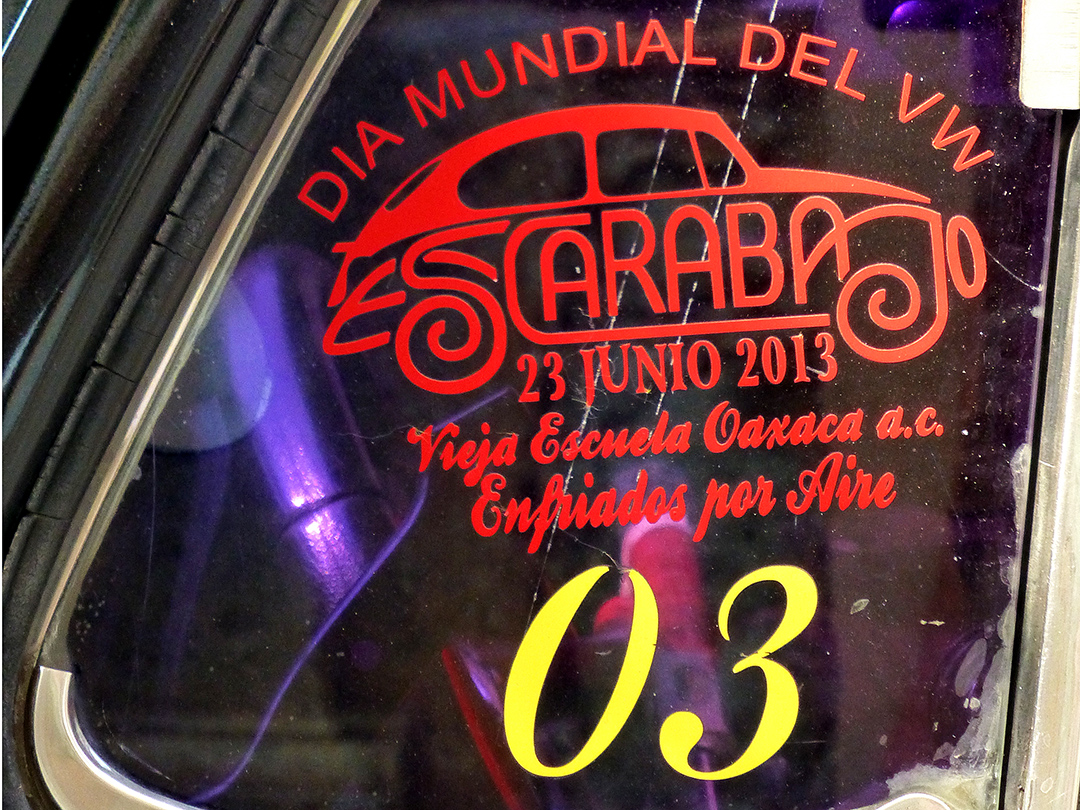
Long ago, in a land far, far away, I once had a Volkswagen Beetle.   It was so old, it didn’t even have a gas gauge, only a reserve tank.  My little bug would inevitably begin running out of gas when I was putt-putting up a hill, requiring me to take my foot off the gas pedal to kick over the reserve tank.  Needless to say, I would hold my breath and offer up silent prayers that I wouldn’t get rear-ended and that there was, indeed, gas in the reserve tank!  But, I loved that car…

So, only a block from Casita Colibrí, how could I resist stopping to admire this beauty?

P1090401

Made in Oaxaca — or at least, tricked out in Oaxaca.

P1090402

Ready to rally again on the Pan American Highway?  It’s just up the road apiece.

P1090404_horiz

Stay calm… Doing it the old school Beetle way!

P1090406

Hmmm… last month’s Old VWs never die and now this post.  Bugs, of the VW variety, might just have to become a regular feature.

Read Full Post »

It’s Cinco de Mayo, but in Oaxaca, like most of Mexico, it’s a business as usual kind of day; schools are in session, businesses and banks are open, and deliveries are being made.  The cervesas and mezcal may be flowing and guacamole may be served, but no more than usual.  Only in Puebla, where the significantly outnumbered Mexican troops defeated the French army in the Battle of Puebla on May 5, 1862, is it a big deal.  However, most every city and village has a street named 5 de mayo and in many, like Oaxaca, a street has been named for Ignacio Zaragoza Seguín, the general who commanded the Mexican army at the Battle of Puebla.  By the way, he was born in what was the Mexican village of Bahía del Espíritu Santo, now Goliad, Texas, USA.

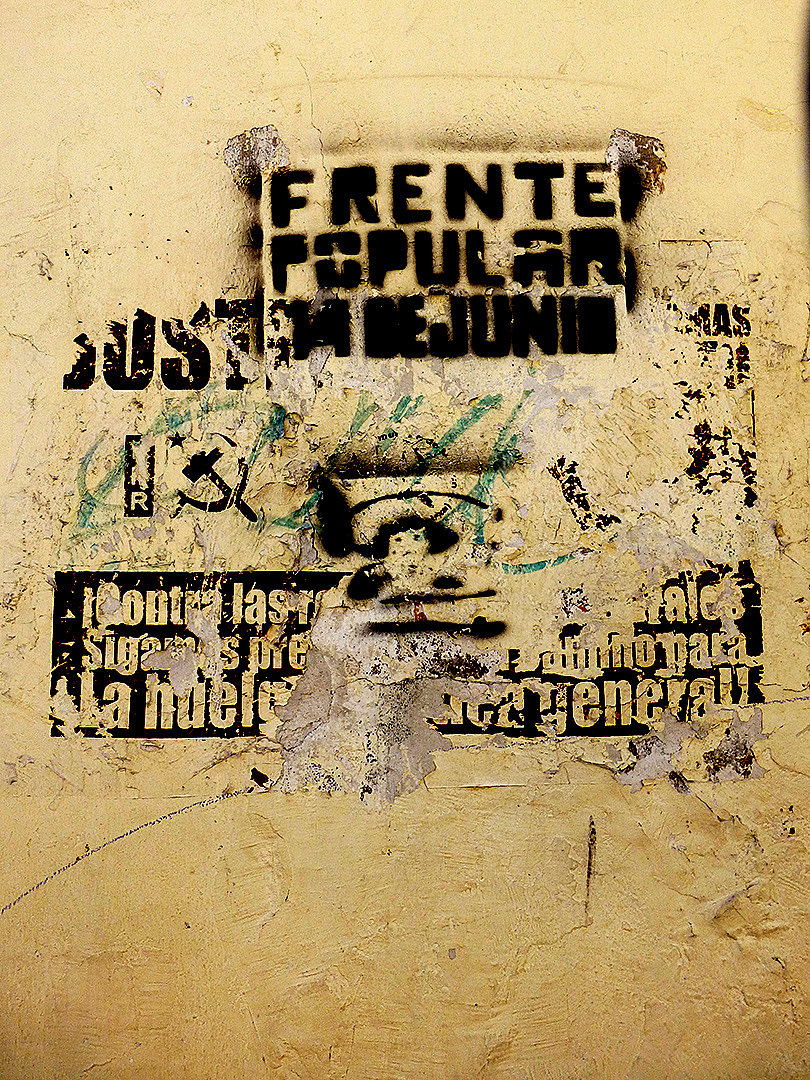
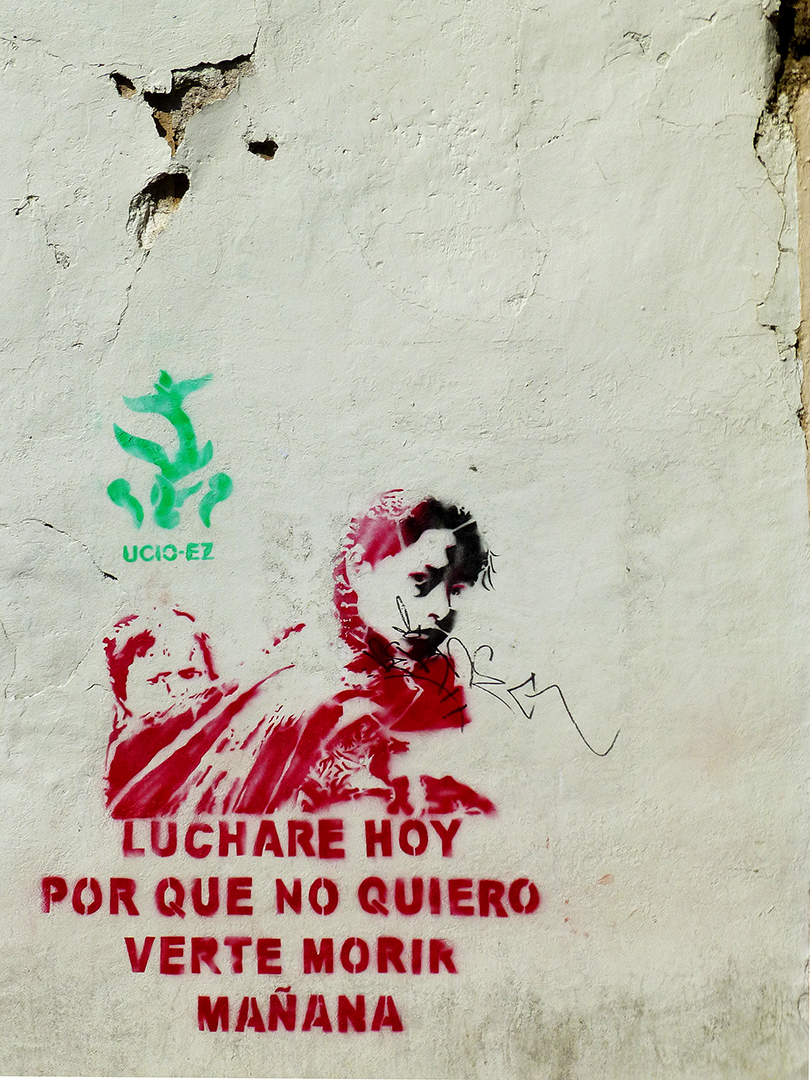
As the walls of Oaxaca continue to show, it’s the current battles that remain front and center…

P1050917 copy P1080998 copy P1080893 copy P1080997 P1050398As the mother in the stencil above explains, against the odds like her ancestors 153 years ago, “I will fight today because I don’t want to see you die tomorrow.”

Read Full Post »

Yesterday, the city of Oaxaca celebrated its 483rd birthday as a Spanish chartered city.  Early in the morning bells were rung, Las Mañanitas was sung, tamales and atole were served, an air force flyover buzzed the city several times, multiple musical events were held, a convite paraded through the streets, fireworks exploded from the Plaza de la Danza, and more, and it continues.  I was going to write about it, but…

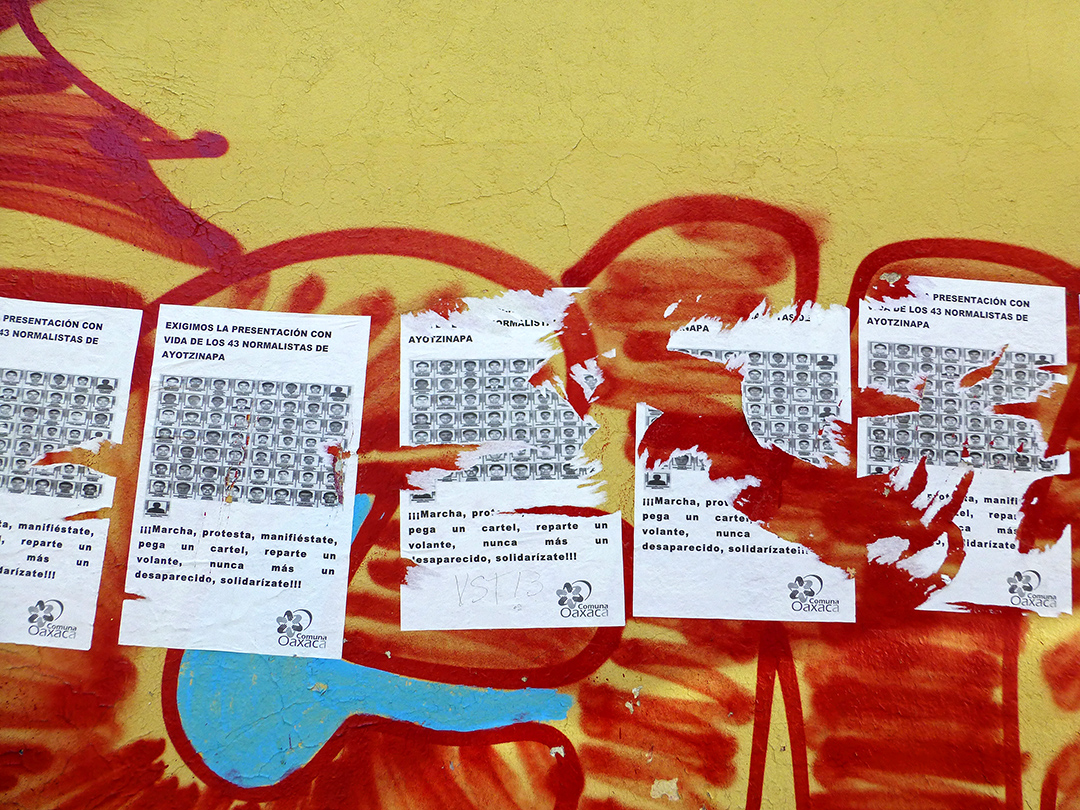
Today a more urgent anniversary requires our attention:  Mexico Marks 7 Months Since 43 Ayotzinapa Students Disappeared.  Family, fellow classmates, friends, and supporters around the world keep their names alive and cry for justice.  And artists continue to reach into our minds and hearts through their music, artwork, and film making.

In the documentary, Ayotzinapa’s 43 Disappeared: Family & Friends Remember, we hear the voices of their classmates and relatives. They don’t trust the official story and are determined to find out what happened.

Near the end of the song, “La Patria Madrina,” from her new album, Balas y Chocolate (Bullets and Chocolat), Lila Downs chants the Ayotzinapa 43 mantra that can be seen and heard all over Mexico, ¡Vivos los llevaron, vivos los queremos!  (They were taken alive, and we want them back alive!)

And, on walls throughout Mexico, our attention is called to the missing 43 students from the Escuela Normal Rural Raúl Isidro Burgos, teachers’ college in Ayotzinapa, Guerrero.

Oaxaca de Juárez

Oaxaca de Juárez

Mexico City

Mexico City

Mexico City

Mexico City

Oaxaca de Juárez

Oaxaca de Juárez

Read Full Post »

Old Volkswagens never die.

P1090066They cruise on down to Oaxaca…

P1090067Put on some bling…

P1090068copyAnd, stop traffic!

Read Full Post »

Love and adventure on Calle de Los Mártires de Tacubaya!!!

Before he plunges into the deep to do battle with the giant pulpo, one last kiss goodbye from the girl in the red car.

P1080676

Kiss the Girl Goodbye

Kiss the girl goodbye
It’s time for me to fly
Wipe the tears away
I’ll be home some day, baby
So baby, please wait for me
Don’t want no one to take my place
You’re the one for me
And that’s the way love should be We’ve been apart so many times before
One more time won’t change things
I’ll even love you more We’ve been apart so many times before
One more time won’t change things
I’ll even love you more (Kiss me) kiss the girl goodbye (goodbye) it’s time to fly
(Kiss me) wipe the tears away (goodbye)
(Kiss me) kiss the girl goodbye (goodbye) it’s time to fly
(Kiss me) wipe the tears away (bye)
(Kiss me) kiss the girl goodbye (goodbye) it’s time to fly
(Kiss me) wipe the tears away

Songwriters:  Peter Criss, S. Penridge
Kiss The Girl Goodbye lyrics © Reach Music Publishing-Digital Obo Rock Steady Music

(Not their typical fare, but still, I can’t believe I’ve posted a song from Kiss!!!)

Read Full Post »

Today the Museo Textil de Oaxaca is celebrating its seventh birthday with live music (of course!), nieves (ice cream), and an expo-venta of tie-dye and batik textiles from Nigerian born, Gasali Adeyemo.  The exhibition and sale culminate a week-long artist-in-residence, in which he taught a 5-day workshop — I’m kicking myself I didn’t take it — and a Friday evening presentation, “African Blues, Mi Vida en Indigo” — which I did attend!  Gasali’s work is spectacular and his face glows when he talks about the traditions, technique, and love that goes into his work.

P1080889P1080985P1080984Note the orange blouse above; it beckoned to me and I couldn’t resist buying it.  The technique is batik on a brocaded cotton that has been dyed with the bark of a tree found in Nigeria.  The name of the tree in the Yoruba language is Epo Ira, which, according to Gasali roughly translates to, “tonic iron tree,” as it is also used medicinally to cure iron deficiency.

By the way, for those of you who are going to the International Folk Art Market in Santa Fe, NM in July, Gasali and his beautiful textiles will be there.

Read Full Post »

“What do you do all day?”  It’s a question I’ve been asked countless times since I began my retired life down Oaxaca way and I’m not alone.  Most expats here have heard those words — a query that hints at the notion that there couldn’t possibly enough to fill the day in a place where one isn’t fluent in the language, isn’t surrounded by family and old friends, and doesn’t have a job.  A large part of the answer is, doing most everything takes longer.  And that is not a bad thing!  Perhaps, a photo diary of this morning’s grocery shopping excursion might provide an illustration.

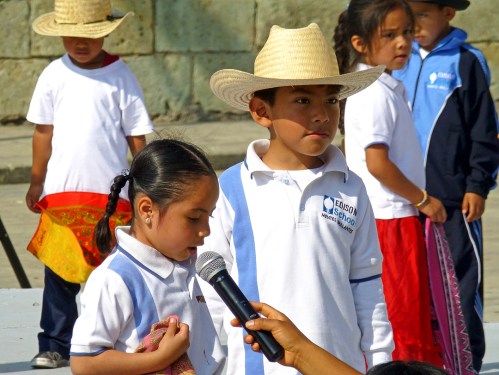
After morning coffee and breakfast, catching up on email and the news, washing dishes, showering and dressing, I grabbed a couple of shopping bags and headed out at 10 AM.  The initial plan had been to walk up to Niños Heroes (the Pan American highway) to photograph some new murals, cross the highway to the Organic Market, and then return home by way of Sánchez Pascuas mercado where I could get chicken, quesillo, and anything else that remained on my shopping list or struck my fancy.  However, for almost an hour, I’d been hearing Guelaguetza music coming from the Plaza de la Danza.  I decided a detour was in order and found kindergartners performing Oaxaca’s traditional folkloric dances, including this one  where couples take turns “dissing” each other in a rhythmic double-entendre laden dialogue.  It always gets laughs — wish I could understand the jokes!  Needless to say, I hung out watching the kids for awhile.
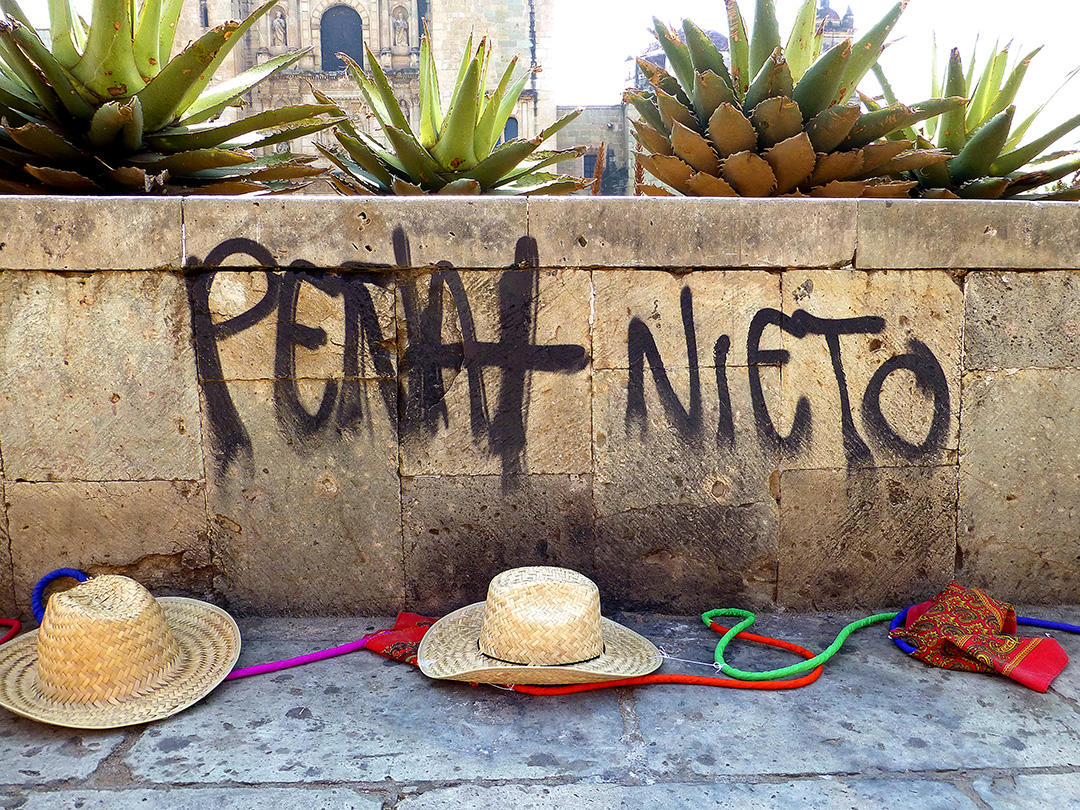
P1080705I finally tore myself away and resumed my original itinerary.  Some of the murals were east of the Pochimilco Organic Market so I decided to start at the end and work my way back — a route which took me up the Macedonio Alcalá where I saw a sidewalk vignette of hats and scarves lined up in front of Santo Domingo.  There was also a small marmota (cloth globe on a pole) laying on its side, so I’m guessing there was to be a calenda (parade) of some sort.
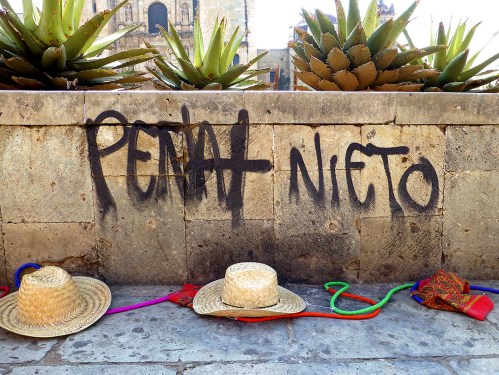
P1080715After stopping to take a few photos (how could I resist the juxtaposition with the Peña Nieto graffiti?) I found myself behind these vendors taking their merchandise up to Llano Park for its Friday market.

P1080717Deciding to speed up my slow progress on the errands I’d set forth for the morning, I passed the gals only to stop to watch Oaxaca’s version of the dog whisperer working with four Xoloitzcuintlis (Mexican Hairless Dogs).

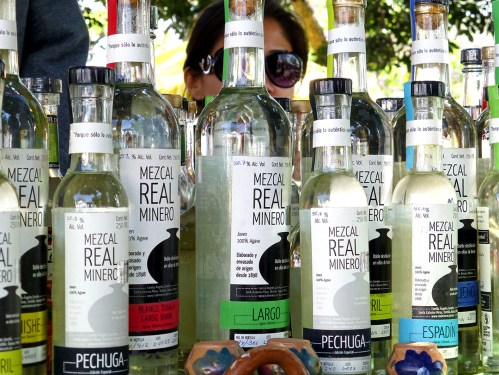
P1080722 (1)Eventually continuing north, I arrived at Niños Heroes and the murals and street art I’d come to find and photograph.  They deserve their own blog post, so I will save those photos for another day.  However, I also ran across this wonderful wall!  P1080752Crossing the highway, I found the newly built and landscaped stairs (almost didn’t recognize them) leading up to Xochimilco and the Pochimilco Organic Market.  I wandered and lingered and tasted — including a few of these mezcals, as I’ve got a US trip coming up and a stepson who probably won’t speak to me if I don’t bring him a couple of bottles.
P1080755Popping some gum in my mouth (didn’t want my breath to smell like I’m a lush), I headed south on Tinoco y Palacios to catch a couple of new murals I’d had fleeting glimpses of when returning from last Sunday’s trip to Tlacolula.  This one had particularly caught my eye.

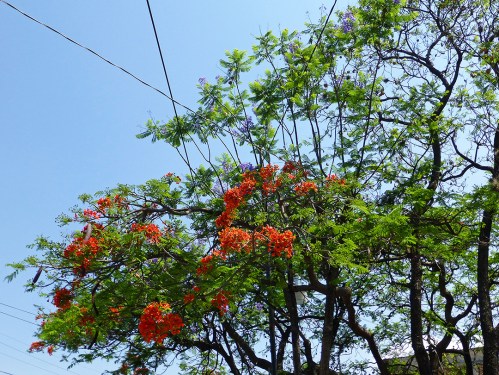
P1080788By the time I arrived at Sánchez Pascuas, it was after 12 noon.  I found my poultry guy, paid a visit to the cheese vendor, picked up some veggies from my favorite produce gal, and, on the way out, bought some homemade salsa verde.  Yummm…  As I descended the three stairs down to the sidewalk, I turned around to admire the beautiful color of the flamboyant and jacaranda trees and the tranquility of this setting in the middle of the state’s bustling capital city.
P1080815It was close to 1 PM when I unlocked the door to my apartment.  If I were in California, I would have jumped in the car, driven down to the local Friday organic market (with not a drop of mezcal in sight), browsed a bit, spent way too much money, climbed back in the car to finish shopping at Safeway, before returning to the house, probably by 11 AM.

Here in Oaxaca, I’d been gone almost three hours, walked close to fifty (often hilly) blocks, and seen some wonderful, creative, and life affirming sights.  And, that doesn’t even include the scattering of conversations with my neighbors and Luís and Luci, who work here.  Just another Friday.  Not a bad way to live one’s life!

Read Full Post »
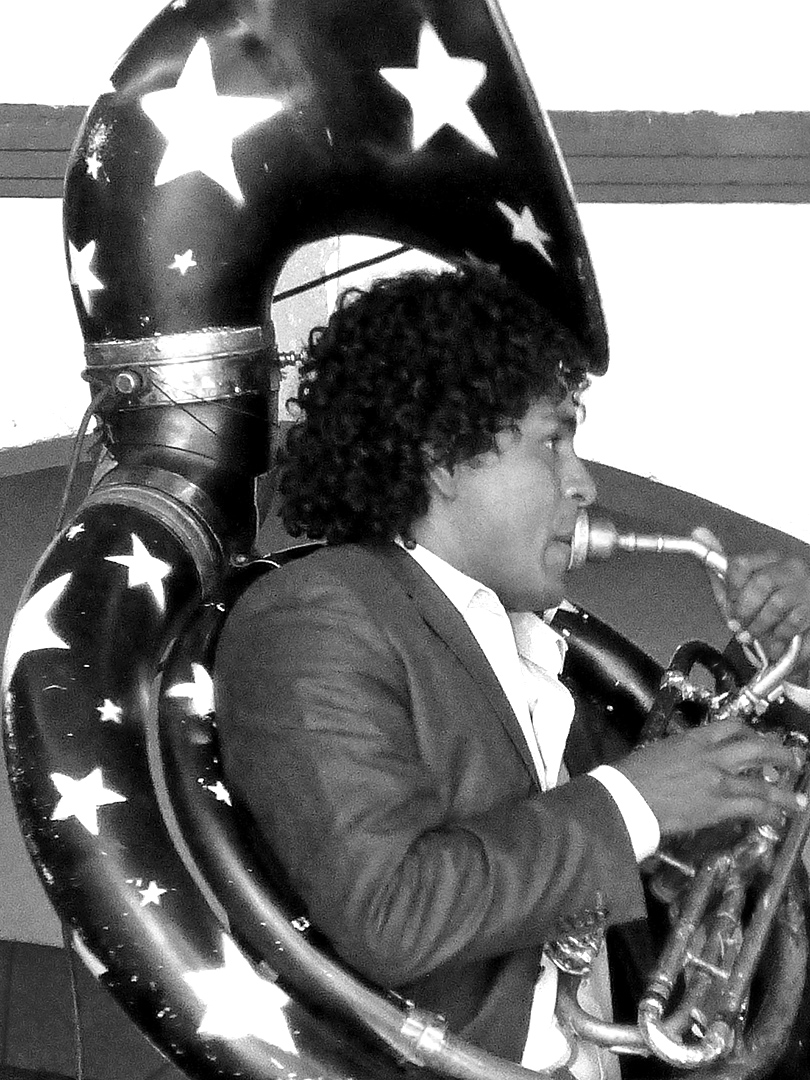
There always seems to be live music in Tlacolula de Matamoros on Sunday market days.  Today it was the hot band, Los Magueyitos de Matalán.  The horns had me seeing stars!

P1080597P1080612

P1080616P1080614Hopefully, Chris over at Oaxaca-The Year After will eventually post the video he took.  In the meantime, here they are on SoundCloud.

Read Full Post »

In my last blog post, I mentioned Teotitlán del Valle does not go on Daylight Saving Time.  And, they are not alone!  As the article, Clocks don’t change where sun keeps time, most of Mexico didn’t adopt DST until 1996 and given the autonomy guaranteed to indigenous communities, “70% of the entire indigenous population of Oaxaca” have chosen to follow the sun — the “King of the Sky.”

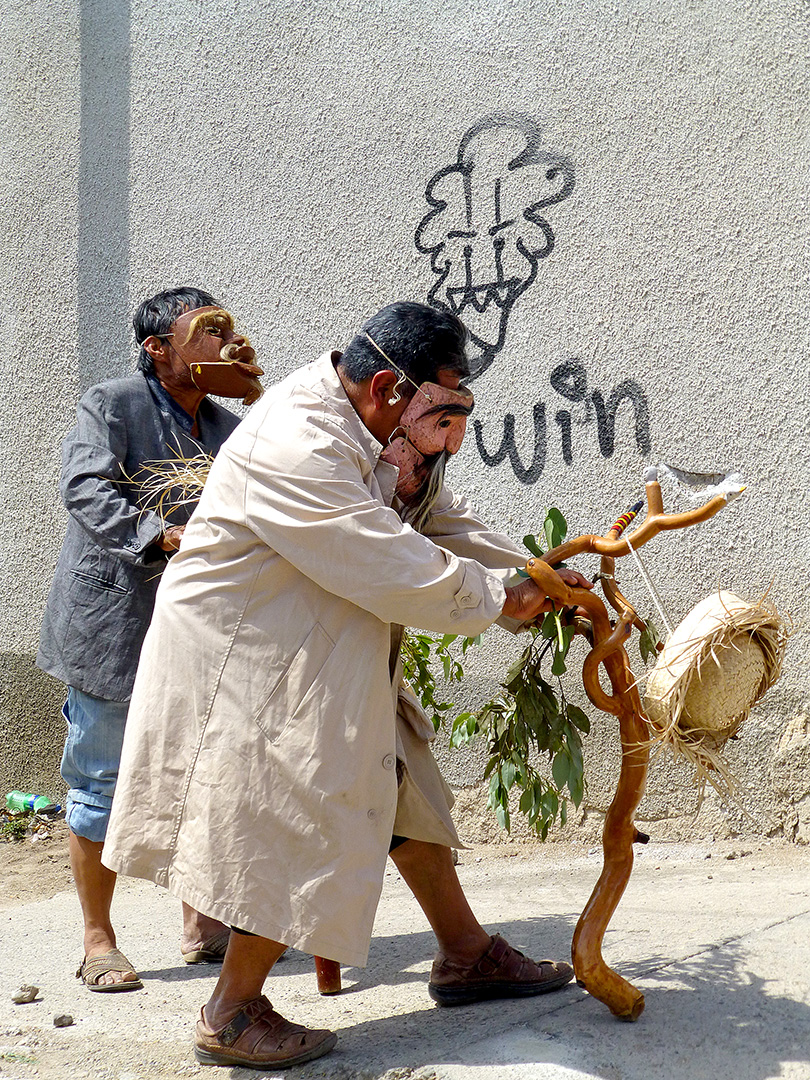
Ojala, blogger buddy Chris (who doesn’t change his watch to DST either) and I will be returning to Teotitlán del Valle for the final day (into night) of the Baile de Los Viejitos, (the Dance of the Old Men) this time hosted by el quinto (5th) sección.  However, before we go, a few more scenes from Tuesday’s fiesta, put on by the segunda (2nd) sección.Viejito with cane

P1080514P1080518

I say, “ojala, ” because several marches and blockades are currently in progress throughout Oaxaca and on the carreteras into and out of the city.  Alas, the video I shot on Tuesday of the Baile de los Viejitos may be as close as I come to the dancing action until next year.

Read Full Post »

It’s Carnaval time in Teotitlán del Valle.  Yes, I know, Easter was last Sunday and Lent is over.  However, like many other things (e.g., not going on Daylight Saving Time), this Zapotec village does things their own way.  Thus, instead of celebrating Carnaval the day before Lent begins, they celebrate for the five days following Easter!  As I’ve written about previously, Carnaval in Teotitlán is a major production that indeed takes a village; young and old, female and male all have parts to play in the festivities that include music, masked men, mezcal, and mouthwatering mole.

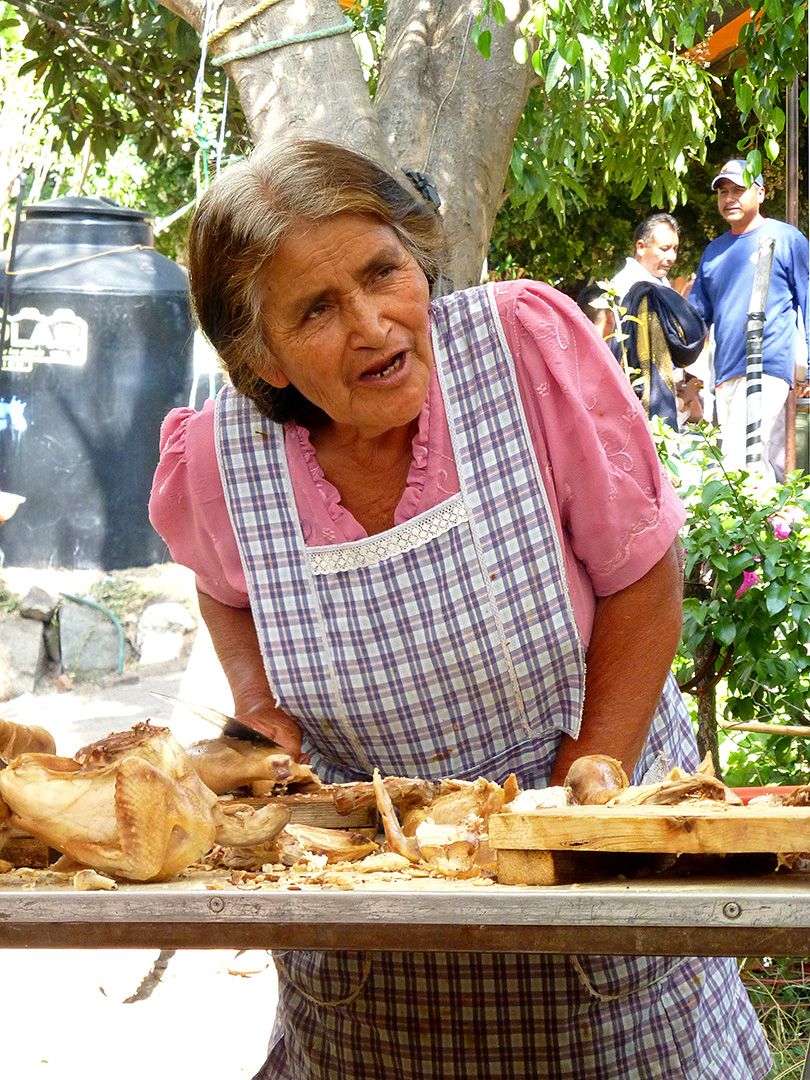
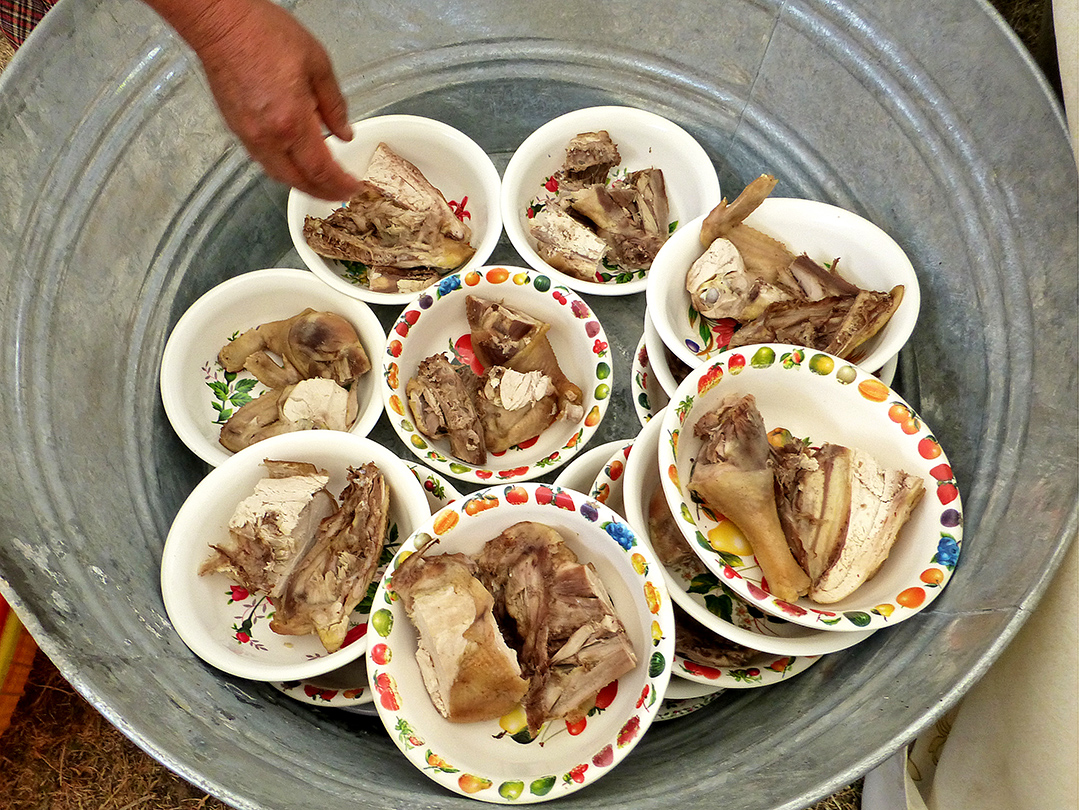
Yesterday, rather than sitting with the men and scattering of male and female extranjeros, gal pal J and I hung out with the women and children in the outdoor kitchen that had been set up in the back of the large earthen courtyard.  There the women prepared enough chicken, mole amarillo, and tortillas to feed one hundred!

P1080563

P1080561 crop

P1080556

The seemingly always well-behaved kids played and took care of the babies while their mamas and abuelas worked.

P1080560

P1080566

P1080569

P1080568

Muchisimas gracias to the women and children of Teotitlán del Valle’s Segunda Sección for being so gracious and welcoming.

Read Full Post »

Today’s Google Doodle solves a little mystery leftover from my brief March visit to Mexico City.  Staying in Colonia Cuauhtemoc, making my way to Insurgentes metro stop took me across Paseo de la Reforma and past this beguiling sculpture.

P1070584

I circumnavigated the sculpture on several occasions in an unsuccessful attempt at finding a plaque identifying the artist.  Thanks to today’s Google Doodle, now I know.  Titled, How Doth the Little Crocodile (also known simply as, Crocodile), it is by the late surrealist artist, writer, expat, and women’s liberation activist, Leonora Carrington, whose 98th birthday is being honored today.  The sculpture’s title comes from the Lewis Carroll poem by the same name.

Carrington led an extraordinary and fascinating life that was touched by many of the most important events and influential people of the twentieth century.  In 2000, she donated the sculpture to Mexico City, her adopted home for the latter part of her life, and it was moved to its current location in 2006.  How lucky for all whose paths cross this whimsical creation with its smiling jaws!

How Doth the Little Crocodile
by Lewis Carroll

How doth the little crocodile
Improve his shining tail,
And pour the waters of the Nile
On every golden scale!

How cheerfully he seems to grin,
How neatly spreads his claws,
And welcomes little fishes in
With gently smiling jaws!

Read Full Post »
It’s been one year since the passing of maestro Arnulfo Mendoza Ruíz.

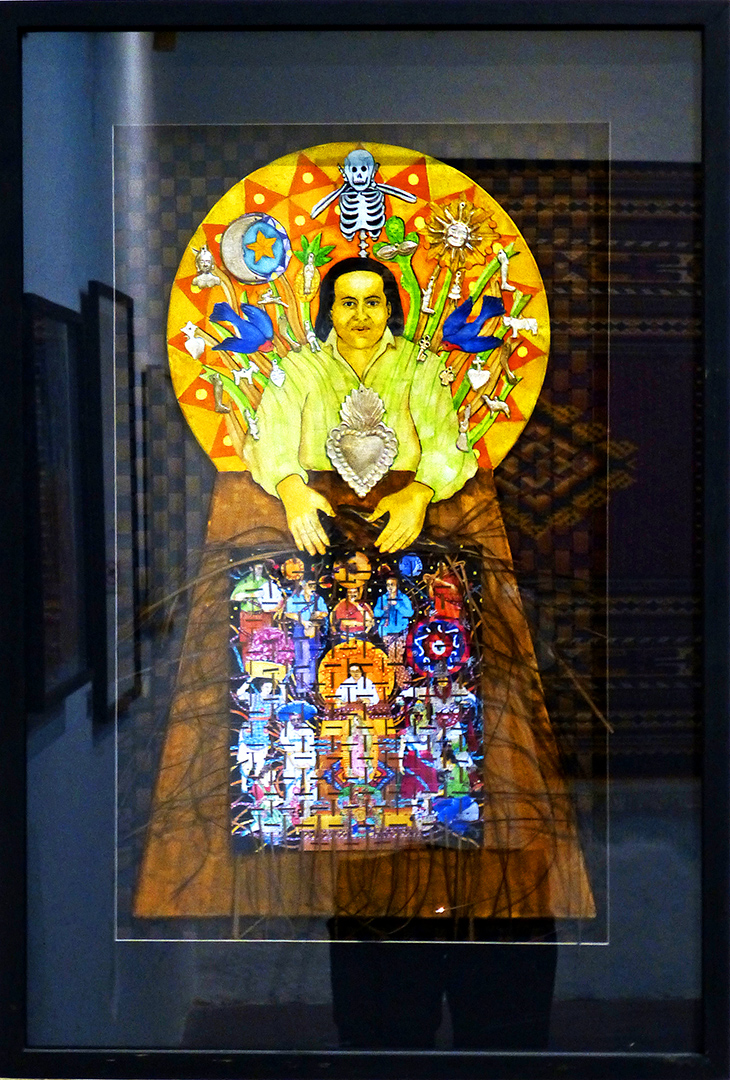
Tejedor de los sueños by Charles Barth

Tejedor de los sueños by Charles Barth (alas, with reflections from other pieces)

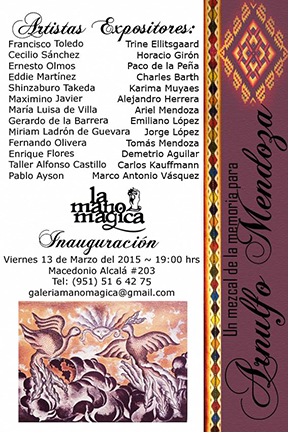
To honor his life, an exhibit of works by his friends, colleagues, and family was inaugurated at La Mano Mágica on March 13, 2015.

ManoMagica exhibit

His older son, Gabriel Mendoza Gagnier, curated this amazing collection of paintings, weaving, and artesanía.

Assisted by Arnulfo’s companion, Yukiko, the opening featured, not only amazing art, but also mezcal, tamales, and surprise entertainment by Carnaval dancers from San Martín Tilcajete, wearing masks carved by some of the well-known carvers from the village, including Inocenio Vásquez and Jésus Sosa Calvo.

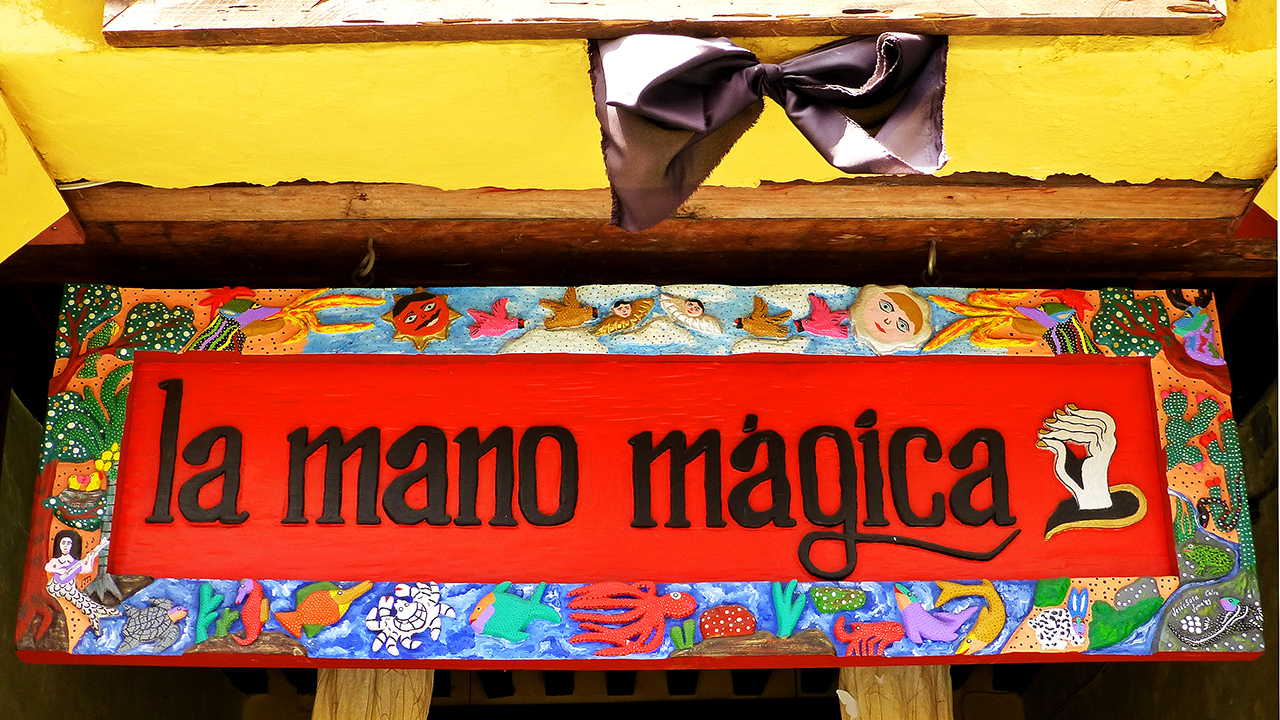
Jésus Sosa Calvo had carved the signature entry sign for La Mano Mágica and recently, unasked, came by to freshen up the paint that had faded over the years under the intense Oaxaca sun.

P1070473

While, in the words of Manuel Matus Manzo,  Arnulfo Mendoza may have gone on “to meet the Jaguar and the god Murcielago,” the dreams of his magical hands remain.

Finally, this beautiful poem by Alberto Blanco from the exhibit’s catalog…

Mitades a Arnulfo

I
La mitad de la tierra
no sueña con la luna.
La mitad de la luna
no sueña con el sol.

Si la luna es la trama,
y si el sol es la urdimbre,
esa tierra es la tela
donde acaso se vive.

II
La vida es la comedia
ya la muerte es el drama,
pero el textil de siempre
es la urdimbre y la trama.

La mitad de la vida,
la mitad de la muerte:
una tela tejida
con un hilo de suerte.


Read Full Post »
« Newer Posts - Older Posts »