Although Christmas trees are making inroads, in Oaxaca it is the nacimiento de navidad (nativity scene) that is the omnipresent symbol of Christmas. Unique and personal, they are seen everywhere; the zócalo, homes, hotel lobbies, store windows, and every kind of business you can think of!
This slideshow requires JavaScript.
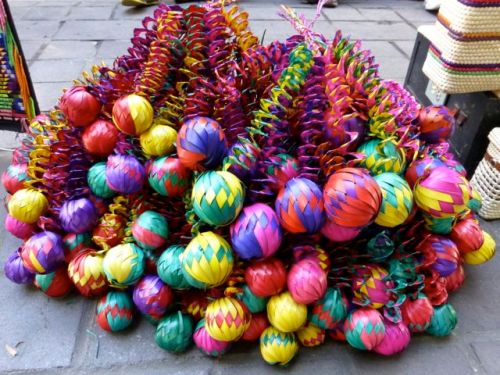
And, yes, this “spiritual but not religious” gringa couldn’t resist a miniature woven straw one of her own. It’s a work of art!
As yesterday’s post reported, fireworks late Monday night heralded the feast day of La Virgen de la Soledad, the patron saint of Oaxaca.
However, that was far from the end of the nocturnal tale. At the stroke of midnight, only an hour after the snaps, crackles, and pops had ended, and when I had finally drifted off to sleep, the bells of the Basilica began a frenzied pealing. They were immediately joined by repeated rocket explosions, and the unmistakable sounds of a tuna band; at 2 AM bells, rockets, and mariachis; at 4 AM more bells, rockets, music, AND a procession winding its way through the streets of the city; its sounds ebbing and flowing for almost two hours.
At 6 AM, I gave up attempting sleep, threw on jeans, shoes, and a sweatshirt (didn’t even bother to wash my face or brush my teeth — don’t tell anybody), grabbed my camera, and headed over to the Basilica. What a sight!!!
The Plaza de la Danza was covered with food stalls offering barbacoa, molotes, empanadas, tacos, buñuelas, hot chocolate, breads, and pastries — the best of Oaxaca street food. And, they were all open!
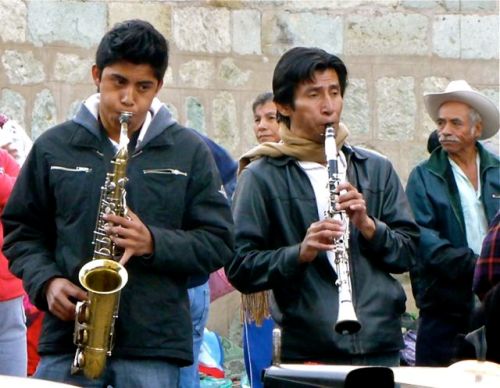
On the Basilica’s plaza, the Banda Auténticos (from San Andrés Huayapam) was playing…
Dancers were dancing…
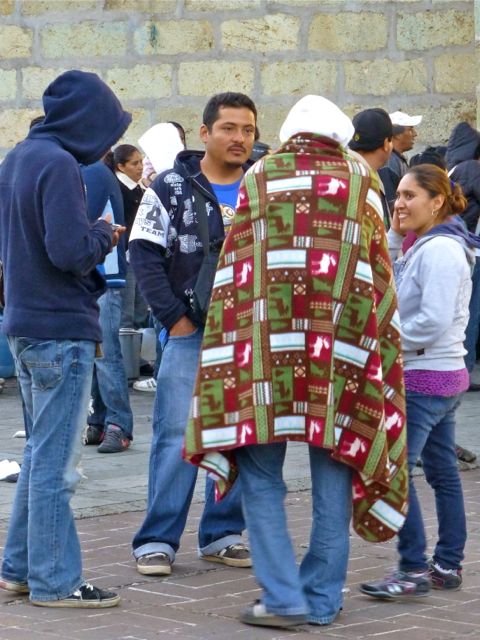
People were just waking up…
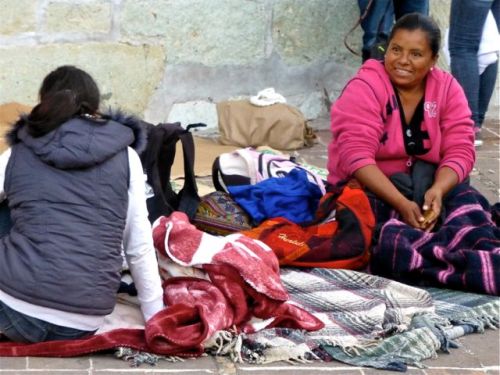
Vendors were selling roses and bouquets of herbs…
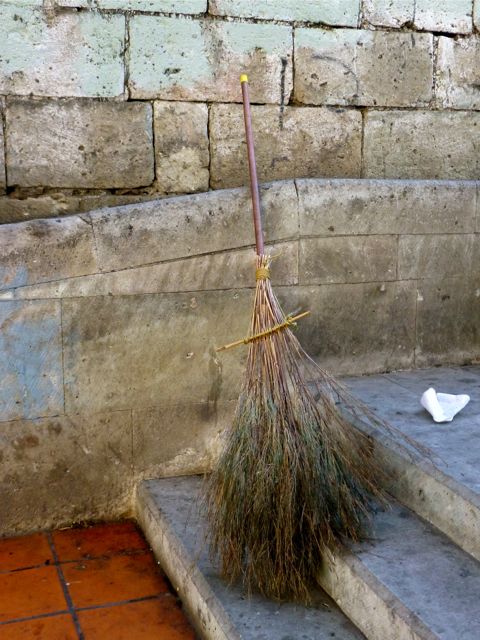
And, ubiquitous twig brooms (escobas de otate) waited to sweep-up the detritus from Soledad and friends pulling an all-nighter.
After a breakfast of barbacoa (chivo) and hot chocolate, I walked back home. Sleep deprived or not, it was a great morning!
Today, Oaxaca’s patron saint, Nuestra Señora de la Soledad, is having her day. Well, that’s not quite accurate, as she has been enjoying ten days of celebrations. However, December 18 is THE Día de la Festividad. So, no surprise, last night around 10:30, from the plaza of the Basílica de la Soledad, the booms and bangs of fireworks and crackles and hisses of a castillo, sounded to herald the upcoming day.
Only a block (as the crow flies) from the action, how lucky am I to have a ringside seat??!!!
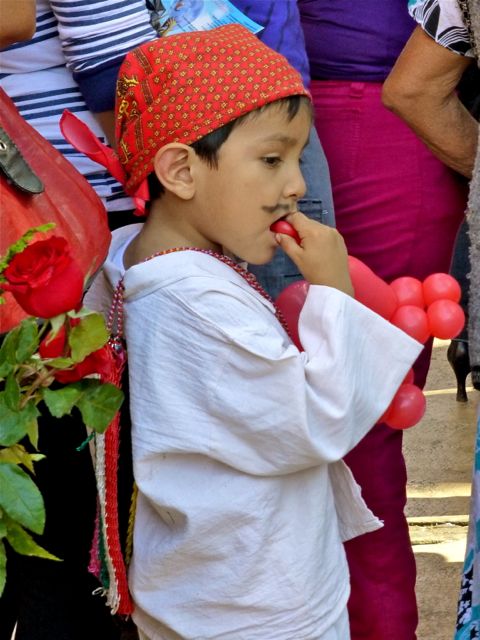
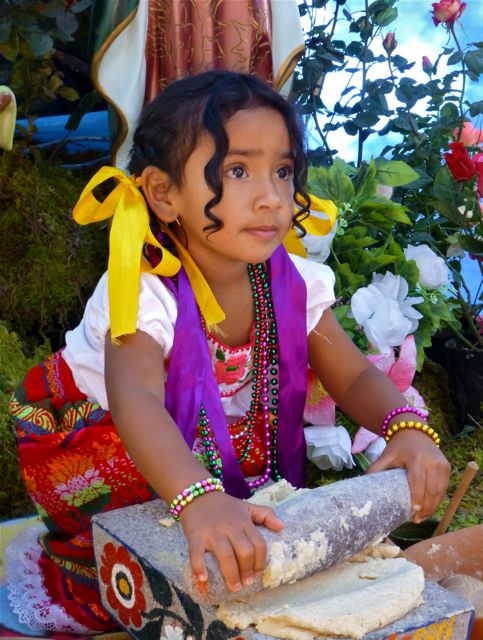
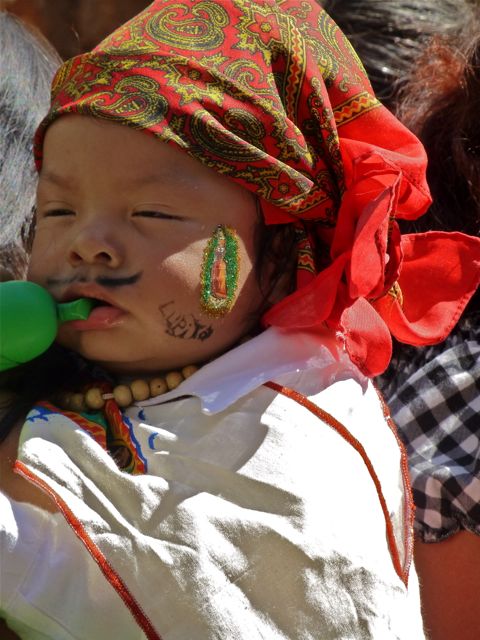
Here they and their parents wait patiently in a line that rings the church.
They are waiting to enter (via the door with a large banner marked, “entrada”) the church and be blessed.
Once they exit (via the door marked “salida”), there are photographers waiting, with burros and panoramic scenes, to take commemorative photographs — for a fee.
The sun is hot, the lines are long, and sometimes it’s long past nap time. By the way, there is also a carnival (with rides and games) and puestos upon puestos of food; the religious and secular meet.
Where are the clowns? Quick, send in the clowns. Don’t bother, they’re here.*
This slideshow requires JavaScript.
Plaza de la Danza, Oaxaca, December 10 — Día Internacional del Payaso (International Day of the Clown). Gracias, Universidad José Vasconcelos.
If, like me, you suffer from coulrophobia (fear of clowns), Oaxaca is a great place for a little immersion therapy. Clowns are seen everywhere and everyday; waiting for the bus, walking their kids to school, as well as performing in parks and plazas. Not so scary anymore!
Riotous clanging from Soledad’s bell towers at 4:45 AM yesterday rudely interrupted a peaceful sleep. Explosions of cohetes and other church bells soon joined the morning’s 2-hour long Virgen de Juquila soundtrack. Chimes, rockets, loudspeakers announcing the presence of the water and gas vendors, fried plantain wagon steam-whistles, horns honking, bus gears grinding, and booming base emanating from open car windows; it’s all part of the cacophony one comes to know and love when living in Mexico.
And, then there is the music… Looking for signs of Juquila yesterday (with all that noise, I figured there must be something going on), I stumbled upon the Sexto Festival Low-Fi 2012. (Fyi: sexto = 6th, in case you were wondering.)
There were vendors…
This definitely didn’t have anything to do with virgins!
This was a music festival that almost didn’t happen. According to event promoter, Thorvalo Pazos Hoga, they were initially denied a permit, “on the grounds of religious and traditional festivals that are celebrated in the month of December in the city.” A silly argument, was his response.
I arrived in the early afternoon and fanaticos (love that word for fans!) were just beginning to gather at the Plaza del Carmen Alto. Ska, hip hop, heavy metal, rock, electronic music, and more would be adding to Oaxaca’s soundtrack until 11 PM.
Yes, we have no marimbas; the music was not your grandparents’ sones and jarabes. The bands had names like: K-OS Party, Cayune, Pichancha, Rekto de Cerdo, Dr. Jekill y Mr. Hyde, Herpes, Coito Violento, Forever, and Survival. Probably not even your parents’ music!
Oaxacan graphic artists designed the stage set. Love how they re-imagined the traditional Navidad piñata.
For the first time since I began nesting in my cozy little rooftop casita, I’m not heading north for Christmas. I admit to having decidedly mixed feelings; my family and most of my closest friends are up in El Norte and I’m already missing them and the traditions we have created. However, this year I get to share the holidays with new friends, create new traditions, and experience festivities heretofore unimagined — Noche de Rabanos (Night of the Radishes)? I can’t wait!
In the meantime, to bring a little of the familiar into the mix, I bought a Christmas tree. Not a real one (sad face) and not one of those seen below that my local supermarket has had for sale for several weeks. Mine is decidedly smaller, measuring exactly two feet, and…
too small to hang my favorite Mexican ornaments on its un-scented, wiry but green(!) boughs. These colorful and wonderfully bouncy decorations will be purchased and a place for them in and around Casita Colibrí will be found.
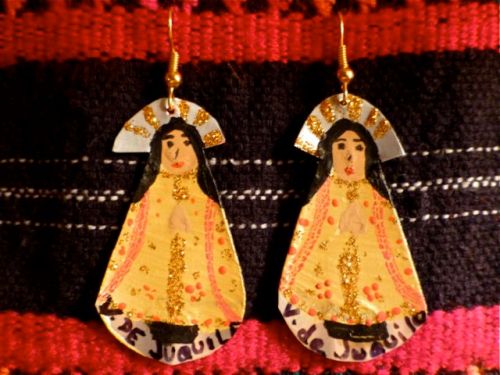
Trimming my tree will present some challenges. No cartons of ornaments, lovingly collected and stored by four generations of the family, to bring down from the attic. And, as I’ve said, the tree is tiny. I’m thinking… digging into my earring collection might be a good place to start.
However, these earrings will have to wait to adorn the tree until after I wear them tomorrow. December 8 is the celebration of the Virgen de Juquila — the first of three Vírgenes honored by Oaxaqueños in December. There will be parades. There will be fireworks. There will be wildly clanging church bells. And, there will be an abundance of magic this month, of this I have no doubt!
The Y-shaped valley of Oaxaca is about 700 square kilometers, not all that big when compared to California’s Sacramento Valley, which is approximately 2,570 square kilometers. Yet, unlike the “sameness” one encounters in Sacramento Valley towns (sorry, CA), one can’t help but be struck by the unique identity of each of the Zapotec villages that are only kilometers apart. One specializes in red clay pots, another in black pottery, and another in green glazed ceramics. There are villages of woodcarvers near weavers of cotton and others of wool, never mind the fashion trends!
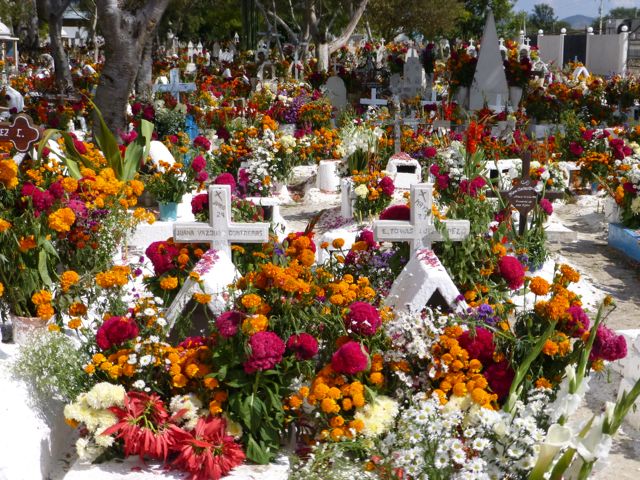
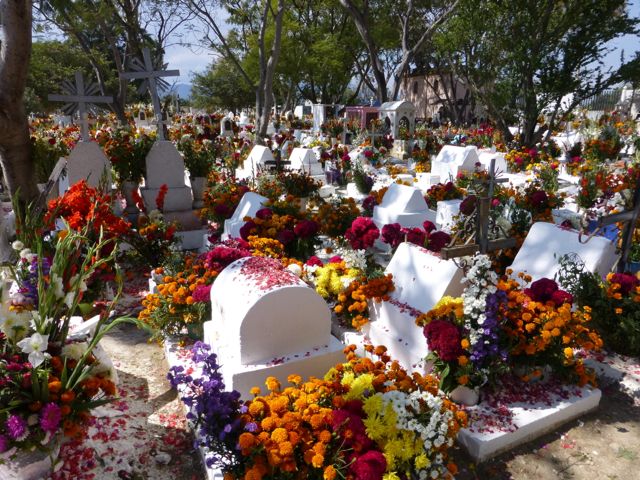
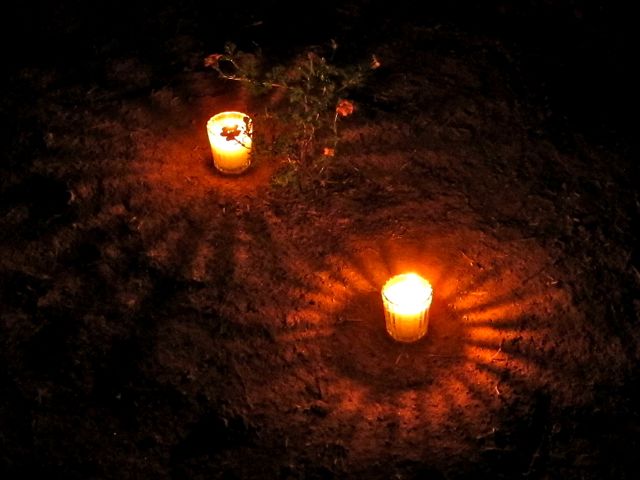
Thus, it should come as no surprise that Day of the Dead celebrations and cemeteries differ, often dramatically, from village to village. And so, from the whitewashed graves of Santiago Apóstol and the candlelight of Santa María Atzompa (today’s earlier post), we came to the carved wooden crosses in the Panteón Municipal of the Villa de Zaachila.
This slideshow requires JavaScript.
Along with livestock, produce, and household goods, wood gathered from the hills surrounding Zaachila is a major part of Zaachila’s weekly Thursday tianguis (open air market). It’s one of my favorites!
With only a couple of days left in November and the Christmas holiday season already making its presence known, it’s now or never to finish sorting through this year’s Día de los Muertos photos — my thoughts and impressions will take the remains of this lifetime, and then some, to process.
To an outsider, especially one whose worldview was shaped by a Judeo-Christian culture, Day of the Dead is often seen through the lens of juxtaposition.
The “unbearable lightness of being” in Santiago Apóstol…
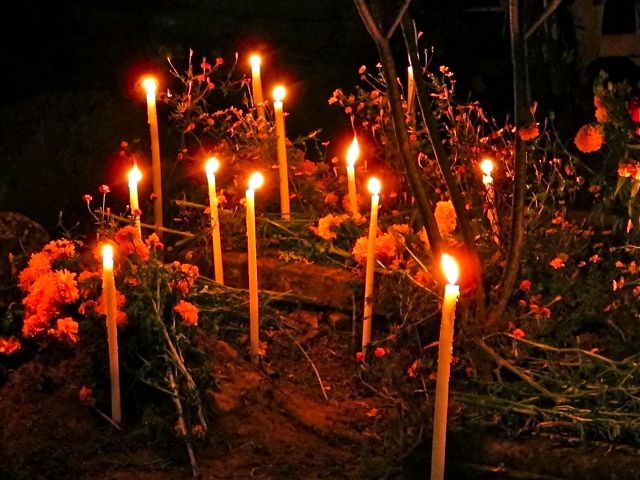
The blurred otherworldly darkness of Santa María Atzompa…
However, light becomes dark becomes light becomes dark, as day becomes night becomes day becomes night, as life becomes death becomes life becomes death… dualism beginning to vanish.
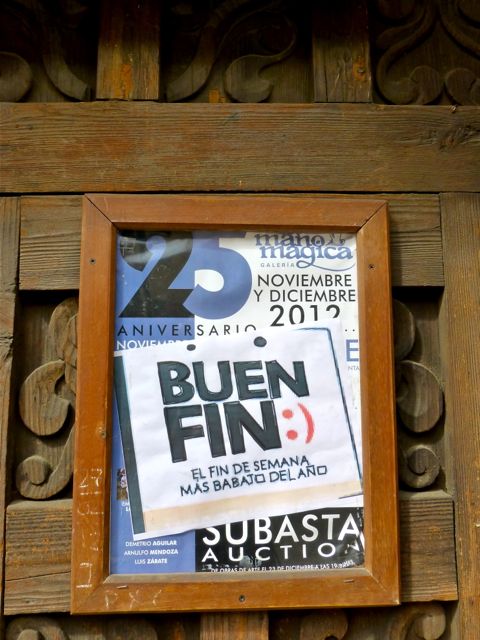
Signs reading, “Buen Fin” began to appear on shop windows around town last week. How nice, I thought, with a 3-day weekend coming up (Monday, 11/19 was Mexican Revolution commemoration day), the stores are wishing one and all a “Good Weekend.”
I’d only glanced and didn’t come close enough to read the smaller and more important print, “Weekend: Cheapest of the Year.” What’s it all about? Last year’s LA Times article, “A ‘Black Friday’ shopping ritual coming to Mexico?” explains it all.
Apparently, I’ve been oblivious or this newest US export has taken a while to make its way all the way down to Oaxaca. But, make its way down to Oaxaca, it has! According to Monday’s Noticias, “This weekend hundreds of Oaxacans went to department stores and shops of all kinds in the city, to stock up on essentials and electronic products, mainly taking advantage of ‘Good Weekend’ promotions.”
You might well ask, “What is a muerteada?” It is a comparsa (parade) that is part of traditional Día de los Muertos celebrations particular to the state of Oaxaca. According to the book, Day of the Dead: When Two Worlds Meet in Oaxaca, the muerteada allows the dead “to ‘occupy’ a living body, either a muerteada participant or an audience member, for a time, and therefore enjoy the entertainment directly rather than vicariously.”
Like Commedia dell’Arte, there are stock characters — in this case, the happy widow, the dying or dead husband, the father of the widow, a doctor, a priest, a shaman, people dressed like death, devils, and las lloronas (weeping women). However, unlike Commedia dell’Arte, in the muerteada men play all the roles.
Last year we joined the Vista Hermosa, Etla murteado. However, this year blogger buddy Chris decided I was ready for the big time — the “battle of the bands” when the muerteadas of San Agustín Etla and Barrio San José meet — Banda Tromba Sinaloense for San Agustín and MonteVerde Banda for San José. FYI: This is after participants and their bands have danced their way up and down the hills of their respective neighborhoods all night long, stopping at designated houses for food and drink — mezcal and cervesas seemed to be the beverage of choice, especially among the men!
So, early on the Nov. 2, we went in search of the San Agustín contingent, we found them, joined in the merriment, were offered food and drink along the way, and eventually came to the crossroad where mania turned to mayhem, albeit organized mayhem — courtesy of the white-shirted security for San Agustín and red-shirted security for San José. They kept the dancers and supporters from each side apart, leaving the face-off to the two bands. It was wild!!! After 20+ minutes of battling bands, it was over and we and the San Agustín contingent trudged back up the hill.
You may have spotted a tall silver-haired gringo right in the middle of the action in one or two of the photos, that would be Chris. Be sure to check out the video he put together of all the madness.
According to Organizing Committee President, Alfredo Erick Pérez, the muerteada in San Agustín Etla dates back to the 1800s, possibly to the days of Mexican President Porfirio Díaz.
In addition to graveside gatherings and decoration, altars, parades, sugar skulls, sand paintings, marigolds, and Day of the Dead bread, painted faces are another distinctive feature of Día de Muertos celebrations. They are most likely seen hanging around cemeteries and dancing through the streets but, like everything else here, you just never know…
The day of the dead in Mexico is a fascinating mixture of Spanish Catholic and native Aztec traditions and beliefs. Skulls and skeletons were an important part of All Saints Day festivals in medieval Europe, especially since the Black Death ravaged the population of Europe in the 1300s. Across Europe artists, playwrights and poets mused on the theme of ‘memento mori’ (remember death) and the ‘dance of the dead’. Many artworks and books from the time depict dancing skeletons, or portraits with a skull to ‘remember death’.
At the same time, in Mexico, the Aztec culture believed life on earth to be something of an illusion – death was a positive step forward into a higher level of conscience. For the Aztecs skulls were a positive symbol, not only of death but also of rebirth.
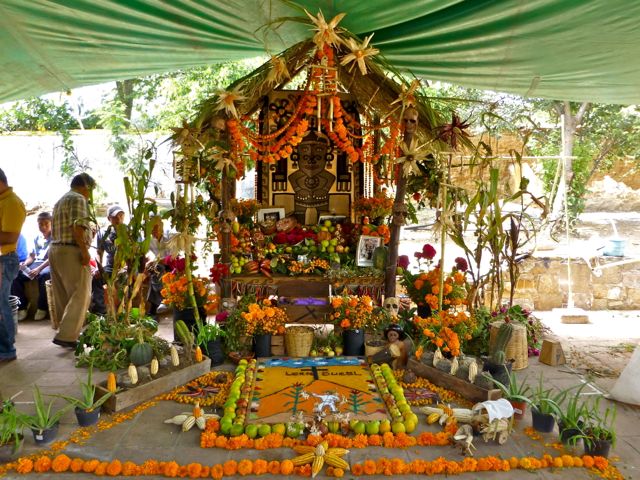
an integral part of the Day(s) of the Dead celebration.
filled with meaning.
a beacon to the departed.
an ephemeral work of art.
the sum of its lovingly chosen parts.
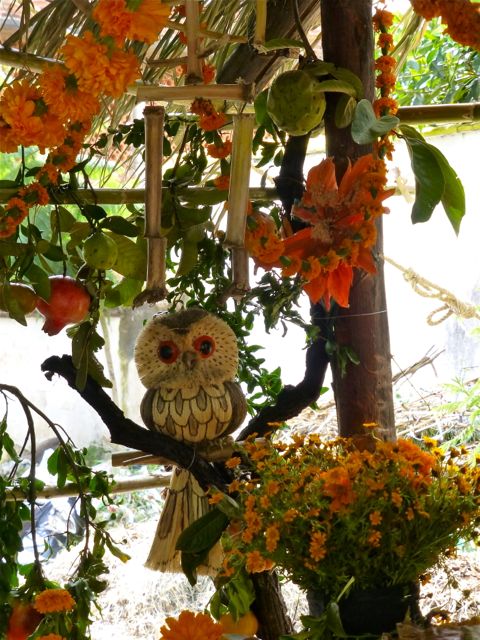
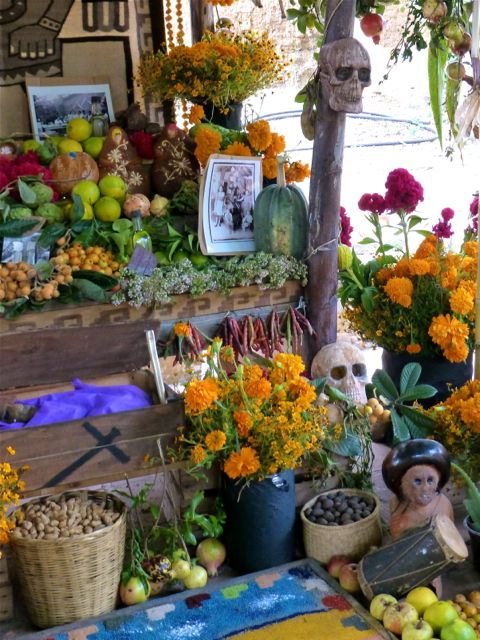
This is another ofrenda from the previously mentioned “altar decorating” competition on the plaza in front of Santo Tomás in Oaxaca’s Xochimilco barrio.
Living and being in Oaxaca during the Días de los Muertos is hard to put into words. There is so much to experience and to think about. Sensory overload challenges the limits of heart and mind and my emotions are running the gamut from extreme exhilaration to a quiet joy to being moved to tears.
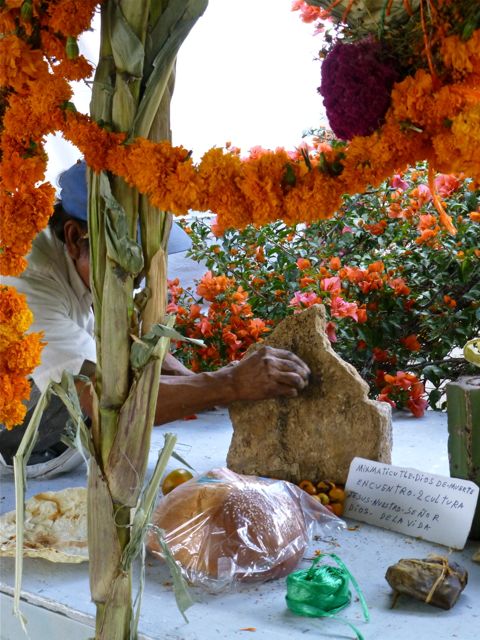
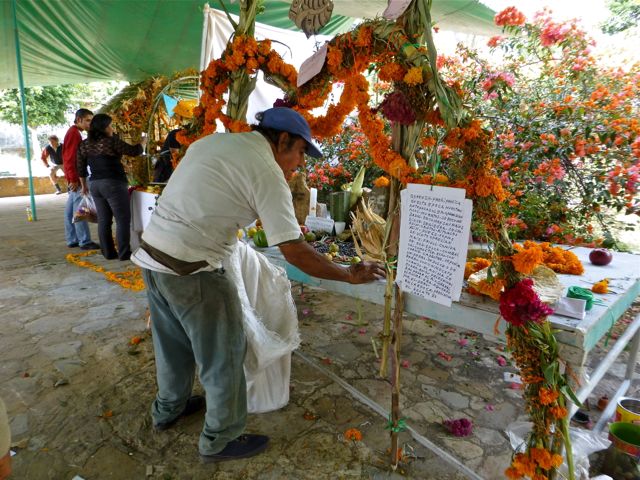
The latter occurred a few days ago, when I walked up to the Templo de Santo Tomás in Oaxaca’s Xochimilco barrio (neighborhood) where an “altar decorating” contest was in progress. Altars were to be judged on authenticity, originality, and creativity. When I arrived, friends and relatives were in the midst of putting the final touches on their altars. Some were elaborate and some exhibited real artistry, but one really touched my heart.
He was alone — no one to help, no playful banter. When I first arrived, he was carefully etching a cross with a piece of charred wood on a stone.
He worked silently and with purpose, pulling items out of a well-worn sugar bag and carefully placing them on his altar.
When the bag was empty, he walked over to a cart and pulled out another one.
Slowly, his vision emerged, with symbology I have only a cursory grasp of and won’t presume to explain.
I don’t know who won the 5000 peso first prize or second or third place purses, and I don’t know if he was doing it for the money (he certainly looked like he could use it).
All I do know is he and his ofrenda moved me deeply.

















 Mexican Peso Converter

 View From Casita Colibrí