Feeds:
Posts
Comments

Archive for the ‘Celebrations’ Category

I’m playing catch-up with blog posts.  After the Good Friday Procession of Silence, I thought life would slow down a little.  That’s what’s happened in years past — I caught up on the “to do” list on the home-front, leisurely plowed through the hundreds and hundreds of photos from Semana Santa, did a little research and a lot of thinking about what I’d just seen and experienced, and then crafted a few blog posts.

That was before we found out that Teotitlán del Valle celebrates 5-days of Carnival after Easter, not before Lent!  A little levity after the solemnity of Semana Santa and in one of our favorite places was not to be resisted.  And so, blogger buddy Chris and I set out on Monday afternoon in search of the house in Sección 1 (the village is divided into 5 geographic areas) that was hosting the daytime fiesta that precedes the evening festivities in the Municipal Plaza.

We returned yesterday for the Sección 5 fiesta, so more to come.  Now it’s off to Tlacolula for the Nieve, Mezcal y Gastronomia Festival.

FYI:  For a more detailed explanation of this Carnival celebration and photos from last year by a professional photographer, check out Ann Murdy’s website.

Read Full Post »

The Semana Santa poster said the Viernes Santo (Good Friday) Procesión del Silencio was to begin at 6 PM in front of .  Knowing the drill, I arrived at 4:45 to take photos as contingents and participants arrived — but nobody was there.  The old antiwar slogan, “What If They Gave a War and Nobody Came” came to mind.

Of course it was going to happen, it’s just that time isn’t what it seems here. Word on the scene had it that, despite the poster info, it wasn’t to begin until 6:30 PM.  No worries!  Well, except that Mexico doesn’t begin Daylight Saving Time until next weekend, the light began rapidly fading, and 6:30 PM became 7 PM.  Por favor, let Oaxaca’s 27th annual Parade of Silence begin!

And it eventually did — up Macedonio Alcalá, left at the Cruz de Piedra, left again on García Vigil to Independencia, another left, and back up the Alcalá.  And so, in darkness and silence the procession returned to the church where it all began.  Contingents could be heard late into the night parading through the streets of the city, as they returned the Jesuses and Marías to their respective home churches.

Lots more photos can be seen over at Oaxaca-The Year After.

Read Full Post »

In Oaxaca the penitents gathered…

Purple hooded penitent

in front of Preciosa Sangre de Cristo on Good Friday…

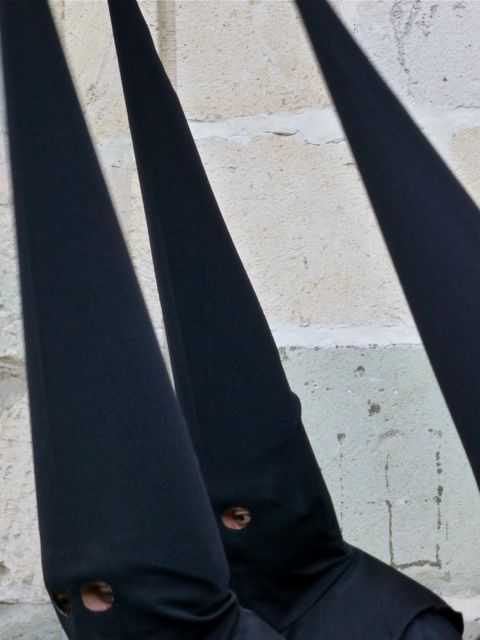
3 black hooded penitents

preparing for the Procession of Silence.

Purple hoods behind black hooded penitent

For those who are wondering, “What’s with the hoods (capirotes)?”  The answer can be traced back to the Middle Ages.  Members of lay religious charitable organizations (cofradías) would don the masks and hoods to guarantee anonymity and promote humility in their service.

From the Holy Week in Seville, Wikipedia page:

At the heart of Semana Santa are the brotherhoods (Hermandades y Cofradías de Penitencia),[1] associations of Catholic laypersons organized for the purpose of performing public acts of religious observance; in this case, related to the Passion and death of Jesus Christ and to perform public penance.

The brotherhoods, besides the day-to-day work in preparation for the processions, also undertake many other self-regulated religious activities, and charitable and community work. Many brotherhoods maintain their own chapel, while others are attached to a regular parish.

The Spanish brought the tradition to Mexico and penitents continue to play a major role in the Viernes Santo, Procesión del Silencio in Oaxaca.

Read Full Post »

And so Viernes Santo (Good Friday) began…

Mass said, a Vía Crucis (Stations of the Cross) procession through the streets of my neighborhood.

Read Full Post »

Lunes Santo (Holy Monday) in Teotitlán del Valle provided another moving and memorable experience.  For some unknown reason, the village re-enacts the 14 stations of the cross on the Monday before Easter.  Following a special early morning mass at the Templo de la Preciosa Sangre de Cristo, statues of Jesus and the Virgin Mary are hoisted on platforms and carried from the church to signal the start of the day-long pilgrimage.  They are led by a band playing a mournful and dissonant tune as they set off to wind their way through the cobblestone streets of Teotitlán.

“Stations” are set up along the route by designated families — some are decorated with the village’s famous woolen tapetes (rugs).  Tamales, non alcoholic beverages (alcohol, even the ubiquitous mezcal, is forbidden during Semana Santa), and nieves (ices) are offered at others.  At all, the appropriate prayers are read, incense of copal is burned, and offerings, including of corn and lilies, are made.  And, as always, children have important roles to play.

This slideshow requires JavaScript.

The procession is solemn and dignified and filled with pre-Columbian, along with Catholic, tradition and symbolism.  Like all the other ritual celebrations in Teotitlán del Valle, these are not performed for the benefit of tourists — they are some of the strands of the warp and weft that have woven this community together for thousands of years.

Read Full Post »

In front of Oaxaca’s Cathedral, the Palm weavers from the Mixteca have been practicing their craft with awesome dexterity, creativity, and skill.

All is ready for Domingo de Ramos (Palm Sunday).

Read Full Post »

You know Semana Santa is on the horizon when tables, large and small, elaborately or minimally decorated, miraculously appear in doorways, street corners, and the Alcalá.  The common denominator is smiling people offering Agua de Jamaica, Horchata, Chilacayota, and even nieves to all passers-by.  Día de la Samaritana (Good Samaritan Day) is an only-in-Oaxaca, 4th Friday of Lent, event.

This year, besides experiencing the joyous mob scene on the Alcalá and the small sidewalk stands on side streets, on a tip from a friend, I made the “taking your life in your hands” crossing of Calzado de la República to the picturesque cobblestoned neighborhood of Jalatlaco.  Tables of aguas and nieves lined the plaza in front of the Templo de San Matías Jalatlaco and pastor Víctor Hernández was recounting the Biblical story, found in the Book of John, of the woman at the well who offered water to Jesus — the inspiration for Día de la Samaritana.  He concluded the story and blessing with the word “¡ataque!” and the masses did, indeed, attack the tables!  By the way, pastor Hernández gets around — he was the same priest who performs the yearly blessing of the animals across town at the Templo de Nuestra Señora de la Merced.

It was a hot day and having already had two aguas, as I made my way over to Jalatlaco, I was jonesing for a nieve but, alas, by the time I figured out which table was serving it, the line was too long.  So, giving up on the nieve, I accepted another agua and headed towards home.  However, in the true spirit of the day, as I was melting in the heat, an older gentleman standing on the sidewalk asked if I would like a nieve and gestured toward a woman standing in the doorway behind a small table.  “Sí” I replied and a styrofoam coffee cup filled with Leche Quemada (my favorite) was thrust into my hand.  Another sublime day in Oaxaca…

Read Full Post »

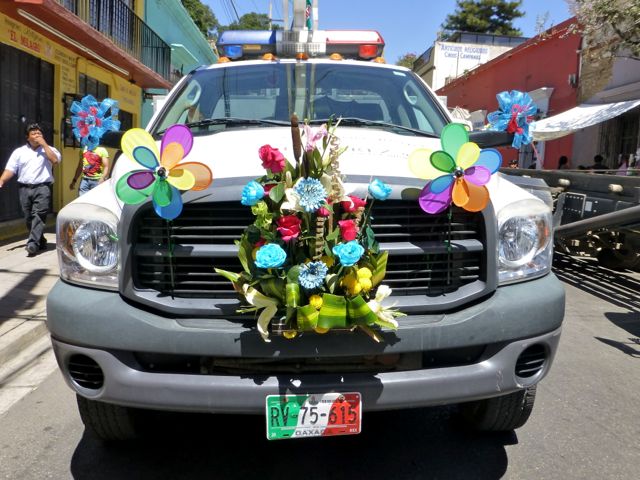
Yesterday was another of the “ya just never know…” days.  Returning to the city from Xoxocotlán after looking at the house my (soon-to-be-former) neighbor is building, the taxi driver pointed down Independencia and said something that we interpreted as, “day of the garbage collector.”  So, instead of going home, my camera and I walked in the direction he pointed and, sure enough, a side street was lined with decorated garbage trucks.

decorated garbage trucks

P1050470

P1050473

However, this day wasn’t for just any old garbage collectors; being March 3rd, it celebrated the founding of the Sindicato Independiente 3 de Marzo of the municipality of Oaxaca.  Depending on which newspaper report one reads, it is either the 34th, 38th, or 39th anniversary.

Marmota with banner

These are the city workers who keep the state’s capital clean — the garbage collectors, street sweepers, drivers, and laborers.  And, the city of Oaxaca IS clean, putting San Francisco to shame!  After a Thanksgiving mass, most of the 1,200 “trabajadores de limpia” and their families filled the plaza in front of the Basilica de la Soledad.  And, like all good Oaxacan celebrations, there were monos, dancers, marmotas, bands, toritos, and the whistles, whirrs, and booms of fireworks (of the all bang, no bling variety).

P1050502

P1050519

P1050499

P1050491

P1050487

So, now you know where to be and what to do next March 3rd!

Read Full Post »

In 1999, UNESCO designated February 21 as International Mother Language Day.  Tomorrow, February 20, Oaxaca begins her own celebration of Día Internacional de la Lengua Materna 2013 with a 2-day conference.

dia internacional de la lengua materna oaxaca 2013

The issue of “lenguas maternas” has a particular resonance in Oaxaca, as the state is home to 16 distinct ethnolinguistic groups:  Amuzgos, Chatino, Chinanteco, Chocho, Chontal, Cuicateco, Huave, Ixcateco, Mazateco, Mixe, Mixteco, Náhuatl, Popoloca, Triqui, Zapoteco, and Zoque.  As anyone who has visited the villages of Oaxaca has discovered, sometimes the abuelos and abuelas only speak their native language, not Spanish.

However, as Ernestina Gaitán Cruz notes in an article in sinembargo.mx, most of these indigenous languages lack an alphabet, having been passed from one generation to another through an oral tradition, and because these “Mother Tongues” are not taught in the schools, a significant number of these languages are in danger of becoming extinct.

Oaxaca is not alone.  From the article, Indigenous Youth Step up to Protect their Roots:

UNESCO estimates that every two weeks, one language disappears from the world.

Education systems have historically played a large part in the disappearance of indigenous languages, sometimes even forcing their extinction by severely punishing and shaming children for speaking native tongues or expressing indigenous identity in any way.

<snip>

In some communities where a large portion of the population speaks only the native language, another issue arises: access to important information on topics such as health care, employment opportunities, legal rights and public services.

And, it isn’t just a particular community that suffers, as The Endangered Languages Project explains, The disappearance of a language means the loss of valuable scientific and cultural information.

Zapotec village of Teotitlán del Valle

Zapotec village of Teotitlán del Valle

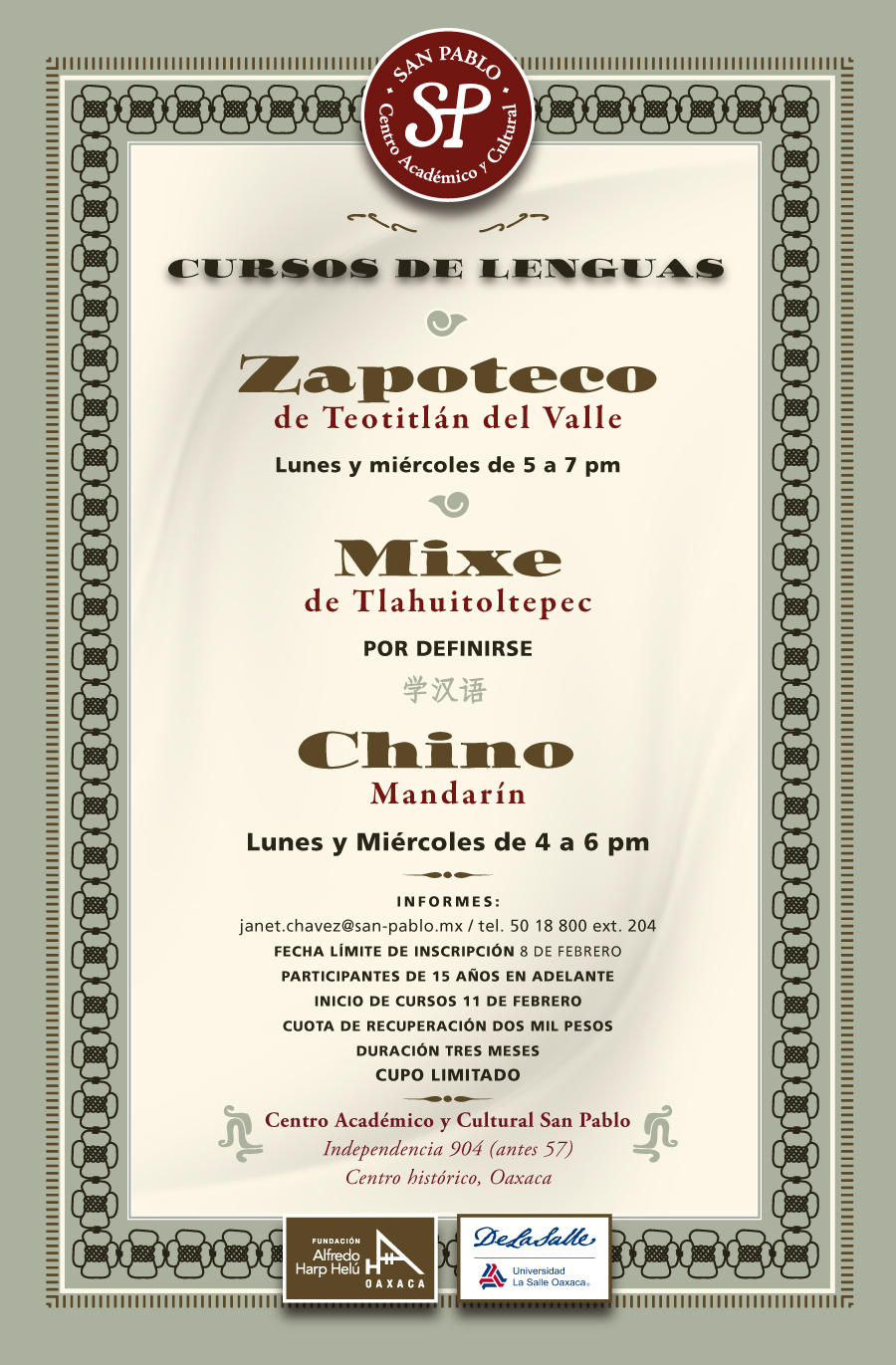
One of the missions of the Centro Académico y Cultural San Pablo in the city of Oaxaca is to document, study, and preserve the indigenous languages of Oaxaca.  The center includes a library, offers language classes, and will be hosting several events during Día Internacional de la Lengua Materna 2013.

Cartel-web-cursos-2013

Read Full Post »

The sun is shining, but it’s cold.  With snow on the ground, I’m living inside.  I’m definitely not in Oaxaca anymore!  I’m outside of Saratoga Springs, New York.  Yes, I traded the land of blue skies, brilliant colors, warm temps, and open doors and windows, for ten days in the frigid, fifty shades of gray, northeast — but for the best of reasons, my grandson’s first birthday. However, I need my Oaxaca fix!  So, with a little time on my hands (nap time for baby) I am going through Noche de Rabanos photos.  And, these little devils, jumped out at me.  (Gosh, I have no idea why!) P1030666 These dancers portray La Danza de los diablos, a dance that is the result of a fascinating fusion of African and Sonoran rituals. P1030669 They are made of dried corn husks P1030668 and were created by Moisés Ruiz Sosa.  The detail is amazing! P1030667 La Danza de los Diablos de Santiago Juxtlahuaca won second prize in the 2012 Totomoxtle Decorado division. P1030670 Ooops!  The adorable little devil who melts this heart just woke up.  Time to do the crawling-around-on-the-floor dance.

Read Full Post »

Got your hearts?  Yes!

Bouquets of heart shaped balloons

Got your flowers?  Yes!

IMG_2263

Got your candy?  Yes!

Candy display on counter

¡Feliz Día del Amor y la Amistad!  (Happy day of love and friendship!)

(ps)  To expand your linguistic skills, learn Frases de amor y amistad en 7 lenguas indígenas mexicanas — including Mixe, Mixteco, and Zapoteco.

Read Full Post »

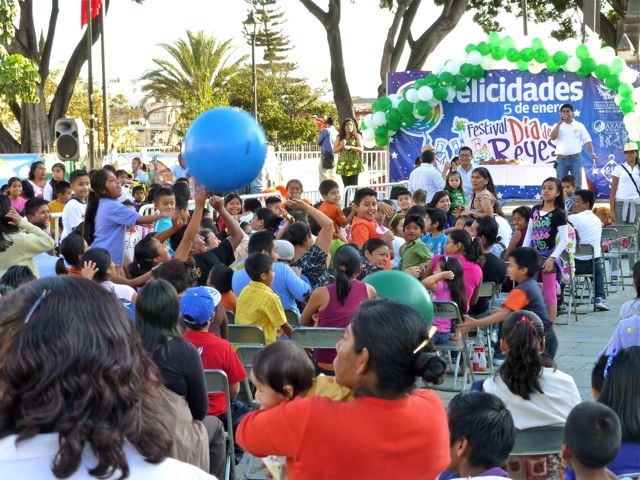
Early Saturday evening, the Plaza de la Danza played host to the Festival Día de Reyes, an event to delight and distribute a kilometer of donated toys to disadvantaged children.  The Kings had kids and their parents seeing double.

P1040333

Lines began forming two hours in advance to be up-front and close to the stage, all the better to be chosen to participate in the games and entertainment that was also part of the festivities.

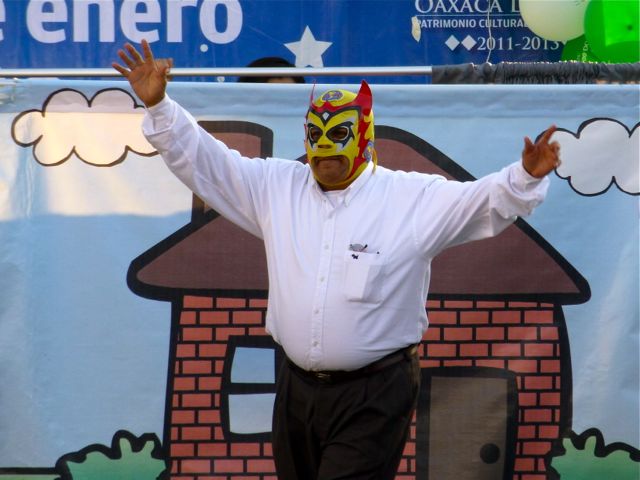
P1040341To the delight of the crowd, three luchadores took the stage to recruit contestants for a mystery contest.

P1040363

The music came up and Oaxaca’s kids began going, “Gangnam Style” — albeit, some more enthusiastically than others — and all got prizes.

Psy may have sung and danced his last “Gangnam Style” on New Year’s Rockin’ Eve, however, it remains alive and well in Oaxaca!

According to this morning’s Noticias, 6,500 toys (donated by citizens, city government entities, foundations, and businesses) were given to each child present and all received a piece of rosca de Reyes.

P1040350

As they say, a good time was had by all!

Read Full Post »

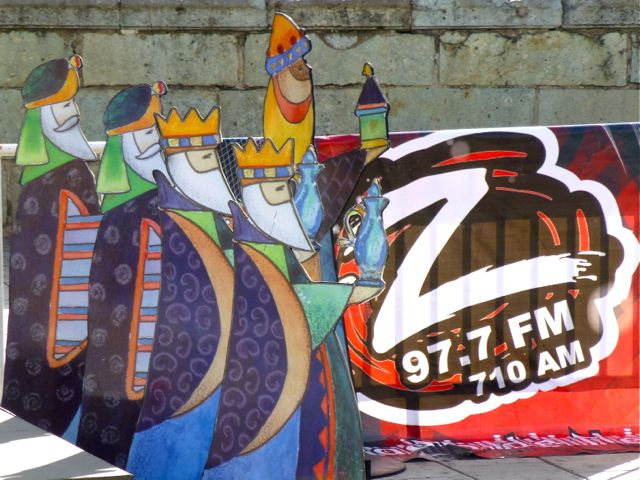
Today, Mexico is celebrating Día de Reyes (aka, Three Kings Day and Epiphany).  It is this morning, not Christmas, that children wake up to find gifts brought during the night not by Santa Claus, but by the Magi.

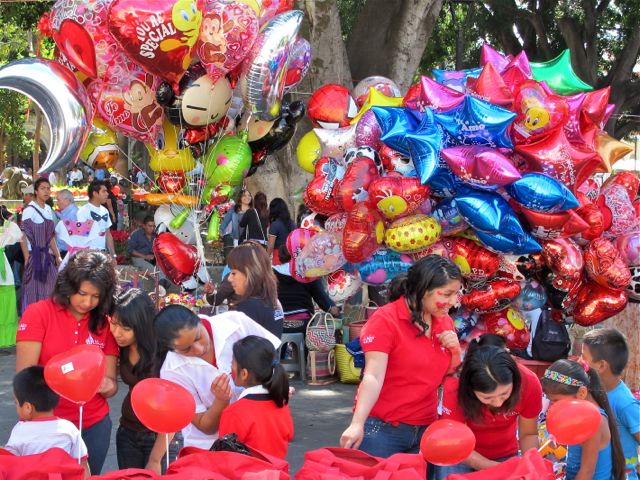
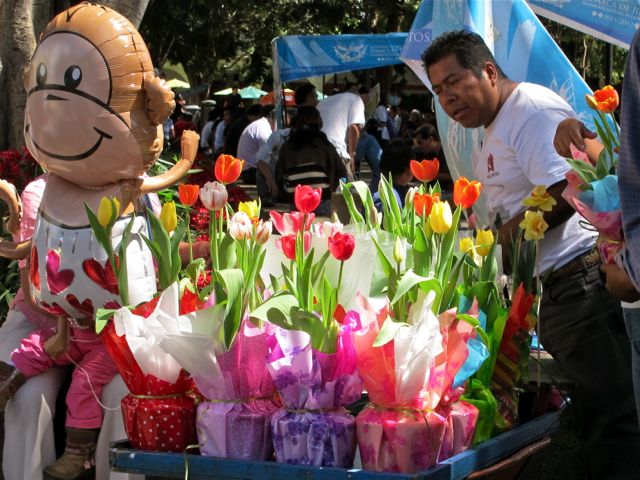
Melchor, Gaspar, and Baltazar have had plenty of time and places to shop.  Several days before December 25, in the aisles of my local supermarket, toys had already replaced Christmas decorations.  Llano Park was turned into Oaxaca’s version of a pop-up Toys R Us.  Puestos (stalls) filled the park, selling everything from dolls to sports equipment, balloons to books, and even something for the family dog.  There were (dicey looking) carnival rides and food stalls offering the usual bounty of street food and the traditional Rosca de Reyes.

And, that’s not all!  Early last night, there was a giant festival in the Plaza de la Danza, to entertain and distribute a kilometer of donated toys to disadvantaged children.  Stay tuned…

Read Full Post »

To the wonderful readers of my blog and to the beautiful people of Oaxaca, I wish you good health, safety, peace, and a 2013 that is filled with joy.

This slideshow requires JavaScript.

Bless you wherever you are
Windswept child on a shooting star
Restless Spirits depart
Still we’re deep in each other’s hearts

Bless You by John Lennon ~

Read Full Post »

Zócalo teeming with young, old, and all ages in between… vendors, Oaxaqueños, tourists from Mexico and the world beyond.  Streets filled with vehicles… parked, double parked, stopped, or moving at a snail’s pace to the shrill sound of transit police whistles.  Posadas converging on the zócalo… fireworks, bands, Marys and Josephs and baby Jesus, candles, angels, monos and marmotas, dancers, sparklers, and an overwhelming abundance of peace and joy and goodwill toward all.

This slideshow requires JavaScript.

Noche Buena (Christmas Eve) magic in Oaxaca.

Read Full Post »

« Newer Posts - Older Posts »