Feeds:
Posts
Comments

Archive for December, 2011

A little craziness from the November 2, 2011 comparsa in Vista Hermosa…

Muchisimas gracias to all my readers.  Thank you for stopping by, your perceptive comments, and your encouragement.  Peace and joy in 2012, if not in the world, at least in your heart!

Read Full Post »

When “progress” isn’t progress; another thought provoking article that discusses what NAFTA hath wrought…

Donkey in corn field

After NAFTA, Mexican farmers sow uncertainty
by:  Mike Wold

Agribusiness and US policy clash with Campesino culture

The donkeys began to sing to each other as it got dark — starting with a honking bray from one far down in the bottom of the valley, then another answering from up on the hillside, then a third from a little way down the dirt road running by Eleazar García’s house. The road itself was empty by now; even earlier it couldn’t have been called busy — a group of schoolgirls in their white uniforms; a pickup truck with empty burlap sacks in the back; a battered van bringing farmers back from Nochixtlán, the market town two hours away.  I’d been in rural Mexico before but never had a chance to watch the light change as the sun sank below the western hills.

<snip>

Supporting small farming in Mexico is a win-win scenario for both the U.S. and Mexico.  But instead, the U.S. has successfully pushed Mexico into an export-oriented agricultural model that assumes depopulation in the rural areas, as large agribusiness replaces small-scale farmers in places like Oaxaca. Many of the displaced farmers will, as a matter of course, migrate north to work in maquiladoras (manufacturing operations) on the border or they will cross to the United States. In other words, the development model the two governments have adopted makes migration inevitable. 

There’s no profit for corporations in helping people stay on the land, where they’re insulated from the ups and downs of the world economy. But, as García put it: “If you really want to combat hunger in the world, it’s in the hands of campesinos. They live on what they grow. It’s important that people begin to understand that.”  [Full article]

Read Full Post »

Fascinating and revealing… from Upside Down World.  I encourage you to read the full article.

Defying the Myth of Native Desolation: Cultural Continuity in Oaxaca
Written by Kathleen Melville
Friday, 09 December 2011 15:56

Woman grinding masa on stone matate

“There is no remedy, and the Indians are coming to an end.” – Don Felipe Huamán Poma de Ayala, 1615 (quoted in Restall, 100)

Despite the passage of nearly four hundred years, Huamán Poma’s dismal pronouncement remains the sad ending to many popular narratives of the conquest. In classrooms throughout the United States, students learn that the arrival of Columbus spelled the end of Native American civilization and that the Spanish conquest obliterated indigenous culture and society in the Americas. As Matthew Restall notes in “The Seven Myths of the Conquest”, this pervasive “myth of native desolation” (102) obscures the strength and vitality of indigenous people throughout history and into the present.

In Oaxaca, Mexico, the lives and work of indigenous people belie the myth of native desolation and attest to thousands of years of continuous, evolving culture. In July, over 30 educators from the United States convened in Oaxaca for a summer institute funded by the National Endowment of the Humanities. Our goal was to better understand the histories and cultures of indigenous people in the region so that we might help illuminate and preserve them through our teaching. With unit plans that we designed and shared, we hope to disturb and diminish the myth of native desolation and to enrich our students’ perspectives on native culture.

<snip>

Globalization and transnational corporations also pose a significant threat to indigenous cultural continuity. Artisans in Oaxaca complained that Asian companies have been mass-producing textiles and wood carvings abroad and then undercutting the tourist market locally. As documented in several articles on this site, the agricultural corporation Monsanto aims to expand its reign into Oaxaca and eliminate small maize farms like the Vicente family’s. Drug cartels, their own breed of transnational organization, also jeopardize indigenous culture by increasingly luring young people into lives of violence far from home. These giants make for formidable foes in the fight for cultural survival, but the indigenous communities of Oaxaca have faced formidable foes in the past. From the Aztec conquest to the Spanish conquest to the present day, indigenous communities in Oaxaca have endured and evolved, defying the myth of native desolation and defining a culturally sustainable future for themselves.  [Full article]

(FYI:  I just had first-hand experience with the threat cheap imports pose to the livelihoods of Oaxaca’s artisans.  I do all my Christmas shopping in Oaxaca (so much more enjoyable than hitting the malls in the USA) and purchased backscratchers for stocking-stuffers that “looked” like they were made from the ubiquitous carrizo found anywhere a trickle of water is found in Oaxaca.  However, there they were in a bin at one of the chain drug stores here in el norte!  I’m thinking they were made in China.  Wood carvers, potters, and weavers, the conversation is the same; business is down and these creative and talented folks are being forced to return to work in the fields.)  — casitacolibrí

Read Full Post »

Apparently, I’m not the only one who has made the journey from Oaxaca to California.  The San Francisco Bay Area has been basking in sun and Oaxacan-blue-skies.  Even though the temps don’t match-up, the coast beckoned…

Wall art on sea wall

And, wall art greeted us in Bolinas.

Wall art of surfer in wetsuit carrying surfboard

Gosh, except for the subject matter, I felt like I was in Oaxaca!

Wall art of whale on seawall

Wait!  Who is that I see?

Wall art of Benito Juárez on seawall

None other than Oaxaca’s favorite son, Benito Juárez.  The subject matter IS the same!!!

Read Full Post »

A few weeks ago, my neighbor gave me the following poem based on the Clement C. Moore classic, ‘Twas the Night Before Christmas.  The author, she said, was unknown.  The reference librarian in me couldn’t resist doing a little digging and found that this is Texas Public Radio DJ Ernie Villarreal’s version of the song, Pancho Claus, by Chicano music legend, Eduardo “Lalo” Guerrero.

~~~

‘Twas the night before Christmas and all through la casa
Not a creature was stirring, Caramba! ¿Que pasa?

Los ninos were all tucked away in their camas,
Some in vestidos and some in pajamas.
While Mama worked late in her little cocina,
El viejo was down at the corner cantina.

The stockings were hanging con mucho cuidado,
In hopes that St. Nicholas would feel obligado
To bring all the children, both buenos y malos,
A Nice batch of dulces and other regalos.

Outside in the yard, there arouse such a grito,
That I jumped to my feet, like a frightened cabrito.

I went to the window and looked out afuera,
And who in the world, do you think que era?

Saint Nick in a sleigh and a big red sombrero
Came dashing along like a crazy bombero!

And pulling his sleigh instead of venados,
Were eight little burros approaching volados.

I watched as they came, and this little hombre
Was shouting and whistling and calling by nombre.

¡Ay, Pancho! ¡Ay, Pepe! ¡Ay, Cuca! ¡Ay, Beto!
¡Ay, Chato! ¡¡Ay, Chopo! ¡Maruca
and ¡Nieto!

Then standing erect with his hand on his pecho
He flew to the top of our very own techo.
With his round little belly like a bowl of jalea,
He struggled to squeeze down our old chimenea.

Then huffing and puffing, at last in our sala,
With soot smeared all over his red suit de gala.

He filled the stockings with lovely regalos,
For none of the children had been very malos.

Then chuckling aloud and seeming contento,
He turned like a flash and was gone like the viento.

And I heard him exclaim and this is VERDAD,
Merry Christmas to all, And to All ¡Feliz Navidad!

~~~

Multicolor star-shaped piñata against blue sky.

Piñata at the southeast corner of the zócalo in Oaxaca.

Paz y alegría a todos  ~~  Peace and joy to all.

Read Full Post »

And the juxtapositions continue; the annual nativity scene set up on the zócalo in Oaxaca across from the Government Palace and the ongoing occupation by the women of San Juan Copala, not to mention the ubiquitous banners of  Section 22 of the Teachers’ Union.

This slideshow requires JavaScript.

Then there were the impossibly cute kids and a rapid request from them.  “Mas despacio, por favor,” sez I.  A slow motion reply followed, “To-ma nu-es-tra fo-to,” sez the older girl.  And, so I did!

Read Full Post »

On December 18, Oaxaqueños celebrated the feast day of the Queen of Oaxaca, La Santísima Virgen de La Soledad (Virgin of Solitude).  There are several minor variations to her story, but there is no doubt that in the State of Oaxaca, she is venerated in a manner similar to the Virgin of Guadalupe and is carried through the streets of the city during many religious celebrations.

Virgen de La Soledad being carried through the streets with plain purple cape

Virgen de La Soledad in her traveling clothes

According to one legend:  In 1620 a mule train bound for Guatemala camped outside the city of Oaxaca discovered an extra mule which did not belong to anyone in the group. The mule refused to move and when prodded rolled over and died. When the pack it carried was opened, it was found to contain the statue of the Virgin of Soledad. Taking this as a sign from heaven, the inhabitants built first a shrine, later a church and finally the imposing basilica which stands today on the spot where the statue first appeared.

Another story:  a muleteer from Veracruz in route to Guatemala noticed he had one too many mules in his pack upon his arrival in Oaxaca. Outside the San Sebastian hermitage, the mule collapsed under the burden it was carrying. All attempts by the muleteer to get it back on its feet were futile; so to avoid punishment he notified the authorities. When he lifted the load off the mule, it got up and died instantly. The burden was inspected, and they found an image of the Virgin accompanied by Christ on it, along with a sign that said, “The Virgin by the Cross.” Faced with this momentous event, Bishop Bartolome Bohorquez ordered a sanctuary built in honour of the divinity.

Still another legend:  a heavily laden burro of mysterious origin appeared outside of town in 1534, fell to the ground, spilling its load next to a rock (still onsite) containing the beautifully carved Virgin (thought to be carved in Guatemala or the Philippines) and a chapel was built on the spot. However, apparently there was an adobe shrine to the Virgin of Solitude atop Cerro Fortín as early as 1532 — and the rock may have even been moved from the mountain in 1617 to the current site (immediately to the right, along the wall as you enter).

She became the patron of not only the city but the entire state, as well as of the mariners who sailed to and from her ports. She wears a purple velvet cape, and her vestments are encrusted with pearls, 600 diamonds, and she wears a 4-lb gold crown.

Virgin of Solitude with purple cape encrusted with pearls and diamonds

Virgen de La Soledad her glass enclosed home at the Basilica

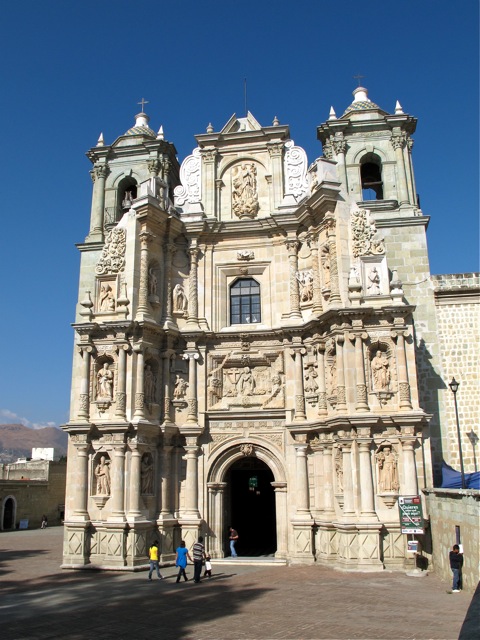
She resides in the church dedicated to her, the Basílica de Nuestra Señora de la Soledad.  Construction began in 1682, it was designed by Father Fernando Méndez, sanctioned by the Viceroy Tomas Aquino Manrique de la Cerda, and consecrated in 1690 by Bishop Isidro Siraña y Cuenca.  The current baroque style facade was built between 1717-1719 and is unusual because it faces east (Photos are best in the AM).  It was built with the green cantera and a pinkish stone, used in the facade.  If one looks carefully, several ways in which the indigenous masons and carpenters introduced their own “pagan” symbology and pantheon into the wood and stone are in evidence.

Facade of the Basílica de Nuestra Señora de la Soledad

East facing facade

It was intentionally built with low spires and towers, to better withstand earthquakes.  The atrial courtyard is enclosed and fitted with two simple access portals, one facing south, and the other east. The latter leads to the Socrates Garden (currently undergoing a major renovation) and the Plaza de la Danza.

References:

Read Full Post »

December seems to be quite a month for the Virgins of Oaxaca.

December 8, I was awakened by cohetes (rockets… all bang, no bling) at 4:45 AM.  They continued sporadically until about an hour later, when wildly clanging church bells heralded a non-stop barrage of more cohetes for several minutes… they eventually faded away, but a banda was heard in the distance.

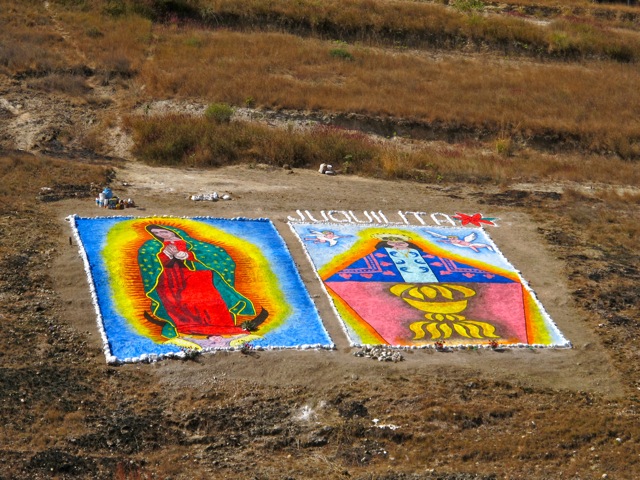
It was the feast day of the Virgin of Juquila (La Virgen de Juquila), one of Oaxaca’s own.  According to legend, in 1633, when a fire burned the small Chatino village of Amialtepec to the ground, a small statue of the Virgin Mary was rescued amidst the ashes. It was a miracle; she was undamaged, save for her light skin color, which was permanently darkened by the smoke… causing her to look more like the Chatino people, who revered her.

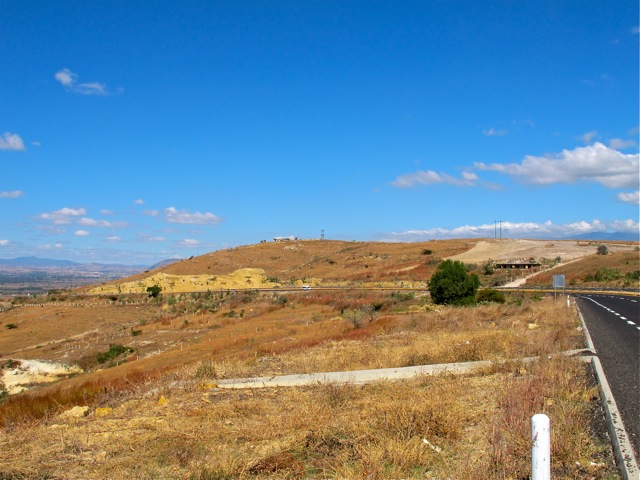
Here she is, in a field alongside La Virgen de Guadalupe, almost at the crest of the new carretera between Oaxaca and San Martín Tilcajete.

Brown fields next to highway at crest of hill

La Virgen de Guadalupe on the left and La Virgen de Juquila on the right.

Sand paintings of the Virgin of Guadalupe and the Virgin of Juquila on a mountainside.

The Virgin of Guadalupe had her day only four days later, on December 12.  La Virgen de Guadalupe is known as the Queen of Mexico and Empress of America, and is the patron saint of México.  Reports estimate that 5.8 million of the faithful made the pilgrimage this year to Basilica of Our Lady of Guadalupe in Mexico City to honor the dark-skinned virgin who appeared to Indian peasant Juan Diego on Dec. 12, 1531 near what is now Mexico City.

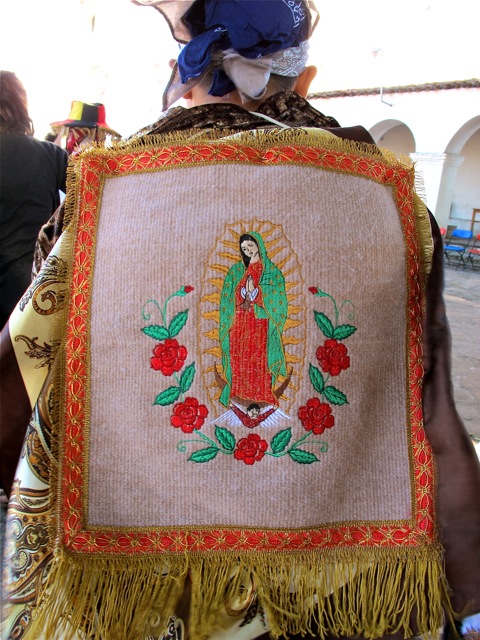
In Oaxaca, worshipers flocked to the Chapel of Guadalupe at the north end of Llano Park and a carnival filled the park for all the little Juan Diegos and girls in period costume to be entertained.  However, I headed out to Teotitlán del Valle to see this Zapotec village honor La Virgen de Guadalupe with their traditional Danza de la Pluma.  Several of the Danzantes (dancers) were wearing capes woven and embroidered especially for this day…

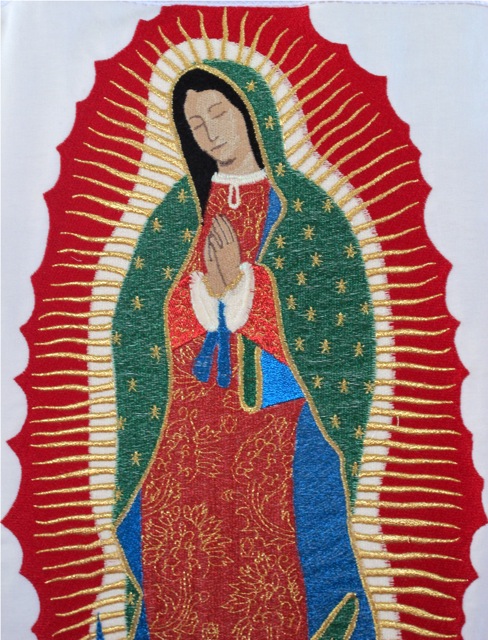
Virgin of Guadalupe embroidered on the back of the cape of a Danzante.

The weaving and embroidery were spectacular!

Closeup of the Virgin of Guadalupe on the back of Moctezuma's cape.

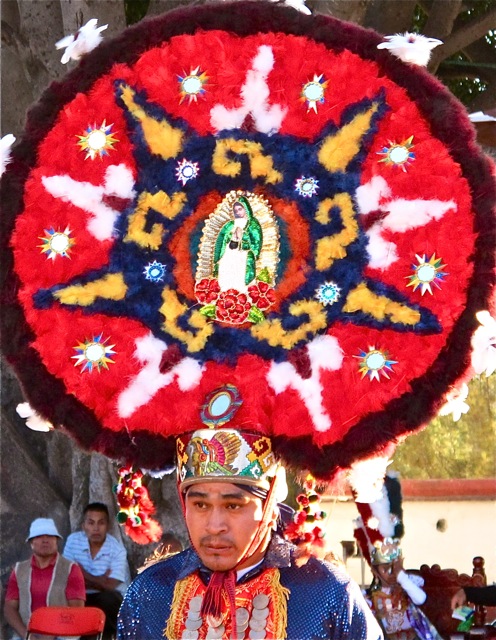
And, at least one of the Danzantes had an image of the Virgin of Guadalupe in the middle of his corona (feathered headdress).

Feathered headdress with image of the Virgin of Guadalupe  in the center.

Malinche and Doña Marina also had similar images on the skirts of their dresses.  To see those and several other photos of the dancers, you should take a look at what Chris has posted at, Oaxaca-The Year After.

Next on the “Virgin” calendar is December 18, the feast day of La Virgen de la Soledad (the Virgin of Solitude), Oaxaca’s patron saint.  Stay tuned…

Read Full Post »

…warms the night and the heart.

After a week (plus) of temps that dropped into the high 30s/low 40s during the night (Brrrr… central heating, what’s that?), sun, clear blue sky, and mild evening temperatures have returned.  It’s perfect weather for strolling around la ciudad, wandering in and out of artesania shops, doing a little stress-free Christmas shopping, and pausing every once in a while to absorb the scene.

This slideshow requires JavaScript.

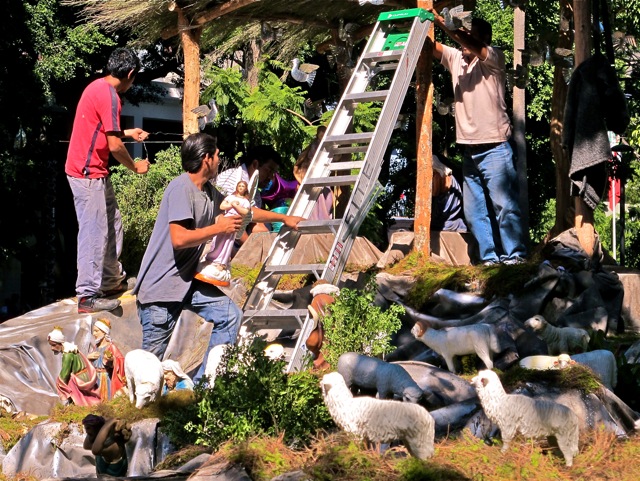
You might have noticed, the angel from Friday’s post successfully ascended the ladder and now graces the top of the stable.  And, along with bells and Rudolph, a Star of David hangs on the side of a building.  Interesting… this is the first time I’ve seen it as part of holiday decorations.  By the way, there are no synagogues in Oaxaca.

Read Full Post »

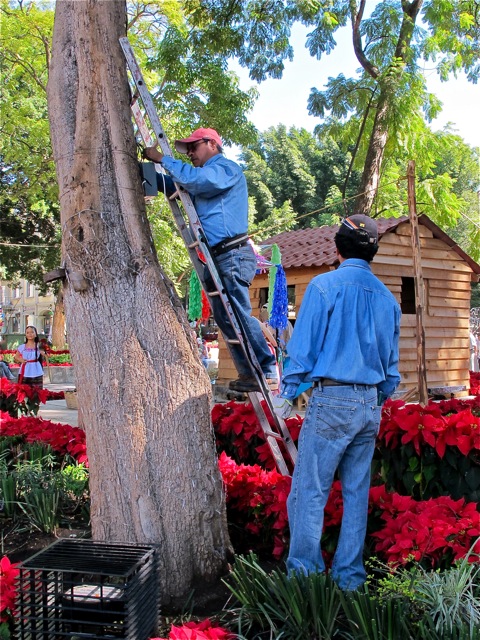
Oaxaca is gearing up for Christmas.  Thankfully, it is not (yet) as hectic and commercial as in el norte.  Though decorations have been been displayed, front and center, in my local Soriana super-mercado for at least a month, it is only in the last few days that the city’s electricians have been positioning lights on the trees around the zócalo…

Electrician positioning light on tree

to  illuminate the welcoming niño.

Mannequin of boy in sombrero and sarape

Lambs have begun appearing…

Long white-haired mannequin carrying lamb.

Angels are being elevated…

Workman about to carry an angel mannequin up a ladder.

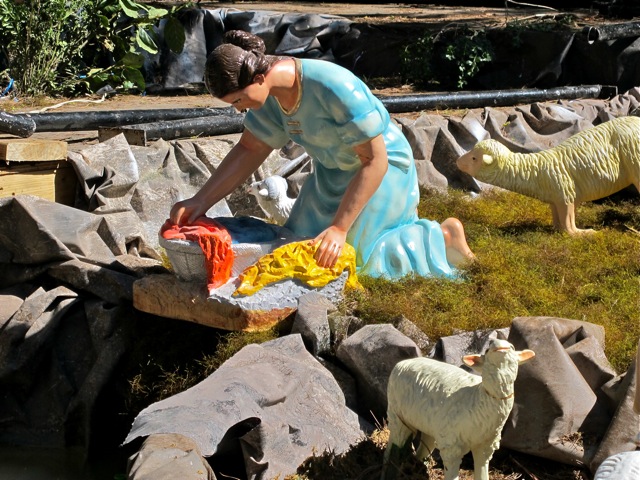
Clothing is laundered in preparation for Navidad…

Female mannequin washing clothes as mannequins of lambs watch.

And, thousands of poinsettias have been brought in to add splashes of color to the beds beneath the 130+ year old Indian laurels.

Flower bed of poinsettias under Indian laurel tree.

It’s beginning to look a lot like Christmas!

Read Full Post »

As promised…

And, there is SO much more!!!

Read Full Post »

… in all manner of ways; there’s a lot of that here.  Successful meetings between old and new are a matter of debate.  The newly renovated Centro Académico y Cultural San Pablo is no exception.  It was acquired, designed by architect Mauricio Rocha, renovated, and repurposed by the Alfredo Harp Helú Foundation.

Located in the heart of the historic district, between the Museo Textil and the Teatro Macedonio Alcalá, this former Dominican convent, originally established in 1529, has been one of those ubiquitous crumbling and peligrosos buildings for a long time.  In addition, to the features of the original cloister, archeological remains from 2,500 years ago were uncovered and have been preserved.

This slideshow requires JavaScript.

The buildings will house a research center (including a library), dedicated to the study of the languages and cultures of the indigenous of Oaxaca, serve as a venue for cultural presentations, and provide exhibit space for the philanthropic endeavors of the Alfredo Harp Helú Foundation, which (among several others) includes the Textile Museum, Museum of Philately (stamps), Institute of Oaxacan Historic , and Children’s Library.

The grand opening, with all the requisite fanfare and dignitaries, was November 26.  Alas, I missed it!  However, the courtyard provided the setting for several performances during the Instrumenta Oaxaca 2011, a 2-week long chamber music festival that ran from November 3rd to the 18th; two of which I attended.  I was dazzled by the setting (and the acoustics weren’t bad, either) and was especially gratified that the library, which the seating faced, presented a prominent and dramatic architectural feature.

Written on the wall of the building housing a small collection from the BS: Biblioteca Infantil (Children’s Library), a quote from Dostoyevsky (of all people):  Los libros son mi aliento, mi vida y mi futuro.  In English:  Books are my breath, my life and my future.

For more (in English) about the Centro Académico y Cultural San Pablo, see Norma Hawthorne’s article, Oaxaca Center Promotes Indigenous Language and Culture, Opens November 26, 2011.

Update:  Read how this cultural and historical gem, lost in plain sight.

Read Full Post »

In August 2011, Vive Oaxaca launched a campaign to showcase the best of the state through a series of video shorts.  Two have already been released online:

Esto es Zaachila

and, Esto es Guelaguetza

I’m looking forward to Monday night’s online release of, Esto es Oaxaca de Juárez.  I guess you know what my Tuesday morning blog post will be!

Read Full Post »

… equals public art on Calzada Niños Héroes de Chapultepec, a section of the legendary Pan-American Highway in Oaxaca’s capital city.

On October 27, 2011, representatives from the groups Espantapájaros, Asaro, Bouler, Viyegax, Arte Jaguar, Lapiztola, and Uriel Marín set to work transforming a long drab wall into a work of art representing the social, cultural, and political life of Oaxaca and Mexico.  The wall of graffiti was part of the Puntos de Encuentro, Primer Festival de Artes Visuales Oaxaca 2011, previously mentioned in my mid-October blog post, Meeting Points….

This slideshow requires JavaScript.

As of a few days ago, the artwork remains to catch the eye of drivers (yikes!), passengers, and pedestrians.

Read Full Post »