Save for yesterday’s 5:00 AM jarring explosion of cohetes (rockets — all bang, no bling) and clanging church bells coming from the Basílica de Nuestra Señora de la Soledad heralding the start of the celebrations for the Virgen de Juquila, the last thirty-two hours have been mostly muted, with only the occasional chiming bells and bursting cohetes — very quiet by Oaxaca standards.
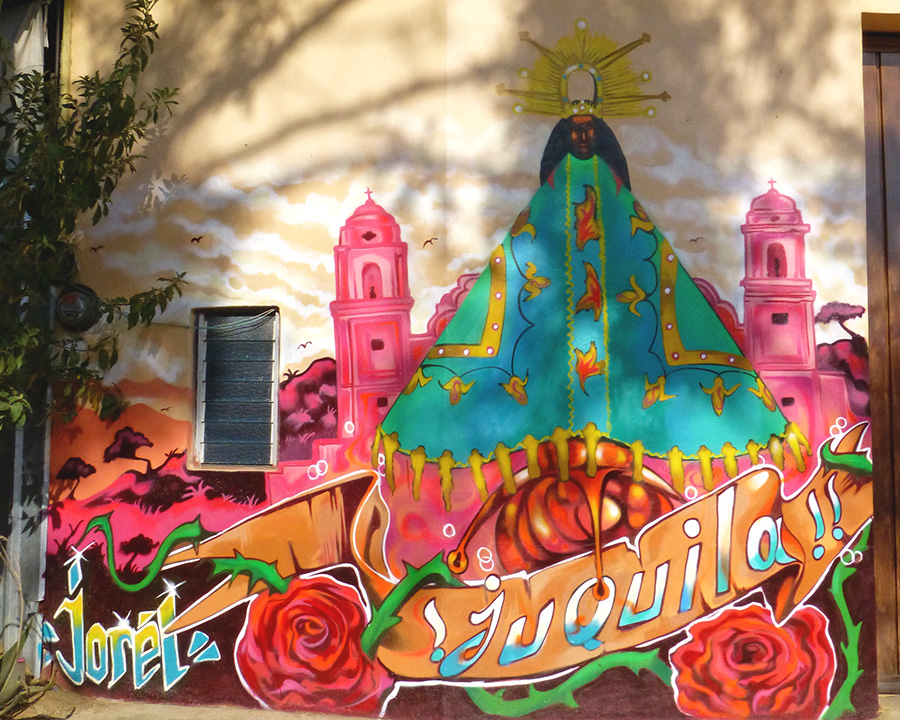
Virgen de Juquila mural in Santa Cruz Xoxocotlán, Oaxaca — seen in 2013.
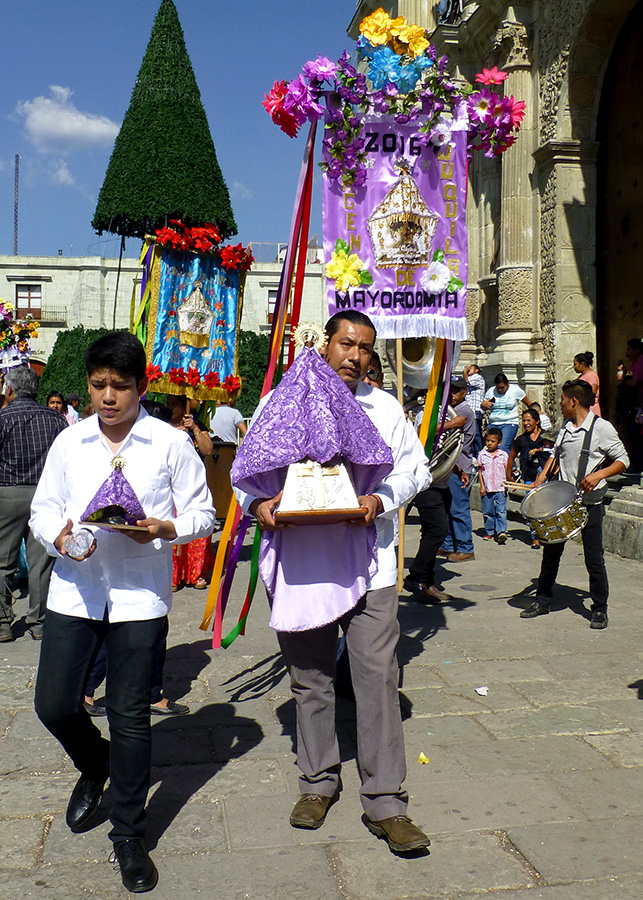
Procession honoring the Virgen de Juquila in front of the Cathedral in Oaxaca city — seen December 8, 2018.
Parish of Santo Tomás Xochimilco chapel to the Virgen de Juquila in Oaxaca city closed, by order dated March 17, 2020, to prevent the spread of Covid-19 — seen May 24, 2020.
Due to Covid-19 concerns, in consultation with Oaxaca’s health department, the archbishop of Oaxaca cancelled holy processions through the streets and called upon the faithful to forego pilgrimmages. This is especially sad for Santa Catarina Juquila, where Juquila’s shrine is located, as just last week it was announced the town had been designated a Mexican Pueblo Mágico. The archbishop also ordered churches closed, with masses to be celebrated and broadcast from behind locked doors during December’s festivities honoring the Virgen de Juquila (December 8), the Virgen de Guadalupe (December 12), and the Virgen de La Soledad (December 18).
Now if only other people and places would take this pandemic as seriously.
What an unusual yet lovely (and delicious) Thanksgiving 2020 was.
Cranberry/pear relish bubbling on the stove.
After the fact, I realized this was only the second Thanksgiving I’ve shared with just one other person. Childhood dinners were filled with parents, grandparents, aunts, uncles, and cousins. Even the Thanksgiving I spent in Denmark, the international school I attended prepared a turkey with all the fixin’s dinner — to the delight of the American students and curiosity of the other international students and Danes. Once married, we hosted or joined family and/or friends — and that has been my tradition ever since, even here in Oaxaca.
Sage dressing with whole wheat bread, celery, onions, and carrots.
Keeping Covid-19 protocols in mind, Kalisa, my (now famous) friend, neighbor, and cocinera extraordinaire and I decided we would persevere in an attempt to carry on with an albeit downsized celebration of just the two of us on my terrace. For the main course, we ruled out turkey, discarded chicken as not special, and settled on repeating the success of rabbit — concluding it would go well with my cranberry/pear relish and sage dressing. And, who knows? The indigenous peoples may have proffered rabbit to the starving and clueless foreigners.
Roast rabbit à la Kalisa.
So, we made our own pilgrimage up to Pochote Mercado Orgánico in Colonia Reforma to again purchase the criollo rabbit Kalisa would be preparing. A couple of days later, at Mercado IV Centenario, we happened upon camotes/sweet potatoes to be used for her “pumpkin” cheesecake. Unlike my first several Thanksgivings here, when bags of fresh cranberries could only be found at Mercado Hidalgo, I was able to purchase all the ingredients for my cranberry/pear relish at Mercado Benito Juárez. As for the dressing, I still had some Bell’s Seasoning brought from the USA a couple of years ago, and the rest was easily found. Looking at our menu, it occurred to me that perhaps we needed something green. That was easily solved with some baby lettuce from my garden (alas, no photo).
Pumpkin cheesecake with caramel topping.
And so it was, a Thanksgiving where two friends gave thanks for our very present blessings — friendship, health, abundance, and being welcomed into the beautiful and loving arms of Oaxaca.
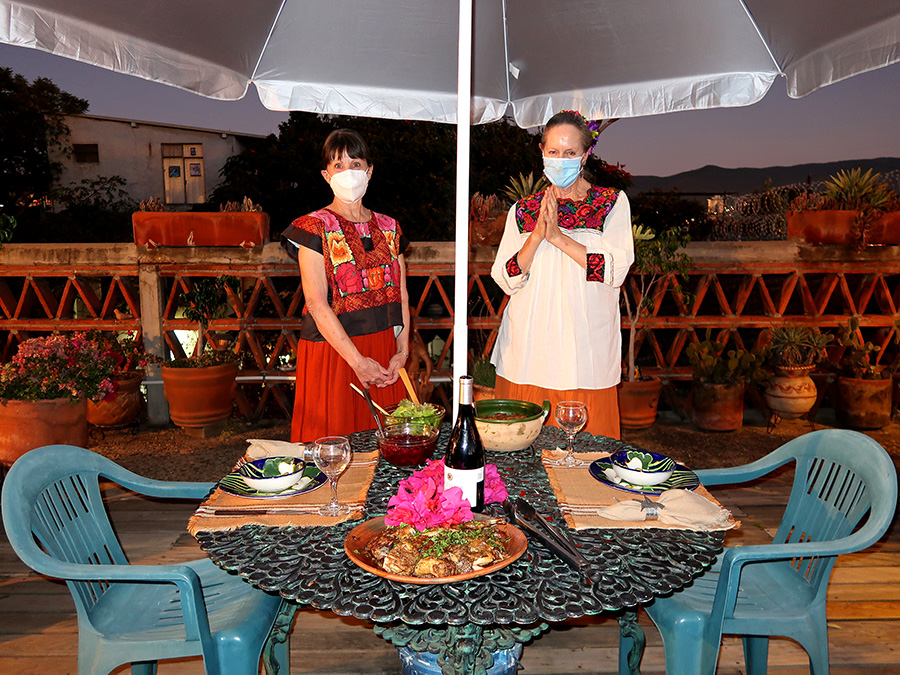
Two friends giving thanks on a rooftop terrace in Oaxaca.
By the way, the place settings were for photo-op purposes only. We retired with filled plates and glasses of wine to the south end of the terrace where we could sit and eat 8 feet apart.
These are strange days leading up to our departed coming to call while we are living in the time of Covid-19. With public activities canceled, thus no nightly calendas (parades) filling the streets and our ears, and fewer tourists, Oaxaca is experiencing more peace and tranquility this Day of the Dead season — albeit laced with a touch of melancholy and anxiety.
Masked and shielded, I braved the mostly local crowds south of the zócalo, to shop for cempasuchil (marigolds), cresta de gallo (cockscomb), apples, mandarin oranges, peanuts and pecans, chocolate, and pan de muertos (Day of the Dead bread) — but it wasn’t nearly as much fun as years past.
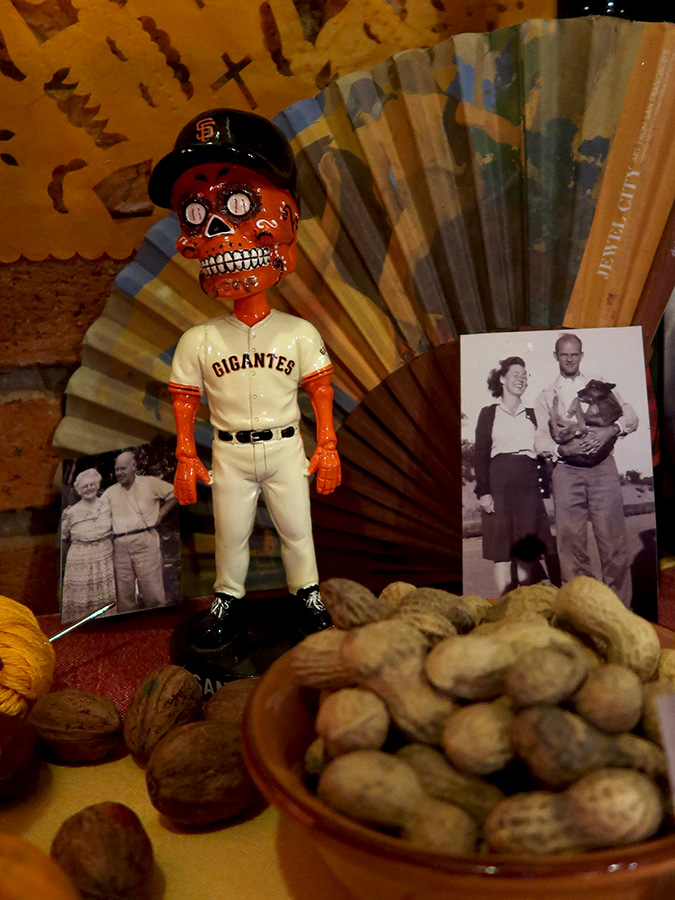
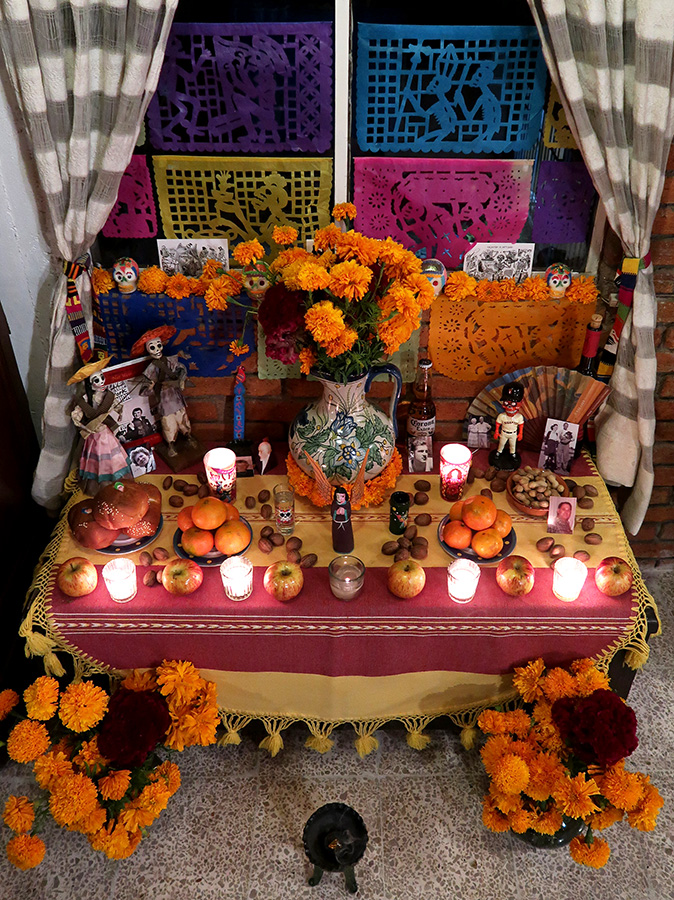
However, the joy returned when I unwrapped photographs of my parents, grandparents, and other loved ones; selected some of their favorite things to put on my ofrenda; placed the fruit, nuts, bread, and chocolate among the photos; positioned candles, flowers, and incense; and poured my departed a copita (little cup) of water and another of mezcal — all to beckon, entertain, and sustain them during their brief stay.
I’m looking forward to a more personal and reflective Día de Muertos this year.
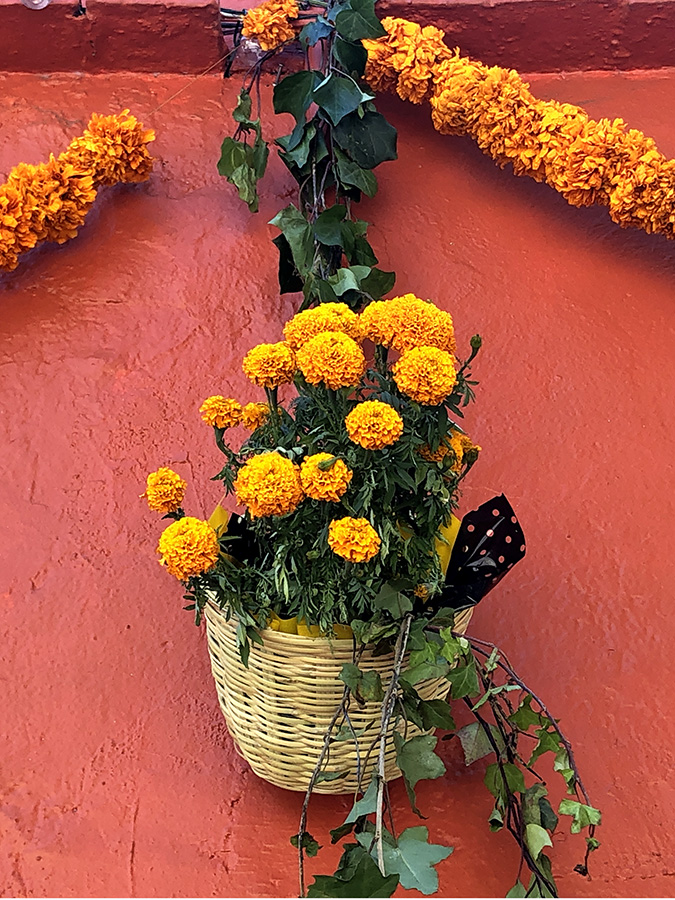
Cempasúchil (marigolds), the flowers synonymous with Day of the Dead, have begun appearing throughout the city. Alas, not in the quantity we are used to.
As I have written previously, because of the acceleration of the Covid-19 cases, the City of Oaxaca will not permit public Day of the Dead celebrations and events.
So it’s a subdued Día de Muertos season we are living.
While the yellows and oranges of the marigolds seem to mirror the semáforo amarillo and naranja (yellow and orange Covid-19 traffic lights) we are bouncing between, they brighten the days and impart a familiar and welcome scent.
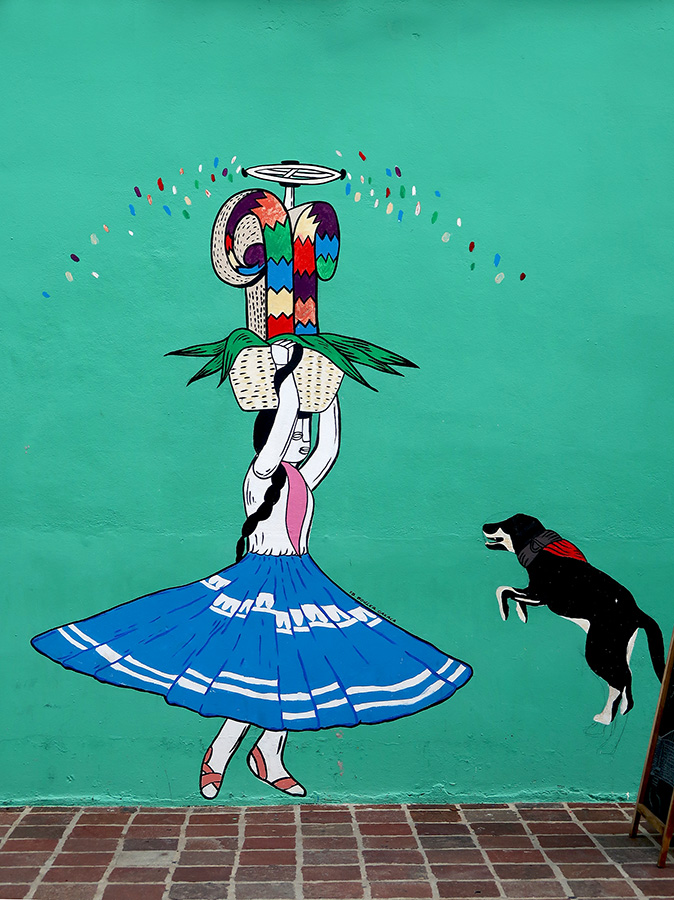
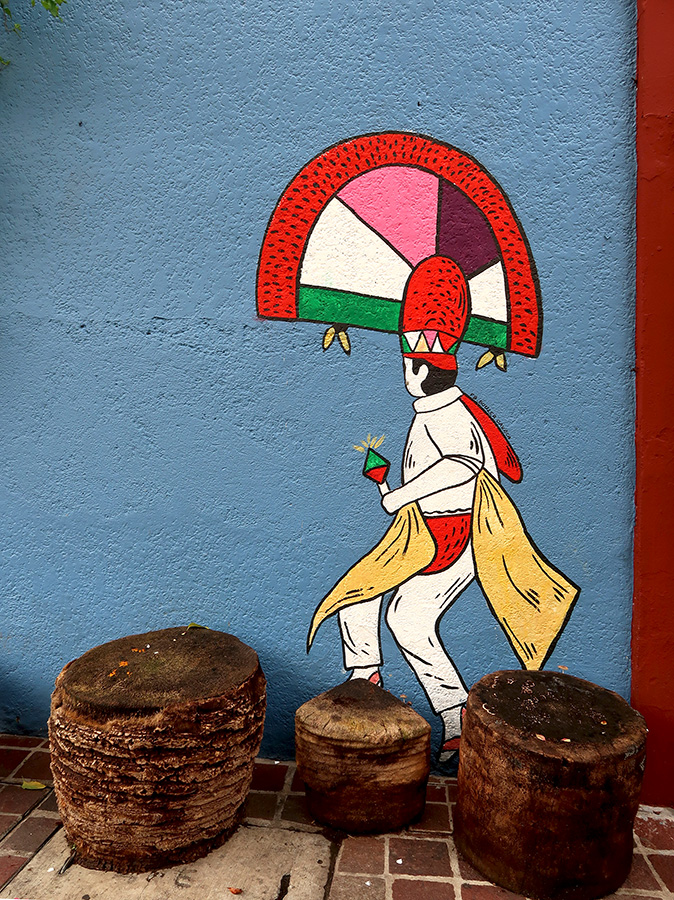
Oaxaca de Juárez, China Oaxaqueña dancer and Mazapán, the dancing dog.Huautla de Jiménez dancer.Danza de la Pluma dancer from Oaxaca’s central valley.
Living vicariously in these days of COVID-19 — be it through books, online concerts and museum tours, video events, and photos of people and places we are longing to see.
To borrow a line from Cole Porter, Oaxaca regrets there will be no Muertos this year, señora.
Due to a rebound in positive Covid-19 cases in both the capital and state (we are back in traffic lightorange — with red threatening), yesterday the city council of Oaxaca unanimously voted to cancel all Day of the Dead activities (NVI Noticias). That means there will be no comparsas (parades), altar displays, sand paintings, costume contests, and no cemetery visits. Other municipalities are expected to follow suit. If you have plans to be here for Día de Muertos, I strongly urge you to reconsider.
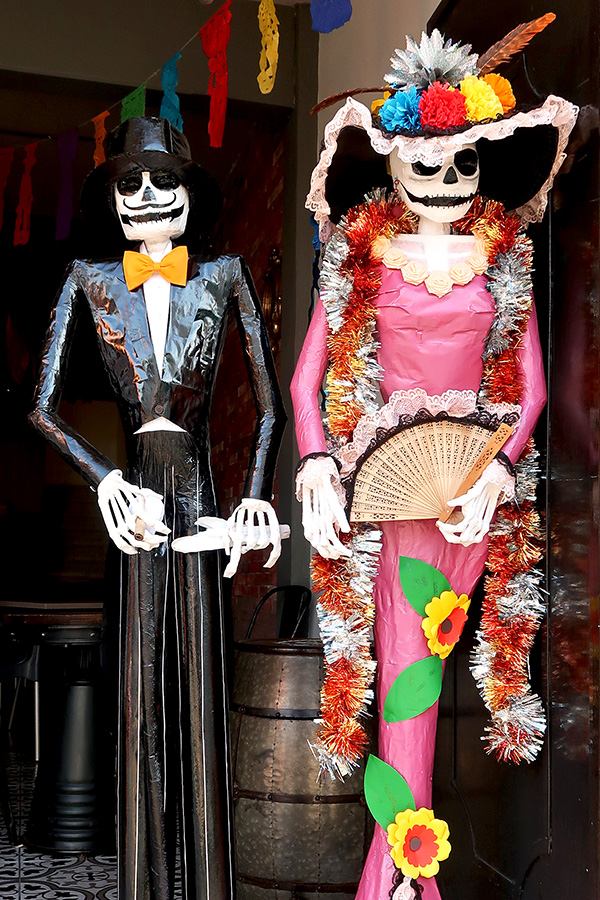
Given this sad and sobering news and the above Catrín and Catrina seen on this morning’s walk, I keep flashing on the Cole Porter song, Miss Otis Regrets — especially this dirge-like version by Kristy MacColl.
This is serious and no time to let your guard down. Please practice social distancing, wash your hands frequently, and for goodness sake, cover your mouth AND nose with a mask when out in public!!!
Last week, after seven months of Casita Colibrí being a visitor free zone, friends from California came to dine. Socially distanced seating was set up at the south end of the terrace.
The counter at the north end of the terraced was used as the staging area for food and drink.
We took turns selecting the fabulous fare prepared by my previously mentioned friend and neighbor, Kalisa.
Blue corn tortillas, guacamole, cucumber, and salsas to start.Huitlacoche quesadillas.Poblano chile strips with goat cheese.Chicken wings.
Masks stayed on, except when eating, and early evening quickly turned into night as we talked and laughed and enjoyed each other’s company. It had been so long!
Kalisa, the visiting couple, and I had so much fun, we did it again two nights later. And, yes, there was mezcal both nights!
While flags are flying, bunting is up, and carts are selling the usual green, white, and red patriotic paraphernalia, it’s not your usual Mexican Independence celebrations.
It is the night before Independence Day, but there are no crowds gathered in the zócalo to hear the governor re-create the Grito de Dolores from the balcony of the Government Palace. Tomorrow there will be no patriotic parade through the streets of the city of Oaxaca. Mexican Independence celebrations during the time of Covid-19.
However, there is a song from Lila Downs…
(ps) The flags above are flying at half staff because the photos were taken on September 13, 2020, the day Mexico commemorates the legend of the 1847 Niños Héroes — boy cadets martyred during the Mexican-American war.
Semáforo amarillo (yellow traffic light), we hardly knew ya. According to this article, due to the resistance and indiscipline of the citizens to maintain prevention measures, as of Monday, September 14, Oaxaca is back in the Covid-19 semáforo naranja (orange traffic light) — meaning a high risk of contagion. Alas, this does not come as a surprise.
As previously mentioned, the semáforo designation is based on ten criteria by the federal government. However, it’s my understanding the implementation is left up to states and municipalities, which means concrete answers as to what this entails is fuzzy — to say the least! Color me orange with big eyes and clenched teeth.
Beginning tomorrow, Oaxaca’s Covid-19 status moves down to Semáforo Amarillo (yellow traffic light) — meaning that in the state of Oaxaca one is now at medium risk for contracting the virus. The methodology used by the federal government to go from one color traffic light to another has expanded and is now based on criteria having to do with case numbers, reproduction rates, percentage of positivity, hospitalizations, hospital occupancy rates, and mortality percentage per 100,000 people. However, judging from comments on the Facebook page of the Servicios de Salud de Oaxaca (Oaxaca Health Services), it’s a controversial move (my translation):
With so much infected and now we are going to yellow traffic light?
They are not real figures, many towns do not appear [on the case list] even though there are new cases.
Covid is still active, the only thing that changed is that they gave you permission to go out and look for it.
It makes a whole economic political show without caring about the health of the Oaxaqueños.
According to the government’s corona virus website, yellow means all work activities are allowed and public spaces can be open — albeit all activities must continue to be carried out with basic preventive measures (masks, hand hygiene, social distancing) and consideration for people at higher risk. However, it won’t mean the reopening of schools; that has to wait for the green light.
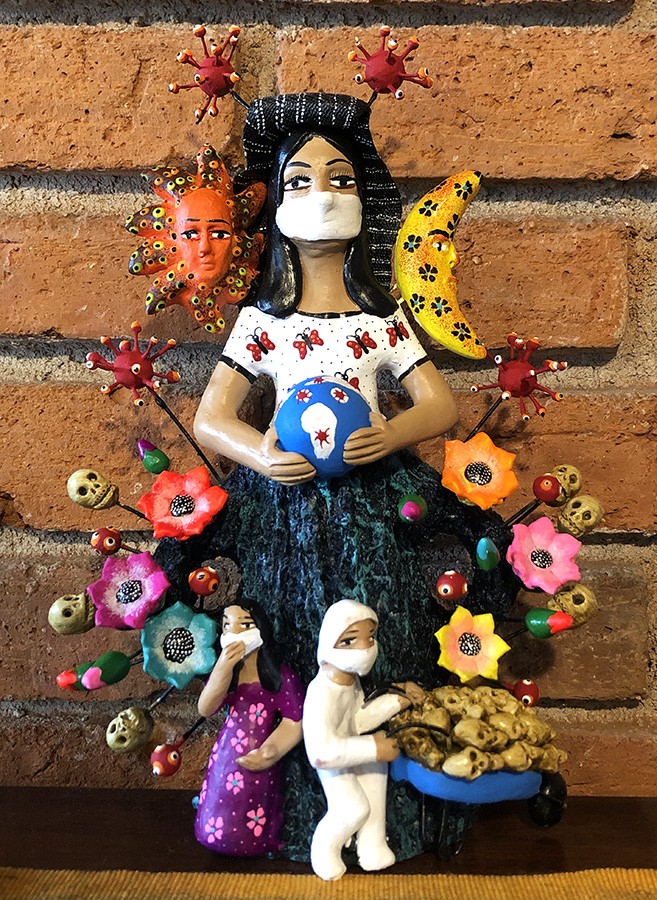
In the meantime, I am thrilled with my new Covid-19 themed clay sculpture by Concepción Aguilar, a member of the iconic Aguilar family of potters from Ocotlán de Morelos. It was a “thank you gift” from the Support for the Folk Artists of Oaxaca, Mexico fundraising effort. The artisans are an integral part of the specialness of Oaxaca. Make a contribution, if you can!
If you are out, about, and going to the mercados in Oaxaca in the last couple of months, you may have seen a clever contraption like the one below set up outside the Independencia entrance to Mercado IV Centenario. Where did they come from? Who made them? And, why? After a little research, I discovered this is a project of La Cosa Buena, “a social enterprise and nonprofit empowering Zapotec and Mixtec communities in Oaxaca to preserve their storied artistic traditions through social initiatives and equitable cultural exchange.”
Manos Buenas COVID-19 is a project that is supplying hand washing stations throughout the state of Oaxaca. Why? Because 30% of Mexico’s population lives without potable water — and that makes the frequent hand washing necessary to help prevent the spread of the virus extremely problematic. Not to mention, according to the project’s website…
“Indigenous communities are nearly three times as likely to be living in extreme poverty and are more likely to suffer negative outcomes from infectious diseases. Many Indigenous communities in Oaxaca are already impacted by malnutrition, pre-existing conditions, and lack access to quality healthcare.
We work with several Indigenous artisan communities in rural parts of Oaxaca. We are actively helping our community during this crisis by building and distributing Hand Washing Stations.
Requiring only wood, rope, soap, and a container of water, they are inexpensive and easy to build. The icing on the cake is the involvement of local artists to bring an artistic aesthetic to these utilitarian and necessary structures. The one below is at La Cosecha and is decorated by one of my favorite arts collective, Tlacolulokos.
And there is more! In addition to the building and distribution of the hand washing stations, the Manos Buenas project is developing graphic and multilingual public health campaigns to insure information and resources re Covid-19 are available in the many languages of Oaxaca’s indigenous communities.
Back in April, I received a message from my hometown library with the request, Help us tell the story of what happened during the COVID-19 pandemic in Mill Valley. A light bulb turned on, my brain went into librarian/archivist mode, and I thought, we should do that here in Oaxaca. What better way to bring the Oaxaca Lending Library community, both here in Oaxaca and those currently scattered around the world, together and provide a venue to share thoughts and feelings, document daily life, and unleash creativity. And, when this nightmare is over, the OLL will have joined an international effort by public and academic libraries, archives, historical societies, and museums to preserve slices of life from this historic time for future community members and researchers to ponder.
Thus, we formed a small committee, met remotely, and issued our own call for submissions. Members and friends, be they here or there, have been asked to submit photographs, stories in prose or verse, and videos. The response has been beyond my wildest dreams and I invite you to view the most recent edition of Archiving the Pandemic in Oaxaca: How will this time be remembered? The contributions are revealing in a variety of happy, sad, challenging, generous, and talented ways.
July 30, 2020 – Calle de Adolfo Gurrión at 5 de mayo, Oaxaca de Juárez.
The project is ongoing; alas, the pandemic’s end is not in sight. However, my heart is lifted in seeing, reading, and sharing experiences with my Oaxaca Lending Library community and knowing we are part of an international effort to help shape the telling of a community story.
(ps) The QR codes on the image above link to the following articles exposing issues medical personnel are facing battling the virus in Oaxaca:
After only two weeks of semáforo naranja (orange traffic light), as of yesterday, the federal government ordered the State of Oaxaca back to semáforo rojo (red traffic light) in the ongoing battle with Covid–19.
To tell the truth, the move to orange had many of us scratching our heads. Closely following the data released by the state health department, we wondered if Oaxaca really was experiencing a downward trend in the four metrics used to move from one traffic light to another: numbers of new cases, hospital occupancy trends, current hospital occupancy, and percentage of positive cases.
As for cubrebocas — a misnomer, if there ever was one for reasons to follow: Sunday’s stroll about town revealed 15% of people not wearing masks; 50% wearing them correctly; 35% wearing the “cubreboca” ONLY over their mouth, just like the name implies. In Cuba they are called “nasobuco,” indicating they need to cover both nose and mouth — a much better name, methinks!
By the way, according to Richard Grabman over at The Mex Files, “85% of Mexicans are wearing masks in public, compared to 67% of people in the US.”
Up until last week, under semáforo rojo (red stoplight), dining at Oaxaca’s much celebrated restaurants had been prohibited and food-to-go became a new and popular option. The Facebook group, Taste Of Oaxaca! soon was filled with restaurant takeout and/or delivery menu options. It was really quite wonderful to see how creative restaurants and chefs became in trying to maintain their businesses, keep staff employed, and meet the needs of their clientele. However, I was blessed with an alternative — mi amiga y vecina (my friend and neighbor), Kalisa, whose passion is cooking and sharing her flavorful fare.
Roast chicken with saffron rice
Homemade pizza with chorizo, cheeses, mushrooms, arugula, and more
Pork loin stuffed with prunes, jamón, spinach, and secret herbs and spices
And, leftovers in my freezer
Pork and beans (with the requisite) epazote
Chicken with broccoli, new potatoes, and olives
Grilled Mennonite cheese sandwich with argula and (Boulenc’s) kimchi
Goat cheese lasagne
While living in the age of Covid-19, at least I’ve been eating well — and this is just a small sample! By the way, rumor has it that tonight I will be going up and over the rooftop with my bowl in hand for pozole rojo. Yummm…












 Mexican Peso Converter

 View From Casita Colibrí