To all the loving fathers out there…
This slideshow requires JavaScript.
A very happy Father’s Day!
To all the loving fathers out there…
A very happy Father’s Day!
Posted in Celebrations, Holidays, Travel & Tourism | Tagged Día del Padre, Father's Day, fathers and children, Mexico, Oaxaca, photographs, photos, popular travel destinations | 6 Comments »
True confession: I’m not in Oaxaca! I arrived in the San Francisco Bay Area a week ago for a 3-week visit. While I love seeing family, friends, “my” mountain (Mt. Tamalpais), and the Pacific Ocean, it also means bone-chilling summer fog, driving instead of walking most everywhere, and the absence of my regular blog fodder — no calendas, ferias, festivals, saints days, bandas, and urban art. (Though, I will probably head to San Francisco for the latter!)
However, this break-in-the-action gives me time to look back through thousands of photos and create posts that had been put on the back-burner when something bigger, better, or more timely cropped up.

So, here we go, back to Friday, April 24, 2014 — the last of five days of Carnaval in Teotitlán del Valle.
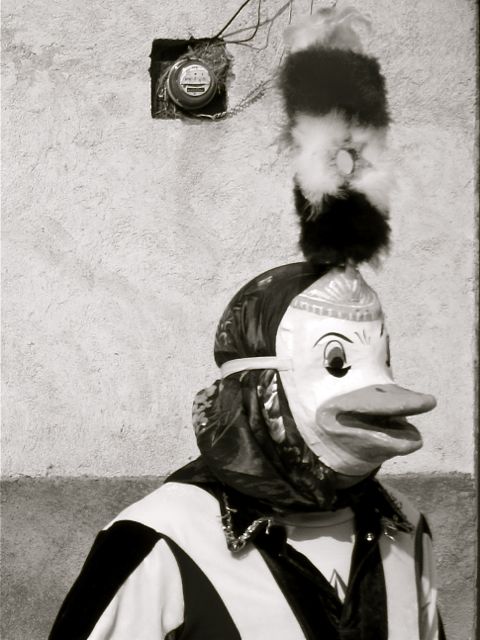
While there are masks, costumes, men dressed as women, and merriment, this is not your Christian pre-Lenten Fat Tuesday/Mardi Gras Carnival.

This is a pre-Hispanic celebration that happens the Monday through Friday after Easter, not before Lent.

Via El Baile de Los Viejitos (the Dance of the Old Men), it brings the community and elected leadership together to remind each of their social contract — in an extremely humorous way.
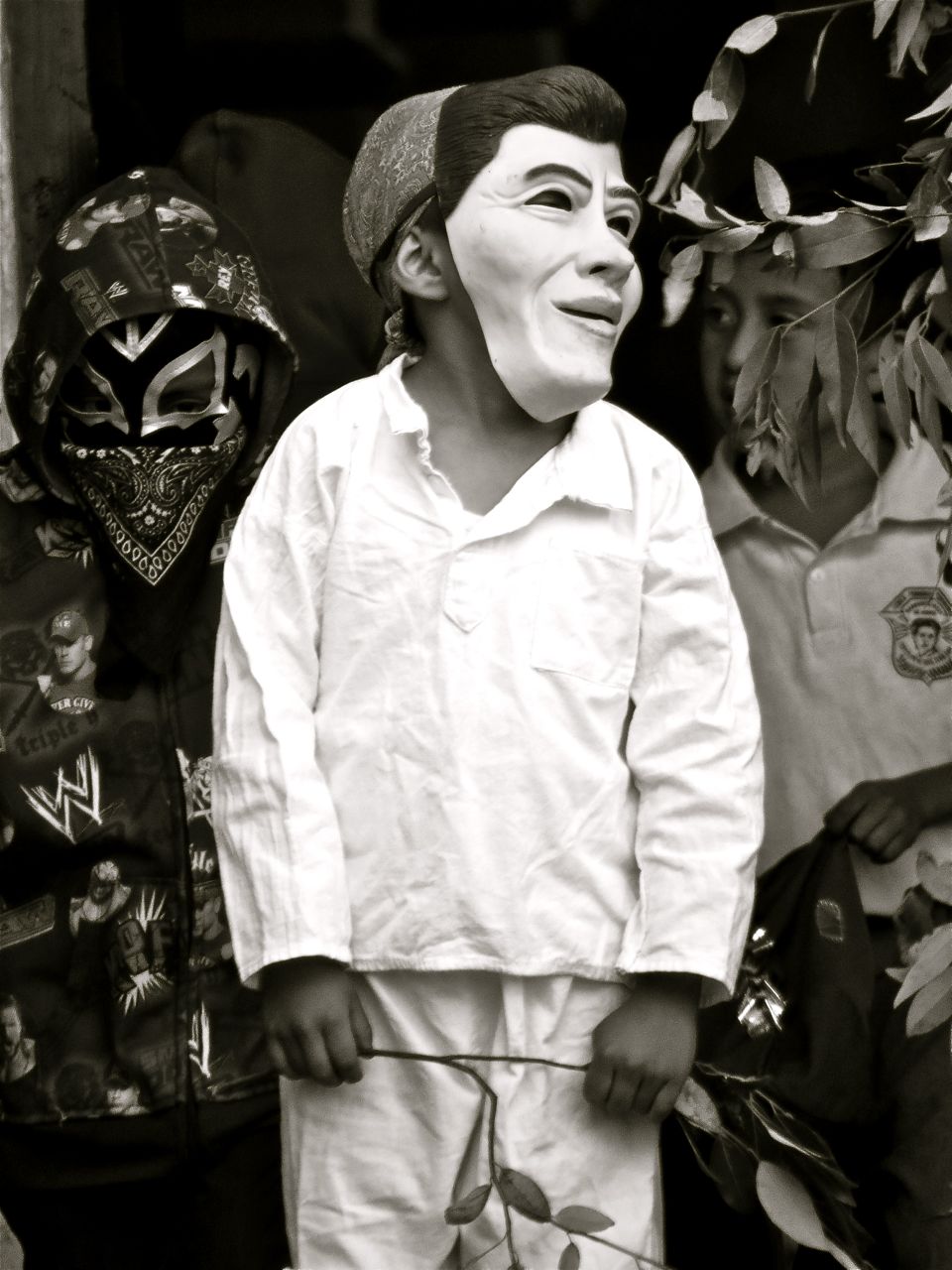
A procession, gathering participants along the way, leads to the Municipal Plaza, where it seems as if the entire village assembles.

And, of course, the dance and ritual continue late into the night…
Posted in Celebrations, Culture, Holidays, Travel & Tourism | Tagged Baile de Los Viejitos, Carnaval, Carnival, Dance of the Old Men, Holy Week, Mexico, Oaxaca, photographs, photos, Semana Santa, Teotitlán del Valle | 3 Comments »
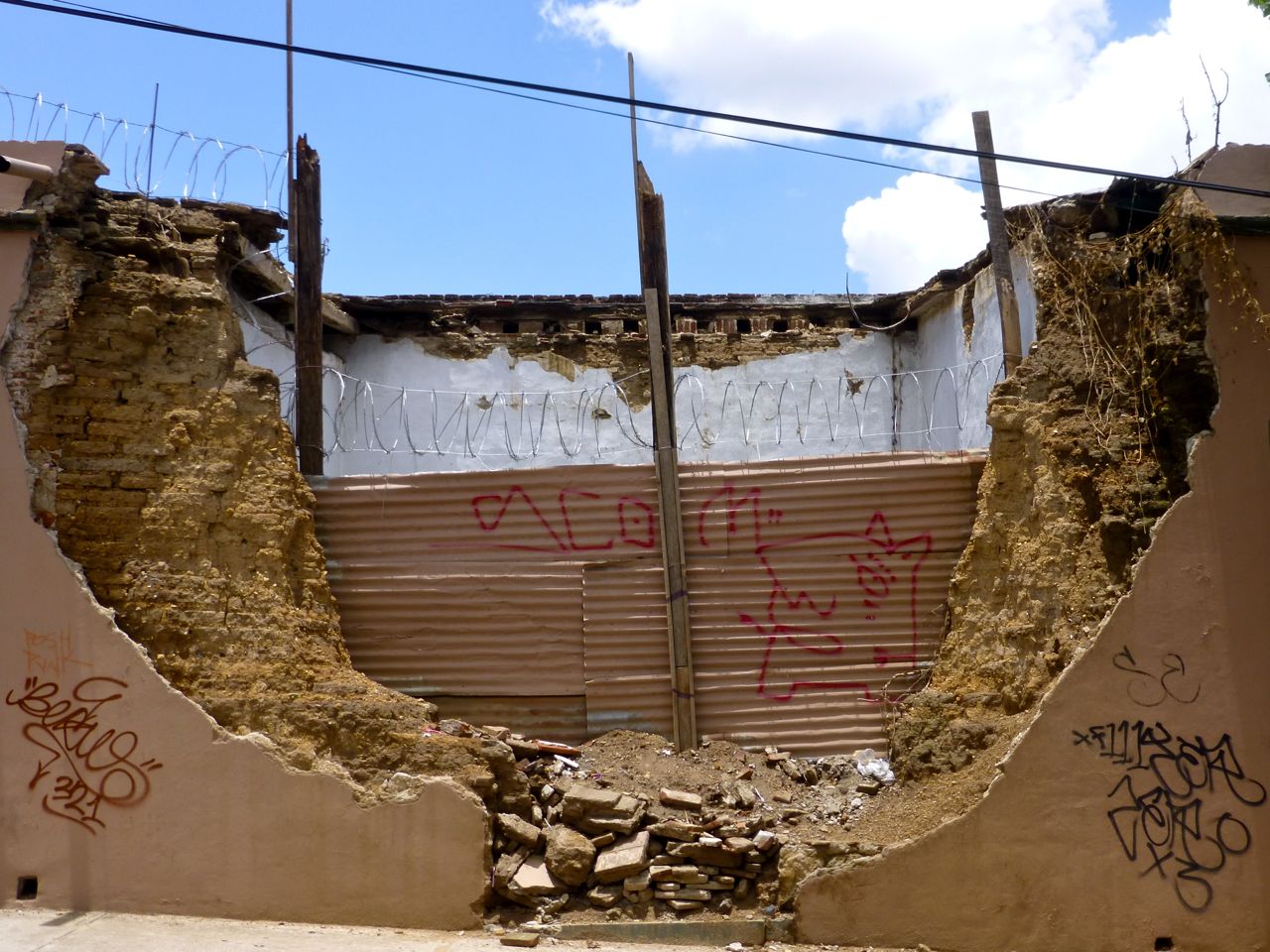
The “buildings in a bad state” in Oaxaca continue to multiply.

Where some see unsightly decay, others see opportunity…

including urban artist, SCOM.
Posted in Buildings, Creativity, Culture, Signs, Travel & Tourism | Tagged abandoned buildings, artists, buildings, dangerous, Mexico, Oaxaca, photographs, photos, popular travel destinations, SCOM, street art, urban art graffiti, wall art | 6 Comments »
Several mornings ago, after a day and night of rain, I went out on the terrace to check on the garden and found…

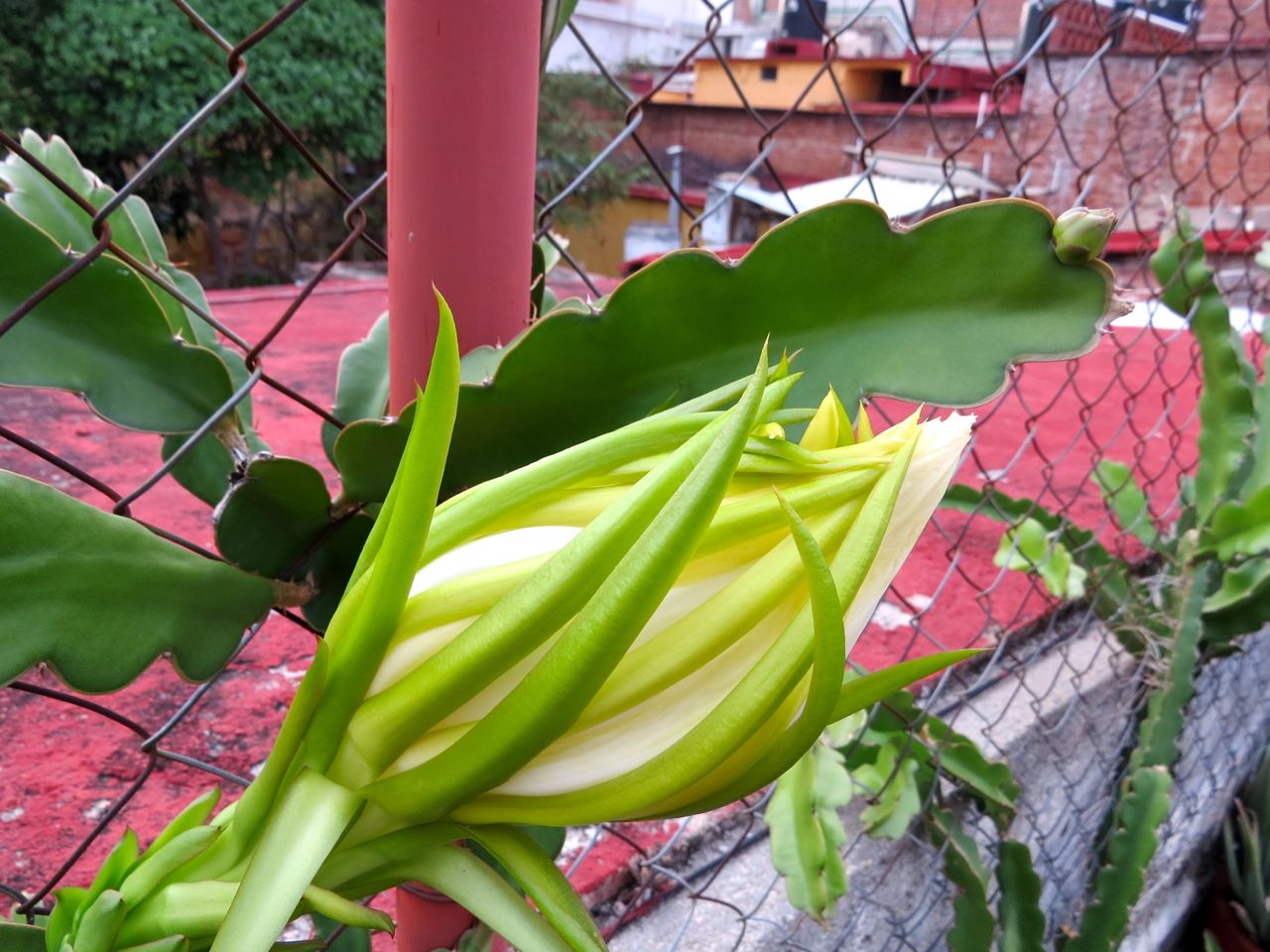
Yikes, one of my Pitahaya (Hylocereus undatus – aka, Dragon fruit) had bloomed overnight! Must be a relative of my other Night Blooming Cereus.
Two years ago, the original cuttings had been laying in the campo of a friend in San Martín Tilcajete. When Chris (Oaxaca-The Year After) asked if we could have some, the answer was, “¡Por supuesto!” Loving the wall of Pitahaya at Centro Académico y Cultural San Pablo, six months later, with the original five cuttings becoming fifteen, I could use them to begin to screen the chain link fence at the new Casita Colibrí. I kept pruning and sticking them in the planter boxes.

June 2, 2014, 8:40 AM
And now, they have begun blooming. Having missed the “night-blooming” of my first flower, I was determined not to miss the unfolding of the second blossom, seen above near the top of the pole, providing the weather cooperated. It did!
June 2, 2014, 7:20 PM

June 2, 2014, 8:40 PM

June 2, 2014, 11:00 PM
By the next day, it had closed, never to reopen again.
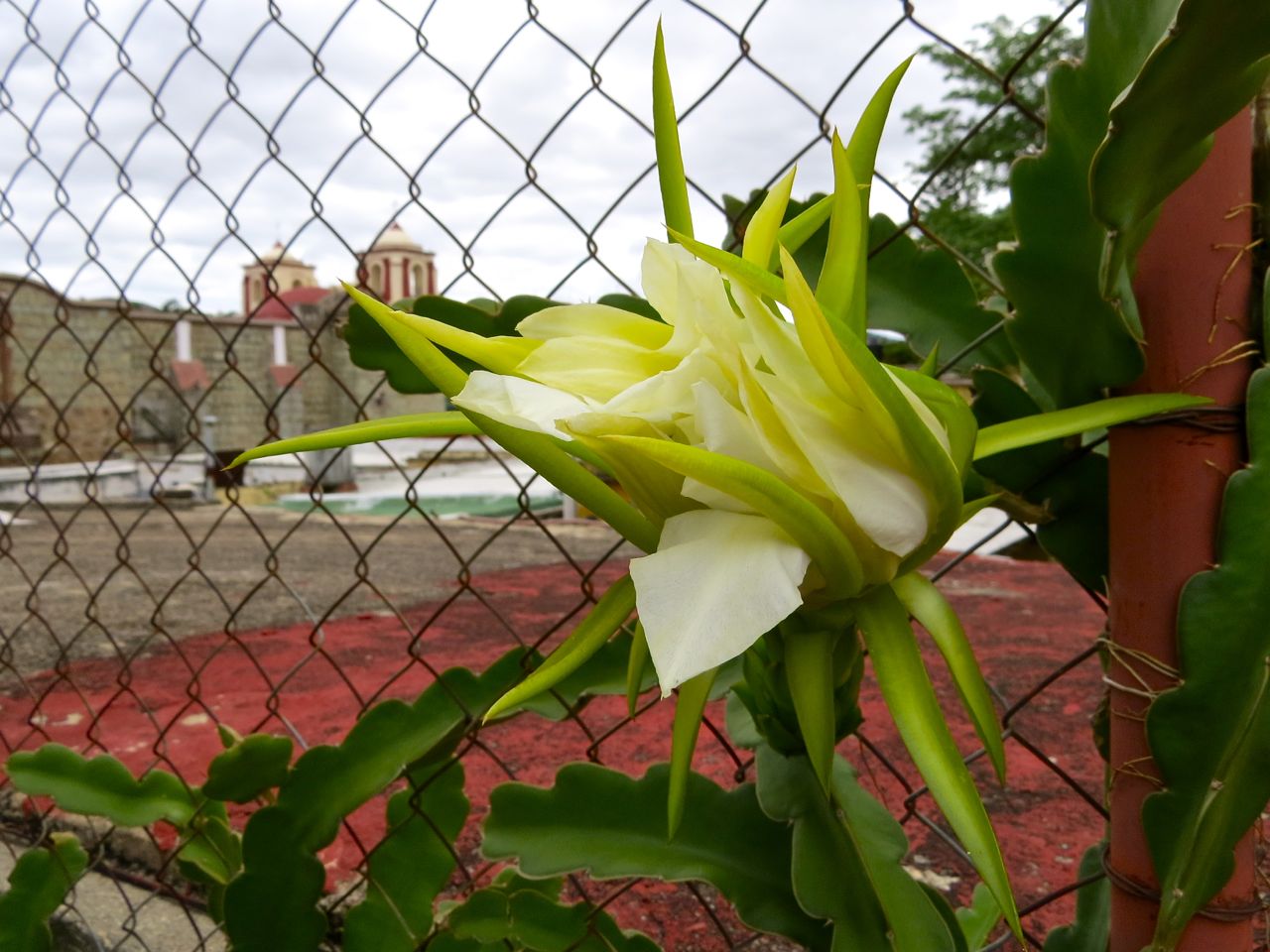
June 2, 2014, 2:54 PM
However, there will be fruit…
Posted in Agriculture, Casita Colibrí, Gardens, Science & Nature, Travel & Tourism | Tagged cactus, Dragon fruit, flowers, garden, Hylocereus undatus, Mexico, Oaxaca, photographs, photos, Pitahaya, succulents | 16 Comments »
The rainy season has definitely arrived in the city, bringing several hours of lluvia every night for the past five nights. The first rains of the season also bring (drum roll, please) chicatanas! Early this morning, I went out onto the terrace with my coffee to be greeted with these not-so-little insects. Flying (into my hair, eeek!) and crawling all over the place!

Female chicatana on a very wet table.
What, you may ask are chicatanas? They are giant flying ants that emerge with the first rains of the season — and by giant, I mean about 4 cm from the head to the tip of the wings for the females. (As in much of the insect world, males are smaller and wingless.)

Male chicatana on the deck.
This occurs early one morning each year and lasts only a few hours. My first experience with them was a couple of years ago, when I arrived at Oaxaca’s airport for my 8:30 AM flight one May morning, to find, yikes(!) an infestation of insects. I had no idea what they were, but nobody seemed to mind, and kids were running around collecting them. The answer came after I boarded the plane and began talking with a Oaxaqueña across the aisle. She explained that the arrival of the chicatanas was a much-anticipated event because they are a delicacy. As the video below documents, they are soaked, cleaned, toasted on a comal, ground, seasoned, and made into a salsa.
According to this post in a Chicago based culinary chat site, it has been almost “500 years since Bernardino de Sahagun reported to Europe on the tzicatana [chicatana in Nahuatl] in his Nueva Historia, from its divine associations to its swarm ethology (mirroring the movements of the Aztecan armies) to its apparent deliciousness to the Nahuan-speaking people in the region.” And, long before that, tzicatanas were mentioned in the Florentine Codex.

Female chicatana doing the back stroke on the table.
By 9:30 this morning, they were gone. However, should you find yourself in Oaxaca during a brief visit by the chicatanas, here is a recipe for Chicatana Salsa.
Posted in Culture, Food, Travel & Tourism, Weather | Tagged chicatanas, culinary traditions, food, insects, Mexico, Oaxaca, photographs, photos, salsa, tzicatana, video | 12 Comments »
“I dunno… not much… festival going on downtown… Yeah, food looks good… couple of bands… castillo tonight… So, ya wanna go?”

Last Sunday on a quiet side street away from the chaos and cacophony of the festival honoring el Divino Señor del Calvario, in San Juan Bautista Coixtlahuaca, Oaxaca. Of course, it’s probably not at all what was being said, not to mention the fact the conversation was most likely in Spanish or Mixtec. But it’s my split second story.
Posted in Celebrations, cell phones, Culture, Travel & Tourism | Tagged el Divino Señor del Calvario, festival, Mexico, Mixteca, Oaxaca, photographs, photos, popular travel destinations, San Juan Bautista Coixtlahuaca | 11 Comments »
I moved into the bigger and better Casita Colibrí (aka, my apartment) almost 16 months ago — and there’s been some big changes made! First on the agenda was screens on doors and windows because, as I’ve mentioned before, Mexican mosquitoes love me. Next up was the swimming pool…

I know, living in a climate where the daytime temperatures hover between the high 70s and low 90s (Fahrenheit) year round, a swimming pool sounds like perfection. I love to swim and have always wanted a swimming pool. HOWEVER, the pool hasn’t seen anything more than rainwater (and the aforementioned and unwanted mosquitoes) for the past 15 to 20 years. In addition, as we were reminded last week, this is earthquake country, so who knows how many cracks there may be hidden behind those tiles. Then there is the not-so-little problem of water shortages in the city.
 Thus, making it my personal aquatic paradise was out of the question. What to do? Besides being unsightly, I was constantly afraid someone (including myself) might become so enchanted with the view and/or engaged in such captivating conversation, they (I) would unwittingly fall in — a thought that brought nightmares! As you can see above, my solution to that possibility was to barricade the pool with plants. However, the combination of the still conspicuous and ugly gaping hole behind, not to mention the waste of valuable space, finally got to me and, though only a renter, I decided to build a deck!
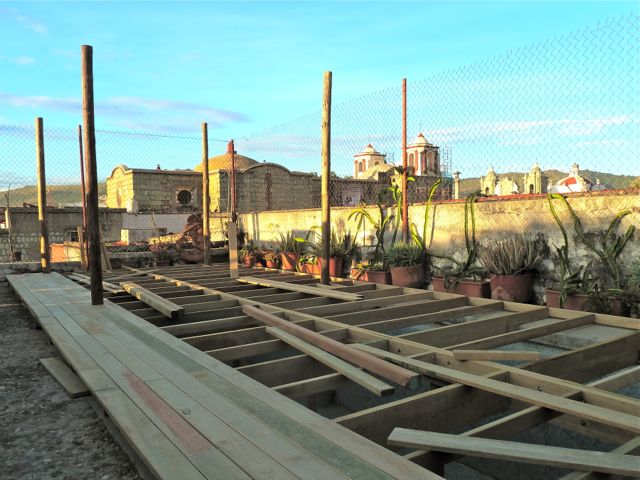
In October, Juan (of Adios mosquitos fame) and I boarded a bus for the La Asunción to pick out the lumber from their mind-boggling selection of wood. They delivered four days later and Juan and Nacho, his trusty assistant, commenced to building, what is probably, the strongest deck in all of Oaxaca.

The space. The view. What an improvement! However, that wasn’t the end of the story. Do you see those four posts sticking up from the deck? Because the deck faces south, those were for a much-needed shade structure. Alas, Juan also has a “day” job at Gorilla Glass and they have gotten extremely busy. Good for them, bad for me! After I returned from the trip to the US in late February, I began a search for someone to complete the project. Tom (a friend’s husband) came to the rescue. He designed the structure, recruited Carlos and his assistant Chivo to build it, selected the materials, delivered said materials and crew, and supervised construction. Needless to say, I owe Tom big time!
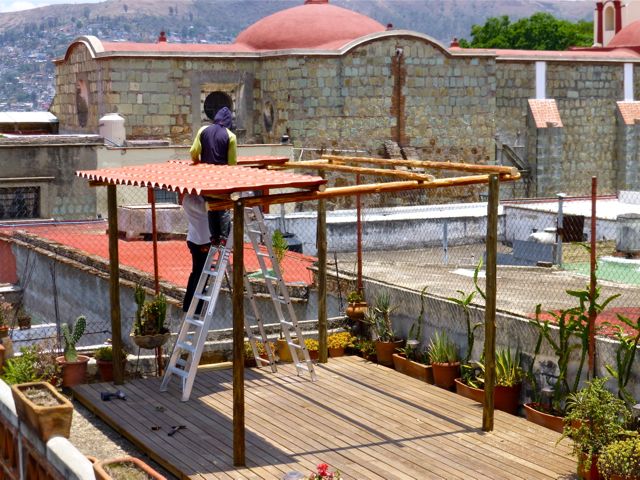
Yesterday, after less than two days of construction, the long-awaited gazebo was ready to shield yours truly and her visitors from the sun’s skin damaging rays, not to mention sweltering heat. Almost immediately after the guys finished, the heavens opened and we were treated to a massive, five-hour long thunderstorm. The timing couldn’t have been better!

By this morning the rains had departed and, with Templo de San José and the Basilica de la Soledad as a backdrop, my new outside room was ready for her close-up. All day today, in between trying to get work done around the house, I kept running outside to admire it.
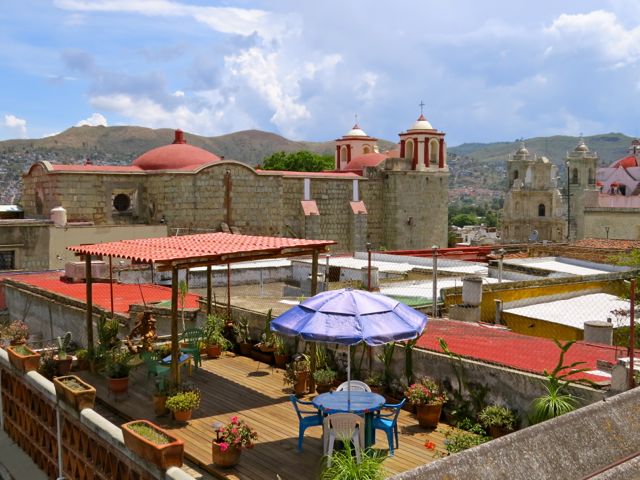
And, it has already been put to good use — a little after noon today, when the sun was at its zenith and sitting outside in days past would have been the last thing we would have considered, my neighbor Marga and I sat comfortably shielded from the sun in those green chairs. Ahhh…
Posted in Casita Colibrí, Gardens, Renovation | Tagged Basilica de la Soledad, deck, gazebo, Mexico, Oaxaca, photographs, photos, rooftop pergola, shade structure, swimming pool, Templo de San José, terrace | 22 Comments »
Bulls, real…
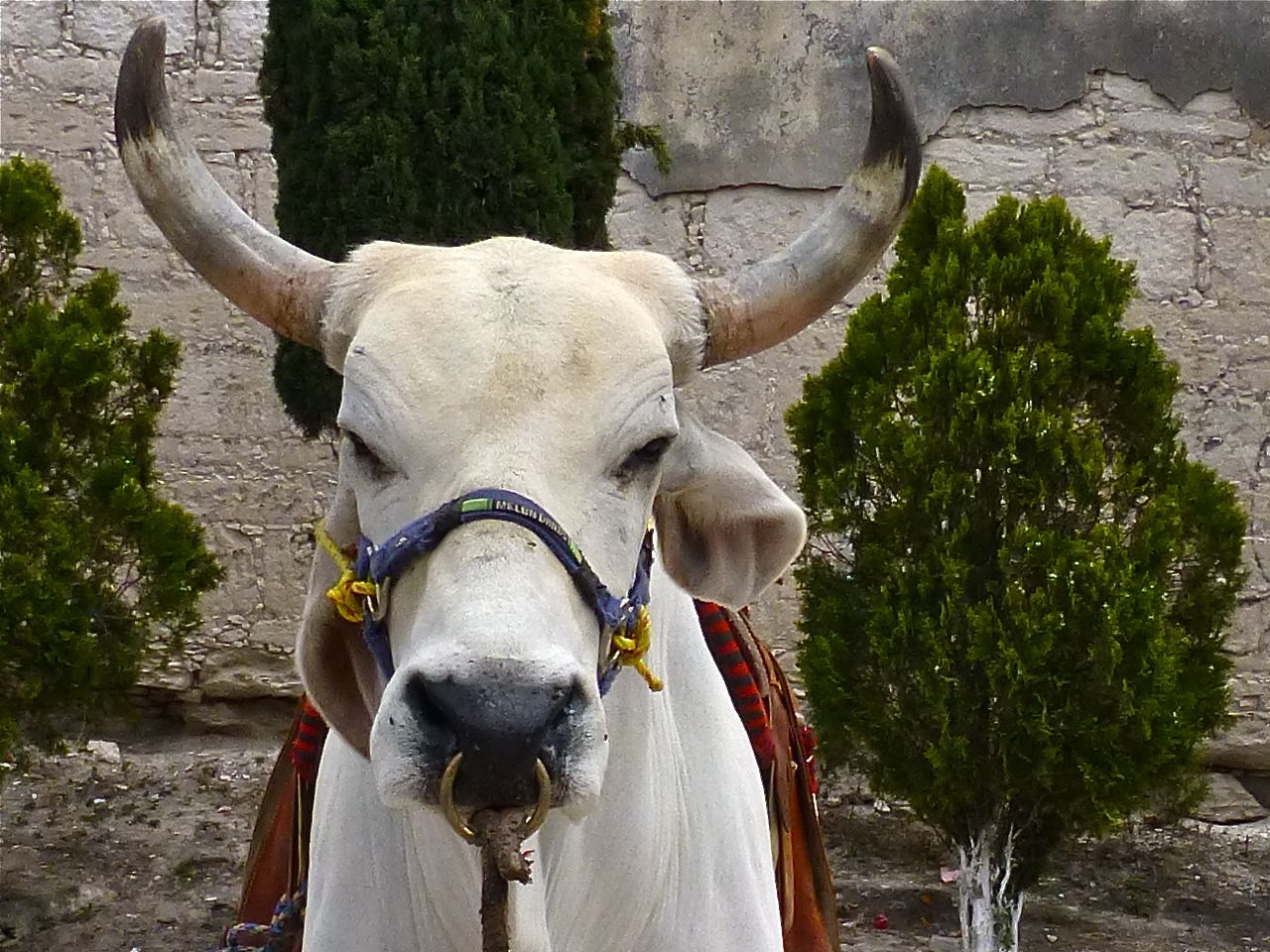
and imagined…

… yesterday on the streets of San Juan Bautista Coixtlahuaca.
We were there for day four of the annual fiesta in honor of el Divino Señor del Calvario and to see the Templo y ExConvento de San Juan Bautista — another of the grand Dominican churches currently undergoing restoration. More about both later. No bull!
Posted in Animals, Culture, Travel & Tourism | Tagged basketball, bulls, Mexico, Oaxaca, photographs, photos, popular travel destinations, San Juan Bautista Coixtlahuaca | Leave a Comment »
Yesterday, I was walking along calle de Flores Magón, and what to my wondering eyes did appear?
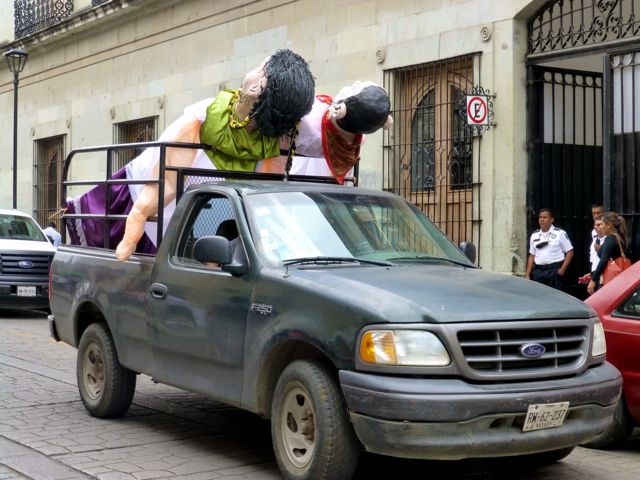
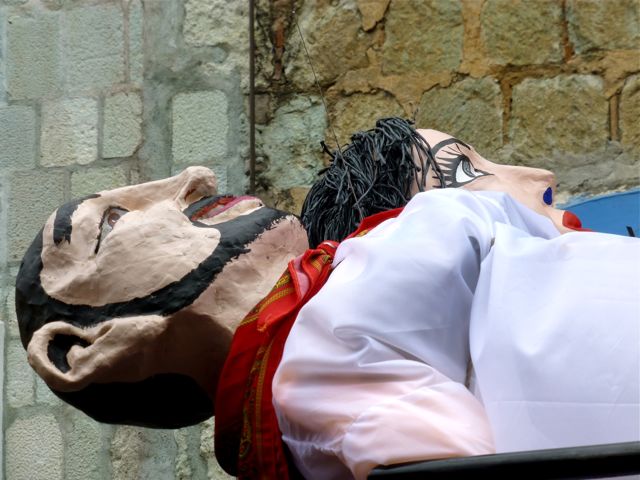
Husband and wife? Novia y novio?? “Just” friends???

I’ve got to say, they looked rather stiff and not very comfortable. Hope their trip was a short one!
By the way, if you want to read a little about my journey to Oaxaca and expat life, Expat Blog recently published an interview with me, American Expat Living in Mexico – Interview with Shannon. There is even a photo of a couple of monos supervising a banda. Perhaps friends of the above???
Posted in Creativity, Culture, Travel & Tourism | Tagged Expat Blog, Expat interview, Mexico, monos, Oaxaca, photographs, photos, popular travel destinations | 6 Comments »
The only true voyage of discovery, the only fountain of Eternal Youth, would be not to visit strange lands but to possess other eyes… —Marcel Proust


He to whom this emotion is a stranger, who can no longer pause to wonder and stand rapt in awe, is as good as dead: his eyes are closed. —Albert Einstein


Open your eyes, look within: Are you satisfied with the life you’re living? —Bob Marley


Eyes looking out on the world from the mural on Tinoco y Palacios, between Vasconcelos and Niños Heroes.
Posted in Creativity, Culture, Travel & Tourism | Tagged Albert Einstein quote, Bob Marley quote, eyes, graffiti, Marcel Proust quote, Mexico, Oaxaca, photographs, photos, street art, urban art | 8 Comments »
Mexico has a long and important place in the history of communication through murals — from stories related by pre-Hispanic civilizations…
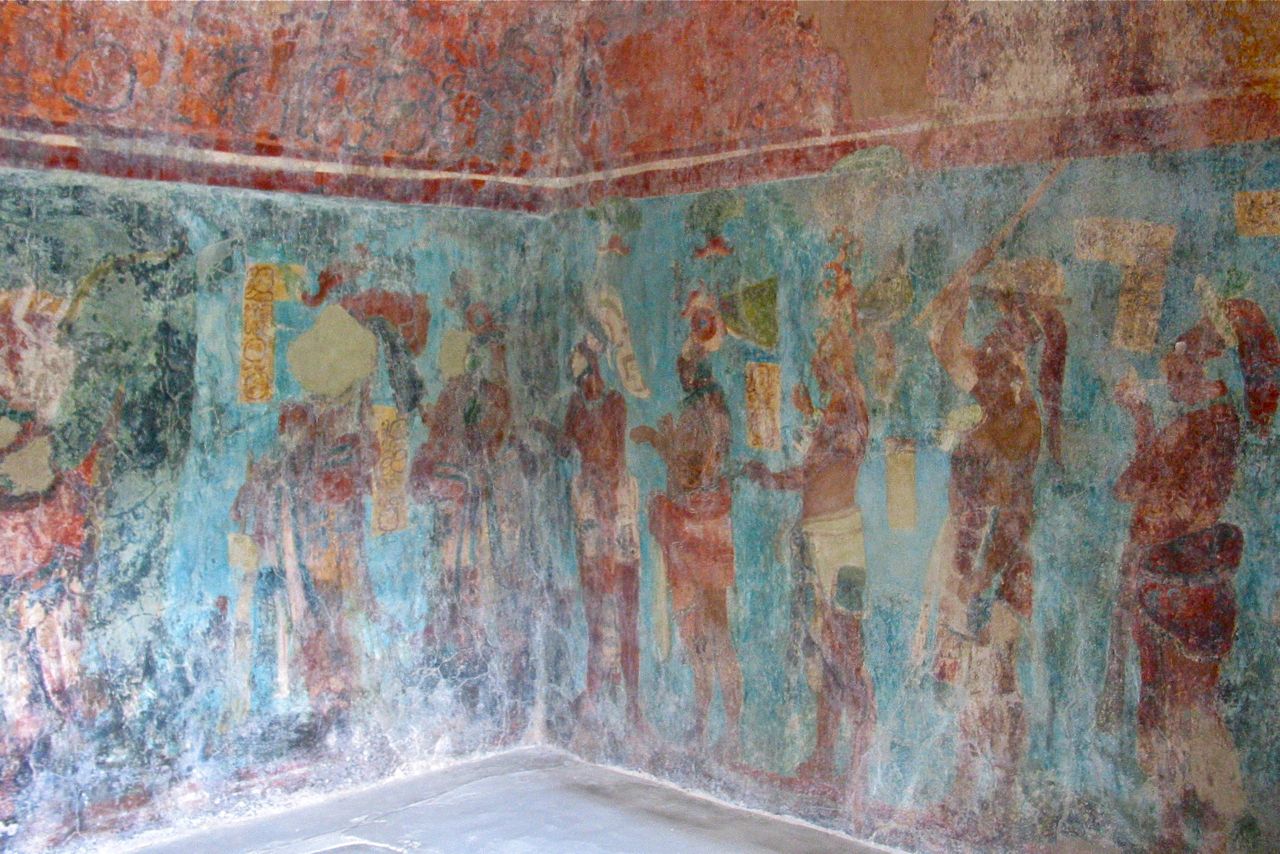
Maya fresco circa 790 C.E. – Bonampak, Chiapas.
through the world-renowned and influential Mexican muralists of the twentieth century: Orozco, Rivera, Siqueiros, and others.
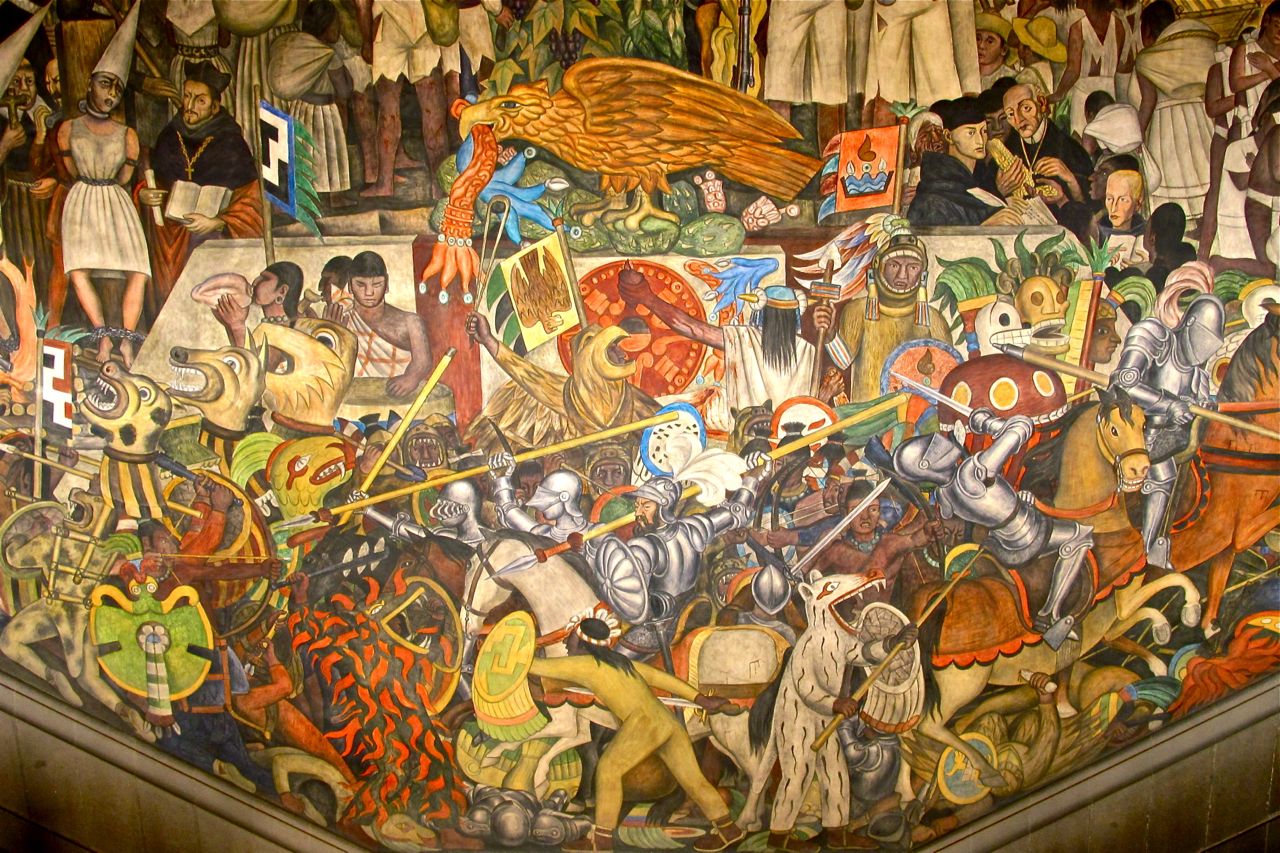
History of Mexico by Diego Rivera, 1931 – National Palace, Mexico City.
And, as many of you know, murals on the walls of Oaxaca are part of the urban landscape, authorized or not, like them or not, they celebrate…

One of several murals in the pedestrian tunnel to the Guelaguetza auditorium in Oaxaca city.
educate…

San Antonino Castillo Velasco, Oaxaca.
reveal past and present — and hopes and fears for the future.

Calle Tinoco y Palacios, between Vasconcelos and Niños Héroes, Oaxaca city.
Those found on the streets we expect to be ephemeral, but commissioned work, both inside and outside of buildings, we hope would have a longer and more permanent lifespan. Of course, the Rockefeller family’s destruction of Diego Rivera’s Rockefeller Center mural showed differently. And, more recently, my friend and artist, Mike Alewitz experienced the obliteration of his mural on the side of the Pathfinder Building, also in New York. Both were instances of political differences and, while distressing, perhaps not too surprising.
However, today Mike is leading a battle in defense of his students’ murals. According to NBC Connecticut:
Central Connecticut State University (CCSU) has built up one of the largest mural collections in the country since the program started in 2001. But Professor Mike Alewitz, who oversees CCSU’s mural painting program, said that collection is at risk.
The school has painted over six of the murals without notice and plans to do the same with another 12, Alewitz said Richard Bachoo, director of operations, confirmed. He said he hopes an appeal to the university and community support will protect the remaining murals.
“It made them feel part of the larger world, that they weren’t looking at blank walls inside an institution, but they were looking at the hopes and dreams of young people,” Alewitz said. “We found out that 18 murals were scheduled to be destroyed.”
<snip>
He says in the 14 years the mural program has existed, the policy has never been implemented in this way. Alewitz said in a statement that this is “the largest destruction of public art in recent history.” While administrators have removed murals in the past, they normally consult with the art department first, he said.
“The real policy has been that people love the murals, so when they’ve been painted, they’ve stayed up,” Alewitz said.
Oaxaca would lose much of her character and lessons would be lost, if we were to wake one morning and find all her murals disappeared. The story is the same at CCSU. For the full article, click HERE. To send messages of protest and to see some of the amazing student murals that enliven the walls and stimulate thinking at CCSU but are slated for destruction, click HERE. And, Why Bureaucrats Fear Art, is a letter to students and fellow artists, by Mike Alewitz.
Posted in Creativity, Culture, People, Travel & Tourism | Tagged art, Central Connecticut State University, culture, Diego Rivera, Mexico, Mike Alewitz, mural painting, murals, Oaxaca, photographs, photos, popular travel destinations, street art, urban art, wall art | 1 Comment »
“When we plant trees, we plant the seeds of peace and seeds of hope.” — Wangari Maathai, 2004 Nobel Peace Prize Laureate. From the poster for the inauguration of the Árbol de la Diversidad (Tree of Diversity) on Macedonio Alcalá celebrating May 17, International Day Against Homophobia and Transphobia.


The Ombudsman for Human Rights of the People of Oaxaca said the International Day Against Homophobia and Transphobia is an opportunity to become aware as a society of respect and acceptance that we owe to the other, a day that encourages us to live and work in building a more just, more humane, more egalitarian and fraternal society. (Noticias, 17 mayo 2014)
Posted in Celebrations, Creativity, Culture, Politics | Tagged Árbol de la Diversidad, Bisexual, Gay, Gente Diferente, International Day Against Homophobia and Transphobia, Lesbian, LGBT, Mexico, Oaxaca, photographs, photos, public art, Transexual, Vinnii Gaxhee, Wangari Maathai quote | Leave a Comment »
Everyday and everywhere there is something to see…

if we just open our eyes.
Posted in Buildings, Creativity, Gardens, Travel & Tourism | Tagged architecture, cactus, Mexico, Oaxaca, photographs, photos, popular travel destinations, shadows | 4 Comments »
These creatures began materializing around town a couple of months ago. I wonder…

Who are they?

Where did they come from?

What do they want?

Perhaps, I should ask here!

The walls of Oaxaca… you have questions, they have answers.
Update: The monsters sprang forth from the mind of SCOM.
h/t Jason Pfohl of Gorilla Glass.
Posted in Creativity, Culture, Travel & Tourism | Tagged art, Gorilla Glass, graffiti, Jason Pfohl, Mexico, Oaxaca, photographs, photos, popular travel destinations, SCOM, street art, urban art | 8 Comments »
Braided with love (and a little pain). Ahhh, I remember it well… Thinking of you, mom.

Triqui mother and daughter near Santo Domingo, Oaxaca city, 2014

3 generations on top of El Picacho, Teotitlán del Valle, 2014 Día de la Santa Cruz.

Queen and mother at 2nd Viernes del Llano, March 2014, Oaxaca city.
Feliz Día de la Madre to all the beautiful, hardworking mothers of Oaxaca and all over the world.
Posted in Celebrations, Culture, Holidays | Tagged Día de la Madre, Mexico, Mother's Day, mothers, Oaxaca, photographs, photos, women | 4 Comments »


 Mexican Peso Converter
 View From Casita Colibrí