The sunburned shoulders have turned brown and the leg muscles are no longer sore. I’ve fully recovered from last Sunday’s annual Día de la Santa Cruz (Day of the Holy Cross) hike up Cerro Picacho (in zapoteco, Quie Guia Betz), the sacred mountain in Teotitlán del Valle.
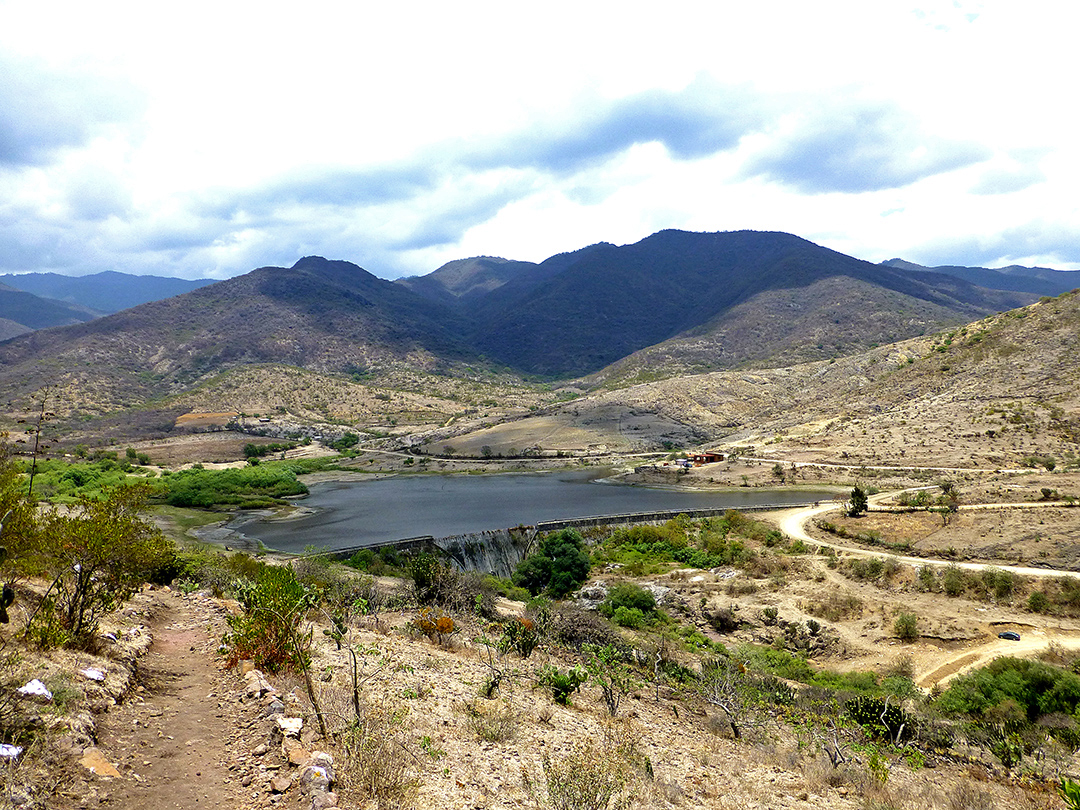
All that remains, are memories and photographs from another lovely, if strenuous, day. The cicadas (cigarras or chicharras, en español) again provided the soundtrack, as we wound our way up the trail from the presa (dam). The climb begins rather benignly but rapidly gets steeper and steeper. That little speck in the lower right of the photo below is the car — and this was less than a tenth of the way to the summit!
At 10 AM, when we began our ascent, it was already hot and experience told us shade trees were few and far between. We were the only extranjeros (foreigners) on the trail and were frequently passed by Teotitecos (people from Teotitlán) going up and coming down and never failing to greet us with “buenos días.” After several rest and water sipping breaks, we eventually reached our destination.
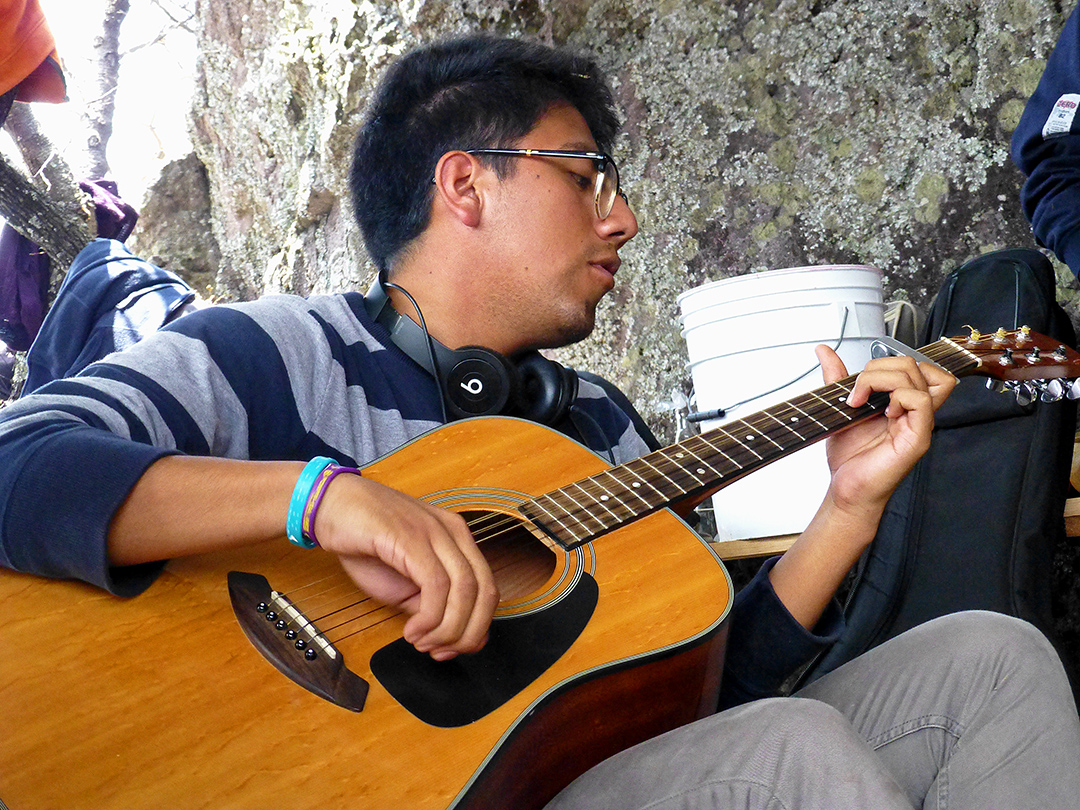
This 2.9 mile (4.7 km) hike took us from 5,750 feet (1,752 meters) to 6,830 feet (2,082 meters). However, once we arrived, we were immediately offered much-needed and appreciated cups of agua de jamaica (hibiscus water) and later we were fed amarillo tamales pulled from steaming pots in the makeshift kitchen. No doubt, the gals in this alfresco cocina appreciated the newly constructed shade structure and counter that had been bolted into the side of the mountain, as I’m sure did the young man who sat down to serenade us.
However, the best was yet to come — the spectacular views of the village and the mountains beyond that unfold when one reaches the summit.
Even more overwhelming is the sense of oneness with the natural world and with generations of Zapotecos who have been climbing and honoring El Picacho for thousands of years.
As I mentioned at the beginning of this post, May 3 is Día de la Santa Cruz. The committee members who organize Teotitlán’s celebration change from year to year, so each year takes on a slightly different character. This year brought the newly built kitchen space and, unlike last year, no foot race up the mountain and the absence of massive speakers blasting music — for which we were grateful!
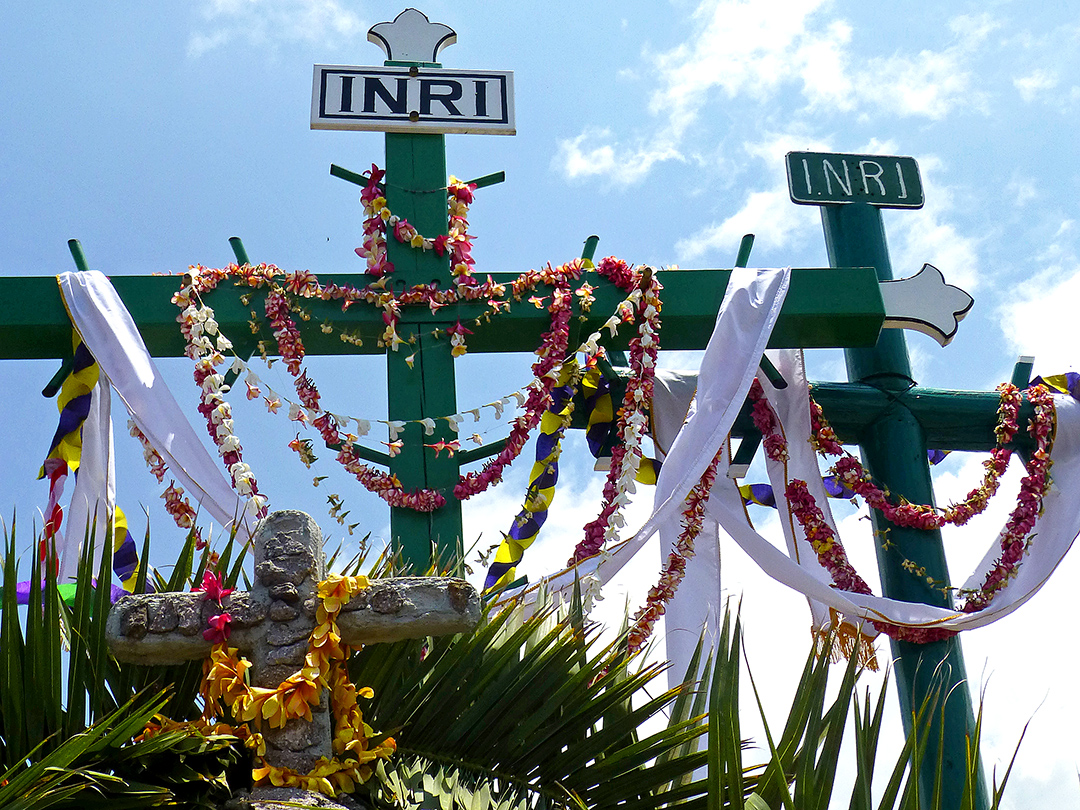
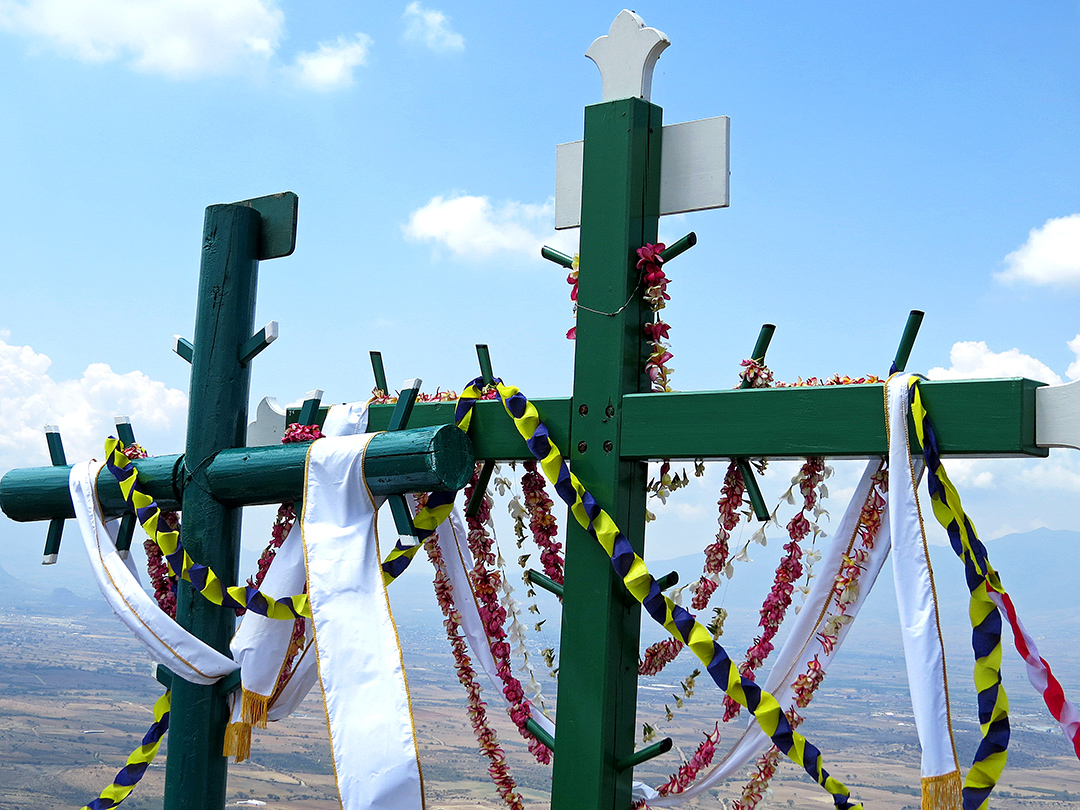
Three permanent crosses can be found atop Picacho and for Día de la Santa Cruz, all were decorated with fragrant garlands of frangipani blossoms. A cross of concrete and stone crowns an altar and two wooden crosses, which I’ve been told were carved in Chiapas, preside above the altar and look out over the valley.
Teotitlán (Teocaltitlán, in náhuatl) means “land of the gods.” Sitting on top of Cerro Picacho, it certainly felt as if I was indeed gazing out at the land of the gods.
It’s Cinco de Mayo, but in Oaxaca, like most of Mexico, it’s a business as usual kind of day; schools are in session, businesses and banks are open, and deliveries are being made. The cervesas and mezcal may be flowing and guacamole may be served, but no more than usual. Only in Puebla, where the significantly outnumbered Mexican troops defeated the French army in the Battle of Puebla on May 5, 1862, is it a big deal. However, most every city and village has a street named 5 de mayo and in many, like Oaxaca, a street has been named for Ignacio Zaragoza Seguín, the general who commanded the Mexican army at the Battle of Puebla. By the way, he was born in what was the Mexican village of Bahía del Espíritu Santo, now Goliad, Texas, USA.
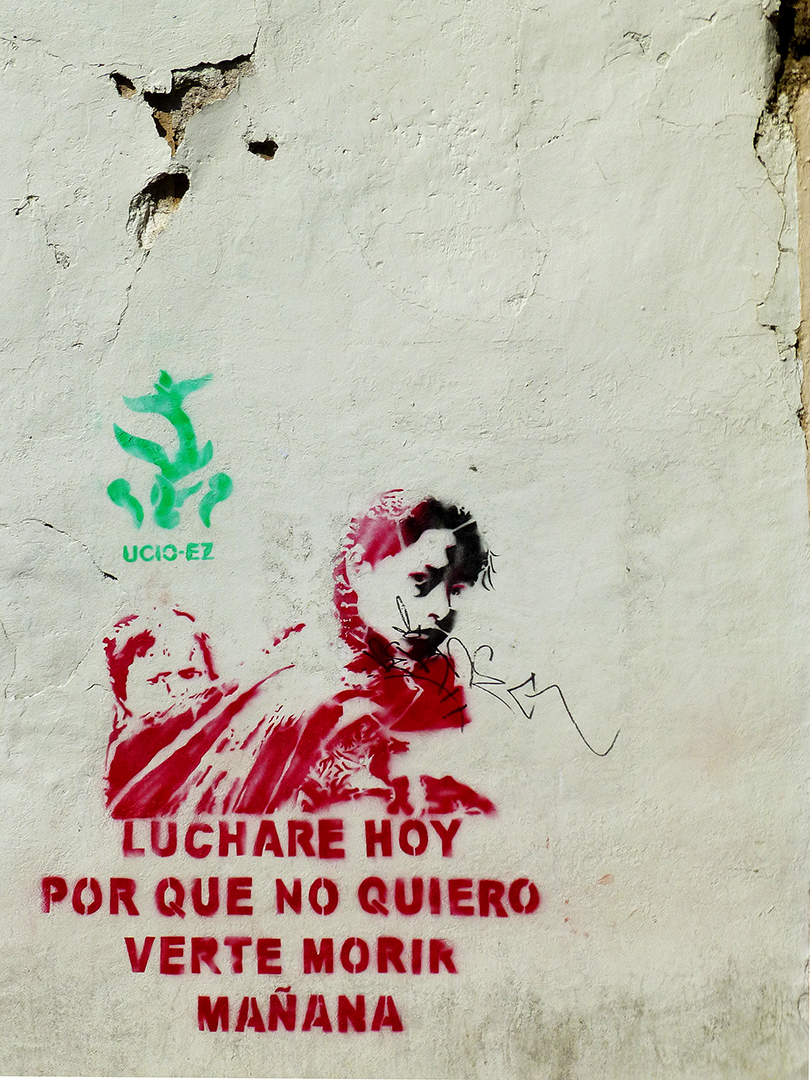
As the walls of Oaxaca continue to show, it’s the current battles that remain front and center…
As the mother in the stencil above explains, against the odds like her ancestors 153 years ago, “I will fight today because I don’t want to see you die tomorrow.”
They march to celebrate past victories; they march to proclaim the dignity of work; they march to defend the right to collective bargaining; they march to demand living wages and safe working conditions; and they march to secure a better future for their children.
Mexico has a minimum wage of around 69 pesos a day ($4.50 US), the lowest in Latin America….the Economic Commission for Latin America and the Caribbean placed Mexico as the only country with a minimum wage below the poverty line. Furthermore 14% of employees receive a salary even lower than this minimum.
It’s no wonder that, as I write, there are marches converging on Oaxaca’s zócalo from points north, south, east, and west. When I was out and about an hour ago, I ran into healthcare workers from as far away as Tuxtepec, in the northeast of the state, and Huatulco, in the southwest.
¡Feliz Día del Trabajo a tod@s! The struggle continues…
May God bless and keep you always May your wishes all come true May you always do for others And let others do for you May you build a ladder to the stars And climb on every rung May you stay forever young Forever young, forever young May you stay forever young.
May you grow up to be righteous May you grow up to be true May you always know the truth And see the lights surrounding you May you always be courageous Stand upright and be strong May you stay forever young Forever young, forever young May you stay forever young.
May your hands always be busy May your feet always be swift May you have a strong foundation When the winds of changes shift May your heart always be joyful And may your song always be sung May you stay forever young Forever young, forever young May you stay forever young.
The Flamboyant trees (aka, Delonix regia and Royal Poinciana) have outdone themselves this year. And yesterday, walking home from the market, I was captured and enraptured by their canopy. On Independencia below the Basilica de la Soledad.
Yesterday, the city of Oaxaca celebrated its 483rd birthday as a Spanish chartered city. Early in the morning bells were rung, Las Mañanitas was sung, tamales and atole were served, an air force flyover buzzed the city several times, multiple musical events were held, a convite paraded through the streets, fireworks exploded from the Plaza de la Danza, and more, and it continues. I was going to write about it, but…
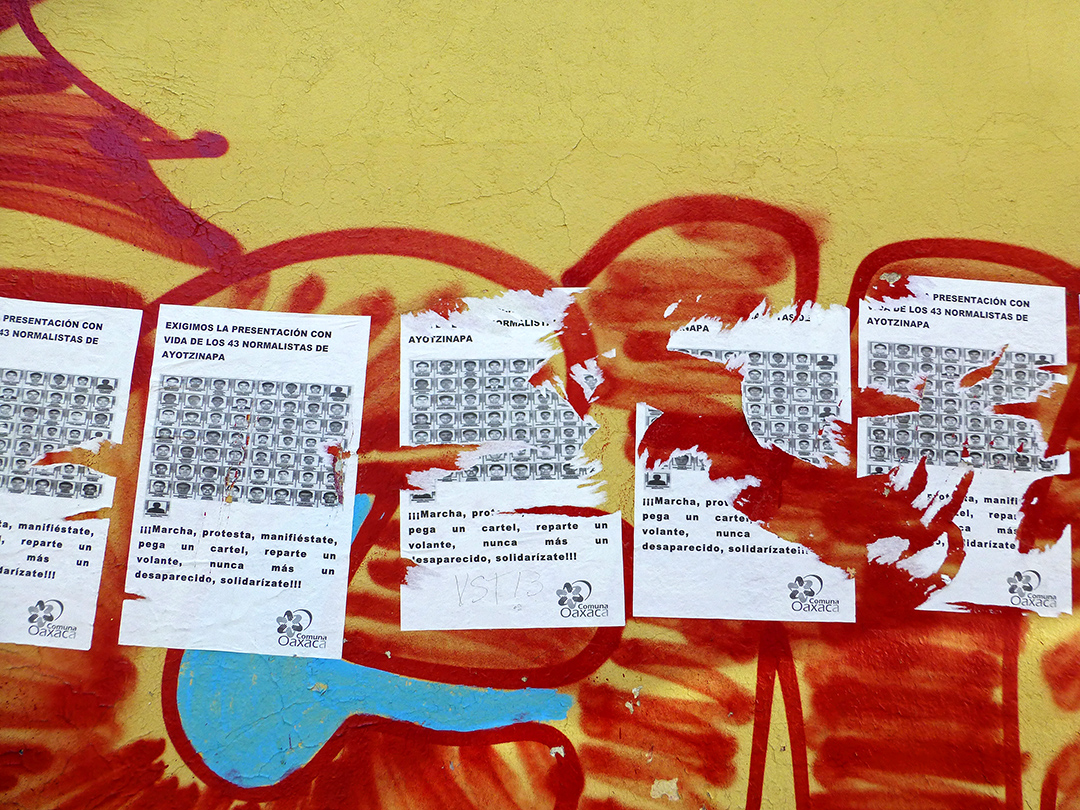
Today a more urgent anniversary requires our attention: Mexico Marks 7 Months Since 43 Ayotzinapa Students Disappeared. Family, fellow classmates, friends, and supporters around the world keep their names alive and cry for justice. And artists continue to reach into our minds and hearts through their music, artwork, and film making.
Near the end of the song, “La Patria Madrina,” from her new album, Balas y Chocolate (Bullets and Chocolat), Lila Downs chants the Ayotzinapa 43 mantra that can be seen and heard all over Mexico, ¡Vivos los llevaron, vivos los queremos!(They were taken alive, and we want them back alive!)
And, on walls throughout Mexico, our attention is called to the missing 43 students from the Escuela Normal Rural Raúl Isidro Burgos, teachers’ college in Ayotzinapa, Guerrero.
When atop the massive plateau that is the archaelogical site of Monte Albán, one can’t help but reflect on the pre-Hispanic cultures that built and inhabited this place; cultures whose gods were of the environment — the elements and the agricultural gifts, to man and beast, those elements provided.
Today, as we celebrate Earth Day, perhaps we need a return to the old gods…
Kiss the girl goodbye It’s time for me to fly Wipe the tears away I’ll be home some day, baby So baby, please wait for me Don’t want no one to take my place You’re the one for me And that’s the way love should be We’ve been apart so many times before One more time won’t change things I’ll even love you more We’ve been apart so many times before One more time won’t change things I’ll even love you more (Kiss me) kiss the girl goodbye (goodbye) it’s time to fly (Kiss me) wipe the tears away (goodbye) (Kiss me) kiss the girl goodbye (goodbye) it’s time to fly (Kiss me) wipe the tears away (bye) (Kiss me) kiss the girl goodbye (goodbye) it’s time to fly (Kiss me) wipe the tears away
Today the Museo Textil de Oaxaca is celebrating its seventh birthday with live music (of course!), nieves (ice cream), and an expo-venta of tie-dye and batik textiles from Nigerian born, Gasali Adeyemo. The exhibition and sale culminate a week-long artist-in-residence, in which he taught a 5-day workshop — I’m kicking myself I didn’t take it — and a Friday evening presentation, “African Blues, Mi Vida en Indigo” — which I did attend! Gasali’s work is spectacular and his face glows when he talks about the traditions, technique, and love that goes into his work.
Note the orange blouse above; it beckoned to me and I couldn’t resist buying it. The technique is batik on a brocaded cotton that has been dyed with the bark of a tree found in Nigeria. The name of the tree in the Yoruba language is Epo Ira, which, according to Gasali roughly translates to, “tonic iron tree,” as it is also used medicinally to cure iron deficiency.
By the way, for those of you who are going to the International Folk Art Market in Santa Fe, NM in July, Gasali and his beautiful textiles will be there.
“What do you do all day?” It’s a question I’ve been asked countless times since I began my retired life down Oaxaca way and I’m not alone. Most expats here have heard those words — a query that hints at the notion that there couldn’t possibly enough to fill the day in a place where one isn’t fluent in the language, isn’t surrounded by family and old friends, and doesn’t have a job. A large part of the answer is, doing most everything takes longer. And that is not a bad thing! Perhaps, a photo diary of this morning’s grocery shopping excursion might provide an illustration.
After morning coffee and breakfast, catching up on email and the news, washing dishes, showering and dressing, I grabbed a couple of shopping bags and headed out at 10 AM. The initial plan had been to walk up to Niños Heroes (the Pan American highway) to photograph some new murals, cross the highway to the Organic Market, and then return home by way of Sánchez Pascuas mercado where I could get chicken, quesillo, and anything else that remained on my shopping list or struck my fancy. However, for almost an hour, I’d been hearing Guelaguetza music coming from the Plaza de la Danza. I decided a detour was in order and found kindergartners performing Oaxaca’s traditional folkloric dances, including this one where couples take turns “dissing” each other in a rhythmic double-entendre laden dialogue. It always gets laughs — wish I could understand the jokes! Needless to say, I hung out watching the kids for awhile.
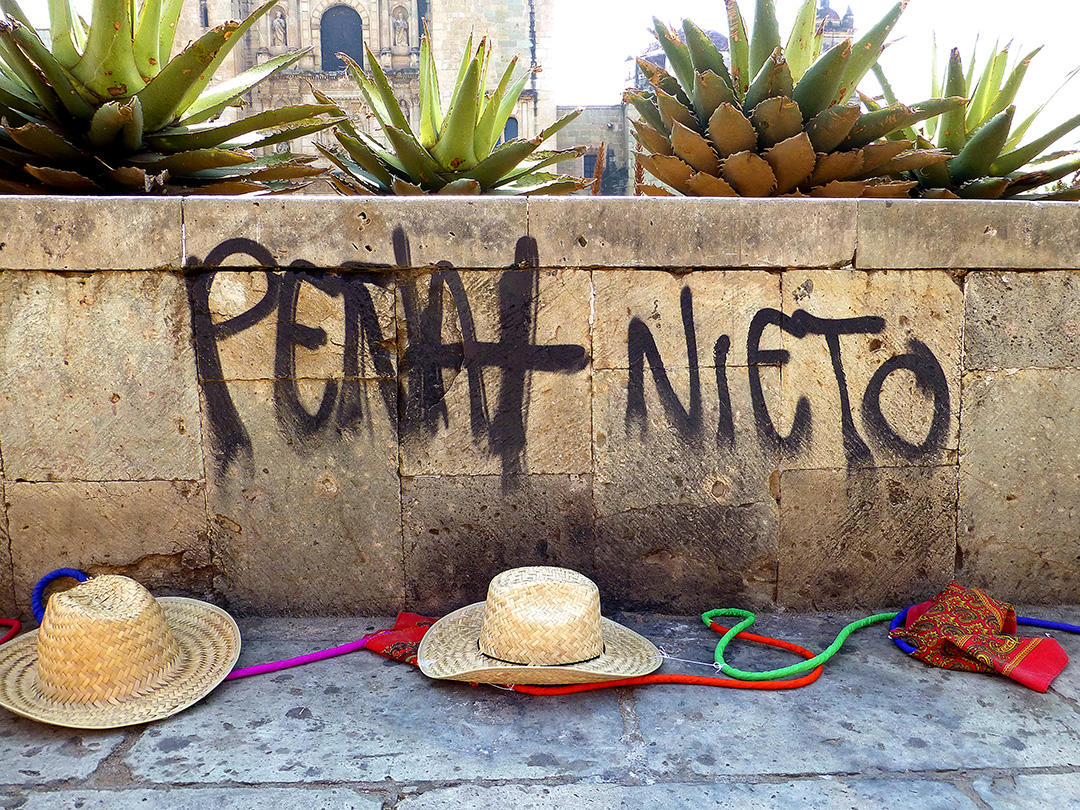
I finally tore myself away and resumed my original itinerary. Some of the murals were east of the Pochimilco Organic Market so I decided to start at the end and work my way back — a route which took me up the Macedonio Alcalá where I saw a sidewalk vignette of hats and scarves lined up in front of Santo Domingo. There was also a small marmota (cloth globe on a pole) laying on its side, so I’m guessing there was to be a calenda (parade) of some sort.
After stopping to take a few photos (how could I resist the juxtaposition with the Peña Nieto graffiti?) I found myself behind these vendors taking their merchandise up to Llano Park for its Friday market.
Deciding to speed up my slow progress on the errands I’d set forth for the morning, I passed the gals only to stop to watch Oaxaca’s version of the dog whisperer working with four Xoloitzcuintlis (Mexican Hairless Dogs).
Eventually continuing north, I arrived at Niños Heroes and the murals and street art I’d come to find and photograph. They deserve their own blog post, so I will save those photos for another day. However, I also ran across this wonderful wall! Crossing the highway, I found the newly built and landscaped stairs (almost didn’t recognize them) leading up to Xochimilco and the Pochimilco Organic Market. I wandered and lingered and tasted — including a few of these mezcals, as I’ve got a US trip coming up and a stepson who probably won’t speak to me if I don’t bring him a couple of bottles.
Popping some gum in my mouth (didn’t want my breath to smell like I’m a lush), I headed south on Tinoco y Palacios to catch a couple of new murals I’d had fleeting glimpses of when returning from last Sunday’s trip to Tlacolula. This one had particularly caught my eye.
By the time I arrived at Sánchez Pascuas, it was after 12 noon. I found my poultry guy, paid a visit to the cheese vendor, picked up some veggies from my favorite produce gal, and, on the way out, bought some homemade salsa verde. Yummm… As I descended the three stairs down to the sidewalk, I turned around to admire the beautiful color of the flamboyant and jacaranda trees and the tranquility of this setting in the middle of the state’s bustling capital city.
It was close to 1 PM when I unlocked the door to my apartment. If I were in California, I would have jumped in the car, driven down to the local Friday organic market (with not a drop of mezcal in sight), browsed a bit, spent way too much money, climbed back in the car to finish shopping at Safeway, before returning to the house, probably by 11 AM.
Here in Oaxaca, I’d been gone almost three hours, walked close to fifty (often hilly) blocks, and seen some wonderful, creative, and life affirming sights. And, that doesn’t even include the scattering of conversations with my neighbors and Luís and Luci, who work here. Just another Friday. Not a bad way to live one’s life!
We had spectacular electrical storms Sunday and Monday nights, with thunder rumbling continuously, lightening flashing in all directions, and torrential rain. And, today, I awoke to a rare early morning downpour — 8 inches of pergola runoff collected in my buckets. Noticias, the Facebook group Bloqueos y Accidentes en Oaxaca, and Reportes en Oaxaca, Mexico all show major flooding throughout the city from this morning’s surprise.
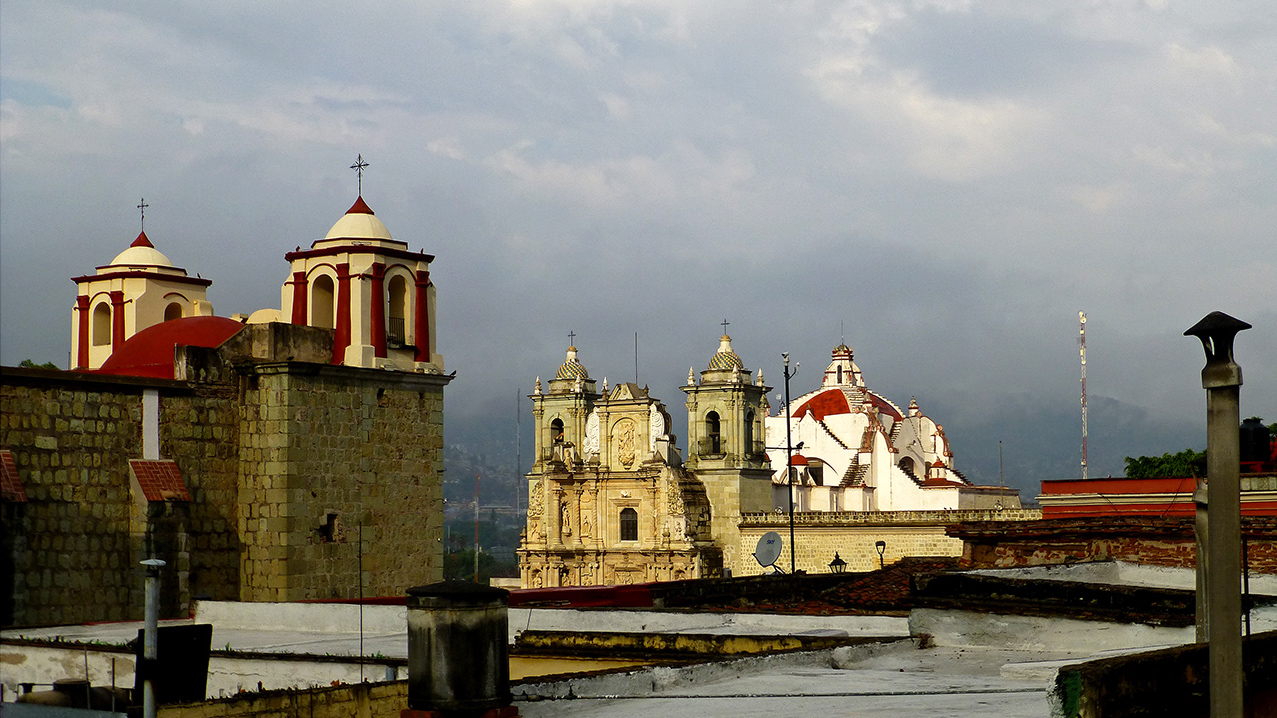
This morning’s view of Templo de San José and Basilica de la Soledad. Where did Monte Albán go?
All of this has me asking, is this the beginning of an early rainy season? Then, there is the report from Conagua (Mexico’s national water commission) that, due to El Niño, there could be a significant increase in the number of Pacific Coast hurricanes this season. Hmmm… it looks like we may be in for a bumpy and wet ride!
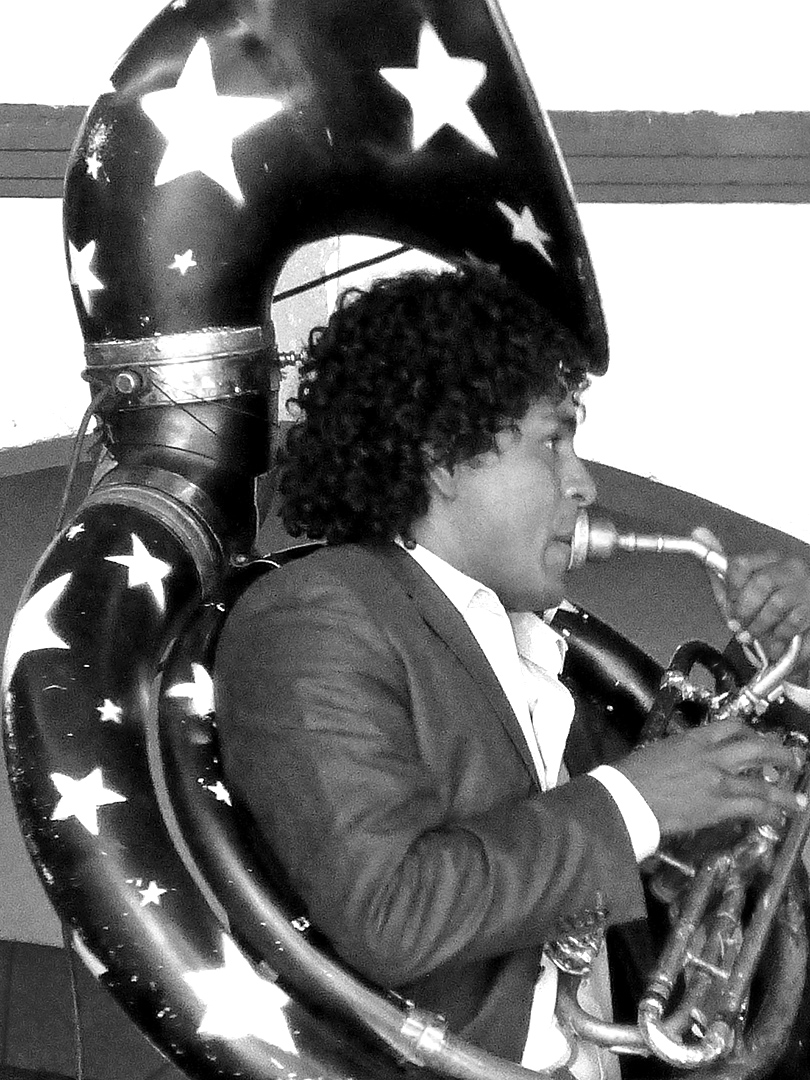
There always seems to be live music in Tlacolula de Matamoros on Sunday market days. Today it was the hot band, Los Magueyitos de Matalán. The horns had me seeing stars!
Hopefully, Chris over at Oaxaca-The Year After will eventually post the video he took. In the meantime, here they are on SoundCloud.


 Listening to the Putamayo World Music Hour’s tribute to mothers and sending mothers everywhere wishes for peace, justice, love, and much joy.



























 Mexican Peso Converter


